Search This Blog

Wednesday, January 10, 2024

'1 Bank Sees Bitcoin Hitting $200,000 After ETF Approval'

 After yesterday's historic fisco, when the SEC announced on twitter it had approved a bitcoin spot ETF for the first time ever, only for groveling democrat lackey Gary Gensler to lisp that "Ackchyually" the SEC account had been hacked",  today the most incompetent and corrupt collection of porn fanatics are expected to approve several spot bitcoin ETF, for real this time.

And while we don't have to say it, Standard Chartered's Geoff Kendrick does so anyway when he writes overnight that ETF approval has been a key driver of BTC price upside (indeed, we got a glimpse of the "sell the news", or rather "sell the hack" event yesterday) and yet according to Kendrick, this is "a watershed moment for normalizing Bitcoin participation by institutional money, and we expect approval to drive significant inflows and price upside for BTC."

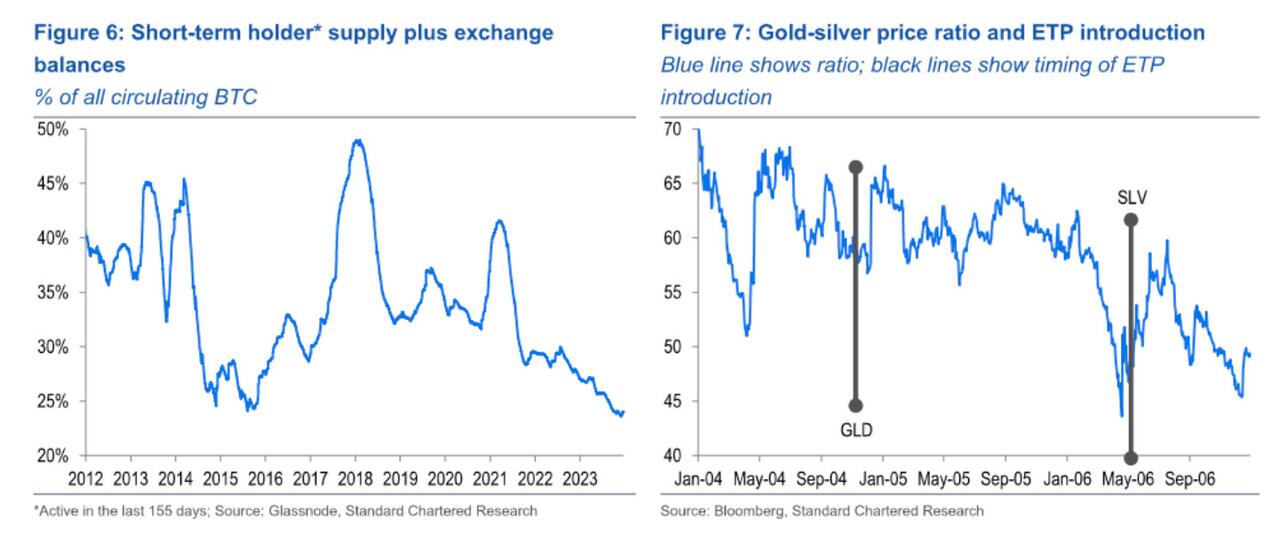
How much upside? Well, to gauge how big a driver this might become, Standard Chartered used the introduction of the first US-based gold ETP (in November 2004) as a point of comparison. The price of gold then rose 4.3x in the seven to eight years it took for gold ETP holdings to mature after the first ETP was introduced.

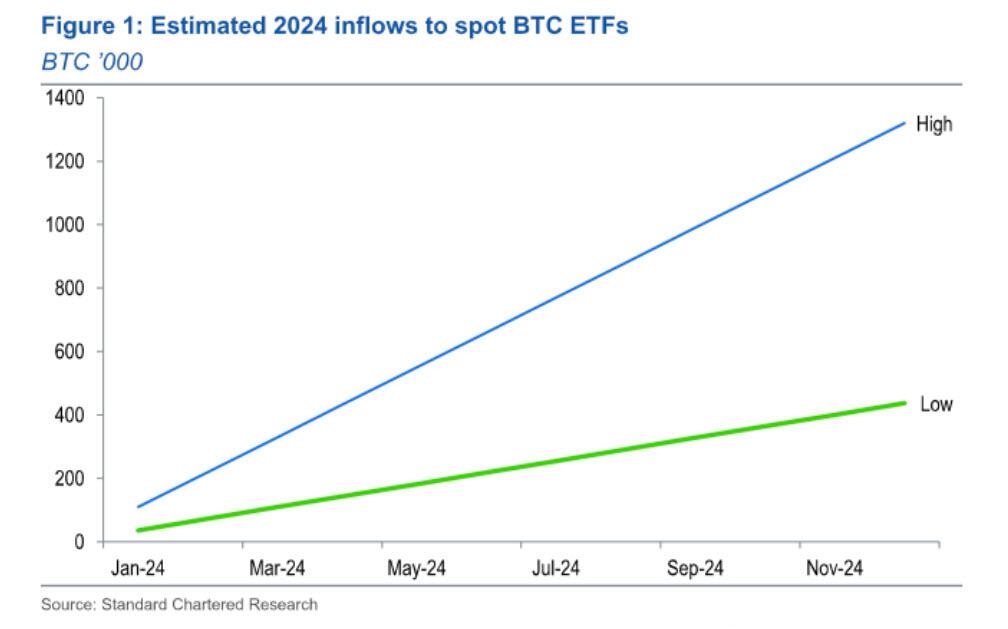
Kendrick expects Bitcoin to enjoy price gains of a similar magnitude as a result of US spot ETF approval, but he sees these gains materializing over a much shorter (one- to two-year) period, given his view that the BTC ETF market will develop much more quickly (and with Blackrock sponsoring it, that's a safe assumption). This is consistent with his end-2024 view of Bitcoin at the $100,000 level. Looking further out, and if ETF-related inflows materialize as he expects, Kendrick thinks an end-2025 level closer to $200,000 is possible. This assumes that between 437,000 and 1.32 million new bitcoins will be held in spot US ETFs by end-2024. In USD terms, this should be roughly USD 50-100Bn.

Some more details on potential inflows...

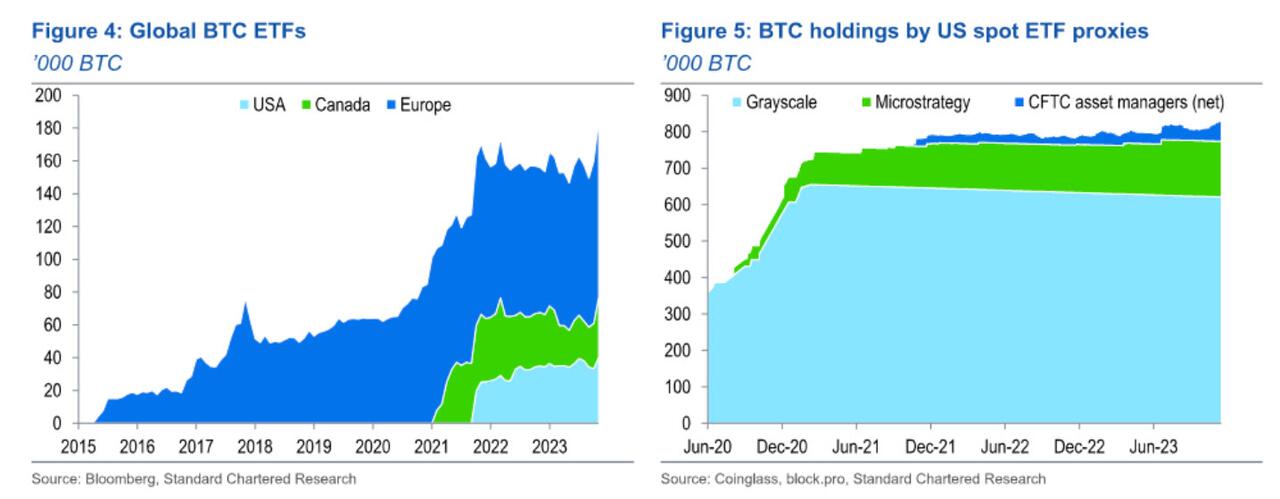
Estimating the scale of inflows to Bitcoin ETFs is difficult. Some reclassification is likely following SEC approval (as BTC holdings move from Grayscale Trust to Grayscale ETF and as futures-based ETFs may become spot ETFs), but changes to current aggregate holdings of 1.015mn are what will drive expected price upside. We look at two historical examples - BTC in 2020 and gold in 2004 - to help gauge potential inflows:

  1. In 2020 (which included the period before and after the last BTC halving on 11 May 2020), the combined holdings of BTC ETFs and ETF proxies increased by 437,000 BTC, or a multiple of 2.3x; the BTC price increased by 4.0x during the year. Applying the same logic to 2024, we arrive at two potential inflow scenarios:
    1. Addition of 437,000 BTC x current BTC price of USD 44,000 = USD 19bn of inflows
    2. Current BTC ETF holdings of 1.015mn x 2.3 = 2.33mn, an increase in holdings of 1.32mn BTC. At a BTC price of USD 44,000, this amounts to USD 58bn of inflows.
  2. For gold, it took several years after the introduction of GLD for ETP holdings to peak (in December 2012). The macro environment turned more supportive of increased gold appetite from a wide spectrum of investors. Total flows were USD 88bn, using the monthly change in the number of ounces held in ETPs multiplied by prices in each month. When GLD was introduced in November 2004, the total stock of above-ground gold was worth around USD 2.2tn, compared with BTC's current market cap of USD 0.86tn. Adjusting the USD 88bn of GLD inflows for relative market caps would suggest USD 34bn of inflows to BTC ETFs.

... and on price impact:

The above calculations provide inflow estimates ranging from USD 19-58bn to achieve the increases in BTC holdings outlined above. However, these estimates are likely to be on the low side, as they assume no BTC price impact from ETF approval or from the inflows themselves (assuming the BTC price stays stable at the current USD 44,000).

However, we think BTC price upside from current levels is likely following SEC approval. One scenario is that the BTC price reaches the USD 100,000 level by end- 2024 at a constant average monthly increase of 7% from the current level of USD 44,000. In that scenario, if inflows to BTC ETFs are constant in BTC terms, it would take USD 31Bn of inflows to achieve our lower-end estimate of a 437,000 BTC increase in holdings in 2024 (as opposed to USD 19Bn of inflows calculated above under an unchanged price assumption). The same calculation for a 1.32mn increase in ETF holdings, our upper-end estimate, yields USD 95Bn of inflows (as opposed to the USD 58bn calculated above based on no price change).

Any new demand impulse may have an even larger impact on prices given declining supply at present. We estimate the amount of immediately available supply by adding exchange balances to BTC holdings that have been active in the past 155 days (Figure 6). Both measures have been decreasing as BTC is taken off-exchange and/or enters long-term buy-and-hold wallets. This measure is at an all-time low as a percentage of total supply in circulation. In other words, supply is more price- inelastic than it has ever been.

Importantly, this measure now stands at 24%, versus 34% at the last halving. So if the 2024 increase in BTC holdings is equal to the 2020 amount (437,000), the price multiple should be more than the 4x achieved in 2020, all else being equal.

If we instead assume that the BTC price rises to an even higher (non-base case) level of USD 175,000 by end-2024 (an increase of 4x from USD 44,000, the same multiple as in 2020) and repeat the above calculations, we arrive at inflows of USD 43bn to add 437,000 BTC, or inflows of USD 130bn to add 1.32mn BTC.

Based on the above, Standard Chartered expects BTC ETF inflows in a rough range of $50-100BN in 2024, where the lowest estimate of inflows ($31bn, based on scaled-down gold ETP inflows) is likely too low, whereas the highest estimate ($130bn, based on a 4x price increase in 2024 and 1.32mn of BTC ETF holdings) is likely too high.

For a slightly less excited outlook we turn to Bloomberg ETF specialist Eric Balchunas, who yesterday responded to Standard Chartered's calculation saying that in his opinion, this is "too high especially for flows as they wouldn't include $GBTC's $30bn. Our over/under in flows by end of year is more like $15b and ballpark $50b for aum (barring massive btc price change)."

He then adds several points: "$15bn in flows for a new category is massively high, even bond ETFs didn't do anything like that in their first year(s). Also if we go out 5-10yrs we think it will be in the gold ETF range at $100b aum. Trust me tho $100b in FLOWS is crazy, would be big shocker."

That said, even if the low range of the estimate is accurate, and we are looking at a $100K bitcoin in two years just on ETF inflows alone, that would still be a huge success for the crypto industry. Of course, all of this ignores the fact that tens if not hundreds of billions in what are currently record money market funds, will be diverted away into some crypto ETFs the moment the Fed announces the end of QT (and hints the restart of a new QE). At that point, the debate will be not whether bitcoin makes it to 6-digit territory, but how soon it can rise above the 7-digits.

https://www.zerohedge.com/markets/why-one-bank-sees-bitcoin-hitting-200000-after-etf-approval

Biden sends Congress ‘incomplete’ records for censorship investigation

 The State Department is facing heightened scrutiny from the House GOP for providing congressional investigators with “incomplete” grant records, including on the agency bankrolling organizations that silence conservative voices online.

Republicans on the House Small Business Committee are re-upping a request to the State Department-housed Global Engagement Center for information on awards the office dished out, including to groups such as the Global Disinformation Index, a British think tank that, the Washington Examiner reported, aims to strip revenue from conservative media outlets. The request is part of the panel’s broader inquiry into “government censorship and revenue interference of American small businesses by proxy,” lawmakers informed GEC Special Envoy and Coordinator James Rubin in a letter Monday.

“The GEC has funded a myriad of companies that label beliefs running afoul of the radical left’s agenda as ‘disinformation,'” House Small Business Committee Chairman Roger Williams (R-TX) and Rep. Beth Van Duyne (R-TX) wrote in the letter to Rubin. “Despite your recent claim that ‘[w]e are not in the business of deciding what is true or not true,’ the third parties receiving GEC funds focus overwhelmingly on ‘right-wing misinformation’ rather than misinformation across the political spectrum. It is clear the Biden Administration considers itself the arbiter of truth.”

The letter is the latest escalation of congressional efforts to investigate the federal government for its ties to the “disinformation” and “misinformation” tracking industry, which Republicans assert serves as a tool to censor conservatives on the internet. The state of Texas joined two conservative media outlets, the Daily Wire and the Federalist, in accusing the GEC in a December lawsuit of funding an unconstitutional “censorship scheme,” particularly due to the government’s grant of $100,000 to the GDI in 2021.

Meanwhile, the since-passed $886 billion 2023 Pentagon spending bill banned the Defense Department from placing “advertisements in news sources based on personal or institutional political preferences or biases, or determinations of misinformation.” The provision also prohibited the agency from entering into contracts “related to the placement of recruitment advertising” with the Global Disinformation Index, the New York-based company NewsGuard, or “any similar entity” that purports to track “misinformation.”

In the letter on Monday, Williams and Van Duyne wrote that the GEC has strayed from its congressional mandate, which holds that funds are not intended to be used “for purposes other than countering foreign propaganda and misinformation.” The GEC has often said its grant to the GDI was to thwart foreign influence, though Republicans have noted that money is “fungible” and taken aim at the GEC for having any remote association with the British think tank.

This sentiment, along with a negative 2022 inspector general report finding that the GEC hasn’t lived up to its mission and was not vetting foreign grants, has propelled the GOP-led House Foreign Affairs Committee to lean toward not reauthorizing the GEC in 2024, according to three sources familiar with the discussions. The House Foreign Affairs Committee has also investigated the GEC over its grant to the GDI, with members on the panel in late October grilling GEC acting Coordinator Daniel Kimmage in a tense hearing.

Williams and Van Duyne noted in the letter how the GEC has awarded funds to Moonshot CVE, an entity claiming to fight “conspiracy theories” and “hate speech,” as well as the Atlantic Council’s Digital Forensic Research Lab, which partnered on the program that culminated in the GDI taking home $100,000. The lawmakers also mentioned the GEC’s backing in recent years of Albany Associates International, a British group, which claimed that “partnerships between government, academia, and tech at a national and local level” are necessary to thwart “disinformation,” the letter said.

Albany Associates counts its founder and managing director as Dieter Loraine, a former senior consultant for the United Kingdom’s Foreign, Commonwealth and Development Office, financial disclosures show. A Washington Examiner review of the London-based group’s social media activity shows it has often shared articles slamming former President Donald Trump and that it called out “right-wing” activists for proliferating “fake news” and “disinformation.”

Albany Associates was incorporated in 2004 and has partnered with the Foreign, Commonwealth and Development Office on overseas projects, including in Somalia for support of the east African country’s military, according to tax forms and British government documents reviewed by the Washington Examiner.

“Throughout the course of this investigation, the committee has developed additional
concerns over whether the GEC maintains proper oversight over the selection and actions of subawardees / subgrantees,” Williams and Van Duyne wrote in the Monday letter. “This committee aims to ensure the GEC is not only aware of where taxpayer dollars are going, but that the GEC is screening and overseeing the work delegated by their award recipients.”

The letter excoriated the GEC, however, for what the office has not provided to the Small Business Committee. Republicans previously requested an “unredacted list of all GEC grant recipients and associated award numbers” from fiscal 2019 to the present, but records the GEC gave to the committee appear to have “complete omission of dozens of awards,” according to the lawmakers.

The Washington Examiner obtained redacted copies of what GEC produced to the panel, which included a snippet of the taxpayer-funded office’s agreements with third parties. For instance, Albany Associates is listed in the documents as receiving GEC funds “to counter terrorist group narratives” in 2019, as well as to thwart “disinformation surrounding mass casualty attacks” in 2021.

The documents list awards to Arizona State University, Breakthrough Media Network, a British organization that says on its website that “disinformation” is “undermining democracies,” Moonshot CVE, and the Virginia-based RAND Corporation think tank, among other groups. They also list an award to Park Capital Investment Group, which is heavily cited in the recent conservative media lawsuit against the GEC as facilitating apparent covert censorship operations.

Park is notably the entity that first received the $100,000 that GEC steered to the GDI, the Washington Examiner reported.

The House Small Business Committee is asking the GEC for far more grant records by Jan. 22, though the committee could be nearing subpoena territory if the State Department-housed office does not comply, according to a source close to the panel, who is not authorized to speak publicly. Congressional investigators asked the GEC to turn over an internal document titled “2023.02.14 GEC-GDI-BLACKLIST.docx.”

The GDI-related document corresponds to the name of a file mentioned, though not included, in recent internal GEC records obtained by the Washington Examiner through the Freedom of Information Act.

Matthew Peterson, editor in chief of Blaze Media, one of the conservative media outlets that the GDI placed on its “dynamic exclusion list” aiming to defund disfavored speech, said people deserve “a public answer from the GEC as to how and why they think they can violate the Constitution and work to destroy private businesses they politically disagree with.”

“This is not a partisan issue,” Peterson told the Washington Examiner. “The freedom of speech and a free press is necessary for our very form of government to function. If those who represent the American people in Congress do not use every avenue available to them to protect Blaze Media and others from our government’s unconstitutional attempt to shut them down, we will lose our republican form of government.”

Another conservative news outlet expressed a similar sentiment.

“I’m sure Antony Blinken has heard the phrase, ‘Don’t Mess with Texas,'” Media Research Center Vice President Dan Schneider told the Washington Examiner. “Well, I wouldn’t mess with Roger Williams, either.”

Schneider, who said Secretary of State Antony Blinken and “State Department bureaucrats are violating the constitutional rights of Americans,” added that he “hopes” the Small Business Committee escalates its inquiry.

On Friday, the majority staff on the panel sent a three-page memo to GOP lawmakers with an update on its investigation into the GEC. The memo asserted that the amount of records not provided “is concerning,” stating, “Far too many taxpayer dollars are being used to fund organizations who work to put conservative small businesses at a competitive disadvantage in the online marketplace.”

“The committee’s investigation has grown to focus on three methods of government-funded,
ideologically driven interference of conservative-leaning small businesses’ ability to compete:
(1) government-induced censorship / removal of business social media accounts preventing
companies from earning revenue through their social media presence; (2) GEC awardees
interfering in small businesses’ ability to earn revenue from hosting ads on their
platforms/websites; and (3) GEC awardees interfering with small businesses’ ability to place
their advertisements on platforms / websites other than their own,” the memo said.

The State Department did not return a request for comment.

https://www.washingtonexaminer.com/news/2789357/biden-administration-gop-incomplete-records-censorship-investigation/

Deviancy Far and Wide

 Last year marked the twentieth anniversary of the passing of Daniel Patrick Moynihan, distinguished educator, politician, diplomat and four-term U.S. senator from New York State from 1977 to 2001. It also marked the thirtieth anniversary of the publication of his landmark essay “Defining Deviancy Down” in The American Scholar. The essay soon became famous on the political right, and it’s no surprise why. Even today, its observations are bracingly relevant. Moynihan brilliantly related the then-rising tide of crime in the U.S. to the normalization of behaviors once considered deviant.

Moynihan understood well the social problems he was analyzing, but he underestimated how far and wide the redefinition of deviancy would spread. When his essay was published in 1993, New York City and much of the country were reeling from the drug crisis, and anti-drug laws received broad public support. Today, politicians in the city and elsewhere have either legally or effectively decriminalized drugs, cannabis stores seemingly are on every block, and opioids are widely available, prompting the city council to mandate that public schools must stock Narcan to prevent drug overdoses.

Moynihan is also celebrated for his controversial 1965 report on black poverty, The Negro Family: The Case for National Action, which linked the rise of single motherhood to social dysfunction and crime. In those days, two-parent families were still considered an ideal to which all should aspire, not a mark of “white privilege,” and mothers were mothers, not “birthing people.” Today, 30 percent of households with children in the U.S. are headed by single parents, 40 percent of all births are to single mothers, and 70 percent of black children are born into single-parent families, with predictable results for social dysfunction and crime.

Our political leaders could have sought to make criminal life less attractive by promoting high ideals for families and communities; instead, they have elected to make it easier to become a criminal by defining deviancy down—again. Criminal justice policies now rest on the magical claim that, if we reduce the ranks of police, make it riskier for those who remain to do their jobs, cease prosecuting or downgrade whole categories of crime, and seek to eliminate incarceration altogether, then communities will become safe. To believe in this program, one must ignore the fact that homicides in cities like Philadelphia and Milwaukee reached record highs in recent years, and in Chicago reached levels not seen in decades—or that unprecedented numbers of taxpayers and retailers are fleeing San Francisco, Baltimore, and New York because of crime. Many public officials proclaim that crime rates are down and point to official statistics showing fewer arrests, charges, convictions, and incarcerations. They abandon their usual veneration of “feelings” and “lived experience” and suggest, when constituents remain skeptical, that the problem is all in their heads. As Chico Marx says, “Who are you gonna believe, me or your own eyes?”

In criminal justice, it’s “see no crime.” In our schools, it’s “see no poor performance.” In education, deviancy is the failure to learn, and it has been defined down by lowering academic standards and ignoring poor student and teacher performance. Public schools once had teachers, many of whom were trained in “Normal Schools,” named after the French Ã©coles normales, to teach reading, writing, and arithmetic, as well as norms like discipline, punctuality, and respect for the written word. Now, equity-driven schools smear such values as white supremacist.

The education establishment greets new data on student performance with plans not to improve learning but to paper over the decline by reducing or eliminating tests for both teachers and students, lowering curriculum standards, and demanding more money. As Moynihan noted, “there is good money to be made out of bad schools.” Teachers’ unions use their clout to amass political power and wealth while opposing merit and accountability. Meantime, half of all American students (and up to 83 percent and 93 percent of students in Chicago and Baltimore, respectively) perform below grade level. To mask these failures and to promote “equity,” grade inflation and outright grade fraud are now common, as are attempts to eliminate or dumb down top U.S. selective public schools, such as Boston’s exam schools, New York City’s specialized high schools, San Francisco’s Lowell High School, and Fairfax County’s Thomas Jefferson High School for Science and Technology.

Moynihan criticized dishonesty in public K–12 education; one wonders if he realized that it was also spreading to colleges, where race-based admissions, remedial courses, grade inflation, diluted syllabi, reduced graduation requirements, and non-rigorous pseudo-academic fields are increasingly the norm. Alarmingly, this decline also extends to law schools and medical schools, where standardized testing and even licensing exams are being targeted for elimination.

Since Moynihan’s essay appeared, an elaborate conceptual superstructure has established itself in America to provide cover for defining deviancy down. This superstructure goes by the name of critical race theory (CRT) or by its street name, diversity, equity, and inclusion (DEI). Much has been written about the harm and havoc CRT and DEI have wrought in all aspects of American life. With the help of progressives deeply embedded in federal, state, and local government, DEI has grown into a multibillion-dollar industry—a Leviathan rivaling the Aid to Families with Dependent Children (AFDC) program that Moynihan tackled in his time.

CRT and DEI do more than just provide fancy terms (e.g., “equity”) to justify lowering standards. Offering a new and improved version of defining deviancy down, they embrace dishonest double standards and celebrate self-contradictory nonsense like “repressive tolerance,” “democratic proletarian state,” “subjective truths,” “anti-racist racism”—and, most recently, “duplicative language” as a new term for clear-cut plagiarism. Even the three words in “DEI” mean their exact opposites.

The saga of former Harvard president Claudine Gay, which began to escalate with her and two other college presidents’ disgraceful congressional testimonies on December 5, richly encapsulates the decline of American higher education under the reign of CRT and DEI. The three presidents—all steeped in the ideology—saw no contradiction between their “free-speech” defense of pro-Hamas rioters on their campuses, on the one hand, and their ruthless application of “codes of conduct” and “values of the university” on students, campus speakers, and even tenured professors who went against the DEI party line.

It didn’t take long for Penn’s alumni and board to reject such moral rot. Penn’s president Liz Magill resigned on December 9, 2023; Scott Bok, head of Penn’s Board of Trustees and Magill’s backer, then resigned as well. Claudine Gay, supported by the head of the Harvard Corporation, Penny Pritzker of the Pritzker family fortune, held on until January 2, weeks after it was revealed that she had plagiarized portions of her Ph.D. thesis at Harvard as well as language in her scant academic papers. Compromised scholarship should have immediately disqualified her as head of a university, as it did the white-male former president of Stanford, but DEI’s double standard bought her time. An article last June in Inside Higher Ed conveniently suggested that “We can be too punitive in thinking about academic integrity.” Though mounting embarrassment finally brought Gay down, the people responsible for the fiasco of her hiring remain in place. They even praised Gay and smeared her critics in a statement released after her resignation. Moynihan, who was also a Harvard professor and prolific scholar, would have been disgusted.

A New Year calls for new resolutions. We should resolve collectively to raise, not lower, standards and to restore respect for the universal values that support academic and professional achievement. Then we can make progress in addressing the social problems that Moynihan so astutely identified.

Biden’s Secret Allies Facilitate Illegal Immigration Crisis

 As the House begins impeachment proceedings against Homeland Security Secretary Alejandro Mayorkas for his failure to do anything about the unprecedented number of illegal crossings at the U.S.-Mexico border, Republicans in Congress should not allow major transportation companies and left-wing special interest groups to escape scrutiny and accountability for their role in facilitating the crisis.

During the holiday travel season, several conservative investigative journalists began sharing videos showing large groups of migrants at airports appearing to bypass security and board planes to various destinations around the country.

One viral video shared on X on December 19 by Ashley St. Clair, a conservative influencer with more than 860,000 followers on the social media platform, seems to show a line of migrants at Phoenix’s Sky Harbor Airport waiting to board a flight. “Entire flight full of migrants being shipped from processing centers on Delta,” St. Clair captioned the post. “Are taxpayer dollars paying for this?”

After St. Clair asked Delta personnel at the airport about the migrants, she reported that “a Delta representative followed me out of the Sky Club and had someone watching me because I asked if the migrants were being flown on my flight from the processing center.”

On the same day, Tayler Hansen of Tencent media reported that illegal migrants were receiving “priority boarding and expedited security” at the Phoenix airport.

Two days later, on December 21, St. Clair posted that she was “in possession of legitimate major airline boarding passes for migrants that quite literally have the name printed as ‘NO NAME GIVEN’” – appearing to confirm that migrants without valid IDs were being shipped from processing centers at the border and allowed to board flights with permission from airlines.

On December 22, Bill Melugin, a national correspondent for Fox News who has been covering the border crisis in-depth throughout Biden’s presidency, shared a photo from Tucson International Airport showing a terminal “full of illegal immigrants released into the US with their DHS paperwork.”

“Airport personnel are directing them into a specific ‘immigration line’ at security while all other passengers go thru regular line,” Melugin wrote. “I likely saw some of these people crossing illegally in Lukeville this week.”

Just a few hours later, independent investigative journalist James O’Keefe, formerly of Project Veritas, reported that migrants were being given temporary identification documents and allowed to board flights “based solely on their word.” As O’Keefe pointed out, “You and I could not travel without showing our ID numerous times and taking off our shoes, but these supposed ‘refugees’ as they’re calling them face none of that security or scrutiny.”

On December 20, O’Keefe also shared a video of an interview with a bus driver at the Phoenix airport who was seen dropping off loads of migrants. The driver stated that he “work[s] for Jet Limousine and take[s] a few trips a day” from the border to the airport – but became noticeably uncomfortable and defensive when O’Keefe questioned him on who was funding the migrant transport operation.

This secretive and seemingly coordinated effort to transport untold numbers of migrants around the country is likely not a new development. Back in 2021, Republicans in Tennessee provided evidence that the Biden administration had chartered planes to ship thousands of migrants to the state in the middle of the night. Similar reports soon emerged from New York as well.

So far, Republicans in Congress have focused most of their attention and inquiries when it comes to the border on members of the Biden administration. Mayorkas is now facing an impeachment battle, and the House GOP has held a number of hearings to question Biden’s top border officials.

But as these recent revelations make clear, Republicans should also consider questioning the heads of major airlines and other transportation companies about their role in facilitating the Biden administration’s schemes. If the federal government is indeed paying airlines to fly people who crossed the border illegally to all corners of the country without any proper documentation or way of tracking them, it would constitute a major scandal that the American people deserve to know about – not to mention a national security threat.

At least one Republican, Rep. Matt Gaetz of Florida, has called for such scrutiny on airline executives. In a letter to Delta CEO Ed Bastion, Gaetz demanded answers on how many migrants the company’s planes have transported since Biden took office, as well as any communications from TSA to Delta about what forms of ID are acceptable for undocumented migrants.

Gaetz’s letter also specifically requested information on Delta’s relationship and communications with non-governmental organizations (NGOs) like charities and nonprofits – another major driver of illegal immigration which often escapes scrutiny.

As some conservative outlets have reported, Biden and other Democrat presidents have for years pumped taxpayer dollars into NGOs to effectively fund illegal immigration under the guise of “humanitarian assistance.” After receiving grants from federal agencies like the State Department or Department of Homeland Security, NGOs then use that money to pay for things like maps and food for migrants coming to the United States and then flights and transportation throughout the country once they arrive.

The presidents and executives of these NGOs – many of whom earn salaries of up to half a million dollars per year – have avoided accountability for their role in fueling the country’s border and immigration crisis. American taxpayers deserve to know how much of their hard-earned money is going to these organizations and what exactly it is used for – particularly if those dollars are going toward funding the relocation and resettlement of illegal immigrants in their own communities.

After 2023 was the worst year on record for illegal immigration, and with a major election looming in November, the border crisis is sure to be one of the top stories of the year in 2024. This is the time for congressional Republicans to place pressure on the left’s entire open borders infrastructure, not just Joe Biden and the Democrats enabling it in Washington D.C.

https://amac.us/newsline/society/bidens-secret-allies-facilitate-illegal-immigration-crisis/

Left-Wing ‘Alliance’ Skirted Arizona’s ‘Zuckbucks’ Ban To Meddle In Key County’s Elections

 A bevy of emails obtained by The Federalist reveal how Coconino County officials have been violating the spirit of Arizona law by colluding with a coalition of left-wing nonprofits tasked with influencing election operations in key battleground states ahead of the 2024 election.

Last year, Coconino County — a Democrat stronghold that delivered Joe Biden a margin of 17,646 votes in 2020, greater than the margin of votes by which Biden won the state — became one of several localities to join the U.S. Alliance for Election Excellence. The Honest Elections Project describes the “Alliance” as an $80 million venture launched in 2022 by left-wing nonprofits to “systematically influence every aspect of election administration” and advance Democrat-backed voting policies in local election offices. Several of the organizations participating in the project include the Center for Civic DesignThe Elections Group, and the Center for Tech and Civic Life (CTCL), the latter of which interfered in the 2020 election to the benefit of Democrats.

During the 2020 contest, CTCL and the Center for Election Innovation and Research collectively received hundreds of millions of dollars from Meta CEO Mark Zuckerberg. These “Zuckbucks” were poured into local election offices in battleground states around the country to change how elections were administered, such as by expanding unsupervised election protocols like mail-in voting and the use of ballot drop boxes. To make matters worse, the grants were heavily skewed towards Democrat-majority counties, essentially making it a massive Democrat get-out-the-vote operation.

With Arizona and 26 other states having passed measures restricting the use of private money in elections in the years since, CTCL and other left-wing nonprofits devised the Alliance as a way to skirt these “Zuckbucks” bans. In a 2023 report, the Honest Elections Project and John Locke Foundation revealed how the Alliance seeks to provide election offices with “scholarships” to cover membership costs, which can then be “converted into ‘credits’ that member offices can use to buy services from CTCL and other Alliance partners.”

Obtained via open records request, the communications reviewed by The Federalist document the process by which Coconino County officials worked behind the scenes to make their county an Alliance member. The extensive coordination between the county and coalition involves regular meetings on election administrative issues and the crafting of election-related materials to distribute to voters ahead of Arizona’s 2024 elections.

Working Behind the Scenes to Skirt State Ban on Private Election Funding

While the U.S. Alliance for Election Excellence wasn’t publicly launched until April 11, 2022, Coconino County’s connections with CTCL — an Alliance participant — date back to the 2020 election cycle. According to the Capital Research Center, Arizona received $5.1 million from CTCL ahead of the November 2020 contest, with more than three-fourths of that money ($3.9 million) going towards four of five counties won by Joe Biden. Coconino County — which Biden won by more than 24 points — received the third largest grant per capita, behind Apache and Navajo Counties.

Coconino’s established connection with CTCL made the Arizona locality a perfect target upon the Alliance’s spring 2022 launch. While Coconino wasn’t a part of the coalition’s 2022 inaugural cohort of participating election offices, county recorder Patty Hansen, a Democrat, sought to gain her jurisdiction access to the Alliance in the weeks following its reveal to the public.

On April 28, 2022, Hansen submitted an application on behalf of Coconino to join the Alliance, which asks applicants to disclose specific information regarding their election administration. The questions included in the application goad local election offices into revealing the size of their elections team, any “improvement” the office would like to make ahead of future elections, and “[h]ow much additional funding would make a meaningful difference” in altering office operations, among other information.

While Hansen received an automated email nearly a month later from CTCL confirming Coconino’s application had been received, Hansen didn’t appear to get a response from CTCL Associate Director Sophie Lehman until Nov. 22, 2022. In her email, Lehman notified Hansen that the Alliance had received Coconino’s application and expressed the coalition’s continued interest in making Coconino an Alliance member. Lehman further informed Hansen that she would receive an Alliance membership agreement after Thanksgiving and that CTCL was “meeting with Alliance partners and our expert legal team to design a membership structure so jurisdictions from across the country can participate in the program.”

“To be clear, this is a pivot from our original vision that would have offered Alliance programming for free,” Lehman wrote.

Honest Elections Project Executive Director Jason Snead previously told The Federalist that CTCL shifted its “original model to a fee-based membership model” as a way of skirting existing “Zuckbucks” bans. “For jurisdictions that are permitted to receive grants, those fees are effectively waived. But jurisdictions that cannot receive private grants can still buy their way in for a relatively small sum, allowing the Alliance to spread its influence even in states where lawmakers have tried to prevent it,” Snead explained.

On Dec. 13, 2022, Lehman informed Hansen that Coconino County had been designated as “a finalist in the inaugural cohort of Centers for Election Excellence” and provided a list of “next steps” for the county to take to become an Alliance member. According to the Alliance membership agreement, counties are given the option of joining the coalition as a basic or premium member, costing $1,600 or $4,800 a year, respectively.

A basic membership grants participating counties access to “a selection of off-the-shelf, publicly-accessible election administration resources, document templates, and training materials,” and “center-specific coaching and consulting from select Alliance partners, in the form of a $800 credit towards the fair market value of Alliance partners’ hourly consulting services,” among other services. Premium members are offered similar services, but are granted $3,040 in credit and “additional multi-center group coaching and consulting sessions hosted by select Alliance partners on an hourly basis.”

Hansen notified Lehman on Jan. 3, 2023, that Coconino County would be subscribing to the Alliance as a basic member and disclosed that she had discussed the legality of the county joining the coalition with “our civil division’s chief deputy county attorney,” who purportedly believed that Coconino joining the Alliance did not “violate[] any state laws.” Lehman replied two days later congratulating Hansen on Coconino becoming an official member of the Alliance.

Hansen confirmed to The Federalist that Coconino County’s Alliance membership fees were “paid for out of the Recorder’s office [taxpayer-funded] annual budget.”

County Officials Briefed on Left-Wing Partners’ ‘Vision and Goals’

With Coconino County’s 2023 membership secured, the Alliance wasted no time in bringing the Arizona locality into the fold of its operations. On Jan. 4, 2023, Lehman offered Hansen the opportunity to participate in a panel discussion on “election funding” at the Alliance’s “Debrief” event in Chicago the following month. As The Federalist previously reported, “The Debrief” was a three-day “inaugural” event designed “for election officials and election experts to come together to distill key lessons learned from the 2022 election cycle and to plan for the years ahead.”

While Hansen initially expressed interest in participating in the panel, she ultimately backed out of attending the event in person due to her partner’s medical issues. Additional communications indicate Hansen and her “team” attended the event virtually.

But “The Debrief” was just one of many Alliance-sponsored meetings Coconino election officials participated in throughout 2023. Shortly after joining the coalition, Hansen and her team were invited to and took part in a virtual “Centers for Election Excellence kickoff call” on Jan. 25, in which participants would “hear about the Alliance vision and goals,” meet other election offices “who have committed” to the Alliance, and meet the Alliance’s participating organizations.

Hansen and her colleagues were also invited in April 2023 to attend an in-person Alliance “cohort convening” in Las Vegas from May 22-24. Communication records confirm Ray Daw, Coconino County’s Native American elections outreach coordinator, represented the locality’s elections team in Las Vegas. Hansen and at least two colleagues opted to attend the event virtually.

Lehman would continue to email Hansen throughout summer 2023, inviting the Coconino recorder and her team to various meetings hosted by Alliance partners. These events included an Aug. 14 Zoom conference hosted by the Elections Group on “election cybersecurity” and several virtual “monthly cohort call[s]” launched on Aug. 23. Emails also confirm Hansen attended the Alliance’s in-person “cohort convening” in Chicago from Nov. 29-Dec. 1.

Hansen confirmed to The Federalist that her and Daw’s respective travel-related expenses to Alliance events were “paid for out of the Recorder’s office annual [taxpayer-funded] travel budget.”

Coconino County Divulged Election Administration Data to Alliance

While Coconino County officials’ meetings with Alliance partners and fellow members were a major facet of the election office-coalition relationship, the Arizona county’s willful exchange of sensitive information and collusion with the Alliance on election-related matters remains equally concerning.

In addition to its invasive application questions, the Alliance requested Hansen disclose information regarding Coconino County’s election office practices. On March 8, 2023, for example, Lehman emailed Hansen several surveys that, once completed, would provide the Alliance with a “snapshot of [Coconino’s election] office’s current practices around poll workers, and which practices [Hansen is] most interested in improving.” Lehman further noted that the Alliance would like to “conduct an hour-long interview” with Hansen’s office to learn more about Coconino County’s poll worker program.

“The surveys and interviews will help the Alliance as a whole decide which resources to prioritize building and what kind of support to provide,” Lehman claimed. While Lehman noted that the aforementioned survey questions were “optional,” a follow-up email sent to Hansen in April indicated Hansen completed the surveys.

County Recorder Pushed Biden Agenda at Alliance’s Request

The Coconino-Alliance relationship was also very collaborative when it came to pushing leftist causes. On March 9, 2023, Hansen received an automated email from CTCL asking recipients to encourage their congressional representatives to support a provision in President Joe Biden’s 2024 fiscal year budget that included “$5 billion over 10 years for state and local election departments.” In an email sent to a CTCL representative the following day, Hansen expressed her desire to “offer my assistance with contacting my representatives to urge them to support” including the provision in the 2024 budget. In her email, Hansen predicted that her congressman, GOP Rep. Eli Crane, would not support the initiative, noting Crane’s role as a member of the House Freedom Caucus and referring to the Arizona Republican as a so-called “election denier.”

Hansen further noted that she would “be happy” to reach out to several Democrat members of Arizona’s congressional delegation, including Rep. Ruben Gallego and Sen. Mark Kelly, to push the initiative forward. A March 27 email from CTCL’s Sofia Martinez indicates Hansen submitted funding requests to Sen. Kyrsten Sinema, an independent who caucuses with Senate Democrats, and Kelly.

Alliance Partners Helped Design Voter Guide

But Coconino and the Alliance’s collusive efforts didn’t stop there. Roughly a month after the Alliance’s February 2023 “Debrief” event, Hansen emailed Lehman requesting the Center for Civic Design’s (CCD) assistance in creating a new version of Coconino County’s 2024 Voter Guide. Hansen included “a couple of these mailings” her office used leading up to prior elections and noted how the county sends 90-day notice mailings “to all of the registered voters in the county every two years” to verify the accuracy of its voter rolls.

“In 2016 we decided to do a Voter Guide for the upcoming state elections. It’s been very well received by the voters, but I think we can improve it,” Hansen wrote. “Arizona also has a complicated system for our Active (used to be called Permanent) Early Voting list mailing. We’d like to see if [CCD] can help us develop a less legalize mailing to our voters that explains the process.”

Donna Casner, Coconino County’s chief deputy recorder, later sent Hansen templates of the county’s 2022 90-day notice on March 28, 2023, which Hansen then forwarded to Lehman the same day.

Coconino’s collaboration with the Alliance on these new election materials continued into the fall, at which point Lehman connected Hansen with CCD’s Tasmin Swanson. After a series of emails, the two women scheduled a Zoom meeting for Oct. 18, which Hansen indicated would be attended by herself, Casner, and their colleague, Sedona Stone. Less than a week later, Casner emailed Swanson three “variations” of Coconino’s 2022 90-day notice templates “including variable data fields, along with an excerpt from [the office’s] procedures manual that outlines the mandatory requirements for the notice.”

Collaboration between Coconino County election officials and CCD continued into November, at which point CCD’s Randy Hadzor was brought into the mix to assist the Arizona locality on redesigning its 90-day notice. In her Nov. 2 email providing Hansen and Casner with CCD’s proposal for the redesign, Swanson noted that the project would likely use up the remaining credit Coconino County received upon subscribing to the Alliance. A Dec. 8 email from Hadzor to Casner indicated the new redesign was “coming along nicely,” with Hadzor expressing hope that he would “be able to send over some preliminary concepts for your review soon.”

The Road Ahead

The Alliance’s efforts to influence and acquire information about local election operations is hardly exclusive to Coconino County. Localities in battleground states throughout the country, such as Georgia’s DeKalb County, for example, have become targets of the Alliance’s scheme to replicate CTCL’s 2020 election shenanigans. Rather than allow states and localities to manage their elections, as the Constitution prescribes, leftist groups such as those comprising the Alliance are intent on dipping their hands into the electoral process to steer elections in Democrats’ favor.

While speaking with The Federalist, Republican National Committee spokesman Gates McGavick referred to the Alliance as a “trojan horse for far-left dark money to influence elections,” and called on Coconino County to be transparent about its active relationship with the coalition.

“Arizona has a ban on third-party ‘Zuckbucks’ to prevent groups just like the [Alliance] from unduly influencing local election administration,” McGavick said. “Sunlight is the best disinfectant, and Coconino County should answer for its collaboration with [the Alliance].”

Communication records show that the Alliance has since offered Coconino County the opportunity to remain an Alliance member throughout 2024.

Hansen confirmed to The Federalist that she is “planning on renewing [her] office’s membership in the Alliance for 2024” and that the funds used to pay for the membership fee “will come out of the Recorder’s office annual [taxpayer-funded] budget.”

https://thefederalist.com/2024/01/08/exclusive-how-a-left-wing-alliance-skirted-arizonas-zuckbucks-ban-to-meddle-in-key-countys-elections/