Search This Blog

Sunday, May 12, 2024

Climate "Reparations" Numbers Are Rigged

 by Paul Mueller via the American Institute for Economic Research,

Nobel Prize–winning economist Esther Duflo thinks rich countries should pay poor countries $500 billion in compensation each year for climate-change damages. It is our “moral debt.” She proposes an international 2-percent wealth tax on the ultra-rich and an increase in the global minimum corporate tax rate to fund this $500 billion transfer. 

You and I may be shocked by such a suggestion but don’t worry: “It’s really necessary. And it’s reasonable. It’s not that hard.” Only someone in an elite, progressive bubble could say something like that. Let’s check her reasoning.

Duflo claims that climate change creates costs, specifically through “excess” deaths due to excessive heat. Poorer countries from the global south near the equator will see more days of extreme heat, and so will see a disproportionate increase in excess deaths. 

Other economists translated those deaths into an externality cost of $37 per ton of CO2. Multiply that by the roughly fourteen billion tons of CO2 emitted by the US and Europe and voila, wealthy countries generate $500 billion in externality costs per year.

She proposes paying for this by increasing the global minimum corporate tax rate from 15 percent to 18 percent and introducing an international 2-percent wealth tax on the ultra-rich, which she defines as the 3000 richest billionaires. We can’t go into the many problems and obstacles to such funding mechanisms here — suffice it to say such ideas will be nearly impossible to implement.

But Duflo’s back-of-the-envelope calculations, besides missing the bigger picture, are so speculative as to require playing make-believe. Let’s play along for a moment to see why. We’ll start by reverse-engineering her $500 billion number into a measure of harm.

Regulatory agencies and insurance companies use the concepts of “statistical value of life” or the “statistical value of a life-year” to do cost-benefit analysis on risk and the monetary value of life. These concepts are slippery, however, and calculated in a variety of ways with a wide range of estimates. 

To keep things simple, let’s assume that the value of one life-year is $200,000. The $500 billion number proposed by Duflo suggests that the cost imposed by wealthy countries burning fossil fuels is the loss of roughly 2.5 million life-year” in poor countries per year.

That sounds like a staggering number!

But what about the benefits that have accrued to developing countries from activities that generate CO2 emissions? Important advances in medicine, such as antibiotics and vaccines, were developed in modern industrialized countries. So, too, were refrigeration, cars, the internet, smart phones, radar; modern agricultural methods with herbicides, pesticides, and fertilizers; improvements in plumbing, building materials, manufacturing, and much more. “Polluting” activities in industrialized countries improved nutrition and safety around the world. These advances, and many others, significantly increased people’s life expectancies — especially in poor countries.

Surely the value of these improvements should weight the opposite side of the scale from the expected harm of climate change — especially since the crusade against fossil fuels and carbon emissions will assuredly slow economic growth and innovation. Let’s consider the case of India for a moment.

Life expectancy in India has basically doubled from about 35 years in 1950 to about 70 years in 2024. If you consider that India has just over a billion people living in it, modern technology developed by rich CO2-emitting countries has added 35 billion life-years in India alone. 

Translating life-years back into dollars, 35 billion life-years times $200,000 per life-year means that the benefits from greater life expectancy in India over the past 75 years is the equivalent of $7 quadrillion dollars — or in annualized terms, an annual benefit of about $93 trillion dollars. In other words, the benefits to India alone are over a hundred times larger than Duflo’s estimate of costs!

Nor is India cherry-picked. China has a similar story with life expectancy rising from 43.45 years to 77.64 years. Similar improvements in life expectancy occur across the global south. 

In Africa

  • Mali (26.35 years to 60.86 years)
  • Chad (35.28 years to 55.44 years)
  • Libya (35.28 years to 73.59 years)
  • Kenya (41.05 years to 67.70 years)
  • Democratic Republic of Congo (38.15 years to 61.86 years)
  • Tanzania (39.86 years to 66.67 years)
  • Sudan (43.02 years to 66.30 years). 

In South America

  • Panama (55.19 years to 79.27 years)
  • Nicaragua (40.44 years to 75.43 years)
  • Colombia (49.48 years to 78.04 years). 

In southeast Asia

  • Indonesia (39.77 years to 72.50 years)
  • Malaysia (52.80 years to 76.79 years)
  • Vietnam (51.24 years to 75.91 years).

Of course, one could argue that developed industrial countries are not solely responsible for increases in life expectancy around the world. But one could just as easily say the same about whether developed industrial countries are solely responsible for global CO2 emissions, climate change, or harm to people in the global south due to hotter weather. Connecting these two issues makes perfect philosophical sense, because the production of CO2 has historically been directly associated with increases in economic growth; which in turn is necessary for all the developments increasing longevity around the world.

Even if we massage the assumptions in Duflo’s favor, the results remain favorable to industrialization. Suppose western technology and industrial activities contribute 50 percent to improvements in life expectancy. That’s still a $46 trillion annualized benefit to India. Reduce the value of a statistical life-year to $100,000 — that’s still a $23 trillion/year benefit from industrialization in the west. Exclude India from the analysis and cut the population we focus on down to 500 million people — that’s still over $12 trillion/year in benefits. Reduce the improvement in life-expectancy by six years — that still leaves about $10 trillion/year in benefits.

So, even after making tons of assumptions to reduce their size, the estimated benefits of industrialization are still about twenty times larger than Duflo’s estimate of its costs. 

Worrying about hypothetical, indirect costs of CO2 emissions when it comes to human well-being is like scrounging for pennies while ignoring $100 bills lying on the sidewalk. Actually, it is worse than that. It is like lighting $100 bills on fire to help you search a dark alley for some pocket change of human welfare.

Economic development, driven largely by Adam Smith’s dictum “peace, easy taxes, and a tolerable administration of justice” which includes strong private property rights and limited government intervention, has improved human living standards in unprecedented ways over the past 300 years. These remarkable improvements in human welfare are not limited to wealthy, developed economies but are enjoyed around the world. 

Duflo talks about the (external) costs of industrialization on certain countries without considering the truly massive (external) benefits of industrialization to those same countries.

If anything, with a proper accounting, developing countries owe rich countries gratitude for the benefits they have received from industrialization and the corresponding CO2 emissions.

Paul Mueller is a Senior Research Fellow at the American Institute for Economic Research. He received his PhD in economics from George Mason University. Previously, Dr. Mueller taught at The King’s College in New York City.

https://www.zerohedge.com/political/climate-reparations-numbers-are-rigged

'Dozens of Colorado dairy farm workers monitored for bird flu symptoms'

The Colorado Department of Public Health and Environment confirmed Friday that approximately 70 dairy farm workers are currently being monitored for possible symptoms of avian flu. 

The 70 workers were recently exposed to the virus while employed at two Colorado dairy farms. Neither the farms or the workers have not been identified. 

None of the workers are reporting symptoms of infection at this time, a CDPHE spokesperson confirmed. The agency will coordinate testing for any of the workers who do report symptoms and ensure flu antiviral drugs are available to them.

The U.S. Department of Agriculture first detected bird flu in a Colorado dairy herd on April 25.

The second Colorado herd tested positive Wednesday. 

The virus was first discovered in a Texas dairy herd in late March. One person from that Texas farm became mildly symptomatic. That is, to this point, the only person to become ill due to the virus's transmission to dairy herds. That person is the first to contract this particular strain of the virus from another mammal, per the World Health Organization. The first person to contract it directly from birds was an inmate working at a commercial poultry facility near Montrose two years ago.

Highly Pathogenic Avian Influenza (HPAI) H5N1 highly contagious and often deadly in birds, and can be easily transmitted between domestic poultry and wild birds.     

"It is important to note that "highly pathogenic" refers to severe impact in birds, not necessarily in humans," according to the Federal Food and Drug Administration

The potential is there, however, for pandemic levels of bird fly. According to the results a 2023 study, severe infections can cause human death at a high rate. In tests, a dozen laboratory monkeys inhaled an aerosol dose of the virus. Four of the six unvaccinated monkeys developed acute respiratory disease and died. The six vaccinated monkeys became ill but survived.  

"Human infections with avian influenza viruses can happen when virus gets into a person's eyes, nose or mouth, or is inhaled," as stated by the Center for Disease Control and Prevention. "This can happen when virus is in the air (in droplets, small aerosol particles, or possibly dust) and deposits on the mucus membranes of the eyes or a person breathes it in, or possibly when a person touches something contaminated by viruses and then touches their mouth, eyes or nose."

In the latest count, 42 dairy herds in nine states have tested positive. The federal government's testing on the commercial milk supply has found "fragments" of the virus in milk after it was pasteurized. Thus, the USDA declared the nation's milk supply to be safe, and pointed out higher risks to consumers who drink or cook with untreated raw milk. 

Still, the USDA is regularly conducting tests for the virus. It has also issued an order requiring the testing of any lactating dairy cattle that cross state lines.

The USDA is offering up to $28,000 in support to each of the 42 dairy farms and their workers. The funds can be used to provide personal protective equipment for the workers; enhanced biosecurity for other workers such as feed truck drivers, milk haulers and veterinarians; increased veterinary costs to dairy operators; and heat treatment systems (similar to pasteurization) used to deactivate the virus in milk that is disposed of by the dairy farms. 

The USDA is also taking steps to make funding available to compensate dairy farmers for the loss of milk production attributable to the virus. The effect of bird flu on the health of the dairy cattle is moderate. The cows exhibits decreasing appetite and lower milk production, but rebound with treatment.

"I have seen many infected cows and they look dull and depressed, similar to how humans feel during a viral infection," wrote a veterinarian and epidemiologist at Colorado State University, Jason Lombard.  

How the disease has been transmitted to dairy cattle has not been confirmed.  

Bird flu has proven fatal to several cats on dairy farms in Texas, New Mexico and Ohio that tested positive for bird flu, according to the American Veterinary Medical Association. 

https://www.cbsnews.com/colorado/news/dozens-colorado-dairy-farm-workers-monitored-avian-bird-flu-symptoms/

Pfizer Whistleblower Leaks Email On “Separate and Distinct” COVID-19 Vaccines to Workers

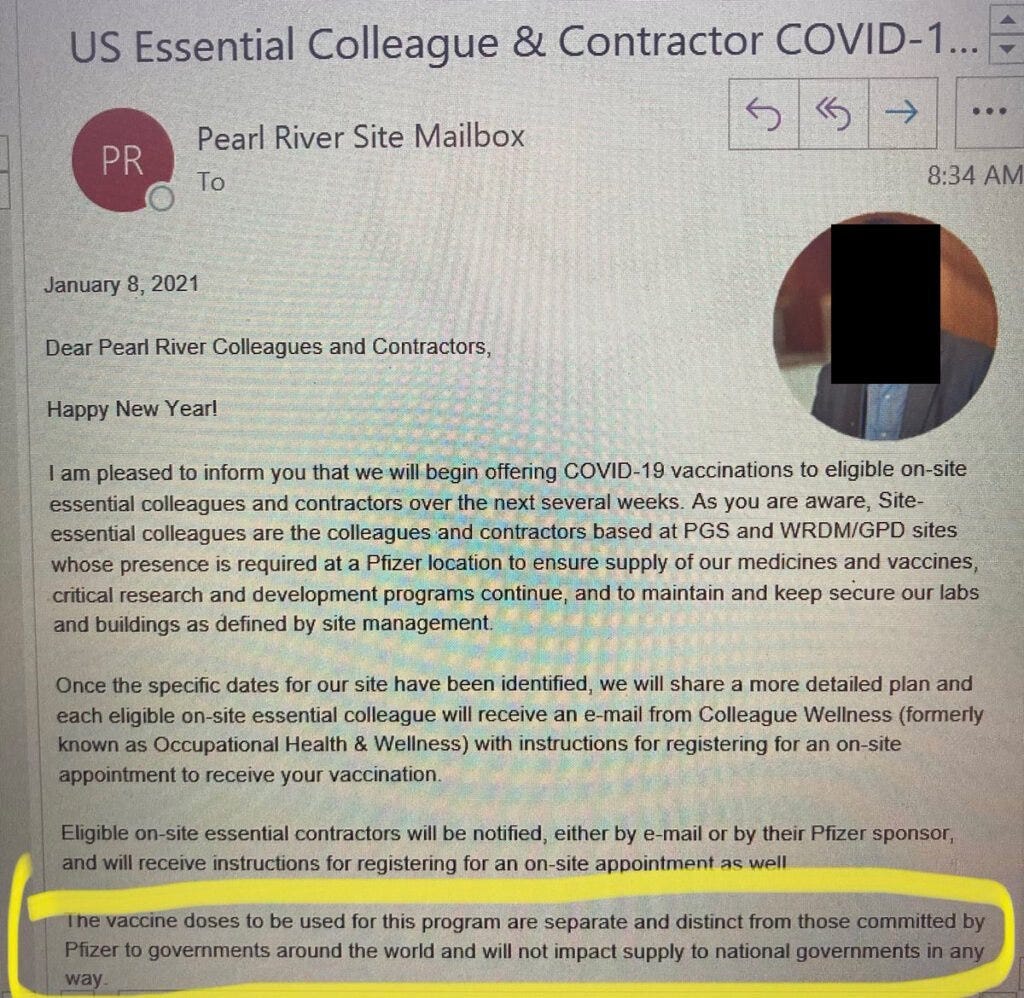
 A Pfizer whistleblower has raised the alarm that Pfizer workers were offered a “separate and distinct” COVID-19 vaccine and were told their jab would “not impact supply to national governments in any way.”

A leaked email from January 2021, provided exclusively to Infowars, explained to colleagues and contractors at Pfizer’s Pearl River research site that site-essential workers would be offered COVID-19 vaccinations that are “separate and distinct” from the doses Pfizer committed to governments worldwide.

“The vaccine doses to be used for this program are separate and distinct from those committed by Pfizer to governments around the world and will not impact supply to national governments in any way.”

Pfizer’s Pearl River research site is located in Rockland County, New York and is one of Pfizer’s nine major R&D sites, according to its website.

======

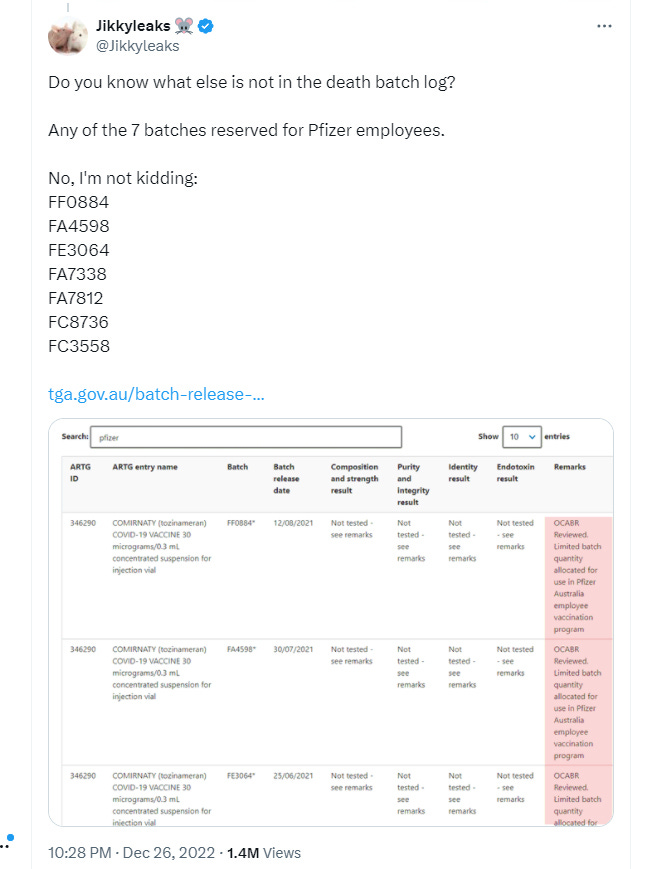
Dec.26, 2022 - Jikkyleaks reveals there are 7 Pfizer employee batches of COVID-19 Vaccine in Australia, that are not in the “Death batch log”

TGA website still has these batches in its database


Dr. William Makis MD: Canadian physician with expertise in Radiology, Oncology and Immunology. Governor General's Medal, University of Toronto Scholar. Author of 100+ peer-reviewed medical publications.

New biosecurity bill sets 2032 decoupling deadline for industry's work with WuXi

 Right after an industry survey suggested that switching away from Chinese CDMOs could take biopharma companies up to eight years, lawmakers have adjusted the BIOSECURE Act. The new draft lays out a 2032 deadline for the separation mandate.

The House version of the BIOSECURE Act has been amended to grandfather existing contracts that drug developers may have with five China-related biopharma service providers, including both WuXi Apptec and its sister contract manufacturer WuXi Biologics. Those relationships, including negotiated option years, are now exempt from national security scrutiny under the proposed legislation until Jan. 1, 2032, according to the revised bill seen by Fierce Pharma.

The original bill only had four initial targets. Although WuXi Bio was newly added, lawmakers have been viewing the two sister firms as related. 

The House Oversight Committee is expected to mark up the bill on May 15. In an unusually swift action, House leadership is considering reserving a floor vote for the BIOSECURE Act this month, Axios reports. In March, the Senate Homeland Security Committee voted to advance a counterpart bill to the Senate floor.

The update to the House bill was welcome news to the biopharma industry.

In a statement on Thursday, Biotechnology Innovation Organization’s CEO, John Crowley, praised the updated bill for providing “a reasonable timeframe for companies to decouple their reliance on China-based biomanufacturing.”

“It ensures during this transition that important biomedical research will not be slowed and that patients will have unimpeded access to life-saving medicines,” Crowley added.

The nearly eight-year period of immunity matches the timeline BIO’s members said they would need to switch away from Chinese contract research and manufacturing service providers.

In a recent survey performed by BIO, 52% of member respondents said switching manufacturing partners for their approved medicines could take two years to eight years. For preclinical and clinical work, 85% of respondents indicated that changing vendors could take anywhere from six months up to six years, depending on the type and size of the service and availability of other providers.

“I think the problem is having decent alternatives and that may take a bit more time,” Daphne Zohar, a serial biotech entrepreneur and CEO of Seaport Therapeutics, tweeted Friday about the updated bill.

Among 134 respondents to BIO’s survey, who represent 124 biopharma companies, 79% of individuals said they have at least one contract or product being supported by a Chinese CDMO. Companies cited difficulties in finding alternative service providers, the need to conduct test runs and validation, the need for regulatory approvals, increased costs and other factors as pain points for potential switches.

A bipartisan group of lawmakers introduced the House bill in January, aiming to block certain “biotechnology companies of concern” from accessing federal funding through their biopharma customers. To secure positions on Medicare and Medicaid, drugmakers would need to cut ties with the Chinese contractors.

WuXi AppTec and genome sequencing firms BGI, MGI and Complete Genomics were the initial targets of the bill. But the U.S. government would be tasked to identify other “foreign adversary biotech companies of U.S. national security concern” for future inclusion, should the law be enacted.

For those potential new additions, the House bill proposes a five-year period of leniency for existing contracts after the identification of the target service provider.

The biopharma industry and the general public are so far blinded from the selection process for potential targets of the bill. Some U.S. biotechs have warned about potential exposure to the bill—even though their Chinese partners are not currently listed.

Nevertheless, biopharma companies have already started distancing themselves from Chinese CDMOs in general.

During a recent press call, Novartis CFO Henry Kirsch said the Swiss pharma is already working on mitigation plans to sever its ties with Chinese contractors.

The impact of the bill has yet to manifest in the financial performance of WuXi AppTec, which recorded about 65% of its revenues from U.S. customers last year. But as the BIO survey has shown, cutting Chinese CDMOs off from the U.S. drug supply chain is a lengthy process.

https://www.fiercepharma.com/pharma/houses-updated-biosecurity-bill-sets-decoupling-deadline-chinese-cdmo-end-2031

US Offering Israel A Strange Incentive To Hold Off Rafah Offensive

 Over the weekend The Washington Post has reported a strange incentive and quid pro quo that the US is offering Israel if it agrees to hold off on the Rafah offensive. 

The Biden administration is ready to hand over to Israel "sensitive intelligence" on the whereabouts of top Hamas leaders. The Washington Post cited four unnamed sources as saying the US "is offering Israel valuable assistance if it holds backincluding sensitive intelligence to help the Israeli military pinpoint the location of Hamas leaders and find the group’s hidden tunnels."

The 'offer' is bizarre and somewhat unprecedented given one would think that Washington's aim alongside Israel would be to dismantle a designated terror organization and ultimately bring down its top leadership. 

But instead this is apparently being dangled like a carrot. Washington is holding out hopes that a ceasefire deal can be accomplished with Qatari and Egyptian mediation, but that still appears to be going nowhere. A full-scale Rafah assault is likely to put an end to Hamas-Israel talks, at least for the near future.

According to more of the 'incentives' for Israel to abandon its Rafah ground offensive: "American officials have also offered to help provide thousands of shelters so Israel can build tent cities — and to help with the construction of delivery systems for food, water and medicine — so that Palestinians evacuated from Rafah can have a habitable place to live, said the officials, speaking on the condition of anonymity to disclose secret diplomatic talks," WaPo writes.

"President Biden and his senior aides have been making such offers over the last several weeks in hopes they will persuade Israel to conduct a more limited and targeted operation in the southern Gaza city," the report continues.

Separately, public comments made by White House National Security Council spokesperson John Kirby during a Thursday briefing appeared to confirm the Post's reporting.

Kirby had said, "We could also, in fact, help them target the leaders, including [Hamas leader Yahya] Sinwar, which we are, frankly, doing with the Israelis on an ongoing basis."

Part of the White House's plan is to first get the bulk of Rafah civilianswhich have been widely reported to be at over one million Palestinianssafely removed and evacuated before major fighting begins. But the main question echoed by almost all is: where will they go?

"The aid community generally is very skeptical there’s any safe way to relocate people out of Rafah," Jeremy Konyndyk, president of Refugees International, was quoted in The Washington Post as saying.

It of course remains unknown the degree to which US intelligence actually has more info on Hamas leaders' whereabouts compared to Israeli intelligence.

Presumably such intel would come through intercepted communications, or perhaps even a human source that had infiltrated Hamas. However, it's highly doubtful the US has its own intelligence officers on the ground - other than possibly those working alongside IDF forces.

https://www.zerohedge.com/geopolitical/us-offering-israel-strange-incentive-hold-rafah-offensive

'Will your last COVID vaccine work against new ‘FLiRT’ variants?'

 [Wait for it..]

There are two new COVID-19 variants circulating, posing a threat to a summer surge.

The Centers for Disease Control and Prevention has been tracking the new variants, scientifically known as KP.2 and KP.1.1 since at least the start of 2024. They’ve been steadily growing in prominence ever since, and have garnered the nickname “FLiRT” because of their mutations.

The latest data shows KP.2 is the dominant strain in the U.S., comprising almost 25% of the tests that have been sequenced. KP.1.1 makes up about 8% as of the end of April. Both are sublineages of the JN.1 lineage of the Omicron variant, the main COVID variant for roughly three years.

Both FLiRT variants are considered very similar to JN.1, health officials say, with early data suggesting only a couple of changes in their spike proteins.

With the virus expected to spread as the summer months approach, it may be sparking concerns about whether the last vaccine dose you received is still protecting you. Ultimately, it depends on when you got your last dose.

In fall, an updated COVID vaccine was released. The CDC has recommended everyone 6 months old and older get the updated vaccines from Pfizer-BioNTech, Moderna, or Novavax. In February, a federal immunization committee voted in favor of recommending an additional dose for those ages 65 and up. Those between the ages of 6 months and 4 years old require multiple doses, the CDC says.

Previously, health officials have said the COVID vaccines would provide protection from the virus for “several months.” In a February update on the newest vaccine booster made available in September, the CDC said that while it had (from September to January) been effective, they expected that protection would “decline over time” as had been seen with previous doses. 

However, because the FLiRT variants are relatively new, there isn’t enough data to show whether the vaccine or immunity from a recent case of COVID will provide effective protection against them. 

Speaking with TODAY, Dr. William Schaffner, professor of infectious diseases at Vanderbilt University Medical Center, said lab studies so far have shown vaccines and immunity may only provide partial protection. Late last month, the World Health Organization recommended that future COVID vaccines formulations be based on the JN.1 variant, a close relative of the FLiRT off-shoots that reigned as the most common in the U.S. over the last few months.

As of Thursday, the CDC is reporting minimal COVID activity in wastewater nationwide, and virus-related hospitalizations and deaths, as well as the rate of patients visiting emergency departments testing positive for COVID, are down.

A spokesperson for the CDC tells Nexstar that the agency is “working to better understand [KP.2 and KP.1.1]’s potential impact on public health,” but notes that based on lab tests, there are “low levels of SARS-CoV-2 transmission overall at this time.”

“That means that while KP.2 is proportionally the most predominant variant, it is not causing an increase in infections as transmission of SARS-CoV-2 is low,” the spokesperson added. “Based on current data there are no indicators that KP.2 would cause more severe illness than other strains. CDC will continue to monitor community transmission of the virus and how vaccines perform against this strain.”

It’s too soon to say whether a new COVID vaccine will be created for the summer months. While the CDC recently eased guidance surrounding COVID, the agency still recommends everyone 6 months old and older get the updated COVID vaccine released in fall, if they haven’t already. Health experts are also continuing to encourage testing if you experience symptoms or are exposed, staying home if you’re sick, practicing good hygiene, and wearing a mask and social distancing when in public.

https://thehill.com/homenews/nexstar_media_wire/4653747-will-your-last-covid-vaccine-work-against-new-flirt-variants/

Fresenius Medical sees up to 2% US dialysis growth by year-end

 The number of kidney dialysis sessions provided by Fresenius Medical Care in its top market, the United States, could rise by as much as 2% by the end of the year, its CEO said, as the impact of the pandemic on patients fades.

WHY IT'S IMPORTANT

Fresenius Medical Care is the world's largest kidney dialysis company, and the fallout from the pandemic - which led to an increase in deaths among patients - has weighed heavily on its shares.

KEY QUOTE

"This year, I’m pleased to say we anticipate U.S. treatment volumes to rebound from a subdued pandemic era by 0.5 to 2 percent by the end of 2024, keeping us on track to a return to pre-pandemic levels of 2 to 3 percent by the end of 2025," CEO Helen Giza said.

Her remarks were posted on the company's website late on Friday as part of a speech prepared for the May 16 annual shareholder meeting.

CONTEXT

Fresenius Medical earlier this year said it anticipated a return to treatment volume growth in the U.S. over the course of 2024, as it slowly recovers from COVID-related deaths among its patients, many of whom suffer from a range of cardiovascular conditions.

On Tuesday, it beat first-quarter operating earnings expectations amid higher pricing and cost-cutting efforts, confirming its profit outlook for 2024.

https://uk.finance.yahoo.com/news/fresenius-medical-sees-2-us-104216563.html