Search This Blog

Monday, October 7, 2024

Cannabis Use in Teens, Young Adults Linked to Lower Academic Success

 Cannabis use during adolescence and young adulthood was linked to lower academic performance, a systematic review and meta-analysis suggested.

Among 63 studies that comprised 438,329 participants, moderate-certainty evidence indicated that cannabis use among individuals ages 24 years and younger was likely associated with lower school grades (odds ratio [OR] 0.61, 95% CI 0.52-0.71) as well as less likelihood of high school completion (OR 0.50, 95% CI 0.33-0.76), university enrollment (OR 0.72, 95% CI 0.60-0.87), and postsecondary degree attainment (OR 0.69, 95% CI 0.62-0.77), reported Li Wang, PhD, of McMaster University in Hamilton, Ontario, and colleagues.

Evidence of the same certainty also showed cannabis use among this age group was likely associated with increased school dropout rate (OR 2.19, 95% CI 1.73-2.78) and school absenteeism (OR 2.31, 95% CI 1.76-3.03), they noted in JAMA Pediatricsopens in a new tab or window. Absolute risk effects ranged from 7% to 14%.

"Although our findings support a negative association between cannabis use and academic achievement, the mechanism of action is uncertain," the researchers wrote. "Cannabis-induced impairment of cognitive function and motivation may play a role; however, whether cannabis use is a cause, correlate, or consequence of these factors is inconclusive."

In their introduction, Wang and colleagues said that, in 2019, 37% of U.S. high school students reported lifetime cannabis use and 22% reported using in the past month. They also noted that the potency of cannabis has increased over time in the U.S., from approximately 4% tetrahydrocannabinol in 1995 to 14% in 2019.

"Cannabis use can lead to short-term cognitive impairments, including memory deficits and impaired attention," they said, with chronic use among adolescents "linked to long-term changes in brain architecture, resulting in impaired information processing and decreased cognitive, memory, and attentive capacity in adulthood."

"The most recent systematic review on adolescent cannabis use and academic achievement found that heavy cannabis use was associated with worse educational outcomes," they continued. "However, this review had important limitations, including the lack of statistical pooling of associations, failure to assess the risk of bias of individual studies and overall certainty of evidence, and a limited search window (2014-2019)." Their analysis was intended to address these limitations.

In the current study, subgroup analyses with moderate credibility suggested worse academic outcomes for frequent cannabis users (weekly or daily) compared with less frequent users (less than weekly), and for those who began cannabis use earlier (at 16 years or younger) rather than later (older than 16).

For instance, two studies indicated a larger association with lower school grades for more frequent cannabis users (OR 0.58, 95% CI 0.53-0.64) versus less frequent users (OR 0.72, 95% CI 0.69-0.75). And two studies indicated a larger association among cannabis users who started using earlier with lower odds of high school completion (OR 0.42, 95% CI 0.28-0.63) versus those who did later (OR 0.77, 95%CI 0.53-1.10).

Low-certainty evidence suggested that cannabis use among adolescents and young adults was also possibly associated with increased unemployment, (OR 1.50, 95% CI 1.15-1.96), with an absolute risk increase of 9%, they added.

Wang and colleagues included research from relevant databases (CINAHL, EMBASE, MEDLINE, PsycInfo, PubMed, Scopus, and Web of Science) from inception through November 10, 2023.

The median age of participants in 31 studies was 16 years, the median proportion of female participants in 47 studies was 52%, and the median proportion of white participants in 32 studies was 70%.

The pooled rate of cannabis use at baseline among 47 studies was 33%, though most studies (89%) did not report the purpose (recreational or medicinal), type, or route of cannabis use.

Concurrent substance use was 26% for tobacco or cigarettes in 21 studies, 46% for alcohol in 26 studies, and 10% for cocaine or other substances in 15 studies. Additionally, there were 12 studies that reported substance use disorder, including cannabis abuse or dependence (median proportion of 8% in nine studies), alcohol abuse or dependence (33% in five studies), and general substance use disorder (6% in three studies).

Limitations included that most studies analyzed in the review were at high risk of bias due to high variability in measures of cannabis use, study populations, geographic areas, and cannabis-related policies, the authors noted. Additionally, they were unable to study the impact of legal status or recreational versus medicinal cannabis as possible sources of variability for most outcomes. They were unable to conduct subgroup analyses for types and potency of cannabis use because of insufficient data, and most studies were conducted in the U.S., potentially limiting generalizability. Also, observational studies did not allow for causal inferences.

Disclosures

Wang had no disclosures. A co-author reported receiving personal fees from Clairvoyant Therapeutics and serving as a principal/senior scientist for BEAM Diagnostics.

Primary Source

JAMA Pediatrics

Source Reference: opens in a new tab or windowChan O, et al "Cannabis use during adolescence and young adulthood and academic achievement: a systematic review and meta-analysis" JAMA Pediatr 2024; DOI: 10.1001/jamapediatrics.2024.3674.


https://www.medpagetoday.com/pediatrics/generalpediatrics/112291

Google is about to learn how DOJ wants to remake its empire


Google (GOOG, GOOGL) is about to find out what the Justice Department believes should be done to dismantle the tech giant’s dominance of the online search market.

Prosecutors are expected to submit a document as early as Tuesday in federal court outlining potential remedies after successfully arguing in a landmark trial that Google acted as an illegal monopoly.

It will be up to District of Columbia District Court Judge Amit Mehta, who sided with DOJ’s monopoly argument, to decide what should happen now in a separate "remedies" phase of the trial that will likely start in 2025.

Potential remedies range from an outright breakup of Google, to making its search engine data available to competitors, to ending agreements that secure its search engine as a default on mobile devices and internet browsers.

"I think it's going to be more complicated coming up with injunctive relief than it was finding the liability," antitrust attorney Carl Hittinger said.

Google has promised to appeal. And Judge Mehta could hold off on any orders to alter Google's behavior while it challenges his ruling in D.C.’s Circuit Court of Appeals.

The judge would lose the right to impose remedies if Google is found not to have broken the law on appeal.

And even if Google fails and is ordered to change its behavior, Judge Mehta could later adjust his orders to better ensure competition is restored.
A breakup

Certainly, a breakup of Google’s empire — the most rare of antitrust remedies — has the most potential to reorder the tech universe.

That could include divestitures of its Android operating system, Chrome browser, or AdWords platform — all of which steer users into Google search.

Any one of the three solutions would rip away a multibillion-dollar revenue stream from the tech giant, plus cut off data that fuels its broader search and advertising ecosystem.

Legal experts disagree about whether this will actually happen. Hittinger said it’s unlikely because Judge Mehta must select a remedy that best serves the public interest.

"You can't just yank the rug out from under the American public that's been using Google's service, now ingrained in our culture, without a substitute," Hittinger said. "Unless other competitors have a platform which is the same or better than Google, what's the public supposed to use in the meantime?"

A divestment of Android away from Google could have consequences for devices aside from those installed on devices used for internet search.
Peloton, for example, uses the open-sourced system to power its exercise equipment. Airplane manufacturers use it to power video screens, and supermarkets use it to run their consumer kiosks.
Developers also rely on Google to maintain Android’s ability to work across platforms.
Hittinger expects Judge Mehta to fashion a remedy similar to the one imposed against Xerox (XRX) in 1975 to end its dominance of the office copier market.

The company was no longer allowed to configure its copiers so that ink cartridge suppliers and other third-party components could not run on its machines.

But Bill Baer, former attorney general for the Justice Department's antitrust division, said he could foresee Judge Mehta requiring Google to divest Android or Chrome.

"The judge, in order to make this remedy meaningful, is going to have to do something that allows competition to flourish," Baer said.

"Because they're a monopolist, they charge the advertisers, who in turn charge us, a whole lot more than if the market were competitive."
Exclusive contracts

One likely scenario, antitrust lawyers said, is for the judge to put an end to agreements that secure Google’s search engine as a default on internet browsers and internet-connected devices that use Google’s Android operating system.

Google pays as much as $26 billion per year to maintain its position on mobile devices like Apple (AAPL) and Samsung smartphones.

Proskauer antitrust lawyer Colin Kass said he suspects Judge Mehta to be particularly receptive to remedies that undo those contracts because their anticompetitive effects were at the heart of the ruling.

"This was a relatively narrow complaint and an even narrower ruling," Kass said.

Representatives from Apple and other companies that benefit from the contracts testified that they chose Google for the quality of its search engine. Competing evidence from the DOJ showed Microsoft's Bing search engine attracted more users on its Edge browser when Google was not the default option.

An end to these revenue-sharing contracts would have considerable consequences for Google and Apple.

The contracts — which require Apple to install Google Search as the default across its Safari browser, Spotlight Search, and Siri — bring in an estimated $20 plus billion for Apple each year.

Targeted search platforms like Yelp (YELP) and Amazon (AMZN) could also benefit from fewer search users being automatically directed to Google.


Plus, he said, it's possible that the court could still allow Google to secure default placements for search but under new non-exclusive contracts that don’t raise antitrust concerns.

If Google can't get default placement any longer, it could also be required to give consumers a choice of search provider.

McGinn predicted the DOJ would ask that mobile devices, browsers, and wireless carriers give consumers a choice between search providers.

"It’s possible we’ll eventually see more phones and browsers preprogrammed to use another search engine," McGinn said.

Last year, the European Union’s antitrust regulator, the European Commission, required Google to give a choice screen based on its determination that the lack of choice violated its antitrust law.
Sharing data with rivals

The DOJ could also ask the judge to force Google to share with rival browsers and search providers its “click and query” data that it uses to refine its search algorithms.

Specifically, the data includes Google’s intellectual property that tracks and learns from information that its search engine users type into its search field and links they choose by clicking on query results.

Rival US search providers include Microsoft (MSFT) Bing, Yahoo Search (owned by Yahoo Finance's parent company), and DuckDuckGo. International search providers include Russia’s Yandex and China’s Baidu.

A spokesperson for DuckDuckGo told Yahoo Finance before the trial that the company hoped the case would result in Google having to share its click and query data.

The data could help more privacy-oriented browsers like DuckDuckGo and search engines compete against Google.

The representative said it can be more difficult for DuckDuckGo to attract advertisers because, unlike Google, it does not assemble user search profiles or search histories and then use that data to target users with advertisements.

Another remedy that some legal experts expect to be on the DOJ’s list is for Google to temporarily open up its internet index data to rival browser providers, such as Microsoft’s Edge, Apple’s Safari, Mozilla’s Firefox, Brave, and Opera.
AI

Even if Google were forced to divest search-related entities or unravel contracts for default placement, these moves may not have a dramatic effect on the company, according to Jefferies senior analyst Brent Thill.

Its bigger threats, Thill said, are from new AI-assisted search engines and recent gains made by rival Meta in attracting advertisers.

"I don't think spinning off a browser or an Android operating system is going to have a dramatic impact on the company," Thill said.

Judge Mehta, however, may have to consider how remedies to restore competition in the traditional search engine market may impact competition in the emerging market for AI-assisted search.

One concern, legal experts said, is that Google's search dominance could unfairly entrench its position in the market for next-generation search.

At the same time, these fresh threats may work to Google’s advantage in the remedies trial, allowing it to argue that its overall search dominance is already under threat.

"If a violation is found, Google will say the market is already solving itself," said former US Federal Trade Commission Chairman and George Washington University antitrust law professor William Kovacic.


https://finance.yahoo.com/news/google-is-about-to-learn-how-doj-wants-to-remake-its-empire-161243461.html

Fauci, the Man Who Thought He Was Science

 On Call: A Doctor's Journey in Public Service, by Anthony Fauci, Viking, 480 pages, $36

As a young medical student, I admired Tony Fauci. I bought and read Harrison's Principles of Internal Medicine, a vital textbook that Fauci co-edited. In reading his new memoir, On Call, I remembered why I admired him. His concern about his patients' plights, especially HIV patients, comes through clearly.

Unfortunately, Fauci's memoir omits vital details about his failures as an administrator, an adviser to politicians, and a key figure in America's public health response to infectious disease threats over the past 40 years. His life story is a Greek tragedy. Fauci's evident intelligence and diligence are why the country and the world expected so much of him, but his hubris caused his failure as a public servant.

It is impossible to read Fauci's memoir and not believe he was genuinely moved by the plight of AIDS patients. Since the first time he learned of the illness from a puzzling and alarming case report, his laudable ambition has been to conquer the disease with drugs and vaccines, cure every patient, and wipe the syndrome from the face of the earth. He is both sincere and correct when he writes that "history will judge us harshly if we don't end HIV."

When an aide in 1985 offered to quit when he contracted AIDS for fear of scandal at Fauci's beloved National Institute of Allergy and Infectious Diseases (NIAID), Fauci hugged him, declaring "Jim, you crazy son of a bitch, there is no way in the world I would ever let you go." This was Fauci at his best.

But Fauci paints an incomplete picture of his attitude toward AIDS patients in its early days. In 1983, in response to a case report of an infant with AIDS published in The Journal of the American Medical Association, Fauci told the press that AIDS might be spread by routine household contact. There was no good evidence then and is none now to suggest that HIV is transmitted that way. But Fauci's statement, prominently echoed in the media, panicked the American people, almost certainly leading many to physically shun AIDS patients out of an unfounded fear of catching the disease.

Fauci does not address this incident, so one is left to speculate about why he was attracted to this theory. One possibility is that there was little political support for government spending on AIDS when the public thought it only affected gay men. As the public came to understand AIDS impacted broader populations, such as hemophiliacs and IV drug users, public support for funding HIV research expanded.

Fauci was tremendously successful in eventually building public support for government spending on treating and trying to prevent the spread of AIDS. Likely no other scientist in history moved more money and resources to accomplish a scientific and medical goal than Fauci, and his memoir proves he was highly skilled in managing bureaucracy and getting his way both from politicians and from an activist movement that was at first highly skeptical about him. (One prominent AIDS activist, playwright Larry Kramer, once called Fauci a murderer.)

Fauci's response to activist criticism was to build relationships and use them as a tool to push for more government funding. Fauci's activist allies seemed to understand the game, staging attacks on Fauci, both playing their part to gain more money for HIV research.

By contrast, his treatment of scientific critics is harsh, crossing lines that federal science bureaucrats should not cross. In 1991, when University of California, Berkeley, professor and wunderkind cancer biologist Peter Duesberg put forward a (false) hypothesis that the virus, HIV, is not the cause of AIDS, Fauci did everything in his power to destroy him. In his memoir, Fauci writes about debating Duesberg, writing papers, and giving talks to counter his ideas. But Fauci did more, isolating Duesberg, destroying his reputation in the press, and making him a pariah in the scientific community. Though Fauci was right and Duesberg wrong about the scientific question, the scientific community learned it was dangerous to cross Fauci.

Fauci's HIV record is mixed. The great news is that, because of tremendous advances in treatment, a diagnosis of HIV is no longer the death sentence it was in the 1980s or 1990s. Fauci claims credit in his memoir, pointing out that the NIAID developed a clinical trial network that made it easier for researchers at pharmaceutical companies to conduct randomized studies of the effectiveness of HIV medications. But any competent National Institutes of Health (NIH) director would have directed NIAID resources this way. Furthermore, many in the HIV community have criticized Fauci for not using this network to test treatment ideas developed within the community—especially off-patent medications. Fauci is more reasonable when he takes credit for the 2003 creation of the President's Emergency Plan for AIDS Relief program (PEPFAR), through which the U.S. sent effective HIV medications to several African nations.

Despite billions of dollars spent on the task, no one to date has produced an effective HIV vaccine or a definitive cure, and the virus remains a threat to the health and well-being of the world population. By Fauci's own high standard, there is still a long way to go.

In the early days of the war on terror, Fauci became head of civilian biodefense, with the mandate to develop and stockpile countermeasures to biowarfare agents. This appointment made Fauci one of the most well-paid and powerful figures in the U.S. government. Fauci leveraged his deep knowledge of the federal bureaucracy, streamlining federal contracting rules to issue "sole source contracts" and "rapid research grants" to create constituencies of companies and scientists who depended on Fauci for their success.

In 2005, avian flu emerged and spread among birds, chickens, and livestock. Also spreading were worries that the virus could evolve to become more transmissible among human beings. Fauci deployed NIAID money to develop an avian flu vaccine, leading the government to stockpile tens of millions of ultimately unused and unnecessary doses.

At this point, virologists persuaded Fauci's NIAID to support dangerous scientific lab experiments designed to make the avian flu virus more easily transmissible among humans.

In 2011, NIAID-funded scientists in Wisconsin and the Netherlands succeeded. They published their results in a prestigious scientific journal, so that anyone with the knowledge and resources could replicate their steps. They effectively weaponized the avian flu virus and shared the recipe with the world, with Fauci and his agency in full support.

The idea behind this gain-of-function research was that we would learn which pathogens might leap into human beings, and that knowing that would help scientists develop vaccines and treatments for these prospective possible pandemics. Fauci, writing to molecular biologists in 2012, downplayed the possibility that laboratory workers or scientists studying these dangerous pathogens might cause the pandemic they were working to prevent. He also argued that the risk of such an accident was worth it: "In an unlikely but conceivable turn of events, what if that scientist becomes infected with the virus, which leads to an outbreak and ultimately triggers a pandemic? Many ask reasonable questions: given the possibility of such a scenario—however remote—should the initial experiments have been performed and or published in the first place, and what were the processes involved in this decision? Scientists working in this field might say—as indeed I have said—that the benefits of such experiments and the resulting knowledge outweigh the risks. It is more likely that a pandemic would occur in nature, and the need to stay ahead of such a threat is a primary reason for performing an experiment that might appear to be risky."

The NIH did pause funding gain-of-function work aimed at increasing germs' pathogenicity. The pause didn't last long, though. In the waning days of the Obama administration, the government implemented a bureaucratic process to permit NIH and NIAID to fund gain-of-function work again. Fauci played a pivotal behind-the-scenes role in reversing the pause, but his memoir provides almost no information about what he did. This is a gaping, telling hole, given subsequent history with COVID-19.

Among the projects Fauci and the NIAID funded during these years was research to identify coronaviruses in the wild and bring them into laboratories to study their potential for causing a human pandemic. The work encompassed laboratories worldwide. Fauci's organization funded an American outfit, EcoHealth Alliance, which worked with scientists at the Wuhan Institute of Virology.

In his memoir, Fauci goes out of his way to deny that any NIH money went to any activities that might have led to the creation of the SARS-CoV-2 virus that causes COVID. When Sen. Rand Paul (R–Ky.) in July 2021 confronted Fauci with the possibility that Fauci's NIAID had funded this work, Fauci resorted to cheap debate tactics to obfuscate his and the NIH's responsibility in supporting this work. It is undeniable that Fauci championed pathogen enhancement for a decade or more.

While the molecular biological and genetic evidence for a laboratory origin of SARS-CoV-2 is strong, many virologists disagree. (Their entire field would come under a cloud were it true, and many virologists' careers have been generously supported by Fauci's NIAID.) The debate on this topic rages on. A review of Fauci's memoir is not the place to settle the dispute.

But in judging Fauci's record as a scientist and a bureaucrat, it's worth knowing that in 2020, Fauci and his boss, Francis Collins, failed to empanel public discussions and debates on this vital topic. Instead, they created an environment where any scientist voicing the lab leak hypothesis came under a cloud of suspicion, accused of advancing unfounded conspiracy theories. As with Duesberg, Fauci sought to destroy the careers of dissenting scientists.

In his memoir, Fauci writes of a "right-wing…smear campaign [that] soon boiled over into conspiracy theories." He asserts, "One of the most appalling examples of this was the allegation, without a shred of evidence, that an NIAID grant to the EcoHealth Alliance with a sub-grant to the Wuhan Institute of Virology in China funded research that caused the COVID pandemic."

But in congressional testimony in 2024, Fauci denied that he had called the idea of a lab leak a conspiracy theory: "Actually, I've also been very, very clear and said multiple times that I don't think the 'concept' of there being a lab leak is inherently a conspiracy theory."

This self-serving denial makes a lawyerly distinction between the possibility of a lab origin of the COVID pandemic and the NIH's funding of EcoHealth Alliance to work with the Wuhan Institute of Virology on coronaviruses. These are neither "right-wing" nor "conspiracy theories," and the likelihood of a connection between the two is, for good reason, the subject of active bipartisan congressional investigation.

Fauci was quick to gather all the glory of administrative achievements like PEPFAR to himself while decrying any possibility of blame for the origin of COVID. But if he is responsible for the consequences of one (the millions of Africans saved because of PEPFAR), he is responsible for the consequences of the other. This includes the tens of millions who have died due to the COVID pandemic and the catastrophically harmful lockdowns used to manage it. This is Fauci at his worst.

By any measure, the American COVID response was a catastrophic failure. More than 1.2 million deaths have been attributed to COVID itself, and deaths from all causes have stayed high long after the number of COVID deaths themselves diminished. In many states, particularly blue states, children were kept out of school for a year and a half or longer, with devastating effects on their learning and future health and prosperity.

Coercive policy regarding COVID vaccination, recommended by Fauci on the false premise that vaccinated people could not get or spread the virus, collapsed public trust in other vaccines and led the media and public health officials to gaslight individuals who had suffered legitimate vaccine injuries. To pay for the lockdowns recommended by Fauci, the U.S. government spent trillions of dollars, causing high unemployment in the most locked-down states and a hangover of higher prices for consumer goods that continues to this day. Who is to blame?

Fauci served as a key adviser to both President Donald Trump and President Joe Biden, and was a central figure on Trump's COVID task force that determined federal policy. If Fauci has no responsibility for the outcomes of the pandemic, nobody does. Yet in his memoir's chapters on COVID, he simultaneously takes credit for advising leaders while disclaiming any responsibility for policy failures.

Fauci implausibly writes that he "was not locking down the country" and "had no power to control anything." These statements are belied by Fauci's own bragging about his influence on a host of policy responses, including convincing Trump to lock the country down in March 2020 and extend the lockdown in April.

He discusses the extended closure of schools, now almost universally seen as a bad idea, in the passive voice, as if the virus caused the school closures on its own. In congressional testimony in 2020, Fauci exaggerated the harm to children from getting infected with COVID, instilling fear in parents that their kids might suffer from a rare complication of COVID infection if they sent them to school. It is impossible not to recall Fauci exaggerating the risk of children contracting HIV from casual contact.

In May 2020, Fauci said that schools should reopen, conditional on "the landscape of infection with regard to testing." But he also recommended six-foot social distancing, based on no evidence—a policy that made it nearly impossible to open schools. Fauci opposed churches holding services and mass, even outdoors, despite the lack of evidence that the disease spread there. His memoir provides little detail about the scientific data he relied on to support these policies.

All this background makes his discussion of the Great Barrington Declaration all the more galling. The Declaration is a short policy document I wrote along with Martin Kulldorff (then of Harvard University) and Sunetra Gupta (of the University of Oxford) in October 2020. Motivated by recognizing that the lethality and hospitalization risk from COVID was 1,000 times lower in younger populations than in older, the document had two recommendations: (1) focused protection of vulnerable older populations, and (2) lifting lockdowns and reopening schools. It balanced the harms of the lockdowns against the risks of the disease in a way that recognized that COVID was not the only threat to human well-being and that the lockdowns themselves did considerable harm.

Fauci denigrates the Great Barrington Declaration as being filled with "fake signatures," though FOIAed emails from the era make it clear he knew tens of thousands of prominent scientists, doctors, and epidemiologists had co-signed it. In his memoir, he repeats a propaganda talking point about the Declaration, falsely claiming the document called for letting the virus "rip." In reality, it called for better protection of vulnerable elderly people.

Fauci asserted it was impossible to "sequester to protect the vulnerable" while simultaneously calling for the whole world to sequester for his lockdowns. His rhetoric about the Great Barrington Declaration poisoned the well of scientific consideration of our ideas. With brass-knuckle tactics, he won the policy fight, and many states locked down in late 2020 and into 2021.

The virus spread anyway.

Fauci does not mention the success of Swedish COVID policy, which eschewed lockdowns and instead—after some early errors—focused on protection of the vulnerable. Swedish all-cause excess death rates in the COVID era are among the lowest in Europe and much lower than American all-cause excess deaths. The Swedish health authorities never recommended closing schools for children 16 and under, and Swedish children, unlike American children, have no learning loss.

If lockdowns were necessary to protect the population, as Fauci claims, Swedish outcomes should have been worse than American ones. Even within the United States, locked-down California had worse all-cause excess deaths numbers and economic outcomes than Florida, which opened in the summer of 2020. It is shocking that Fauci still does not seem to know these facts.

Near the end of his memoir, Fauci writes that by March 2022, he knew "there would not be a clear end to the pandemic"; the world would need to learn to "live indefinitely with COVID." He reasons that "perhaps the vaccine and prior infection had created a degree of background immunity." This is as close as he comes in the book to admitting error.

A part of me cannot help but admire Fauci, but the extent of damage caused by his hubris gets in the way. He once told an interviewer, "If you are trying to get at me as a public health official and a scientist, you're really attacking not only Dr. Anthony Fauci, you're attacking science….Science and the truth are being attacked." Despite his career accomplishments, no one should give any man, much less Fauci, credit for being the embodiment of science itself.

If Fauci's goal in writing this memoir is to guide how historians write about him toward the positive, I do not think he succeeded. He will be remembered as a consequential figure for his contributions to the American approach to the HIV and COVID pandemics. But he will also be remembered as a cautionary tale of what can happen when too much power is invested in a single person for far too long.

Jay Bhattacharya is a professor of health policy at Stanford University and a research associate at the National Bureau of Economic Research. In 2020, he co-authored the Great Barrington Declaration in opposition to COVID-19 lockdowns.

https://reason.com/2024/10/06/the-man-who-thought-he-was-science/

Lessons from Stanford's COVID Conference

by Vinay Prasad MD 

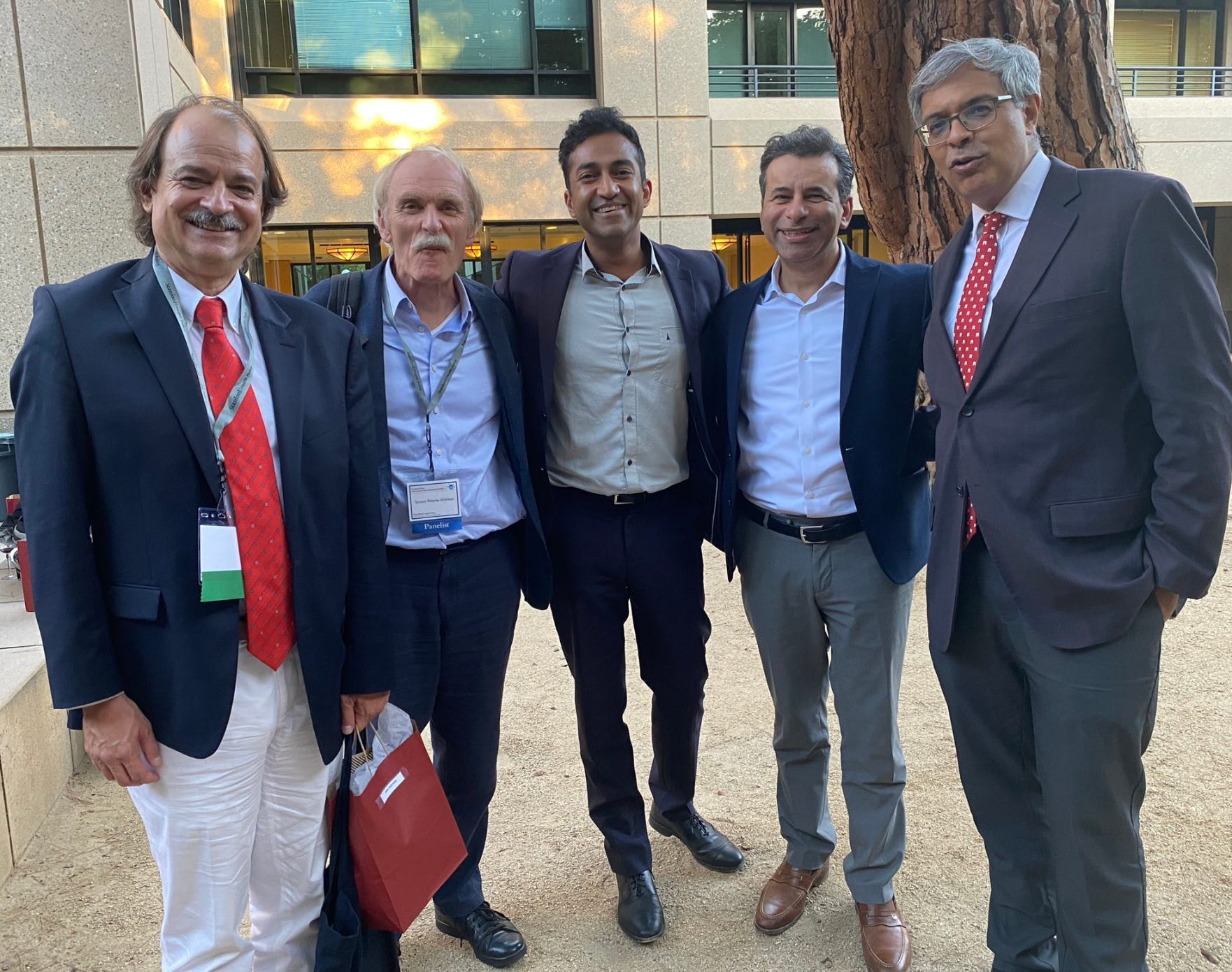
On Friday, I spoke at Stanford, discussing lessons from the COVID19 pandemic. Here are 5 things I learned.

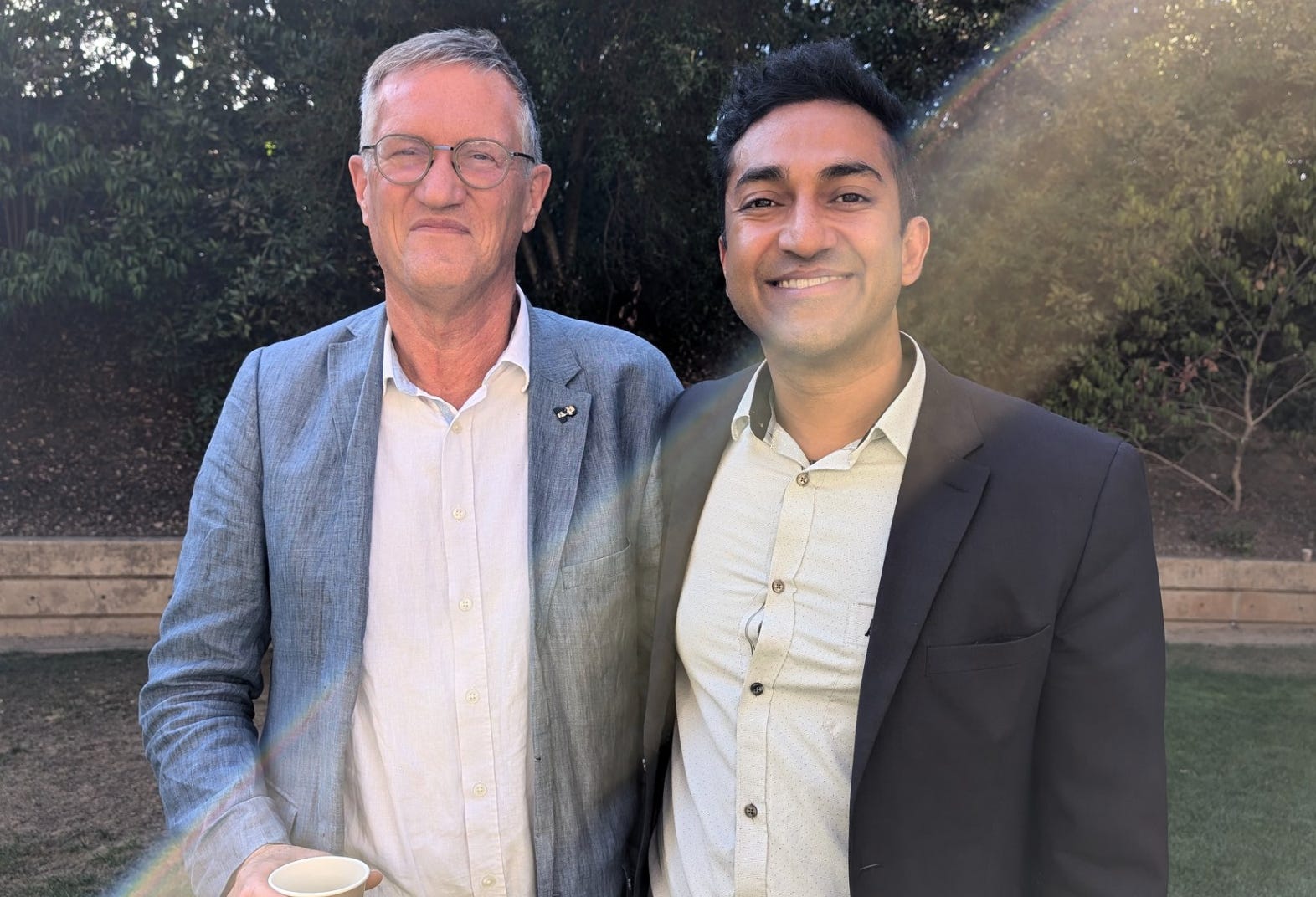
Lesson 1: Some people still believe that short term elementary school closure was justified, but Anders Tegnell knows better. Tegnell didn’t follow the groupthink in 2020.

Anders led the Swedish response and notably Sweden never closed elementary schools. Anders told me that the data from Wuhan was clear. Children were not the drivers of COVID-19 spread, and they faced no risk from COVID different than typical respiratory viruses. Thus, closing elementary schools— even short term— was a bad decision, and Sweden didn’t make it because he reviewed the data. I would wager that most people who thought it was a good idea did not review Wuhan data at the time.

Lesson 2: Everyone admits that prolonged school closure was bad, but they refuse to accept responsibility for silence. I don’t think anyone denies that prolonged school closure (anything more than 6-10 wks) was completely insane and harmful. Notably, San Francisco kept schools closed for 18 months.

Yet, many people were silent about school closure at the time. Including faculty who focused on early life development and equity. I think many people should admit that they are not really good at thinking independently in the face of groupthink. That would serve them well as academics — because they might be more humble about their beliefs going forward.

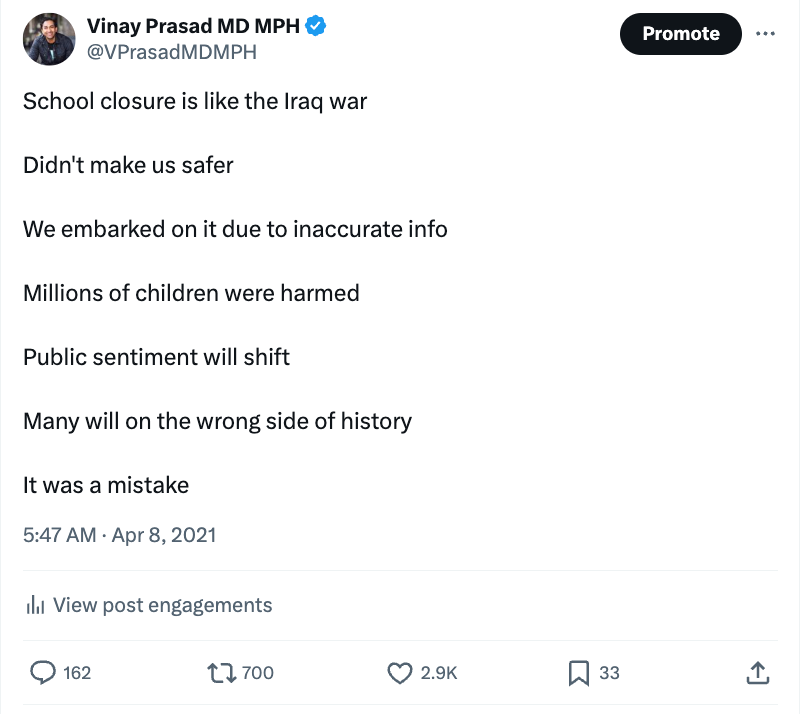
For the record: I did podcasts against school closure in the summer of 2020. And famously tweeted this, which I continue to think is correct.

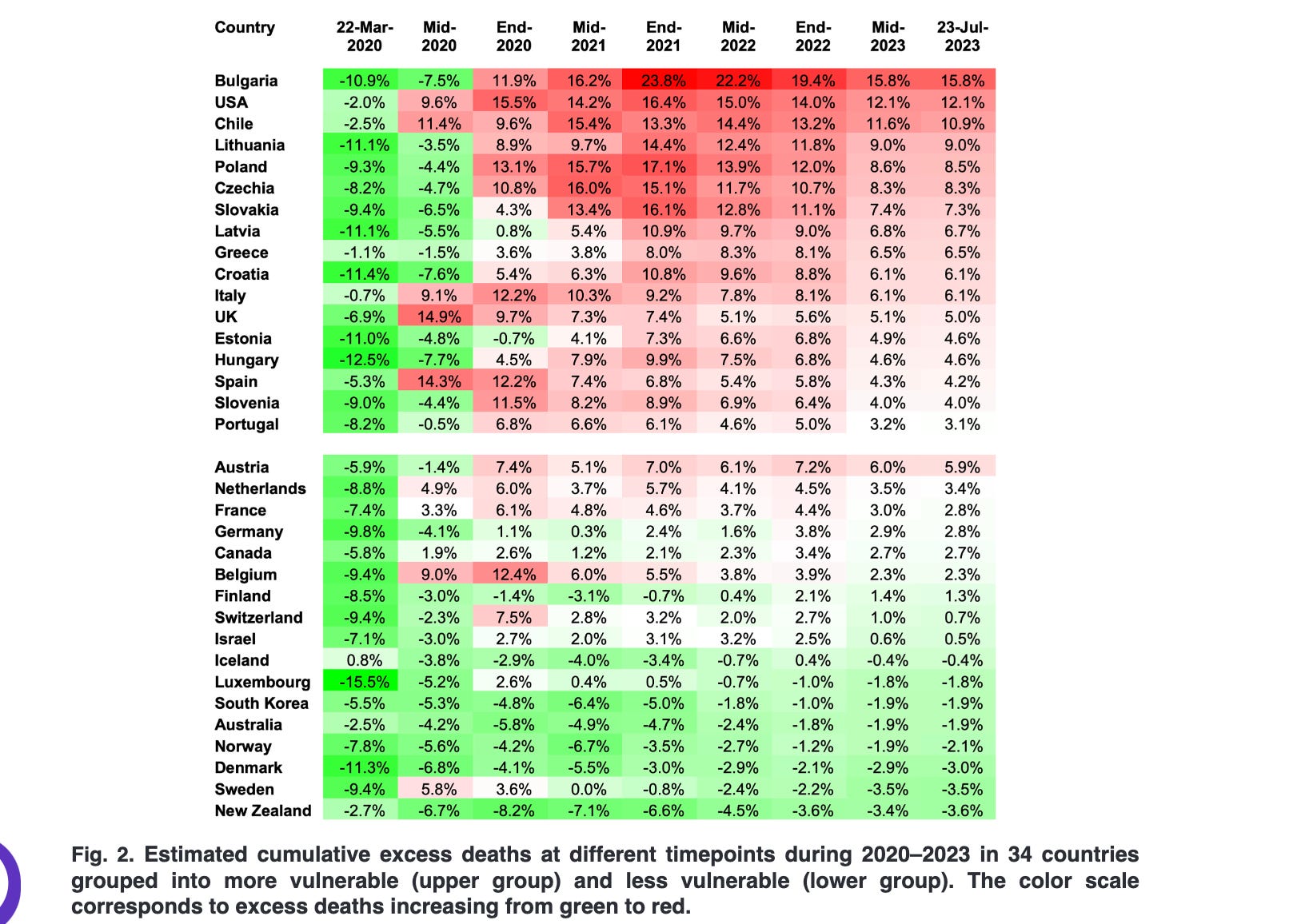
Lesson 3: John Ioannidis made an interesting point. He showed a graph of excess death by country and time period. Look at the countries with almost no excess death (bottom)

Sweden and New Zealand had drastically different pandemic approaches. Ioannidis’ point is that largely countries with more income inequality did poorer than more egalitarian places. Lockdowns, border closure, and the like were not as important as access to basic health care. I will continue mulling over these data.

https://www.drvinayprasad.com/p/5-lessons-from-stanfords-covid-conference

Consumers Crack: Credit Card Debt Plunges Most Since Covid As APRs Hit Record High

 Last month, we - and many others - were stunned when after several months of progressively declining revolving credit growth, in July credit card debt unexpectedly soared by the most since January, sending total consumer credit growth surging by just under $27 billion, the single biggest monthly increase since 2022. We called it a "Last Hurrah" moment (literally "In "Last Hurrah", Credit Card Debt Unexpectedly Soars Despite Record High APRs As Savings Rate Hits Record Low") and said that "with consumers ever more strapped for actual cash and equity, as the personal savings rate in the US collapses from over 5% to 2.9% - the lowest since the Lehman bankruptcy - in just one year, as all the excess savings from covid are long gone there is only so much more credit card maxing out that can take place before reality finally sets in."

One month later, reality has set in with a bang, because just a month after a bizarre surge in revolving credit, the Fed reported that in August, total consumer credit growth plunged by more than half to just $8.9 billion, below the $12 billion estimate...

... but while non-revolving credit which is far less volatile and much more stable, grew $10.3 billion, a big drop from the previous month's $16 billion, if still the 2nd highest monthly increase of 2024 

... the punchline is that the much more consumer-outlook sensitive revolving credit reversed all of its July surge and then some, as August saw the biggest revolving credit drop since the covid crash!

And what is especially notable is that just days before the Fed's first rate cut since the covid crash, where Powell telegraphed an econ panic with his "jumbo" rate cut, the average rate on all credit cards in the US just hit a new high of 21.76%, up from 21.51%.

It will be very interesting to see if APRs drop next month when we get the update for September, after the Fed's rate cut, because one month ago we made a prediction that while deposits and savings rates immediately dropped, interest rates on debt - such as credit card APRs - will barely budge (if not keep rising).

Finally, in light of the collapse in credit card funded spending, we can stop pretending that the government's recent fabrication of savings data, which was upwardly "revised" from a record low 2.9% to a nice and balmy 4.8%, is even remotely credble.