Search This Blog

Friday, January 10, 2025

Are Patients On GLP-1s Getting the Right Nutrients?

 As the use of glucagon-like peptide 1 receptor agonists (GLP-1 RAs) continues to exponentially expand obesity treatment, concerns have arisen regarding their impact on nutrition in people who take them.

While the medications’ dampening effects on appetite result in an average weight reduction ≥ 15%, they also pose a risk for malnutrition.

“It’s important to eat a balanced diet when taking these medications,” Deena Adimoolam, MD, an endocrinologist based in New York City and a member of the national advisory committees for the Endocrine Society and the American Diabetes Association, told Medscape Medical News. “If someone’s diet is minimal, it’s important they’re keeping up with their need for macronutrients — protein, fat, carbohydrates — as well as micronutrients — vitamins and minerals.”

The decreased caloric intake resulting from the use of GLP-1 RAs makes it essential for patients to consume nutrient-dense foods. Clinicians can help patients achieve a healthy diet by anticipating nutrition problems, advising them on recommended target ranges of nutrient intake, and referring them for appropriate counseling.

Where to Begin

The task begins with “setting the right expectations before the patient starts treatment,” said Scott Isaacs, MD, president-elect of the American Association of Clinical Endocrinology.

To that end, it’s important to explain to patients how the medications affect appetite and how to adapt. GLP-1 RAs don’t completely turn off the appetite, and the effect at the beginning will likely be very mild, Isaacs told Medscape Medical News.

Some patients don’t notice a change for 2-3 months, although others see an effect sooner.

“Typically, people will notice that the main impact is on satiation, meaning they’ll fill up more quickly,” said Isaacs, who is an adjunct associate professor at Emory University School of Medicine, Atlanta. “It’s important to tell them to stop eating when they feel full because eating when full can increase the side effects, such as nausea, vomiting, diarrhea, and constipation.”

A review article, written by lead author Jaime Almandoz, MD, University of Texas Southwestern Medical Center, Dallas, in Obesity offers a “5 A’s model” as a guide on how to begin discussing overweight or obesity with patients. This involves asking for permission to discuss weight and asking about food and vitamin/supplement intake; assessing the patient’s medical history and root causes of obesity, and conducting a physical examination; advising the patient regarding treatment options and reasonable expectations; agreeing on treatment and lifestyle goals; and assisting the patient to address challenges, referring them as needed to for additional support (eg, a dietitian), as well as arranging for follow-up.

Impact of GLP-1 RAs on Food Preferences

Besides reducing hunger and increasing satiety, GLP-1 RAs may affect food preferences, according to a research review published in the International Journal of Obesity. It cites a 2014 study that found that people taking GLP-1 RAs displayed decreased neuronal responses to images of food measured by functional magnetic resonance imaging in the areas of brain associated with appetite and reward. This might affect taste preferences and food intake.

Additionally, a 2023 study suggested that during the weight-loss phase of treatment (as opposed to the maintenance phase), patients may experience reduced cravings for dairy and starchy food, less desire to eat salty or spicy foods, and less difficulty controlling eating and resisting cravings.

“Altered food preferences, decreased food cravings, and reduced food intake may contribute to long-term weight loss,” according to the research review. Tailored treatments focusing on the weight maintenance phase are needed, the authors wrote.

Are Patients Vulnerable to Malnutrition?

A recent review found that total caloric intake was reduced by 16%-39% in patients taking a GLP-1 RA or dual glucose-dependent insulinotropic polypeptide (GIP)/GLP-1 RA, but few studies evaluated the composition of these patients’ diets. Research that examines the qualitative changes in macronutrient and micronutrient intake of patients on these medications is needed, the authors wrote.

They outlined several nutritional concerns, including whether GLP-1 RA or GIP/ GLP-1 RA use could result in protein intake insufficient for maintaining muscle strength, mass, and function or in inadequate dietary quality (ie, poor intake of micronutrients, fiber, and fluid).

“Although we don’t necessarily see ‘malnutrition’ in our practice, we do see patients who lose too much weight after months and months of treatment, patients who aren’t hungry and don’t eat all day and have one big meal at the end of the day because they don’t feel like eating, and people who continue to eat unhealthy foods,” Isaacs said.

Some patients, however, have medical histories placing them at a greater risk for malnutrition. “Identification of these individuals may help prevent more serious nutritional and medical complications that might occur with decreased food intake associated with AOMs [anti-obesity medications],” Almandoz and colleagues noted in their review.
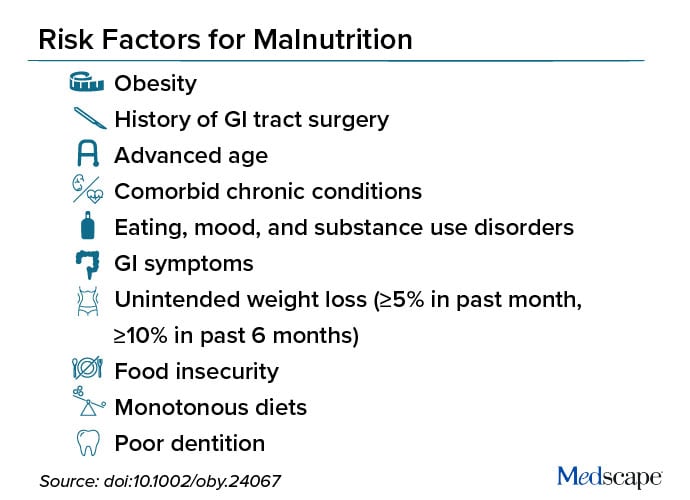
photo of Risk factors of malnutrition

What Should Patients Eat?

Nutritional needs vary based on the patient’s age, sex, body weight, physical activity, and other factors, Almandoz and colleagues wrote. For this reason, energy intake during weight loss should be “personalized,” they added.
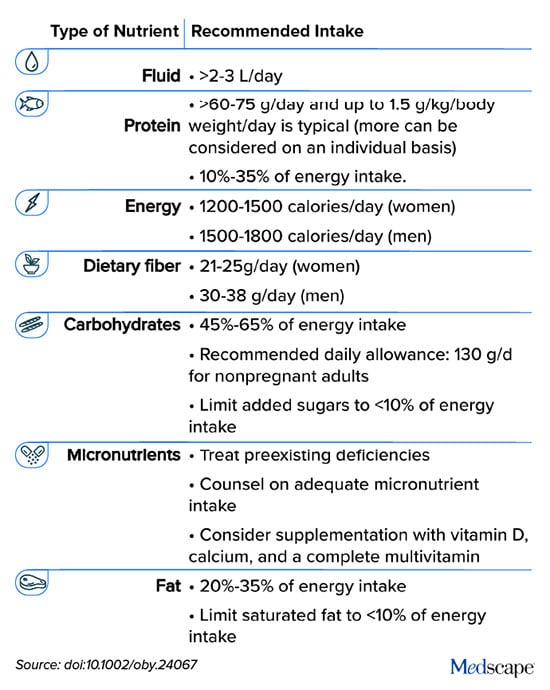
photo of Type of Nutrients

The authors also recommended specific sources of the various dietary components and noted red flags signaling potential deficiencies (Table).

Table. Nutritional Recommendations for Patients Being Treated with Anti-Obesity Medications
Dietary ComponentSources Signs/Symptoms of DeficiencyAdditional Considerations 
Fluids
  • Water
  • Low-calorie beverages
  • Nutrient-dense beverages (eg, low-fat milk, soy milk)
  • Limit sugar-sweetened beverages, alcohol, and caffeine
  • Hypotension
  • Tachycardia
  • Dizziness
  • Greater risk for dehydration in older individuals
  • Low carbohydrate/ketogenic diets may increase dehydration risk
Energy
  • Healthy dietary pattern (vegetables, fruits, whole grains, lean protein, low-fat dairy/dairy alternatives, and healthy fats)
  • Reduced fat/lean mass
  • Decreased strength/functional capacity
  • Aging is associated with decreased energy expenditure
Fiber
  • Whole grains
  • Vegetables
  • Beans, peas, and lentils
  • Fruits
  • Nuts and seeds
  • Fiber supplementation if necessary
  • Constipation
  • Plant-based foods contain soluble and insoluble fiber
Protein
  • Beans, peas, and lentils
  • Nuts, seeds, and soy products
  • Seafood
  • Lean meat and poultry
  • Low-fat dairy foods
  • Eggs
  • Meal replacement products if intake from whole foods is insufficient
  • Loss of lean body mass
  • Weakness
  • Edema
  • Hair loss
  • Skin changes
  • Aging and acute illness are associated with increased protein requirements
Carbohydrates
  • Whole grains
  • Fruits
  • Vegetables
  • Nuts and seeds
  • Dairy foods
  • Dairy alternatives
  • Low carbohydrate diets (ketogenic diets) may increase risk for dehydration, fatigue, halitosis, and other adverse events
  • Very low carbohydrate diets may lead to restricted intake of fruits, vegetable, and whole-grain foods, which are important sources of micronutrients and dietary fiber
Fats
  • Nuts and seeds
  • Avocado
  • Vegetable oils (limit palm and coconut oils)
  • Fatty fish and seafood
  • Essential fatty acid deficiency (dry skin, hair loss, and impaired wound healing)
  • Adequate fat intake may promote gallbladder emptying (reduces risk for weight reduction–related cholestasis)
  • Malabsorptive intestinal track disorders or history of malabsorptive bariatric surgery increases risk for deficiency of essential fats and fat-soluble vitamins
  • Consumption of high-fat meals may cause gastric distress
Almandoz JP, Wadden TA, Tewksbury C, et al. Nutritional considerations with antiobesity medications. Obesity (Silver Spring). 2024; 32: 1613-1631. Source

Nutritional needs vary based on the degree of appetite suppression in the patient, Adimoolam said. “I recommend at least two servings of fruits and vegetables daily, and drinking plenty of water throughout the day,” she added.

Protein in particular is a “key macronutrient,” and insufficient intake can lead to a variety of adverse effects, including sarcopenia — which is already a concern in individuals being treated with GLP-1 RAs. Meal replacement products (eg, shakes or bars) can supplement diets to help meet protein needs, especially if appetite is significantly reduced.

“There are definitely concerns for sarcopenia, so we have our patients taking these drugs try to eat healthy lean proteins – 100 g/d — and exercise,” Isaacs said. Exercise, including resistance training, not only improves muscle mass but also potentiates the effects of the GLP-1 RAs in patients with obesity and type 2 diabetes.

Adequate hydration is essential for patients taking GLP-1 RAs. “One of the commonly described side effects is fatigue, but there’s no biological reason why these medications should cause fatigue. My opinion is that these patients are dehydrated, and that may be causing the fatigue,” Isaacs said.

Some patients taking GLP-1 RAs lose interest in food. Isaacs regarded this as an “adverse reaction to the medication, which necessitates either stopping it altogether, changing the dose, or adjusting the diet.” There are “many different solutions, and one size doesn’t fit all,” he said.

Dietary and Behavioral Counseling

The drugs don’t necessarily motivate a person to eat healthier food, only to eat less food, Isaacs noted.

“The person might be eating low-volume but high-calorie food, such as bag of chips or a cookie instead of an apple,” Isaacs said. Patients who are losing weight “may not realize that weight loss isn’t the only important outcome. Because they’re losing weight, they think it’s okay to eat junk food.”

Patients need education and guidance about how to eat while on these medications. Most patients find counseling about meal planning helpful, he said.

Isaacs gives nutritional guidance to his patients when he prescribes a weight loss medication. “But most physicians don’t have time to offer that type of specific counseling on an ongoing basis,” he said. Isaacs refers patients requiring more detailed and long-term guidance to a dietician.

Patients with monotonous diets of poor quality are at increased risk for nutrition deficiencies, and counseling by a registered dietitian could help improve their dietary quality.

Registered dieticians can develop a multifaceted approach not only focusing on medication management but also on customizing the patient’s diet, assisting with lifestyle adjustments, and addressing the mental health issues surrounding obesity and its management.

People seeking obesity treatment often have psychiatric conditions, psychological distress, or disordered eating patterns, and q uestions and concerns have emerged about how GLP-1 RA use might affect existing mental health problems. For example, if the medication suppresses the feeling of gratification a person once got from eating high-energy dense foods, that individual may “seek rewards or pleasure elsewhere, and possibly from unhealthy sources.”

Psychological issues also may emerge as a result of weight loss, so it’s helpful to take a multidisciplinary approach that includes mental health practitioners to support patients who are being treated with GLP-1 RAs. Patients taking these agents should be monitored for the emergence or worsening of psychiatric conditions, such as depression and suicidal ideation.

Achieving significant weight loss may lead to “unexpected changes” in the dynamics of patients’ relationship with others, “which can be distressing.” Clinicians should be “sensitive to patients’ social and emotional needs” and provide support or refer patients for help with coping strategies.

GLP-1 RAs have enormous potential to improve health outcomes in patients with obesity. Careful patient selection, close monitoring, and support for patients with nutrition and other lifestyle issues can increase the chances that these agents will fulfill their potential.

Isaacs declared no relevant financial relationships.

https://www.medscape.com/viewarticle/are-patients-glp-1s-getting-right-nutrients-2025a10000k1

Court puts plea deal on pause for 9/11 mastermind: 23 years later, justice for terrorists delayed again

 A federal appeals court has delayed Friday's scheduled military court hearing where suspected 9/11 mastermind Khalid Sheikh Mohammed and two co-conspirators were expected to plead guilty as part of a deal negotiated with prosecutors. 

The pause, though welcomed by the many who opposed the plea deals, prolongs a decades-long crusade for justice by the victims' families. 

The plea deals, which would have three 9/11 terrorists avoid the death penalty and face life in prison, have drawn sharp outcry from the public and even prompted a dispute within the Biden administration to undo them. 

On New Year’s Eve, a military appeals court shot down Defense Secretary Lloyd Austin's effort to block the deal between military prosecutors and defense lawyers, saying Austin did not have the power to cancel plea agreements.

Then, on Wednesday, the Department of Justice appealed that ruling. 

Specifically, the court opinion said the plea deals reached by military prosecutors and defense attorneys were valid and enforceable and that Austin exceeded his authority when he later tried to nullify them.

The defense now has until Jan. 17 to offer a full response to the Department of Justice's request to have the plea deals thrown out. Government prosecutors then have until Jan. 22 for a rebuttal, with possible oral arguments on the issue to follow. 

The plea deals, offered to Mohammed and two co-conspirators, were meant as a way to wrap up the quest for justice to those who have been waiting more than two decades to see the terrorists that killed their loved ones convicted. They would allow prosecutors to avoid going to trial.

But why did the government settle for a plea deal after 23 years of building a case in the first place? 

"I haven't spoken to a single person who thinks these plea deals were a good idea. Most people are horrified," said Brett Eagleson, president of 9/11 Justice. 

Khalid Shaikh Mohammad

Khalid Shaikh Mohammed, the alleged Sept. 11 mastermind, shortly after his capture during a raid in Pakistan in 2003 (AP)

"It's our thought that this was rescinded in name only and like it was done right before the election. So, Austin was trying to save any attempts at sort of a political loss on this," said Eagleson.

In its appeal this week, the government says, "Respondents are charged with perpetrating the most egregious criminal act on American soil in modern history — the 9/11 terrorist attacks.

"The military commission judge intends to enforce pretrial plea agreements that will deprive the government and the American people of a public trial as to the respondents’ guilt and the possibility of capital punishment, despite the fact that the Secretary of Defense has lawfully withdrawn those agreements," the appeal said. "The harm to the government and the public will be irreparable once the judge accepts the pleas, which he is scheduled to do in hearings beginning on January 10, 2025."

Khalid Sheik Mohammed and Guantánamo Bay 

Khalid Sheik Mohammed and Guantánamo Bay 

The appeal also noted that once the military commission accepts the guilty pleas, there is likely no way to return to the status quo.

Defense lawyers for the suspected 9/11 perpetrators argued Austin’s attempts to throw out the plea deals that his own military negotiated and approved were the latest developments in the "fitful" and "negligent" mishandling of the case that has dragged on for more than two decades. 

If the plea deal is upheld, the architects of the attacks that killed 2,976, plus thousands more who died after inhaling toxic dust in rescue missions, will not be put to death for their crimes.

"You would think that the government has an opportunity to make right, and you would think that they would be salivating at the opportunity to bring us justice," Eagleson said. "Rather than doing that, they shroud everything in secrecy. They're rushing to get these plea deals done, and they're marching forward despite the objections of us.

Austin Ukraine

U.S. Defense Secretary Lloyd Austin speaks at the Hennadii Udovenko Diplomatic Academy of Ukraine at the Ministry of Foreign Affairs of Ukraine Oct. 21, 2024 in Kyiv, Ukraine. (Viktor Kovalchuk/Global Images Ukraine via Getty Images)

"We want transparency. We want the discovery that's been produced. In this case, we want to know who are these guys they're talking to? On what grounds does our government think that these guys are guilty? Why can't they share that with us? It's been 23 years. You can't tell me that you need to protect national security sources and methods because, quite frankly, if we're using the same sources and methods that we were 23 years ago, we have bigger fish to fry." 

The government opted to try five men in one case instead of each individually. Mohammed is accused of masterminding the plot and proposing it to Usama bin Laden. Two others allegedly helped the hijackers with finances. 

In 2023, a medical panel concluded that Ramzi bin al-Shibh was not competent to stand trial and removed him from the case. Mohammed, Mustafa al-Hawsawi and Walid bin Attash, are all part of the plea agreement that will allow them to avoid the death penalty. One other will go to trial.  

"The military commission has really been a failure," said John Ryan, a retired agent on the FBI's joint terrorism task force in New York. 

Hundreds of people have been convicted of terrorism charges in the U.S. Ramzi Yousef, the perpetrator of the 1993 World Trade Center bombing, was convicted in 1997.

But the military commission’s 9/11 case has faced a revolving door of judges, who then each take time to get up to speed with the 400,000 pages and exhibits in the case. Col. Matthew N. McCall of the Air Force, the fourth judge to preside over hearings in the case, intends to retire in the first quarter of 2025 before any trial begins. 

Khalid Sheikh Mohammed sketch

A courtroom sketch of Khalid Sheikh Mohammed and Walid Bin Attash (AP Photo/Janet Hamlin, Pool, File)

McCall was assigned to the case in August 2021, and he held only two rounds of hearings before suspending the proceedings in March 2022 for plea negotiations. Another judge would have to get up to speed, and it could be another five to 10 years before a conviction, according to Ryan, who observed many of the hearings at Guantánamo. 

"You have parents and grandparents [of victims] that now are in their 80s, you know, and want to see justice in their lifetime," he said. 

"So, they would prefer to see the death penalty, but they’re sort of accepting the plea agreement here." 

In the 23 years it’s taken to go to trial, critical witnesses have died, while others have waning memories of that fateful day. 

For many years, the trial was delayed as the prosecution and the defense argued over whether some of the government’s best evidence, obtained under torture by the CIA, was permissible in court. The defense argued their clients had been conditioned to say anything that would please interrogators under this practice. 

Former Attorney General Eric Holder has blamed "political hacks" for preventing a U.S.-based trial and thereby leading to the plea deal. 

Years of proceedings in the untested military commissions system have led to countless delays. 

Holder in 2009 had wanted to try the men in the Manhattan court system and promised to seek the death penalty, but he faced swift opposition in Congress from lawmakers who opposed bringing the suspected terrorists onto U.S. soil. 

In 2013, Holder claimed Mohammed and his co-conspirators would be sitting on "death row as we speak" if the case had gone through the federal court system as he proposed. 

Ten years later, Attorney General William Barr also tried to bring the Guantánamo detainees to the U.S. for a trial in federal court in 2019. He wrote in his memoir that the military commission process had become a "hopeless mess." 

"The military can’t seem to get out of its own way and complete the trial," Barr wrote. He, too, ran into opposition from Republicans in Congress and then-President Trump. 

https://www.foxnews.com/politics/ksm-plead-guilty-prosecutors-plea-deal-23-years-building-case

Lawmakers urge FTC to release newest report on pharmacy benefit managers

 A bipartisan, bicameral group of lawmakers is calling on the Federal Trade Commission (FTC) to vote in favor of releasing an interim staff report on pharmacy benefit managers (PBM).

Sens. Elizabeth Warren (D-Mass.) and Josh Hawley (R-Mo.), along with Reps. Jake Auchincloss (D-Mass.) and Diana Harshbarger (R-Tenn.), wrote to the FTC in light of Tuesday’s open commission meeting to consider issuing a second interim staff report on PBMs.

“PBMs were originally created to handle the prescription drug benefit on behalf of health plans, negotiating directly with drug manufacturers and setting pharmacy networks for their contracted payers,” the lawmakers wrote.

“But over the years, these once little-known middlemen have morphed into giant, vertically-integrated conglomerates that control every link in the drug coverage and delivery chain, including pharmacies and health plans.”

The FTC launched its inquiry into PBMs in 2022. Last year, the agency released its first interim staff report on PBMs, and it found that dominant, vertically integrated PBMs use their outsized market share to profit off of patients and independent pharmacists.

FTC Chair Lina Khan said at the time the report highlighted how PBMs “can squeeze independent pharmacies that many Americans — especially those in rural communities —depend on for essential care” and “hike the cost of drugs — including overcharging patients for cancer drugs.

PBM reforms were included in earlier drafts of the government funding bill last month, but the ultimately were left out. The package would have included a ban on linking PBM compensation to a drug’s Medicare list price as well as a requirement that PBMs “fully pass through 100 percent of drug rebates and discounts … to the employer or health plan.”

The second staff interim report being considered includes findings from the FTC’s study on the contracting practices of PBMs.

This group of lawmakers who wrote to the FTC introduced legislation last month that would prohibit the joint ownership of both PBMs and pharmacies, calling this practice a “gross conflict of interest.” They cited the FTC’s report last year as having informed this bill.

“We expect a second interim report will shine further light on the industry that will be invaluable to legislators as the policy priorities of the 119th Congress take shape,” they wrote.

“Accordingly, we urge FTC to issue its second interim staff report swiftly and continue investigating the serious effects of the PBM industry on patients, taxpayers, and independent pharmacies.”

The FTC’s open commission meeting will be held virtually at 11 a.m. EST Tuesday. Time will be given for members of the public to address the commission.

https://thehill.com/policy/healthcare/5077622-ftc-urged-release-interim-report/