Target $60
Thursday, January 16, 2025

HHS Says Vertex is ‘Grasping at Straws’ With Casgevy Fertility Suit
Along with its gene editing therapy Casgevy, Vertex is offering fertility preservation support for its patients—a program that the HHS claims violates anti-kickback statutes.
In a court filing on Monday, the Department of Health and Human Services fired back at Vertex Pharmaceuticals, standing by a directive that the biotech’s proposed fertility services program to go with its gene editing therapy Casgevy would violate anti-kickback statutes.
Vertex sued the HHS in July 2024 after the department’s Office of the Inspector General (OIG) decided not to issue a favorable opinion on the company’s fertility support for Casgevy patients.
The gene editing treatment process involves pre-treatment with high-dose chemotherapy to empty the bone marrow of stem cells. As a result, patients often suffer from serious side effects, including infertility. Vertex offers financial support to help its patients avail themselves of fertility preservation services such as freezing eggs, embryos or reproductive tissues.
According to the biotech’s lawsuit, the OIG claimed that Vertex’ fertility program “poses more than a low risk of fraud and abuse, and does not promote access to gene therapy care.”
The biotech challenged this allegation, asserting in its lawsuit that “the Fertility Preservation Program would not improperly skew medical decision-making or provide an improper inducement to prescribe,” nor would it persuade patients to “undergo treatment with Casgevy in exchange for the Fertility Preservation Program.”
The HHS does not appear to be convinced. In its filing on Monday, the department’s lawyers laid out several counter arguments, claiming that Vertex’s arguments “twist the statute’s meaning” and that the biotech is “grasping at straws” with its interpretations of precedent rulings and “attempts to shoehorn” different statutes to the anti-kickback policy.
The HHS maintained its prior determination that Vertex’s fertility preservation program “would obviously constitute an ‘independent benefit’” for patients, and in turn carry the risk of skewing both medical and patient decision-making.
“Vertex is not offering $70,000 to any sickle cell patient who undergoes myeloablative conditioning to prepare for treatment, regardless whether that patient elects to purchase Vertex’s Product, or its competitor’s similar gene-therapy product, or a bone- and blood-marrow transplant,” the HHS wrote. “Vertex is only offering payments on behalf of patients who select its own Product.”
“More importantly, the statute Congress wrote prohibits offering or paying ‘any remuneration … directly or indirectly, overtly or covertly, in cash or in kind,’ if made with the relevant purpose,” the document reads. Of note, the anti-kickback statute “contains no exception for remuneration with arguable social merit,” the HHS emphasized.
https://www.biospace.com/policy/hhs-says-vertex-is-grasping-at-straws-with-casgevy-fertility-suit
After Letter to Commissioner, FDA Finally Gives Vanda Reason for Rejection, Chance for Hearing
After a series of strongly worded letters—one of which was addressed directly to Commissioner Robert Califf—the FDA has publicly laid out its reasoning for rejecting Vanda Pharmaceuticals’ gastroparesis drug candidate tradipitant.
In a notice posted on the Federal Register on Wednesday, the FDA finally provided a justification for declining to approve Vanda Pharmaceuticals’ gastroparesis candidate tradipitant last year—and offered the biotech a chance to request a hearing regarding the rejection.
The FDA’s explanation—a rarity for the regulator—comes just days after Vanda wrote to Agency Commissioner Robert Califf, criticizing the federal body for “unacceptable” delays in its decisions and responses. Vanda put much of the blame on Califf, who according to the biotech had allowed a “culture of obfuscation and closemindedness to fester at FDA.”
Tradipitant is a small molecule blocker of the neurokinin-1 receptors, which are typically specifically expressed in the gastrointestinal tract and in regions of the brain involved in the vomit reflex. The FDA issued its Complete Response Letter for tradipitant in September 2024, though at the time, Vanda claimed that the regulator did not present its reasoning for the rejection.
Vanda bristled at the regulatory rebuff and quickly issued a scathing assessment of the FDA, claiming that the decision “generally disregarded the evidence provided.” The biotech also blasted the timing of the verdict, which according to Vanda came past the mandated 180-day review period under the Federal Drug and Cosmetic Act.
In its notice on Wednesday, the regulator laid out several deficiencies with Vanda’s application for tradipitant. One of the biotech’s Phase III studies, for instance, “did not demonstrate a statistically significant” effect of tradipitant versus placebo at improving nausea severity in gastroparesis patients.
In this late-stage trial, Vanda’s candidate likewise failed to best placebo in terms of other signs and symptoms of gastroparesis. “The estimated difference between tradipitant and placebo for these endpoints was generally close to zero, except for the nausea-free days endpoint, which numerically favored placebo at Week 12,” the regulator pointed out.
Vanda also backed tradipitant’s application with data from a Phase II trial that, the FDA conceded on Wednesday, demonstrated a significant improvement in individual daily nausea severity scores after treatment with the experimental drug. However, the regulator pointed out that these results “were not persuasive” due to “methodological shortcomings . . . that could bias results.”
The agency did not detail these shortcomings, only noting that Vanda’s statistical adjustments to account for these concerns “were not robust with respect to missing data assumptions.”
Taken together, tradipitant’s data package failed to “demonstrate substantial evidence of effectiveness on its own,” the FDA wrote.
As for safety, the regulator likewise called Vanda’s data “inadequate” to establish the safety of using tradipitant for gastroparesis, a chronic condition that typically requires ongoing or recurrent medication. “Additional longer-term safety data are needed, in part, to inform the safe use of the drug” in this indication, according to the FDA.
BioNTech Strives to Become Commercial ‘Powerhouse’
Annemarie Hanekamp has overseen some of the most transformative changes in oncology over her years in Big Pharma. Now, she will oversee BioNTech’s transition from a COVID-19 vaccine maker to an “end-to-end organizational oncology powerhouse.”
If you look at Annemarie Hanekamp’s resume, she’s the person pharma calls when they need to make a huge commercial shift—and fast. Luckily, her new employer BioNTech knows a thing or two about that.
Hanekamp took the reins as Chief Commercial Officer in July 2024 to oversee BioNTech’s transition from a COVID-19 vaccine maker back to its original roots as an oncology company. She arrives as BioNTech prepares to launch its first oncology asset in 2026. The company has a lofty goal of commercializing therapeutics in 10 indications by 2030.
The stakes are high for Hanekamp and her new team. Over at peer company Moderna, President Stephen Hoge, who leads all R&D for the company, admitted in September 2024 that the famed biotech had taken on too much. Hoge and crew set out to cut $4 billion in R&D expenses by 2028 and slowed down the drug discovery engine to clear the way to execute a planned three launches a year for three years in a row.

“I think we are not naive in how much it takes to commercialize assets,” Hanekamp told BioSpace in an interview on the sidelines of the J.P. Morgan Healthcare Conference.
She would not comment specifically on Moderna’s actions, but said the industry has learned that developing drugs sequentially no longer works. Now, BioNTech and others are shifting to developing the pipeline in parallel. The approach carries an elevated risk, but that’s a good way to figure out the winners early on, Hanekamp said.
“We’re a company that’s willing to take a risk and fail fast, fail quick, to then learn and move on. I think that sets us up uniquely for success.”
Speed is everything, and Hanekamp said that she and CEO Ugur Sahin know it’s not just about a return for shareholders. Patients need new options as fast as possible.
“In terms of how we bring these therapeutics to patients, there are different avenues. . . . Not biting off more than we can chew, I think is a very important theme,” Hanekamp said. “Because nothing would hurt me, personally, more—and I know Ugur as well—if we have an innovative therapy that can add benefit to patients’ lives, and we cannot get it to the patients.”
That means being open to partnerships where it makes sense, while developing into a fully commercial biotech company. BioNTech partnered with Pfizer to produce the COVID-19 vaccine during the pandemic, a relationship that is ongoing. Hanekamp wouldn’t rule out any kind of partnership but said it will depend on the asset and whether it can be successful with BioNTech alone or with another company involved. Hanekamp said her JPM schedule is chock full of meetings with potential partners.
“There’s no company—including Big Pharma, which I came from—that has unlimited resources and can do it all,” Hanekamp said.
This time around, BioNTech is signing many deals as the lead or bigger partner, such as the DualityBio partnership signed in April 2023 to develop new antibody-drug conjugates (ADCs). The sidestep to COVID loaded BioNTech up with cash to use for this transition back to oncology. The biotech has a robust pipeline and has been trimming around the edges to ensure the strongest programs survive.
“We want to be a commercial end-to-end organizational oncology powerhouse,” Hanekamp said. “Yes, our goal is to establish a commercial footprint. But how do we go best? How do we ensure that the assets we’re developing actually get into patients? Otherwise it doesn’t really matter what we do.”
From Scratch
Prior to joining BioNTech last year, Hanekamp was head of the radioligand therapy program at Novartis where she helped navigate the early launch challenges of prostate cancer therapy Pluvicto, which was met with unprecedented demand. She also previously oversaw Bristol Myers Squibb’s immunotherapy strategy in the heyday of the Opdivo-versus-Keytruda era.
“I was there for the first wave of the immuno-oncology,” Hanekamp said. “Not everybody believed in it, to say the least, and it was really hard to get there. I had to build a team. I had to build the organization that started to convince the external world.” The challenge was that, unlike traditional cancer therapies at the time, the tumors did not just melt away. Immunotherapies took time.
While the scenario at BioNTech is different, Hanekamp is in familiar territory overseeing a dramatic transformation. She said the key to building a commercial team is to understand that the ultimate goal of selling a drug must involve all teams at all stages, from manufacturing to legal to R&D to IT and more.
“I worked mostly at Big Pharma, where they had established commercial organizations, but I had to deal with a lot of mindset changes after reorganizations, after building up, introducing new eras, like the immunomodulators, that I feel like this just comes together,” Hanekamp said. “I can do that now at scale for a company that has such an exciting pipeline that not everybody saw in this industry.”
That does not mean coming in and telling everyone how it’s going to be. Hanekamp began her new role with an ear keen to listen and understand how BioNTech’s extraordinary experience with COVID-19 could be applied to the company’s next generation. Hanekamp is focusing on building a lean, AI-informed commercial team that is anchored in the data coming from BioNTech’s clinical studies.
“The benefit we have,” Hanekamp said, “is that we are not set back by [an] established commercial footprint. So we can really build this from scratch.”
Whose Ceasefire?
by Sean Ring
Someone, please tell Joke Biden that no matter what he does before Monday, he’ll still go down as the worst President the United States has ever had. The divisive Obama is a close second, but recency bias may be creeping in. After all, those who were cognizant adults in the 1970s swear the worst president ever was America’s most famous peanut farmer, Jimmy Carter. (I was around but barely out of diapers.)
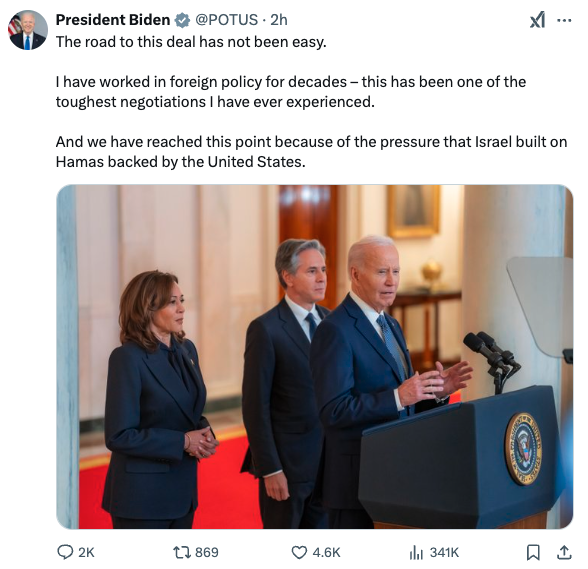
You probably weren’t even awake during the negotiations!
Carter, who died earlier this month, must’ve thanked his lucky stars for the Delaware Degenerate. I think he stuck around just to watch Biden fiddle and fumble in the Oval Office. Once Trump won in November, Carter could meet his maker with a smile, knowing he didn’t win the Presidential Horse’s Ass Trophy.
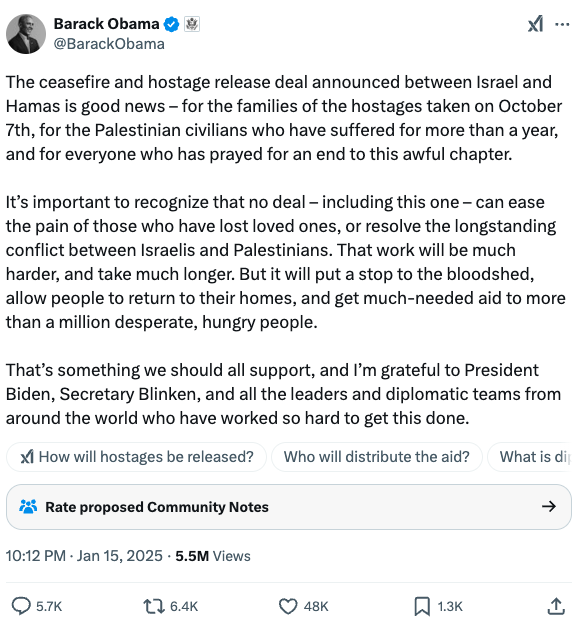
Really, Barack?
Amazingly, Carter remains in the news over 40 years after he left the presidency in Ronald Reagan’s hands. But with him allegedly voting for Kamala, finally snuffing it, and then having to watch from above the living Presidents (and current Vice President) look awkward at his Washington funeral, you’d think that’d be it.
But no, because with Trump’s team negotiating (their word, not mine) a ceasefire between Israel and Hamas, Biden was frantic to avoid looking like he had nothing to do with it, even though he had nothing to do with it.
And that’s because there’s a precedent: the 1981 release of Iran’s American hostages.
Reagan and the Iran Hostage Crisis
Quick Background
The Iran Hostage Crisis was a diplomatic standoff between the United States and Iran that lasted 444 days, from November 4, 1979, to January 20, 1981. Remember the date.
In early 1979, the Shah of Iran, Mohammad Reza Pahlavi, a close ally of the United States, was overthrown during the Iranian Revolution. The revolution brought Ayatollah Ruhollah Khomeini to power, establishing an Islamic Republic.
Iranians resented U.S. support for the Shah, who had been accused of oppressive rule and corruption. The U.S. had also orchestrated the 1953 coup that reinstated the Shah after Prime Minister Mohammad Mossadegh tried to nationalize Iran’s oil industry.
In October 1979, the U.S. allowed the Shah, who was in exile and suffering from cancer, to enter the country for medical treatment. This enraged many Iranians, who demanded his return to stand trial.
Iran finally released its American hostages on January 20, 1981, the day Ronald Reagan took office as President of the United States.
But here’s the thing: Iran freed the hostages just minutes after Ronald Reagan was sworn in as president. The timing was a deliberate kick in the goolies to outgoing President Carter.
Why Iran Screwed Carter
In April 1980, the U.S. launched a rescue attempt, Operation Eagle Claw, which was a disaster. Eight American servicemen died in an aircraft collision in the desert. This incident only heightened tensions.
The crisis humiliated the United States and deeply damaged Carter’s reputation. The President struggled to resolve it, and it became a major issue in the 1980 presidential election.
To be fair, the Algiers Accords were finalized in the last days of Carter’s presidency and established the terms of the hostages’ release. Key provisions included unfreezing Iranian assets and assurances that the U.S. wouldn’t intervene militarily in Iran’s affairs.
While the crisis dominated Carter’s final year as President and contributed to his defeat in the 1980 election, the timing of the release allowed President Reagan to begin his presidency with a vim and vigor missing during Carter’s term.
Many believe Reagan threatened Iran through back channels with military action, and that’s why the hostages were released immediately upon his taking office. Others suggest the Iranians preferred negotiating with Carter than with Reagan, as Reagan would’ve taken a tougher line.
This tactic allowed the Iranians to deal with Carter, but not give him the satisfaction of saying he was the President who ended The Crisis.
Now you can see the historical parallel and why Biden jumped in front of the cameras so quickly.
Bibi Kicks Biden In the Goolies This Time
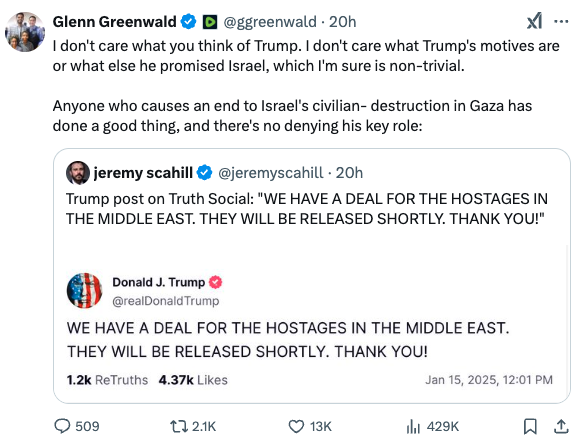
Glenn Greenwald has been on fire the past few days, first posting this upon the ceasefire:
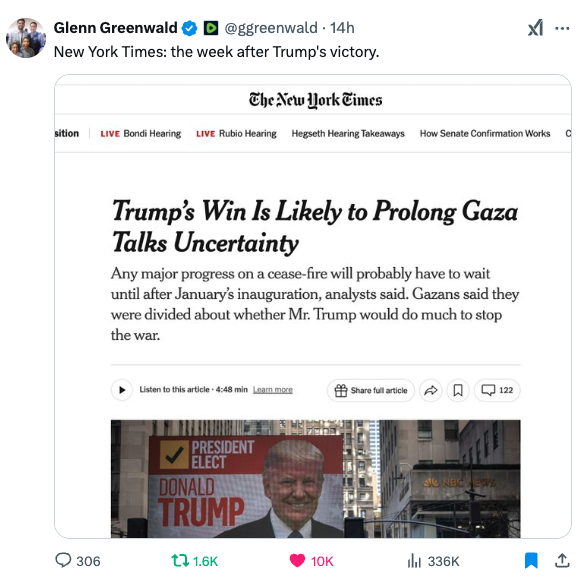
And this one, a few hours later, rubbing it in the MSM’s faces:
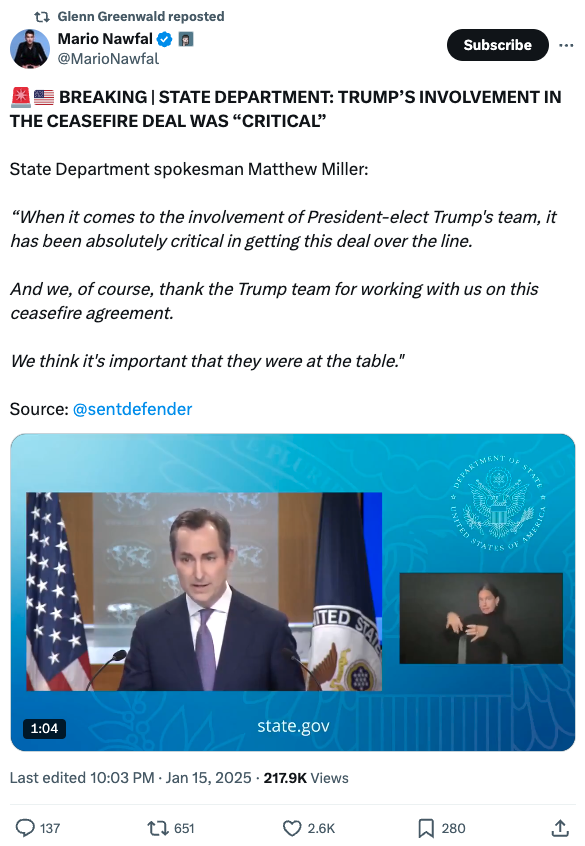
Then, he reposted Foggy Bottom’s very own Eddie Munster, saying that everybody at State knows which way the wind is blowing… Good doggies!
But the icing on the cake came from Bibi himself:
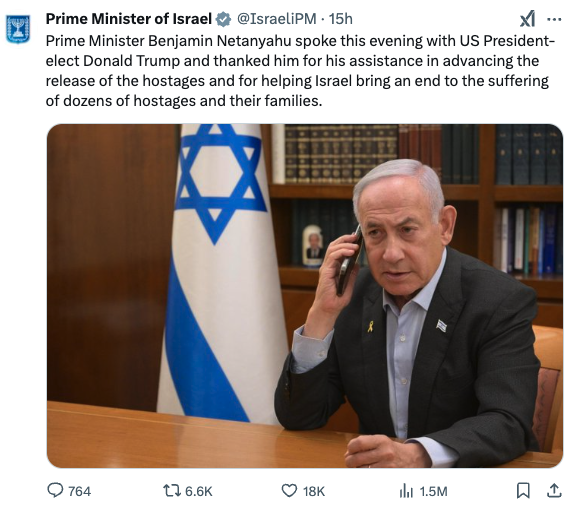
“Ouchy!” as my son would say. That must have hurt. Only days ago, Bibi turned down the invitation to Trump’s inauguration. Now he’s thanking him for getting the deal done. I’m still not sure he wanted the deal. But get one, he did.
Worse, this proves Biden and his team had almost nothing to do with this deal. Presumably, Biden didn’t cut a deal earlier because he or his team didn’t want to pressure Israel and lose Jewish-American votes in the process. If that were the strategy, it clearly backfired.
Wrap Up
I suppose we couldn’t expect Joke Biden to congratulate Trump and his team for crafting the ceasefire. He must have thought, “I’ve got to grab some of this credit for myself and my team! I can’t be like Carter!”
I can’t help but think of my old Saturday morning cartoons. To paraphrase Russell of Fat Albert’s Junkyard Gang, “Joke Biden is like a field trip from school: no class.”
Israel Delays Approving Hostage Deal, Accusing Hamas Of Reneging & Stoking 'Crisis'
An expected vote by Israel's security cabinet to approve the Gaza ceasefire deal has been delayed by several hours, followed by an accusation from the Prime Minister’s Office accusing Hamas of trying to thwart finalization of the deal at the last minute.
The hold-up could prove deeply awkward and embarrassing, given the signal from Israeli officials has been that it's all but a done deal, and on Wednesday the United States and Qatar were the first to pronounce an agreement had been reached, with Biden issuing formal congratulatory remarks.

"Hamas is reneging on the understandings and creating a last-minute crisis that is preventing an agreement," Netanyahu's office said. "The Israeli cabinet will not convene until the mediators notify Israel that Hamas has accepted all elements of the agreement."
President-elect Donald Trump has also praised the "epic" deal, describing in a Wednesday statement that it "only happened as a result of our Historic Victory in November, as it signaled to the entire World that my Administration would seek Peace and negotiate deals to ensure the safety of all Americans, and our Allies."
Israeli media says the government is still "holding off" on acceptance of the deal as of Thursday afternoon (local time). Times of Israel writes the following:
Israel was still holding off on Thursday afternoon from officially declaring that a ceasefire-hostage release deal announced a day earlier by mediators had been reached with Hamas, insisting that details remained to be finalized and that Hamas was throwing last-minute wrenches into the negotiations.
Nevertheless, most Israeli officials indicated the agreement was all but a done deal, with the focus moving to the internal political battle playing out ahead of the expected cabinet and security cabinet votes, which were delayed by at least several hours.
It could be hardline holdouts in Netanyahu's security cabinet who are attempting to gain influence in their resistance to the agreement, which they have called a bad deal.
"Other reports in Israeli media suggested instead that the delay in convening the cabinet was due to attempts to gain the support of far-right Finance Minister Bezalel Smotrich, who has threatened to quit the government along with National Security Minister Itamar Ben Gvir if the war is ended," Times of Israel continues.
The impending deal reportedly lays out an initial six week ceasefire phase which includes gradual withdrawal of Israeli forces from Central Gaza as well as the return of displaced Palestinians to North Gaza.
Of the some 100 hostages still held by Hamas, at least one-third are believed already deceased. Dozens were released upon an initial deal struck early in the conflict.
Like with the first hostage exchange, dozens of Palestinian prisoners are expected to be released under this new agreement in return for each Israeli hostage. Meanwhile some sporadic bombings and fighting and Gaza have continued into Thursday.
But will the much celebrated deal collapse just as it reaches the finish line of Netanyahu's desk?
Atara to explore strategic options after CRL
Atara received FDA Complete Response Letter (CRL) solely related to inspection findings at third-party manufacturer
CRL did not identify deficiencies related to clinical efficacy or safety data in the Biologics License Application (BLA), and the FDA did not request any new clinical studies to support approval
Atara remains committed to working with the FDA, Pierre Fabre Laboratories, and the third-party manufacturer to bring EBVALLO to patients in the U.S.
Atara has engaged a well-known financial advisor to support exploration of all strategic options
Atara remains focused on preserving future EBVALLO financial value for the benefit of all stockholders
Atara has entered into a non-binding term sheet with Redmile Group to provide up to $15 million in funding, which Atara believes is sufficient to fund the ongoing activities required to achieve BLA approval
Subscribe to:
Posts (Atom)