Search This Blog

Wednesday, March 5, 2025

Government Pays $2.5 Million to Person Injured by COVID Vaccine — But 98% of Claims Are Denied


A U.S. taxpayer-funded program to provide compensation for COVID-19 vaccine injuries recently awarded over $2.5 million for a single vaccine-related injury.

The compensation, issued by the Countermeasures Injury Compensation Program (CICP), was revealed as part of CICP’s most recent update, published this week for the period ending Feb. 1.

It is one of just 26 COVID-19 vaccine injury claims the program has approved for payment so far — out of a total of 14,234 claims filed.

The payout compensates an unnamed person for injuries associated with thrombosis with thrombocytopenia syndrome (TTS), a blood-clotting disorder that was most commonly linked to the Johnson & Johnson and AstraZeneca shots but also sometimes reported after the Pfizer and Moderna shots.

It is one of six COVID-19 vaccine injury awards made between Dec. 2, 2024, and Feb. 1, 2025, and it is the largest payout from the CICP so far.

Except for one $370,376 payment approved in August 2024 that experts say likely compensated for a death, all of the CICP payments approved to date have been under $13,000, with most averaging under $3,500.

Most payments were for myocarditis injuries.

Wayne Rohde, an expert in vaccine injury compensation, said many are asking whether this large payment is a sign that under the Trump administration, more and higher compensation will be granted to vaccine-injured people.

“No,” he said, “it doesn’t. But it does mean that there’s a lot of people who are severely injured and need proper medical care, and they’re not getting it.”

Rohde said the award also “serves as a notice to our elected officials that they need to get their act together and figure out what to do with these thousands of people that have filed petitions and are just pending.”

Rohde, who is also the author of “The Vaccine Court: The Dark Truth of America’s Vaccine Injury Compensation Program,” said that in the two months since the last CICP-approved payment had been posted, the program had only processed six awards — and it dismissed about 140.

Dr. Joel Wallskog, a Wisconsin orthopedic surgeon injured by Moderna’s COVID-19 vaccine, said these numbers demonstrate that CICP is a “dismal failure.” It is supposed to be a safety net for the vaccine injured, he said, but there is a 98% denial rate.

“The CICP budget for 2025 is $10 million dollars — $1 million for actual injuries, and $9 million for administrative costs of the program,” he said. “Can you imagine a private business that actually budgets for 90% overhead? It would be out of business.”

Wallskog, who serves on the board of React19, an advocacy group representing thousands of vaccine-injured people, added:

“In my opinion, this is evidence of our government and federal regulatory agencies abusing the COVID-19 vaccine-injured community. They will continue to do whatever necessary to dismiss us, censor us, and downplay our injuries.

“We are the COVID-19 vaccines’ dirty little secret no one wants to talk about. We at React19 know that we will not stop fighting until the injured get adequate care and fair and just compensation.”

The group has created its own fund to support vaccine-injured people neglected by the government.

‘CICP was never designed to handle a nationwide long-term pandemic’

The CICP was established under the Public Readiness and Emergency Preparedness (PREP) Act, which protects pharmaceutical companies from liability for all injuries sustained from “countermeasures,” including vaccines and other medications — administered during a public health emergency.

Unlike the National Vaccine Injury Compensation Program (VICP), which covers injuries arising from vaccines routinely administered to children and pregnant women, the CICP — in the few cases where it does make awards — pays only for unreimbursed medical expenses and up to $50,000 per year for lost wages.

“You’re not going to get reimbursed because you lost your home in foreclosure,” Rohde said. “You’re not going to get reimbursed because your spouse left you. You’re not going to get reimbursed because your child committed suicide because they couldn’t handle the pain that you’re going through — those things that destroy the family. Those are costs that we can’t even address.”

Rohde said this is in part because the program was designed as a short-term solution for natural disasters, hurricanes, wildfires and other regional issues.

“The CICP was never designed to handle a nationwide long-term pandemic or outbreak,” Rohde said. “Never.”

The program has limited funding, a one-year statute of limitations and is a purely administrative process — people cannot argue their case in court, he said. It is rife with issues that make it ill-equipped to handle injuries on the scale of those caused by the COVID-19 vaccines.

Wallskog said most people don’t even have a diagnosis within a year of injury. The program doesn’t cover legal costs, and the process isn’t transparent.

He said:

“The biggest weakness with the CICP is the burden of proof required for a claim to be approved and accepted. A temporal relationship between your shot and your adverse event cannot be used as proof of causation.

“Seventy percent of vaccine injuries occur within the first 7 days after COVID-19 vaccination. However, this can’t be used to support your claim. That is ridiculous.”

He said the program is “deliberately deficient by design,” and that all the denials, including his own, inform people that “there is not compelling, reliable, valid, medical, and scientific evidence that the COVID-19 vaccine directly caused your injury.”

When dealing with a novel virus and vaccine, those restrictions place an unreasonable burden of proof on the injured, he said. “We are in the largest clinical trial in world history. We are learning more every day about the vaccines, their ineffectiveness and their associated adverse events.”

Attorney Ray Flores, senior outside counsel for Children’s Health Defense, and expert on the PREP Act and government vaccine injury compensation programs, told The Defender that this situation is set to continue for a long time.

“Everyone thinks COVID-19 Public Health Emergency is over,” Flores said. “That is only partly true. The emergency may be over, but protections for COVID-19 vaccines and other countermeasures remain in place for almost five more years, and could possibly be extended past that.”

Flores added:

“The PREP Act is Public Enemy No. 1. It lays the groundwork for dangerous experimental substances to be injected without the manufacturer standing by anything it says or does when designing, making and marketing these products.”

https://childrenshealthdefense.org/defender/cicp-payout-covid-vaccine-injury/

Moderna anticipates 2027 release for cancer vaccine in collaboration with Merck

 Moderna Inc (BMV:MRNA). anticipates the release of a personalized cancer vaccine, currently being developed in partnership with Merck & Co (NYSE:MRK)., by 2027, according to a statement made by Moderna (NASDAQ:MRNA)’s President Stephen Hoge. He made these remarks at an investor conference on Wednesday.

The company is presently conducting a late-stage trial for a skin cancer vaccine. Hoge expressed optimism about the potential revenue from the cancer vaccine, stating that it could materialize rapidly. He also confirmed that the phase three study for the vaccine had been fully enrolled as of September 24.

Hoge further discussed the adjuvant melanoma market, which is the initial indication for the vaccine. He suggested that the market could be significantly profitable due to the considerable improvements they’ve observed over Keytruda, a checkpoint inhibitor. Hoge also mentioned plans for expansion into non-small cell lung cancer, renal cancer, and bladder cancer once the vaccine is approved and launched.

In response to an inquiry about the efficacy of the vaccine, Hoge explained that the minimum efficacy target is approximately 50%. He maintained that they are hopeful of surpassing this target, although the actual efficacy rate will only be determined after further case accrual.

Hoge also commented on the risk of pandemic influenza, such as the H5 bird flu. He emphasized the importance of having countermeasures in place due to the high rate of transmission of the H5 bird flu across different species. Moderna is currently preparing to move forward to phase 3 for a potential influenza vaccine, following satisfactory phase 1 and 2 data.

https://in.investing.com/news/stock-market-news/moderna-anticipates-2027-release-for-cancer-vaccine-in-collaboration-with-merck-93CH-4704660

Radnet upped to Strong Buy from Outperform by Raymond James

 Target to $65 from $85

https://finviz.com/quote.ashx?t=RDNT&p=d

Moderna mRNA Vaccine Tech Patents Invalidated by Tribunal

 Pfizer Inc. and BioNTech SE convinced an administrative tribunal to throw out portions of two patents Moderna Inc. asserted against the companies in litigation over their competing Covid-19 vaccines.

Pills, Profits, Ploys and the Economics of Medicare Part D

 Welcome to Medicare Part D, where your prescription drugs come with co-pays and co-insurance. If you thought co-pays and co-insurance were mundane payment terms, think again — these figures are expertly designed to shuffle more costs onto you while keeping insurers comfortably in the black.

All Medicare beneficiaries must have some form of Part D prescription drug coverage, either as a standalone product (PDP) or as part of a Medicare Advantage program (MA-PD). In Medicare Part D, co-payments are fixed amounts you pay for a specific prescription. In contrast, co-insurance is a percentage of the total cost of the service that you're responsible for after meeting your deductible.

Part D programs have drug formularies, lists of drugs they cover, typically divided into three tiers where costs are increasingly offset onto the beneficiary rather than the insurer. 

Tier 1 – preferred generics

Tier 2 – generics

Tier 3 – branded drugs

Generally, co-pays cover tier 1 drugs, and tier 3 drugs are covered by co-insurance. The more significant distinction is that co-pays are more protective against list prices; co-insurance exposes you to greater out-of-pocket costs as those list prices rise. 

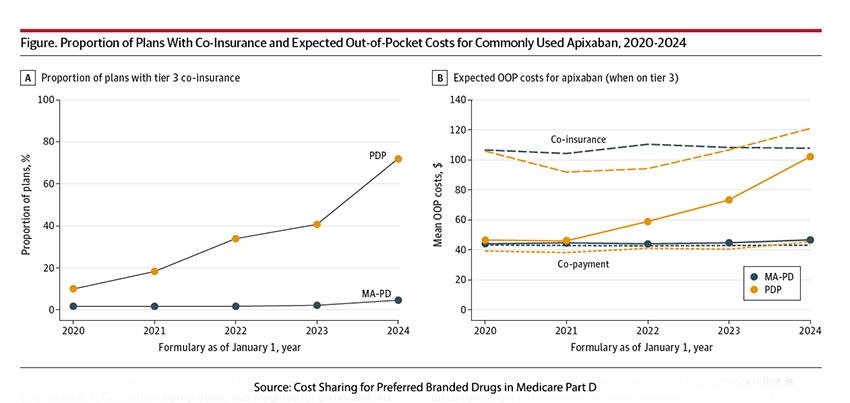
A study in JAMA Network Open looked at the cost of tier 3 branded drugs between 2020 and 2024 for standalone and Medicare Advantage drug plans. 

  • Figure A shows that roughly 5% of MA-PD programs used co-insurance over those four years, while the percentage of PDPs using co-insurance rose from approximately 10% to 72%.
  • Figure B shows the impact of that change on the most widely prescribed Tier 3 medication, Eliquis or apixaban. The out-of-pocket cost to beneficiaries in a Medicare Advantage program rose about 5% to $46.93. On the other hand, the cost to beneficiaries in standalone programs rose 118% to $102.32

They present additional data showing that these increases “were consistent across drugs.” During the time frame surveyed, the price of apixaban rose 22% while the standalone share more than doubled. Costs were shifted onto beneficiaries and more so for the standalone programs. 

Why might that be?

It could mean that PDP programs pay more than MA-PD programs pay for the same medication. However, the same insurance company offers both plans, so I think this possibility is less likely. It might mean that MA-PD programs are getting greater rebates, which they pass on to consumers, or are so adequate that MA-PD programs do not need to take more from their beneficiaries. Again, when these insurers purchase in bulk, often from themselves, this price discrimination makes little sense. 

The researchers end with a bit of MBA speech

“These findings reinforce broader evidence of differentiation between the PDP and MA-PD markets…”

For the business impaired, differentiation is meant to nudge demand. In this case, the high out-of-pocket costs to the standalones are another “stick” used to move them into MA programs where the insurer can control more of the costs and continue to keep the “golden crumbs” alluded to in the Bonfire of the Vanities. It is part of the grift. You are funding a well-oiled machine on an uneven playing field where they have all the information, and you bear the costs. 

Medicare Part D was supposed to make prescription drugs more affordable, but it's just another rigged financial maze where insurers and PBMs profit and beneficiaries pay more for the same medications. Meanwhile, the illusion of "choice" in Medicare drug coverage remains just that—an illusion. Until policymakers address the deeper incentives driving these pricing games, the only thing guaranteed in Part D is that someone is making money off you.


Source: Cost Sharing for Preferred Branded Drugs in Medicare Part D JAMA Network Open DOI: 10.1001/jama.2024.28092

Dr. Charles Dinerstein, M.D., MBA, FACS is Director of Medicine at the American Council on Science and Health. He has over 25 years of experience as a vascular surgeon.

https://www.acsh.org/news/2025/03/04/every-picture-tells-story-pills-profits-ploys-and-economics-medicare-part-d-49327

Viatris Inc.: Piper Sandler & Co price target reduced from USD 14 to USD 10.

 maintains a neutral recommendation

https://www.marketscreener.com/quote/stock/VIATRIS-INC-115117632/

New York City loses bid for swift return of $80.5 million FEMA migrants grant

 A U.S. judge on Wednesday declined to order the Trump administration to immediately return to New York City $80.5 million of grants intended to cover part of the city's cost of housing migrants.

U.S. District Judge Jennifer Rearden ruled at a hearing in Manhattan federal court.

City officials sued after the funds paid on February 4 by the Federal Emergency Management Agency, part of the Department of Homeland Security, went missing from a bank account, having been clawed back by the agency.

Kristi Noem, the homeland security secretary, said on February 12 the money represented "the full payment that FEMA deep state activists unilaterally gave to NYC migrant hotels."

But the city called the clawback a "money grab" that thwarted Congress' purpose in appropriating the money.

It urged Rearden to order the $80.5 million returned and bar Republican President Donald Trump's administration from similar further takings.

The dispute stemmed from grants FEMA gave the most populous U.S. city to defray the cost of sheltering migrants in hotels.

These grants were part of a push to reduce overcrowding at facilities near the border, as migration surged during former Democratic President Joe Biden's administration.

Trump has vowed to crack down on border crossings and step up deportations.

In a February 28 court filing, U.S. Department of Justice lawyers accused the city of letting one hotel housing migrants, the Roosevelt Hotel in Midtown Manhattan, become a "base of operations" for crime.

They said a funding pause was warranted while the administration investigated.

The Justice Department also said that because the $80.5 million reimbursed the city for costs it already incurred, no emergency justified Rearden, a Biden appointee, ordering a return of the money.

In response, the city said on March 3 that proposed legislation aimed at ending the migrant sheltering program created a risk it might never get its funds back.

It also said concerns about crime were "red herrings" because FEMA had determined it was entitled to the payment.

New York City Mayor Eric Adams said last month the Roosevelt would no longer be used as a shelter due to a drop in migrant arrivals.

https://www.streetinsider.com/Reuters/New+York+City+loses+bid+for+swift+return+of+%2480.5+million+FEMA+migrants+grant/24457422.html