Search This Blog

Sunday, March 9, 2025

White House Condemns 'Radical Islamist Terrorists' Now Attacking Syria's Alawites & Christians

 The Trump administration on Sunday issued a statement of condemnation in response to the ongoing sectarian killings in Syria under the Jolani regime, which has also included foreign fighters going door to door and killing non-Sunni Muslims and in some instances Christians in and around Latakia on the coast.

The fresh words issued by Secretary of State Marco Rubio call out the "radical Islamist terrorists" and "foreign jihadis" for the murderous rampage targeting the Christian, Druze, Alawite, and Kurdish communities.

Damaged Syrian church from earlier in the war.

As we detailed earlier, since Thursday and Friday over 1,000 civilians have been killed - though some regional correspondents say the numbers could be in the multiple thousands. Much of the atrocities are happening far away from any media cameras, though the jihadists themselves have photographed and filmed many of their brutal crimes.

Rubio's full statement published to the State Department's website reads as follows:

"The United States condemns the radical Islamist terrorists, including foreign jihadis, that murdered people in western Syria in recent days. The United States stands with Syria’s religious and ethnic minorities, including its Christian, Druze, Alawite, and Kurdish communities, and offers its condolences to the victims and their families. Syria’s interim authorities must hold the perpetrators of these massacres against Syria’s minority communities accountable.

However, the unfortunate recent history of the war in Syria is that it was Washington arming and training many of the very Sunni Islamist fanatics now doing the killing.

Mostly this was under the Obama administration, with reports that Trump ordered a shutdown of the CIA side of the US program during his first term in office.

Many of these US-backed factions were persecuting and killing Christians, as we've also long documented, but following Assad's ouster on December 8 many Syrian Christians have once again begun fleeing the country as the jihadists now have free reign over all territories previously protected by Assad forces.

The plight of Syria's Christians has suddenly come back onto the West's radar, after long being ignored. Tucker Carlson issued the below strong message this weekend:

"During the years that neocons in the west backed the war against Assad, the percentage of Christians in Syria went from ten percent to two percent," Carlson accurately pointed out.

'Now that Assad has been driven from power, many of the remaining Syrian Christians are being slaughtered and their holy places desecrated," he added.

The topic began trending enough to get Elon Musk's attention...

The jihadists have continued the killings through Sunday - in some cases burning villages, and going into the homes of non-Sunnis and massacring whole familiesThe terrorists haven't been shy about uploading their killings on the internet as well as in livestreamsMen, women, children, and even babies are being brutally murdered.

The tragic situation, and the West's role in it, has been summarized by a cleric of the Eastern Orthodox Church, which is the predominant Christian faith of Syria and the Middle East. "As you see the unfolding tragedy in Syria, keep in mind, this is your tax dollars at work. This was brought to you by the US government, the State of Israel, and Turkey. They said Assad was bad. This is what they replaced Assad with," Priest John Whiteford said on X.

https://www.zerohedge.com/geopolitical/trump-white-house-condemns-radical-islamist-terrorists-currently-attacking-syrias

India's Sun Pharma to acquire Checkpoint Therapeutics

 Will add UNLOXCYT™ (cosibelimab-ipdl), the first and only FDA-approved anti-PD-L1 treatment for

metastatic or locally advanced cutaneous squamous cell carcinoma (cSCC) to Sun Pharma's global
onco-derm franchise

Will leverage Sun Pharma's global presence to
accelerate patient access to UNLOXCYT™ (cosibelimab-ipdl)

Upfront cash payment of $4.10 per share of common stock,
representing aggregate upfront consideration of up to $355 million

Stockholders will also receive a contingent value right for
up to $0.70 per share on achievement of a milestone

Acquisition is subject to approval by Checkpoint's stockholders
and other customary closing conditions

Sun Pharmaceutical Industries Limited (Reuters: SUN.BO, Bloomberg: SUNP IN, NSE: SUNPHARMA, BSE: 524715 (together with its subsidiaries and/or associated companies, "Sun Pharma")) and Checkpoint Therapeutics, Inc. (Nasdaq: CKPT) ("Checkpoint") today announced that they have entered into an agreement by which Sun Pharma will acquire Checkpoint, an immunotherapy and targeted oncology company.

Checkpoint is a Nasdaq-listed commercial-stage company focused on developing novel treatments for patients with solid tumor cancers. Checkpoint has received approval from the U.S. Food & Drug Administration (FDA) for UNLOXCYT™ (cosibelimab-ipdl) for the treatment of adults with metastatic cutaneous squamous cell carcinoma (cSCC) or locally advanced cSCC who are not candidates for curative surgery or curative radiation.

Dilip Shanghvi, Chairman & Managing Director of Sun Pharma, said, "Combining UNLOXCYT, an FDA-approved anti-PD-L1 treatment for advanced cutaneous squamous cell carcinoma, with Sun Pharma's global presence means patients with cSCC may soon have access to an important, new treatment option. The acquisition further bolsters our innovative portfolio in onco-derm therapy."

"I am proud of the dedication and passion of our team at Checkpoint that allowed us to achieve the first and only FDA-approved anti-PD-L1 treatment for patients with advanced cSCC, and we are excited to enter this transaction with Sun Pharma as the next step to bringing UNLOXCYT to cSCC patients in need of a differentiated immunotherapy treatment option," said James Oliviero, President and Chief Executive Officer of Checkpoint. "Sun Pharma is aligned with Checkpoint's commitment to improving the lives of skin cancer patients, and I believe this transaction will maximize value for our stockholders and provide accelerated access to UNLOXCYT in the United StatesEurope and other markets worldwide."

Transaction Summary

Upon completion of the transaction, Sun Pharma will acquire all outstanding shares of Checkpoint and Checkpoint stockholders will receive, for each share of common stock they hold, an upfront cash payment of $4.10, without interest, and a non-transferable contingent value right (CVR) entitling the stockholder to receive up to an additional $0.70 in cash, without interest, if cosibelimab is approved prior to certain deadlines in the European Union pursuant to the centralized approval procedure or in GermanyFranceItalySpain or the United Kingdom, subject to the terms and conditions in the contingent value rights agreement. 

The upfront cash payment of $4.10 per share of common stock represents a premium of approximately 66.0% to Checkpoint's closing share price on March 7, 2025, the last trading day prior to today's announcement.

In connection with the transaction, Checkpoint, Sun Pharma and Fortress Biotech, Inc., Checkpoint's controlling stockholder ("Fortress"; Nasdaq: FBIO), have entered into a royalty agreement, under which following the closing of the transaction Fortress would be entitled to receive royalty payments based on future sales of cosibelimab during a specified term, in lieu of royalty rights that were granted to Fortress in connection with its founding of Checkpoint.

In connection with the evaluation of Checkpoint's strategic alternatives, the Checkpoint board of directors (the "Board") formed a special committee of independent and disinterested directors (the "Special Committee"), which led the review and negotiations for this transaction. The Special Committee, with the assistance of its independent financial and legal advisors, conducted a comprehensive review of potential strategic alternatives available to Checkpoint and ultimately determined that the compelling and certain cash consideration and meaningful upside presented by the CVRs in this transaction provides superior risk-adjusted value relative to Checkpoint's standalone prospects and other available alternatives. The Special Committee unanimously approved, and recommended that Checkpoint's Board approve, the proposed transaction. After considering this recommendation, Checkpoint's Board unanimously approved the proposed transaction. In arriving at its unanimous recommendation in favor of the transaction, the Special Committee considered several additional factors which will be outlined in public filings to be made by Checkpoint.

The transaction is expected to be completed in the second calendar quarter of 2025. The transaction is subject to customary closing conditions, including required regulatory approvals and approval by the holders of a majority of the voting power of outstanding shares of Checkpoint common stock, and by the holders of a majority of the shares of Checkpoint common stock that are not held by Fortress or by certain other affiliates of Checkpoint.

https://www.morningstar.com/news/pr-newswire/20250309cg36978/sun-pharma-to-acquire-checkpoint-therapeutics

Trud-Out: Mark Carney To Become Canada's Next PM

 Aaaaaannndd, he's gone!

Ex-Bank of Canada and Bank of England governor and king of the globalists, Mark Carney, has tonight won the race to become Canada's next prime minister, replacing globalist Justin Trudeau.

Carney, a former central banker, won the contest to lead the Liberal Party of Canada with 85.9% of the vote. 

Throughout the leadership race, Carney portrayed himself as an experienced crisis manager who led major central banks at pivotal moments - in Canada, during the global financial crisis, and in the UK, during its tumultuous exit from the European Union. 

But he is relatively untested as a politician and does not currently hold a seat in Parliament. The first crisis he will face is a trade war.. which until now he has been quiet about.

“We have made this the greatest country in the world and now our neighbors want to take us,” Carney said in a brief speech before the results were announced on Sunday. 

“No way.”

The transfer of power from Justin Trudeau to Carney is expected to take place within days.

Globalist-er and globalist-er (but at least it wasn't Christia Freeland).

As the Epoch Times notes further, the next federal election must take place by October. Opposition parties have said they intend to vote non-confidence in the minority Liberal government to trigger an election sooner. Carney said on the campaign trail that he may call an early election to get a “strong mandate.”

The House of Commons is currently suspended until March 24, after Trudeau asked the governor general to prorogue Parliament on Jan. 6, the same day he announced his plan to resign and initiate a Liberal leadership race to find his replacement.

Once Carney becomes prime minister, it will end Trudeau’s nine-plus years of heading the federal government.

Trudeau took the Liberals from third place to a majority government in 2015, and won two subsequent elections in 2019 and 2021, although his government was reduced to a minority.
He announced his resignation in January following widespread public calls from within caucus amid declining poll numbers and a weak showing for the Liberals in byelections.

Carney

Carney will become a prime minister who doesn’t currently hold a seat in the legislature, a rare occurrence. In 1984, Liberal Prime Minister John Turner also took the top job after winning the Liberal leadership race following the resignation of Pierre Trudeau, without holding a seat in the legislature at the time.

Even more unusual, Carney will be the first prime minister who has never held an elected public role in Canada’s history.

Prime Minister Justin Trudeau meets with then Bank of England governor Mark Carney at the G20 Summit in Buenos Aires, Argentina, on Nov. 30, 2018. The Canadian Press/Sean Kilpatrick

Carney served as the governor of the Bank of Canada from 2008 to 2013, after which he became the governor of the Bank of England until 2020.

He became active in the private sector after leaving his roles with central banks, serving on a number of boards and holding executive roles in financial companies. As well, he became the U.N. Special Envoy on Climate Action and Finance. Carney said he resigned from all these roles in January when he launched his leadership bid.

Carney has said he'll have a focus on the economy as prime minister, and said he plans to cut taxes for the middle class and reduce government spending.

One of Carney’s major focuses is climate change policies. He has said he‘ll remove the unpopular consumer-facing carbon tax and replace it with an incentive model, and that he’ll put the costs for emissions on major businesses.

He has also said he'll work to remove interprovincial trade barriers and respond to U.S. tariffs dollar-for-dollar, while working to diversify Canada’s export markets.

Carney, who holds British and Irish citizenship, has said he has begun the process of renouncing both citizenships.

Carney informally advised the Canadian government on the economic response during the pandemic, and was formally named as an economic advisor to the Liberal Party in September 2024.
The son of teachers, Carney was born in Fort Smith, Northwest Territories, and grew up in Edmonton. He holds a doctorate in economics from Oxford and received his bachelor’s degree from Harvard.

https://www.zerohedge.com/geopolitical/trud-out-mark-carney-become-canadas-next-pm

Lab-grown food could be sold in UK within two years

 Meat, dairy and sugar grown in a lab could be on sale in the UK for human consumption for the first time within two years from now, sooner than expected.

The Food Standards Agency (FSA) is looking at how it can speed up the approval process for lab-grown foods.

Such products are grown from cells in small chemical plants.

UK firms have led the way in the field scientifically but feel they have been held back by the current regulations.

Dog food made from meat that was grown in factory vats went on sale in the UK for the first time last month.

In 2020, Singapore became the first country to authorise the sale of cell-cultivated meat for human consumption, followed by the United States three years later and Israel last year.

However, Italy and the US states of Alabama and Florida have instituted bans.

The FSA is to develop new regulations by working with experts from high-tech food firms and academic researchers.

It says it aims to complete the full safety assessment of two lab-grown foods within the two-year process it is starting.

But critics say that having the firms involved in drawing up the new rules represents a conflict of interest.

The initiative is in response to concerns by UK firms that they are losing ground to competition overseas, where approvals processes take half the time.

Prof Robin May, the FSA's chief scientist, told BBC News that there would be no compromise on consumer safety.

"We are working very closely with the companies involved and academic groups to work together to design a regulatory structure that is good for them, but at all costs ensures the safety of these products remains as high as it possibly can," he said.

But critics such as Pat Thomas, director of the campaign group Beyond GM, are not convinced by this approach.

"The companies involved in helping the FSA to draw up these regulations are the ones most likely to benefit from deregulation and if this were any other type of food product, we would be outraged by it," she said.

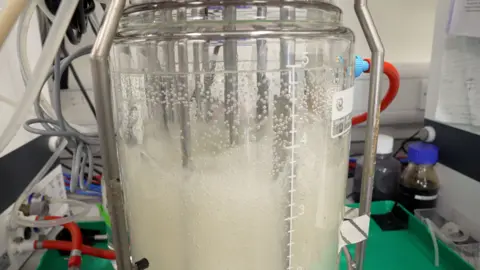
BBC News A covered jar with white-coloured liquid bubbling way. Small tubes and wires can be seen coming out of it.BBC News
The cells are grown in fermentation tanks and then processed to look like food

The science minister, Lord Vallance, took issue with the process being described as "deregulation".

"It is not deregulation, it is pro-innovation regulation," he told BBC News.

"It is an important distinction, because we are trying to get the regulation aligned with the needs of innovation and reduce some of the bureaucracy and duplication."

Lab-grown foods are grown into plant or animal tissue from tiny cells. This can sometimes involve gene editing to tweak the food's properties. The claimed benefits are that they are better for the environment and potentially healthier.

The government is keen for lab-grown food firms to thrive because it hopes they can create new jobs and economic growth.

The UK is good at the science, but the current approvals process is much slower than in other countries. Singapore, the US and Israel in particular have faster procedures.

Ivy Farm Technologies in Oxford is ready to go with lab-grown steaks, made from cells taken from Wagyu and Aberdeen Angus cows.

The firm applied for approval to sell its steaks to restaurants at the beginning of last year. Ivy Farm's CEO, Dr Harsh Amin, explained that two years was a very long time to wait.

"If we can shorten that to less than a year, while maintaining the very highest of Britain's food safety standards, that would help start-up companies like ours to thrive."

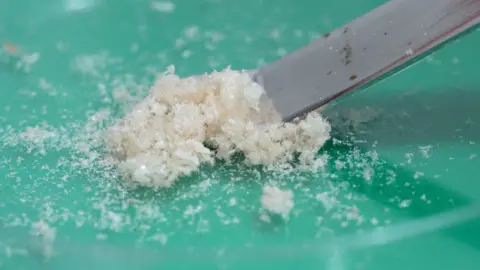
A small mound of white powdery crystals with a spatuala about to take a tiny amount.
These lab-grown crystals look like sugar and are much sweeter

Dr Alicia Graham has a similar story. Working at Imperial College's Bezos centre in west London, she has found a way to grow an alternative to sugar. It involves introducing a gene found in a berry into yeast. This process enables her to produce large amounts of the crystals that make it taste sweet.

It doesn't make you fat, she says, and so is a potential sweetener and healthy substitute in fizzy drinks.

In this case I am allowed to taste it. It was incredibly sweet and slightly sour and fruity, reminding me of lemon sherbet. But Dr Graham's firm, MadeSweetly, is not allowed to sell it until it gets approval.

"The path to getting approval is not straightforward," she tells me.

"They are all new technologies, which are not easy for the regulator to keep up with. But that means that we don't have one specific route to product approval, and that is what we would like."

The FSA says it will complete a full safety assessment of two lab-grown foods within the next two years and have the beginnings of a faster and better system for applications for approvals of new lab-grown foods.

Prof May of the FSA says the purpose of working with experts from the companies involved as well as academics is to get the science right.

"It can be quite complex, and it is critical that we understand the science to make sure the foods are safe before authorising them."

But Ms Thomas says that these high-tech foods may not be as environmentally friendly as they are made out to be as it takes energy to make them and that in some cases their health benefits are being oversold.

"Lab-grown foods are ultimately ultra-processed foods and we are in an era where we are trying to get people to eat fewer ultra-processed foods because they have health implications," he said.

"And it is worth saying that these ultra-processed foods have not been in the human diet before."

https://www.bbc.com/news/articles/c2ern1zjkvyo

'Concerning' Trend: Cosmetics Retailers Targeting Tweens and Preadolescents

 Cosmetics retailers have significantly stepped up their marketing of skin care products to tweens, teens, and even preadolescents — a trend that a pediatric dermatologist warns may not only cause harm to their skin but also could contribute to self-image and mental health issues for these young consumers.

"Two years ago, I would've said it isn't a problem, but now, just with the growing number of children participating in this phenomenon, I do think it is a problem, and one of the biggest reasons is that there's very little regulatory oversight in the health, wellness, and beauty space," Sheilagh Maguiness, MD, a pediatric dermatologist at the University of Minnesota, said at the 2025 American Academy of Dermatology annual meeting.

According to Verified Market Reports, the children's cosmetics market was valued at $1.5 billion in 2022 and is projected to reach $2.5 billion by 2030. No fewer than seven retailers sell beauty and skin care products specifically to teens, tweens, adolescents, and preadolescents, with names like Bubble Skincare and Drunk Elephant, a Sephora brand targeting tweens. Although many of these products are age-appropriate, Maguiness warned that some are not suitable for young skin.

Focusing on Fragrances

Maguiness zeroed in on the fragrances added to these products. "We all know that fragrance blends are proprietary, and retailers do not have to post or list the individual ingredients of fragrance in their products," she said. "That means there are hundreds of different chemicals in fragrances, and some of those chemicals are not things that we want to be repeatedly exposing our infants or our children to."

Fragrances contain allergens and other potentially harmful ingredients such as benzophenone, naphthalene, musk ketones, volatile organic compounds, and phthalates, Maguiness said, citing a 2022 JAMA Pediatrics study that linked phthalate exposure to a higher risk of preterm births. She noted that 90% of baby products labeled as safe for babies contain a known allergen, "mostly fragrance."

Maguiness added that the European Union bans 1300 chemicals in cosmetics, and Canada restricts or bans 573 ingredients. The United States, on the other hand, bans only 11 chemicals, including lead and asbestos

"I don't need to tell you what the impact on skin health of these ingredients is," she said. "I mean, what 10-year-old needs retinol or exfoliating acids that are very harsh? They also shouldn't be exposing themselves to allergens in fragrances or certain surfactants. In addition, physical scrubs and their ingredients can cause microtrauma to the skin barrier, leading to irritant dermatitis." 

Among the potential harms, she said, are irritant or allergic contact dermatitis, compromised skin barrier, post- and premature hyperpigmentation, and even the risk of scarring.

"All of these products are very understudied in a very low-regulatory environment, and what's really piqued my curiosity about fragrance over the years is not only the tendency for it to cause skin reaction — allergic contact dermatitis — but there are real health hazards from elevated levels of urinary phthalates." 

Role of Marketing and Social Media

Aggressive marketing on social media is only adding fuel to the trend, she said. 

"This complete lack of regulation really enables predatory marketing, where your child becomes the target and the consumer," Maguiness said. "We know these claims are misleading; the packaging is meant for tweens and teens, and the emotional impact of brand marketing to children on social media is extremely powerful."

Maguiness presented evidence that 57% of Gen Alpha tweens, born between 2010 and 2023, spend 3 or more hours a day on digital devices, and 49% of them said they trust influencers as much as family and friends, according to a report in Digital Voices. Other research showed that US households with 6- to 12-year-olds spent 27% more on skin care in 2023 than in 2022. 

"The impact on mental health is not well studied with respect to skin care obsession in general, but we know what it does in a social media–driven area where young girls especially are more vulnerable and there are more consequences: depression, anxiety, and even, sadly, suicidality," Maguiness said.

"The skin barrier in young children and tweens is not quite yet mature; it is not the same as that of an adult and, hence, it's less capable of handling the potency of ingredients meant for mature skin," Maguiness said. 

"Things that we apply to younger skin can be (a) more irritating and (b) more easily absorbed into the bloodstream," she added. Even some adults with sensitive skin cannot tolerate, for example, a 10% salicylic acid exfoliating solution on their face. "But yet, these products are so readily available for children to buy and use, and use in combination with multistep, really expensive routines. It's concerning."

Maguiness disclosed financial relationships with Pelthos Therapeutics, Regeneron Pharmaceuticals, and Stryke Club. 

https://www.medscape.com/viewarticle/concerning-trend-cosmetics-retailers-targeting-tweens-and-2025a10005qo

DeepSeek fever cools as hedge funds continue to sell China stocks

 Hedge funds sold China equities for the fourth-straight week, according to Goldman Sachs' prime brokerage desk.

Sales were driven by both shorts and longsat a ratio of 2.3 to 1.

"Macro Products and Single Stocks were both net sold and made up 77% and 23% of the total notional net selling, respectively," Goldman said. "Onshore and offshore equities were net sold on the week, led by ADRs and H-Shares."

"Post DeekSeek (DEEPSEEK), China was by far the most notionally net bought market on the Prime book YTD thru Feb 17th, around which HFs have reversed course – net flow in Chinese equities (NYSEARCA:FXI) (NASDAQ:MCHI) (NYSEARCA:KWEB) (NYSEARCA:CQQQ) (NYSEARCA:YINN) (NYSEARCA:YANG) is now roughly flat on a YTD basis."

"Gross/Net allocations to Chinese equities now stand at 5.6%/8.7% of total Prime book exposure, which ranks in the 89th/97th percentiles vs. the past year and in the 27th/51st percentiles vs. the past five years," Goldman added.

https://www.msn.com/en-us/money/topstocks/deepseek-fever-cools-as-hedge-funds-continue-to-sell-china-stocks/ar-AA1AyWBI

Zuckerberg’s Meta was willing to shut down political dissent to enter China: report

 Meta (NASDAQ:META) was willing to censor political content and shut down political dissent in a failed attempt to enter the lucrative Chinese market, The Washington Post reported Sunday, citing a whistleblower complaint by a former global policy director at the company. 

The social media giant was so "desperate" to enter China, that it was willing to let the Chinese Communist Party oversee all social media content and suppress dissenting opinions, the report said, citing the complaint by Sarah Wynn-Williams, who was part of a team handling Meta's (META) China policy. 

Meta (META) platforms including Facebook, Instagram and WhatsApp, along with other global social media players are banned in China, a country with one of the most sophisticated and extensive censorship regimes in the world. 

Facebook, along with Twitter (now known as X), and Google (GOOGL) (GOOG) were first blocked in China in 2009, after riots occurred in Xinjiang, a special autonomous region in western China.

Despite Meta (META) founder Mark Zuckerberg's several high-profile visits to the world's second-largest economy, the company has been unable to establish a foothold in the country. 

Zuckerberg in recent years has stepped up criticism of the Chinese government, warning in 2019 that the country was "exporting their vision of the internet to other countries." 

The company has reportedly funded American Edge, a nonprofit that has run campaigns criticizing China and ByteDance (BDNCE)- owned short video platform TikTok. 

Earlier this week, Joe Kaplan, Meta's (META) chief global affair officer said the company would work with the U.S. administration to "keep the U.S. at the cutting edge of AI and make sure the global AI standard is based on our shared values, not China's." 

"For many years Meta has been working hand in glove with the Chinese Communist Party, briefing them on the latest technological developments and lying about it," said Wynn-Williams to the Washington Post. "People deserve to know the truth." 

According to the report, Meta (META) developed a censorship system for China in 2015 and was willing to hire a "chief editor" who would decide what content to remove and have the power to shut down the entire site during times of social unrest. 

Zuckerberg was willing to crack down on a high-profile Chinese dissident living in the United States following pressure from a high-ranking Chinese official in order to curry favor with the country, the report said. 

Meta (META) executives repeatedly "stonewalled and provided nonresponsive or misleading information" to American investors and regulators about the company's efforts to enter China, the report said. 

"This is all pushed by an employee terminated eight years ago for poor performance. We do not operate our services in China today. It is no secret we were once interested in doing so as part of Facebook’s effort to connect the world," said a Meta (META) spokesperson.

"This was widely reported beginning a decade ago. We ultimately opted not to go through with the ideas we'd explored, which Mark Zuckerberg announced in 2019," the spokesperson added.

https://www.msn.com/en-us/news/world/zuckerberg-s-meta-was-willing-to-shut-down-political-dissent-to-enter-china-report/ar-AA1AzdBq