Search This Blog

Thursday, April 17, 2025

uniQure Breakthrough Designation to AMT-130 for Huntington’s


uniQure (NASDAQ: QURE) has received FDA Breakthrough Therapy designation for AMT-130, its gene therapy treatment for Huntington's disease, a rare inherited neurodegenerative disorder with no current disease-modifying therapies.

The designation is based on promising interim data from Phase I/II trials showing dose-dependent slowing of disease progression. The company presented 24-month data in July 2024, demonstrating meaningful disease progression slowdown based on cUHDRS scores compared to natural history.

AMT-130 has already received Regenerative Medicine Advanced Therapy (RMAT), Orphan Drug, and Fast Track designations. The treatment has been administered to 45 patients to date, with additional regulatory guidance on the Biologics License Application expected in Q2 2025.

Nurix gets FDA clearance to initiate trial for its anti-inflammatory drug candidate

 Nurix Therapeutics and Gilead secure FDA IND clearance for GS-6791, targeting IRAK4 protein in inflammatory conditions.

https://seekingalpha.com/news/4432156-nurix-gets-fda-clearance-to-initiate-trial-for-its-anti-inflammatory-drug-candidate

Sanofi in $1.8B research deal for 2 bispecific antibodies for autoimmune, immunology

 Sanofi is continuing to splash the cash for autoimmune and immunology assets this spring by penning a new deal with little-known U.S. artificial intelligence research biotech Earendil Labs in a pact that could be worth up to $1.8 billion. 

The French pharma is handing over $125 million upfront, with a near-term payment of $50 million to follow, for the exclusive worldwide rights to a pair of bispecific antibodies. HXN-1002 targets α4β7 and TL1A with the aim of treating ulcerative colitis and Crohn's disease, while HXN-1003 targets TL1A and IL23 in order to treat colitis and skin inflammation.

Should the two drugs progress through the clinic and reach the market, Sanofi will be liable to pay $1.72 billion in development and commercial milestone payments, which includes that $50 million near-term fee, alongside tiered royalties.

“We firmly believe that Sanofi's extensive expertise in the autoimmune disease field will significantly accelerate the development of HXN-1002 and HXN-1003, ultimately bringing these potentially life-changing treatments to patients worldwide as soon as possible,” Earendil Labs President & co-CEO Zhenping Zhu, M.D., Ph.D., said in an April 17 release.

Little is publicly known about Earendil Labs, which touts itself as a “global leader in AI-driven research and development of next-generation biologics therapeutics.” The biotech describes itself as affiliated with Helixon Therapeutics, a company that, like Earendil, claims to harness machine learning for protein drug design.

"Our platform leverages state-of-the-art predictive protein modeling and high-throughput biology, revolutionizing the discovery and development of bispecific antibodies,” Earendil co-CEO Jian Peng, Ph.D., said in the same release. “This collaboration underscores Earendil Labs' capability to generate potential first-in-class or best-in-class product candidates, with the aim of transforming patient care.”

Sanofi has been on a spending spree in recent weeks to bolster its autoimmune and immunology pipeline, returning to Nurix earlier this month for a $480 million autoimmune deal comprising a degrader of a once-undruggable transcription factor. In March, Sanofi penned a $1.6 billion agreement with Dren Bio for a CD20-directed antibody aimed at B-cell non-Hodgkin lymphoma.

Sanofi—which co-markets the anti-inflammatory blockbuster Dupixent with Regeneron—has been undergoing a major pipeline shake-up in an effort to become “an immunoscience powerhouse," according to an internal letter obtained by Fierce Biotech last year. 

In the pharma’s full-year earnings call in January 2025, Sanofi’s head of R&D, Houman Ashrafian, Ph.D., reiterated this point, reminding investors that the company is becoming a “premier immunology powerhouse” with the option to combine various molecules it is developing in this space.

https://www.fiercebiotech.com/biotech/sanofi-pens-18b-deal-2-bispecific-antibodies-aimed-autoimmune-immunology

Wednesday, April 16, 2025

Pharma companies expected to absorb any tariff hit in short term


U.S. tariffs on pharmaceuticals could eventually mean higher prices for brand-name medicines, but in the near term the costs would likely be absorbed by drugmakers rather than patients whose payments are often set by health insurance.

U.S. health insurers, which pay the bulk of prescription drug costs, act as a buffer between drugmakers and patients, with beneficiaries subject to co-pays and co-insurance based on the prices insurers negotiate with drugmakers.

"Patented drugs are already generally set at the price the market will bear, so in that sense manufacturers are not likely to substantially increase the prices of these drugs," said Melissa Barber, postdoctoral fellow at Yale University and an expert on drug pricing.

On Monday, the Trump administration said in a regulatory filing it had opened a national security investigation into pharmaceuticals to show why the U.S. needs tariffs to boost domestic manufacturing. Rates and timing remain uncertain, but the industry has been lobbying for phased-in tariffs.

The hit could be big. Close to $213 billion in pharmaceutical products were imported to the U.S. last year, nearly triple 2014's $73 billion, according to the United Nations trade database.

And equity research group Bernstein Societe Generale estimated that U.S. tariffs could add $46 billion in costs to the pharmaceutical industry, compared with current annual revenue of $700 billion for major companies. The threat of import duties has already spurred drugmakers to accelerate shipments to the U.S. and warehouse supplies, which analysts say will protect their 2025 financial outlooks and take the pressure off any immediate price increases.

Some tariff costs could eventually be shifted to patients and the taxpayers who fund U.S. government health programs, but the real risk is to lower-margin, generic drugs, said Robin Feldman, a professor at UC Law San Francisco. Cheaper generic drugs, which are allowed after patents expire on branded products and are mostly made in India and China, account for over 90% of U.S. prescriptions, but just 17% of spending, according to the Association for Accessible Medicines.

The trade group has said their members will not be able to raise prices because their margins are so thin. ING analyst Diederik Stadig estimated that a 25% tariff on India, for instance, would result in an increase of 17.5% for generic drugs produced in India.


Bill Coyle, head of biopharma at consulting firm ZS, said drugmakers will try to pass on tariff costs, but because many categories are very competitive, "the real downstream impact" would be cost-cutting by companies.


Eli Lilly (LLY) CEO Dave Ricks, in a recent BBC interview, said prices for the company's drugs are fixed under commercial and government agreements, "so we have to eat the cost of the tariffs." He said such higher costs would "typically" lead to cuts in staff or research and development activity.

Drugmakers, including Lilly, Novartis (NVS), and Johnson & Johnson (JNJ), are already committing to increasing their U.S. manufacturing footprints, while acknowledging that it will take years to complete new projects.

Pharmaceutical companies in recent decades moved production capacity outside of the U.S., including to European Union countries like Ireland in part because of low-income tax rates for intellectual property on blockbusters like Lilly's weight-loss injection Zepbound and Merck's cancer immunotherapy Keytruda.


At the same time, drugmakers have come to rely on the U.S. market for the bulk of their revenue. In 2022, the U.S. accounted for half of worldwide prescription drug revenue, but only 13% of volume, according to the Iqvia Institute for Human Data Science.

A RAND study of 2022 prescription prices found that U.S. health plans paid more than three times as much for brand-name pharmaceuticals as other countries, even after estimated discounts. A Reuters review found that Medicare's recently-negotiated prices for its 10 most costly drugs are still more than double, and in some cases five times, what drugmakers agreed to in other high-income countries.

Sources said tariffs could be part of a broader administration focus on narrowing the gap between U.S. drug prices and those in foreign countries.

"It's the threat of tariffs that could bring pharmaceutical manufacturers and payers to the table sooner rather than later (to) talk about price," said William Padula, professor of pharmaceutical and health economics at the University of Southern California.

https://finance.yahoo.com/news/analysis-pharma-companies-expected-absorb-100345370.html

Bessent's Grand Strategy: Use Tariff Negotiations To Isolate China From The Rest Of The World

 Yesterday, president Trump laid out the stakes in the ever-escalating trading war between the US and China, in typical laconic fashion: "We may want countries to choose between us and China(a topic discussed further here), with the White House adding that "The ball is in China’s court. China needs to make a deal with us."

This strategy, of forcing the world into "us (or US) vs them" camps first emerged last week when Trump reduced reciprocal tariffs for all countries except China, something we highlighted at the time.

A few days later, this now appears to be the official strategy in the global trade war.

As the WSJ reports, the Trump admin plans to use ongoing tariff negotiations to pressure U.S. trading partners to limit their dealings with China, according to people with knowledge of the conversations.

The idea, as we laid out in not so many words, is to extract commitments from U.S. trading partners to isolate China’s economy in exchange for reductions in trade and tariff barriers imposed by the White House. US officials plan to use negotiations with more than 70 nations to ask them to disallow China to ship goods through their countries (the so-called "transshipment" loophole), prevent Chinese firms from locating in their territories to avoid U.S. tariffs, and not absorb China’s cheap industrial goods into their economies.

Those measures are meant to put a final stake in China’s already sinking economy (which somewhat ironically got a boost in the first quarter as its export partners front-loaded purchased goods ahead of the tariff price surge which is already in place and which will put a deep freeze on China's manufacturing empire) and force Beijing to the negotiating table with less leverage ahead of potential talks between Trump and President Xi Jinping. The exact demands could vary widely by nation, given their degree of involvement with the Chinese economy.

US officials have already presented the idea in early talks with some countries according to WSJ sources, who added that Trump himself hinted at the strategy on Tuesday, telling the Spanish-language program “Fox Noticias” he would consider making countries choose between the US and China in response to a question about Panama deciding not to renew its role in the Belt and Road Initiative, China’s global infrastructure program for developing nations.

According to the WSJ, the brain behind the strategy is Treasury Secretary Scott Bessent, who has taken a leading role in the trade negotiations since Trump announced a 90-day pause on reciprocal tariffs for most nations—but not China—on April 9.

Bessent pitched the idea to Trump during an April 6 meeting at Mar-a-Lago, the president’s club in Florida, said people familiar with the discussion, saying that extracting concessions from U.S. trading partners could prevent Beijing and its companies from avoiding U.S. tariffs, export controls and other economic measures.

The tactic is part of a strategy conceived by Bessent to isolate the Chinese economy that has gained traction among Trump officials recently. Debates over the scope and severity of U.S. tariffs are ongoing, but officials largely appear to agree with Bessent’s China plan.
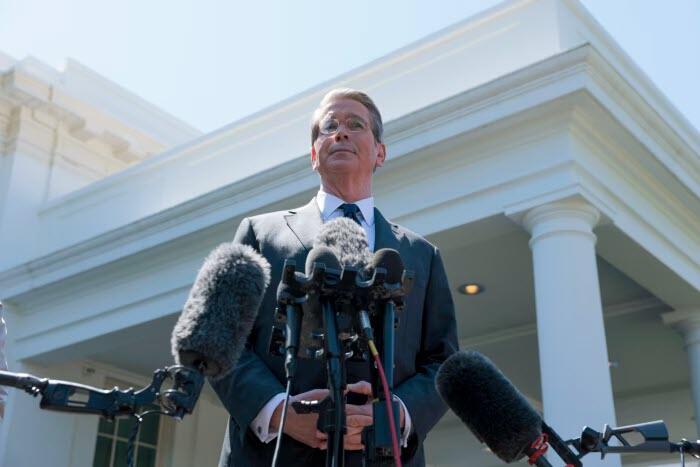
It involves cutting China off from the U.S. economy with tariffs and potentially even cutting Chinese stocks out of U.S. exchanges. Bessent didn’t rule out the administration trying to delist Chinese stocks in a recent interview with Fox Business. Still, the ultimate goal of the administration’s China policy isn’t yet clear.

Bessent has also said there is still room for talks on a potential trade deal between the U.S. and China. Such talks would have to involve Trump and Xi. White House press secretary Karoline Leavitt read a new statement from Trump during Tuesday’s press briefing suggesting a deal with China isn’t imminent.

“The ball is in China’s court,” Leavitt said when reading Trump’s statement. “China needs to make a deal with us. We don’t have to make a deal with them. China wants what we have…the American consumer.”

Indeed it does, as do all the countries that China uses for tolling and/or transshipment, so if the White House truly cracked down on all possible ports of entry to US consumers, who account for 70% of the roughly $30 trillion in US GDP, then China will have no choice but to either concede, or pursue two other approaches which we laid out before: devalue the currency or unleash a massive fiscal stimulus.

It also isn’t clear that the anti-China line has entered into negotiations with all nations. Some countries haven’t heard demands from U.S. negotiators related to China, although negotiations remain in early stages. Many expect the Trump administration to raise China-related demands sooner or later.

Bessent has shown his desire for anti-China pledges from U.S. trading partners before. In late February, he said that Mexico had offered to match U.S. tariffs on China as part of negotiations over Trump’s tariffs on Mexico imposed because of the fentanyl trade. Bessent called Mexico’s offer a “nice gesture,” but the idea didn’t find much traction with the administration.

Since then, Bessent has taken a more central role in trade negotiations, assuming a lead in talks over reciprocal tariffs after Trump announced his 90-day pause on April 9. The Treasury secretary is slated to meet with Japan’s economic revitalization minister today and has laid out a list of nations he thinks could soon reach deals with the U.S., including Japan, the U.K., Australia, South Korea and India.

Of course, China isn't waiting for the trap to close in on it, and is conducting its own trade diplomacy. This week, Xi traveled to Vietnam, a key U.S. trading partner hard-hit by Trump’s tariffs, and signed dozens of economic pledges with the Hanoi government, although at the same time Vietnam has hinted it could balance out its trade balance with the US by purchasing substantial military equipment from the US.

China views Trump’s reciprocal trade gambit as an opportunity, Peter Harrell, the former senior director for international economics on former President Joe Biden’s National Security Council, said on a panel discussion Tuesday at Georgetown Law.

But China’s ability to counteract U.S. trade policies is limited, Harrell said. While the U.S. remains a “massive net importer,” China is reducing its imports from the rest of the world and focusing on self-sufficiency. The problem, as Michael Pettis has laid out, is that China is years if not decades behind having a vibrant consumer class of its own. Which only leaves mercantilism for now.

And that's why Beijing is scrambling to inflict as much financial damage on the US as possible - up to and including dumping US Treasuries in hopes of sending the dollar tumbling and prompting narratives about "the end of the US dollar reserve status" while maintaining the impression that all is well domestically as discussed here.

China “isn’t going to replace the U.S. as a source of demand for the products that a bunch of these developing countries…make,” Harrell said. “So the economics of this are going to prove challenging for China, but I think we see them playing the politics of this reasonably savvily.”

https://www.zerohedge.com/markets/bessents-grand-strategy-use-tariff-negotiations-isolate-china-rest-world

Trump Signs Order Barring Illegal Immigrants From Receiving Social Security

 by T.J. Muscaro via The Epoch Times (emphasis ours),

President Donald Trump signed a memorandum on April 15 directing several federal agencies to take measures to prevent Social Security payments from going to ineligible people such as illegal immigrants and fraudsters.

A woman walks past a Social Security Administration office in Flushing, New York City, on Feb. 10, 2021. Chung I Ho/The Epoch Times

The memorandum was directed at the Social Security Administration inspector general, the Social Security commissioner, the attorney general, and the secretaries of labor, health and human services, and homeland security.

Meanwhile, the commissioner is directed to cooperate with the attorney general to expand the SSA’s full-time fraud prosecutor program specifically targeting identity theft and beneficiary-side fraud to at least 50 U.S. Attorney Offices by Oct. 1.

The memo also “establishes a Medicare and Medicaid fraud prosecution program in 15 U.S. Attorney offices,” White House press secretary Karoline Leavitt said during a press briefing.

Department heads are ordered to prioritize the placement of prosecutors in both programs to the offices whose jurisdiction has been determined by Homeland Security to cover the top 10 largest known populations of illegal immigrants.

The memo also directs the inspector general of the Social Security Administration (SSA) to investigate earnings reports for individuals over the age of 100. Earlier this year the Department of Government Efficiency reported that hundreds of eligible Social Security recipients were found to be well over a century old.

The inspector general is also required to investigate instances of mismatched Social Security records to combat identity theft.

The SSA will be asked to consider resuming the implementation of civil monetary penalties on individuals found to have engaged in Social Security fraud.

“These taxpayer-funded benefits should be only for eligible taxpayers, and President Biden should think about what he did in his last term, which is allow tens of millions of illegal people into our country, many of whom were fraudulently receiving these benefits,” Leavitt said.

This latest executive action was made shortly after the White House announced that more than 6,300 illegal immigrants had been stripped of Social Security and other federal benefits. Those individuals had been paroled into the United States by the Biden administration during or after 2023 and were flagged as a national security risk, holding a criminal record, or listed in the FBI’s terrorist screening database. Their parole, which shielded them from deportation, ended on April 8.

Those individuals’ Social Security numbers were reclassified by the SSA into an Ineligible Master File to further ensure they can never access federal aid again.

The SSA also announced on April 15, before Trump’s signing of the memorandum, that it launched new identification technology. Specifically, it targets suspicious activity in telephone claims and bank changes by analyzing anomalies and patterns within a person’s account and requiring in-person identity proofing at a Social Security office if irregularities are detected.

The changing of bank information over the phone accounted for approximately 40 percent of direct deposit fraud, according to the SSA, with the Inspector General’s Office estimating that $33.5 million in benefits for nearly 21,000 beneficiaries was misdirected between January 2013 and May 2018.

The SSA has implemented the Department of the Treasury’s Bureau of the Fiscal Service’s Account Verification Service (AVS) to secure instant verification, but these two entities are not the only ones collaborating.

Work to oust illegal immigration by tracking the flow of money has also begun between the Department of Homeland Security (DHS) and the IRS, using the sharing of taxpayer data to target possibly dangerous illegal immigrants.

Information sharing across agencies is essential to identify who is in our country, including violent criminals, determine what public safety and terror threats may exist so we can neutralize them, scrub these individuals from voter rolls, as well as identify what public benefits these aliens are using at the American taxpayer expense,” a DHS spokesperson told The Epoch Times.

Anne Johnson, Chase Smith, and Jack Phillips contributed to this report. 

https://www.zerohedge.com/political/trump-signs-order-barring-illegal-immigrants-receiving-social-security

EPA Chief Sounds Alarm On Rogue Climate Group Launching SO2 Balloons To Geo-Engineer Earth

 Rogue climate activists in Northern California are launching balloons filled with sulfur dioxide into the upper atmosphere in an effort to manipulate the Earth's temperature. In exchange, the climate startup behind the operation sells "cooling credits" priced at $30 for a subscription or $5 to offset 1 ton of carbon dioxide. The startup's unregulated operations are causing a major stir and have drawn the attention of EPA Administrator Lee Zeldin. 

"Make Sunsets is a startup that is geoengineering by injecting sulfur dioxide into the sky and then selling "cooling credits." This company is polluting the air we breathe. I've instructed my team that we need to quickly get to the bottom of this and take immediate action," Zeldin wrote on X. 

Luke Iseman, the former director of hardware at Y Combinator, launched Make Sunsets a few years ago with the backing of Boost VC, Draper Associates, Pioneer Fund, and angel investors. 

Make Sunsets takes its name from the striking sunsets caused by high-altitude sulfur dioxide particles, like those observed after the 1991 eruption of Mount Pinatubo, which temporarily lowered global temperatures by roughly .2°C for about a year.

Allowing rogue activists to play God with the climate is a disaster waiting to happen. These aerosols increase Earth's albedo (reflectivity), causing temporary global cooling and potentially disrupting jet stream behavior. 

View NOAA form here. 

Here's more from the EPA:

U.S. Environmental Protection Agency's (EPA) Office of Air and Radiation (OAR) submitted a demand for information to a startup company calling themselves "Make Sunsets," which is launching balloons filled with sulfur dioxide (SO2) seeking to geoengineer the planet and generate "cooling" credits to sell. This issue was initially identified in 2023 during the last Administration, but no action was taken to find out more about this questionable startup and activity.

Make Sunsets is already banned in Mexico. Their website states they want to scale this activity significantly and have already conducted over 124 deployments. It is unclear where the balloons are launched and where the SO2 is from. Furthermore, it is not known if the company has been in contact with any state, local or federal air agencies. Thus, EPA is submitting a demand for information to get answers and plans to take additional actions as necessary.

A review of public records shows that Luke Iseman and Andrew Song manage operations at Make Sunsets. The entity is also listed as the founder of Insituform Technologies, Inc.

An address listed on Make Sunsets' publicly available profile shows a mansion in Northern California.

Iseman's X page is full of Make Sunsets' latest operations:

He even boasted about his donation to a far-left climate organization called "Just Stop Oil."

Just Stop Oil has been a rogue group targeting Tesla with repeated attacks.

Perhaps unregulated solar geoengineering in the hands of leftist climate activists isn't such a great idea.

We're confident the rabbit hole of this group's associations goes much deeper—and even a quick look at the founders' social media profiles suggests they're idelogically aligned with the de-growth climate cult that has undermined Western economies while giving China a clear runaway with its coal-powered factories. 

https://www.zerohedge.com/weather/epa-chief-sounds-alarm-rogue-climate-group-launching-sulfur-dioxide-balloons-gzoengineer