Search This Blog

Thursday, April 17, 2025

The Remarkable Rags-to-Riches Story of Stacey Abrams

 by Paul Sperry

By her own admission, Stacey Abrams has made a number of "personal financial missteps” in her career. Despite a history marked by bill collectors, tax liens, and ethics investigations, the Georgia politician and Democratic Party activist has managed to amass a small fortune – while working most of her career in the not-for-profit sector. 

Financial records show that when she first entered statewide politics in 2018, she reported a net worth of less than $109,000. By 2022, the last year she had to publicly file a financial report, it had grown to more than $3.2 million. Abrams is probably even better off than that, thanks to her latest venture: Rewiring America, which uses federal funds to provide low-income people with free electric appliances. 

The green-energy startup hired Abrams as senior counsel in 2023 after she helped secure federal funding for the nonprofit by putting together an umbrella group that applied for and won grants totaling $1.9 billion from the Biden Environmental Protection Agency, according to a podcast interview she gave last year. Those funds were frozen last month by the Trump administration while it investigates the grant application and award process along with Congress. 

It’s just the latest in a string of investigations involving Abrams, who has presidential ambitions, and nonprofits she’s launched. Last month, Georgia lawmakers announced a special probe into her New Georgia Project and its fundraising arm, which failed to report millions of dollars in contributions and spending tied to Abrams’ first gubernatorial bid. She's also been accused by ethics watchdogs of personally misusing political donations raised for her campaigns. 

SaportaReport
William Perry, Georgia ethics watchdog: “I’ve always been concerned about her leveraging public service to enrich herself."

“I’ve always been concerned about her leveraging public service to enrich herself,” William Perry, who formerly led the Georgia chapter of liberal Common Cause, told RealClearInvestigations. Perry, who developed a thick file on Abrams while investigating money in Georgia politics for 15 years, said he knows of no other candidate for statewide office with more documented cases of ethics violations than Abrams. 

Although Abrams’ career has been pockmarked by financial problems and ethics investigations, she has never been charged with a crime. Instead, her career illustrates the often cozy and remunerative relationship between political insiders and government entities that discharge public dollars. In previous articles, RCI has reported on the connection between those close to the Democratic Party and Biden administration green energy grants.  

Money woes have followed Abrams – an academic star who was raised in a middle-class home by parents who became ministers – since graduating from Yale Law School in 1999, even though she started out making $95,000 a year, not including a large signing bonus, with a top corporate law firm in Atlanta. 

After running up several credit cards and failing to pay her taxes, Abrams, who has never married and has no children, racked up almost $230,000 in debt, financial records reveal. She has spent much of her adult life fending off bill collectors while repairing her bad credit. Despite working as a tax attorney before launching her decades-long career in government, she has seen the IRS file at least two liens on her property to recover back taxes and penalties.  

The 'Allure of Available Cash'

Abrams did not respond to requests for comment, but she has acknowledged a history of debt and tax problems. In her 2018 memoir, “Lead from the Outside,” she lamented: “I’d love to say that I learned my lesson after law school, and that I maintained my personal finances in pristine order. But, alas, I discovered a second way to stumble … The allure of available cash, money I should have remitted to the Internal Revenue Service, proved irresistible. … [W]hen the time came to pay my taxes, I fell behind.” 

She wrote that it would take her “a long time” to get out of debt and start building wealth. “Over the years, my income has gone up and down,” Abrams wrote, “but I still have precious little in the way of wealth beyond my slowly appreciating house and bare-bones retirement account.” 

Zillow
Abrams is a multimillionaire with a 4,100-square-foot Atlanta home in a desirable neighborhood near Emory University (with wine cellar and pool with pool house). It's valued at more than $1.4 million.

But in the seven years since then, Abrams has seen a miraculous turnaround in her finances – going from someone with “precious little” to a multimillionaire. And it all happened after she ran unsuccessfully for governor of Georgia, first in 2018 and then again in 2022, during which she raised a combined $81 million. It’s unusual. Most politicians build wealth after reaching high office, but Abrams did so after losses vaulted her to celebrity status, achieved in part by blaming racially discriminatory voter suppression for her loss.
Amazon
Abrams has been accused of tapping public resources to drum up sales for her books.

Tax filings and personal financial disclosures reveal some of her newfound wealth has come from nonprofit organizations she's started, including more than $750,000 through the Southern Economic Advancement Project and at least $427,500 from two New Georgia Project-tied nonprofits, where she worked part-time. 

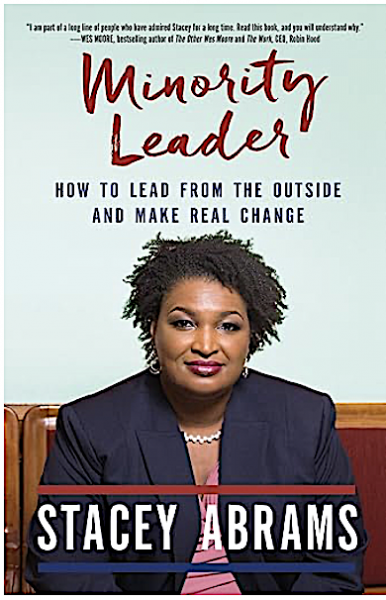
But that doesn’t account for all of it. Income from several book deals – several works of nonfiction and eight “romantic suspense novels” – also contributed to her wealth. The total value of those contracts is not public, but according to her 2022 disclosure, she owed her publishers advances totaling $800,000 against future royalties. Abrams has been accused of tapping public resources to drum up sales for her books. In 2018, Perry’s government watchdog group filed a complaint alleging she used her campaign staff and travel budget to promote her memoir “Minority Leader,” whose publisher gave her a $150,000 advance, according to a personal financial disclosure she filed in her bid for Georgia governor. 

“It is illegal for the candidate to utilize campaign contributions and resources to promote and sell the candidate’s book,” wrote Perry, who now heads Georgia Ethics Watchdogs, in a complaint filed with the state’s campaign finance commission. “And this is precisely what Abrams has done." 

The watchdog, who says he originally supported Abrams as a Democrat, added that at least one Abrams campaign staffer “reported travel expenses that matched her book tour." The state ethics commission declined sanctions. 

Perry said Abrams has had "more ethical challenges than any other statewide candidate" for office, including conflicts of interest from lucrative state contracts she helped land for a consulting firm she co-founded while she was working on related policies with Georgia’s governor as a state lawmaker. “Stacey Abrams was once a public official I liked a lot,” he said, “but she’s become unethical." 

The 51-year-old Abrams began her career in government working for the city of Atlanta as an attorney before serving 11 years in the Georgia State Assembly. 

At the same time she worked for the state, she started a consulting firm, Sage Works LLC, “providing advice to governmental and nonprofit clients on operations,” according to her disclosures. Records show she was paid $62,000 in taxpayer money as a consultant on an Atlanta urban redevelopment project in 2006 and 2007, which raised ethical red flags.

Many 'Mistakes' in Finances

“When I left the city of Atlanta to run for office, I had to figure out a way to afford my house and I started a consulting firm,” she explained in an interview at the time. “They [city officials] hired me and I negotiated a pretty good price for myself and built a reputation as someone who understood the intersection of public and private enterprise when it comes to particularly public-private development.” 

While in the assembly, Abrams also supplemented her state salary with more than $150,000 in per diem payments. Such payments are routine. But in 2011, she claimed more out-of-session expenses than any other Georgia House member, Perry pointed out. That same year, she claimed per-diem pay plus mileage for working in Georgia on the same day that a lobbyist reported buying her a cab ride out of state in Miami. When confronted with the discrepancy, Abrams said she made a mistake and reimbursed the state. 

Abrams made so many “mistakes" on her annual state financial disclosures she had to file no fewer than 18 amendments after watchdogs and local media caught major errors and omissions. “Abrams' reports have to be repeatedly amended,” Perry said. "She apparently forgets about hundreds of thousands of dollars she's earned from companies she owns or serves as a partner, or board of directors she has served on.” 

She also made “mistakes” in her campaign reports. Perry questioned more than $84,000 she reimbursed herself from her legislative campaign accounts between 2006 and 2017 without providing details or any itemization of what the money was spent on. “This means she could have pocketed the money, which of course would be illegal,” he said. 

After he filed an ethics complaint, Abrams promised to disclose where the money went but never did. 

When Abrams first ran for governor in 2018, she loaned her campaign $50,000 even though records showed she owed the IRS $54,052. She claimed financial hardship for deferring tax payments while working to support her parents, for whom she had bought a new Honda and later a new house in Stone Mountain for $370,000. 

“You can’t pay your taxes, but you have the money to run for governor?” Perry said. “She of course paid herself back [for the campaign loan]and did so while on a payment plan for back taxes with the IRS.” 

newgeorgiaproject.org
The Abrams-founded New Georgia Project and its "action fund" failed to disclose $4.2 million in contributions and $3.2 million in spending  on behalf of Abrams’ failed 2018 bid for governor, a state probe found.

In April 2018, Abrams used campaign resources to promote her book, “Minority Leader: How to Lead from the Outside and Make Real Change,” which was released one month before the gubernatorial primary election. She enlisted several paid campaign officials to post a link to the book-purchasing website on Twitter. Her communications director even encouraged her followers to “pre-order your copy today.” Her staff also promoted her book tour in tweets. Abrams herself pushed sales on her official campaign page on Facebook. 

Using campaign contributions to promote the sale of a book for the personal profit of a candidate does not qualify as “ordinary or necessary expenses” allowed by state law. 

After Georgia Ethics Watchdogs filed a 13-page complaint with the state ethics commission, Abrams said her campaign did nothing wrong. However, all campaign web pages supporting the sale of the book were suddenly removed, and all the book promotions posted on social media by her campaign staff were deleted. 

Raising more ethics alarms, Abrams appears to have used charitable donations to her nonprofits to fund her political campaigns. A year before she launched her 2018 bid for governor, Abrams founded a fundraising arm for her voter registration nonprofit, New Georgia Project. The state ethics board found that the project and its "action fund" failed to disclose $4.2 million in contributions and $3.2 million in spending during the 2018 election cycle on behalf of Abrams' failed bid for governor. Earlier this year, the organizations agreed to pay a $300,000 fine for the violations, prompting dozens of layoffs. 

The nonprofits “primary purpose was political activity,” and therefore “violated numerous state laws relating to their political activity,” the Washington-based Foundation for Accountability and Civic Trust said in a recent letter to the IRS calling for their tax-exempt status to be revoked.

Registered as 501(c)(3) and 501(c)(4) nonprofits with the IRS, the groups are prohibited from engaging in campaign activity. A special committee of the Georgia Senate is investigating whether “dark money” was funneled through Abrams’ nonprofits to her campaign. Meanwhile, the House Ways and Means Committee has asked the IRS to revoke the tax-exempt status of the groups. Abrams no longer lists the New Georgia Project on her personal website. 

American Pride Rises

Abrams is also the founder of a host of other liberal nonprofits, including: Fair Fight Action, Fair Count, the Southern Economic Advancement Project , and American Pride Rises APR Network, a national organization dedicated to defending and expanding DEI. Collectively, the nonprofits have raised more than $100 million in charitable donations. As 501(c)(3) nonprofits, they are not required to reveal their donors. But in her books, Abrams has thanked wealthy liberal philanthropists Steve Phillips and Susan Sandler, as well as "the Soros family.” U.S. agencies also fund her organizations through federal grants. 

Abrams resigned from Fair Fight Action’s board before she announced her second run for governor in 2022, but the nonprofit nonetheless acted on her behalf during the election. Campaign disclosures reveal an in-kind donation – valued at $542,000 worth of Fair Fight employees’ time – plus a $1.5 million direct donation from Fair Fight to Abrams’ leadership PAC. 

LinkedIn
Sister's salary: $182,000/year.

Abrams also appoints members of her family and close friends to lucrative positions at her nonprofits, as well as through campaign consulting jobs. Her sister Jeanine Abrams, for one, has earned $182,000 a year in total compensation as president of her Fair Count nonprofit, which Stacey Abrams founded to make sure communities of color aren’t undercounted in the census, according to its latest IRS filing. And Abrams’ “dearest friend” and longtime partner Lauren Groh-Wargo has netted $330,000 a year as the CEO of Fair Fight Action, even though the nonprofit is $2.5 million in debt and has had to lay off about 75% of its staff. 

As an entrepreneur, Abrams has built wealth by founding or co-founding a number of private businesses that have also relied on government contracts. 

She co-founded the financial services firm NOWaccount Corp in 2010 to take advantage of an Obama-era federal jobs program. “I read the [Small Business] Jobs Act,” Abrams said, and took it back to her partner and said, “Here’s what we can do.” Abrams, in turn, worked with the Obama administration to help her utilize a state lending program the act initiated for minority businesses. 

The Home Front/YouTube
Lauren Groh-Wargo, Fair Fight Action CEO and Abrams' "dearest friend": $330,000 a year.

Through 2017, NOWaccount took in several million dollars from government programs run by Fulton County and the state of Georgia, funds that were backed by the federal government. Abrams landed the contracts while working for the state and the governor on related business. 

Though she said she "walled myself off" from government decisions tied to the contracts, minutes from a 2014 Fulton County meeting involving her business tell a different story. They state that she not only personally attended the meeting, but “Representative Stacey Abrams appeared in connection with the request for a letter of inducement for the issuance of $20,000,000 in taxable bonds” to backstop NOWaccount’s transactions and accelerate payments to her clients. Taxpayer guarantees gave her NOWaccount a substantial boost. 

Abrams was paid at least $660,000 in salary from NOWaccount, even as her company ran into trouble with the Georgia Department of Community Affairs. The agency complained her outfit recommended loan applications for approval of clients with inflated credit scores and who otherwise would not have been eligible to receive lines of credit from the state program. All told, taxpayers had to cover more than $1.3 million in defaults connected to her company. 

Another watchdog group, Government Accountability Institute, suspects Abrams actually pocketed millions from the dealeveas taxpayers bailed out her clients, according to a 202study.

Nonetheless, Abrams used the episode as a case study in successful entrepreneurship to help sell her 2022 book, “Level Up: Rise Above the Hidden Forces Holding Your Business Back.” 

Government contracts also provided the revenue stream for another firm started by Abrams – Insomnia Consulting, which specializes in writing up reports for the development of government transportation, energy, and water projects. One of her biggest clients was an Eskimo tribe project in Alaska. 

climateone.org
Ari Matusiak, Rewiring America CEO: He credits Abrams with helping secure a Biden administration mega-grant.

Abrams’ latest government-tied venture is perhaps her most controversial – and could be her most lucrative. 

Since March 2023, she’s been working as senior counsel for Rewiring America, a Washington-based green-energy group that’s backed by a $2 billion EPA grant as part of former President Biden’s climate agenda to “decarbonize” the country. 

The goal is to replace all gas appliances in households by encouraging homeowners to take advantage of green tax credits, rebates, and other inducements made available through Biden’s Inflation Reduction Act of 2022, which included $27 billion for a Biden initiative called the Greenhouse Gas Reduction Fund. 

As part of her contract with Rewiring America, Abrams has traveled to communities of color like DeSoto, Ga., to help give away “free” heat pumps, heat pump water heaters, and induction stoves to residents. 

She also helped “build” an online “calculator” people have used to find out what incentives and rebates they qualify for to electrify their homes. She says she’s educating minorities “on the losing end of environmental justice” that they have access to thousands of dollars waiting for them in an "electric bank account.” 

As she did with the Obama jobs bill, Abrams studied the Biden legislation and saw opportunity. Although Abrams and legacy media outlets, including the Washington Post and Politifact, have downplayed her role, she was a key player in putting together the coalition, Power Forward Communities, that applied for the $2 billion grant made available through Biden’s act. Rewiring America is part of that coalition. 

“[T]he other thing that we did, that Stacey and I have been working on over the last year and change, is that we put together a coalition to apply for something called the Greenhouse Gas Reduction Fund, and we were selected for two billion dollars to really create a way forward for low- and moderate-income households in communities so that every kitchen table is able to participate,” Rewiring America CEO Ari Matusiak said last July while sitting next to Abrams for a Bloomberg Green Festival podcast interview in Seattle. 

The Rewiring America website lists Matusiak, who formerly worked for Obama in the White House, as the “founder and co-chair of Power Forward Communities, a national coalition awarded $2 billion from the Greenhouse Gas Reduction Fund to decarbonize and reinvest in American households.” 

During the podcast, Abrams said that “even though the Inflation Reduction Act passed in [2022], it has taken time to deploy that much money. Those dollars are coming online.” 

After running for statewide office and helping Biden win Georgia in 2020, Abrams almost overnight has become a multimillionaire with a 4,100-square-foot home near Emory University valued at more than $1.4 million and more than $727,000 in stocks and bonds. 

To hear Abrams, it all came from “leveraging” the private sector in the years after she left the Georgia statehouse. But the record shows she never really disconnected from the public sector and has been mixing her private business with the public interest her entire career. 

https://www.realclearinvestigations.com/articles/2025/04/16/the_remarkable_rags-to-riches_story_of_stacey_abrams_1103954.html

Harvard, Meet Bob Jones

 by John Hinderaker

When I first saw President Trump’s suggestion that Harvard might lose its tax-exempt status, in addition to federal funding, I considered it mere Trumpian bombast. But Randy Barnett’s comment puts it in a different light:


It had been a long time since I had thought about the Bob Jones case, decided in 1983, so I looked it up. You can read the Supreme Court’s decision here. Bob Jones was a 501(c)(3) charitable organization, and it had a policy that prohibited interracial dating or marriage. Because of that policy, the IRS revoked Bob Jones’s tax-exempt status. The case reached the Supreme Court, which upheld the IRS’s action on an 8-1 vote. The Court’s holding was unambiguous:

The IRS’s 1970 interpretation of § 501(c)(3) was correct. It would be wholly incompatible with the concepts underlying tax exemption to grant tax-exempt status to racially discriminatory private educational entities. Whatever may be the rationale for such private schools’ policies, racial discrimination in education is contrary to public policy. Racially discriminatory educational institutions cannot be viewed as conferring a public benefit within the above “charitable” concept or within the congressional intent underlying § 501(c)(3).

Emphasis added. I am sure Harvard never imagined that it would fall under the same condemnation that befell Bob Jones University. But why shouldn’t it? Hasn’t the Supreme Court already found, in Students For Fair Admissions, Inc. v. President and Fellows of Harvard College, that Harvard engages in illegal race discrimination? Yes. That is the holding in the case:

The universities’ main response to these criticisms is, essentially, “trust us.” None of the questions recited above need answering, they say, because universities are “owed deference” when using race to benefit some applicants but not others. Brief for University Respondents in No. 21–707, at 39. It is true that our cases have recognized a “tradition of giving a degree of deference to a university’s academic decisions.” Grutter, 539 U. S., at 328. But we have been unmistakably clear that any deference must exist “within constitutionally prescribed limits,” ibid., and that “deference does not imply abandonment or abdication of judicial review,” Miller–El v. Cockrell, 537 U. S. 322, 340 (2003). Universities may define their missions as they see fit. The Constitution defines ours. Courts may not license separating students on the basis of race without an exceedingly persuasive justification that is measurable and concrete enough to permit judicial review. As this Court has repeatedly reaffirmed, “[r]acial classifications are simply too pernicious to permit any but the most exact connection between justification and classification.” Gratz v. Bollinger, 539 U. S. 244, 270 (2003). The programs at issue here do not satisfy that standard.

Emphasis added. I doubt that the people who run Harvard have internalized the fact that they lost the Students for Fair Admissions case because they engaged in illegal race discrimination. I am sure they feel as virtuous as they always have. I don’t know whether they have modified their admissions procedures to conform to the SFFA ruling, or not. My guess is that they are lying low, hoping for future Democratic administrations that will shift the balance on the Supreme Court and, once again, approve of race discrimination.

But in the meantime, how is Harvard different from Bob Jones University? They are different in one important respect: Bob Jones’s policy may have been benighted, but it was based on its founders’ understanding of scripture, and the university stood behind it. Harvard, a slipperier institution, will never admit what the Supreme Court has ruled: that its practices are racially discriminatory.

The key question, I think, is whether Harvard has complied with the Supreme Court’s ruling in the SFFA case, or whether it continues to engage in illegal discrimination. If the former, it wouldn’t be appropriate for the IRS to revoke its 501(c)(3) status. But if Harvard is a scofflaw, if it has continued to discriminate in defiance of the Court’s order, then its case is indistinguishable from that of Bob Jones U. In that case, President Trump’s suggestion is well-founded, and its tax-exempt status could be, and should be, revoked by the IRS.

And, finally, of course, Harvard is one of many. There aren’t actually a great number of institutions of higher education that are selective, but of those, a large majority have engaged in race discrimination for many years. Trump’s warning should apply not just to Harvard, but to all of them.

https://www.powerlineblog.com/archives/2025/04/harvard-meet-bob-jones.php

Climate zealots are always wrong — but never own up to their nonsense

 I guess United Nations Secretary-General Antonio Guterres didn’t think his hyping global warming risks brought him enough attention, so now he says, “The era of global boiling has arrived!”

Global boiling? Give me a break.

Yes, the climate is warming.

We can deal with that.

What annoys me is politicians, activists and media pushing hysterical myths.

Myth 1: The Arctic will soon be ice-free.

It “could already be ice-free by the summer of 2030!” shrieks a DW News report.            

“‘Doomsday Glacier’ is melting faster than scientists thought,” adds the BBC. “Earth’s biggest cities are at risk!”

Nonsense.

“It’s not happening at nearly the catastrophic pace that they claim,” says Heartland Institute fellow Linnea Lueken.

But the media show dramatic images of melting and missing ice.

“No ice! There’s all these walruses laying out on a stony beach . . . It’s because it’s the summertime! In the winter, it all comes right back!”

As far as ice disappearing in winter, too, “Compared to the amount of ice that’s in the Arctic,” says Lueken, it “is like a grain of sand . . . so minuscule compared to the amount of ice that’s there, it doesn’t even show up on a trend chart when you plot it.”

But zealots push hysteria.

In 2009, Al Gore, while collecting a Nobel Prize, said there was “a 75% chance that the entire north polar ice cap . . . during some of the summer months, could be completely ice-free within five to seven years!”

In just five to seven years! Oh, no!

Wait . . . seven years have passed. In fact, 16 years passed. The ice cap has plenty of ice, even in summer.

Yet nobody calls him on it.

“They absolutely should be calling him on it,” says Lueken.

Myth 2: Polar bears are going extinct.

Polar bears look cute, so environmental groups use them in ads to sucker you into donating money.

But polar bear populations have increased!

In the 1960s, 17,000-19,000 was the highest of three scientific estimates of polar bear population. Today, there are about 26,000 polar bears.

Yet the Environmental Defense Fund collected almost a quarter-billion dollars from gullible donors running ads that say: “Your support can help Environmental Defense Fund save the polar bears!”

The EDF hasn’t agreed to my interview requests.

I understand why. I would call their advertising sleazy.

“Absolutely,” agrees Lueken, “the data is right there. It’s not hard to find out that polar bears are fine.”

OK, maybe polar bears aren’t going extinct, but we might starve!

That’s Myth 3.

MSNBC shrieks, “Climate change could create a massive global food shortage.”

President Barack Obama said, “Our changing climate is already making it more difficult to produce food!”

“There is no claim less true.” sighs Lueken. “Food production has skyrocketed.”

She’s right, and the data is there for everyone to see. Agriculture output sets record highs year after year.

In fact, the extra carbon dioxide in greenhouse gases probably increases food production.

“We inject CO2 into greenhouses for a reason,” Lueken points out. “It helps to fertilize plants for faster and better growth.”

As the climate has warmed, the world experienced the biggest drop in hunger and malnutrition ever.

Still, when food prices rise, media idiots will blame climate change.

The New York Times claimed “devastation that climate change had wrought” caused a rise in coffee prices.

But global coffee production has increased by 82% since the 1990s.

The Times story focused on a brief decline in coffee production in Honduras.

But since the ’90s, coffee production there rose more than 200%.

“They never apologize,” I note. “They never say, ‘Oh, we got this wrong.'”

“No,” replies Lueken. “Even if they did have a retraction, the damage is already done.”

Alarmist media and environmental groups never apologize.

When doom doesn’t happen, they just move on to the next scare.

John Stossel is the author of “Give Me a Break: How I Exposed Hucksters, Cheats, and Scam Artists and Became the Scourge of the Liberal Media.”

https://nypost.com/2025/04/16/opinion/climate-zealots-are-always-wrong-but-never-admit-it/

WSJ: 'Depleted Hamas Is So Low on Cash That It Can’t Pay Its Fighters'

 Hamas is facing a new problem in Gaza: coming up with the cash it needs to pay its rank and file.

Israel last month cut off supplies of humanitarian goods to the enclave, some of which Hamas had been seizing and selling to raise funds, according to Arab, Israeli and Western officials. Its renewed offensive has targeted and killed Hamas officials who played important roles in distributing cash to cadres and sent others into hiding, Arab intelligence officials said.

In recent weeks, the Israeli military has said it killed a money changer who was key to what it called terrorist financing for Hamas as well as a number of top political officials in rapid succession.

The result for Hamas has been a debilitating squeeze.

Salary payments to many Gaza government employees have ceased, while many senior Hamas fighters and political staff began receiving only about half of their pay midway through last month’s Ramadan holy period, the intelligence officials said. Rank-and-file Hamas fighters’ pay had been averaging around $200 to $300 a month, they said.

A line of Hamas fighters before the handover of Israeli hostages’ bodies.
Hamas fighters awaited the handover of four Israeli hostages’ bodies in Gaza in February. Photo: Eyad Baba/Agence France-Presse/Getty Images

The shortfalls are creating hardship across Hamas’s ranks in Gaza’s cash economy and signal a deepening organizational dysfunction in the militant group as it also contends with a more aggressive Israeli military strategy.

“Even if they sit on large amounts of cash, their ability to distribute it would be very limited right now,” said Eyal Ofer, an open-source researcher on Gaza’s economy. Ofer said Hamas’s typical payment methods were to have a courier carry cash or to set up a disbursement point, either of which could create targets for Israeli troops. “Those two things would grab attention,” he said.

Hamas didn’t respond to a request for comment on its financial position or its methods for sourcing cash.

Hamas, which controls Gaza’s civilian government, got monthly cash transfers of $15 million from Qatar before the war. It also has raised funds from places including western Africa, South Asia and the U.K., building up a stockpile of some $500 million, much of it in Turkey, according to Western and Arab officials. 

A man stands atop a truck carrying humanitarian aid in Rafah, Gaza.
Trucks in Gaza carrying humanitarian aid, which Hamas is said to have used to build new income streams. Photo: Haitham Imad/Shutterstock

Once the war started, Israel tightly limited the transfer of physical cash into Gaza, forcing U.S.-designated terrorist group Hamas to find ways around the restrictions. Early on, the group was involved in taking $180 million from branches of the Bank of Palestine and other institutions, current and former Palestinian officials said.

Hamas used the flow of humanitarian and commercial goods to build new income streams, according to Arab, Israeli and Western officials. This has included charging taxes on merchants, collecting customs on trucks at checkpoints, and commandeering goods for resale. Hamas also has used overseas cash to buy humanitarian goods that are then sold in Gaza and turned back into cash, the officials said.

Even with these workarounds, Hamas was nearing a liquidity crisis before the January cease-fire brought an influx of aid into Gaza, giving the group a chance to refill its coffers, the Israeli and Western officials said. Those pathways closed when Israel sealed Gaza’s borders to humanitarian supplies in March.

“There is a big crisis in Hamas in terms of getting the money,” said Moumen Al-Natour, a Palestinian lawyer from the Al-Shati refugee camp, in central Gaza. Natour, who has been part of a burgeoning opposition movement to Hamas’s rule, said the group was struggling to pay Hamas-affiliated government employees. “They were mainly dependent on humanitarian aid sold in black markets for cash.”

Aid organizations have criticized the cutoff, saying it risks bringing extreme hunger back to the enclave’s two million residents. Israeli Defense Minister Israel Katz said Sunday that blocking aid undermines Hamas’s control and said this week that Israel is working on a new plan to distribute aid through civilian partners.

Palestinians ferrying their belongings in Gaza City following Israeli evacuation orders.
Palestinians in Gaza City after fleeing neighborhoods on Israeli evacuation orders last week. Photo: Bashar Taleb/Agence France-Presse/Getty Images

Hamas’s ability to generate income via aid has been so significant that Israel is re-evaluating its screening process for future shipments. In the past, it focused on blocking goods it thought presented security risks. Now, the military is considering added scrutiny even for permitted goods if they could have high economic value to Hamas, an Israeli official said.

During the cease-fire, Hamas set up distribution points for salary collection, paying people in cash or at times with goods, the Arab intelligence officials said. After Israel resumed its attacks in March, disbursement shifted to person-to-person networks, as much of the group went into hiding.

The reduced payments are making it harder for Hamas to bring in new recruits and maintain cohesion as Israel seizes more land and Gazans mount a rare spate of protests against Hamas for failing to end the war.

The broader cash crunch is compounding the stress on civilians in Gaza, where Israel’s currency is legal tender. Displaced Gazans who have to search for food, shelter or medicine in the shattered enclave also need to scramble for the cash to pay for it.

Israel’s central bank routinely refreshed Gaza’s supply of physical shekels ahead of the war, but Gaza hasn’t received an injection of new bills since the fighting began 18 months ago. Many of Gaza’s 56 bank branches and 91 ATMs have been destroyed or rendered out of service over the course of the war.

Aid organizations have provided tens of millions of dollars in cash assistance to Palestinians since the war began, disbursing funds through popular electronic-payment applications, according to the Arab intelligence officials. Gazans also get remittances from family and friends abroad. But to turn that into cash, Palestinians need to pay money exchangers commissions in excess of 20%, a senior Palestinian financial official said. 

No one knows exactly how much physical cash remains in Gaza, but analysts such as Ofer estimate there may be $3 billion in bills in circulation. 

The cash shortage is so dire that it has created a cottage industry of money repair shops, where Palestinians physically wash the bills and patch them back together with tape, in order for them to re-enter circulation.

https://www.wsj.com/world/middle-east/hamas-finances-fighters-payments-gaza-f98df760

How Much Of Government Grants Goes To Left-Wing Causes And Propaganda

by Francis Menton

 Back on February 14, I had a post titled “How Much Of This Has Been Paid For By The U.S. Taxpayer?” The post asked that question about a sample of issues held dear by the Left: migrant caravans, services in the U.S. to illegal aliens, DEI and climate alarm.

Over the intervening weeks it has become clear that the general answer is “a lot of it,” but the details will be slow to emerge. For example, you can go to the website of DOGE and get an endless list of hundreds of contracts and grants that have been reduced or canceled. But they all seem to have legitimate headlines or titles, even if they were wasteful. How much of this money was getting diverted to an NGO, and from there to another NGO and then another until it ended up funding migrant caravans or pro-Palestinian propaganda or some other such cause. There is very little indication.

Certainly, you can count on the biggest left-wing grant recipients to be less than honest in defending their fiefdoms. Consider, for example, Harvard University. It’s been big news the past couple of days that Harvard has refused to knuckle under to President Trump’s demands that it rein in anti-semitism, in order to retain its many hundreds of millions, if not billions, of dollars of annual federal funding. Harvard President Alan Garber defended the university’s position in an email addressed to the “Harvard Community” that is publicly available here. Here’s how it starts out:

For three-quarters of a century, the federal government has awarded grants and contracts to Harvard and other universities to help pay for work that, along with investments by the universities themselves, has led to groundbreaking innovations across a wide range of medical, engineering, and scientific fields. These innovations have made countless people in our country and throughout the world healthier and safer. . . . These partnerships are among the most productive and beneficial in American history. New frontiers beckon us with the prospect of life-changing advances—from treatments for diseases such as Alzheimer’s, Parkinson’s, and diabetes, to breakthroughs in artificial intelligence, quantum science and engineering, and numerous other areas of possibility. For the government to retreat from these partnerships now risks not only the health and well-being of millions of individuals but also the economic security and vitality of our nation.

It all looks like mis-direction to me. How much of Harvard’s federal funding goes to the widely-supported subjects that Garber lists — Alzheimer’s, Parkinson’s, diabetes, AI, quantum science and engineering? Clearly a small minority. And how much goes to garbage like, for example, climate alarm? Garber won’t even mention that one, nor will he provide a quantitative breakout of how much federal taxpayer money Harvard sends down that particular rathole. If you wish, you can go to the Harvard website, where you will find an unbelievable profusion of climate alarm initiatives, for example the Harvard University Center for the Environment/Climate, Harvard University Climate Solutions, Harvard Business School Confronting Climate Change, the Harvard Radcliffe Institute Climate Change Initiative, Harvard School of Public Health Center for Climate, Health and the Global Environment, etc., etc., etc. There are many more. It is a fair bet that all of these are majority federally funded, and that few if any of them would exist at all without the federal largesse.

More generally, here is an article from Harvard Magazine in 2022 that breaks down the faculty of Harvard’s “Arts & Sciences” divisions between science, humanities and social sciences. (“Arts & Sciences” excludes the professional schools like Law, Medicine and Business.). In round numbers, it’s 40% science and 60% humanities and social sciences. Garber doesn’t even try to defend anything in the majority consisting of humanities and social sciences. A huge percentage of that is America hatred and Marxism. Granted, the humanities and social sciences get far fewer federal grants; but they benefit from the gigantic “overhead” allowances that Harvard has attached to its science and medical grants.

And I haven’t even gotten to Harvard’s tolerance of anti-semitism. On that subject, the Harvard Jewish Alumni Association commented today on X: “Harvard’s fighting the Trump administration harder than it’s ever fought antisemitism.”

On the question of federal funding for the migrant invasion, again nothing yet coming out of DOGE-land enables any kind of overall quantification. Glenn Reynolds (of Instapundit) has an op-ed in today’s New York Post that compiles some prior Post reporting on the subject. The title is “How Democrats used NGO’s to end-run voters.” Reynolds:

[A]s we’ve learned recently, partly as the result of Department of Government Efficiency digging, many “non-governmental” entities are really just fronts for government activities that Americans would never stand for if Washington attempted them directly. For example, America’s border crisis was funded in large part by President Joe Biden’s government, which sent large sums of money in the form of grants to various NGOs that helped train migrants on how to get to the United States — and how to claim asylum when they arrived.

Most significantly, Reynolds links to this February 1 Post piece reporting that Homeland Security Secretary Kristi Noem had terminated some $1.4 billion of funding for 2025 to some 15 UN agencies and 230 (!) NGOs that were involved in some way in providing services to the migrants. That is undoubtedly the tip of the iceberg.

A huge and barely-explored question remains, which is how much federal funding finds its way via various NGOs to Democrat-supporting political groups? A tantalizing hint emerged on March 27, when a gun-control group called March for Our Lives suddenly laid off 13 of its 16 paid staffers. March for Our Lives is the group founded by anti-gun activist David Hogg, the same guy who got elected Vice Chair of the DNC on February 1. The stated mission of MFOL is “voter engagement” on the gun control issue. Go to the tax filings of MFOL, and you will not find any disclosures of who the donors are. At a Facebook page called “Donald Trump for President” (I’m not sure that this is a valid Trump page) it is alleged that MFOL suffered a “drastic collapse in donations via ActBlue immediately following Trump’s closure of USAID.” So, was MFOL funded via funds laundered from grants originally coming from USAID? It is certainly a reasonable hypothesis, although at this point I cannot find definitive confirmation. Maybe one of the readers can find that. I do not know of any other reason why funding for an anti-gun group, let alone one so high-profile as MFOL, would suddenly evaporate shortly after Trump’s inauguration. You would think that Trump’s inauguration would be energizing the anti-gun groups, rather than the opposite.

So let’s all be on the lookout for Democrat activist groups seeing their ActBlue or other such funding suddenly disappearing. I highly doubt that MFOL will be the only one.

https://www.manhattancontrarian.com/blog/2025-4-15-trying-to-figure-out-how-much-of-the-government-grants-goes-to-left-wing-causes-and-propaganda

I’m a Plastic Surgeon. This “Gender-Affirming” Procedure Is a Scam

 I am a plastic surgeon. Over the past 35 years, I’ve seen many of my colleagues abandon the most basic premise in human biology: that there are two, immutable sexes. Their capitulation to “queer theory” has resulted in children receiving needless, dangerous, and life-altering surgeries—all based on the lie that people can change their sex.

Each of these “gender-affirming” procedures is grotesque. I want to focus on just one—“top surgery,” a breast procedure that I, as a plastic surgeon, understand well. Top surgery is a euphemism that refers to cutting off a woman’s natural breasts to masculinize her chest. Because most of today’s trans-identifying adolescents are girls, top surgery is the most common gender-related operation, and is performed on girls as young as 13 years old.

Surgeons refer to this procedure as a bilateral mastectomy—typically performed as a treatment for breast cancer. As a “gender-affirming” intervention, the operation involves removing as much breast tissue as possible while preserving the skin and nipple-areola complex.

Mastectomies carry several risks and consequences. One is the potential loss of one or both nipples due to compromised circulation. Another is the creation of an uneven or otherwise abnormally shaped chest. Like other surgeries, it also carries risks of infection, bleeding, blood clots, and other complications.

Top surgery has lasting consequences. The procedure results in permanent nerve damage and surgical scars. Since the surgery removes all duct tissue, it renders patients permanently unable to breastfeed.

Advocates of “gender-affirming” care often insist that this damage is reversible. Asked about girls who later regret their decision to have their breasts removed, Joanna Olson-Kennedy, a pediatrician and prominent advocate of transgender medicine stated, “If you want breasts at a later point in your life, you can go and get them!”

Her comments are unacceptable and dangerously naive. If she is telling patients that they can easily “go and get” breasts after a mastectomy—that breast reconstruction is a low-risk procedure—she is misleading them. Breast reconstruction is a major surgery. It requires inserting implants and/or shifting skin, fat, and, sometimes, muscle, from one area of the body to the chest. Some procedures leave two distinct surgical sites, both with potential complications. In the worst case, reconstruction can have catastrophic consequences, such as failed reconstruction or even death. Even if the procedure avoids these harms, the patient’s reconstructed breasts will never look or feel normal.

Neither top surgery for a person with gender dysphoria, nor breast reconstruction for a “detransitioner” who regrets her initial procedure, results in a natural, functional chest. In both cases, minors are left with permanently disfigured bodies, and potentially lifelong medical complications.

We will one day view “gender-affirming care” in minors with the same revulsion that we now view frontal lobotomies. Until then, many children will continue to suffer tragic—and irreversible—consequences.

What Is a Woman?

 by John Hinderaker

Certain U.S. Supreme Court justices may be unable to answer that question, but the Supreme Court of the U.K. has concluded that a woman is–well, you know–a woman. The London Times reports:

Every organisation in Britain has been told to revisit their equality policies after the country’s highest court ruled that trans women were not legally women.

Women’s rights campaigners celebrated as the Supreme Court declared on Wednesday that the definition of a woman in the Equality Act was based on biological sex, ending years of confusion over the issue.

Campaigners said organisations that allowed biological men into women’s spaces must immediately scrap the policies or face legal action.

The court’s opinion is long–interminable, actually. It involves the interpretation of multiple statutes. This is some of the key language:

169. The only other guidance as to the meaning of these expressions is given in the general interpretation provisions in section 212(1) which provide:

“In this Act …
‘man’ means a male of any age; …
‘woman’ means a female of any age.”

170. In other words, what is made unlawful is sex discrimination against women and men; and the provision in section 212(1) ensures that boys and girls are protected against discrimination connected to their sex.

171. The definition of sex in the [Equality Act] 2010 makes clear that the concept of sex is binary, a person is either a woman or a man. Persons who share that protected characteristic for the purposes of the group-based rights and protections are persons of the same sex and provisions that refer to protection for women necessarily exclude men. Although the word “biological” does not appear in this definition, the ordinary meaning of those plain and unambiguous words corresponds with the biological characteristics that make an individual a man or a woman. These are assumed to be self-explanatory and to require no further explanation. Men and women are on the face of the definition only differentiated as a grouping by the biology they share with their group.

Across Europe, governments as well as medical institutions are retreating from the “trans” mania of a few years ago. But we Americans are a little behind the times. This morning, the U.S. government sued the State of Maine on account of Maine’s insistence on allowing boys to play in girls’ sports. The federal government alleges, I think correctly, that allowing boys to compete in girls’ sports illegally discriminates against girls under federal civil rights law.

This is a strange issue on which to fight to the death, but that apparently is what the Democratic Party has chosen to do.

https://www.powerlineblog.com/archives/2025/04/what-is-a-woman-3.php