Search This Blog

Thursday, April 24, 2025

Vanda Escalates Against FDA, Blasts ‘Bureaucrats’ for Delaying Stomach Drug


The tradipitant saga stretches back to September 2024, when the FDA declined to approve Vanda’s drug in gastroparesis, a stomach condition characterized by delayed gastric emptying.

Vanda Pharmaceuticals slammed what it called “FDA bureaucrats” who are “committed” to delaying the biotech’s request for a hearing regarding its gastroparesis drug candidate tradipitant.

What’s more, according to a statement released Wednesday by Vanda, these agency officials are shirking accountability and have instead pointed their fingers at “a new scapegoat,” namely the recent layoffs at the regulator and the newly appointed FDA Commissioner Marty Makary. “FDA bureaucrats have created policies to avoid scrutiny of their decision-making by habitually denying hearings,” Vanda continued.

The tradipitant saga stretches back to September 2024, when the FDA declined to approve Vanda’s drug in gastroparesis, a stomach condition characterized by delayed gastric emptying. Patients with gastroparesis suffer from malnutrition, among other complications. Vanda said at the time that the regulator’s decision “generally disregarded” the data, while also criticizing what it called the FDA’s “delayed” action.

In January, the biotech escalated the matter to former FDA Commissioner Robert Califf. Vanda partly blamed Califf for cultivating and tolerating a “culture of obfuscation and closemindedness” at the agency. Days later, the FDA finally provided an explanation for the rejection: tradipitant “did not demonstrate a statistically significant” treatment effect, among other reasons, and gave Vanda the chance to have its case heard.

Vanda took the opportunity. Through its general counsel, the biotech told the FDA that it was expecting a hearing “no later than May 7.” But in a letter earlier this month, the FDA said that it would be able to respond to Vanda’s request “no later than September 12, 2025.” Among the reasons for the extended timeline include the “significant reduction in force” which affected certain officials that had been “assigned to lead the review” of Vanda’s request.

Vanda isn’t buying it. “This cannot be true,” the biotech said, noting Makary’s claims that the staffing cuts did not involve scientists or reviewers.

“It is unfair for CDER and its lawyers to blame the recent reductions in force for their habitual institutional delays on hearing requests,” according to Vanda. “These statements also conceal the extraordinary fact that FDA has denied every hearing request on new drug approvability for at least the past decade.”

In light of these issues, the biotech is asking Makary to “step in and restore adherence to the law at FDA.” It is yet unclear what specific actions Vanda is expecting from Makary.

BioSpace has reached out to Vanda for comment on the matter.

https://www.biospace.com/fda/vanda-escalates-vendetta-against-fda-blasts-bureaucrats-for-delaying-stomach-drug

Merck Slapped With Lawsuit Over Cancer Treatment

 Halozyme Therapeutics is suing Merck for patent infringement.

The San Diego biotechnology company said Thursday it believes a proposed form of Merck's cancer medicine Keytruda uses a formulation that infringes on its patents. It has filed a lawsuit in a New Jersey district court.

Halozyme is taking issue with a form of Keytruda, still under review for regulatory approval, that can be delivered under the skin, or subcutaneously. Halozyme is arguing it developed the technology and that Merck is using it without having obtained a commercial license to do so.

Merck reported first-quarter earnings on Thursday and said sales of intravenous Keytruda increased 4% to $7.21 billion in the quarter.

Merck said the subcutaneous form of the drug has completed phase 3 clinical testing and is under review in the U.S. and Europe. It has the potential to increase access and save administration time, Merck said.

Merck didn't immediately respond to a request for comment.

https://www.morningstar.com/news/dow-jones/202504248413/merck-slapped-with-lawsuit-over-cancer-treatment

Trump says effort for Iran nuclear deal going well

  President Donald Trump on Thursday said U.S. attempts to broker a nuclear deal with Iran are going well, ahead of technical talks between U.S. and Iranian delegations in Oman on Saturday.

"I think we're doing very well on an agreement with Iran. ... That one is well on its way - we could have a very, very good decision. And a lot of lives will be saved," Trump told reporters in the Oval Office.

https://www.yahoo.com/news/trump-says-effort-iran-nuclear-182952155.html

Judge partly blocks Trump order seeking to overhaul U.S. elections

 A federal judge on Thursday blocked parts of President Donald Trump's executive order seeking to impose new rules on U.S. elections, which Democrats and other groups said risked denying eligible citizens the right to vote.

U.S. District Judge Colleen Kollar-Kotelly ruled that the Trump administration cannot enforce parts of the order requiring federal election officials to assess whether people who are registering to vote are citizens. However, she declined to block parts of the order that sought to force states not to count mail-in ballots received after election day.

https://www.yahoo.com/news/judge-partly-blocks-trump-order-181611531.html

Trump Admin Asks Supreme Court To Allow Prohibition Of Troops With Gender Dysphoria

 by San Dorman via The Epoch Times,

The Trump administration is asking the Supreme Court to halt a federal judge’s order preventing it from implementing a policy disqualifying individuals who have gender dysphoria or have undergone medical interventions for that condition.

U.S. Solicitor General D. John Sauer told the court on April 24 that the Department of Defense “rationally determined that service by individuals with gender dysphoria would undermine military effectiveness and lethality—consistent with similar, longstanding determinations for a wide range of other medical conditions.”

The administration’s request for emergency relief came after a separate order in which the U.S. Court of Appeals for the Ninth Circuit denied another of the administration’s requests to block the lower court order.

U.S. District Judge Benjamin Settle said in March that “all transgender service members are likely to suffer the irreparable harm of losing the military service career they have chosen, while otherwise qualified accession plaintiffs will lose the opportunity to serve.”

Settle said the plaintiffs were likely to succeed in claiming that the administration’s policy violated the Constitution.

Sauer disputed this, stating in part that the individuals who sued “have no constitutionally protected interest in continued military service or the employment benefits that come with military service.” He also noted that the Supreme Court had blocked two injunctions on a similar policy from former Defense Secretary James Mattis.

At a minimum, Sauer said, the justices should limit the scope of the lower court’s injunction to just the parties before the court rather than its current, nationwide scope. The lawsuit was brought in February by servicemembers who identified as “transgender” in a court filing.

Sauer’s filing followed the Supreme Court’s decision to set oral argument over the administration’s request to halt three nationwide injunctions against President Donald Trump’s birthright citizenship order. The practice of district court judges granting nationwide relief has garnered significant controversy and grown in recent years. Along with Sauer, congressional Republicans have raised questions about how the practice aligns with the authority granted to judges under federal law.

Early in his presidency, Trump signed Executive Order 14183, titled Prioritizing Military Excellence and Readiness. Among other things, it prohibited males from sharing “sleeping, changing, or bathing facilities designated for females” and vice versa. It also stated that establishing high standards for things such as troop readiness and cohesion was “inconsistent with medical, surgical, and mental health constraints on individuals with gender dysphoria.”

The executive order encountered another block in Washington, where a federal judge similarly said it faced constitutional challenges.


"Our Export Orders Disappeared": Chinese Factories Shutting Down, Laying Off Workers, FT Finds

 By now it has become abundantly clear (and if it isn't, the openly biased media has certainly made it its purpose to highlight over and over) what the downside is to the US from Trump's ongoing trade war against the world, but especially China: sliding markets, rising rates, dumping dollar. The economy has so far proven resilient, with hard data surprising to the upside for the past 2 months (perhaps as a result of pre-buying ahead of tariffs), even as sentiment (among Democrats) has crashed and inflation expectations (also among Democrats) have exploded (yet oddly those same Democrats aren't rushing to spend all their hard-earned savings today instead of waiting a year from now when they are certain their purchasing power to be 6-10% lower). However, as Michael Every writes today, if what is now effectively a US-China trade embargo remains in place, the US economy "could see shortages on shelves within weeks and/or of price rises" and then, even if there is a tariff U-turn logistics would then be overwhelmed.

In short, we know what the pressure points for the US are. But what about China, and why has the media kept such a tight lid on reporting across the Pacific (besides the obvious, namely that in a Trump world, China, Democrats and the media are all aligned in seeking to tear down the US).

To answer this all important question - because stated simply, the first country that hits a max pain point will also be the one that loses the trade war - we were one of the (very) few to take a closer look at how the sudden freeze in China's exports to the US and their various supply chains is translating into a domestic economic impact, and found that several sectors of China's economy are already in deep pain (see "Chinese Plastics Factories Face Mass Closure As US Ethane Supply Evaporates").

Today, the FT picks up where we left off, and finds that factories across all of China have begun shutting down and furloughing workers "as the trade war unleashed by US President Donald Trump dries up orders for products ranging from jeans to home appliances."

As we first explained earlier this week, with most Chinese goods now facing US duties of at least 145%, or simply lacking the raw materials needed to process goods and sent them onward to the US, Chinese factory owners told the FT that American customers have cancelled or suspended orders, forcing them to cut production.

With about 15% of all Chinese exports last year going to the US...
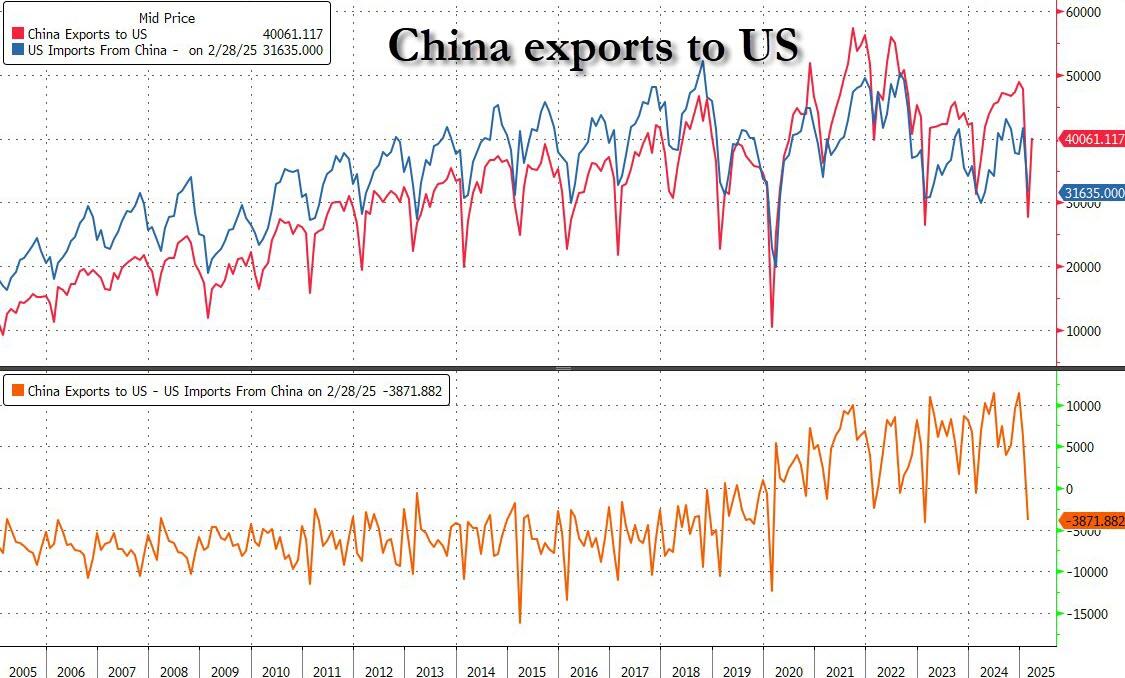
... and with China increasingly transshipping billions of goods to the US using such (formerly) untariffed venues such as Vietnam... 
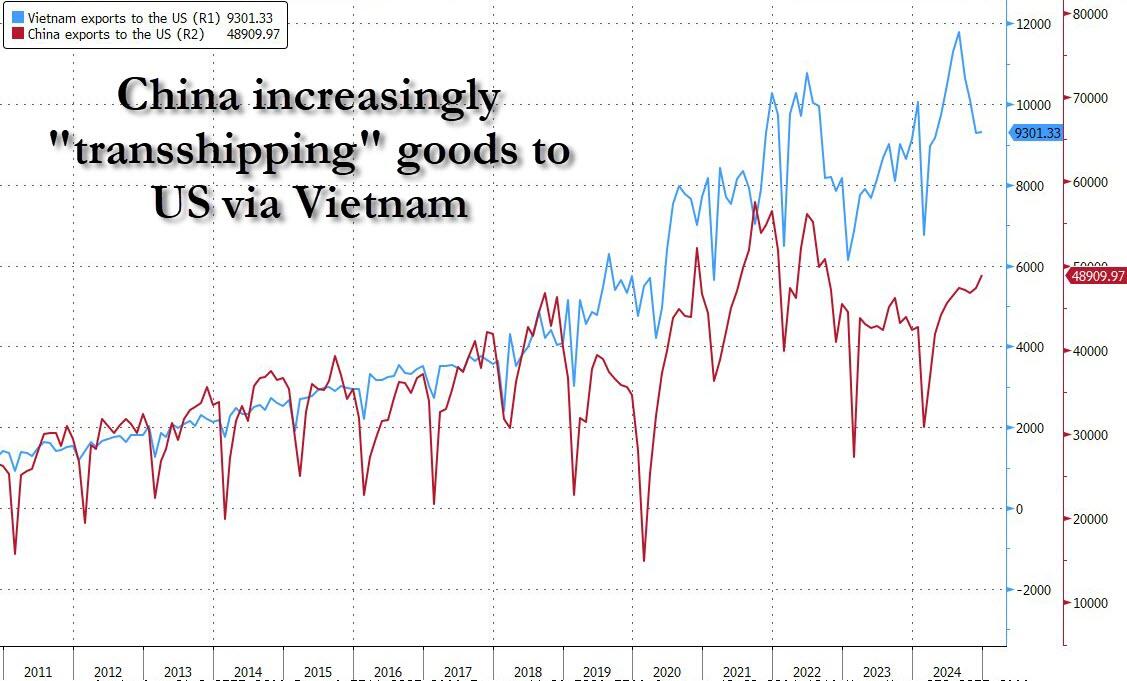
.... it is not all surprising that as China's largest trading partner halts most imports, pain would be pervasive. And it is: in interviews with the Financial Times and via dozens of social media posts, workers shared pictures of quiet production lines or factory suspension notices, highlighting how the tariffs are starting to bite.

According to workers who opened up to the FT, trade war had prompted the suspension of production for a week or more at plants making products ranging from shoe soles to jeans, electrical outlets and portable stoves. 

Some factory owners said they were cutting overtime or weekend work.

Wang Xin, head of the Shenzhen Cross-Border E-Commerce Association, an industry group representing more than 2,000 Chinese merchants, said many of them were “extremely anxious” and had told factories and suppliers to halt or delay deliveries. This had prompted some factories to suspend production for one to two weeks, she said.

Three factory recruiters in Guangdong who work with manufacturers said more factories were cutting overtime and weekend work with only the most heavily dependent on American orders putting the whole factory on leave.

Our export orders disappeared so we’ve temporarily stopped,” said a 28-year-old plastics factory worker in Fujian province, adding that production had been halted for a week so far.

Others are bracing for a much longer shutdown: executives at DeHong Electrical Products in Dongguan, Guangdong province, gave workers one month leave on minimum wage and said the factory was under “significant near-term pressure” after clients suspended orders.

“Management is working hard to find solutions, including expanding into new markets and optimising cost structures, so we can resume normal operations as soon as possible,” DeHong said in a notice seen by the Financial Times. As Treasury Secretary Scott Bessent said yesterday, "good luck" finding a replacement market that will absorb all your US-based production.

The problem for China is that unlike the US, it has no centralized social safety net, so the longer the trade war continues and the more workers are furloughed - then fired - the progressively faster the situation will get. 

Hangzhou Stellarmed, a company in Zhejiang province that makes endoscopy kits primarily for the US market, told full-time workers they could use the rest of April to find new jobs and provided them with access to a headhunting agency. Once again, good luck finding new jobs when on the margin, millions of export workers are about to be laid off everywhere.

“We don’t know how long this will last,” said Shi, the factory owner, who did not want to be identified by her full name. “We can only wait and see, there is nothing we can do.”

Similar anecdotes are prevalent across the country: plastic mould maker Dongguan Yuanguan Technology blamed the tariffs for forcing it to cancel all weekend overtime at its factory, according to a company notice and a worker.

A 26-year-old man in Zhejiang said the toy factory he worked at sold mostly to the US, forcing management to give workers about two weeks off. “It’s not easy at the moment,” he said, asking not to be named.

Needless to say, it is unclear how widespread the factory suspensions are, said Han Dongfang, founder of China Labour Bulletin, which closely tracks Chinese manufacturing and labour. “The rearrangement of China’s manufacturing sector will be a long-term process and workers will be sacrificed,” he said. Furthermore, the fact that any marginal pain will be amplified as trade war weakness will mean that Beijing will do everything in its power to prevent the full extent of the shutdowns from being revealed. 

Meanwhile, China’s electronics supply chain - which employs tens of thousands of people - got a reprieve last week when Washington exempted smartphones along with some other electronics from the steepest tariffs. But domestic eletronics producers are bracing for the worst, expecting to be swept in the trade war along with the rest of their peers, and big tech companies and cities with large concentrations of exporters, such as Shenzhen and Dongguan, are rolling out support programs intended to “stabilize foreign trade”. Shenzhen last week unveiled subsidies for companies to participate in foreign trade shows and said it would expand export insurance to help cover cancelled US orders, among other policies. Yet again, good luck.

A manager at Ningbo Taiyun Electric said they had suspended production on April 12, but had since restarted reduced output of electric hair straighteners and curling irons. “We still have some orders from Europe, we’re trying to get more,” said the manager, who asked not to be named. “Hopefully the US will change its policies.” Because if it doesn't, millions will end up unemployed; and with no short-term welfare state benefits to hold them over until the economy recovers, it could get very ugly... just as Trump expects it will.

Elsewhere, UBS' Chief China Economist, Tao Wang thinks China still has a big output gap as its growth recovery has been weak, something which the nevertrump  media also refuses to highlight. That’s why the Central Economic Work Conference last year said China has three priorities: 1) boost consumption, 2) support technology innovation and 3) defend the world trade order.

Regarding the trade war, it is a big demand shock to China happening now, but according to UBS China policy response will only happen later, if only so Xi does not telegraph weakness before Trump. This will drag China growth this year to only 3.4% y/y.

Tao thinks China will respond mainly with bazooka fiscal stimulus, and monetary easing will be in the secondary role, just as we predicted.

China, which reported a record trade surplus of nearly $1tn last year, has responded to Washington’s tariffs by imposing an extra 125 per cent levy on imports from the US. While Trump has repeatedly said he wants to speak with Chinese President Xi Jinping to resolve trade issues, Beijing appears in no hurry to request a call between the two leaders... But when a procession of angry unemployed factory workers heads for Beijing, Xi will be running to dial the White House.

https://www.zerohedge.com/economics/our-export-orders-disappeared-chinese-factories-shutting-down-laying-workers-ft-finds

Gabbard refers two alleged leakers to DOJ for prosecution — with third ‘on its way’

 Director of National Intelligence Tulsi Gabbard has made Justice Department referrals against two individuals whom she’s accused of leaking classified material to the press, as the Trump administration pursues a crackdown across agencies.

Gabbard, 44, alleged that one of the individuals handed classified material to the Washington Post and the other gave sensitive information to the New York Times.

“A third criminal referral is on its way,” Gabbard said in an announcement Wednesday, accusing the third alleged leaker of illegally sending material to the Washington Post.

Specific material that had been leaked is still unclear, but the move is widely seen as a warning to other potential leakers against handing classified material to the media.

Top brass in the Pentagon and the Department of Homeland Security have similarly opened internal probes into leaking, with some officials musing about using polygraphs to identify leakers.

Tulsi Gabbard vowed to hold leakers “accountable to the fullest extent of the law.”Getty Images
“Politicization of our intelligence and leaking classified information puts our nation’s security at risk and must end,” Gabbard said in a statement. “Those who leak classified information will be found and held accountable to the fullest extent of the law.

“I look forward to working with the Justice Department and FBI to investigate, terminate and prosecute these criminals.”

Gabbard accused the alleged leakers of seeking to undermine President Trump’s agenda.

The DNI faced controversy last month over a Signal group chat leak.Jack Gruber-USA TODAY via Imagn Images

Ultimately, the DOJ would have to decide whether to pursue criminal charges against the alleged leakers.

The DNI convened a task force — the Director’s Initiative Group — earlier this month to examine ways to boost transparency within the intelligence community. Part of its mission is to go after unauthorized leaking of classified information.

Last month, Gabbard faced scrutiny from lawmakers on the House and Senate intelligence committees over the leaked Signal group chat in which she had been included.

The Signal chat had been formed by national security adviser Mike Waltz, who inadvertently added Atlantic editor-in-chief Jeffrey Goldberg.

Pentagon boss Pete Hegseth blasted out attack planes against the Houthis that the military carried out in mid-March.

https://nypost.com/2025/04/23/us-news/dni-tulsi-gabbard-refers-two-alleged-leakers-to-doj-for-prosecution-with-3rd-on-its-way/