Search This Blog

Friday, April 25, 2025

Your Facts vs. Mine: Science in the Age of Political Theater

By Chuck Dinerstein, MD, MBA 

We’re often told to “follow the science”—a comforting phrase that suggests clarity, objectivity, and consensus. But in today’s hyperpolarized world, even science itself has become a political Rorschach test. A new study in Science reveals that Democrats and Republicans cite science differently and effectively operate from separate scientific realities.

“I want to pause here and talk about this notion of consensus and the rise of what has been called consensus science. … Historically, the claim of consensus has been the first refuge of scoundrels; it is a way to avoid debate by claiming that the matter is already settled.  …In science consensus is irrelevant. What is relevant is reproducible results. The greatest scientists in history are great precisely because they broke with the consensus.”

 - Michael Crichton

Crichton's critique challenges a popular narrative: that science speaks with a unified voice. While his stance may oversimplify science's collaborative and cumulative nature, he raises a valid concern—consensus can be misused as rhetorical armor to shut down debate. In practice, however, scientific consensus is often a signal of accumulated evidence, not ideological conformity.

Partisan Science

Following the science seems to be a homily best honored in word rather than deed. “scientific” evidence or reports are often flashed around to support regulation. According to a Pew survey, there is a clear divide between how Democrats and Republicans view science. As noted by Vox in describing Pew’s findings: 
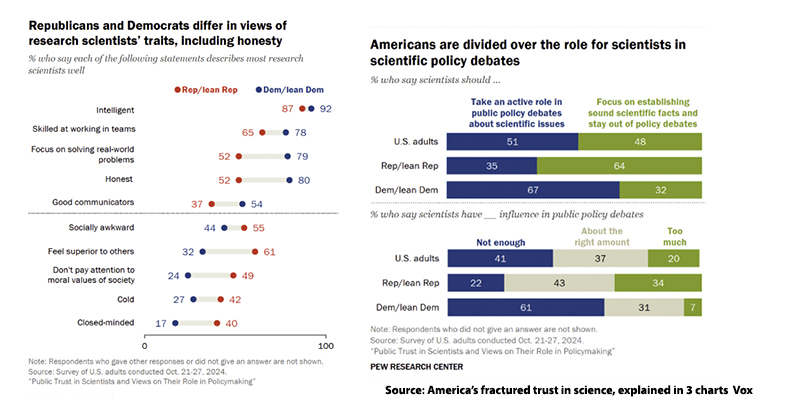
Of course, how citizens feel and Congress acts may differ, and we get a fascinating picture of what following the science means to partisans from a new study in Science

How Science Splits Along Party Lines

Is science used differently by policymakers in different parties? Spoiler Alert: Yes, and consistently across the years.

As we might expect, the researchers found 

“systematic differences in the amount, content, and character of science cited in policy by partisan factions in the United States. These differences are strikingly persistent across fields of research, policy issues, time, and institutional contexts.”

In other words, how science informs policy is not just a matter of quantity but of ideology. It’s not simply that one side cites more science—it’s that both parties consistently select different kinds of science to support their policy positions, reinforcing partisan narratives rather than converging around shared evidence.

Researchers analyzed a massive dataset to explore how science is used in American policymaking: over 49,000 congressional reports and hearings since the mid-1990s, plus more than 190,000 policy documents from U.S. think tanks dating back to 1999. They zeroed in on the 424,000 scientific papers cited in these documents and traced them to a global database of over 122 million academic publications.

By linking these two worlds—science and policy—they could see not just what science was being cited but also the nature of the science used: whether it was peer-reviewed or a preprint, its influence within its field, and how often it had been cited by other researchers. This comprehensive mapping allowed the researchers to reveal how deeply political ideology shapes the selection of scientific evidence in policymaking, not just the presence.

A Tale of Two Approaches

Let’s begin with the good news. Policy has increasingly cited science in the last 25 years. It has grown from 20% to 35% of policy statements, especially in documents generated by think tanks. This suggests that, at least on the surface, science is playing a larger role in shaping policy conversations.

But dig deeper, and a partisan pattern emerges. Congressional committees, central engines of policy development, show a clear divide. Committees led by Democrats are nearly twice as likely to cite scientific research as those led by Republicans. This partisan disparity becomes especially evident when committee control switches from Republican to Democrat. The shift is immediate and substantial, spanning nearly every domain—“20 of the 23 scientific fields and 15 of the 17 issue areas.”

“You are entitled to your opinion. But you are not entitled to your own facts.” 

– Senator Daniel Patrick Moynihan

Yet, in today’s policy landscape, facts are increasingly factionalized. While both Democrats and Republicans draw on scientific research, they are rarely drawing from the same sources. Only 5 to 6% of scientific citations are shared across party lines. The authors note that “partisans [are] consistently less likely to cite the same science.” In fact, the actual level of bipartisan overlap is about half of what would be expected by chance. This gap has held firm over time and across institutional settings—suggesting it’s not a passing trend but a persistent feature of modern policymaking.
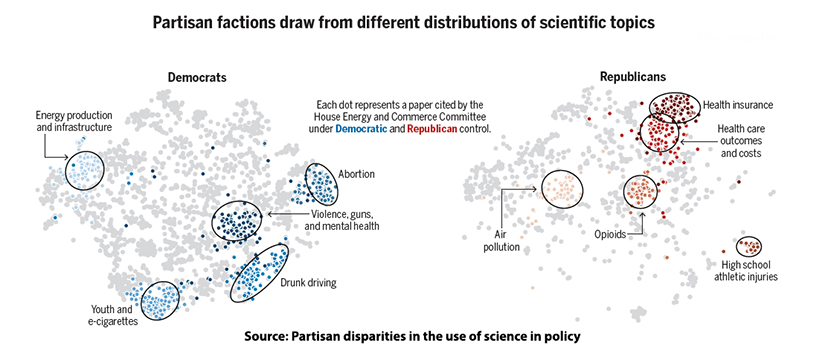
This divergence is often driven by political agendas. Take the House Energy and Commerce Committee: under Democratic leadership, the scientific topics cited differ sharply from those cited when Republicans are in charge. The committee’s focus shifts—not just in priorities but in the kinds of studies deemed relevant.

The split in think tanks working on the same issue is even more striking. In comparing minimum wage policies, the Urban Institute (left-leaning) and the Employment Policies Institute (right-leaning) cited 62 different studies—only one overlapped. That’s not just ideological framing—it’s near-total epistemic separation. As the researchers put it, “The science cited by the left- and right-of-center think tanks is nearly perfectly separated.”

And the quality of that science differs as well. Democratic-led congressional committees are more likely to cite peer-reviewed research, studies among the top 5% most cited in their field, and slightly older literature—possibly reflecting a preference for established consensus. While both parties cite research of similar average influence, the Democratic pattern suggests a tilt toward more academically validated work.

Among think tanks, the contrast grows sharper. Left-leaning think tanks prefer more recent, peer-reviewed, and widely cited science, often echoing influential research within academic circles. Right-leaning think tanks, by contrast, tend to cite less prominent or less current studies—possibly prioritizing ideological alignment over academic standing.

Why is this divide more pronounced in think tanks than in Congress? One likely reason is accountability. Regardless of party, legislators must ultimately face voters and weigh the practical consequences of lawmaking. This pressure may push both sides to incorporate more credible science, even if selectively. Think tanks, especially the ideologically rigid ones, have no such constraint. They can indulge in confirmation bias with impunity, curating science that flatters their worldview.

Trust Issues

Researchers went straight to the source to understand how science influences policy: surveying the professionals who shape laws and regulations—from judges and corporate leaders to government officials. They also surveyed 1,000 likely voters to see how elite perspectives compare to the general public's.

The results were striking. Across the board, political elites—regardless of party—trust scientists more than voters. However, partisan differences remain: Democratic elites show much greater trust in science than Republican elites. For example, over 60% of Democratic elites rated the National Academies of Sciences as “very trustworthy,” compared to just 23% of Republicans. This mirrors the broader populist backlash among Republican voters, where skepticism of expert authority has grown in parallel with political polarization. 

Politics Over Peer Review

“Science is often seen as holding a relatively privileged position partly owing to its commitment to Mertonian norms like organized skepticism.”   [1]

However, science is far from the only voice in the room. While the composition of Agency committees has and continues to be controlled by the Administration, that is not the case for Congressional Committees or think tanks. Science isn’t always the loudest or most relevant voice in Congressional ears. 

While Democrats may foreground evidence to justify regulatory action, Republicans may prioritize individual liberty, market autonomy, or regulatory restraint—values not invalidated by science but which shape how evidence is used. The researchers point out that when seeking information, Democrats and Republicans may use “science in roughly equal measure.” However, Republicans using hearings and committee meetings as performance may be more intent on messaging their political base. A base that is increasingly distrustful of scientific expertise. 

The lack of commonality in the science each partisan group highlights may indulge their respective voting bases, but it simultaneously undermines scientific credibility and government trust. In turn, mistrust raises questions about bias, not just in how science is used but also in how it is produced. While a Republican Administration is tearing apart the “deep state” aspects of government-funded research, both parties have culpability in creating an environment that fosters research’s Bonfire of the Vanities. 

Science is still a powerful force in policymaking—but its credibility, influence, and utility are increasingly filtered through political lenses. When science becomes just another partisan talking point, we lose more than consensus—we lose the foundation for problem-solving in a complex world. How can we agree on a future if we can’t even agree on the facts? In our fragmented “reality,” good science risks being drowned out in partisan noise.

[1] Robert K. Merton's four norms of science—Universalism, Communality, Disinterestedness, and Organized Skepticism—form the ethical foundation of scientific inquiry by promoting objectivity, open knowledge sharing, impartiality, and critical evaluation. Together, these principles ensure that scientific claims are judged on merit, shared for collective progress, pursued without personal bias, and rigorously scrutinized for validity.

Source: Partisan disparities in the use of science in policy Science DOI: 10.1126/science.adt9895

https://www.acsh.org/news/2025/04/25/your-facts-vs-mine-science-age-political-theater-49440

Why the CFPB’s Medical Debt Rule Hurts the Patients It Aims to Protect

 Chronic disease, high healthcare costs, and overregulated health sanctions have already strained America’s healthcare system, eroding trust in nearly every corner of it. The trust that does remain exists between patient and provider, not only to treat symptoms but to prevent them. Now, a last-minute rule finalized by President Biden’s Consumer Financial Protection Bureau (CFPB) threatens to make things worse. The rule bans the consideration of medical debt in credit reports—an action with  far-reaching consequences for patients, providers, and the broader economy. Unless Congress intervenes this month under the narrow window of its Congressional Review Act (CRA) authority, this well-intentioned but deeply flawed regulation could quietly become law — and the damage could be lasting.

For providers, this rule isn’t just about credit scores, it’s about maintaining access to care, and ensuring the sustainability of our healthcare system.

Healthcare providers aren’t banks, but they often act like lenders. When someone receives care and can’t pay upfront, providers typically offer services with the expectation of payment later. If medical debt can’t be reported to credit bureaus, it doesn’t just vanish—it gets absorbed by the providers.

Small practices, especially in rural communities where a physician is more than just a doctor—they're a lifeline—are particularly at risk. Mounting unpaid bills can lead to difficult decisions: cutting services, laying off staff, or in some cases, shutting their doors for good. Over time, these quiet acts of compassion—treating a child with a fever, caring for an elderly patient with diabetes—add up. And when those services disappear, what vanishes isn’t just kindness; it’s daily, essential care.

Providers have spoken out with concerns about the impact on their patients and practices, with over 1,000 comments opposing the ban, but the agency persisted under the false pretense of protection.

Eventually, this financial strain will spread further. To survive, not only will providers raise prices, but insurance companies will be led to increase insurance premiums or out-of-pocket costs for everyone— especially those who already struggle with access to affordable care. Illness and disease are no one’s choice, but for those who suffer from chronic illnesses and are already subject to constant treatments and bills these increased costs will only serve as another symptom. The system needs to protect them.

Making America healthy again doesn’t end with protecting patients from overregulated regimes. It means building a healthcare system that works for all patients, providers, and communities. That means rejecting past administration policies that sound good on paper but ultimately allow costs to be hidden, passed along, and inflated for the rest of us.

In many communities, medical providers are the last line of defense, offering care first and trusting patients to follow through. Stripping away their ability to report unpaid medical debt doesn’t just shift the burden—it threatens the entire system. Republican policymakers in the House and Senate have introduced CRA proposals to repeal the rule, but time is running out.  Legislation must pass by the end of April.

Only if the Senate acts now to approve the legislation can it be moved to the House for immediate approval and then to President Trump to be put into law. Only then will Americans be protected from the potentially disastrous impacts of this ban. Without immediate action, this rule will take effect and with it, consequences that will impact the entire economy and the most vulnerable within it.

Jerry Rogers is editor at RealClearPolicy and RealClearHealth. He hosts 'The Jerry Rogers Show' on WBAL NewsRadio 1090/FM 101.5 and the Federal Newswire's ‘The Business of America’.

https://www.realclearhealth.com/articles/2025/04/25/why_the_cfpbs_medical_debt_rule_hurts_the_patients_it_aims_to_protect_1106389.html

Kennedy might pull the COVID shot for kids: Good!

 by Vinay Prasad

The media coverage of changes around COVID-19 vaccination speaks poorly of the media. First make no mistake: the CDC should ABSOLUTELY remove COVID-19 from the Childhood Immunization schedule. It if stays, it shows the United States is a corrupt country: because there is no randomized evidence that kids ever benefit (in terms of real clinical outcomes) from this shot, and no evidence of any sort that a kid born today will need one in the future, and this shot earns some companies money.

Yet, in the article, I was disappointed to read this quote by Paul Offit, whom I generally respect.

“It’s like in Jurassic Park, when the Tyrannosaurus rex keeps checking where in the fence is a weakness,” said Paul Offit, a pediatric infectious disease specialist at the Children’s Hospital of Philadelphia. “He could do a lot of harm. I think he will do a lot of harm unless somebody stops him.”

Removing an unproven vaccine from the schedule, and one that is widely not accepted in Europe is not akin to letting a t-rex escape, but rather an important course correction. Medicine must admit when we make mistakes. If anything, removing unnecessary shots from the childhood schedule will bring focus to the necessary ones, such as measles.

Next, look at this. The CDC is finally contemplating what it should have done ALL ALONG. The COVID shot should only ever have been recommended to populations with a net benefit.

It is astonishing that this is remotely controversial. As you well, know, I, and some of my colleagues, have been saying this all along.


https://www.drvinayprasad.com/p/kennedy-might-pull-the-covid-shot

Are Top Cancer Centers Misleading on Screening?

 You are 50 years old, otherwise healthy, and have not yet undergone any cancer screening. Recently however, you hear some of your colleagues at work discussing cancer screening tests, and how cancer incidence has been increasing. This news makes you feel a bit uneasy, and you begin to contemplate if you should also get tested, even though you have no symptoms. 

On the way home, you see a billboard for a nearby cancer center that says, “Ranked Among the Top 10 Cancer Centers in the Country, Five Years in a Row!” You think, “Wow, this is one of the best cancer centers in the country. Thank God, I live nearby, I could be treated here if I got cancer one day.” 

Once home, you reflect on the day and check out the cancer center’s website, hoping to get more information. But are you getting unbiased information on screening? Is this a reliable source for when to start and stop screening, what screening tests to use, and how often? Is the website providing enough information on the benefits and harms of screening for you to make an informed decision on the matter?

That’s what we aimed to discover in our research project — the results of which have just been published. In the paper, we compare the screening recommendations for lung, colorectal, breast, prostate, and cervical cancers at the Top Ten US Cancer Centers with those of the US Preventive Services Task Force (UPSTSF) — an independent organization of multi-disciplinary national experts in disease prevention and evidence-based medicine. The USPSTF publishes evidence-based recommendations on screening tests for various conditions, including cancer. Unlike other society-specific recommendations — such as the American College of Gastroenterology colonoscopy screening guidelines, for example — USPSTF experts have no conflicts of interest influencing their recommendations and the USPSTF screening recommendations are considered the gold standard. 

Here's what our analysis revealed: The screening recommendations from the Top Ten US Cancer Centers often differ from the USPSTF recommendations. This discordance was almost always in the direction of the cancer centers recommending more screening than the USPSTF. The difference was most notable for prostate and breast cancers and to a lesser extent colorectal and cervical cancers. Lung cancer screening recommendations from cancer centers were generally congruent with USPSTF guidance.

What does it mean that top cancer centers recommend more screening? These elite centers either recommend starting screening at an earlier age and stopping at a later age or not stopping at all. The centers often listed more modalities than USPSTF recommended for screening, such as MRI as well as mammogram when a mammogram is sufficient and less expensive. Many of these centers also promoted executive physicals that include several cancer screening tests under a flat-fee package, with costs ranging from $1700 to $10,000.

A major issue with recommending more screening is that all screening tests come with harms. These harms can manifest, for instance, as overdiagnoses. Overdiagnoses occur when the screening test detects false positives — lesions that look like cancer but are not, in fact, cancers. False positives not only lead to overtreatment but also unnecessary anxiety. Patients ultimately receive unnecessary medical interventions — biopsy, surgery, chemotherapy, radiation, for instance — to assess or treat lesions that don't need to be treated. 

Despite the potential harms of screening that need to be considered alongside the benefits, the Top Ten Cancer Center websites primarily focused on the importance of getting screened, with only one center also highlighting the potential harms of breast cancer screening.

Furthermore, we found that very few of these websites referred patients to the USPSTF recommendations, and none included metrics on the benefits vs risks of screening — such as the number needed to screen or the number needed to harm — to help people understand the trade-offs.

This discordance and lack of transparency matters, especially if these cancer centers are being promoted as the cream of the crop. Because these centers are viewed by the public as trustworthy resources, when their screening recommendations don't align with the gold standard, it exacerbates public misunderstanding of the risks and benefits of screening and can foster mistrust of the system.

I have observed this misunderstanding in my own practice. I have been treating a 82-year-old patient with metastatic colon cancer who is on her third line of chemotherapy. One day, she tells me she cannot make her chemotherapy appointment the following week because she has a mammogram on the same day. Not only is this patient beyond the recommended age for a mammogram, but the likelihood that detecting a breast tumor would affect her prognosis during her treatment for metastatic colon cancer is as low as it can be in medicine. 

This type of confusion is not unusual. Studies have shown that patients often overestimate the benefits and underestimate the harms of screening. What we don't want is for top cancer centers to perpetuate these misunderstandings.

Ultimately, I think we need to ask ourselves what “Top Ten” even means. The phrase indicates top quality, but if accurate guidance on cancer screening is a metric, then these centers fail. 

It is also clear that there is a huge conflict of interest at play here — recommending more tests and doing more screening generates more revenue, but is that in the best interest of the public? 

Our society rewards doing more, but in medicine, oftentimes, less is more. And doing more with no benefit should be considered a poor performance metric, not plugged as the right care. It definitely does not speak of “Top Quality.”

https://www.medscape.com/viewarticle/are-top-cancer-centers-misleading-screening-2025a10009oy

Kenvue spikes as Dan Loeb’s Third Point reportedly builds stake

 Kenvue (NYSE:KVUE), the consumer care spinoff of Johnson & Johnson’s (JNJ), traded higher on Friday after The Financial Times reported that activist investor Dan Loeb’s hedge fund, Third Point Capital, has amassed a stake in the company.

Citing people familiar with the matter, the publication noted that Kenvue's (NYSE:KVUE) management will come under renewed investor scrutiny after the transaction, which marks the third activist campaign against the Band-Aid maker.

The details about the size and extent of the Third Point’s stake were not immediately clear. However, in early March, KVUE settled a closely watched proxy fight with activist investor Starboard Value by naming three new directors from the New York-based hedge fund to the company’s board.

Weeks later, Reuters reported that activist investor TOMS Capital Investment Management has also built a stake in Kenvue (NYSE:KVUE), seeking an outright sale of the company or a separation of assets. In 2022, Third Point and TOMS built stakes in Colgate-Palmolive (CL), pushing for a sale of its Hill’s Pet Nutrition division.

https://www.msn.com/en-us/money/companies/kenvue-spikes-as-dan-loeb-s-third-point-reportedly-builds-stake/ar-AA1DDcFb

Merck stock gains on Summit data for cancer drug with Akeso

  Merck (MRK) stock rises as Summit Therapeutics (SMMT) posts latest survival data for lung cancer therapy ivonescimab developed with Akeso

https://seekingalpha.com/news/4435941-merck-stock-gains-summit-data-cancer-drug

Chinese Delegation Spotted Entering Treasury Department, Demands Photos Be Deleted: Report

 There has been lots of confusion over the past week whether Trump has - or has not - spoken to Xi Jinping, to set trade negotiation talks in motion. According to Trump, he has and more than once...

... while China has repeatedly denied it has had any contact with its US counterparts, which is to be expected: admitting it is negotiating would be seen as a carte blanche for other countries to do the same, ending any attempts at negotiation "cartelization" Beijing may have tried to impose.

Unfortunately, the problem is that both sides tend to.... exaggerate reality, which makes a definitive conclusion either way challenging. And absent 3rd party confirmation either way, the market is forced to flip a coin to decide who is telling the truth. Unless, of course, there was 3rd party confirmation, which now appears to be the case.

According to an overnight report in The JoongAng, one of the three biggest newspapers in South Korea, and the newspaper of record for South Korea, it was "confirmed that the United States and China have begun behind-the-scenes contacts in relation to the 'tariff war' waged by US President Donald Trump."

Again, as noted above, after Trump said he had been in contact with China every day, the Chinese side, through a Foreign Ministry spokesperson briefing, said that Trump was effectively lying: "we have never had any consultations or negotiations with the United States, and (the related remarks) are all fake news.” The Chinese Ministry of Commerce also denied this, saying, “Economic and trade negotiations (with the United States) are not underway.”

However, in its overnight report, JoongAng Ilbo confirmed that at around 7 am ET on the 24th, a high-ranking official from the Chinese Ministry of Finance entered the Treasury building located right next to the White House in Washington D.C. accompanied by about 10 attendants.

At around 7:00 AM on the 24th (local time), a high-ranking official from the Chinese Ministry of Finance (equivalent to the Ministry of Planning and Finance) was seen entering the US Treasury Department headquarters building in Washington, D.C., accompanied by about 10 attendants. The photo shows Chinese attendants waiting for the meeting between the two sides to end. They were wearing ID cards for attending the G20 Finance Ministers' Meeting, and their nationality was written as 'China' on the ID cards. Washington=Correspondent Kang Tae-hwa; source

According to the report, the exact identities of the senior officials leading the dozen or so entourage have not been confirmed, "but they were all wearing the identification required for entry into the G20 finance ministers and central bank governors meeting currently taking place in Washington." It was the same type of identification worn by Lan Poan, China’s Minister of Finance, when he met with Choi Sang-mok, the Minister of Strategy and Finance, who visited the U.S. the day before.

Deputy Prime Minister and Minister of Strategy and Finance Choi Sang-mok, who is visiting Washington, D.C. to attend the G20 Finance Ministers' Meeting and the International Monetary and Financial Committee (IMFC), is greeting Chinese Finance Minister Lan Poan on the 23rd (local time). Courtesy of the Ministry of Strategy and Finance. Source

The Korean newspaper adds that "Chinese officials strongly blocked the press from taking photos of high-ranking officials entering the U.S. Treasury building this morning." 

The Chinese officials then reportedly said that “we have no authority to block the freedom of the press,” but added “we have the right to refuse to allow our personnel to be photographed,” and demanded that the press delete all photos taken on their smartphones.

When the press asked him to reveal the identity of the person who had blocked the interview, he refused, saying, “I have no obligation to reveal my identity.” However, the ID card he was wearing had his name, photo, and nationality written as “China.”

The 'Treasury Department Meeting' between the US and China on this day began at around 7:00 AM, about an hour before Deputy Prime Minister Choi and Minister of Trade, Industry and Energy Ahn Duck-keun began the '2+2 Trade Consultation' with US Treasury Secretary Scott Besent and US Trade Representative (USTR) Jamison Greer. As a result, the Korea-US tariff negotiations were conducted following the US-China backroom contacts.

A diplomatic source told JoongAng Ilbo, “The fact that the treasury channels of both the U.S. and China are actually operating means that both countries have reached a critical point under domestic and international pressure due to the current retaliatory tariffs,” and predicted that “the results of the backroom negotiations between the two sides could be a major turning point in the tariff war.” 

As for why China has been extremely secretive about the process, the source told the South Korean outlet that “since this tariff war is unfolding as a battle of pride with the leaders of both countries directly appearing, it may not be easy to create some kind of ‘win-win structure." He added that "the fact that China visited the U.S. Treasury Department in person could be an extremely sensitive issue for China."

Remarkably, Trump may have been telling the truth... again.

Source: The JoongAng

https://www.zerohedge.com/markets/chinese-delegation-spotted-entering-treasury-department-demands-photos-be-deleted-report