Search This Blog

Tuesday, June 3, 2025

‘Fastest growing fire risk’ is a source that can’t be extinguished by normal means


A big round of applause to the progressive useful idiots who demanded we all go “net zero,” and used the government to bludgeon any opposition into submission—thanks to their (non)brilliance, the “fastest growing fire risk” is a source that can’t be extinguished by normal means.

According to a report from the BBC, a Welsh fire and rescue service is sounding the alarm (once again) on lithium batteries, specifically those found in “substandard” e-bikes and e-scooters, which, in the words of a fire safety organization, are “tearing through homes” across the U.K.

Here are the numbers, from the article: Between April 2020 and March 2025, a time span of roughly five years, there were 136 lithium-ion battery fires in South Wales—100 of those, or around 74%, happened in the last two years. And, the injury and death data:

Of those reported fires over the last five years:

  • 30 people were injured with 24 of these occurring in the last two years
  • 49 were accidental dwelling fires, with 34 of these occurring in the last two years. One of these incidents led to a fatality linked to a fire involving a fault in a battery charger.
  • Of the 136 incidents, 39 involved an e-scooter or an e-bike with 25 of these incidents occurring in the last two years. These led to 13 people being injured, 10 of which occurred in the last two years.
  • There were 16 accident dwelling fires in south Wales which involved an e-scooter or an e-bike with 10 of these occurring in the last two years. These incidents led to five people injured with three of these occurring in the last two years.

As you can see, the fallout is increasing exponentially.

And, on top of that, lithium battery fires spew insanely toxic chemicals and poisons into the air, leaving another lasting impact. The advice from professionals? “It is crucial to steer clear of breathing in any” of the fire’s smoke.

What makes these fires especially awful is that you can’t extinguish them by normal methods. Water can actually exacerbate the problem, and traditional fire extinguishers won’t suffice—you have to have a specialized fire extinguisher meant for lithium battery fires:

If an e-bike battery catches fire, classic ABC or carbon dioxide extinguishers are generally not the first choice. Normal water extinguishers are also unsuitable as they can cause further short circuits in a live system. Special fire extinguishers for lithium batteries are the better choice: fire extinguishers filled with silicon, gel or pyrobubbles, for example, offer an efficient way of extinguishing a burning e-bike battery.

And, this is from just yesterday, stateside:

Lithium-ion battery may have started small apartment fire in Salt Lake City

An electric scooter may be to blame for a small apartment fire Monday morning in Salt Lake City. It’s the fourth fire potentially involving lithium-ion batteries on the Wasatch Front in the last four months.

But it’s not just the bikes and scooters—it’s any lithium battery that poses a heightened threat. So much so that even TSA and certain airlines are no longer permitting lithium-ion batteries to be stowed away in luggage. See below, from an item at the New York Post:

TSA just banned popular tech necessity for travel from checked luggage

The TSA just banned a travel essential from checked luggage following a new advisory from the Federal Aviation Administration.

Portable chargers and power banks that use lithium batteries are no longer permitted in checked bags, per the guideline.

And, from Forbes:

Southwest Airlines is the first U.S. airline to ban passengers from charging devices with a power bank inside a carry-on bag due to the risk of a charger’s lithium battery overheating or catching fire—going further than current FAA guidance.

Reality is consistent, and wherever you find chaos and death, there’s no doubt a progressive leftist policy behind it.

https://www.americanthinker.com/blog/2025/06/fastest_growing_fire_risk_is_a_source_that_can_t_be_extinguished_by_normal_means.html

Palestinian group harrassing Beverly Hills restaurant patrons runs into table of Iranian Jews, gets surprise


Near Los Angeles, Beverly Hills and the adjacent South Robertson area has many Jewish residents.

In recent years, they have been subject to violent antisemitic attacks and vandalism against their synagogues, which is bad enough. Since I once lived there, I wrote about those outrages hereherehere, and here.

But they are also subject to harassment from something called the "Palestine News Network" which, far from being a news agency, is a putrid activist group whose sole aim is to harass Jews dining out in restaurants in the area.

The Anti-Defamation League has them on their radar:

1. Overview: Palestine News Network (PNN) is a network of people who harass strangers, often Jews, prodding them about their stance on Palestine. The group also expresses support for anti-Israel terror and violence.  

Individuals associated with PNN have a history of entering neighborhoods with significant Jewish populations, or approaching those attending Jewish or Israel-related events, where they shoot videos that walk the line between “interview” and provocation.

PNN also posts videos or other content celebrating the death of Israelis, the October 7 terror attacks, news of terror attacks in Israel, and expressing support for terror groups like Hamas and dictators, such as the former leader of Syria Bashar al Assad.

Imagine the shriveled minds that spend all their time thinking about how they can harass Jews in restaurants. They're out there.

And imagine trying to take your family to dine out in the neighborhood and having to deal with creeps like these interrupting your meal by thrusting cameras in your faces and asking you questions that you aren't interested in getting into conversations about as you try to eat.

Sadly, that happens, and nothing seems to be done about it.

But the creeps were in for a surprise when they ran into a group of Iranian Jews (about 90% of the Iranian population in Beverly Hills is Jewish) dining out at Il Pastaio on 400 N. Canon Drive (a few feet from Rodeo Drive) and pulled their usual provocations, asking an Iranian family trying to have dinner together what they thought of the Palestinians:

The Iranians, who are famously pro-Israel even if they aren't Jewish. but certainly among the Jews as Queen Esther's people, were having none of it, and colorful insults, to the say the least, followed, making these antisemitic tools look like fools.

It was a good response, and could have surprised them if they didn't know that most Iranians in the area are Jews, though I think they did.

The right way to handle this would be for the manager of the restaurant to send in his biggest goons to lift them up by the scruffs of their necks and fling them into the street as bad for business. But in light of the inexplicable passivity, the Iranians' responses were just the right tone.

https://www.americanthinker.com/blog/2025/06/palestinian_harassment_group_bothering_beverly_hills_restaurant_patrons_run_into_a_table_full_of_iranian_jews_and_were_in_for_a_surprise.html

US Still Prosecuting Former ISIS Members After Officially Embracing One In Damascus

 This week a 49-year-old naturalized American citizen has been sentenced to a decade in federal prison, after confessing to traveling to Syria to join the Islamic State.

Lirim Sylejmani pled guilty to terrorism charges in December, and was sentenced by a federal court on Monday.  Sylejmani had attended an ISIS training camp beginning in November 2015, after moving from Kosovo to Syria with an intent to joint the terror group. "The defendant will spend a decade in prison thinking about the betrayal to this country," US Attorney Jeanine Ferris Pirro said in a statement.

Illustrative: ISIS terrorist on top of abandoned Syrian jet, via BBC/Getty Images

UPI writes that "Prosecutors said he changed his name to Abu Sulayman al-Kosovi and trained alongside other recruits to be an ISIS soldier following his arrival in the Middle Eastern country. His training included instruction on using AK-47 rifles, PK machine guns, M-16 rifles and grenades."

According to the Defense Post:

When the Kosovo-native was 23, he found refuge in the United States after fleeing a genocidal regime. Sixteen years later, he decided to join one.

Sulejmani is one of hundreds of American citizens believed to have joined Islamic State in Iraq and Syria since 2014. But as the Trump administration transfers dozens of high-priority ISIS suspects from makeshift prisons across northeast Syria as U.S. troops levels draw down...

But the unspoken irony and contraction here is that he had joined the Syrian battlefield at a time the West was "looking the other way" as thousands of international jihadists joined the fight to topple Assad (a fight that the CIA and Pentagon were supporting covertly). NATO member Turkey had essentially opened the border, a 'jihadi highway' into Syria as part of the covert effort to overthrow the Syrian government.

The other irony is that the US has just embraced Syrian leader Ahmed al-Sharaa (Jolani), who himself was at one point early in the Syrian proxy war a personal emissary of ISIS terror chief Abu Bakr al-Baghdadi.

Apparently some kinds of terrorism are OK, according to Washington's regime change playbook...

Jolani is also well-known for being the founder of Syria's initial al-Qaeda branch, Jabhat al Nusrah, which has since morphed into Hayat Tahrir al-Sham (HTS), which rules from Damascus in the wake of Assad's overthrow in December. HTS has even spent a long time on the US terrorism list, though the $10 million bounty which had been on Jolani's head has recently been removed by the FBI and US Treasury.

As for Sulejmani, he had long been held in an prison near Hasakah run by the Pentagon-backed Syrian Democratic Forces (SDF). Thousands of suspected ISIS fighters were held there for years, amid efforts to send foreign fighters to their respective home countries for prosecution.

Lirim Sulejmani, via The Defense Post

Sulejmani had actually asked to be deported to Kosovo, due to it being largely Islamic and a small country, but that didn't happen. Kosovo was recognized as a nation by the Bush administration, after it was forcibly peeled away from Serbian control following years of war as well as NATO military intervention.

Meanwhile, Syrian AQ founder al-Sharaa is planning to travel to New York in December to address the United Nations...

Confused Americans might rightly be asking: what was 20 years of the so-called Global War on Terror (GWOT) really all about? What was it all for?

https://www.zerohedge.com/geopolitical/us-still-prosecuting-former-isis-members-after-embracing-one-damascus

Remaking K–12 Classes For A Healthier America

 by David Mansdoerfer via The Epoch Times,

America’s kids are navigating a health crisis, and our outdated K–12 health classes aren’t helping.

With childhood obesity at 20 percent, teen mental health issues doubling, and chronic diseases looming, the current curriculum—think food pyramids, anti-drug lectures, and awkward sex-ed—is woefully inadequate.

It’s time to transform these classes with a Make America Healthy Again (MAHA) approach, empowering students with practical, science-based tools for lifelong wellness.

Nutrition education needs a complete overhaul. Ditch memorizing calorie counts for hands-on lessons in reading labels, spotting hidden sugars, and cooking affordable, nutrient-dense meals. Schools could partner with local farmers or chefs to make it fun, showing kids that real food isn’t just for influencers. Imagine middle schoolers mastering a stir-fry or high schoolers debating ultra-processed foods’ impact on their bodies. These skills build confidence and independence, setting kids up to make smarter choices in a world of fast-food traps.

Mental health demands equal focus. Anxiety and depression rates among teens have surged, yet coping strategies are rarely taught. A MAHA curriculum would introduce age-appropriate mindfulness, stress management, and sleep science. Elementary students could practice breathing exercises; high schoolers could explore how social media algorithms hijack their attention. Teaching kids to set tech boundaries isn’t coddling—it’s equipping them for a digital world where mental resilience is non-negotiable.

Physical activity must evolve beyond dodgeball and humiliating fitness tests. Only 24 percent of kids meet daily exercise guidelines. Health classes should inspire movement through yoga, strength training, or outdoor challenges. Schools could use wearable tech to gamify fitness, rewarding effort over athletic talent. The aim? Make exercise a joy, not a chore, fostering habits that stick into adulthood.

Prevention ties it all together. Kids need to grasp how lifestyle shapes their future, from cutting diabetes risk to boosting heart health. Lessons could use real data—like how 10,000 steps a day lowers disease risk—or feature doctors sharing relatable stories. This isn’t about scaring kids; it’s about showing they hold the reins.

Skeptics might call this overhaul costly or unrealistic, but poor childhood health habits fuel billions in healthcare costs annually. MAHA classes are an investment, like building roads—do it right, and the benefits compound. Start with pilot programs, retrain teachers, and tap community resources. This isn’t partisan—it’s common sense. Every parent wants their kid to thrive. By remaking health classes, we give students the tools to build healthier bodies, minds, and futures.

Let’s stop lecturing kids on health and start teaching them how to live it.

https://www.zerohedge.com/political/remaking-k-12-classes-healthier-america

Treasury Vs Fed: With Fed Sidelined, Bessent Unleashes Record $10 Billion Bond Buyback

 Back on April 14 when bond yields were soaring in the aftermath of Trump's liberation day amid speculation that China or Japan were selling some of their US paper to stabilize their currency, a selloff which was compounded by the concurrent unwind of the massive $2 trillion basis trade, Treasury Secretary Steve Bessent appeared on Bloomberg TV to ease fears of a wholesale unwind of the US bond market. In the interview, among other things, Bessent revealed that he has breakfast with Powell every week, and also said that if the Fed does nothing, he might take matters in his own hands, and since the Treasury has a "big toolkit" one of the things it could do is "up the Treasury buybacks" (to prop up Treasuries, in lieu of QE). 

Six weeks later, with the Fed sidelined and unwilling to do anything to ease the plight of US treasuries which continue to trade at dangerous levels - the 30Y is flirting with a 5% level - it appears this is what Bessent has done.

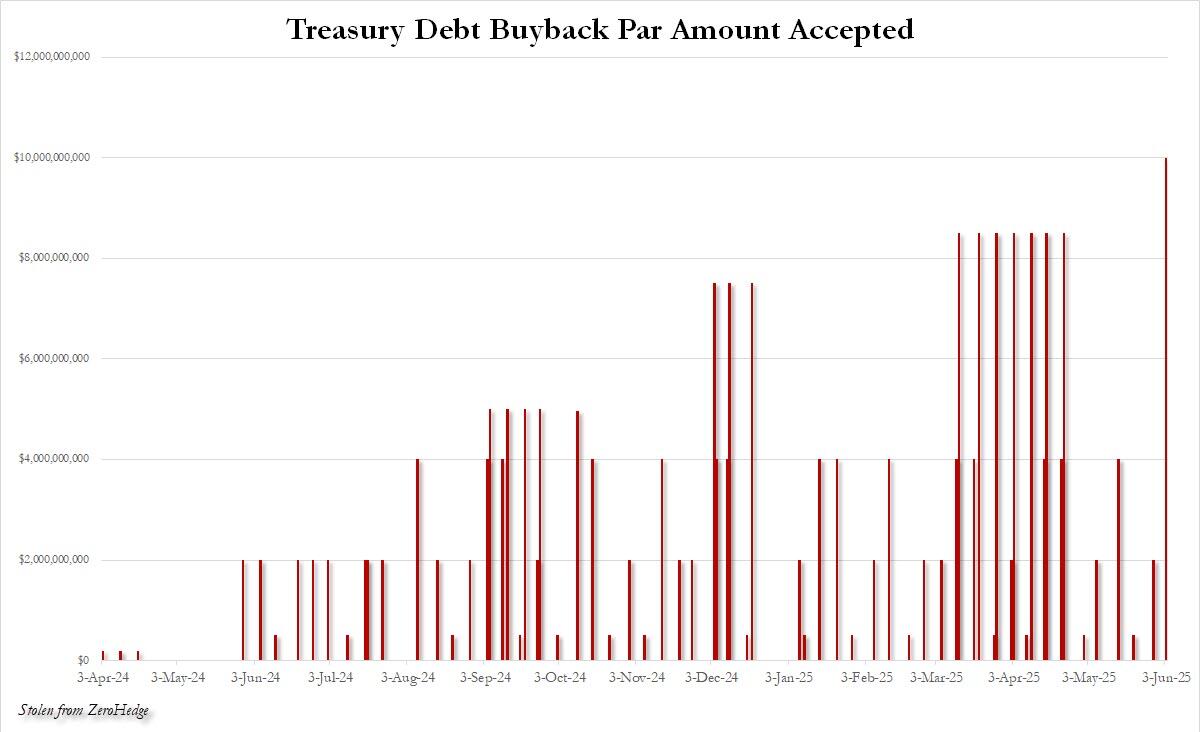
At 2pm on Tuesday afternoon, the Treasury announced the results of its latest Treasury buyback operation (which some had likened to a QE lite because it effectively monetizes Treasuries in the open market, similar to the Fed's POMO operations, and similar to stock buybacks). While the operation itself was not remarkable - the Treasury had been holding these these more or less weekly since April 2024 - the size of it was: at $10 billion, this was the largest Treasury buyback operation in history.

Here is a snapshot of all historical Treasury buybacks in the past year: the trajectory is clear.

Source: US Treasury

And while the maturity range of the cusips accepted for buyback was of low duration, in the interval between July 15, 2025 and May 31, 2027, we are about to see sizable increases in the total buyback size of longer duration treasuries. 

Sure enough, tomorrow at 2pm, the Treasury will complete a buyback focusing on Treasuries maturing in the 2036-2045 interval, i.e., 10-20 year paper, and the maximum amount to be redeemed will be $2 billion, up 100% from the last such buyback on May 6, when the maximum amount to be redeemed was $1 billion. In fact, the last time there was a treasury buyback anywhere close to today's amount was in mid/late April when Treasuries were tumbling and when someone had to step in and cushion their fall since Powell was nowhere to be found.

Which begs the question: with the political Federal Reserve - which had no qualms cutting rates two months before the election but refuses to do so now that core PCE has slumped to the lowest level since the covid crash, is Bessent finally stepping in to rein in the Treasury market, and is Yellen's Activist Treasury Issuance strategy which dominated bond buying for much of 2023-2024, about to be replaced with Bessent's Activist Treasury Buyback strategy until such time as the Fed finally does something. 

https://www.zerohedge.com/markets/its-treasury-vs-fed-fed-sidelined-bessent-unleashes-record-10-billion-bond-buyback

Over 100 Illegal Immigrants Arrested By ICE At Florida Construction Sites

  by Darlene McCormick Sanchez via The Epoch Times (emphasis ours),

A day after a top White House aide said the Trump administration wanted to increase illegal immigrant arrests to 3,000 per day, more than 100 illegal aliens working at Florida construction sites were taken into custody.

An Immigration and Customs Enforcement agent and a local police officer arrest an illegal immigrant in Florida in April 2025. ICE

U.S. Immigration and Customs Enforcement (ICE) apprehended the foreign nationals during a targeted enforcement operation at building sites in Tallahassee on May 29, according to an ICE Homeland Security Investigations news release.

The multi-agency operation led to the arrest of illegal immigrants from at least seven countries, including Nicaragua, El Salvador, Guatemala, Mexico, Venezuela, Colombia, and Honduras.

One illegal immigrant was charged with four counts of assault on law enforcement officers. Another attempted to pull a weapon on officers, according to ICE.

“These types of enforcement actions aim to eliminate illegal employment, holding employers accountable and protecting employment opportunities for America’s lawful workforce,” stated ICE Tallahassee Assistant Special Agent in Charge Nicholas Ingegno.

White House Deputy Chief of Staff Stephen Miller told Fox News’s “Hannity” on May 28 that the White House was setting a goal for ICE to arrest at least 3,000 illegal immigrants per day, far above the 1,000 per day arrest quota set earlier.

ICE officials emphasized the agency’s continued focus on identifying public safety and national security threats, but said in the release that those unlawfully present in the country who are encountered during enforcement operations may also be taken into custody and deported.

A senior Department of Homeland Security spokesperson told The Epoch Times via email that the agency is enforcing immigration law, unlike under the previous administration.

“[President Joe] Biden ignored this legal fact and chose to release millions of illegal aliens, including violent criminals, into the country with a notice to appear before an immigration judge,” the spokesperson said.

Most illegal immigrants who entered the country over the past two years are subject to expedited removal, the spokesman said.

“ICE is now following the law and placing these illegal aliens in expedited removal, as they always should have been,” he said.

If they have a valid, credible fear claim, they will continue in immigration proceedings, but if no valid claim is found, aliens will be subject to a swift deportation.

The workplace raids could become more frequent as President Donald Trump cracks down on illegal immigration after some 11 million foreign nationals unlawfully entered the United States during the Biden administration.

Selene Rodriguez, campaign director for Secure and Sovereign Texas at the Texas Public Policy Foundation, told The Epoch Times that more worksite raids targeting illegal immigrants are likely given the more aggressive arrest and deportation goals.

“The point is, they came across illegally and undetected, and they’re trying to remain here illegally and undetected, and that qualifies you for deportation,” she said.

Trying to maintain a high number of deportations will likely call for adjustments in the administration’s approach, Rodriguez said.

She said the Trump administration is more likely to hit its arrest and deportation goals with the help of state and local law enforcement.

Florida leads the country in its efforts to work with ICE, Rodriguez noted.

In April, ICE worked with local law enforcement in Florida to arrest more than 1,100 illegal immigrants.

Florida’s county sheriffs and officers in 67 county jails signed up for what are called 287 (g) agreements to work with ICE.

Texas also stands to drastically increase the number of counties cooperating with ICE thanks to the passage of Senate Bill 8, which is expected to be signed into law by Gov. Greg Abbott.

The original bill was strengthened to mandate that all county sheriffs who operate or contract to operate jails must apply for and accept an agreement to work with ICE if offered.

That means about 235 of Texas’s 254 counties will be required to partner with ICE to enforce immigration law.

A state grant program would help sheriffs defer the costs involved with helping ICE.

Unlike Florida, Texas’s bill won’t require municipalities to enter into ICE agreements, Rodriguez said.

https://www.zerohedge.com/political/more-100-illegal-immigrants-arrested-ice-florida-construction-sites

Remembering Bernie Kerik

 Bernard Kerik, who died last week at 69, in some ways embodied the American archetype of the self-made man. He rose from high school dropout to New York City police commissioner during the crucible of 9/11, only to fall from grace amid scandal and imprisonment, before picking himself back up and starting again.

Born in Newark, New Jersey, in 1955, Kerik endured early years marked by instability. As if out of a James Ellroy novel, his mother, a prostitute, abandoned him when he was a child and later died from a blow to the head, likely a homicide, leaving a psychological void that Kerik would later describe as formative. He dropped out of Paterson’s Eastside High School but found structure in the U.S. Army, serving as a military cop in South Korea and training special forces at the John F. Kennedy Unconventional Warfare Center in North Carolina. After working in private security, including for the Saudi royal family, he joined the NYPD in 1986.

His ascent was rapid, aided by an alliance with Rudy Giuliani, whom he served as bodyguard during the 1993 mayoral campaign. Giuliani, who has always prized loyalty, saw in Kerik a kindred spirit—aggressive, tireless, unpretentious. “We’ve been together since the beginning,” Giuliani said on his podcast after Kerik’s death. “He’s like my brother. I was a better man for having known Bernie. I certainly was a braver and stronger man.”

In 1998, Giuliani named Kerik commissioner of New York City’s Department of Correction, then mired in violence, racial tension, and gang activity—especially at Rikers Island. Kerik’s performance was impressive. He cracked down on entrenched “security posts” controlled by inmate gangs and supported line officers in reasserting control. He emphasized direct accountability, top-down discipline, and unflinching managerial will. The approach earned him enemies among progressives and correctional-union leaders but inspired many of his officers. “‘Shit happens,’” Kerik recalled of their attitude when he arrived. “I said: ‘You make $120,000 for what? What do you do?’” After a few years in charge, though, he could confidently say: “Today, I’d put my managers up against any managers in New York City, and I’ll bet you my people know more about their jobs.”

Kerik (right) with Mayor Rudy Giuliani and Governor George Pataki, November 2001 (Photo by George Best/Getty Images)

The results were undeniable. As Frank Straub and Paul E. O’Connell detailed in a 1999 City Journal essay, inmate-on-inmate violence dropped, staff absenteeism declined, and the system held firm during years when other cities saw their jails descend further into chaos. Kerik attributed this success not to funding or reformist policy, but to a restoration of moral clarity: officers were there to maintain order, and inmates to follow it.

I met Kerik a few times at Manhattan Institute events during those years and interviewed him as well. He had the confident air of a man who had faced real danger—he’d been a ponytailed, goateed, diamond-earring-wearing, undercover narcotics cop, in addition to his later security work in the Middle East—and the coiled bearing of a martial arts expert (he held a black belt in karate). But I also sensed that he walked a little too close to the fire—that he had an undue appetite for risk.

In 2000, Giuliani named him the city’s 40th police commissioner. Kerik’s tenure was brief but unforgettable. He stood beside Giuliani in the smoldering rubble of Ground Zero, helped coordinate the city’s emergency response, and—like the mayor—became, for a time, a national symbol of American resilience.

In 2003, the Bush administration dispatched Kerik to Iraq to help rebuild the country’s shattered police force. Though his tour was short, it raised his national profile and paved the way for his nomination as Secretary of Homeland Security in 2004. The nomination collapsed within days, amid revelations that he had employed an illegal immigrant nanny. That embarrassment soon widened into scandal: an abandoned Korean daughter, unreported loans, tax evasion, misused city contractors, and ties to mob-linked firms all came to light. In 2009, Kerik pleaded guilty to eight felony counts and served three years in federal prison.

His later years were marked by reinvention. In his 2015 memoir, From Jailer to Jailed, he reflected on his career and his time behind bars with candor. While some critics saw the book as self-exculpating, it revealed someone capable of reflection. Donald Trump pardoned him in 2020, after which Kerik became a vocal supporter of efforts to challenge the results of the 2020 election. During the January 6 investigations, his name resurfaced—this time as a behind-the-scenes operator for Giuliani’s legal team. Loyalty had become the throughline in a career full of second acts. FBI director Kash Patel’s praise of Kerik on his passing as “a warrior, a patriot, and one of the most courageous public servants this country has ever known” suggested that his public rehabilitation was complete.

Writing in City Journal in 2001, Kerik offered a populist defense of rank-and-file police officers, arguing that accusations of racism often masked discomfort with the blunt realities of street-level law enforcement. That short piece—“It’s Rudeness, Not Racism”—reads as strikingly relevant today, following years of anti-police agitation, the rise of the Black Lives Matter movement, and a wave of decarceral policies that have left many cities more dangerous and disorderly. As City Journal has long maintained, public safety depends not on abstractions but on moral clarity and enforcement. Kerik died at a moment when the nation, weary of permissive governance, has once again begun to demand order.

Bernard Kerik’s life, marked by triumph and disgrace, remains a cautionary tale about human nature—but also a reminder that, in America, leadership often emerges from unlikely places.