Search This Blog

Friday, June 6, 2025

NIH Dissolving Pricey Infectious Disease Centers

 by Paul D. Thacker

Senior officials inside the NIH are working to shut down a Tony Fauci initiative launched in 2020 called the Centers for Research in Emerging Infectious Diseases or “CREID.” Meanwhile, attorneys inside the Justice Department have launched initial inquiries into one of the CREID grants awarded to Scripps Research Institute researcher Kristian Andersen, who is now in the process of fleeing the United States for a position being created for him at the University of Oslo.

NIH Director Jay Bhattacharya did not respond to repeated requests for comment, but an NIH spokesperson confirmed the agency is shutting down the CREID grants. “Though the grants have been properly terminated, money will be released to the grantees to assure safe shutdown of these programs in terms of biosafety and security,” said an NIH spokesperson, adding that pandemic preparedness remains important but the dangers of health comorbidities in infectious disease outbreaks was further underlined during COVID. “Strengthening overall health through proactive disease prevention offers a more resilient foundation for responding to future health threats—beyond reliance on vaccines or treatments for yet-unknown pathogens.”

Tony Fauci announced the formation of CREIDs in 2020, awarding 11 grants worth around $17 million, with $82 million in expected funding in succeeding years. NIH did not explain how much of the $82 million slated for CREID had already been spent. Two CREID grantees have been the focus of intense scrutiny since Fauci’s announcement: Peter Daszak of the nonprofit EcoHealth Alliance and Kristian Andersen of Scripps.

Daszak was later discovered to have undisclosed ties to the Wuhan Institute of Virology (WIV), having provided an NIH subaward to WIV researcher Shi Zhengli. At the close of the Biden Administration, the Department of Health and Human Services (HHS) finally debarred EcoHealth Alliance and Peter Daszak from receiving federal funds, in part because “in response to NIH’s multiple safety-related requests” EcoHealth Alliance had not provided WIV records.

Andersen also faced close inspection for his CREID grant. Some months before Fauci gave final sign off on Andersen’s CREID award, Andersen and other researchers published a paper in Nature Medicine titled, “Proximal Origin” that dismissed the possibility of a Wuhan lab accident. Andersen’s paper was widely hailed by scientists as proof, at the time, that discussions of a COVID lab accident was a conspiracy.

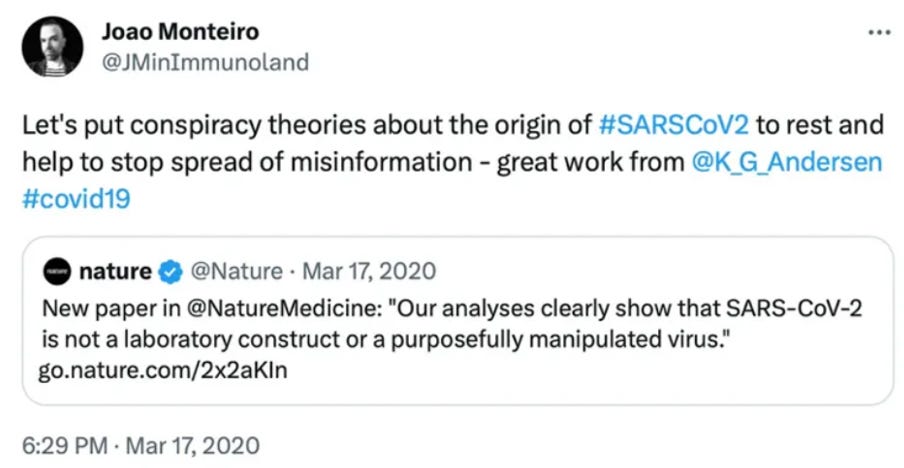
Nature Medicine’s editor-in-chief, Joao Monteiro, tweeted that the “Proximal Origin” paper “put conspiracy theories” about the pandemic’s possible lab origin to rest.
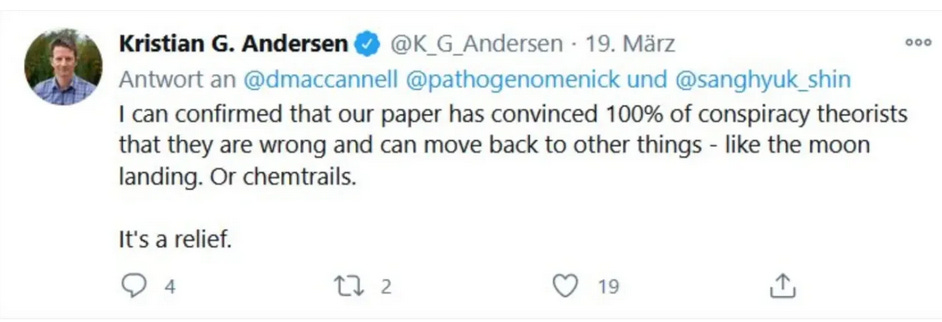
Andersen echoed Monteiro’s statement days later, associating “conspiracy theorists” worried about a possible lab accident with people who doubt the Moon landing.
The paper would go on to become one of the most heavily cited scientific papers in 2020. However, emails made public through freedom of information act requests and by congressional investigators later found that the papers’ authors had run it past funders—Collins and Fauci at the NIH, as well as with Jeremy Farrar, then at the Wellcome Trust and now with the World Health Organization.

Congressional Republicans later charged that Fauci had helped orchestrate the paper, while House Democrats pointed the finger at Jeremey Farrar, publishing a report that concluded Farrar helped “organize and facilitate” and “led the drafting process of the paper.”

The group BioSafety Now has demanded Nature Medicine retract the “Proximal Origin” paper, calling it a “a product of scientific misconduct.” Two weeks ago, The DisInformation Chronicle reported that the Justice Department began an initial inquiry into the paper, sending Nature Medicine a list of questions that included, “How do you handle allegations that authors of works in your journals may have misled their readers?” The existence of the Justice Department letter to Nature Medicine had not been previously reported.
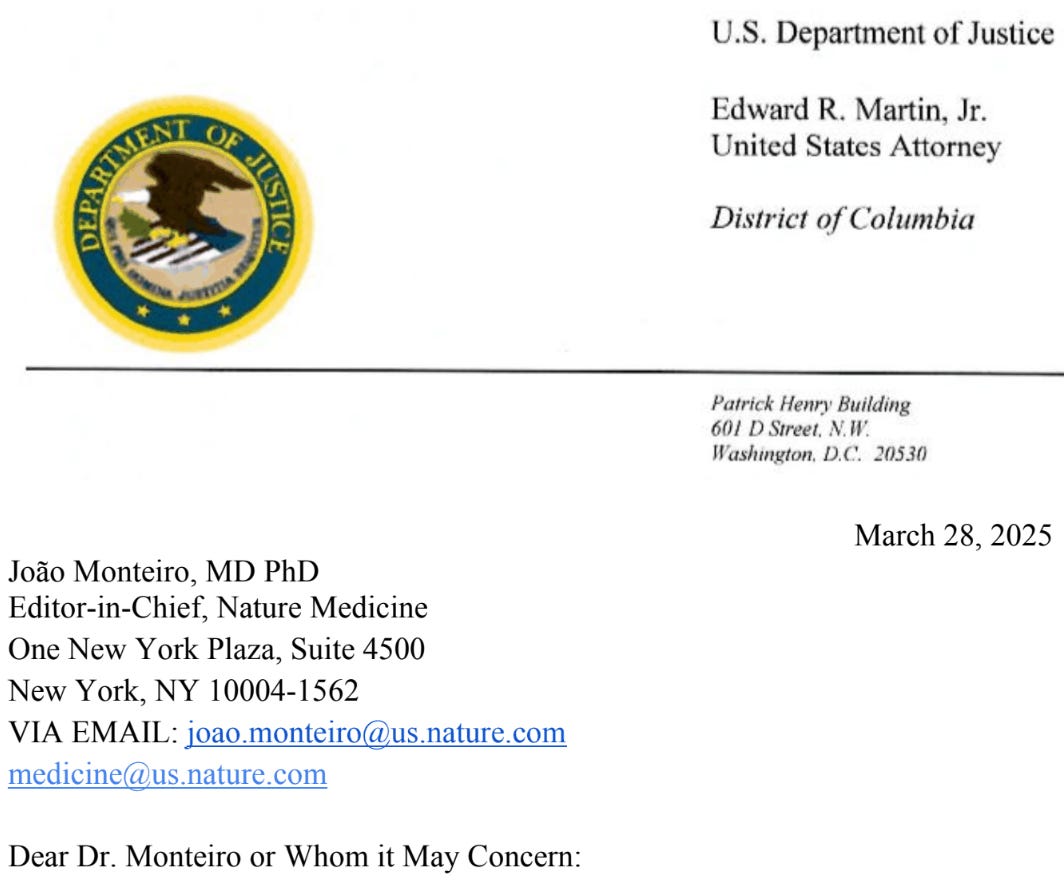
Justice Department officials opened the inquiry as they suspect the paper may have been a quid pro quo, published by the authors to dismiss the possibility of a lab accident in exchange for the Fauci CREID grant. Andersen addressed these bribery allegations two years ago during a congressional hearing.

“There is no connection between the grant and the conclusions we reached about the origin of the pandemic,” Andersen wrote in sworn testimony to Congress in July 2023. “We applied for this grant in June 2019, and it was scored and reviewed by independent experts in November 2019.”

The Intercept later reported that Andersen “knew that was false.” NIH records show the Fauci CREID grant to Andersen wasn’t finalized until May 21, 2020, two months after Andersen published “Proximal Origin” in March 2020.

Misleading intelligence agencies

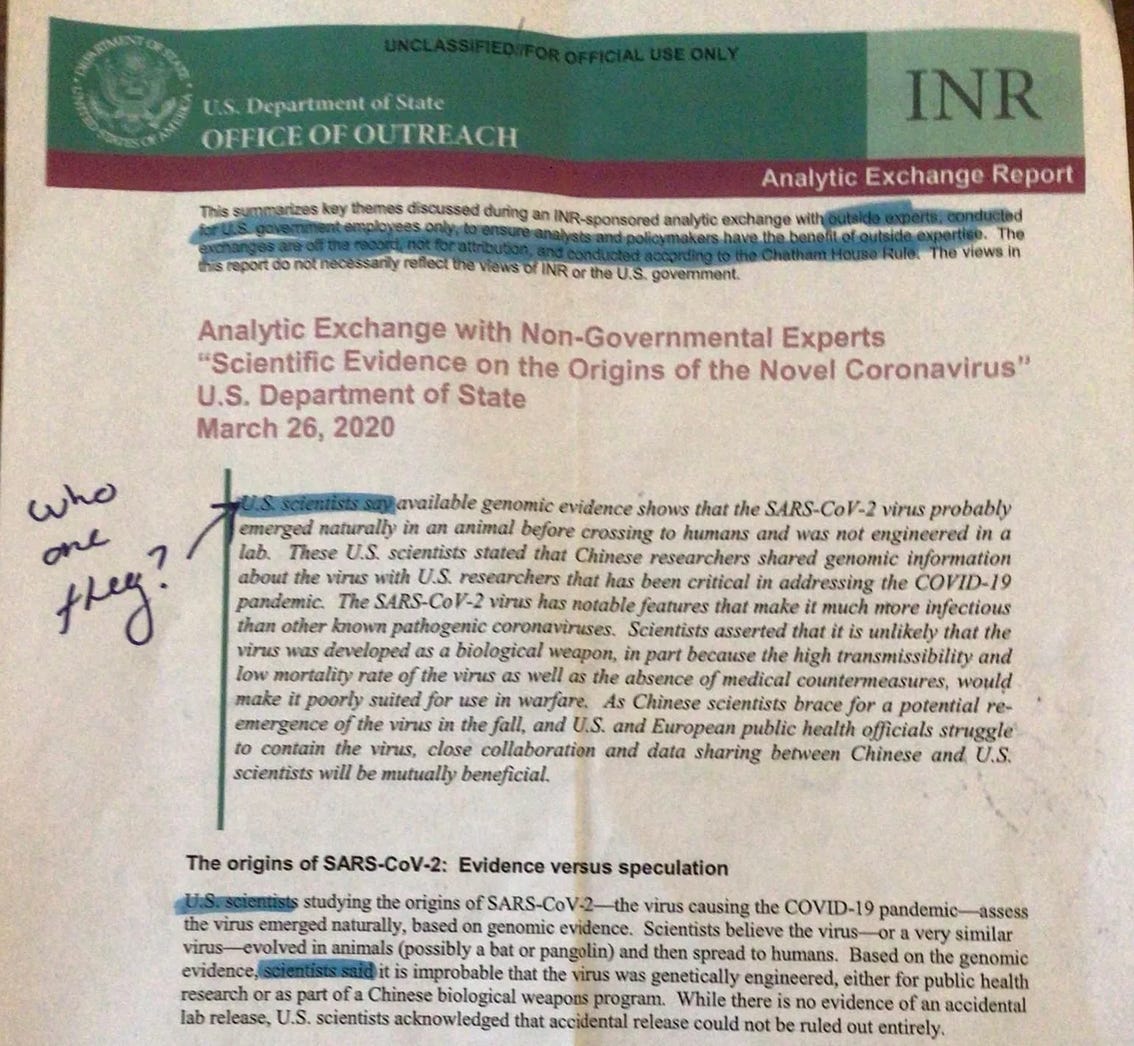
Justice Department officials are also likely to examine Andersen’s possible role in misleading US intelligence agencies. A week after Nature Medicine published “Proximal Origin,” the State Department’s Bureau of Intelligence and Research (INR) published an intelligence report that circulated inside security agencies. First reported by The DisInformation Chronicle, the INR report is marked “UNCLASSIFIED/FOR OFFICIAL USE ONLY.”

The INR report documents a briefing that non-government scientists gave to State Department officials, downplaying the possibility of a Chinese lab accident and citing the “Proximal Origin” paper. The names of the scientists who briefed State remained unknown until a couple years ago, when emails found that one of the scientists was Kristian Andersen, who is apparently a citizen of Denmark, not the US.
“Did we have a foreign national parading into the intel agencies and convincing senior officials to not look into a matter?” said a State Department official who is not cleared to speak to the media. “That’s a counter intelligence matter. We need a professional law enforcement investigation.”

Andersen’s involvement came to light in a late 2020 email sent by State Department official David Feith in which Feith wrote that Andersen had briefed State for their March 2020 INR report. “In fact, I'm told that in a briefing organized by INR earlier this year, [Andersen] said that several features that had initially raised questions in his mind were subsequently put to rest by more detailed analysis,” Feith explained by email. “Notably, it was that subsequent follow-on analysis, referred to by Anderson in the INR discussion….”

Based on the briefing by Andersen and colleagues, State’s INR report concluded there was no evidence the virus originated in a lab. “U.S. scientists said that while they cannot completely rule out that scenario, it was improbable and not supported by available evidence.”
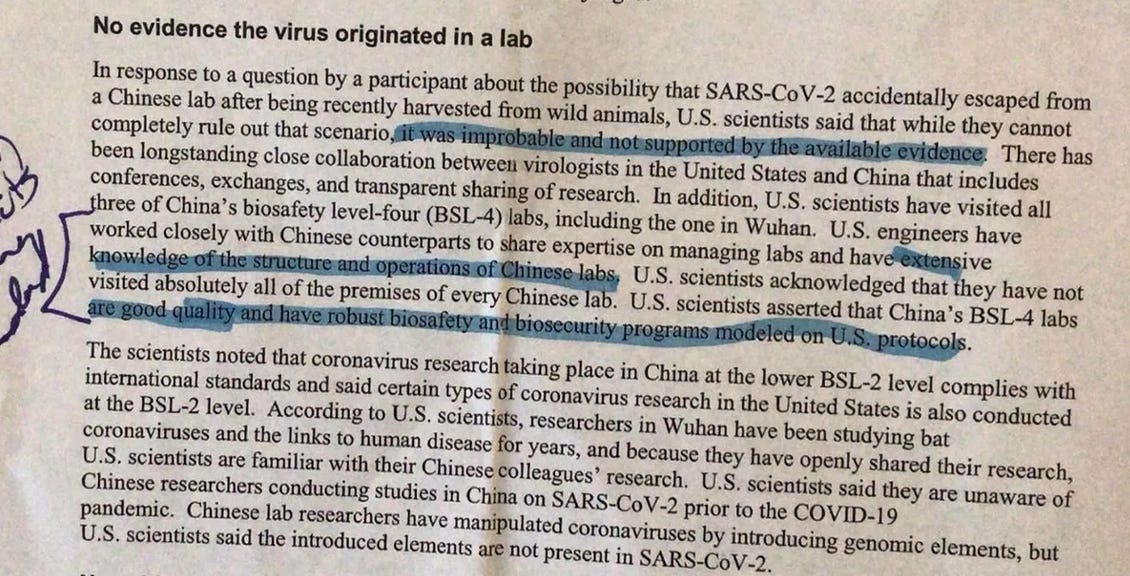
But on April 16, 2020, a month after briefing the State Department, Andersen sent a Slack message to his “Proximal Origin” co-authors. This message contradicts what scientists told the State Department.

“I’m still not fully convinced that no culture was involved,” Andersen wrote his co-authors, a month after briefing State that a lab accident was not supported by evidence. “We also can't fully rule out engineering (for basic research).” Andersen added that a critical part of the virus called the furin cleavage site “still could have been inserted” into the virus.

Researcher Andreas Martin Lisewski with Germany’s Constructor University published a recent study supporting Andersen’s suspicion that a furin cleavage site was inserted into the COVID virus called SARS-CoV-2. After analyzing the sequence, Lisewski concluded the SARS-CoV-2 furin cleavage site came from a laboratory-constructed MERS virus. Although legacy media have ignored these findings, virologist Christian Drosten of Charité University in Berlin presented these conclusions that the SARS-CoV-2 virus was not natural at a World Health Organization meeting last February.

“I don’t see how this not a criminal misleading and counterintelligence matter,” said the State Department official. “This is way beyond the threshold needed for a grand jury.”

During a sworn congressional deposition, Andersen testified that he also briefed the CIA and FBI, although the nature and timing of those discussions is unclear.

As the noose continues to tighten on Andersen, he has been looking to move outside the United States and has apparently found a new home at the University of Oslo. The move would be a precipitous fall in status for Andersen, as Scripps Research Institute has been ranked as one of the most influential scientific programs in the world.

Andersen did not respond to questions and repeated requests for comment sent to his Scripps email.

Finding refuge

“I have heard from several sources that there is an ongoing effort from a group of scientists at the University of Oslo to recruit Andersen, and that this might be finalized in the near future,” said Sigrid Bratlie, a molecular biologist and senior advisor at Norway’s Langsikt Policy Centre.

The campaign to find a position for Andersen at the University of Oslo apparently began last October when professors Anne Spurkland, Rein Aasland, and Nils Christian Stenseth invited Andersen to give a lecture on the Oslo campus. Nelseth has long trumpeted Andersen’s research. In 2021, he published a paper with WIV scientist Shi Zhengli that dismissed the possibility of a Wuhan lab accident, citing Andersen’s “Proximal Origin” paper.

Covering the “facts and the fiction” of the COVID pandemic, Andersen claimed during the October lecture that critiques of his research were mere political attacks that had been spread by conspiracy theorists, naming two Oslo researchers sitting in the audience: Sigrid Bratlie and Gunnveig Grødeland, a professor at the University of Oslo.

Andersen’s Oslo talk was sponsored by the Norwegian Society for Immunology which later released an apology. “Kristian Andersen’s lecture concluded by asserting that, based on his findings, SARS-CoV-2 necessarily originated from an animal at the Wuhan wet market,” the statement reads. “In retrospect, unfortunately, it seems the purpose of his lecture was just as much about stopping the free debate in Norway on this topic.”

Undeterred, Stenseth, Spurkland and Aasland then helped nominate Andersen for membership in the Norwegian Academy of Science and Letters. Two months ago, the Academy accepted Andersen’s nomination.

The exact position being created for Andersen at the University of Oslo is unclear. Stenseth, Spurkland, and Aasland did not respond to questions and repeated requests for comment sent by email. University of Oslo officials also contacted by email did not reply.

Andersen’s arrival in Oslo is likely to be greeted with some trepidation. Last week, Bratlie published a book to positive reviews in Norway titled, “The Wuhan Mystery – the hunt for the origins of the covid pandemic.” Bratlie’s book argues that the pandemic likely started from a lab accident in Wuhan, evidence that was then covered up by international scientists to protect reputations, jobs, and funding. This cover-up, she argues, impedes society’s ability to prepare for future pandemics.

Bratlie said that scientists have legitimate worries about the current climate for research in Trump’s America, but these concerns should be balanced with the need to protect democratic principles and academic integrity.

“I would be absolutely devastated on behalf of Norwegian academia if this recruitment happens,” Bratlie said of the University of Oslo’s bid to bring Andersen to her country. “If Andersen has contributed to a cover-up of the origins of the pandemic, potentially extending to criminal acts, he should be held accountable and not be given amnesty or academic shield in Norway.”

https://disinformationchronicle.substack.com/p/nih-dissolving-pricey-infectious

It’s the Hospitals, Senator

 Late May’s passage of the House Reconciliation Bill has generated a hurricane of outraged debate and fevered analysis over the near-trillion dollars of government spending cuts it might feature over the next decade. All of it is to be expected; threaten to apply even a partial tourniquet to the eternal flood of DC swamp-gold, and fear-mongering grievance will follow, every time. No matter the final details once it survives Senate scrutiny and House/Senate conference negotiations, one fact will remain unaltered: America’s hospital system is conspicuously missing from the “waste, fraud, and abuse” decries from President Trump, DOGE, Speaker Johnson, and other sober voices regarding the unsustainably rising costs of the US Healthcare system.

The American people – or at least those who recently have been subject to a hospital experience – already know this sad reality first hand: overcrowding, soaring prices, degraded service, a total lack of price-transparency, and phantom-billing. These are just a few of the hallmarks of the modern-day hospital visit in the richest country on earth, which will only be worse for those who lose insurance coverage or are underinsured with these potential cuts.

But if American taxpayers had greater visibility regarding the underlying financial health practices of their average local hospital, how receptive would they be to their elected representatives trimming some of the fat? Very receptive, one imagines, considering they  spent over $1.5 trillion on hospital care in 2023 (out of pocket, and not counting their sizeable tax contribution) – and that represented the largest segment of a nearly $5 trillion pie. Furthermore, if taxpayers understood the extent to which “non-profit” hospitals abused – ridiculed, really – that term, and the cushy tax breaks they enjoyed at their expense, taxpayers wouldn’t just be receptive to cutting certain hospital subsidies, they would be demanding them.

Consider the components of hospital spending: Prices of services and Quantity of services. Hospitals in the US have seen increases in both price and quantity. Over the past 25 years, hospital prices have risen over 250%. This is twice the overall rate for medical care and triple the rate of inflation. Hospital consolidation has exacerbated the problem with over 1600 hospital mergers taking place between 2000 and 2020. While these mergers should bring benefits of scale, research has shown that hospital mergers have historically driven price increases and lower wages in the markets they serve. In terms of quantity, there is also a skewed incentive for American Hospitals, which primarily operate on a “fee-for-service” (FFS) model. Because insurers pay for each test or treatment, regardless of its necessity, hospital providers have a financial incentive to deliver as many services as possible.

Consider the “Fair Share Deficit,” which is a term to describe the discrepancy – often vast – between the benefits a “non-profit” hospital provides to its patients and the surrounding region in which it operates, and the amount of federal, local, and state tax exemption it receives. In 2024 alone, these disparities totaled $25.7 billion, with a full 80% of non-profit hospitals revealed to be “in the red,” not only to the people they “serve” locally, but also to the average American taxpayers footing the bill, with little knowledge, no consent, and zero recourse, save that which they entrust to their elected officials.

Consider also “non-profit” hospital CEO pay, and the extensive network of so-called “administrators” required to run one of these bloated “charitable” endeavors. Between 2012 and 2019, non-profit CEO compensation grew 30 percent, reaching a mean average annual salary of over $600,000. The individual stories are even more compelling, and atrocious. Take Ohio’s fabled – perhaps because they spend so much on advertising? – non-profit hospital, the Cleveland Clinic. Its tax subsidies aside, it took in over $1billion in federal funds over a 38-month period ending in June 2023, specifically to provide inexpensive medications to low-income patients, which it neglected to do, and instead ploughed the dough right into its general coffers. Rather than offer affordable medication to needy patients, the Cleveland Clinic instead provided more than one million dollars apiece to 22 executives, paid another 30 individuals over $500,000, and finished the year with almost $1 billion in “net income,” or, what your accountant would call, “profit.” And if your accountant neglected to call that profit, the Internal Revenue Service (IRS) – empowered by your elected officials – would come knocking on your door.

It would be an exercise in hilarity to hear a U.S. Senator’s “constituent services” aid to discuss the waste, fraud, and abuse in the Medicaid or Medicare programs without mentioning hospital costs. Especially to a voter back home, lucky to be making a median annual salary of $61,984, and very much paying taxes on it. Americans are waking up to what’s going on – hospitals have been ripping them off for years and the government should be taking steps to rectify the situation. Once hospitals start pricing their services more fairly, American taxpayers will be left with the better, more affordable services that always stem from a competitive (rather than a government price-fixed) marketplace.

There have been hospital reforms proposed for years. Luckily, there are several bills in this session of Congress including bills to enhance price transparency at hospitals, align payment rates with the health services offered rather than the location in which they are offered (known as “site neutrality”), and even hold non-profit hospitals accountable to meeting federally codified community benefit standards. Let’s hope that we don’t try to address the US Healthcare system problems without addressing the $1.5 trillion elephant in the room.

Jerry Rogers is editor at RealClearPolicy and RealClearHealth. He hosts 'The Jerry Rogers Show' on WBAL NewsRadio 1090/FM 101.5 and the Federal Newswire's ‘The Business of America’.

https://www.realclearhealth.com/articles/2025/06/06/its_the_hospitals_senator_1114948.html

FDA Not Recommending Newly Approved COVID-19 Vaccine: Official

 The Food and Drug Administration (FDA) approved a new COVID-19 vaccine, but it is not recommending that people receive it, the agency’s top vaccine officials said on June 4.

“There’s another misconception I want to clarify, which is, people have said, ‘You at FDA are recommending the shots to high-risk people and older people.’ I want to be very clear, the FDA is not your doctor. We are not; we don’t recommend shots to people,” Dr. Vinay Prasad, head of the FDA’s Center for Biologics Evaluation and Research, said in a video released by the agency.

“What we do is we make them available for patients to have a conversation with their doctor. But I can understand a 66-year-old who goes to see their doctor, and they may decide to do it or not do it; that’s their medical decision. FDA is granting a marketing authorization for that, but we are not in the business of making recommendations.”

Dr. Marty Makary, the FDA commissioner, said on social media platform X that the FDA’s job “is to review data and decide whether products are safe and effective.”

Officials with the Center for Biologics Evaluation and Research on May 31 approved a new COVID-19 vaccine from Moderna.
The FDA cleared the shot for two groups who have previously received a COVID-19 vaccine: people ages 65 and older, and those ages 12 to 64 with at least one condition that the Centers for Disease Control and Prevention says increases their risk of severe COVID-19.
The CDC recently stopped recommending COVID-19 vaccines for healthy children and pregnant women.
The FDA typically authorizes and approves vaccines, while the CDC issues vaccine recommendations. Prasad’s predecessor at the FDA, Dr. Peter Marks, who resigned earlier this year, repeatedly recommended COVID-19 vaccination during the COVID-19 pandemic.
“You should get a COVID-19 booster,” Marks said in one video, published on Dec. 21, 2021. He said that a booster, or an additional shot on top of a previous vaccination, “will increase the level of your immunity and will provide strong protection from the serious complications of COVID-19, including hospitalization and death.”

The COVID-19 vaccines were originally marketed as one- or two-dose regimens, with no mention of potential boosting. When evidence emerged showing that the effects of the vaccines waned over time, the FDA cleared boosters.

The agency later authorized or approved updated formulations of the vaccines in a bid to better target newer variants. They relied primarily on animal and immunogenicity data.

Prasad and Makary announced in May that the FDA would not approve COVID-19 vaccines for Americans who are neither elderly nor have one of the risk conditions, such as obesity, as defined by the CDC, unless manufacturers produced trial data showing that the vaccines were effective against clinical endpoints such as symptomatic COVID-19 among the healthy.

“The FDA can only approve products if it concludes, based on scientific evidence, the benefit-to-harm balance is favorable. And we simply need more data to have that confidence for younger individuals at low-risk of severe disease,” Prasad said at the time.

The FDA’s approval of Moderna’s new COVID-19 vaccine was based on data from a trial in which participants received either the new vaccine or Moderna’s already-available COVID-19 shot. The trial showed the new vaccine triggered non-inferior immune responses, according to data that Moderna provided to the FDA.

“We at FDA felt that that was sufficient to allow this product to be available to the vulnerable people, older people and high-risk people,” Prasad said on June 4.
Moderna has committed to running a placebo-controlled trial of the new shot among healthy people ages 50 to 64. The FDA “will scrutinize every aspect of the trial,” Health Secretary Robert F. Kennedy Jr. said on June 3.

“They’re not going to go up against another Moderna product in this study. It’s Moderna vaccine against a saline placebo,” Prasad said. “We’re going to see all the adverse events in this study. We’re going to see whether or not it helps people, and what it does, and whether or not it’s working like we think it might be in 2025.”

https://www.theepochtimes.com/health/fda-not-recommending-newly-approved-covid-19-vaccine-official-5868308

Digital health firm Omada prices $150m IPO

 In another sign of recovery in digital health investing, Omada Health has priced an initial public offering (IPO) of $19 per share, looking for $150 million in proceeds and a valuation upwards of $1.1 billion.

The specialist in delivering virtual treatment and support between doctor visits for people with chronic conditions like prediabetes, diabetes, musculoskeletal (MSK) conditions, and high blood pressure said that the offer is expected to close on Monday, with its shares trading on the Nasdaq under the OMDA ticker.

The IPO comes just a few weeks after Hinge Health, a company which provides digital health technology (DHT) for managing MSK conditions like back and joint pain and post-surgical rehabilitation, raised $437 million in its IPO. That ended a long hiatus in public listings for digital health companies.

Omada started operating in 2012, providing DHTs for diabetes prevention and weight control through private health plans a similar business model to Hinge – and has steadily increased its offering to cover additional areas, including support for people taking GLP-1 agonists to lose weight. As of the end of March, the company had more than 2,000 commercial customers and 679,000 people actively enrolled in one or more of its programmes.

Many digital health companies that took the plunge and went public after the pandemic saw their share prices decimated last year as investors lost faith in the sector, mainly due to uncertain reimbursement pathways and high customer acquisition costs.

Omada seems to have shown more resilience. In its IPO prospectus, the company said its first-quarter 2025 revenues rose 57% to $55 million, revealing further momentum on its 2024 growth of 38% to $170 million. Part of that increase comes on the back of an alliance announced last year with Amazon to promote its DHTs to Amazon Prime members.

It said it is planning to use the proceeds of the IPO for paying off debt, working expenditures, and capital projects that could include the acquisition of "complementary businesses, products, services, or technologies."

The company puts its success down to its focus on helping people with chronic health conditions make the behavioural changes needed to make sure that treatments delivered through conventional healthcare channels are effective.

"Between what can be short and infrequent office visits, patients are often left to manage their condition on their own," according to Omada's IPO prospectus.

"Many have a hard time sticking to care plans and health goals – losing weight, eating better, exercising more – and have few resources to turn to for ongoing questions, accountability, and support as they work to change their lifestyle."

https://pharmaphorum.com/news/digital-health-firm-omada-prices-150m-ipo

Bayer trial combines two top drugs for kidney disease

 The combination of Bayer's mineralocorticoid receptor antagonist (MRA) finerenone and Boehringer Ingelheim and Eli Lilly's SGLT2 inhibitor Jardiance works better than either drug used alone in patients with chronic kidney disease (CKD) associated with type 2 diabetes.

That is the finding of the phase 2 CONFIDENCE trial, presented at the European Renal Association (ERA) congress and simultaneously published in the New England Journal of Medicine, that, according to Bayer, could "deliver a substantial and early [improvement in] long-term outcomes for millions of patients worldwide."

In the study, patients receiving the combination therapy saw a 52% reduction in urine albumin-to-creatinine ratio (UACR), a biomarker for kidney damage, after 180 days of treatment.

That was a 29% and 32% greater relative reduction in UACR, respectively, compared to Kerendia and Jardiance given alone, and easily exceeded the recommendation by the American Diabetes Association (ADA) to try to achieve a 30% or greater reduction in the biomarker to slow progression of CKD.

The results showed that nearly three out of four patients taking the dual regimen achieved that threshold, 20% more than with either treatment alone, and there were no side effects other than those that are already recognised with the two drugs.

Finerenone is already on the market as Kerendia (and Firialta in some markets) for CKD associated with type 2 diabetes, and is one of Bayer's top growth prospects, with sales rising 89% in the first quarter of this year to almost $180 million.

Bayer has sales expectations of $3 billion or more for the drug, fuelled mainly by a recently filed follow-up indication in a common form of heart failure, but the combination could also help to drive growth as Jardiance (empagliflozin) has become a cornerstone therapy for CKD after getting approved for the indication in 2023.

The CONFIDENCE data is also an early sign that a follow-up trial called CONFIRMATION-HF – testing the Kerendia/Jardiance combination in patients hospitalised or recently discharged with heart failure – will also have a positive readout.

Rajiv Agarwal of Indiana University School of Medicine and VA Medical Center, who chaired the study's steering committee, said the data "provide key insights to clinicians when considering how to optimise disease management, supporting the early combined use of finerenone and an SGLT-2 inhibitor for a positive impact on patient outcomes."

Type 2 diabetes affects an estimated 462 million people globally, of whom around 40% go on to develop CKD.

https://pharmaphorum.com/news/bayer-trial-combines-two-top-drugs-kidney-disease