A bipartisan group of U.S. senators hasreintroduceda bill designed to address ongoing shortages of generic drugs by expanding domestic stockpiles and manufacturing capacity.
Here are three notes:
The Rolling Active Pharmaceutical Ingredient and Drug Reserve Act, reintroduced by Sens. Gary Peters, D-Mich., Marsha Blackburn, R-Tenn., Tim Kaine, D-Va., and Ted Budd, R-N.C., would require HHS to award contracts to manufacturers in the U.S. or allies to maintain stockpiles of essential medications and ingredients, according to a June 12 news release from Mr. Peters’ office.
A 2023 report cited in the release showed that at least 15 medications remained in shortage for more than a decade, with many generics being low-cost but complex to manufacture.
In addition to expanding the federal drug stockpile, the senators also requested the Government Accountability Office investigate unused domestic manufacturing and federal efforts to scale up advanced production.
Vistagen (Nasdaq: VTGN), a late clinical-stage biopharmaceutical company pioneering neuroscience with nose-to-brain neurocircuitry to develop and commercialize a new class of intranasal product candidates called pherines, today provides an update on the timeline for the ongoing clinical trials in its U.S. registration-directed PALISADE Phase 3 Program evaluating fasedienol for acute treatment of social anxiety disorder (SAD). The Company’s PALISADE-3 Phase 3 clinical trial remains on track for expected topline data in the fourth quarter of this year. Topline results for its PALISADE-4 Phase 3 clinical trial are expected in the first half of 2026.
On June 14, two very different parades took place on opposite sides of the Atlantic. In London, thousands gathered Saturday for theTrooping the Colour, also known as theKing’s Birthday Parade. Although King Charles III will not turn 77 until Nov. 14, the royal family traveled through central London by carriage, flanked by military bands, horseback soldiers, and a cheering crowd.
Meanwhile, in Washington, D.C., another parade unfolded: President Donald Trump’s 250th Anniversary of the U.S. Grand Military Parade and Celebration. Like the British ceremony, it was staged with grandeur and symbolism. There were troops, flags, and patriotic fanfare — and it happened to coincide with Trump’s 79th birthday and Flag Day.
The juxtaposition couldn’t have been more striking: a king and a populist, each leading the nation in a moment of public ritual. But only one parade was hailed by the media as dignified tradition; the other was condemned as egotistical pageantry.
A Crown for Them, Contempt for Us
Nowhere was the contrast more glaring than in the American response to Trump’s parade. Hours before the evening event, thousands of “No Kings” protesters clogged the streets of major cities, small towns, and countries beyond our borders, including Canada and Mexico. Funded by dark money NGOs like Indivisible, the American Civil Liberties Union (ACLU), and 50501, the movement showed not just a coordinated resistance to Trump himself, but a broader hostility to the very idea of American exceptionalism. What was advertised as a protest against “authoritarianism” quickly revealed itself to be a rejection of patriotism, military honor, and the founding ideals that built this nation.
Contrast this with the media’s glowing coverage of the British monarchy — a literal blood-based ruling class — and the hypocrisy becomes impossible to ignore. When King Charles dons his crown and rides in a fancy carriage, CBS News headlines photos of Princess Kate and celebrates the royal family’s commemoration of Air India plane crash victims.
When Trump shines his birthday spotlight on America’s defenders, the same outlet headlines how “rare” such displays are in the U.S. while running multiple articles providing readers city-specific “what to know” guides for “No Kings” demonstrations in Michigan, New York City, Northern California, Los Angeles, and Texas. CBS News, which is still facing a lawsuit from President Trump over the network’s edited 60 Minutes interview clip of Kamala Harris, even promoted “No Kings” day merch in a story published Friday.
The media reduced the U.S. celebration to three words: “Trump’smilitaryparade.” That shorthand, adopted by outlets like CNN, NBC News, and the New York Times, wasn’t unbiased reporting. It was a loaded dismissal, meant to frame the event as a self-aggrandizing, militaristic, and vaguely un-American spectacle. Stripped of context, the propaganda press made America’s parade sound like something out of North Korea instead of a patriotic tribute that transcended party lines and marked 250 years of constitutional liberty.
British papers weren’t any better. The BBC’s preemptive reporting attached the “No Kings” protest to its headline about “Trump’s military parade,” featuring an image of a woman running past a large tank in D.C. — an obvious attempt to evoke Tiananmen Square, not the National Mall. Meanwhile, in its coverage of the Trooping the Colour, the same BBC’s story said King Charles III was “cheered by crowds” celebrating the monarch’s official birthday. And while the Guardian ran a piece tracing the U.S. parade “from Mesopotamia to MAGA,” its coverage of the King’s parade was out of sight.
They Don’t Hate Kings — They Just Hate America
Let’s be honest: Democrats and their media allies don’t actually hate kings. They just hate leaders who govern with the consent of the governed, especially if those voters are from the heartland, flyover states, or wear a uniform. Trump’s parade didn’t bother them because it looked regal. It bothered them because it was proud. It refused to apologize for America’s strength, for its history, or for the men and women who still believe this country is worth defending.
Ironically, the people waving “No Kings” signs are the very ones most eager to be ruled by elite, unelected institutions: international bodies, activist judges, and administrative state agencies. They claim to hate tyranny, but they’re perfectly content being governed by “experts” they never voted for, just so long as those “experts” hate the same people they do
In reality, it’s not the monarchy they oppose — it’s independence. Trump’s parade celebrated 250 years of defiance, of choosing self-rule over hereditary power. The Trooping the Colour celebrated a family lineage. One looked to the Constitution; the other to a crown.
Two Parades. One Choice.
So yes, there were two parades on June 14. One celebrated the symbolism of hierarchy. The other celebrated the spirit of a republic — messy, loud, proud, and free. And only one of them sent the media into a meltdown.
Let them praise the King. We’ll keep the Constitution.
Julianna Frieman is a writer based in North Carolina. She got her bachelor’s degree in Political Science from the University of North Carolina at Charlotte. She is pursuing her master’s degree in Communications (Digital Strategy) at the University of Florida. Her work has been published by the Daily Caller, The American Spectator, and The Federalist.
(“From a bridge in Tehran, an Iranian woman asks Israel to eliminate Iran’s supreme leader and his son in addition to attacking the IRIB television and radio network.” — Amir Tsarfati)
While some debate whether regime change in Iran is ongoing, it is already happening.
And of course it is necessary. As one of the now deceased Iran nuclear scientists explained just weeks ago, their scientists and nuclear installations can all be destroyed but the information required to construct weapons remains. Everything can be reconstructed. True that.
But that’s just one reason regime change is mandatory. The other is what these sadistic Shiites do to women. The misogyny of the ayatollahs is beyond comprehension. This is regime that got started by scraping makeup from women’s faces with razor blades. It got worse from there, especially regarding females who were incarcerated, almost always falsely..
Here’s just a tinge from Grok since it’s been my observation that most Americans, even supposedly educated ones, don’t know much about this:
“… there is substantial evidence from multiple sources, including human rights organizations, former prisoners, and international reports, indicating that the Iranian regime has engaged in the systematic rape of female prisoners, particularly virgins, before their executions. This practice, rooted in a distorted interpretation of Islamic law, was especially prevalent during the 1980s, notably during the mass executions of political prisoners in 1988. The justification was based on a belief that virgins would go to heaven if executed, and rape was used to prevent this. These acts were often framed as "forced marriages" or "temporary marriages" (sigheh) to prison guards or officials, ensuring the women were no longer virgins before execution.”
While doing research for the screenplay “Keys to Paradise” that is set in Iran, Sheryl and I learned that the parents of the raped women were informed of this “marriage” of their daughters that very night as a final exercise in what one might term paleo-sadism.
At that time we also met several of the former political prisoners whose faces resembled Picasso’s from the artist’s cubist period, their bones beaten into distortion from repeated beatings. Your heart went out to them even as you had difficulty looking directly at them.
To put it mildly, this made me partial to regime change. Horrifying as it is, I could not but approve when I saw this video Jun16 from Iranian TV that is a harbinger of the change that is coming rapidly. (Watch to end)
These evil people could have met their end years ago were in not for Barack Obama. Here’ another excerpt from Grok about what I consider close top the darkest moment of US, when we betrayed freedom to such an extent many of us were sickened:
“The phrase ‘Obama, are you with us or are you with them?’ was reportedly chanted by Iranian demonstrators during the 2009 Green Movement protests, which erupted after the disputed presidential election on June 12, 2009. These protests, sparked by allegations of electoral fraud in favor of incumbent President Mahmoud Ahmadinejad, saw millions of Iranians, particularly supporters of opposition candidate Mir Hossein Mousavi, take to the streets. The specific chant emerged as a plea directed at U.S. President Barack Obama, reflecting some protesters' desire for international support, particularly from the United States, amid the Iranian government's violent crackdown.”
Obama was obviously “with them,” as he elected to “negotiate” (to no end, needless to say) with Ahmadinejad rather than support the demonstrators in any meaningful way.
Many have speculated on why Obama did that, so I won’t do so except to say that those who pretend to the monikers “liberal” and “progressive” are the furthest thing from those.
The most significant healthcare reform of Donald Trump’s first term may have been letting businesses give their workers pre-tax funds to buy their own health insurance. But few firms have opted to embrace this option. A modest regulatory reform could soon change that.
Tax incentives have made employers the main purchaser of health insurance in America. But employer-sponsored insurance plans poorly fit individual workers’ needs and typically overpay for medical care. Although a 2019 reform allowed firms to give their workers pre-tax funds to purchase their own health insurance, this new arrangement is being held back by overregulation.
The purchase of healthcare benefits by employers doesn’t work well. Just when staff have begun to understand their insurance plans, human resource departments tell them that everything is about to change. Employers don’t enjoy the experience either. The cost of covering a family has risen from $9,950 to $25,572 over the past two decades, and Starbucks now spends more on healthcare for its staff than it does on coffee.
Businesses struggle to get a good deal purchasing health insurance for their employees. This is because workers resist curbs on access to unnecessary services and higher out-of-pocket costs for visiting costlier providers. Patients bear the associated inconvenience, but typically believe that the resulting savings accrue to their employers rather than to themselves.
While individuals care about having their own doctor, local hospital, and a few other key medical providers in their health insurers’ networks of preferred providers, employers must satisfy workers spread across different neighborhoods who use a wide variety of providers. That makes it very difficult for group health plans to negotiate good rates by threatening to leave costly medical systems out of their networks – encouraging expenses to spiral upwards.
The collective purchase of health insurance by employers also causes benefit packages to be needlessly expansive. One study estimated that workers would be willing to forego 10% to 40% of the funds their receive from employers, to control of the choice of their health insurance plans.
Nonetheless, employers purchase most private health insurance because it allows them to compensate staff without bearing income or payroll taxes. To redress this distortion, the first Trump administration from 2019 permitted firms to give staff pre-tax funds to purchase their own insurance from the individual market by establishing Individual Coverage Health Reimbursement Arrangements (ICHRA). Yet, in 2024, fewer than 1% of workers received health benefits through ICHRA style accounts.
Until recently, the appeal of ICHRA was inhibited by the woeful state of the individual market’s risk pool. But this has since been redressed: whereas Gold-tier individual market plans in 2018 cost 19% more than the average employer contribution to similar group insurance, in 2023, Gold-tier individual market premiums averaged 13% less.
As a new Manhattan Institute report notes, this development gives ICHRA benefits potentially widespread appeal – which is now being held back only by a regulatory prohibition on employers giving staff a choice between group health benefits and funds to purchase their own insurance.
This regulation is designed to stop firms from designing their benefits to selectively dump employees with the costliest medical needs on the individual market. But this approach prevents businesses from allowing any workers to benefit from a switch, unless they are willing to force all workers off their current plans. That makes offering ICHRA benefits a big leap for human resource departments, and an unpalatable option for firms.
The Trump administration could maintain this anti-dumping safeguard much less onerously, by reforming ICHRA’s regulations. It should simply require that ICHRA contributions exceed minimum standards and that associated group plans conform to the same benefit requirements as those which apply to the individual market.
Doing so would allow firms to give each of their staff the choice to control their own health insurance. This would allow them to opt for plans which better meet their needs at lower cost – a development which would benefit employers and employees alike.
Chris Pope is a senior fellow at the Manhattan Institute.
One of the most powerful figures at the US Food and Drug Administration (FDA) has admitted she refused the Covid-19 mRNA vaccine while pregnant—even as her agency promoted it as “safe and effective” for all pregnant women.
Dr Sara Brenner’s explosive disclosure, made on 15 May 2025 at the MAHA Institute Round Table in Washington, DC, is as revealing as it is troubling.
A preventive medicine physician, Brenner has worked at the FDA since 2019. As the FDA’s Principal Deputy Commissioner—and briefly its Acting Commissioner—Brenner was at the centre of decision-making.
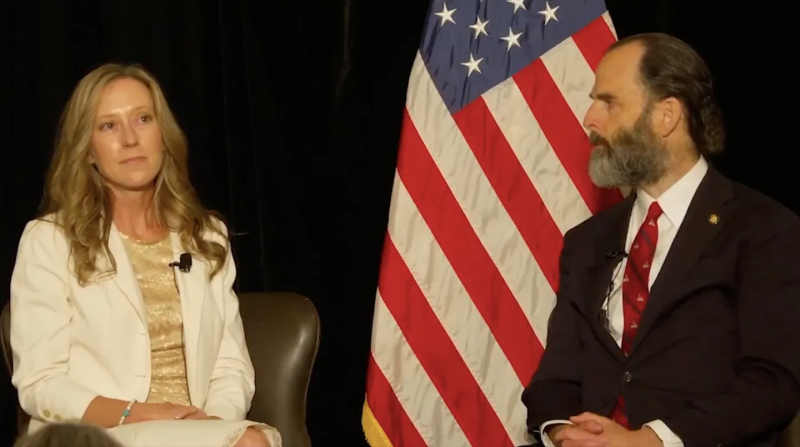
Dr Sara Brenner with Leland Lehrman on 15 May 2025 at the MAHA Institute Round Table in Washington, DC
Prior to that, she was Chief Medical Officer for diagnostics and was detailed to the White House to support the Biden administration’s Covid-19 response. She didn’t just participate in the pandemic response, she helped shape it from within.
“Knowing what I knew—not only about nanotechnology, about medicine, about the medical countermeasures—but also having a very strong and firm grounding in bioethics…there were many things that were not right,” she told the audience.
That someone with her seniority and access to internal data privately rejected the vaccine, while her agency promoted it to millions of pregnant women, presents a profound ethical dilemma.
Brenner’s Concerns about mRNA Safety
Brenner explained that her decision was driven by a lack of safety data, particularly around the biodistribution of the vaccine’s lipid nanoparticles (LNPs)—the tiny fat particles used to deliver the mRNA into cells.
“It was unknown at the time what the biodistribution patterns of those products were…That was my primary concern, and that exposure I was very concerned about,” said Brenner.
She had reason to be cautious.
As a nanomedicine expert who built an MD/PhD program in the field, Brenner had spent years researching the “biodistribution, excretion, metabolism and toxicities associated with engineered nanoparticles.”
“Materials that don’t exist in nature—there’s a lot of unknowns,” said Brenner.
She warned that unintended toxic effects—especially in vulnerable populations like pregnant women—could not be ignored.
“Regardless of the medical product or the intervention, there’s always going to be the need to evaluate both the intended outcomes…and the unintended consequences,” she cautioned.
Warnings Ignored
Brenner’s concerns echoed those raised in 2021 by Canadian immunologist Dr Byram Bridle, who first exposed internal documents from Japan’s regulatory agency showing that LNPs didn’t remain at the injection site, but travelled throughout the body and accumulated in organs including the ovaries, liver, spleen, and bone marrow.
At the time, Bridle’s warnings were aggressively dismissed. His reputation took a hit, and he faced institutional censure from the University of Guelph, where he was a professor, for speaking out against vaccine mandates.
Dr Byram Bridle, Canadian immunologist. Photo credit: Kenneth Armstrong
Now, Brenner’s comments confirm that these concerns were not only valid—they were quietly shared at the highest levels of the FDA.
During the event, Brenner also revealed that her worries extended to breastfeeding and potential exposure to her child after birth.
A 2022 study published in JAMA Pediatrics detected vaccine-derived mRNA in the breast milk of vaccinated mothers for at least 48 hours—the very scenario Brenner had feared.
Yet the FDA made little effort to publicly investigate or address the findings, dismissing them with the vague reassurance that there was “no evidence of harm.”
No Mandate for Brenner?
It’s unclear how Brenner managed to avoid the vaccine mandate that applied to all federal employees at the time. She didn’t say. Perhaps she received a religious or medical exemption—but she left that part out.
What she did reveal was that she had concerns—deep enough not to take the vaccine during her pregnancy. Yet she said nothing publicly, while her agency told millions of other women it was safe.
For many, that silence is hard to accept, and it has left many asking why she didn’t warn other women about a product with ‘zero’ clinical safety data in pregnancy.
No one but Brenner knows the full story. But the ethical contradiction is hard to ignore.
Silence Inside the Castle
Brenner acknowledged the immense pressure inside the FDA to stick to the official narrative.
“They don’t let you get very far out of the castle at FDA with your talking points,” she admitted nervously.
She described the period as a “dark night of the soul” for many civil servants, a time when even “very obvious things” took bravery to say.
She eventually found support through a group called Feds for Medical Freedom—federal workers advocating for informed consent, bodily autonomy, and pushing back against government overreach.
A Culture Change?
Today, under a new administration, Brenner says the culture inside the FDA is shifting. She praised Commissioner Dr Marty Makary and said transparency is finally becoming a priority.
“We’re moving very quickly to make it such that there will be more transparency…so that people can see and evaluate for themselves what the truths are.”
But Brenner’s remarks won’t undo what has already happened—especially to those who were vaccine-injured or whose pregnancies were affected.
What her comments do offer is a rare glimpse into the internal dynamics of a government institution that issued sweeping public assurances while failing to acknowledge its own uncertainty.
“There was no acknowledgement of what was unknown. There were only statements and assertions that were really more like beliefs,” Brenner said of the FDA’s messaging during the pandemic.
That may be her most important admission.
This is more than a story about one woman’s personal decision. It is a story about institutional culture, regulatory failure, and the consequences of silence.
Those who spoke up were punished. Those who stayed silent kept their jobs and reputations. And those who were forced to comply were often left to deal with the collateral damage.
When asked whether she believed she had made the right decision in refusing the Covid-19 vaccine, Brenner replied simply, “I believe so.”
Now that she has spoken, the question remains—who else knew, and said nothing?
Maryanne Demasi, 2023 Brownstone Fellow, is an investigative medical reporter with a PhD in rheumatology, who writes for online media and top tiered medical journals. For over a decade, she produced TV documentaries for the Australian Broadcasting Corporation (ABC) and has worked as a speechwriter and political advisor for the South Australian Science Minister.
General Mills (NYSE: GIS) today announced plans to remove certified colors from all its U.S. cereals and all foods served in K-12 schools by summer 2026. Additionally, the company will work to remove certified colors from its full U.S. retail portfolio by the end of 2027.
For nearly 160 years, General Mills has been providing families quality, great-tasting products across its beloved portfolio of brands.
This change impacts only a small portion of General Mills’ K-12 school portfolio, as nearly all its school offerings today are made without certified colors. Similarly, 85 percent of General Mills’ full U.S. retail portfolio is currently made without certified colors.
“Across the long arc of our history, General Mills has moved quickly to meet evolving consumer needs, and reformulating our product portfolio to remove certified colors is yet another example,” said Jeff Harmening, chairman and CEO, General Mills. “Today, the vast majority of our foods are made without certified colors and we’re working to ensure that will soon apply to our full portfolio. Knowing the trust families place in us, we are leading the way on removing certified colors in cereals and all our foods served in K-12 schools by next summer. We’re committed to continuing to make food that tastes great and is accessible to all."
For decades, General Mills has proven its reformulation capabilities and delivered products that delight consumers and meet a changing landscape. General Mills is the leading provider of whole grains to Americans with other notable efforts including industry-leading sugar-reduction work across General Mills’ K-12 school portfolio, doubling vitamin D in General Mills’ cereals in 2023 to help close nutritional gaps, and reducing sodium by 20 percent across key product categories since 2019.