Search This Blog

Wednesday, June 18, 2025

MAIA Biotechnology partners with Roche for cancer treatment studies

 MAIA Biotechnology, Inc. (NYSE American: MAIA), a clinical-stage biotech company with a market capitalization of $50.31 million, has entered into a clinical master supply agreement with Roche to investigate the combination of MAIA’s telomere-targeting agent ateganosine (THIO) with Roche’s checkpoint inhibitor atezolizumab (Tecentriq) for treating multiple hard-to-treat cancers, according to a press release statement. 

The agreement will support future studies examining the potential efficacy of combining these treatments. Preclinical studies have shown ateganosine to be "highly synergistic and effective" when used with Roche’s anti-PD-L1 agent, according to Vlad Vitoc, M.D., MAIA’s Chairman and CEO. 

Ateganosine is a first-in-class investigational telomere-targeting agent currently in clinical development for non-small cell lung cancer (NSCLC). The compound works by inducing telomerase-dependent telomeric DNA modification, triggering DNA damage responses and selective cancer cell death.

The treatment is being developed as a second or later line of treatment for NSCLC patients who have progressed beyond standard checkpoint inhibitor regimens.

https://www.investing.com/news/company-news/maia-biotechnology-partners-with-roche-for-cancer-treatment-studies-93CH-4101314

FDA signs off on Gilead’s landmark long-acting PrEP med

 With the FDA’s much-anticipated nod for Gilead Sciences’ long-acting HIV pre-exposure prophylaxis (PrEP) injection Yeztugo (lenacapivir), a new era of HIV prevention has dawned.

The approval, which came a day ahead of its June 19 scheduled FDA decision date, marks the first for a twice-yearly PrEP option and fittingly comes just before the 13-year anniversary of the introduction of world’s first PrEP option, Gilead’s daily pill Truvada. 

Along with the convenience factor of the every-six-month injection, Yeztugo also touts competitive efficacy proven through two large phase 3 studies. Gilead has touted its clinical effort as the “most comprehensive and diverse HIV prevention trial program ever conducted."

In Gilead’s PURPOSE 1 trial of cisgender women at sites across South Africa and Uganda, Yeztugo use yielded an unprecedented 100% efficacy rate, with zero HIV infections observed across the treatment group. The drug also demonstrated its superiority when compared to Gilead's own Truvada, the results showed.

The PURPOSE 2 trial, meanwhile, tested the long-acting PrEP drug in a broader population that included cisgender gay and bisexual men, transgender people and non-binary people at sites across the world. Again, Yeztugo proved to be widely effective at reducing HIV infections; 99.9% of those who took the twice-yearly option did not acquire HIV, with only two cases reported out of more than 2,000 participants. The result showed that Yeztugo is 89% more effective at reducing HIV than once-daily Truvada, the company pointed out.

In studying Yeztugo across the PURPOSE trials, Gilead noted adherence issues with the once-daily comparators Truvada and its newer option, Descovy. With two yearly injections of Yeztugo, PrEP users can “get it and forget it” instead of having to remember to take a daily pill, Jared Baeten, M.D., Ph.D., Gilead’s SVP of clinical development and head of virology, explained in a recent interview with Fierce Pharma.

It's all a part of the company’s plan to “redefine the PrEP market” as a whole, chief commercial officer Johanna Mercier noted on an earnings call last summer. While Gilead already has a hold on the PrEP market with its existing pills, “new options” are needed to work toward the goal of “ending infections in this country and around the world,” Baeten said.

Now, with the FDA’s blessing, the company can hit the ground running with the “thoughtful and creative” rollout it’s been plotting (PDF) for months now.

Gilead has already set up agreements with six drugmakers that were given a royalty-free license to make and supply low-cost versions of the long-acting PrEP option in 120 high-incidence, resource limited countries. It also is utilizing the European Medicines Agency’s EU-Medicines for all program to allow other drug regulators to leverage Europe’s accelerated review of the drug for their own assessments, potentially speeding up broader global access.

“We see the potential for lenacapivir to be a medicine of global impact,” Baeton said. “We’re pushing on all sides to make sure that the impact at the global scale is going to fulfill the promise that lenacapivir holds.”

Even so, to deliver on its goal of widening the existing PrEP market, “targeted approaches” will be needed to unlock underpenetrated markets overseas, Citi analysts pointed out in a December note to clients. In the U.S., Gilead looks to expand the 400,000-person PrEP market to more than 1 million people by the mid-2030s.

Yeztugo marks another feather in Gilead's cap when it comes to the company's leading HIV portfolio. The drug's active ingredient, lenacapivir, was first approved several years ago for adults with multi-drug-resistant HIV under the brand name Sunlenca. It’s a “tiny, tiny population,” Baeton said, but one that the company is “so proud” to treat.

Despite the company’s work in other treatment areas like oncology and liver disease, Gilead's HIV products continue to make up the majority of its overall sales, driven largely by HIV treatment Biktarvy. 

Gilead hasn’t yet offered specific sales expectations for Yeztugo, but it expects the current PrEP market to grow “quite rapidly” upon launch considering that many PrEP-naïve people are “hanging in there” until it’s available, Mercier said on an April earnings call. Mizuho analysts previously put lenacapavir's peak annual sales potential at around $4 billion.

Until now, GSK’s 2021-approved every-two-month Apretude was the longest-acting player in the PrEP market. Considering that lenacapivir’s launch is “one of the most awaited in the HIV market,” Citi analysts figure Gilead’s PrEP portfolio can secure more than 60% share of the U.S. PrEP market by the mid-2030s, according to a December note to clients. 

https://www.fiercepharma.com/pharma/its-here-fda-signs-gileads-landmark-long-acting-prep-signaling-new-era-hiv-prevention

'Fed keeps rates unchanged, sees two cuts in 2025 but less easing in later years'

 The Federal Reserve held interest rates steady on Wednesday and policymakers signaled borrowing costs are still likely to fall this year, but slowed the overall pace of expected future rate cuts in the face of estimated higher inflation flowing from the Trump administration's tariff plans.

In new economic projections, policymakers sketched a modestly stagflationary picture of the U.S. economy, with economic growth slowing to 1.4% this year, unemployment rising to 4.5% by the end of this year, and inflation finishing 2025 at 3%, well above the current level.

While policymakers still anticipate cutting rates by half a percentage point this year, as they projected in March and December, they slightly slowed the pace from there to a single quarter-percentage-point cut in each of 2026 and 2027 in a protracted fight to return inflation to the central bank's 2% target.

Under the new projections, inflation remains elevated at 2.4% through 2026 before falling to 2.1% in 2027 amid largely stable unemployment.

"Uncertainty about the economic outlook has diminished but remains elevated," the Fed said in its latest policy statement, a modification of language used in May, at a more turbulent moment in the trade debate, when it said that the risk of both higher inflation and higher unemployment had risen.

https://www.msn.com/en-us/money/markets/fed-keeps-rates-unchanged-sees-two-cuts-in-2025-but-less-easing-in-later-years/ar-AA1GYwCT

'Brits & Ukrainians Are Plotting To Manipulate Trump Into Escalating Against Russia'

 by Andrew Korybko via Substack,

Russia’s Foreign Intelligence Agency (SVR) warned that the Brits and Ukrainians are preparing two false flag scenarios in the Baltic Sea.

The first one would see Ukrainian-transferred Soviet/Russian torpedoes explode near a US ship there and a supposedly malfunctioning one will then be found to implicate Russia in the alleged attack

The second, meanwhile, will involve Ukrainian-transferred Soviet/Russian mines fished out of the Baltic Sea and presented as proof of a Kremlin plot to sabotage international shipping.

These perfidious provocations are being employed to manipulate Trump into escalating against Russia after Secretary of Defense Pete Hegseth announced in mid-February that the US won’t extend Article 5 mutual defense guarantees to NATO countries’ troops that might deploy to Ukraine. That scenario was the initial one that was planned for getting him to pull out of talks with Putin and then double down on support for Ukraine, but his team preemptively scuttled it through Hegseth’s announcement.

That’s why efforts are now underway to organize a false flag attack against a US ship in the Baltic and/or frame Russia as a threat to international shipping through the fishing out of its mines there. The Baltic has already been a so-called “NATO lake” since even before Finland and Sweden’s joined NATO given their prior shadow membership in the bloc, however, so it’s unrealistic that Russia could really carry out either of these two operations undetected even if it wanted to.

Here are some background briefings:

* 11 March: “Russian Spies Warn That The UK Is Trying To Sabotage Trump’s Envisaged ‘New Détente’

* 24 March: “Putin’s Senior Aide Patrushev Shared Some Updates About The Arctic & Baltic Fronts

* 22 April: “Estonia Might Become Europe’s Next Trouble Spot

* 1 June: “Russia’s Military Build-Up Along The Finnish Border Will Likely Be The New Normal

* 3 June: “The Russian-Ukrainian Talks Are At An Impasse That Only The US Or Brute Force Can Break

To summarize, they detail the contextual evolution of this scenario from SVR’s prior warnings of the UK’s intent to sabotage the Russian-US talks on Ukraine to the motives of regional actors (Estonia and Finland) in going along with this, ending with the diplomatic impasse that defines today’s state of affairs. About that, if the US doesn’t coerce Ukraine into the concessions that Russia demands for peace but also doesn’t wash its hands of this conflict, then it might very well double down on its involvement instead.

The reasonable speculation that Trump knew about Ukraine’s strategic drone strikes against Russia in advance coupled with the latest speculation that he deceived Iran with duplicitous diplomacy doesn’t do much to inspire confidence in him personally since he could possibly be in on these false flag plots too. Despite Putin’s bonhomie with Trump, which was recently expressed through their most recent call, some in Russia are beginning to suspect Trump of double-dealing.

It’s therefore imperative that he preemptively commit to not escalating against Russia if either of these two false flag scenarios transpire just like Hegseth preemptively averted the deployment of NATO countries’ troops to Ukraine (at least for now) by declaring that Article 5 won’t extend to them. It’s unclear whether Trump read SVR’s warning or if he can rely on his advisors to inform him (unless Putin told already him), however, so he might not even be aware of this and could thus be manipulated.

https://www.zerohedge.com/geopolitical/brits-ukrainians-are-plotting-manipulate-trump-escalating-against-russia

Can Bureaucracy Love Science? ‘Bethesda Declaration’ Reveals NIH’s Culture Crisis

 On June 9, about 300 employees of the National Institutes of Health, representing all 27 NIH institutes, issued a letter they called the “Bethesda Declaration,” calling on NIH director Jay Bhattacharya, MD PhD, to reverse the Trump administration’s course on multiple initiatives. 

The declaration was explicitly inspired by the October 2020 “Great Barrington Declaration,” co-authored by Bhattacharya, an epidemiologist who was then a professor of health policy at Stanford, and signed at the American Institute for Economic Research’s Great Barrington campus. That declaration asked public health authorities to redirect anti-COVID efforts away from mandatory school and workplace closures, since children and healthy adults were at low risk of death, and focus efforts on protecting the elderly and chronically ill. For voicing this perspective, its authors (also including Dr. Martin Kulldorff, biostatistician and professor of medicine at Harvard, and Dr. Sunetra Gupta, epidemiologist and professor at Oxford) were blacklisted on Twitter (now X) and personally targeted for attack by federal health officials.

The authors of the Bethesda Declaration call on Bhattacharya to pay more than lip service to “establishing a culture of respect for free speech and dissent,” affirm that “dissent is the very essence of science,” and ensure that dissenting voices are “heard and allowed.” They accuse the Trump administration of politicizing research; cutting funding for research on health disparities, COVID immunization, health impacts of climate change, and the health needs of diverse populations; undermining global collaboration, peer review, and funding of indirect research costs; and firing essential NIH staff

Both parties to the dispute can agree on one thing: the NIH’s annual budget of about $50 billion makes it the world’s largest and most influential organization supporting biomedical research. To be sure, pharmaceutical firms and biomedical device manufacturers invest several times this amount in research each year, but their programs are more directly tied to future profit, while NIH can support investigations with no immediate prospects of generating revenue. Many such projects, including Watson and Crick’s discovery of the structure of DNA, have subsequently turned out to produce immense economic returns.

Yet Bhattacharya’s mission, as he conceives of it, extends far beyond cost reduction to the very ethos and culture of biomedical research. For one thing, he is focused on the contemporary “replicability crisis.” A 2016 paper published in Nature showed that more than 70 percent of over 1,500 researchers polled have been unable to reproduce the published results of another researcher. One well-known 2021 review of cancer biology research showed that among studies that had been repeated, the effect sizes were on average 85 percent smaller than what had been reported.

Bhattacharya means to combat this reproducibility crisis by reversing the current heavy bias against publishing replication studies. As things stand, biomedical journals are almost 10 times as likely to publish positive as negative results, meaning that any medical researcher who wants to get a doctorate, get published, and get funded needs to show that the therapy under investigation is effective. The culture of science must shift to recognize that studies that fail to replicate published results are as important a part of good scientific practice as positive ones. 

Bhattacharya himself incurred the wrath of leaders at NIH such as director Francis Collins, not only by co-authoring the Great Barrington Declaration but also by publishing results during the first months of the pandemic that showed that the prevalence of COVID infection was far higher than officials supposed (the Santa Clara study). The significance of this finding was this: calculations of mortality rates depend not just on numbers of deaths (the numerator) but also on numbers of cases of infections in the population (the denominator). Bhattacharya found estimates of the latter were systemically too low, which dramatically and incorrectly inflated COVID’s perceived lethality. 

For many, it is difficult to believe that published scientific results could be wrong. But as Bhattacharya’s colleague John Ioannidis has long argued, most findings are almost certainly wrong, due to biases built into research methodology that Bhattacharya aims to correct. This is not mainly fraud but unrecognized bias. For example, most studies have small sample sizes and low statistical power, data sets are routinely not shared, the culture of scientific publication and citation favors positive results, study results are not subjected to replication, and researchers are under tremendous pressure to “succeed.” 

The NIH has been perfectly designed to produce the results it is currently getting. What is it really good at? Keeping established researchers funded and ensuring that current research paradigms are carried forward into the future. To sit on a committee that evaluates research proposals, for example, scientists must be funded, which tends to reinforce current paradigms. Moreover, researchers must present preliminary data to show that their proposals are likely to produce positive results. Not surprisingly, the NIH culture makes it difficult for new researchers to secure funding to investigate new ideas. Likewise, it’s rare to receive funding for research that challenges or seeks to overturn NIH’s previously published findings. 

Bhattacharya also criticizes NIH’s current pattern of funding for indirect costs. While there are nearly 6,000 US colleges and universities, only a relatively small number – dozens – receive substantial amounts of NIH funding, often charging indirect costs rates of over 50 percent. Every $1 million of direct research funding needs to be accompanied by more than $500,000 of additional funding to cover costs such as facilities, maintenance, utilities, and support personnel. This concentrates research in relatively few centers, further reducing diversity among researchers, their investigations, and scientific ideas. 

The core question is this: what does the NIH, and more broadly speaking, the scientific enterprise, exist to do? Is its principal purpose to sustain funded researchers and their research programs? Or is it to promote discoveries that improve human health? If the latter is paramount, then the culture of the NIH must shift to put truth above success. What matters most is not how many grant dollars scientists garner, how many papers they publish, or how many awards they receive, but the degree to which they accurately illuminate what we really need to know. 

Much hangs on Bhattacharya’s response to the Bethesda Declaration. Will he engage in character assassination and retribution, seeking to silence or terminate those criticizing the administration’s policies? Or will he speak out and act on behalf of good science, a word with origins in the Latin root meaning “to know.” 

Science needs open and self-critical discussion that welcomes differing points of view, insists on the highest standards of evidence, shuns biases, and prizes the truth above all else. The NIH’s pursuit of knowledge has been ailing, and restoring it to good health will require strong medicine. 

Richard Gunderman, MD, PhD, is Chancellor’s Professor of Radiology, Pediatrics, Medical Education, Philosophy, Liberal Arts, Philanthropy, and Medical Humanities and Health Studies at Indiana University.

Biogen bids to extend use of Skyclarys to younger patients

 Biogen has started a phase 3 trial that it hopes will extend the label for its Skyclarys therapy for inherited neurological disease Friedreich's ataxia (FA) to include children as young as two.

Skyclarys (omaveloxolone) has been approved since 2023 as a treatment for patients aged 16 and over with FA, an ultra-rare disease that results in a range of symptoms, including difficulty walking, inability to coordinate movements, and muscle weakness.

The disease – which affects a few thousand people in the US – typically leads to patients becoming incapacitated and wheelchair-bound by their teens or early twenties, and leads to early death. Skyclarys is the only FDA-approved drug for FA  and has been launched in 40 countries worldwide.

The new trial, called BRAVE, will enrol FA patients aged two to 15 and will include ambulatory and non-ambulatory children, according to Biogen. Testing the drug in the younger age group could be significant, as symptoms of FA generally start to emerge between the ages of five and 15 but can manifest earlier or later.

"Recognising the symptoms of Friedreich ataxia typically begin in childhood, and earlier onset of symptoms is associated with faster disease progression, there is tremendous unmet need in the paediatric community," said Stephanie Fradette, who heads the neuromuscular development unit at Biogen.

"We have been urgently advancing the paediatric development plan for omaveloxolone and are thrilled that the Phase 3 BRAVE study has now begun," she added.

BRAVE is expected to enrol around 255 children with FA and will initially run for 52 weeks. It will look at the change from baseline in the Upright Stability Score (USS), used to measure disease progression in FA, with an open-label extension that will continue to follow patients out to two years.

Skyclarys is an important growth product for Biogen, which has been hit in the last few years by a series of pipeline failures and patent expiries, as well as the disastrous launch of Eisai-partnered Alzheimer's therapy Aduhelm (aducanumab) and slow uptake of follow-up therapy Leqembi (lecanemab).

Sales of the drug came in at $382 million last year, and added another $124 million in the first quarter of 2025, although Biogen said sales in the US this year have been affected by "Medicare discount dynamics."

The company has modelled a $50 to $100 million impact from the Medicare Part D redesign in 2025, with around a third of that total related to Skyclarys.

Biogen acquired rights to Skyclarys in 2023 when it bought Reata Pharma for $7.3 billion. Analysts have previously suggested that the drug could make sales of more than $1 billion a year at its peak.

https://pharmaphorum.com/news/biogen-bids-extend-use-skyclarys-younger-patients

Reports Of Warplanes Seeking To Strike Ayatollah As Israel Hit 1,100 Iranian Targets Since Friday

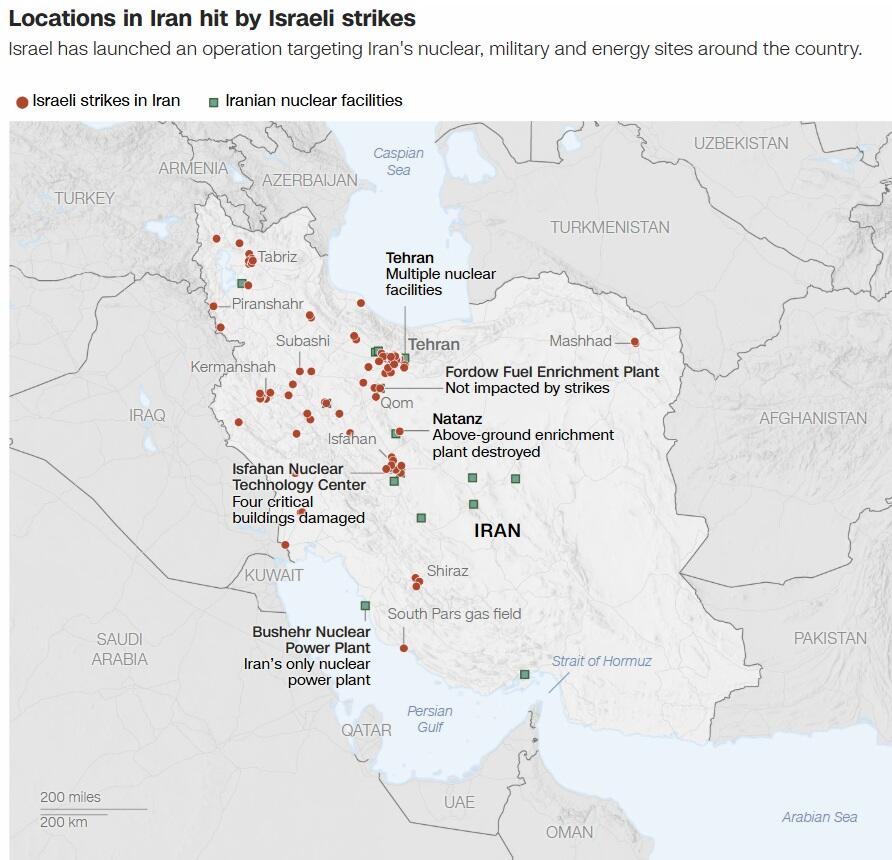
 More waves of missiles and strikes were exchanged between Israel and Iran overnight, with Israeli's military announcing that 1,100 Iranian targets were hit since Friday.

The Israeli Air Force affirmed Wednesday that it is currently striking "military targets belonging to the Iranian regime in Tehran." The war shows no signs of abating, and as yet there are no announcements that Iranian and US negotiators plan to meet.

Via Reuters

Despite more waves of Iranian missiles having pummeled Israel in the overnight and early morning hours, Israeli leaders are trying to present normalcy and are telling the population not to panic.

"Alongside intensified combat against Iran to remove threats — we will reopen the economy, gradually release the public, and return Israel to a path of activity and security," Defense Minister Katz said, given schools and public venues have been closed, and airspace shut for days.

On the other side, Iranians say they are living through "a nightmare" after Israel's latest attacks, which involved more than 50 aircraft on Iranian centrifuge and missile production sites overnight.

Hebrew social media accounts are now widely claiming that Israeli jets are going after locations where they believe Ayatollah Khamenei could be hiding. Though is bunker is likely only known to his closest aides...

The Israelis continue going for command and control, nuclear, and vital infrastructure sites. Defense Minister Israel Katz has lately announced Israeli Air Force fighter jets just "destroyed the headquarters of the Iranian regime's internal security, the main arm of the Iranian dictator’s oppression."

"As we promised, we will continue to target symbols of [Iran's] rule and strike the Ayatollah regime wherever it may be," he said.

CNN: Data as of June 17, 2025 at 6:00 p.m. ET. The Institute for the Study of War with AEI’s Critical Threats Project, CNN analysis of social media, International Atomic Energy Agency

But Israeli casualties are mounting, amid immense damage on the ground. According to Israel's Channel 12, "Since the start of the battle last week, Iran has launched approximately 400 ballistic missiles toward Israel, killing 24 people and wounding 840."

In an astounding statement, given the world stands at the brink of a WW3-style broader Mideast conflagration which could burn for weeks or months more, German Chancellor Friedrich Merz has praised Israel for doing the "dirty work for all of us" - in reference to the Western allies.

* * *

Below are some of the latest developments in the conflict via Newsquawk:

Geopolitics: Latest

  • Iranian Supreme leader to speak shortly, according to ISNA.
  • Iranian ambassador to the UN, says, if we come to the conclusion that the US is directly involved in attacks on Iran, we will start responding to the US

US Involvement?

  • US officials signalled that the next 24 to 48 hours would be critical in determining whether a diplomatic solution with Iran is possible - or if the president might resort to military action instead, according to ABC.
  • "Western sources: We have indications that the US will attack Iran soon", according to Kann News.
  • US embassy in Jerusalem will be closed Wednesday through Friday, according to the US State Department.
  • US President Trump is considering a range of options when it comes to Iran, including a possible US strike on the country, according to multiple officials cited by NBC.
  • Israel Channel 12 journalists report US could join the war against Iran Tuesday night, via Faytuks News citing a telegram post.

Strikes Headlines

  • Iranian Revolutionary Guards said Iran's Fattah missiles broke through Israeli defences, giving it 'complete domination' over Israeli airspace.
  • "Israel's Channel 12: Army attacks Tehran's refineries", according to Al Arabiya.
  • Israeli military said it attacked a centrifuge production site and several weapons production sites of the Iranian regime last night.
  • IDF Spokesman said the Iranian regime still has great capabilities that allow it to harm them, Al Jazeera reports. They attacked the IRGC headquarters and killed Iran's Chief of Staff. "When we finish our mission, we will announce it and will not allow the existential threat against us to continue".
  • Iran has reportedly prepared for strikes on US bases if the US joins the war, according to NYT; Officials suggest that in the event of an attack, Iran could begin to plant mines in the Strait of Hormuz.
  • Iranian Supreme Leader Khamenei said The battle has begun, via Al Hadath.
  • Iranian state media claimed that tonight (Tuesday night) will "hold a surprise the world will remember for centuries", according to multiple reports.
  • "IRGC: Attacks on Israel will continue continuously and gradually", according to Sky News Arabia.

Diplomacy Headlines

  • "Source familiar says there are no plans for a meeting this week between Witkoff and Araghchi", according to an Al-Monitor journalist.