Search This Blog

Monday, February 23, 2026

Astellas, Vir engage in $1.7B deal for masked prostate cancer bispecific

 Astellas is aiding Vir Biotechnology’s oncology pivot with a $1.7 billion global collaboration focused on a potential best-in-class T-cell engager (TCE) for prostate cancer.

Under the leadership of CEO Marianne De Backer, Ph.D., Vir is trading a stake in its PSMA-targeted bispecific VIR-5500 for a $335 million upfront and near-term capital infusion from Astellas.

The PSMAxCD3 bispecific leverages Vir’s PRO-XTEN dual-masking technology, which is designed to keep the therapy inactive until it’s unmasked within the tumor. The drug is reporting updated phase 1 data at the 2026 ASCO Genitourinary Cancers Symposium (ASCO GU) that the partners believe are promising. 

The alliance validates Vir’s shift from an infectious disease focus toward immuno-oncology in a strategic move that De Backer launched by licensing the PRO-XTEN platform and three clinical-stage TCEs—including VIR-5500—from Sanofi in 2024. For Astellas, the deal could reinforce the Japanese pharma’s position in the prostate cancer market as its Pfizer-partnered Xtandi (enzalutamide) starts to lose patent protection and market exclusivity in different territories this year. 
 

The perfect match


Astellas emerged as “the perfect partner” after a “competitive” process, De Backer told Fierce Biotech in an interview. As the world’s No.1 company in prostate cancer with “very deep expertise internally on clinical development,” Astellas is “the partner of choice in this field,” she said.

De Backer joined Vir in 2023 after leading business development at the pharmaceutical branch of Bayer, which is also experienced in prostate cancer based on its next-generation androgen receptor inhibitor Nubeqa (darolutamide). 

“The field is moving very, very fast. And we believe that we could accelerate the program by working together with someone who has a really strong track record in the space,” De Backer said, adding that the partnership could also broaden the patient populations that could be explored for VIR-5500.

Along with the ASCO GU data revelation, Vir said it expects to move VIR-5500 into phase 3 testing in 2027. While the company has so far been testing the drug in metastatic castration-resistant prostate cancer (mCRPC), it now also aims to initiate phase 1 dose-expansion cohorts in metastatic hormone-sensitive prostate cancer in the second quarter of 2026. 

“It’s the promise of what T-cell engagers can deliver,” Anthony Jarkowski, primary focus lead of immuno-oncology at Astellas, said in the joint interview with Fierce, when asked about the company's rationale for the deal. “What we see from VR-5500 is really a good efficacy profile, and importantly, the safety profile looks really manageable.”

Besides its deep experience in prostate cancer, Astellas is also not entirely new to TCE work; the company has a Claudin18.2xCD3 agent currently in clinical development for stomach cancer.

The $335 million includes $240 million in cash, $75 million in an equity investment at a 50% premium to Vir’s 30-day average share price, and a near-term $20 million milestone. The San Francisco biotech is also eligible to receive up to $1.37 billion in additional development, regulatory and sales milestones, plus tiered, double-digit royalties on future ex-U.S. sales. 

Astellas and Vir will share development costs 60-40. In the U.S., Vir will have the option to co-promote VIR-5500, with profits or losses shared equally. Astellas will be solely responsible for commercialization outside the U.S.

Vir’s original licensing deal with Sanofi means some proceeds from the Astellas pact will be shared with the French pharma.
 

Updated phase 1 data


Astellas and Vir are venturing into a highly competitive field. In PSMA alone, Novartis is already making commercial progress with its blockbuster radioligand therapy Pluvicto. And Janux Therapeutics’ masked TCE, JANX007, is currently ahead of VIR-5500 in the development race. 

Further, Amgen’s STEAP1-targeting xaluritamig and Johnson & Johnson’s KLK2-targeting pasritamig are both TCE candidates designed to treat prostate cancer. 

Despite existing treatment options, an unmet medical need still exists in prostate cancer, as only about 30% of patients with metastatic castration-resistant prostate cancer (mCRPC) can live to five years after diagnosis, according to Vir. 

Rather than introducing a radioactive foreign agent, a TCE activates a patient’s own T cells to fight the tumors, potentially avoiding some side effects. But TCEs come with their own toxicity problems due to that immune activation mechanism, most notably cytokine release syndrome (CRS). That’s where Vir’s PRO-XTEN comes in.

Compared with Janux’s single-masking technology, Vir’s dual masks cover both the tumor-associated antigen side and the CD3 component. This allows for additional protection before reaching the target tumor, enabling a great therapeutic index, De Backer explained. 

Updated efficacy data to be presented at ASCO GU showed that 14 (82%) heavily pretreated mCRPC patients who got the highest evaluated doses (3,000 μg/kg or above) of VIR-5500 achieved a 50% or greater reduction in PSA levels from baseline, while nine (53%) saw at least a 90% reduction. These endpoints are called PSA50 and PSA90, respectively.

The PSA responses were notably improved from the initial data that Vir reported a year ago from several lower-dose cohorts, and they now look very similar to the 86% PSA50 and 54% PSA90 that Janux reported in December among late-line patients who received its selected phase 1b dosing regimen. 

Out of 11 patients evaluable for tumor responses under the RECIST criteria who received the highest doses, VIR-5500 led to an objective response rate of 45%, including four confirmed responses and one unconfirmed response. By comparison, Janux recently reported a 30% ORR among 27 patients without breaking up confirmed and unconfirmed cases, a decline from the previous 50% ORR generated in eight evaluable patients.

As for safety, a potential key differentiator for VIR-5500, Vir again stated that prophylactic steroids were not required to prevent serious CRS events, and no IL-6 inhibitors were used to manage CRS. 

CRS was observed in 29 (50%) of all 58 patients, and Vir described the events as “generally restricted to grade 1.” No grade 3 or above CRS was seen in the go-forward dose that Vir has selected, De Backer told Fierce. However, the chief executive didn’t say whether any grade 3 events were recorded in other subgroups. More detailed data will be presented at ASCO GU on Feb. 26. 

Among all patients who got various doses of VIR-5500 monotherapy, grade 3 or above treatment-related adverse events occurred in seven (12%) patients.

“It is remarkable to see these early signs of profound anti-tumor activity in heavily pretreated mCRPC patients, and the favorable tolerability with minimal CRS to date means VIR-5500 could play a role in treating earlier disease,” Johann de Bono, the phase 1 trial’s principal investigator and a prostate cancer expert from The Institute of Cancer Research in the U.K., said in a Feb. 23 statement.

“What really stood out to us is how they’re balanced—efficacy and toxicity,” Jarkowski said.

Vir’s dual-masking technology could also give VIR-5500 a preferable dosing frequency compared to its rival. Janux’s recent data came from a dosing schedule of once every week—and the company also has some early data for a once-every-other-week regimen—whereas Vir’s drug was administered once every three weeks (Q3W). However, both are still more frequent than Pluvicto’s once-every-six-weeks schedule, although Pluvicto administration is currently limited to designated treatment centers thanks to its radioactive nature.

De Backer argued that Q3W dosing is “already very attractive, even if you want to move to earlier lines or outpatient setting.” Both De Backer and Jarkowski added that Vir and Astellas will work together to decide what to explore in the future.  

Vir said it has concluded dose-escalation in late-line mCRPC and “has defined a preliminary go-forward dose” for expansion, with monotherapy dose-expansion in this setting planned for the second quarter. Dose-escalation of VIR-5500 in combination with Xtandi is ongoing in early-line mCRPC, with dose expansion also expected to start in Q2.

https://www.fiercebiotech.com/biotech/astellas-vir-engage-17b-deal-masked-prostate-cancer-bispecific

Canadian Drugmaker Apotex Seeks Up to $730 Million in First-Half IPO


Canadian generic drug manufacturer Apotex Inc. is looking at the first half of the year for an initial public offering in Toronto that could raise as much as C$1 billion ($730 million), according to people familiar with the matter.

An IPO of that size would be Canada’s largest debut since 2021. RBC Capital MarketsJefferies Financial Group and TD Securities are advising on the transaction, people familiar with the offering have said.


"The World Is In Peril": Anthropic's Safety Boss Quits

 by Kay Rubacek via The Epoch Times,

Most people have never heard of Mrinank Sharma. That is part of the problem.

Earlier this month, Sharma resigned from Anthropic, one of the most influential artificial intelligence companies in the world.

He had led its Safeguards Research Team, the group responsible for ensuring that Anthropic’s AI could not be used to help engineer a biological weapon.

His final project was a study of how AI systems distort the way people perceive reality. It was serious, consequential work for humankind.

His resignation letter was seen more than 14 million times on X.

It opened with the words, “the world is in peril.”

And it ended with a poem and by announcing that he was leaving one of the most consequential jobs in artificial intelligence to pursue a poetry degree. Yes, you read that right: peril and poetry.

The poem he quoted is, “The Way It Is,” by the American poet William Stafford.

It speaks of a thread that runs through a life—a thread that goes among things that change, but does not change itself. While you hold it, you cannot get lost. Tragedies happen. People suffer and grow old. Time unfolds, and nothing stops it. And the final line: you don’t ever let go of the thread.

Although he didn’t state it explicitly, I argue that that thread is morality. It is the enduring sense that some things are right and some things are wrong—not because a law says so, and not because it is profitable, but because human beings, at their best, have just always known it.

Sharma spent two years watching that thread being let go under pressure, in rooms the public is never shown.

His letter said:

“Throughout my time here, I’ve repeatedly seen how hard it is to truly let our values govern our actions.

“I’ve seen this within myself, within the organization, where we constantly face pressures to set aside what matters most, and throughout broader society, too.”

He wrote that humanity is approaching a threshold where “our wisdom must grow in equal measure to our capacity to affect the world, lest we face the consequences.”

He wanted to contribute in a way that felt fully in his integrity and to devote himself to what he called “the practice of courageous speech.”

A man who built defenses against bioterrorism concluded that the most important thing he could do next was learn to speak with honesty and courage.

That is a major signal about what is happening behind closed doors in AI research and development.

Many experts have compared the development of AI to the development of the atomic bomb. The Manhattan Project was built in total secrecy. The public had no knowledge of it, no voice in how it was used, and no say in what came after. When it was over, some of the scientists who built it spent the rest of their lives in anguish. Several walked away during the project itself.

Sharma was not alone. Numerous safety researchers have walked off AI projects from multiple companies. These departures may be the only signals we, the public, have, because almost everything else about AI development is happening beyond public view. The internal debates, the safety trade-offs, the negotiations over what this technology will and will not be permitted to do—none of it is being shared with the people whose lives it will most profoundly shape. We are not part of this conversation. We are being presented with outcomes and told to adapt.

John Adams wrote that the Constitution was made only for a moral and religious people, and is wholly inadequate for any other. George Washington warned that liberty cannot survive the loss of shared moral principles. The founders studied the collapse of republics throughout history and arrived at the same conclusion: The machinery of freedom requires a moral people to sustain it. Laws and institutions are not enough on their own. They depend on citizens and leaders who hold themselves to something that exists before the law and above it.

That is the thread of human society, and no AI system holds it. If people allow AI to replace the question of right and wrong with the measure of what is legal and permitted, the machine will carry that measure forward at a scale and speed that no previous generation has had to reckon with.

As Sharma ended his resignation letter, “You don’t ever let go of the thread.”

We are at a crossroads not unlike the one the atomic scientists faced.

Sharma’s resignation was a signal.

The wave of departures before and after it are signals.

The reported tensions between AI companies and government over where moral limits should be drawn are also signals.

Together, they are pointing at something the public has not yet been fully invited to consider: that the most important questions about this technology are being worked out without us, and that the thread of morality, which has always required people to hold it by choice, needs to be part of that conversation.

https://www.zerohedge.com/ai/world-peril-anthropics-safety-boss-quits

What The FBI Is Investigating In Criminal Probe Of 2020 Election

 by Petr Svab via The Epoch Times (emphasis ours),

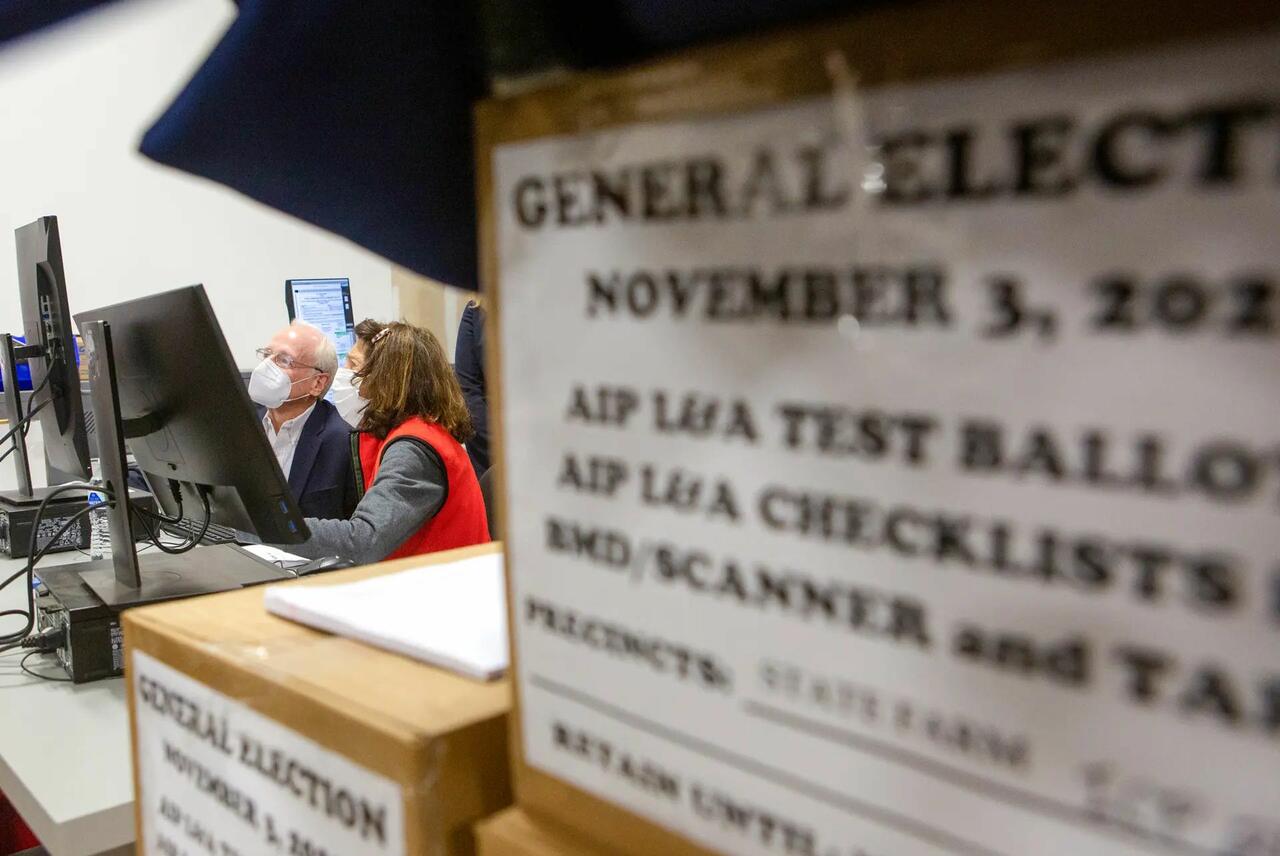
After the election offices of Georgia’s most populous county were raided last month, the FBI has disclosed information indicating where its investigation is heading.

FBI agents are seen at the facility in Union City, Ga., on Jan. 28, 2026.

Federal laws may have been broken during the 2020 election according to the affidavit supporting the court-approved raid. Yet the breadth of the materials seized shows the FBI may be able to check the integrity of the ballots more broadly, uncovering further issues or putting speculation to bed.

President Donald Trump’s campaign challenged the Georgia election most vigorously, as he lost the state to President Joe Biden by fewer than 12,000 votes according to the official tally. The legal challenges failed. Instead, Trump was indicted based on rationale that his efforts to challenge the election results were allegedly executed with corrupt intent. The case was dismissed after he became president again in 2025.

The renewed investigation now targeting Fulton County, which covers the broader Atlanta area, uses a rationale analogous to the case against Trump. The affidavit states that if known irregularities in the election were intentional, such acts would be criminal.

On Jan. 28, agents seized some 700 boxes of election records, including physical ballots from the 2020 election. County officials have since filed a lawsuit seeking to have the materials returned.

The issues detailed in the affidavit were largely discovered years ago by concerned citizens using data obtained through freedom of information requests or litigation. Georgia Secretary of State Brad Raffensperger, who was responsible for overseeing the election and is running for governor of the state, has dismissed the issues as administrative and human errors too small to affect the election’s result.

The FBI, however, has a different perspective.

“If these deficiencies were the result of intentional action, it would be a violation of federal law regardless of whether the failure to retain records or the deprivation of a fair tabulation of a vote was outcome determinative for any particular election or race,” reads the affidavit signed by FBI Special Agent Hugh Evans.

Raffensperger has repeatedly stressed that the 2020 votes were counted three times, including a hand recount and a machine recount.

However, many of the deficiencies outlined in the affidavit happened during these recounts.

The Fulton County Election Hub and Operation Center is seen in Union City, Ga., on Jan. 28, 2026.

The Original Count

Vote counting in Georgia starts by law on election day. Fulton County had more than half a million ballots to tabulate—almost 90 percent cast early or by mail. The result was announced several days later: Biden won the county by 26-point margin.

One issue with the results was a lack of receipts. Each tabulator machine should be “closed” at polls closing and tabulator tape should be printed out to show how many ballots and votes for each candidate were counted. Then, the tape should be signed by the poll manager and two witnesses.

Yet tabulator tapes for more than 300,000 votes weren’t signed, and some were missing altogether, wrote Evans, referring to an analysis by Clay Parikh, a voting machine security expert.

Raffensperger said that was merely administrative oversight, as the vote tallies aren’t recorded on the tape alone. They are also preserved on memory cards in the machines.

But Parikh’s analysis went deeper.

“Parikh identified one tabulator that was used to close out 15 tabulator machines from 12 different locations. In addition, the poll closing time and report printed times on several closing tabulator tapes were close enough in time that Parikh believed someone had to have manipulated the times on the reports,” Evans wrote.

“Parikh believed this showed that the memory cards were removed from the original tabulator and put in another tabulator to print out the closing tabulator tapes.”

Employees of the Fulton County Board of Registration and Elections process ballots in Atlanta on Nov. 4, 2020. Vote counting in Georgia starts, by law, on election day. Fulton County had more than half a million ballots to tabulate—almost 90 percent cast early or by mail. Brandon Bell/Reuters

The tabulators also have “protective counters” that track how many ballots have been scanned on them over their lifetime.

“The protective counters on at least five tabulator tapes from the same unit were identical,” Parikh found, according to Evans. “Some of the reported ballots scanned exceeded the protective counter number.”

This indicated to Parikh that no ballots were ever scanned on these machines and that the numbers generated from those ballots were done so by placing an unencrypted memory card into the unit to generate the closing tape,” Evans wrote.

“This would have allowed an opportunity for the tabulation to be tampered with.”

The tabulators are supposed to scan each ballot, creating a digital record. But the majority of the images from the original in-person voting count have not been preserved by the county, Evans said. At the time, the county was not legally required to preserve them, but it’s not clear why they were discarded to begin with.

“This is another impediment to ruling out non-criminal explanations for the activities during the election,” the affidavit said.

Hand Recount

On Nov. 11, 2020, Raffensperger announced a Risk Limiting Audit. Because the race was so close, it meant recounting all the ballots by hand, according to state law. The ballots were counted in batches and the final tally for each batch was supposed to be put into an electronic auditing system called “Arlo.”

Several people who participated in the audit said they witnessed suspicious occurrences, including a batch of 110 ballots that contained 107 featuring votes for exactly the same candidates. The bubbles on them were filled exactly the same and the paper felt different from other ballots, the participants said. The ballots were marked as absentee but lacked creases from being folded in a return envelope.

It’s possible such “pristine” ballots can be created by duplication, where a damaged ballot is copied on a new one. But those should be clearly marked as “duplicate,” and the original needs to be preserved, Evans said.

Cyber Ninjas CEO Doug Logan (L), whose Florida-based consultancy oversaw a 2020 election ballot audit ordered by the Arizona Senate, speaks at the Arizona Veterans Memorial Coliseum in Phoenix on April 22, 2021. Ross D. Franklin/AP Photo

One of the witnesses, who had been a poll manager for 25 years, also remembered a batch of about 60 ballots marked as coming from a senior living center. She “believed these ballots should have been folded as well but were not,” the affidavit said.

Yet another witness, one of the Fulton County Commissioners, was a poll worker at the time. When helping test the voting machines prior to the election, she saw a pile of unsecured papers used to print testing ballots.

She stated she could have printed any ballot she wanted,” Evans wrote.

She also saw some people “printing random ballots” and managed to rip some up, according to Evans

“She was not sure the reason they were printing ballots as all the test ballots had already been printed.”

None of the witnesses in the affidavit were identified by name.

Evans also mentioned a complaint submitted to Georgia Governor Brian Kemp by chemical engineer Joseph Rossi, alleging inconsistencies in the hand recounts results for dozens of ballot batches. Kemp’s office independently verified the allegations, concluded they were factual, and passed them on to the State Election Board for an investigation, which was eventually conducted by Raffensperger’s office.

Raffensperger dismissed those as human errors during data entry. But some of them raise the question of how such a specific error could have been made.

Members of an adjudication review panel examine scanned absentee ballots at the Fulton County Election Preparation Center in Atlanta on Nov. 4, 2020. Because the race was too close, on Nov. 11, 2020, Georgia Secretary of State Brad Raffensperger announced a risk-limiting audit requiring a full hand recount under state law. Jessica McGowan/Getty Images

For example, one batch was reported as 200 votes for Biden and zero for any other candidate. But when Kemp’s office checked the ballot images for that batch, it showed 85 votes for Biden, 12 for Trump, and three for other candidates.

Another batch was reported as 150 votes for Biden and zero for other candidates. In fact, the batch contained 97 votes for Biden, eight for Trump, and one for a third-party candidate.

There were two more batches reported each as 100 votes for Biden and zero for others. In fact, one had 87 votes for Biden and 10 for Trump; the other had 74 for Biden and 25 for Trump.

https://www.zerohedge.com/political/what-fbi-investigating-criminal-probe-2020-election

Taleb, Citrini Fuel AI Scare Trade as IBM Drops Most in 25 Years

 The artificial intelligence “scare trade” erupted again on Monday as growing concerns about the disruptive power of AI dragged down shares of delivery, payments and software companies, and sent International Business Machines Corp. to its worst plunge in 25 years.

It began after a bearish report was published over the weekend by a little known firm called Citrini Research.

The report, released on social media Sunday, outlined the potential risks to various segments of the global economy, using hypothetical scenarios set in the future, specifically calling out food delivery services and credit card companies as ones facing trouble.

Then AI startup Anthropic said in a blog post Monday that Claude Code tool can help with modernizing COBOL, a dated programming language that’s mainly run on IBM computers.

And finally came a warning from Nassim Taleb: investors should brace for escalating volatility and even bankruptcies in the software sector as the AI rally enters a fragile phase.

IBM shares closed down 13%, the biggest one-day drop since 2000. DoorDash Inc., American Express Co., KKR & Co Inc. and Blackstone Inc. all slumped by at least 6%. Shares of other companies name-checked in the article, including Uber Technologies Inc., Mastercard Inc., Visa Inc., Capital One Financial Corp. and Apollo Global Management Inc. all fell by 4% or more.

“The sole intent of this piece is modeling a scenario that’s been relatively underexplored,” a preface to the article, which was published Sunday, said. “Hopefully, reading this leaves you more prepared for potential left tail risks as AI makes the economy increasingly weird.”

Citrini Research, founded by James van Geelen, presented a scenario set in June 2028 where AI’s disruption has caused mass unemployment for white collar workers, declining consumer spending, software-backed loan defaults and economic contraction. Still, the report notes clearly — “What follows is a scenario, not a prediction.”

Among the various outcomes discussed in this “thought exercise,” Citrini laid out a situation where the dominance of delivery apps like DoorDash and Uber Eats are displaced by “vibe-coded” alternatives.

“We definitely believe agentic commerce will be transformative to the industry,” DoorDash co-founder Andy Fang said in an X post in response to Citrini. “The ground is shifting underneath our feet, and the industry is going to need to adapt to it.”

To Taleb, the author of the markets are underpricing structural risks while overestimating the durability of current AI leaders.

Dire Outlook

Citrini’s report described a potential scenario where AI agents seek to save users’ money by eliminating transaction fees charged by payment processing firms like Mastercard and Visa.


“We are certain some of these scenarios won’t materialize,” the report said. “As investors, we still have time to assess how much of our portfolios are built upon assumptions that won’t survive the decade.”

The grim illustration added even more anxiety into a stock market that has been jolted repeatedly in recent weeks by fears of AI disruption and geopolitical upheaval.

“The report raises real concerns about disruption, even if things don’t end up as dire as the worst-case scenario,” said Thomas George, a portfolio manager at Grizzle Investment Management. “Certainly you don’t feel great after reading it, and I’m sure it leaves anyone holding these stocks with less conviction,” he said.

Citrini’s van Geelen started his career in medicine, and holds a bachelor of science degree from the University of Connecticut in pre-medicine studies, according to his LinkedIn profile. Speaking to Bloomberg’s Odd Lots podcast in 2023, he said he worked his way through undergraduate studies as a paramedic — first in Connecticut and then in California. He also co-founded one of Connecticut’s first medical marijuana dispensaries.

Sectors from software, to wealth management and logistics have all been swept up in the indiscriminate selloffs in recent weeks as investors nervous about the potential disruptions from new AI tools have slipped into a “shoot first, ask questions later” mode.

While software companies have been among the hardest hit, insurance brokers, private credit firms, cybersecurity and even real estate services stocks have all been caught up in the so called “AI scare trade.”

Yet, analysts, strategists and investors have also warned that many of these reactions are exaggerated and are likely overestimating any AI-related risks at this point.

“It is a remarkable reaction,” said Michael O’Rourke, chief market strategist at Jonestrading. “I have seen this market exhibit incredible resilience in the face of actual negative news. Now a literal work of fiction sends it into a tailspin.”

https://finance.yahoo.com/news/software-payments-shares-tumble-citrini-162303649.html

More US recon, tanker planes move toward Iran

 A United States Air Force Boeing KC-135 Stratotanker aerial refuelling aircraft and an E-3 Sentry radar-detection plane were detected on Monday en-route to the Middle East amid heightened tensions with Iran.

FlightRadar data indicated E-3 radar planes were conducting operations above southern and eastern Turkey, while a Stratotanker has apparently been moving toward coastal Israel after departing from Crete. USS Gerald R. Ford had also arrived near the Greek island earlier on Monday.

https://breakingthenews.net/Article/More-US-reckon-tanker-planes-move-toward-Iran/65728096

Protara 68% complete response at six months in Phase 2 for bladder cancer


Protara reports 68% complete response at six months with TARA-002 in Phase 2 ADVANCED-2 BCG-unresponsive bladder cancer trial

  • Company plans to complete enrollment of the registrational TARA-002 cohort in ADVANCED-2 in the second half of 2026.