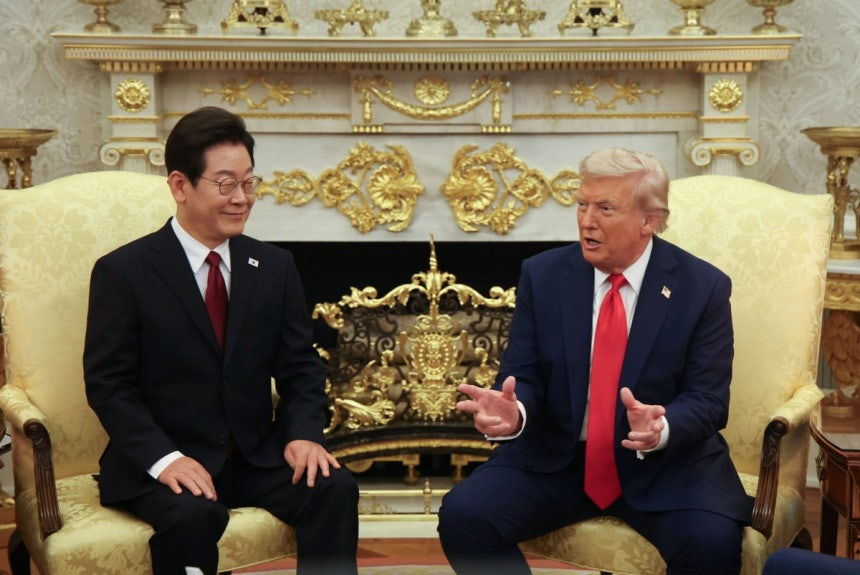
Despite the US Supreme Court’s decision to strike down President Donald Trump’s "reciprocal tariffs," Seoul will “largely maintain” trade conditions under a prior tariff agreement, including its $350 billion investment pledge, government and industry sources said Sunday.
Trump responded to the ruling by signing an executive order imposing a new 10 percent global tariff, set to take effect Tuesday. He has also signaled that the rate could be raised to 15 percent, though he has not provided a specific legal basis.
In a post on Truth Social, he said he would raise the tariff “effective immediately” to a “legally tested” 15 percent level.
The new 10 percent baseline tariff is lower than the 15 percent reciprocal tariff previously applied to Korea, but Seoul is maintaining a cautious stance, anticipating that Trump may pursue alternative avenues to advance his agenda.
“We are closely monitoring follow-up measures by the US administration and will continue amicable discussions on implementing the bilateral tariff agreement regardless of the Supreme Court’s ruling,” a ministry official said Sunday.
The remarks echoed Industry Minister Kim Jung-kwan’s earlier statement Saturday that the trade conditions secured through the negotiations would “largely be maintained.”
The US Supreme Court ruled that the president cannot base reciprocal tariffs on the International Economic Emergency Powers Act. However, other tariff authorities remain intact.
Experts say Seoul should avoid hastily reversing its agreement with Washington, noting that tariffs imposed under separate statutes — including Section 232 of the Trade Expansion Act — remain valid.
“It was not only the 'reciprocal' tariffs but also item-specific tariffs that placed significant pressure on Korea during last year’s negotiations with the US,” said Jang Sang-sik, head of trade trend analysis at the Korea International Trade Association.
Korea’s investment pledge is also tied to broader strategic cooperation in areas such as shipbuilding, energy and nuclear-powered submarine projects.
For the new baseline tariff, Trump is invoking Section 122 of the Trade Act of 1974, which allows the president to impose tariffs of up to 15 percent for up to 150 days without congressional approval. The authority is temporary, and securing longer-term legislative backing could prove difficult, as Democrats and some Republicans oppose elements of his trade policy.
With tariffs remaining a central economic tool for Trump, analysts expect Washington to seek alternative measures to offset potential revenue losses following the court decision, particularly targeting countries such as Korea that are already engaged in negotiations.
Semiconductors are a key area of concern. The Trump administration has floated tariffs of up to 100 percent on chips, though analysts consider such rates unlikely given the US dependence on imports of advanced semiconductors from countries including Korea.
Tariffs on Korea’s automotive, steel and battery sectors remain unchanged, as these industries are subject to Section 232 duties tied to national security concerns. Auto tariffs are under renegotiation, with discussions focused on reducing the rate to 15 percent from a potential 25 percent, while steel tariffs remain at 50 percent.
In Seoul, parties on both sides of the National Assembly said they would proceed with legislative procedures related to the investment pledge despite the court ruling. Lawmakers have formed a special committee on US investment and aim to pass the relevant bill at a plenary session scheduled for March 5.
“We plan to carry out the hearing as scheduled and review the government’s position,” said Rep. Kim Sang-hoon of the main opposition People Power Party, who heads the special committee.
The government is also preparing to launch a committee dedicated to implementing the investment agreement.
Companies are closely watching developments, as policy uncertainty is viewed as more challenging than the tariffs themselves.
“Tariffs are burdensome, but uncertainty is more difficult for companies because it increases planning costs and complicates investment decisions,” an industry official said.

No comments:
Post a Comment
Note: Only a member of this blog may post a comment.