by Maryanne Demasi via The Brownstone Institute,
For months, a quiet battle has been unfolding inside the US Food and Drug Administration (FDA).
It began with an analysis of child deaths after Covid vaccination, followed by strategic leaks to major media outlets, and has now erupted into the open with a memo from the regulator’s own vaccine chief.
In September, it was reported that FDA officials had privately investigated 25 paediatric deaths following Covid vaccination — the first systematic review of such cases since the rollout began.
The findings were meant to be presented to the CDC’s Advisory Committee on Immunization Practices (ACIP). But the presentation never came. The meeting passed without a word. Something had happened behind closed doors.
Now we know what.
On 13 November 2025, STAT published an extraordinary insider account describing a tense internal meeting in which FDA scientist Dr Tracy Beth Høeg presented evidence of young people who had died after Covid vaccination.
According to STAT, her findings triggered pushback from career FDA regulators who feared the implications of acknowledging fatal cases.
Now, comes the explosive memo from FDA vaccine chief Dr Vinay Prasad, confirming — for the first time — that US regulators have formally attributed at least 10 of these children’s deaths to Covid vaccination.
Prasad called it “a profound revelation” with far-reaching implications for American vaccine policy, adding that the true number is “certainly an underestimate.”
Here, I’ll take you through the memo, the leaks, the internal rebellion at FDA, and what this means — not just for Covid vaccines, but for all vaccine approvals going forward.
This story marks a turning point in US vaccine regulation.
The Story That Divided the Regulator
In early September, insiders at the FDA and CDC quietly told the New York Times and the Washington Post that the agency had begun investigating child deaths reported to VAERS.
My reporting confirmed that Dr Tracy Beth Høeg, a senior adviser within the FDA’s vaccine division, had led the review — contacting families, gathering medical records, and obtaining autopsy findings.
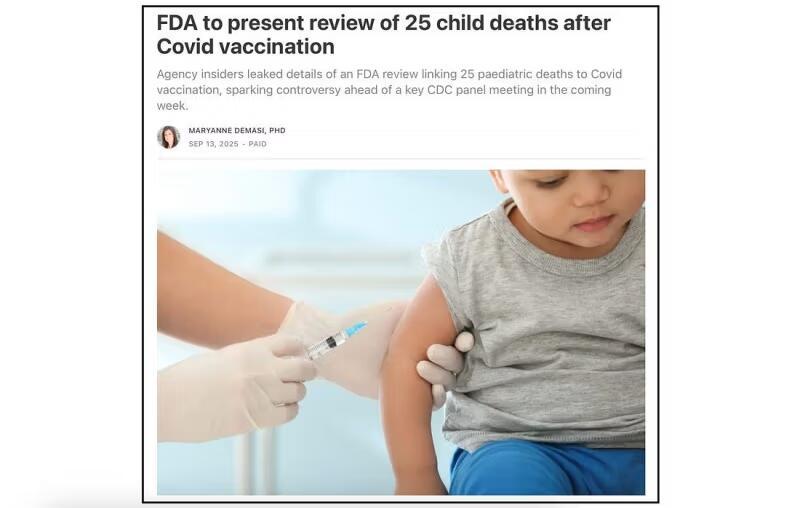
click image for story
It was the first case-by-case evaluation of paediatric deaths conducted since the vaccines were authorised.
The review identified twenty-five children whose deaths occurred following vaccination. Those findings were expected to be presented to ACIP on 18–19 September. Instead, without explanation, the discussion disappeared from the agenda.
Even FDA Commissioner Dr Marty Makary had hinted at the findings on CNN, saying, “We’ve been looking into the VAERS database self-reports, [and] there have been children that have died from the Covid vaccine.”
He described an “intense” investigation involving doctors, autopsies, and family interviews. Yet ACIP heard nothing.
Had the FDA reversed course — or had internal forces blocked disclosure?
STAT’s reporting offered the first real clues.
Inside the FDA: The Meeting That Changed Everything
STAT described a confidential gathering of FDA vaccine scientists in which Høeg presented slides listing roughly two dozen deaths of young people following vaccination.
One slide reportedly read: “Timing fits. Diagnosis fits. No better explanation found. Sufficient information provided.”
According to STAT, some career regulators reacted with “quiet horror” — not at the deaths themselves, but at the policy implications of acknowledging them.
The article portrayed Høeg as pushing to bring the findings to ACIP and to amend vaccine labels for younger males, while longtime staff resisted, describing the evidence as “thin” and worrying about restricting vaccine access.
STAT reported that “no career regulator would stand by the decision,” and Høeg backed away from presenting the cases to ACIP.
It was a rare glimpse of a regulator divided against itself: career staff trying to contain the findings, and FDA leadership apparently trying to surface them.
Nothing more was said publicly — until Prasad’s memo detonated inside the agency.
Prasad’s Explosive Memo
The memo from Dr Vinay Prasad, Director of the FDA’s Centre for Biologics Evaluation and Research (CBER), is unlike anything ever issued by a senior US vaccine regulator.
Addressed to all CBER staff, it confirmed what STAT only implied: FDA scientists had determined that “at least 10 children have died after and because of receiving Covid-19 vaccination.”
Prasad wrote that the true number is “certainly an underestimate” and that “the real number is higher.”
He wrote that “deaths were reported between 2021 and 2024, and ignored for years,” calling it a systemic failure that “requires humility and introspection.”
“It is horrifying to consider that the US vaccine regulation, including our actions, may have harmed more children than we saved,” he wrote.
Prasad defended Høeg’s analysis, saying “Dr Hoeg was correct in her assessment,” and that disagreements reflected subjective coding — not differing facts.
He also noted that healthy children at extremely low risk from Covid had been “coerced” into vaccination under Biden-era mandates, some of which he said “were harmful.”
He added that it was “difficult to read cases where kids aged 7 to 16 may be dead as a result of covid vaccines.”
Prasad also challenged one of the most repeated claims in pandemic messaging — that Covid infection causes more myocarditis than vaccination.
He argued that these comparisons rely on faulty denominators, because they count only people sick enough to seek hospital care while ignoring the far larger number of infections that never present to clinics.
He underscored that vaccination does not prevent eventual infection, so the comparison cannot be framed as “virus versus vaccine.”
A vaccinated child still encounters the virus over their lifetime — but now carries the additional myocarditis risk from the vaccine itself.
The Leaks
Prasad’s memo contained another revelation — confirmation of internal sabotage inside the FDA.
He wrote that “slides she presented, emails she sent, and distorted firsthand reports” from Høeg’s meeting had been leaked to media outlets by staff who believed they were acting appropriately.
He condemned the behaviour as “unethical, illegal, and…factually incorrect,” a blunt repudiation of how the STAT narrative had framed events.
In Prasad’s telling, Høeg had not exaggerated the evidence at all. She had uncovered what the FDA had failed to recognise for nearly three years — that Covid vaccines had killed children.
Far from being the rogue figure depicted in selective leaks, she was doing precisely what the public assumes a regulator does: investigating deaths, contacting families, gathering records, and treating each case as a potential signal that demands scrutiny.
For Prasad, the leaks weren’t merely improper — they betrayed the core obligation of a scientific agency.
He said internal debates must remain inside the FDA until ready for public release, and that he would not “endorse selective reporting of our meetings and documents.” Anyone unwilling to follow that principle, he said, should resign.
It was an extraordinary directive — and a clear sign that the internal battle over whether to acknowledge children’s deaths had reached a breaking point.
A Reaction from Inside ACIP
When the memo surfaced, ACIP vice-chair Dr Robert Malone issued his own statement.
He wrote that he had been aware of the review through ACIP’s internal working group, and that the child deaths “have been known since this summer but not released to the public due to the need to validate the initial findings independently.”
Bound by confidentiality, he could only say, “I have seen the data and findings, and they are even more stunning than this strongly worded letter indicates.”
He said he was “stunned, gobsmacked,” adding: “The significance and importance of this letter in the context of US and global vaccine policy cannot be overestimated. This is a revolution, the likes of which I never expected to see in my lifetime.”
Malone then took aim at the Covid-19 mRNA products: “These products do not work. They do not prevent disease and death. And as Secretary Kennedy testified in the Senate, objective analysis cannot even demonstrate that, on balance, they saved lives.”
MIT professor Retsef Levi — who leads ACIP’s Covid-19 Vaccines Workgroup — issued a similarly forceful response.
He wrote, “the acknowledgement that at least 10 children died from COVID vaccination must be followed with disclosure to the parents,” and said regulators and media “have gaslighted the vaccine injured, including the parents who lost their precious child.”
He described disclosure as “a moral imperative” and essential for any hope of trustworthy vaccine programs.
Inside ACIP, the memo is being understood not only as a scientific shift — but an ethical reckoning.
Critics Rise Up
Predictably, the memo triggered pushback from establishment figures who have spent years defending the Covid vaccines from scrutiny.
Dr Paul Offit — a long-time industry-aligned vaccine promoter and a familiar voice deployed whenever safety concerns arise — dismissed the memo as “science by press-release.”
He argued that the memo lacked context and should not be treated as evidence, calling the memo “irresponsible” and “dangerous.”
But Prasad’s communication was never presented as a scientific publication. It was an internal memo to staff. Offit’s attempt to judge it by academic-paper standards is a tactic to avoid addressing what the memo actually says — that children died and regulators overlooked it.
Former CBER director Dr Peter Marks — whose tenure is explicitly criticised in the memo for failing to identify child deaths for years — said he was “taken aback by the clearly political tone of the communication.”
But Prasad’s memo details precisely why Marks’s era is under scrutiny, including his 2021 decision to push out senior FDA officials Marion Gruber and Philip Krause after they objected to the Biden administration’s rush toward booster approval.
If anything was political, it was that episode.
For years, figures like Offit and Marks insisted that VAERS was a robust early-warning system — and that anyone citing it without follow-up investigation “didn’t understand pharmacovigilance.”
Now that FDA investigators have actually done the follow-up — contacting families, obtaining medical records, and reviewing autopsies — these same voices suddenly claim VAERS can’t establish causality at all.
This is the core hypocrisy. You cannot praise VAERS as the backbone of vaccine safety, then declare its signals meaningless once they are properly investigated.
Critics also warned that stricter evidence requirements — such as randomised trials and rejection of surrogate endpoints — would “slow innovation” or “harm vaccine confidence.”
But vaccine confidence is already shattered. Fewer than 10% of American healthcare workers took last season’s Covid booster.
Trust collapsed not because regulators asked too many questions — but because they asked too few, dismissed safety concerns that later proved real, and insisted on messaging long after the data had shifted.
The problem for these critics is not that children have died after vaccination. The problem is that the regulators have finally acknowledged it.
The Future of Vaccine Regulation in the United States
Prasad’s memo goes far beyond confirming child deaths. It announces a structural overhaul of vaccine oversight.
He wrote that future vaccine approvals would require randomised trials for most new products; that immunogenicity studies would no longer be accepted as proof of effectiveness in new populations; and that vaccines for pregnant women would not be authorised on unproven surrogate markers.
He committed to rewriting the US influenza vaccine framework and overhauling assessments of concomitant vaccination.
Most strikingly, he declared that vaccines would be treated as “no better or worse” than any other medical product — ending decades of special regulatory leniency.
“Never again,” he wrote, “will the US FDA commissioner have to himself find deaths in children for staff to identify it.”
A Global Shift Begins
The ACIP meeting on 4–5 December will be the first held under these new realities — with the knowledge that the FDA has attributed paediatric deaths to Covid vaccination, that senior leadership has repudiated the previous regulatory approach, and that a revolution in evidentiary standards is underway.
Because many international regulators track the FDA, the acknowledgment that children died from the Covid-19 vaccine — and that the agency failed to detect it — marks a seismic moment in global vaccine policy.
For bereaved families, the acknowledgment is devastating but necessary. For the public, it signals that the institutional silence of the pandemic era is beginning to fracture.
The reckoning has begun.
Republished from the author’s Substack
https://www.zerohedge.com/medical/reckoning-underway-fda


