Search This Blog

Thursday, April 23, 2026

'Axios: Iran may have placed more mines in Hormuz'

 Iran's Islamic Revolutionary Guard Corps (IRGC) deployed more mines in the Strait of Hormuz this week, Axios reported on Thursday, citing a US official and another source familiar with the matter.

According to the report, US President Donald Trump instructed the US Navy to "shoot and kill" any Iranian boat putting mines in the strait after being briefed on the IRGC's activity.

The source added that the US military detected the Iranian operation in the critical maritime way and has been keeping a close eye on it. The military knows how many new mines Iran placed, the US official claimed, without revealing the exact number.

https://breakingthenews.net/Article/Iran-may-have-placed-more-mines-in-Hormuz/66138670

MSFT Plans First Voluntary Buyout In 51-Year History; Gates Foundation To Slash 20% Of Staff


Summary: 

  • First CNBC reports MSFT's first-ever Voluntary Buyout in 51-Year Company History,

  • Then a report by BBG on Meta planning 10% Workforce Cut, All Within Hours

  • To note: Reuters First reported Meta's 10% cut late last week (report)  

Meta Layoffs 

First, Microsoft unveiled a voluntary buyout program, a move that could incentivize thousands of employees to leave.

Now, Meta Platforms has reportedly followed with plans to cut 10% of its workforce. Taken together, today's back-to-back announcements suggest that as Big Tech continues to spend aggressively on AI infrastructure and data center buildouts, management teams are trimming excess fat to reallocate capital toward the AI race.

Bloomberg reports that Meta plans to reduce its workforce by 10%, or roughly 8,000 employees, and leave 6,000 open roles unfilled. The layoffs are expected to occur on May 20.

Meta had nearly 79,000 employees at the end of last year, according to Bloomberg data.

The outlet cited an internal memo written by Janelle Gale, chief people officer, in which she said, "We're doing this as part of our continued effort to run the company more efficiently and to allow us to offset other investments we're making."

Meta shares are flat on the year but in-line in seasonal trends. 

"I know this is unwelcome news, and confirming it puts everyone in an uneasy state, but we feel this is the best path forward, given the circumstances," Gale wrote.

Reuters first reported last week that Meta planned to cut 10% of its workforce (read here). 

MSFT Plans First Voluntary Buyout In 51-Year History; Gates Foundation To Slash 20% Of Staff

Until early April, Microsoft shares were on track for their worst start to a year in Bloomberg data going back to 1997.

Then, in late March, The Information reported that the tech giant had imposed a hiring freeze across parts of its cloud and sales divisions.

Now, in yet another sign of belt-tightening, Microsoft is preparing its first voluntary employee buyout program in the company's 51-year history.

CNBC cites a new internal memo detailing a one-time retirement program for senior director-level employees and below whose combined years of employment and age total 70 or more.

While CNBC notes that voluntary buyouts are expected to involve a "small percentage of its workforce," a separate Bloomberg report states that the new voluntary retirement program could affect about 7% of its U.S. workforce.

Microsoft's latest annual report says it had about 126,000 employees in the U.S. The voluntary retirement program could allow the tech giant to cut upward of 9,000 employees. It reported 228,000 employees worldwide in 2025.

The adjustments to its workforce come as the hyperscaler is spending massive amounts of capital on data centers during the AI boom and heavy data-center spending cycle.

At the same time, Microsoft is changing how it rewards employees by separating stock awards from cash bonuses, giving managers more flexibility to reward top performers. It is also simplifying manager review choices, reducing compensation options from nine to five.

"Our hope is that this program gives those eligible the choice to take that next step on their own terms, with generous company support," Amy Coleman, Microsoft's executive vice president and chief people officer, wrote in a memo.

Separately but still related, The Wall Street Journal reported earlier this week that the Gates Foundation is slashing up to 500 jobs, or about 20% of its staff, as the left-wing NGO has come under fire for funding questionable protests and for Gates' ties to Epstein.

https://www.zerohedge.com/markets/msft-plans-first-voluntary-buyout-51-year-history-gates-foundation-slash-20-staff

Beyond Cookies - How To Stop The Invisible Browser Fingerprint That Tracks You Everywhere

 For years, the privacy advice was simple: clear your cookies, use incognito mode, or click "Reject All" on those annoying consent banners. That advice is now outdated.

A groundbreaking study published last year has delivered the first peer-reviewed proof that the $600 billion online advertising industry has moved on from cookies. The new tracking method is called browser fingerprinting, and it works even if you never log in, never accept cookies, and have legally opted out under privacy laws.

Researchers from Texas A&M University and Johns Hopkins University built a tool named FPTrace to measure exactly how this works in the wild. They simulated real user sessions, systematically altered browser fingerprints, and watched what happened to the ads being served and the bids advertisers placed in real time. The results were clear: when the fingerprint changed, the price advertisers were willing to pay to target that "user" changed with it. Tracking signals dropped. The system was actively using the fingerprint to follow people across sessions and sites.

And crucially, this happened even in tests where cookies were fully deleted and users were in "opt-out" mode under GDPR and CCPA rules. The law’s exit door for cookies does not cover fingerprinting.

How Browser Fingerprinting Works (No Permission Required)

Every time your browser loads a page, it leaks dozens of tiny, seemingly harmless signals:

  • Screen resolution and color depth
  • Installed fonts
  • GPU model and graphics capabilities
  • Audio processing signatures
  • Browser version, plugins, and language settings
  • Time zone
  • Canvas rendering differences (how it draws hidden shapes)
  • Whether you run an ad blocker
  • Even battery level in some cases

Alone, each detail is common. Combined, they create a unique "fingerprint" that can identify your device with startling precision. No cookies. No login. No pop-up asking for consent. Just loading the page is enough.
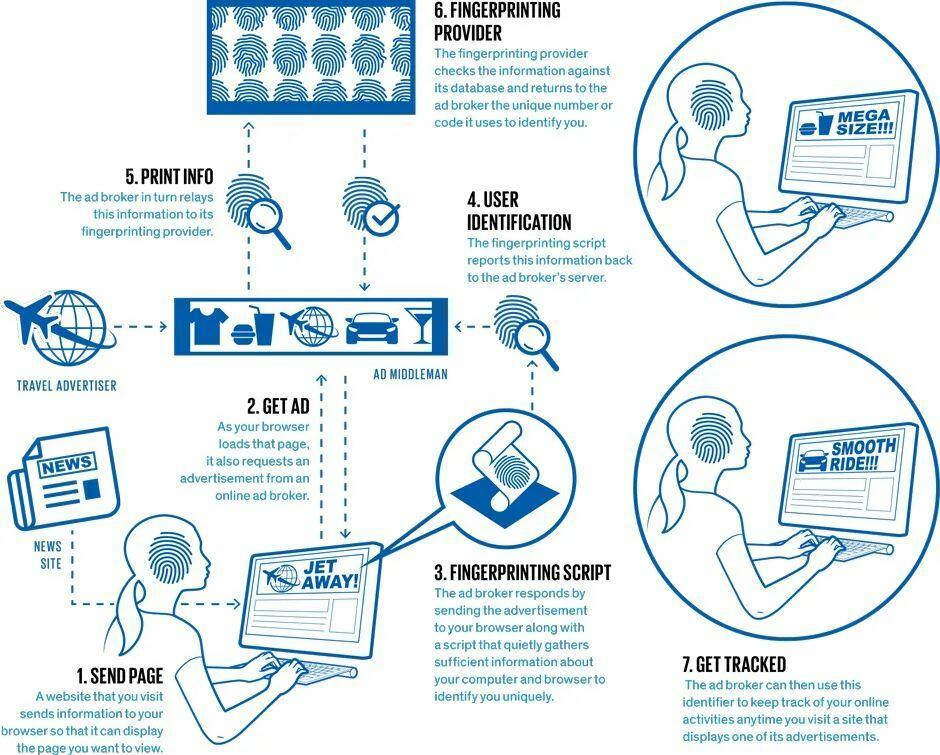
Studies have long shown how pervasive this is. Princeton’s Web Transparency Project and related research have repeatedly found fingerprinting scripts running on a significant share of popular websites.

The Electronic Frontier Foundation’s long-running Cover Your Tracks test (formerly Panopticlick) has demonstrated that a large majority of browsers produce fingerprints unique enough to track users without any cookies at all—historically around 83% or higher in large samples.

Why This Matters Now

Cookies are dying. Google has been phasing out third-party cookies in Chrome, and Apple has aggressively blocked them in Safari for years. Advertisers needed a replacement that users cannot easily clear, block, or reset. Browser fingerprinting is that replacement: it is invisible, persistent, and rebuilds itself if your setup changes slightly.

The result? Targeted ads that follow you across devices and sessions, even when you think you’ve gone "private." And because it operates below the surface of most privacy laws, the protections many people rely on simply don’t apply.

What Actually Works to Protect Yourself

Most people get privacy wrong by making their setup more unique (rare browsers + 30 extensions = the most identifiable fingerprint on the internet). True anonymity comes from uniformity, not obscurity.

Here are the proven defenses, ranked by effectiveness:

1. Choose the right browser (the single biggest decision)

  • Tor Browser – The gold standard. It forces every user to share the exact same fingerprint. Anonymity through uniformity.
  • Brave – Excellent middle ground for everyday use. It randomizes canvas, WebGL, audio, and other fingerprintable surfaces every session.
  • Firefox (with strict settings) – Strong out of the box and highly customizable. Avoid Chrome for privacy-sensitive activity; it offers no native fingerprint resistance.

2. Add the right extensions (Firefox or Brave only)

  • uBlock Origin – Blocks fingerprinting scripts before they can run. (Note: Chrome’s Manifest V3 severely limited the full version; Firefox is required for maximum protection.)
  • CanvasBlocker – Randomizes your canvas output whenever a site tries to read it.

3. Flip one powerful Firefox setting Type about:config in the address bar → search for privacy.resistFingerprinting → set it to true. This standardizes canvas, timezone, fonts, and other outputs so you blend in with everyone else. Takes 30 seconds and makes a measurable difference.

Bottom line: Clearing cookies no longer protects you. The advertising industry has quietly built a more resilient tracking system that operates in the shadows of your browser. 

https://www.zerohedge.com/technology/beyond-cookies-how-stop-invisible-browser-fingerprint-tracks-you-everywhere

Amneal inks $1.1B Kashiv buyout to pursue biosimilar market leadership


The takeover will give Amneal control of four facilities to manufacture biosimilars for a planned wave of launches in the coming years.

Amneal Pharmaceuticals has struck a $1.1 billion deal to buy Kashiv BioSciences, securing manufacturing capacity to support its ambition to become a global biosimilar leader.

New Jersey-based Amneal has a long-standing relationship with Kashiv, licensing biosimilar copies of Amgen’s Neulasta and Neupogen from the company in 2017. Amneal won FDA approval for both the drugs in 2022, which it sells as Fylnetra and Releuko, respectively. The companies expanded their relationship in 2024, when Amneal licensed a Xolair biosimilar from Kashiv. Amneal’s co-CEOs—brothers Chirag and Chintu Patel—directly or indirectly own half of Kashiv.

Amneal has agreed to buy Kashiv for $375 million in cash, $375 million in equity and up to $350 million in milestones, according to a Wednesday release. The deal will allow Amneal to integrate its biosimilar commercialization capabilities with the development and manufacturing infrastructure that already partly underpins its biologics business. Kashiv makes Fylnetra and Releuko at a facility in Chicago that has fill-finish capabilities.

The Illinois plant is one of four facilities Amneal will acquire through the deal. Kashiv runs a facility in New Jersey with 6,000 L of capacity to make monoclonal antibodies and fusion proteins, plus two plants in India. Amneal will expand the sites to support its pipeline, committing to establishing 50,000 L of capacity at one of the Indian plants and increasing the volume of the New Jersey facility to 24,000 L.

On an earnings call Wednesday, Amneal co-CEO Chintu Patel said drug substance capacity is expected to scale from 26,000 liters in 2026 to 75,000 by 2028. Patel added that Amneal anticipates $30 million to $50 million a year in capital expenditures to reach its capacity target.

Amneal’s investments are intended to ensure capacity rises in line with demand from new biosimilar launches. After buying Kashiv, Amneal’s pipeline will include six biosimilars that could come to market by next year. The Xolair biosimilar is the biggest of the opportunities, accounting for $4.6 billion of a $14 billion total. The New Jersey plant will make the Xolair copy, according to Amneal’s other CEO Chirag Patel.

The company could launch another six biosimilars with a total addressable market of $42 billion from 2028 to 2030. The figure reflects the almost $20 billion opportunity open to a copy of Merck’s Keytruda and the almost $10 billion market for a biosimilar version of Eli Lilly’s Trulicity.

Amneal, which has won approval for five biosimilars in the past three years, wants to deliver three to five products a year. The cadence may demand ongoing investments in manufacturing. Chirag Patel said that the infrastructure is designed to allow Amneal to keep adding another 25,000 liters as needed once it hits its current target of 75,000 liters.

https://www.biospace.com/deals/amneal-inks-1-1b-kashiv-buyout-to-pursue-biosimilar-market-leadership

Molina Q1 2026 adj EPS $2.35 beats on lower medical costs as 2026 EPS guidance reaffirmed at ≥$5


  • Q1 adjusted EPS $2.35 beat $1.57 estimate on $10.2B premium revenue; consolidated MCR 91.1% and pretax margin 1.6%.
  • Total Q1 2026 revenue $10.8B, down 3% year over year, missing analyst revenue estimates.
  • Latest SEC filing reports Q1 2026 GAAP EPS $0.27 on $10.2B in premium revenue.
  • Management said Q1 results were modestly better than internal and external expectations across all three segments.
  • 2026 guidance reaffirmed for premium revenue ≈$42B and adjusted EPS at least $5, despite Q1 upside.
  • Medicaid 2025 trend was 7.5%, including 250 bps acuity; 2026 Medicaid trend assumption reduced to 5%.
  • Q1 Medicaid trend and MCR were modestly favorable; management believes post‑redetermination acuity shift is now behind them.
  • Medicaid membership attrition outlook worsened to -6% from -2%, mainly in CA, IL, NY and TX.
  • Marketplace exposure reduced; Q1 Marketplace MCR 84% (≈79.5% excluding prior‑year items) with 70% renewals and 50% silver mix.
  • Medicare segment guided to 2026 revenue $6.6B and EPS drag of $1.25, mostly from MAPD losses.
  • MAPD exit planned for 2027, including $93M impairment; duals business (~$5.5B revenue, 94% MCR) expected to improve with better Stars.
  • Operating cash flow $1.1B; parent cash $213M now, targeted above $600M by year‑end via upstream dividends.
  • Main concern remains uncertainty around Medicaid cost trend, redetermination impacts and regulatory changes despite favorable early data.
  • Strong quarter driven by better‑than‑expected medical cost trend and improved Marketplace and duals profitability.

White House Reviewing SEC Bid to Ease Share-Offering Disclosures


The White House is reviewing new US Securities and Exchange Commission rules that would make it easier for companies to go public or raise capital by easing disclosures for new offerings and speeding up the registration process.

According to the SEC, one proposal would overhaul offering rules to “modernize the shelf registration process,” which could allow more companies to issue securities faster in order to take advantage of favorable market conditions.

Another proposal would expand the availability of simplified filing requirements currently only permitted for emerging growth companies — new issuers with total gross revenue under $1.235 billion. Those companies are allowed to make fewer investor disclosures and provide audited financial statements for just two years, rather than three.

The proposed rule changes, which were previewed by SEC Chairman Paul Atkins in a speech earlier this week, were received by the White House on Wednesday, according to a post on the Office of Management and Budget website.

“A critical part of Chairman Atkins’ agenda is his plan to Make IPOs Great Again, which he’s indicated will include rulemakings to allow more companies to benefit from reduced regulatory burdens and easier access to our public capital markets,” the SEC said in a statement. “As with any rulemaking, the public will have the opportunity to comment on the proposals and make their feedback heard.”

Among the changes Atkins plans to propose is allowing publicly-traded companies to make financial disclosures only twice a year, rather than quarterly.

The commission, currently down to three Republican members, would have to vote on the proposal after the White House sends it back to the agency with any edits, before it will be made public. The agency then takes public feedback and incorporates it into a final rule, which will also have to be voted on before it could take effect. The whole process typically takes between 18 to 24 months.

https://ca.finance.yahoo.com/news/white-house-reviewing-sec-bid-171736378.html

Trump moots killing Iran deal opponents as Israel says ready to resume war


  • President Donald Trump endorsed a hardline opinion article arguing Washington does not need an agreement with Iran, including a call to target Iranian leaders resisting a deal.

  • Israel’s defense minister said on Thursday the country is prepared to resume military operations against Iran and is waiting for authorization from Washington, signaling readiness for both offensive and defensive action as targets have already been identified.

  • President Donald Trump said Iran was divided between “hardliners” and “moderates” amid leadership infighting and said the US had “total control” over the Strait of Hormuz.

  • President Donald Trump said he had ordered the US Navy to “shoot and kill” any boats laying mines in the Strait of Hormuz and to intensify mine-clearing operations.

  • Iran said it had begun collecting transit fees from ships in the Strait of Hormuz, with the first revenues deposited into the central bank.

  • US and Israel bear responsibility for the consequences of the war as the “aggressors,” Iran’s Foreign Minister Abbas Araghchi said during a meeting in Tehran with the South Korean special envoy, according to the foreign ministry.

  • Iran’s internet blackout entered its 55th consecutive day on Thursday, with connectivity flatlining at about 2% of normal levels after 1,296 hours, NetBlocks said.

  • Iran’s Revolutionary Guards said it seized two ships in the Strait of Hormuz on Wednesday after a ceasefire extension, following reports that vessels had come under fire in the area.