Search This Blog

Saturday, May 9, 2026

Bahrain arrests 41 people over links to Iran's IRGC

 The Bahraini Interior Ministry announced on Saturday that the country's law enforcement arrested 41 people over their alleged links to Iran's Islamic Revolutionary Guard Corps (IRGC).

The ministry said that the country's security services discovered the group, which was later charged with "espionage with foreign entities and sympathy with blatant Iranian aggression."

"Investigations continue to take the necessary measures against anyone found to be involved in the activities of this organization and to have committed illegal acts," the ministry added.

https://breakingthenews.net/Article/Bahrain-arrests-41-people-over-links-to-Iran's-IRGC/66257857

Iran said to get Russian drone parts via Caspian Sea

 Iran has managed to receive drone components from Russia through the Caspian Sea, The New York Times (NYT) reported on Saturday, citing a source from the United States.

The source said that, since the naval blockade and the closure of the airspace amid the conflict with the US and Israel, Iran has boosted traffic via the Caspian Sea. It was also speculated that Russia has been sending other commercial goods to Iran.

The report came amid the US and Iran's latest attempt to solve their conflict diplomatically. Meanwhile, the New York Post alleged that the US offered to ease some of the sanctions against Iran if it agreed to halt its uranium enrichment program.

https://breakingthenews.net/Article/Iran-said-to-get-Russian-drone-parts-via-Caspian-Sea/66257771

More from Iran on Khamenei injuries


Iran’s Supreme Leader Mojtaba Khamenei is in "good health" and suffered only minor injuries during the February 28 strikes, senior Iranian officials said on Friday, dismissing mounting speculation over his condition and ability to govern.The officials insisted that Khamenei remains actively involved in state affairs and accused Iran’s enemies of spreading "rumours and false claims" about his health following the attack that reportedly killed his father, former Supreme Leader Ali Khamenei, along with several senior Iranian figures.Mazaher Hosseini, head of protocol in the office of the supreme leader, said Mojtaba Khamenei sustained only limited injuries during the strike. According to Iran International English, Hosseini said Khamenei suffered injuries to his kneecap, lower back and the area behind his ear."During the attack Khamenei as not in the place where the attack took place. They hit his home where is wife was killed. He was on his way, on the stairs, when the missile stuck there. Hewas on the stairs when the blast knocked him on the ground," Hosseini said while addressing supporters, Iranian International English reported.
"Thank God, he is in good health. The enemy is spreading all kinds of rumours and false claims. They want to see him and find him, but people should be patient and not rush. He will speak to you when the time is right," he added.Hosseini also acknowledged that"a small piece of shrapnel had hit him behind the ear" but insisted that the wounds were healing and that Khamenei was now "in complete health".The remarks come amid continuing conflicting reports over Mojtaba Khamenei’s medical condition, with several international media reports claiming he suffered serious injuries during the strikes.Earlier this month, Reuters reported, citing three people familiar with his inner circle, that the 56-year-old cleric suffered severe facial injuries and serious wounds to one or both legs during the strike on the supreme leader’s compound in central Tehran.The report also claimed that several members of his family, including his wife and close relatives, were killed in the attack alongside Ali Khamenei.According to the report, Mojtaba Khamenei remains mentally alert and continues participating in major state decisions through audio conferences, including discussions linked to the ongoing conflict and negotiations with Washington.A separate report by CNN, citing US intelligence assessments, said Mojtaba Khamenei has emerged as a central figure in shaping Iran’s war and negotiation strategy following recent US and Israeli strikes.The report said US intelligence agencies have not visually confirmed Khamenei’s whereabouts since he assumed leadership after his father’s death.CNN further reported that Khamenei is avoiding electronic communication and relying instead on trusted couriers and face-to-face meetings while undergoing medical treatment for burns and other injuries affecting parts of his face, arm, torso and leg.Meanwhile, Donald Trump said on Friday that the United States expected to receive a response from Iran regarding Washington’s proposal aimed at ending the ongoing West Asia conflict. "We'll hear from them supposedly tonight," Trump told reporters before travelling to Virginia.Asked whether Iran was deliberately delaying the process, Trump said, "We'll find out soon enough."Trump also rejected suggestions that Washington had made merely a "one-page offer" to Iran. "Well, it's more than a one-page offer. It's an offer that basically said they will not have nuclear weapons; they are going to hand us the nuclear dust and many other things that we want," Trump said.When asked if Iran had accepted the terms, Trump replied, "They have agreed. When they agree, it doesn't mean much because the next day they forget they agreed."


https://timesofindia.indiatimes.com/world/middle-east/he-was-on-the-stairs-iran-claims-mojtaba-khamenei-was-knocked-down-by-us-blast-but-is-recovering-well/articleshow/130970449.cms

'HHS officials considered banning SSRI antidepressants - report'

 HHS officials recently discussed whether to ban selective serotonin reuptake inhibitors (SSRIs), among the most popular antidepressant medications prescribed, amid a push to reduce the use of the drugs.

The development, which was broken by Reuters, comes after HHS Secretary Robert F. Kennedy Jr. at the Mental Health and Overmedicalization Summit, sponsored by the MAHA Institute, on May 4 said that psychiatric medications should no longer be considered the default in treatment. He added, however, "If you are taking psychiatric medication, we are not telling you to stop."

Most SSRIs are available as generics. Common brand names are Prozac, Zoloft, Lexapro, and Paxil. A 2026 study found that 16.6% of Americans take an antidepressant.

A May 4 HHS news release stated that the department is launching a "MAHA Action Plan to Curb Psychiatric Overprescribing."

"Today, we take clear and decisive action to confront our nation’s mental health crisis by addressing the overuse of psychiatric medications—especially among children," RFK Jr. said. "We will support patient autonomy, require informed consent and shared decision-making, and shift the standard of care toward prevention, transparency, and a more holistic approach to mental health."

HHS spokesman Andrew Nixon told Reuters that the department "has not had any discussions about ​banning SSRIs, and any claims suggesting otherwise are false."

https://www.msn.com/en-us/health/other/hhs-officials-considered-banning-ssri-antidepressants-report/ar-AA22JzDc

Iranians risk arrest at Iraq border to escape Tehran's total internet blackout


Desperate to communicate with the outside world, Iranians are increasingly travelling to the border with Iraq, where Iraqi SIM cards and impromptu hotspots became a hot commodity, they told Euronews.

Iranians living near the border with Iraq's Kurdistan region are crossing into neighbouring territory or gathering at the frontier just to get online, as the Tehran regime's months-long internet blackout has cut tens of millions of people off from the outside world.

The Islamic Republic officials have justified the restrictions by citing "security considerations" and the need to counter "cyber warfare".

Citizens say the blackout has cut them off from independent news sources, made it impossible to reach family members abroad, and in many cases destroyed their livelihoods.

Authorities have also outright criminalised many of the tools Iranians have turned to in order to get online, including VPNs and Starlink satellite internet.

"After the war began, the internet in Iran was completely shut down and practically no communication existed between inside and outside the country," a resident of the border city of Baneh told Euronews, speaking anonymously for security reasons.

Iran and Iraq share a 1,600-kilometre-long border, from the tripoint with Turkey to the Arvand river and the Persian Gulf to the south. Baneh, a city of some 100,000 residents, is just 30 kilometres from the nearest crossing.

"In Baneh, where much of the economy depends on trade, many merchants and shopkeepers needed internet access to continue their work, and for this reason they turned to SIM cards from neighbouring countries," they explained.

Some residents of towns near the Kurdistan region already held Iraqi SIM cards or travelled into Iraq to obtain them. In areas with stronger cross-border reception, people called relatives abroad or tried to keep their businesses running.

An improvised internet access point eventually appeared several kilometres outside Baneh, near the frontier.

"Many people would go to an area about 3 to 4 kilometres outside the city of Baneh, near the Iraqi border, where reception was better and it was possible to connect to the internet," the Baneh resident explained.

"Gradually, the number of people going there increased, and a group built a small shack on the spot and started offering internet access by the hour in exchange for money, by sharing their mobile internet with others via Wi-Fi," they said.

More than 50 arrests

Islamic Republic authorities eventually raided the site. "They raided the area, arrested more than 50 people and confiscated their mobile phones," the Baneh resident said.

"The agents went through all the data stored on the mobile phones of those arrested and then warned that anyone who approached the border or carried an Iraqi SIM card would face a harsh response."

"Those detained were put under pressure to explain why they had sought to access the internet.

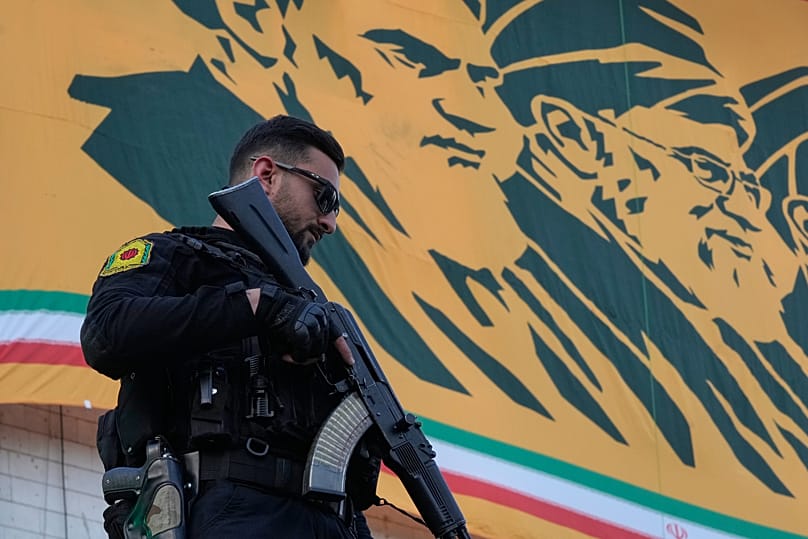
FILE: A police officer stands guard in front of a banner with portraits of late Ayatollahs Khomeini and Khamenei in a state-organised rally, Tehran, 29 April 2026
FILE: A police officer stands guard in front of a banner with portraits of late Ayatollahs Khomeini and Khamenei in a state-organised rally, Tehran, 29 April 2026 AP Photo

Many had only called relatives abroad, while others were traders and businesspeople who needed the internet to do their work," he added. Most were released after signing written pledges. Around 10 people remain in custody, according to eyewitnesses Euronews spoke to.

The crackdown made people more cautious at the border crossings as well.

"At the moment, because of security sensitivities, people avoid some border crossings, and many of those travelling between Iran and the Kurdistan region wipe their mobile phones and laptops to avoid arrest or being accused of collaborating with Israel and the US," another witness told Euronews.

Internet for the few

Over the past months, only a small number of Iranians have managed to access the global internet through costly or officially prohibited means.

A limited category of business licence holders can register for what authorities call "pro internet," but a 50-gigabyte package costs around 2.8 million tomans — around €15 at current free-market exchange rates — and is charged separately from registration fees.

For many workers whose monthly salary does not reach 20 million tomans (€110), the cost is out of reach.

A select few also have access through special SIM cards or privileged journalistic access. Some who have such access refuse to use it, either because it is unavailable to most Iranians or because they are concerned that their online activity is being monitored.

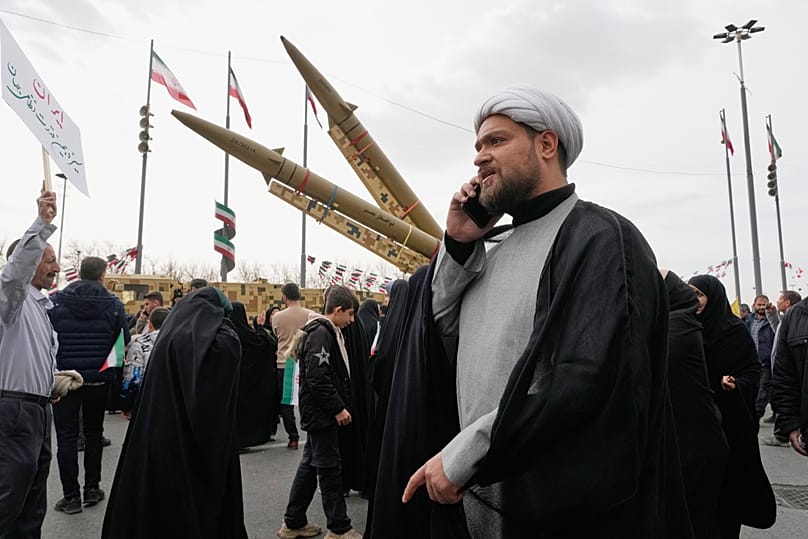
FILE: A cleric talks on his phone as he walks in front of missiles during an annual rally marking the Islamic Revolution at the Azadi square in Tehran, 11 February 2026
FILE: A cleric talks on his phone as he walks in front of missiles during an annual rally marking the Islamic Revolution at the Azadi square in Tehran, 11 February 2026 AP Photo

VPN prices, which spiked sharply at the start of the blackout, have since fallen as supply has increased. A limited number of Starlink devices, most of them smuggled, are also circulating — but their use carries the risk of prosecution and has already cost one person their life.

In the latest incident, a 40-year-old businessman from Tehran died in detention after security forces arrested him when he went to follow up on the case of his brother, who had been held on charges related to the use of Starlink equipment.

A resident of Sardasht told Euronews that access conditions in the border areas were now "somewhat better" and that most people without any of these options were using Iran's domestic "national internet" and waiting for the restrictions to end.

The head of the Iran Chamber of Commerce's economy commission Afshin Kalahi told domestic media that the shutdown was causing direct daily losses of $30 million to $40 million (€25.5m to €34m) for Iran's economy.

Iran's ministry of communications separately cited daily business losses of 600 billion toman (€30.3m) for businesses.

The ministry also said that around 10 million people — mainly from the middle and lower classes — depend on stable digital communications for their work.

https://www.euronews.com/2026/05/08/exclusive-iranians-risk-arrest-at-iraq-border-to-escape-tehrans-total-internet-blackout

Friday, May 8, 2026

US FDA to ease crackdown on some under-review unauthorized vapes


The U.S. Food and Drug Administration (FDA) said on Friday it would not prioritize enforcement against certain unauthorized e-cigarettes and ‌nicotine pouch products if the companies have marketing applications under review.

The ‌new guideline applies to products with premarket applications that have been accepted for review or supplemental ​filings that have been pending for more than 180 days, the agency said.

Non-tobacco-flavored vape makers, who face heightened scrutiny due to youth usage concerns, must also provide sufficient scientific data to assess whether the products are "appropriate for the protection of ‌the public health".


The change means ⁠that manufacturers with products that meet the agency's conditions are unlikely to face enforcement action even if they sell their ⁠products without the legally-required license.


It marks a boost for companies like Philip Morris International, which have held off on launching new products while waiting for an agency ​decision, sometimes ​at the expense of market share.

Tobacco companies ​have been lobbying President Donald ‌Trump and other key officials in the administration for changes including a faster, clearer FDA authorization process.

Earlier this week, the agency approved the marketing of certain fruit-flavored e-cigarettes in a first authorization of non-tobacco-flavored vaping products.


The FDA also said on Friday that applications that include detailed data on product composition, health risks ‌and device specifications are more likely to ​meet regulatory standards.

"By not prioritizing these tobacco products ​for enforcement, FDA will be ​able to better allocate its enforcement resources. FDA lacks the ‌resources to pursue enforcement against every ​product that has not ​received authorization," it said.

The FDA may still take action against products that have certain "presumptively underage-appealing elements such as depicting a cartoon-like fictional character, ​disguising its nature as ‌a vaping product, or resembling a children's toy, phone, or gaming platform."

https://www.yahoo.com/news/articles/us-fda-ease-crackdown-under-210817959.html

Iran lawmaker blames European tankers for oil slick near Kharg Island


An Iranian lawmaker rejected claims that Tehran had dumped oil into the sea near Kharg Island after satellite images showed large oil slicks around the key export hub.

Jafar Pourkabgani, a member of parliament representing Bushehr province, said the slicks were caused by “oil residue and ballast water waste from European tankers” discharged into the sea.

“This claim is false and part of the enemy’s psychological operation,” he wrote on X, referring to allegations that Iran had released oil because storage tanks were full.

Satellite images published on Friday appeared to show large oil slicks around Kharg Island, with some reports estimating the affected area at around 40 square kilometers.

Experts cited by Fox News said the slick could be linked to operational strain in Iran’s oil export system, though the exact cause has not been independently confirmed.

https://www.iranintl.com/en/liveblog/202605087268