Search This Blog

Sunday, May 10, 2026

Qatar confirms drone attack on cargo ship

 Qatar's Ministry of Defense confirmed on Sunday that a commercial cargo vessel was struck by a drone in the country's territorial waters. The ship was traveling from Abu Dhabi and was hit northeast of Mesaieed Port.

"The incident resulted in a limited fire onboard the vessel, with no reported injuries. The vessel continued its journey toward Mesaieed Port after the fire was brought under control. The necessary measures were taken, and coordination was carried out with the relevant authorities," the ministry added.

The ministry further condemned the event and called for an investigation into the incident to determine who was responsible.

https://breakingthenews.net/Article/Qatar-confirms-drone-attack-on-cargo-ship/66258708

Iran-Linked Media Floats Data Tax On Hormuz Undersea Internet Cables

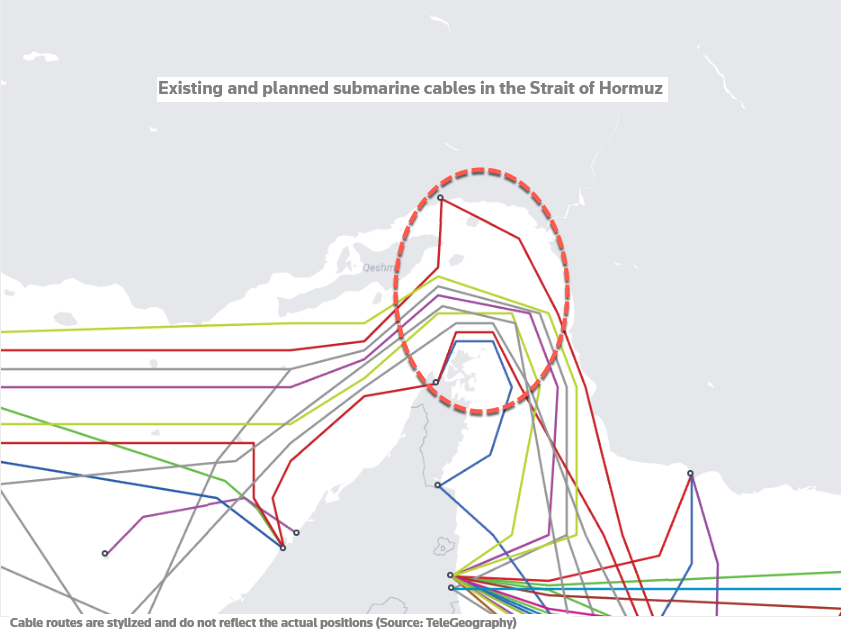
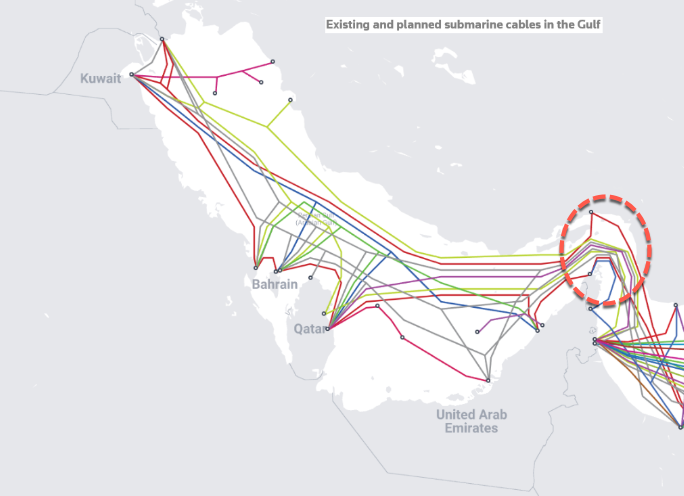
 An Islamic Revolutionary Guard Corps-linked media outlet has signaled that submarine fiber-optic cables running through the Strait of Hormuz remain in Tehran’s crosshairs.

Tehran views Hormuz not only as an energy chokepoint but also as a digital chokepoint, with undersea cables beaming internet across the Gulf and into the global network.

Source: Retuers 

Tasnim published an article titled “Three Practical Steps for Generating Revenue from Strait of Hormuz Internet Cables,” pointing out that Tehran must reassess how it exercises sovereignty over the strategic maritime chokepoint.

Source: Retuers 

The IRGC-linked outlet said that submarine fiber-optic cables in the critical waterway facilitate more than $10 trillion in financial transactions each day, and claimed that Iran has been deprived of the economic and sovereign benefits tied to the digital economy.

Source: Retuers 

Tasnim warned that any disruption, cut, or damage to these cables, whether from natural causes or ship anchors, could impose heavy losses on the world's economy.

"These cables, which are laid on the seabed using advanced technologies such as DWDM and double-armored standards, carry the bulk of international internet traffic, cloud synchronization, enterprise virtual private networks, voice traffic, and financial-payment networks. From the perspective of the digital economy, any disruption, outage, or damage to these communications highways, whether from natural incidents or ship anchors, can cause irreparable losses," the outlet stated.

Tasnim lists three steps for how Iran should begin imposing fees on internet traffic routed through Hormuz:

  1. Licensing and tolls: Iran should require telecom consortia and cable operators to obtain permits for laying and operating cables through the strait, with initial licensing fees and annual renewal payments.

  2. Iranian legal jurisdiction over tech firms: Major technology companies using the cables, including Google, Microsoft, Amazon, and Meta, should be required to operate officially under Iranian law and cooperate with Iranian technology firms, knowledge-based companies, and media entities.

  3. Iranian control over maintenance and repair: Iran should develop the technical infrastructure to control or participate in the maintenance and repair of the cables, turning cable servicing into both a revenue stream and a sovereignty tool.

Beyond the quest to charge data fees, Tehran has already imposed fees or tolls on vessels passing through the strait.

Last week, Iran's newly created Persian Gulf Strait Authority pushed forward with a new protocol for commercial vessels transiting the strait. It’s unclear whether the protocol will incur a fee.

However, Iranians have made "demands for payments, payments for toll fees, as we say, for those vessels to be granted permission to sail," Dimitris Maniatis, CEO of maritime risk consultancy Marisks, told CNN.

The direct result of Tehran’s attempt to position itself as the gatekeeper of the Hormuz chokepoint, across energy, freight, and potentially digital traffic, will be to accelerate global efforts to bypass the strait. That means rerouting pipelines, tanker traffic, commercial shipping, and eventually undersea cable infrastructure away from Iran’s strait.

That effort has already started:

.  https://www.zerohedge.com/geopolitical/iran-linked-media-floats-data-tax-hormuz-undersea-internet-cables

China-linked US solar factories shunned in Trump crackdown

 Top solar companies, banks, and insurers have stopped doing business with at least a half dozen recently built U.S. solar panel factories because of restrictions on Chinese-linked businesses attached to tax credits by the One Big Beautiful Bill Act, Reuters reported this week, citing industry executives and internal documents.

The law, which blocks manufacturing credits from going to factories that are tied to China, is meant to address Chinese dominance in the supply chain and help with reshoring production, but it also threatens to slow the deployment of solar energy, according to the report.

"It's holding up financings of desperately needed solar and storage projects," Keith Martin, an attorney at Norton Rose Fulbright, told Reuters.

Top U.S. residential solar installer Sunrun (RUN) reportedly is among the companies now avoiding Chinese suppliers.

Banks including Morgan Stanley, JPMorgan, and Goldman Sachs are said to have scaled back tax-equity financing for some solar projects due to concerns that interpretations by the Trump administration could retroactively invalidate tax credits.

The Solar Energy Manufacturers for America Coalition, a trade group representing non-Chinese companies with U.S. factories such as First Solar (FSLR) and Hanwha's Qcells, has urged the Treasury Department to take a tough stance.

Chinese-linked factories account for ~40% of U.S. manufacturing capacity, according to Reuters, and "very few Chinese manufacturers are actually decoupling themselves from their U.S. factories entirely," according to Wood Mackenzie.

China's JinkoSolar (JKS), which operates a factory in Florida, and the ​Chinese parent company of Boviet Solar, which makes panels in North Carolina, have said they are looking for outside investors.

ETFs: (TAN), (ICLN) (QCLN), (PBW), (PBD), (ACES), (CNRG), (ERTH), (SMOG)

https://www.msn.com/en-us/money/markets/china-linked-us-solar-factories-shunned-in-trump-crackdown-reuters/ar-AA22NqIy

Spencer Pratt can win in LA

 by Joe Concha

“A reality show star comes out of nowhere to enter politics and win a race almost no one expected him to win.”

This narrative, of course, could apply to Donald Trump‘s improbable victory in the 2016 presidential election. Trump had never run for public office before. One debate moderator, John Harwood, with CNBC at the time, called his race a “cartoon candidacy” as Trump was onstage as the clear front-runner. Democratic strategist James Carville said the Republican Party was “driving off a cliff” in nominating Trump and was “committing suicide” in the long term in doing so. And on the morning of the election, the New York Times gave Democrat Hillary Clinton a 73% chance of winning.

We’ve seen those from the entertainment business make the jump to the political arena before, most famously by President Ronald Reagan, a two-term governor of California before pursuing the highest office in the land. Arnold Schwarzenegger also served eight years as California governor earlier this century. Actor and director Clint Eastwood was an effective mayor of Carmel, California. And Sonny Bono was mayor of Palm Springs, California, before becoming a congressman. There are other examples from Fred Thompson to Al Franken, but you get the point.

Politics, especially in the social media era, is seemingly just as much about performance and presentation as it is policy. Zohran Mamdani, New York’s socialist mayor, is a prime example. He had zero executive experience before running, but a highly effective, and cheap-to-produce, online campaign propelled him to an easy victory over former Gov. Andrew Cuomo and the seemingly perpetual Republican candidate Curtis Sliwa.

Trump also used social media, especially the platform now known as X, in reaching low-propensity voters that political ads on TV were not reaching in the cord-cutting era. Clinton may have out-raised Trump 2-to-1 during that cycle, but social media became the great equalizer on the messaging front.

Which brings us to former reality star Spencer Pratt’s campaign for mayor of Los Angeles. Pratt, a registered Republican, also has no prior political experience. But in a world where voters increasingly are willing to ignore and even embrace it, having no experience may be a net plus. This is especially true for Pratt, who is already proving to be an outstanding public debater and speaker, both during interviews, live events, and campaign videos.

On Wednesday night, Pratt and Mayor Karen Bass, along with City Councilmember Nithya Raman, met for a debate ahead of the June 2 primary. Under California rules, the top two candidates will meet in the general election in November. And while Pratt was a decided underdog to finish first or second in June, he’s now gaining with gale force winds at his back following what was a dominant and masterful performance on that debate stage.

How dominant? An NBC-4 Los Angeles online poll shows 87% of those responding believe Pratt won, while just 8% said Bass won, and 5% going to Raman.

“With polls showing large shares of undecided voters, Pratt’s strong showing could alter the dynamics of the June 2 primary,” according to the Los Angeles Times. “Pre-debate surveys placed Bass in the lead, but Pratt’s media savvy, viral campaign ads, and outsider appeal have drawn attention. Analysts note that while online polls are not scientific, his performance may boost fundraising and visibility, especially among voters seeking a break from City Hall’s status quo.”

Winning is absolutely possible for Pratt if he can finish first or second in the primary to get to the general. Bass is sitting at 25% approval in one of the bluest cities in the country, according to a recent University of California, Los Angeles, poll. Her handling of the wildfires, after leaving the state in January 2025 for a trip to Ghana despite ample warning for the possibility of massive wildfires due to forecasted high Santa Ana winds, has proven to be almost impossible to recover from. Almost none of the 17,000 homes destroyed in Los Angeles County have been rebuilt more than 17 months later. Homelessness is still rampant in LA, as is drug use. Taxes remain among the highest in the country. Unemployment is the highest in the United States, as are gas prices.

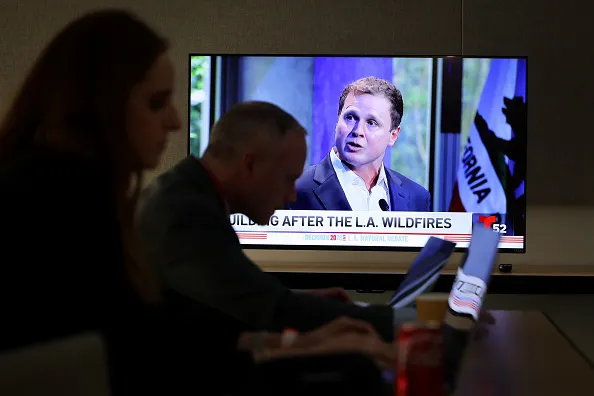
Los Angeles, CA - MAY 06, 2026: Spencer Pratt is shown on a television while journalists work during the 2026 Los Angeles Mayoral debate at Skirball Cultural Center on Wednesday, May 6, 2026 in Los Angeles, CA.
Spencer Pratt is shown on a television while journalists work during the 2026 Los Angeles mayoral debate at Skirball Cultural Center on Wednesday, May 6, 2026, in Los Angeles. (Jason Armond/Los Angeles Times via Getty Images)

Pratt’s momentum took off after he released an online video of himself standing in front of a trailer home he’s been forced to live in since the wildfires burned down his home. The video proceeds to show the opulent homes of his opponents.

“This is where Mayor Bass lives. Do you notice something? Or here, where Nithya Raman’s $3 million mansion sits,” Pratt said in the ad. “They don’t have to live in the mess they’ve created.”

On X, the ad has been viewed more than 13 million times on Pratt’s official account alone, with tens of thousands of reposts spreading it all over the internet.

But the question is: Are there enough Republicans and independents left in Los Angeles to put a non-Democrat over the finish line in a general election? Bass won by nearly 10 points in 2022 over Rick Caruso, who was a Republican before becoming a Democrat before the 2022 election in an attempt to avoid being labeled. History is also not on Pratt’s side, with the last Republican being elected Los Angeles mayor, Richard Riordan, coming in 1993. Pratt, however, believes the majority of his votes will come from Democrats, and he’s putting the choice as a binary one between common sense and socialist chaos.

“It’s just the socialists and the communists that don’t back me,” Pratt said recently. “But no, I’m confident I’m probably going to win with 51% on June 2 because I don’t do a political message.

“I don’t do national politics. I don’t do tribal politics. I don’t talk about other states. I’m localized. I just want to fix our streets, get the lights on. I want people to feel safe. I want to get our tax money to not be robbed by these literal criminal [nongovernmental organizations] stealing from our tax to increase the homelessness.”

According to U.S. News and World Report’s annual state rankings, California clocks in at 38th-worst in crime, 32nd-worst on the economy, 42nd-worst on fiscal stability, 35th on infrastructure, and 24th on education. Only healthcare ranks highly. And per a MortgagePoint study, the city has one of the largest population declines in the U.S., losing more than 300,000 residents between 2020 and 2026. For a city with a good climate and coastline, that’s an incredible number. Reasons cited include high housing costs, crime concerns, high cost of living, and weakening job markets.

Maybe the tide is notably turning in blue states when solid candidates are offered, which didn’t happen in New York against Mamdani. People are either leaving for red states or quickly realizing that leaders such as Bass are only making their lives more expensive and dangerous.

Republican Steve Hilton is leading all candidates in the race for California governor. Pratt is coming on like a freight train in Los Angeles. Accountability may finally be coming in the Golden State — a place where a few celebrities have come out of nowhere before to capture the hearts and minds of a public desperately yearning for basic common sense and competency.

https://www.washingtonexaminer.com/in_focus/4561401/how-spencer-pratt-can-win-los-angeles-mayor-race/

Iranian army spokesman threatens Hormuz access over sanctions


Iranian Army spokesman Mohammad Akraminia warned that countries supporting US sanctions against the Islamic Republic could face difficulties passing through the Strait of Hormuz.

Tehran is now enforcing what he described as its right under international law and maritime regulations to exercise authority over the strategic waterway, Akraminia told the state news agency IRNA.

He said Tehran would respond with “surprising options” to any new strikes, adding that it will include “more advanced and newer equipment, modern methods of warfare and, most importantly, new arenas of war.”

https://www.iranintl.com/en/202605100996

AI Is Losing The PR Battle And The Consequences Could Be Huge

 by Donald Kendal via The Epoch Times,

Lately, when watching high-profile sporting events like the NBA Playoffs, you may have noticed a rash of commercials for artificial intelligence (AI) companies. While average commercials strive to show off new products or services or recruit new customers, these AI commercials seem to have a different primary objective. They seem to target goodwill.

Heartwarming commercials show families bonding over AI-generated memories, where AI brings life to old family photos. Emotional voice-overs promise connection, creativity, and even nostalgia. These AI companies are trying to sell people a good reputation.

This strategy should tell us something. Companies don’t often spend millions trying to make you feel good about their brand unless they know, deep down, that you don’t trust it.

Despite hundreds of billions of dollars pouring into AI development, the industry is quietly losing the battle for hearts and minds. And sentimental advertising is not doing much to fix this problem.

Rare Bipartisan Agreement on AI

A new national survey from Marquette University Law School should give the AI industry serious pause. According to the poll, roughly 70 percent of Americans believe artificial intelligence will do more harm than good for society. Even more striking, the skepticism cuts across party lines.

Poll Director Charles Franklin put it bluntly: “It really is striking … there’s pretty much bipartisan skepticism … That’s an awful lot of partisan agreement, where we normally see Republicans and Democrats on opposite ends.”

In today’s political climate, bipartisan agreement on anything is rare. On AI, however, Americans seem united, just not in the way Silicon Valley might hope.

Worse yet is the fact that this poll supports similar findings on AI skepticism from numerous other surveys. A particularly damning NBC News poll from last month showed that AI’s net favorability rating ranked lower than nearly every other topic.

Why the Left and Right Don’t Trust AI

The industry is up against stiff headwinds in its battle for public trust.

For every story about the potential for AI curing diseases or boosting productivity, there are headlines about job displacement, algorithmic bias, and systems behaving in ways even their creators don’t fully understand.

We’ve seen AI tools generate historically inaccurate content in the name of ideological goals. We’ve seen concerns about “woke AI,” where outputs appear shaped by political preferences rather than objective reality. We’ve seen warnings from industry leaders themselves that these systems could eventually escape human control.

At the same time, public trust in the institutions building AI is already fragile.

Progressives have long been skeptical of massive corporations wielding outsized economic power. They also raise concerns about the environmental footprint of massive data centers and the risk that AI-driven productivity gains will further concentrate wealth among a small group of industry elites.

Conservatives, meanwhile, have grown increasingly wary of Big Tech after years of content moderation controversies and corporate activism tied to ESG-style frameworks.

In other words, both sides of the political spectrum are looking at the same handful of companies building the most powerful technology in human history while wondering if they can be trusted.

The Political Winds

AI companies should understand that this skepticism won’t stay confined to opinion polls. These poor poll results and negative stories in the media are giving bountiful ammunition to policymakers who are looking to target the burgeoning AI industry.

Lawmakers are beginning to float a wide range of proposals aimed at regulating artificial intelligence, some narrowly tailored, others sweeping in scope. Certain efforts are understandable, particularly those designed to prevent abuses similar to what we saw during the height of the Big Tech censorship debate.

Some proposals go further.

Some policymakers seek to impose heavy restrictions on AI, computational infrastructure, or model development. In New York, legislative proposals aim to restrict AI models from offering guidance on medical, legal, or professional issues.

A major threat to the industry is a proposal from the likes of Sen. Bernie Sanders (I-Vt.) and Rep. Alexandria Ocasio-Cortez (D-N.Y.) to impose a moratorium on the construction of AI data centers. This would essentially slow AI development in the United States to a crawl, potentially giving adversarial countries like China a great advantage in the AI race. In this scenario, the future of AI could then be left in the hands of governments that care far less about individual liberty and personal autonomy.

Earning Public Trust

If the AI industry wants to win back public confidence, it will need to do more than produce emotionally manipulative advertisements. It will need to address the concerns driving that skepticism in the first place.

Americans don’t want AI systems that nudge them toward preferred political outcomes, filter information through ideological lenses, or act as invisible referees of acceptable thought. They want assurance that these tools of the future act on objective truth rather than political ideology.

That means committing to principles that protect individual liberty and personal autonomy. It means transparency in how systems are trained and deployed. It means resisting pressure from governments, activist groups, or corporate interests to embed subjective values into systems that increasingly shape public life.

This route is possible. Elon Musk, for example, has acknowledged the importance of free expression and open inquiry in AI development. But this course needs to be fleshed out, fully implemented, and become an industry standard.

Without clear, consistent standards, suspicion will remain that there is a political agenda behind the interface.

The Fate of AI Is Not Set

The trajectory of artificial intelligence development may be inevitable, but there are many questions that need to be answered.

The best way forward for the AI industry is not through carefully crafted marketing campaigns, but a deliberate effort to earn public trust. That trust must be built on transparency, commitment to truth, and clear respect for individual liberty and personal autonomy.

If these companies want to usher in a new era of prosperity powered by AI, they must show the public that this technology will serve people, not shape or control them.

https://www.zerohedge.com/ai/ai-losing-pr-battle-and-consequences-could-be-huge

Maersk CEO Warns Iran War Is A "New Wake-Up Call" For Global Trade

 It is becoming increasingly clear that reopening the Strait of Hormuz has become a top U.S. priority (really a global priority) , as oil executives and industry insiders warn that the clock is ticking toward an energy and global trade shock if the maritime chokepoint remains closed for another month.

Frederic Lasserre, head of research at Gunvor, one of the world's largest oil traders, warned earlier this week: "The tipping point is clearly June. This is the point at which something has to give."

JPMorgan analysts warned that the world is spiraling toward a catastrophic cliff-edge shortage of crude oil if the maritime chokepoint is blocked for another four weeks.

Speaking to CNBC's "Squawk Box Europe" earlier this morning, Maersk CEO Vincent Clerc warned that a "new wake-up call" has emerged beyond energy markets and that if the Hormuz chokepoint remains shuttered, it could severely impact global trade in the coming months.

Clerc was speaking to CNBC after Maersk reported a plunge in profitability and kept its guidance unchanged, but warned that the US-Iran war and the resulting Gulf energy shock are "dominant forces shaping the macroeconomic outlook, as well as the trade and logistics environment."

Maersk wrote in its earnings report that the Iran war had introduced an "additional layer of uncertainty."

"Currently, fragile ceasefires are in place in both Iran and Lebanon, negotiations proceed slowly, and traffic at the Strait of Hormuz remains at a near-standstill. The conflict has already weighed on sentiment. Consumer confidence deteriorated," the shipper said.

Maersk warned that crude oil prices in the $90 to $100 per barrel range and continued Hormuz chokepoint disruption would soon begin hitting global container demand, which is still expected to grow between 2% and 4%.

It noted that the balance of risks is "on the downside and more adverse outcomes cannot be ruled out."

"Energy and shipping disruptions in the Strait of Hormuz are rapidly reshaping global supply chains," Maersk said in the earnings report. "After the recent tariffs on U.S. imports, the conflict represents another wake-up call to deploy new tools to make supply chains more resilient and develop new strategies to mitigate future disruptions."

We pointed out earlier this week:

Latest as of Thursday morning:

It is increasingly evident that another month of Hormuz disruption represents a critical tipping point for energy markets and the global economy. If the conflict extends through June and the chokepoint remains shuttered, first-order impacts would likely worsen across Asia and Europe, where dependence on Gulf crude, refined products, LNG, and container flows is highest. From there, the shock could spread into fuel shortages, factory disruptions, higher shipping costs, and broader economic turmoil.

The clock is ticking.

https://www.zerohedge.com/geopolitical/maersk-ceo-warns-iran-war-new-wake-call-global-trade