Search This Blog

Friday, May 15, 2026

Future of Aardvark’s Prader-Willi drug in doubt as FDA slaps full hold on program


Aardvark Therapeutics had previously voluntarily suspended studies of ARD-101—and a related asset called ARD-201—after detecting anomalous echocardiographic readings in healthy volunteers that could indicate reduced heart efficiency.

The FDA has put a full clinical hold on Aardvark Therapeutics’ lead asset for Prader-Willi syndrome, freezing all ongoing trials of the drug due to cardiac concerns observed in a healthy volunteer trial.

The hold, announced Thursday after market close, applies to the Phase 3 HERO study testing the candidate ARD-101 for the treatment of hyperphagia in patients with Prader-Willi syndrome. Aardvark will also have to suspend a late-stage open-label extension of HERO. The biotech is working with the FDA to figure out a way forward for ARD-101.

“It’s hard for us to have any confidence here,” Stifel wrote in a March 1 note to investors, referring to the ARD-101 cardiac observations.

Aardvark crashed nearly 30% to $4.73 per share before the opening bell on Friday.

Even before the FDA’s formal hold, Aardvark in late February paused both HERO and the extension study after detecting “reversible cardiac observations.” These signals arose in a separate healthy volunteer study when participants were dosed at above therapeutic levels.

A few weeks later, these cardiac worries spilled over to Aardvark’s other asset ARD-201, the design and mechanism of which are based on ARD-101. In mid-March, the biotech paused the Phase 2 POWER and STRENGTH studies testing ARD-201 as an obesity treatment. The former is looking at how well the asset could maintain weight loss in patients who had received GLP-1s, while the latter is assessing ARD-201’s additive benefits when used alongside GLP-1s.

According to Aardvark’s analysis, an echocardiograph reading of two patients showed patterns that could be indicative of lower heart efficiency. These patients were given 1,600-mg doses of ARD-101 twice-daily—two times the target dose in HERO.

The biotech conducted heightened dosing in healthy volunteers as part of a routine safety study to support a regulatory application for ARD-101.

The signal “seems plausibly drug-related which we think raises important questions,” the Stifel analysts wrote in the March note. In particular, even if lower doses of ARD-101 prove safe, that could then compromise or cap the drug’s efficacy.

“This adds significant uncertainty and it’s very hard to build confidence in what the path forward may look like,” Stifel said at the time.

The overhang hasn’t yet lifted for Aardvark, with William Blair continuing to harbor concerns for ARD-101 in a May 5 note. “We believe the clinical risk of ARD-101 is elevated,” the analysts wrote. “The cardiac events could be mechanism-based and call into question the therapeutic window of ARD-101.”

In a Q1 report last week, the biotech said that it is still in discussions with the FDA over ARD-101’s future.

https://www.biospace.com/fda/future-of-aardvarks-prader-willi-drug-in-doubt-as-fda-slaps-full-hold-on-program

Biogen’s Alzheimer’s results bolster tau theory—and Denali’s next gen candidate


If Biogen has shown that tau can impact cognition, Denali’s technology—validated with an FDA approval in Hunter syndrome—could ensure the medicine gets where it needs to be for the greatest therapeutic impact, analysts said.

Biogen has helped validate the tau theory of Alzheimer’s, though with many caveats, side notes and what-ifs still to be addressed. But the news of the big biotech’s success with BIIB080 has helped bolster an eager group of smaller companies like Denali Therapeutics, which just might have a therapy that can break through in the challenging neurodegenerative disease.

The Phase 2 results for BIIB080, released yesterday, led to a spike for Denali’s shares. But the stock has returned to normal as of Friday, trading around $19.39 apiece.

“Investor confidence in the tau hypothesis should rise, naturally boding well for DNL628,” Jefferies wrote on Thursday afternoon.

Biogen showed that BIIB080, a tau-targeting agent, led to cognitive improvements and improved key biomarkers associated with Alzheimer’s. The therapy failed on the main goal of the study, dubbed CELIA, as it did not lead to a dose-dependent change in disease severity at 76 weeks.

Nevertheless, Biogen is advancing into Phase 3, buoyed by other efficacy signals. Analysts and investors were also enthused by the data, with Jefferies seeing “sufficient [positive] cognitive trends” to support late-stage advancement.

Biogen plans to release more details at the AAIC conference in July, which Jefferies believes could move Denali’s stock if positive.

That’s because the biotech’s Transport Vehicle technology helps ease transfer of medicines across the blood-brain barrier. If Biogen has shown that tau can impact cognition, Denali’s technology—which has been validated with an FDA approval in Hunter syndrome—could ensure the medicine gets where it needs to be for the greatest therapeutic impact. Its DNL628, which uses the same technology and targets tau, is now in early clinical studies in patients with Alzheimer’s.

“Taken together, BIIB080’s data clinically validates the intracellular tau approach partially de-risks DNL628 (also targets intracellular tau), and even potentially leaves room for ‘628 to differentiate on efficacy,” Jefferies wrote.

Denali will reveal Phase 1b data for DNL628 in the first half of next year. The company is looking for a 40%–50% reduction in tau, according to Jefferies. As for cognitive impacts, the firm noted that the trial is relatively short at 24 weeks and therefore not powered to show such changes. If such effects emerge, however, it will be a major positive for Denali.

The biotech also has an edge because DNL628 is an intravenous injection, whereas Biogen’s BIIB080, now called diranersen, is delivered by intrathecal injection directly into the cerebrospinal fluid.

Another biotech in the mix is Alector, which similarly has an anti-tau asset called AL164 that has readthrough to the Biogen data, according to William Blair. The siRNA therapy is still preclinical, with investigational new drug enabling studies getting underway. Like Denali, William Blair expects Alector to benefit from Biogen’s AAIC readout.

Alector’s shares gained nearly 7% to close at $2.30 on Thursday.

Denali is also developing an A-beta asset for Alzheimer’s, similar to approved Alzheimer’s therapies Biogen and Eisai’s Leqembi and Eli Lilly’s Kisunla. The Salt Lake City-based biotech will release Phase 1/2b data for DNL921 in 2027, which, if successful, will allow the drug to move directly into Phase 3, Jefferies noted.

The next gen drug could be better than Leqembi and Kisunla given Denali’s blood-brain barrier technology, and even best Roche’s upcoming asset trontinemab, the analyst wrote. Roche’s Genentech unit showed in December last year that trontinemab cleared amyloid plaques in the brain, marking a return to the Alzheimer’s space for the Swiss pharma after a series of clinical failures saw Biogen and Lilly rise above.

https://www.biospace.com/drug-development/biogens-alzheimers-results-bolster-tau-theory-and-denalis-next-gen-candidate

DOJ criminal antitrust probe into Data iSight pricing triggers Claritev premarket plunge


DOJ criminal antitrust probe into Data iSight pricing triggers premarket plunge.

  • Reports of a new DOJ criminal price-fixing inquiry into Claritev (formerly MultiPlan) and its Data iSight tool emerged May 14, per Capitol Forum circulation and traders (GuruFocus, multiple wires).
  • Investigation focuses on alleged coordination with major insurers to suppress out-of-network reimbursements via algorithmic pricing.
  • Escalation from ongoing civil antitrust MDL lawsuits; DOJ filed a statement of interest in 2025 backing providers’ claims of collusion.
  • Stock dropped ~15% on May 14 (closed $23.47 after trading as high as ~$28 recently); continued selling drove premarket losses of ~19.5–26% on May 15.
  • No other fresh company-specific news (earnings were May 7; recent conference participation and product launch were neutral-to-positive).
  • Criminal probe raises heightened legal and business-model risks for the company’s core repricing services.

P3 Health swings to positive EBITDA, raises 2026 outlook on flat medical trend


  • Q1 adjusted EBITDA $26M vs -$22M YoY, exceeding internal expectations and marking inflection.
  • Revenue $386M (+3% YoY) despite at-risk membership falling to 106k from 118k.
  • Improved contract economics drove ~15% YoY MA per-member funding and 63% delegated membership.
  • Full-year 2026 adjusted EBITDA guidance raised to $20–60M (midpoint $40M).
  • Medical margin $74M; adjusted MLR 85.2% with flat MA medical cost trend.
  • Clinical programs: Tier 1 share 62% (from 56%), Stars ahead, member visits +5% vs plan.
  • Problem: growth constrained near term after pruning unprofitable contracts and still-limited delegation in one major market.
  • Balance sheet: $25M cash; ~$250M debt converted to preferred plus $30M new preferred issued.
  • Management tone confident, stressing structural, durable drivers and constructive Medicare Advantage macro backdrop.
  • Q&A centered on utilization mix, sustainability of favorable prior-year development, and pathway to broader delegation.
  • Main concern: sustainability of unusually low medical cost trend and growth with a smaller membership base.
  • Strong quarter, driven by structurally improved payer contracts and disciplined medical cost management.

Yield-Hungry Investors Bet on Credit as Government Debt Sours


Credit investors enticed by high yields are buying up corporate bonds, shrugging off the lingering Middle East conflict and focusing instead on robust results from blue-chip businesses.

Risk premiums on US investment-grade bonds on Thursday fell to their lowest level since early February. High-grade bond funds in late April and early May saw the most inflows since September 2020. And one borrower this week, Gilead Sciences Inc., sold longer-dated debt at a yield below that of its existing debt, signaling an unusually high level of demand.

https://www.bloomberg.com/news/articles/2026-05-15/inflation-risk-gives-corporate-bonds-the-edge-over-sovereigns

Re-Arranging The Global Game-Board 'Bigly'

 by James Howard Kunstler,

Resource Scramble

“Trump has done so much damage to libtardery that the Democrats will need a decade of uninterrupted power to undo it, which they're not going to get.”

- Matt Forney on X

If you learned anything from this week’s extravaganza in Beijing, it is that Donald Trump is aggressively re-aligning world relations so that the USA does not end up one of the losers in the global resource scramble that lurks darkly behind all current events.

China does not intend to be an eventual loser, either, though it has lost a lot of traction lately.

The Eurolands are certainly the main losers, embracing loserdom as the old and sick long for death.

India and some of the BRICs countries, are looking a little loser-ish just now.

The primary resource all nations scramble for is oil. Without lavish supplies of oil, you can’t have an advanced techno-industrial economy and, as the feckless Eurolanders learned the hard way, there really isn’t an adequate substitute for oil. The flow of oil depends on economically producible reserves of oil country-by-country, but also on geographic advantage, as we are learning just now in the Hormuz crisis.

“Europe’s crude oil production started its permanent decline in 2001. Asia-Pacific’s production hit a maximum in 2010, and it has been declining since. Africa’s peak oil production took place in 2008, and it has been mostly declining since.”

- Gail Tverberg, OurFiniteWorld.com

Also, turns out, the peak oil story is still real, despite fifteen years of shale oil miracles.

The Persian Gulf states, including Saudi Arabia are probably past peak. American shale oil is in the peaking zone, too — the Permian Basin in Texas is running short of sweet spots. The Arctic National Wildlife Reserve (AMWR) is open for leasing, but it is expensive to drill and produce in the harsh arctic region and the US Geological Survey estimates recoverable reserves there between 7.7 – 10 billion barrels — America consumes roughly 7.5 billion barrels-a-year, so. . . .

There’s Canada, of course, and its tar sands, but the Great White North these days leans rather hostilely towards its neighbor to the south (us). Otherwise, North America is pretty fully explored oil-wise. There can’t be a whole lot of hidden, un-tapped “elephant” fields out there. On the plus side, America enjoys its geographic advantage, comfortably cushioned between the Atlantic and Pacific Oceans, far from the madding crowd of Eurasia.

We have lately trumpeted our supposed acquisition of Venezuela, but projected production of US companies there looking ahead several years would be under a million barrels-a-day while the US uses 20.5-million barrels a day. As for Venezuela’s jungle-bound oil sands, well, for now, fuggeddabowdit.

Russia’s Ministry of Natural Resources puts its commercially recoverable oil resources (with current technology and prices) at around 80-billion barrels, which is a lot, and leaves Russia in a theoretically favorable place for the short term, anyway. China uses about 17-million barrels-a-day and imports about 70-percent of that. Its imports of Iranian oil are substantial but obscured in official statistics due to the evasion of US sanctions. The Hormuz blockade has put a hurt on China.

Here’s how the global resource scramble translates into geopolitical behavior: As has been evident for some time, US interests are increasingly alienated from Euroland’s interests, and better aligned with Russia’s interests. Europe is demonstrably insane these days, roiling with loose talk as it whirls around the drain. Russia, under V. Putin, looks more like the adult in the room. Even Russia’s military operation in Ukraine looks rational if you consider how the EU and the CIA started the damn thing in the first place circa 2014 for the very purpose of provoking Russia.

Mr. Trump has yearned to normalize relations with Russia since he stepped on-stage in 2016, to the great consternation of America’s neocons, CIA shadow-meisters, and the born-again communists running the Democratic Party (who seem to resent Russia ditching Marxism-Leninism thirty-five years ago). This week, the US and China have mutually proposed becoming “partners” rather than rivals on the world scene. We will surely remain mutually wary, but apparently things have changed.

Most urgently, China would like its oil imports from the Persian Gulf restored, and the obvious way to make that happen would be for them to lean on Iran to stop screwing around and come to terms with the US — give up the enriched uranium and stop laying jihad on everybody near and far. We’ll know soon enough if China will do that for us, and we have some goodies promised for them, Nvidia chips, soybeans, and more.

Mr. Trump is rearranging the global game-board bigly, and the net result will be the sorting-out of winners and losers.

Iran is the poster boy for that. It could go either way for them, soon, and rather sharply.

If Iran’s jihad-happy leaders just quit FAFOing, they have the chance to re-enter the global community as an advanced modern economy with a comfortable standard of living.

Or, the US could just blow up what’s left there.

China will probably deliver that message forcefully in the days ahead.

There remains, however, the dirty business of America’s domestic enemies, of whom we learn more and more each week.

This week, it was the testimony of “whistleblower” CIA agent James Erdman that the CIA worked sedulously to conceal the true origins of Covid-19. It looks pretty much like what half of America has suspected all along: that Covid was a trip laid on the nation by its own Deep State (mainly the CIA), in concert with the rogue Democratic Party, for the express purpose of queering the 2020 election.

Related seditious operations apparently continue to this very hour. Former CIA Director John Brennan told MSNBC’s Nicolle Wallace this week: “There’s still a legion of professionals in the law enforcement environment, the Department of Justice, as well as the CIA and other places — the ones who are refusing to follow politically motivated prosecutions, those who are refusing to support any type of political activities on the part of the Trump administration. . . .” Did he just admit that the conspiracy he kicked off in 2016 is still ongoing? And that he is an active party to it? I think so. Do you think Joe DiGenova noticed that down in the DOJ’s Southern District of Florida?

Just as astoundingly, this week former FBI Director James Comey told CNN’s Kasie Hunt that he “still speaks regularly” to current FBI employees. Say, what. . . ? He palavers with the very agency that is investigating him for serious felonies, such as threatening the life of the US president? Sounds a little out-of-order, ya think? Does he long to spend the rest of his life as captain of the ping-pong team at the Lewisburg Federal Penitentiary?

https://www.zerohedge.com/geopolitical/re-arranging-global-game-board-bigly

A Mexican Standoff With Iran

 by Adam Sharp

Both President Trump and Iranian leaders are standing firm on their red lines.

Before peace negotiations restart, Iran has made 5 demands:

  1. Ending the war on all fronts, including Lebanon
  2. Lifting all sanctions
  3. Releasing frozen Iranian assets
  4. Compensation for war damages and losses
  5. Recognition of Iran’s sovereign rights over the Strait of Hormuz

Trump called the proposal “TOTALLY UNACCEPTABLE!”.

The President has criticized Obama fiercely for releasing frozen Iranian funds, and hasn’t backed down on that subject.

As far as paying compensation, that’s not going to happen either. Sanctions relief could come in time, but asking for a total end before negotiations restart is a pipe dream.

And ending the war in Lebanon would mean Israel would have to stop bombing Hezbollah and likely give up the 10% of the country it currently occupies.

Nearly every one of these 5 points is a non-starter. And Iran knows it.

To understand the thinking here, we have to apply game theory.

A Mexican Standoff

In the classic Spaghetti Western The Good, The Bad, and The Ugly, there is a classic Mexican standoff near the end.

image 1

All three men in the standoff want the gold buried nearby. All are armed and deadly with their weapons. The scene’s tension is legendary. You don’t see filmmaking like this anymore.

I won’t spoil the ending for those of you who (somehow) haven’t seen this excellent movie. But these standoff scenes have become a cinematic staple for a reason.

Here is how Wikipedia defines a Mexican standoff:

“A Mexican standoff is a confrontation where no strategy exists that allows any party to achieve victory. Anyone initiating aggression might trigger their own demise. At the same time, the parties are unable to extract themselves from the situation without either negotiating a truce or suffering a loss, maintaining strategic tension until one of those three potential organic outcomes occurs or some outside force intervenes.”

This is essentially where we are with Iran. Everybody is armed to the teeth, staring each other down, wondering if there’s a resolution that doesn’t involve missiles, bombs, and drones.

With our current situation, however, the world economy hangs in the balance.

Last Man Standing

Early on during the conflict, the U.S. Navy allowed Iranian oil tankers to continue passing through the Strait of Hormuz and deliver their cargoes, mostly to China.

However, on April 13th, Trump ramped up the pressure with a blockade. A few Iranian ships have snuck through, but most are stuck.

Iranian oil is piling up in storage. They are likely close to reaching capacity. And when that storage is full, things get tricky for Iran.

The country’s oil wells are particularly vulnerable to shut-ins (shutting down production). Stopping the flow can seriously damage the wells. We saw this during COVID, which combined with U.S. sanctions, crippled Iran’s oil exports for years:
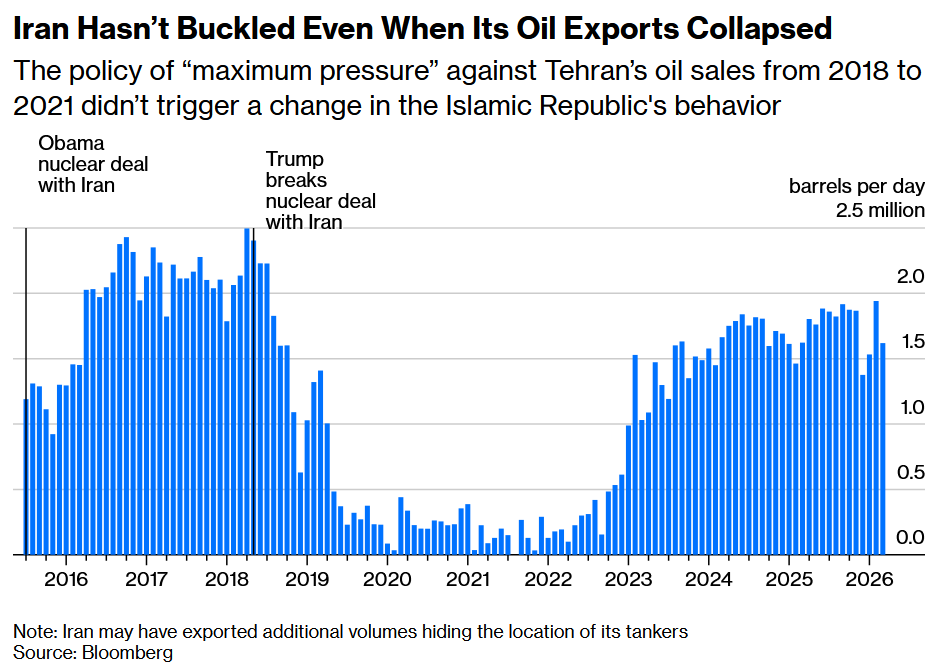
image 2

This was an absolutely devastating blow for Iran. Oil is their biggest industry, by far. Their currency was annihilated, and it’s getting destroyed even worse today. But somehow they buckled down and weathered the storm from late 2019 to 2022.

The blockade is currently costing Iran about $500 million per day. That’s a massive hit. President Trump has also sanctioned Chinese oil refineries for processing Iranian crude, which was a big trade war escalation.

However, it sounds like he may back down on this matter after his recent visit to Beijing. China has essentially told the refineries to ignore the sanctions, which is the first time that’s happened. Another Mexican standoff.

President Trump is betting that Iran will break first. I’m not sure that’s a great bet. This is a country that’s been under harsh sanctions for 47 years, cut off from the world.

And like it or not, the current leadership remains firmly in charge.

Iran vs. The World Economy

I ran some numbers this morning, and it looks like so far, the world has spent about an extra $600 billion on oil, fertilizers, and liquefied natural gas (LNG).

The energy crisis is beginning to work its way through the global economy. Inflation is picking up, as we covered yesterday.

When the price of fuels, plastics, and fertilizers spike, it affects almost everything. And it’s really only just beginning.

Yields on government bonds around the world are spiking. Investors are demanding higher yields to account for higher inflation. This is a bad sign for a debt-bloated world.

So while Iran is under serious pressure, so are the rest of us. Americans are struggling with high energy and food prices, and don’t want another prolonged war in the Middle East.

Last Man Standing

Despite Iran’s economy being put in a vise, I don’t expect them to give in.

For them, this conflict is existential. So they’re willing to accept prolonged economic pain. Or even a return to war.

Are they bluffing? Perhaps. But it doesn’t seem like it. They are united with a certain religious and nationalist zealotry.

Can we say the same? Are we willing to restart the war, or let the Strait of Hormuz remain closed for another few months, or even the rest of 2026?

If Hormuz remains shut, the pain will quickly become extreme. And despite his threats to end Iran as a civilization, I don’t think Trump wants to restart the war. We were the party which asked for a ceasefire via Pakistan. And we know that Iran will strike back at Gulf oil infrastructure and further damage U.S. and Israeli targets in the region.

I hate to say it, but President Trump has painted himself into a corner. It’s a classic Mexican standoff. There are no good exit options.

At the beginning of this conflict, back on March 7th, Jim Rickards made a bold statement.

In a war of attrition, really a war for survival, victory goes to the last man standing. That may be Iran.

At the time, almost nobody else was saying this. The U.S. appeared triumphant and unstoppable. He also predicted that U.S. munitions would become a problem, and they have. The March 7th piece, Jim Rickards’ Most Surprising Iran Takes, is worth a re-read today. He nailed it.

Exit Possibilities

President Trump wants to find an exit that can be spun as a win. Frankly, this is a longshot. So for now, the Mexican standoff will continue.

Eventually we may simply have to withdraw. It’s happened before. Vietnam, Afghanistan.

What that would look like isn’t exactly clear. Would all the U.S. bases in the Gulf be repaired and rebuilt? Even though they’re under threat from Iranian missiles and drones? If not, that’s a sea change in U.S. power projection in the region. If they are rebuilt, that’s going to be a rather expensive proposition, especially considering the new defensive measures which would be required.

Would the Strait of Hormuz remain under Iranian control? That’s another key consideration.

Ultimately, a deal remains the most likely outcome. But it could take years to reach a lasting agreement.

In the meantime the world economy will suffer. Somehow, stocks are just below fresh all-time highs. But I don’t see that lasting as this situation drags out.

This is why every past administration avoided a hot war with Iran. Now President Trump must find a way to salvage the situation. Even if that means making compromises.

If he can put aside his pride and make a deal, my respect for Trump will only rise. But it remains unlikely until the pain becomes unbearable. So buckle up.

https://dailyreckoning.com/a-mexican-standoff-with-iran/