Search This Blog

Tuesday, June 9, 2026

Ivermectin Effective Against New World Screwworms Larval Stages (L1, L2, L3)

 On June 3, 2026, the USDA confirmed the first U.S. case of New World screwworm (Cochliomyia hominivorax) in decades, after larvae were recovered from the umbilical wound of a calf in Zavala County, Texas.

As of June 8, additional confirmed cases have emerged in multiple Texas counties — including La Salle and Gillespie — alongside the first confirmed case in New Mexico, involving a dog in Lea County that had recently traveled from Mexico.

The New World screwworm, eradicated from the United States in 1966, has advanced steadily northward through Central America and Mexico since 2023, producing extensive outbreaks in livestock, pets, and wildlife.

Unlike ordinary flies, New World screwworm larvae are obligate parasites that enter through open wounds and consume living tissue. As the infestation progresses, they produce expanding lesions that can become severe without prompt intervention.
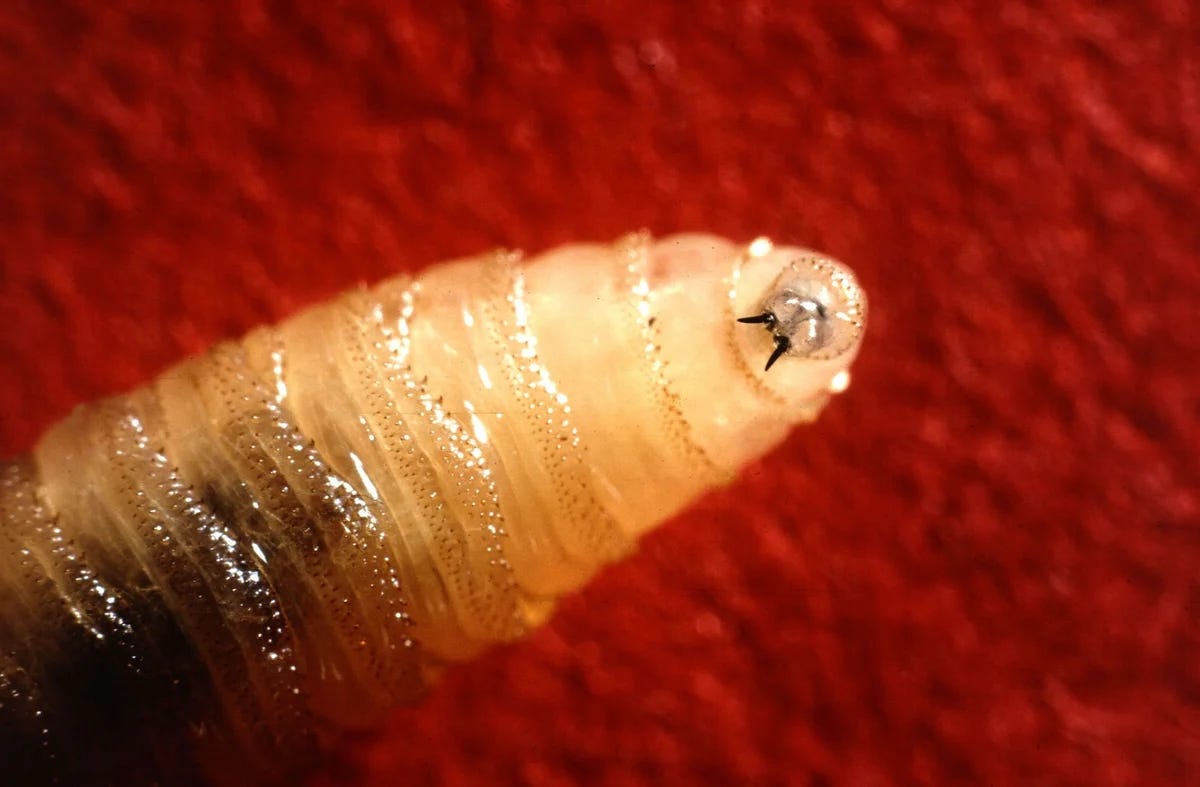
So what can be done about it? You guessed it… Ivermectin.


Ivermectin: Proven Activity Against New World Screwworms in Animals and Humans

Livestock

Ivermectin has shown remarkable effectiveness against New World screwworms in livestock.

In February 2026, the FDA granted an Emergency Use Authorization (EUA) for Ivomec (ivermectin) 1% injectable as an over-the-counter preventive for cattle exposed to screwworm risk — including after birth, castration, or wound detection.

Why? Because 12 field studies conducted in South America — where New World screwworm outbreaks are common — found that ivermectin provided more than 97% protection against screwworm infestations in wounds under real-world conditions.

Researchers found that a single injection could provide 10–21 days of protection, killing young screwworm larvae before they could burrow deeper into living tissue.

Humans

Published case reports suggest ivermectin can be effective when New World screwworms invade wounds in the mouth, eye socket, skin, or other tissues — a condition known as myiasis.

In a 2011 case series involving six patients, doctors treated individuals suffering from severe oral New World screwworm infestations following major facial trauma, where larvae had invaded damaged tissue in and around the mouth. Mechanical removal alone proved difficult because many larvae were deeply embedded in living tissue. Physicians administered subcutaneous ivermectin (200 μg/kg), which killed the remaining larvae and made them substantially easier to remove. All six patients experienced successful recovery without major complications, leading the authors to conclude ivermectin was an effective adjunctive therapy for severe oral infestation.

In a separate 2006 case series involving two patients, physicians treated severe orbital (eye socket) New World screwworm infestation in individuals with underlying skin cancer, where larvae had penetrated tissue surrounding the eye and posed a serious risk of progressive tissue destruction. After receiving oral ivermectin along with wound debridement, the larvae died and could be removed more completely, helping control the infestation and avoid more aggressive surgical intervention. The authors concluded that ivermectin appeared to play an important therapeutic role in severe cases of New World screwworm myiasis.

“Horse paste” wins again.


Nicolas Hulscher, MPH

Epidemiologist and Foundation Administrator, McCullough Foundation

https://www.thefocalpoints.com/p/ivermectin-kills-new-world-screwworms

Watching for Infectious Disease Threats During the World Cup

 A collaborative of public health groups are utilizing tools like wastewater surveillance to monitor pathogens throughout the upcoming FIFA World Cup, hoping to detect and prevent the spread of disease during the massive soccer event -- and to trigger a public health response early if threats arise.

The effort is being led by the Health Security Operations Center (HSOC), a project of Georgetown University's National Center for Health Security and Resilience in partnership with MedStar Health.

Rebecca Katz, PhD, MPH, a professor at Georgetown University and director of HSOC, described it as an "independent civil society effort" with more than 30 collaborators monitoring infectious disease threats throughout the World Cup.

Katz noted that when it comes to major global events, the onus to prepare for public health threats and conduct monitoring usually falls on the host country. However, America's public health infrastructure has been gutted in recent years, and the Trump administration removed the U.S. from the World Health Organization earlier this year.

A CDC spokesperson told MedPage Today the agency is utilizing "syndromic surveillance, laboratory data, wastewater surveillance, traveler-based genomic surveillance, and event-based intelligence" in their World Cup surveillance.

"As part of HHS, CDC is regularly engaging with public health departments in host cities, other federal agencies, and partner organizations," the spokesperson said.

They also highlighted port of entry protocols to respond to ill international travelers and a forthcoming World Cup data dashboard.

"This is really the first time we're trying this, to see how a nongovernmental entity can work independently but in support of all of these efforts," Katz told MedPage Today.

FIFA is not an official partner, but the organization will receive HSOC's daily situation reports which will highlight relevant public health findings synthesized from HSOC collaborators. Government officials, associations, and emergency managers in major hospital systems are also on the distribution list.

Wastewater surveillance is one important thread, with partners like Verily, Biobot Analytics, SecureBio, and WastewaterSCAN providing data and analyses then synthesized by HSOC. Most are utilizing existing infrastructure for World Cup surveillance.

"It's really important when you are preparing for large events to have systems that you already know and trust, and have them work really well," said Marlene Wolfe, MSc, PhD, an assistant professor at Emory University in Atlanta and the program director and co-principal investigator of WastewaterSCAN, in an interview in which a press person was also present.

The group has more than 140 sites across the country, testing for 20 infectious diseases multiple times a week. These pathogens are mostly respiratory diseases, like COVID and respiratory syncytial virus; gastrointestinal viruses, like norovirus and rotavirus; and outbreak diseases, like measles and hepatitis A. From years of collecting data, WastewaterSCAN already has baselines and knows annual averages and seasonal trends. Wolfe said for the World Cup and beyond, wastewater data can help clinics and hospitals be prepared for surges and inform clinicians' differentials.

Vindell Washington, MD, MS, chief physician executive at the health tech company Verily, noted that wastewater surveillance trims down the window of noticing a change in pathogens that could impact public health really quickly. On their World Cup dashboard, Verily will be featuring analysis from Katelyn Jetelina, PhD, MPH, a communication partner of HSOC, who is explaining what wastewater trends indicate alongside other public health analyses on her popular newsletter Your Local Epidemiologist.

Depending on how it goes with the World Cup, Katz said HSOC plans to use the lessons learned to plan efforts for the 2028 Los Angeles Olympics, which will also be "an extraordinarily complex mass gathering event." However, the project has little funding, but most collaborators are contributing using their own resources -- goodwill Katz isn't sure how long she can count on.

How Wastewater Surveillance Works

Anthony Maresso, PhD, a professor of virology and microbiology at Baylor College of Medicine in Houston and principal investigator of Texas Wastewater and Environmental Biomonitoring (TexWEB), explained that while basic wastewater surveillance dates back to the 1940s, it grew in popularity during the COVID pandemic.

"The field has really exploded," Maresso said. "Almost any pathogen can kind of be tracked."

Wastewater surveillance is simple -- samples are collected, sent to a lab, and processed -- and far cheaper than other detection or surveillance measures, Maresso noted.

There are two methods of sample analysis: polymerase chain reaction (PCR) and metagenomic sequencing. PCR tests for particular pathogens has about a 48-hour turnaround time. Metagenomic sequencing takes about a week from sample collection to data output, but it can catch a wider web of pathogens since it analyzes all the genetic material in a sample. Wastewater surveillance groups contributing to HSOC utilize both types.

"That's why I think it's perfect for the World Cup," Maresso said. With mass travel, it's hard to predict exact pathogens. He said to think of wastewater surveillance like weather radar: a tool to help decision makers figure out how to respond to probable threats.

The World Cup kicks off June 11 and will end July 19. Millions of fans will travel to attend games in 11 U.S. cities and some locations in Canada and Mexico. On top of that, the participating teams have base camps in North American cities. For instance, the Democratic Republic of the Congo, where an Ebola outbreak is raging, is partnered with Houston, Texas.

While measures are in place to prevent Ebola's spread into the U.S., Maresso said metagenomic wastewater surveillance would help detect it early.

Marisa Donnelly, PhD, director of epidemiology at Biobot Analytics, said that Biobot added additional testing sites and is deploying some metagenomic sequencing on top of their usual PCR testing.

"I think this World Cup is a test case to show the system that we built for wastewater monitoring," Donnelly said.

https://www.medpagetoday.com/special-reports/features/121671

'Dementia May Be Worse for People Taking Glucosamine'


  • Glucosamine use was associated with faster progression from mild cognitive impairment to dementia in a large retrospective study.
  • Among Alzheimer's patients, glucosamine use correlated with higher mortality risk over 10 years.
  • Researchers suggested that glucosamine may be harmful after neurodegeneration begins, but not before.

Glucosamine -- a popular supplement used for joint pain -- was associated with faster progression to Alzheimer's disease and worse survival among Alzheimer's patients, a retrospective study of electronic health records suggested.

Glucosamine use was linked with a 25% higher likelihood of progression from mild cognitive impairment to dementia (P<0.001) over 5 years, reported Ramon Sun, PhD, of the University of Florida McKnight Brain Institute in Gainesville, and co-authors.

In a 10-year survival analysis, use of the supplement was tied to a 25% increase in mortality risk among patients with Alzheimer's disease or related dementias (P=0.0023), the researchers noted in Nature Metabolism.

Ten-year survival analyses in people with mild cognitive impairment showed no significant difference between glucosamine users and non-users (P=0.252), suggesting some effects of glucosamine may be specific to people with established neurodegeneration rather than the general population, Sun and colleagues noted.

"Glucosamine is one of the most widely used supplements in the U.S., with roughly 40 million users overall. Around 8% of patients in our dementia cohort took it. That works out to roughly half a million people in this clinical population alone," Sun said.

"The harm appears specific to a brain already in neurodegeneration," he pointed out. "Earlier Mendelian randomization work linked glucosamine to lower dementia risk in cognitively healthy adults. Our healthy-mouse data are consistent with that. The supplement looks safe or possibly protective before disease onset, and harmful after."

The findings were based on the health charts from roughly 24,000 patients in the University of Florida health system who were diagnosed with Alzheimer's disease or related dementias from 2012 to 2024. The analysis also included about 41,000 patients with mild cognitive impairment.

The researchers tracked patients who had documented glucosamine usage for at least 1 year after being diagnosed with dementia or mild cognitive impairment. Overall, about 8% received glucosamine. The median follow-up was about 5 years.

The retrospective analysis was part of a larger project that investigated possible metabolic drivers of Alzheimer's disease.

Glucosamine is a natural amino sugar produced by the body and found in healthy cartilage. Arthritis patients often take glucosamine supplements, though the American College of Rheumatology does not recommend them.

Glucosamine can cross the blood-brain barrier and influence pathways that build complex sugar structures on proteins, a process known as glycosylation. N-linked glycosylation could integrate with pathological features of Alzheimer's disease, possibly influencing its progression, Sun and colleagues suggested.

In transgenic Alzheimer's mouse models, for example, glucosamine increased the attachment of sugar residues to proteins, leading to worse cognitive outcomes. When Sun's team suppressed this attachment in mice, memory improved.

The researchers also found that sugar attachment was significantly increased in human Alzheimer's brain specimens compared with specimens from controls.

"The harm signal is not just an epidemiological association," Sun noted. "N-glycan accumulation in postmortem Alzheimer's disease brains scales with Braak stage. Isotope tracing shows the brain produces more N-glycans, not that clearance fails."

The findings suggest that N-glycosylation is a targetable pathway for combating Alzheimer's disease, observed Yasuhiko Kizuka, PhD, of Gifu University in Japan, in an accompanying commentary.

"The results of the epidemiological analysis of individuals who use glucosamine, together with the results of glucosamine supplementation in the Alzheimer's disease mouse models, warrant a future clinical trial to determine whether glucosamine uptake in individuals with mild cognitive impairment and Alzheimer's disease worsens clinical symptoms," Kizuka wrote. "Clarifying these issues could pave the way for understanding and overcoming Alzheimer's disease in the future."

Glucosamine is a supplement that a meaningful fraction of dementia and cognitively impaired patients take with no current guidance to consider stopping after diagnosis, Sun noted. "Our data argue that conversation should happen," he said.

The study results are preliminary and require validation, the researchers acknowledged. "We are evaluating which N-glycan pathway inhibitors are candidates for central nervous system penetration. Several such inhibitors exist in cancer research, but none has been developed for the brain or tested in Alzheimer's disease," Sun pointed out.

"In parallel, we want to test discontinuation in patients. A standard placebo-controlled randomized trial would not be ethical now that we have a harm signal in this same population," he said.

"The cleanest design is to identify Alzheimer's or mildly cognitively impaired patients already taking glucosamine, ask them to stop, and follow cognition longitudinally," he added. "This would directly test whether removing the supplement slows decline."

Disclosures

This study was supported by the National Institutes of Health, the MBI Gator NeuroScholar Program, and the University of Florida.

Sun had no disclosures. Co-authors reported relationships with Maze Therapeutics, Valerio Therapeutics, PTC Therapeutics, the Glut1-Deficiency Syndrome Foundation, and Wolters Kluwer.

Kizuka had no conflicts of interest.

Hinge Health lifts Q2, 2026 revenue, non-GAAP operating income guidance, sees up to $824 m 2026 revenue


  • Guidance update disclosed in an SEC filing today ahead of Hinge Health's inaugural Investor Day.

SpaceX aims to launch orbital AI computing tests by end of next year: sources

SpaceX executives say the company is aiming to launch initial demonstrations of space-based artificial intelligence computing infrastructure by late 2027, ahead of the "as early as 2028" timeline ‌for deployment disclosed in its IPO filing, according to two people who attended investor presentations held ahead ‌of the offering.


The orbital-compute effort is central to SpaceX's long-term growth pitch to investors. The company claims in its IPO documents that it is "the only ​company with a commercially viable path to building orbital AI compute at scale."

SpaceX has requested permission from regulators to launch up to 1 million space-based data-center satellites.

During two investor presentations ahead of the IPO, both featuring President Gwynne Shotwell and Chief Financial Officer Bret Johnsen, SpaceX executives outlined a roadmap to begin demonstrating orbital-compute capabilities in 2027, according to the two people ‌familiar with the discussions. Both sources were at ⁠a Goldman Sachs meeting and one attended another meeting as well.

While the IPO filing said orbital data-center deployments could begin as early as 2028, it did not distinguish between demonstration missions ⁠and commercial deployments.

Shotwell and Johnsen, who have been meeting with major investment banks to pitch a $75 billion fundraise in the company's IPO targeting a valuation of $1.75 trillion, described the initial deployments as demonstrator systems intended to validate the technology before any broader commercial ​rollout, the ​sources said.


One of them interpreted the timeline in the IPO ​filing as providing management room for potential delays ‌in Starship development or satellite manufacturing.

SpaceX did not immediately respond to a request for comment on the event attended by several investors and portfolio managers.

SpaceX stock is scheduled to begin trading on the Nasdaq on Friday under the ticker symbol SPCX, with the IPO price targeted at $135 per share.

STARSHIP DELAYS POSE CHALLENGE

Starship, the fully reusable rocket that underpins the company's plans for orbital computing, remains years behind SpaceX CEO Elon Musk's original targets and has yet to demonstrate the rapid reusability ‌needed to make large-scale deployment economically viable.

Dan Loeb Reveals DOJ Threat To Trump Over Ross Ulbricht Commutation In Final Hours Of First Term

 by Juan Galt via Bitcoin Magazine,

Hedge fund manager Dan Loeb has publicly claimed that the Department of Justice threatened President Donald Trump in the final hours of Trump's first term in January 2021, warning it would "go after" him if he commuted the sentence of Ross Ulbricht, creator of the Bitcoin-powered Silk Road marketplace. After the reported threat, Trump withdrew the commutation, forcing Ulbricht to serve four additional years in prison before receiving a full pardon in January 2025 during Trump's second term.

Loeb, founder and CEO of Third Point LLC, made the revelation on the All-In Podcast while discussing his role in criminal justice reform and Ulbricht's clemency efforts. "On the last day of Trump's 45th term, we were certain that he was going to get out," Loeb stated. "And the Justice Department, for whatever reason, said, 'If you commute his sentence, we're going to go after you,' to the president. So he, as I understand, he withdrew the commutation."

This account is the first public report of such a direct threat from the DOJ during the closing days of Trump's first presidency. It has not been independently corroborated by other sources to date, and no specific DOJ official has been named as delivering the warning. The claim rests on Loeb's recollection, likely conveyed through the advocacy chain that included crypto figures like Riva Tez, Charlie Kirk, and then-White House counsel David Warrington.

DOJ Leadership In January 2021

Jeffrey A. Rosen served as Acting Attorney General after William Barr's departure in late December 2020. Richard Donoghue was Acting Deputy Attorney General. The Office of the Pardon Attorney, a DOJ unit that reviews clemency petitions and issues recommendations, operated under their oversight. Presidents, including Trump, frequently bypassed standard OPA processes for politically sensitive cases.

The alleged threat appears to have gone well beyond typical DOJ advisory input on issues such as sentence proportionality, victim impact, or enforcement priorities. Ulbricht had been serving a double life sentence plus 40 years following his 2015 conviction on charges including operating a continuing criminal enterprise, narcotics distribution via the internet, money laundering, and hacking. Contrary to popular belief and widely publicized insinuations by the mainstream media, Ulbricht was never prosecuted on any charges related to murder for hire.

Silk Road, which relied primarily on Bitcoin for transactions, represented one of the earliest large-scale experiments in the use of an alternative currency to the dollar, making the case and its history foundational to the Bitcoin community.

A warning framed as potential retaliation against the President himself would constitute an extraordinary escalation in tensions between the executive branch and the Department of Justice over clemency authority. Such pushback likely stemmed from institutional concerns about appearing soft on major drug trafficking and money laundering cases tied to the early Bitcoin economy.

Four-Year Delay And Political Impact

The reported DOJ intervention in the final days of Trump's first term cost Ulbricht four more years behind bars. As Loeb recounted, Charlie Kirk later took the lead on the clemency effort. "This was his only ask of the president," Loeb said, referring to Kirk. Kirk's advocacy helped turn Ulbricht's release into Trump's primary promise to libertarians and the crypto community during the 2024 campaign. Trump delivered on that promise with a full and unconditional pardon early in his second term.

Ironically, the delay strengthened the "Free Ross" movement. What began as advocacy for clemency in a case viewed by many in Bitcoin circles as emblematic of government overreach evolved into a potent political force. The campaign highlighted issues of disproportionate sentencing, self-custody, privacy tools, and resistance to broadly unpopular and ineffective war on drugs, core themes in Bitcoin's ethos of financial sovereignty and of high importance to the libertarian voting block. This momentum and Trump's promise to pardon Ulbricht are widely considered to have earned Trump the libertarian and crypto vote in 2024.

Broader Context For Bitcoin

Loeb framed his involvement in Ulbricht's case as part of broader criminal justice reform, linking it to his broader philanthropy efforts on education and concerns over opportunity and income inequality. He highlighted three categories for clemency: the wrongly convicted, the rehabilitated, and those with disproportionately harsh sentences. Ulbricht, who acknowledged wrongdoing on Silk Road while denying murder-for-hire allegations, fit the latter category in Loeb's assessment.

The episode highlights ongoing tensions between law enforcement, Bitcoin innovation, and the libertarian culture that makes up a large part of the U.S. public. Silk Road, one of the earliest Bitcoin marketplaces, remains a reference point in debates over decentralization, privacy, and regulatory overreach. Similar cases continue to draw attention in the Bitcoin community, including Bitcoin activist Ian Freeman, the developers of the Samourai Wallet privacy tool, and Roman Storm of Tornado Cash - all facing charges viewed by many as attacks on Libertarian leaders, the freedom of commerce, self-custody and financial privacy tools.

https://www.zerohedge.com/political/dan-loeb-reveals-doj-threat-trump-over-ross-ulbricht-commutation-final-hours-first-term

Man Accused In Fatal Charlotte Train Stabbing Ruled Incompetent To Stand Trial

 Two months after mental health experts deemed Decarlos Brown Jr. incompetent to stand trial for the fatal train stabbing of 23-year-old Ukrainian refugee Iryna Zarutska last year - when Brown shouted "I got that white girl" - a federal judge has agreed with them. 

White House press secretary Karoline Leavitt speaks alongside photos of Ukrainian refugee Iryna Zarutska and Decarlos Brown Jr. during a press briefing at the White House on Sept. 9, 2025. Saul Loeb/AFP via Getty Images

Brown, 34, will be committed to a federal facility for treatment for up to four months in an attempt to restore competency, Judge Kenneth D. Bell said in his order on June 9.

After Brown's time in the treatment facility, the court will again take up the case to determine if he is then considered competent. If he is found competent, the murder case will resume.

If he is not found to be competent, and the court finds he cannot be restored to competency, the court will rule on further treatment.

The defendant stands accused of stabbing Zarutska to death on a Charlotte, North Carolina, commuter train in August 2025.

Brown was charged with one count of Violence Against a Railroad Carrier and Mass Transportation System Resulting in Death. If convicted, the defendant faces the death penalty.

A random horror caught on camera

As we noted in April, the killing occurred on the evening of August 22, 2025. Twenty-three-year-old Iryna Zarutska, still wearing her black baseball cap from her shift at Zepeddie’s Pizza, boarded the Lynx Blue Line light-rail train heading home. She took a seat. Seconds later, Brown - already seated directly behind her - pulled a pocketknife from his hoodie and stabbed her three times in the neck and upper body in a sudden, unprovoked attack.

Surveillance video, which quickly circulated online, captured the gruesome moment: Zarutska’s desperate attempts to fight back as blood poured from her wounds, while other passengers initially failed to intervene. Brown stood, wandered through the train leaving a trail of blood, and exited at the East/West Boulevard station. He was arrested on the platform minutes later. Investigators say he told officers he believed the young woman had been “reading his mind.”

Zarutska, who had fled the Russian invasion of Ukraine in 2022 seeking safety and a new life in America, died at the scene. Friends and family described her as vibrant, hardworking, and full of hope. Heart-wrenching videos later shared by loved ones showed her laughing, cooking, and enjoying simple moments with friends—images that stood in heartbreaking contrast to the brutality of her final minutes.

A suspect with a long trail of red flags

Brown was no stranger to the justice system. Court records and family statements show he had amassed more than 14 arrests in North Carolina since 2007, including charges for assault, firearms violations, and felony robbery.

Two years after he was released from a five-year sentence for robbery, the same year Zarutska fled Ukraine, Brown was arrested again for assaulting his sister, who did not pursue charges. 

His mother and sister have publicly described a sharp decline in his mental health after a prison stint, including violent outbursts, delusions, and refusal to take prescribed medication for schizophrenia. Despite multiple attempts by his family to have him involuntarily committed, he was repeatedly released - most recently on cashless bail after what authorities described as a bogus 911 call.

* * * Top sellers

Brain Rescue - Your baseline daily brain food

Peak Focus - Nootropic ultra-focus, no jitters

Community members gather for a vigil honoring the life of Iryna Zarutska, who was fatally stabbed on a commuter train last month, Monday, Sept. 22, 2025, in Charlotte, N.C.
https://www.zerohedge.com/political/man-accused-fatal-charlotte-train-stabbing-ruled-incompetent-stand-trial