After all the headlines about “Ozempic mouth” — and “Ozempic breath” and “Ozempic teeth” — emerging research points to possible explanations, notably how GLP-1 drugs delay the emptying of the stomach and intestines.
When the CEO of Hershey recently credited GLP-1 users with a spike in sales of sugar-free mints and gum, the drug’s oral-related effects got the attention that dentists had already noted. But as more patients taking GLP-1 report oral changes, reflected in a nascent but growing body of literature, questions arise for clinicians about how to manage them. And halitosis is far from the only issue.
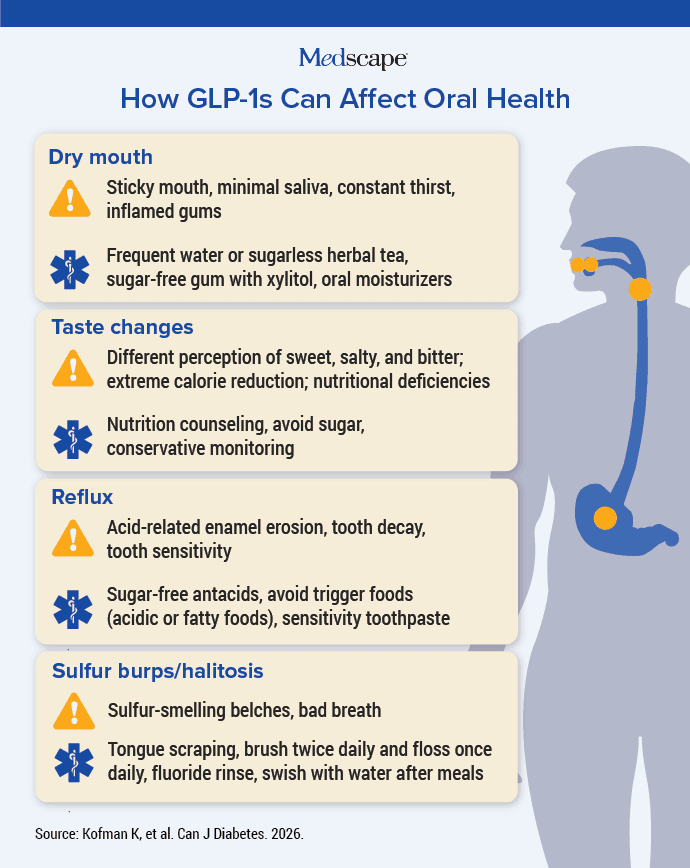
Dry mouth, or xerostomia, is the most common oral change, said Jennifer L. Thompson, DDS, chair of the American Dental Association Council on Dental Practice. That “can contribute to other challenges like bad breath, changes in taste such as a metallic or bitter sensation, tooth sensitivity, and an increased risk of cavities and gum disease.”
Up to 24% of users report vomiting, which brings harsh stomach acids into the mouth. This can lead to tooth decay and bad breath. Some research suggests that gastrointestinal adverse effects and dry mouth occur more often with semaglutide (Ozempic and Wegovy) than with other GLP-1 receptor agonists.
Research Points to Delayed Gastric Emptying
Most of these oral symptoms are a downstream result of delayed gastric emptying, said Aviv Ouanounou, DDS, an associate professor at the University of Toronto Faculty of Dentistry in Toronto, Ontario, Canada. He’s the co-author of a forthcoming paper (now in preprint) on the possible oral health effects of semaglutide.
GLP-1 therapy “can lead to prolonged retention in the stomach, in the intestines,” Ouanounou said. “That creates an environment which is a conducive to bacterial overgrowth, to fermentation, causing odor perceived as bad breath.” This can lead to a buildup of hydrogen sulfide, causing so-called sulfur burps.
Another in-press paper, published online this week, analyzed International Classification of Diseases codes from records of more than 200,000 GLP-1 users and found patients were 32.9% more likely to experience gastroesophageal reflux disease. Reflux and regurgitation can cause more bad odor and erosion of the enamel, Ouanounou said. (That study found no link to bad breath or dry mouth, though these symptoms may have been left out if they weren’t recorded by a diagnosis code.)
“Studies are limited with direct links to GLP-1s,” Ouanounou said, “but the mechanism, the pathways of the slow motility, leads to all these things, consistent with GI [gastrointestinal] physiology.”
Dry mouth might be a direct effect. A recent review of studies on the mechanism of oral effects found that the drugs may interact with the salivary glands — again, semaglutide more than others. Saliva production depends on a delicate back-and-forth between calcium and cyclic adenosine monophosphate signals inside salivary gland cells. If semaglutide keeps the GLP-1 receptor active for too long, it may throw off that balance, reducing secretion and desensitizing the glands over time.
“Saliva plays an especially important role in protecting teeth by washing away food and neutralizing acids produced by plaque,” Thompson said. “When saliva is reduced, these bacteria can grow more easily, increasing the risk of tooth decay, gum inflammation, and bad breath.”
As for changes in taste perception, the relationship has yet to be clearly defined. But the naturally occurring peptide hormone GLP-1 is involved in taste mechanisms. A 2026 review of literature found that in the taste buds, it seems to make certain flavors less noticeable by changing how taste cells respond and how they send signals. In the brain, GLP-1 activity appears to reduce the reward response to sweet foods and may make bitter tastes feel more unpleasant.
Not enough evidence exists yet to know whether oral changes in an otherwise healthy GLP-1 user could indicate a more serious problem. Even so, they shouldn’t be ignored.
“Oral changes alone do not diagnose gastroparesis, SIBO [small intestinal bacterial overgrowth], or another gastrointestinal condition,” Thompson said. “However, persistent or worsening oral symptoms, especially when paired with gastrointestinal symptoms, may prompt further discussion.”
Helping Patients Manage the Symptoms
While dry mouth and sulfur burps might not be reason enough for a patient to discontinue the use of a life-changing drug, nobody enjoys the experience. Good oral hygiene — twice-daily brushing for 2 minutes each time and flossing at least once a day — can help, as can these other measures recommended by the American Dental Association and/or Ouanounou:
Dry Mouth
Advise patients to drink plenty of water or herbal tea without sugar.
Stimulate saliva production with sugar-free gum or pastilles containing xylitol, a sugar alcohol shown to prevent tooth decay. The act of chewing gum itself increases saliva production.
Recommend over-the-counter oral moisturizing rinses, sprays, gels, or lozenges.
In severe cases, consider prescribing pilocarpine to boost saliva production.
Changes in Taste Perception
Suggest smaller, more frequent meals to better tolerate the effects.
Refer patient for nutritional counseling to maintain a balanced diet.
Monitor the patient closely because altered taste perception can lead quickly to nutritional deficiencies.
Reflux and Vomiting
Encourage patients to replenish fluids consistently and eat smaller, more frequent meals.
Suggest sugar-free antacids.
Help patients identify trigger foods or behaviors to avoid — they might include certain acidic or fatty foods or smoking.
Advise against brushing teeth right after vomiting when tooth enamel is softened and vulnerable to mineral loss. Instead, have them swish with water immediately and wait at least 30 minutes to brush.
Recommend using toothpaste formulated for sensitive teeth.
Consider modifying the medication dose to reduce vomiting.
Sulfur Burps and Halitosis
Advise the use of a fluoride-containing antibacterial toothpaste, preferably with zinc, to help neutralize sulfur compounds and kill odor-causing bacteria.
Recommend tongue scraping and flossing at least once a day.
Instruct patient to swish and spit out water after eating to remove food debris.
Recommend a fluoride-containing mouth rinse.
Conditions such as dry mouth, vomiting, and reflux put a patient at a higher risk for tooth decay. If they’re not able to follow recommendations — or if the suggestions don’t help their symptoms — encourage them to see their dentist every 3 or 4 months rather than the standard 6-month interval.
Those cited in this article reported no relevant disclosures.
For kids with central precocious puberty (CPP), there shouldn't be a one-size-fits-all approach to testing and treatment, according to a clinical practice guideline from the Endocrine Society.
The guideline, the first of its kind from the society, first recommended watchful waiting via periodic physical examinations rather than immediate evaluation with laboratory testing and/or radiologic imaging in girls who present with thelarche, commonly known as breast budding, between the ages of 7 and 8 years.
They also suggested 4 to 6 months of observation to differentiate unsustained or slowly progressive puberty from rapidly progressive puberty before starting diagnostic evaluation in girls younger than 7 years with initial breast development.
Though there are "many important clinical questions regarding the diagnosis and management of CPP ... 10 of the most controversial clinical questions were prioritized," noted Guideline Development Panel Chair Ana Claudia Latronico, MD, PhD, of the University of São Paulo, and colleagues.
Panel Co-Chair Stephanie Roberts, MD, of Boston Children's Hospital, told MedPage Today that it was important to issue the guideline now because "children are entering puberty younger than in past decades."
"Early puberty can affect a child's adult height and is associated with long-term physical and emotional health risks, including psychosocial stress, heart disease, and some cancers later in life," Roberts continued. "Children who start puberty much earlier than usual should be carefully evaluated so they receive the right care at the right time -- without unnecessary tests or treatment."
In girls and boys with evidence of precocious puberty, the panel recommended initial evaluation with basal luteinizing hormone concentration by ultrasensitive assay, rather than a gonadotropin-releasing hormone (GnRH) agonist stimulation test to distinguish kids with CPP from those without the condition.
The panel also suggested that brain MRI should not be routinely performed in girls ages 6 to 8 years and boys ages 8 to 9 years with CPP but without central nervous system (CNS) findings. However, they added that the recommendation should not apply to younger kids or those of any age presenting with CNS findings like headaches, seizures, or visual field deficits.
Ultimately, "fewer children need brain MRIs as part of their evaluation for CPP and this can be targeted to certain subgroups," Roberts emphasized.
The guideline development panel also recommended against routine genetic testing (e.g., to identify loss-of-function mutations in MKRN3, DLK1, and/or MECP2) for kids with CPP. For those with familial CPP, genetic testing should be considered based on shared decision-making with family.
For many kids with CPP, the panel suggested GnRH agonist treatment. However, certain subgroups may not achieve net benefit from this treatment.
"Puberty-pausing medication, which temporarily pauses the brain signals that start puberty, can be an effective treatment and has the potential to increase adult height as well as improve psychosocial and long-term health outcomes among children with early puberty," Roberts explained. But some subgroups of kids, such as older girls with slowly progressive puberty, "may not need the same level of testing or treatment."
For kids with CPP expected to use a GnRH agonist in the long term, the panel recommended initiating therapy with long-acting GnRH agonist preparation rather than with a monthly GnRH agonist. Long-acting GnRH preparations are those with at least 3 months duration of action (e.g., 3-month and 6-month injectable formulations and a 12-month subcutaneous implant).
They suggested against routine biochemical testing (e.g., luteinizing hormone and sex steroid concentrations) to monitor pubertal suppression in kids being treated for CPP with a GnRH agonist.
They finally recommended against the routine addition of growth hormone to GnRH agonist therapy in kids with CPP and against the routine continuation of GnRH agonist treatment beyond chronological age 10 to 11 for girls or 11 to 12 for boys and/or bone age 11 to 12 for girls or 12 to 13 for boys.
The guideline was co-sponsored by the American Academy of Pediatrics, the Brazilian Society of Endocrinology and Metabolism, the European Society of Endocrinology, the European Society for Paediatric Endocrinology, the Latin American Society for Pediatric Endocrinology, the Pediatric Pharmacy Association, and the Pediatric Endocrine Society.
To develop the guideline, a systematic review was conducted for each clinical question answered with a recommendation. There were few randomized controlled trials, leading the panel to primarily rely on observational studies and indirect evidence.
The panel also sought evidence relevant to all elements of the Grading of Recommendations, Assessment, Development, and Evaluation (GRADE) evidence-to-decision framework, including stakeholder values and preferences (based on input from clinical experts and a patient parent representative), required costs and other resources, cost-effectiveness, acceptability, feasibility, and potential impact on health equity. However, the panel did not identify high-quality evidence addressing these evidence-to-decision factors.
Disclosures
The Endocrine Society provided funding for the development of the guideline.
Latronico and Roberts reported no industry relationships relevant to the guideline. Several co-authors reported relevant industry relationships or engagements, but recused themselves from voting or writing on related topics covered in the guideline.
The United Kingdom Maritime Trade Operations (UKMTO) said on Saturday that it received a report that a tanker was hit by an unidentified projectile 6 nautical miles east of the coast of Oman.
According to the report, the crew is safe, and the strike did not cause major damage or environmental impact. The vessel is continuing toward its next port of call, while authorities said they are investigating the incident.
Iranian Foreign Ministry spokesperson Esmail Baghaei called for caution on sharing information about the exact timing of the signing of the United States-Iranmemorandum of understandingon Saturday, as everything is still uncertain.
In a statement, he noted that it shouldn't be ruled out that the deal could be signed "in the coming days," adding, however, that the signing is unlikely to take place tomorrow. He further stated that the Iranian delegation has no plans to travel to Pakistan, Geneva, or anywhere else within the next two days.
Baghaei mentioned that the Islamabad memorandum focuses on ending the war, with the nuclear matter to be discussed at a later stage. He stressed that this memorandum is "not a final agreement" with Washington, but rather a document that raises key points of contention. Meanwhile, Pakistan's Foreign Ministry insisted that the electronic signing of the memorandum would take place tomorrow.
Araghchi: A deal, if reached, will be signed remotely by both sides and then announced.
The UAE had agreed to release a total of $10b, more than $3b of which had already been delivered (Reuters).
Bloomberg latest: US Senior admin officials says Iran deal accomplishes core US objectives and deal reopens Strait of Hormuz; Iran deal guarantees long-term peace in region and includes inspection regime.
Pakistan PM Sharif: "we can confirm that a final, agreed upon text of the peace deal has been reached & Pakistan is now working closely with both sides to finalize the next steps."
Surprise, surprise: Iran FM says sides "have never been closer and pending its finalisation, the media should refrain from entering speculation about its content, details to be shared in due course."
Trump on Truth Social rejects Iran's version of MoU terms (below): "What they said, including their weak & pathetic statement on having a deal, bears no relation to the truth."
Tehran: "Contrary to what is being circulated by Western media, Iran will not commit to relinquishing control of the Strait of Hormuz."
CNN speculates (prematurely, it seems) on Geneva signing of 'Islamabad Declaration' as soon as Sunday or next week.
UAE Ready to Unlock Billions for Iran as US Deal Gets Closer
There's been much more movement on a final MoU revealed today that previosly. Now Reuters is reporting on potentially unlocked Iranian funds, in order to get a negotiations format back to the direct negotiating table, to hammer out a final peace deal.
The UAE has agreed to unlock billions of dollars for Iran, Reuters reports, citing four sources:
The UAE had agreed to release a total of $10b, more than $3b of which had already been delivered
Two other sources with knowledge of the arrangement tell Reuters the move put the total funds involved at $20b
Reuters could not establish whether the funds earmarked for the transfers belong to the UAE or originate in long-blocked Iranian accounts in the UAE banking system, or elsewhere
“The UAE’s foreign policy is guided by promoting de-escalation and reducing tensions across the region, while advancing lasting peace and stability, a UAE official tells Reuters. “The UAE supports efforts, including those undertaken by the United States, to protect the peoples of the region from the repercussions of conflict”
Trump Admin Official: Imminent Deal Accomplishes Core US Objectives
Bloomberg is out with some specifics, via an unnamed Trump admin official, providing some further texture to what seems the most 'hopeful' (emphasis on the tick marks) development concerning a finalized Memorandum of Understanding to end the war and hash out a final deal...
It remains that there are a healthy dose of ifs in here...
BBG: US Senior admin officials says Iran deal accomplishes core US objectives and deal reopens Strait of Hormuz [Iran has a very different interpretation of this point]; Iran deal guarantees long-term peace in region and includes inspection regime.
If Iran complies, will be rewarded economically.
Benefits for Iran accrue if they actually deliver.
US expects to sign agreement overt next few days.
US to get enriched material under Iran deal.
Draft agreement also lifts US blockade and leads to dismantlement of Iran nuclear programme.
Iranians don't get anything upon signing agreement.
Not quite at finish line yet, but very close.
80-85% confident a deal gets signed.
Iran deal is specific about opening Strait and lifting of blockade and moving of enriched material.
Will be significant sanctions relief based on how Iran performs.
US seen substantial progress in text of agreement.
Regional peace agreement is broad.
Agreement on specificity over destruction and removal of enriched material.
Confident Israelis will get on board.
Some Iranians don't love this deal, but think dissent is quite minimal.
Vice President JD Vance has sought to clarify the US position:
Iran is "not receiving any cash" just for signing a deal, Vice President JD Vance said Friday.
Vance said in a post on X that he was "seeing a lot of fake information about a potential deal."
"The Iranians are not receiving any cash, and no funds are being released for simply signing a deal or attending a meeting," he said, adding that the agreement on the table had been structured, "to ensure that the U.S. and its allies' concerns are prioritized."
Only if Iran "meets its obligations, then economic benefits will flow to them and to the entire region."
"This deal has the potential to remake the region and lead to lasting peace," he said. "The president is going to get us a good outcome, one way or the other."
As a reminder, here are the 14-points issued by the Iranian side on Friday:
1. An immediate and permanent ceasefire on all fronts, including Lebanon.
2. A commitment by Washington not to interfere in Iran’s internal affairs and to respect its sovereignty.
3. A complete lifting of the maritime blockade within 30 days.
4. A commitment by the United States to withdraw its forces from the vicinity of Iran.
5. The reopening of the Strait of Hormuz within 30 days, according to Iranian arrangements.
6. The suspension of sanctions imposed on the sale of oil, petrochemical products, and their derivatives, while enabling Iran full access to the financial resources generated from them.
7. The necessity of presenting reconstruction plans for Iran valued at no less than $300 billion by the United States and its allies.
8. Conducting negotiations within a 60-day period to reach a final agreement that includes nuclear issues, the full lifting of primary and secondary U.S. sanctions, as well as the cancellation of resolutions by the UN Security Council and the Board of Governors of the International Atomic Energy Agency.
9. Iran reaffirms its commitment to the Nuclear Non-Proliferation Treaty (NPT) not to produce nuclear weapons.
10. A U.S. commitment, during the negotiation period, not to increase its forces in the region and not to impose new sanctions on Iran.
11. The release of $24 billion in frozen Iranian funds within 60 days, with half of this amount made available to Iran before the start of negotiations and after signing the memorandum of understanding.
12. The establishment of a monitoring mechanism to implement the agreement.
13. The approval of the final agreement through a resolution issued by the UN Security Council.
14. Final negotiations will not begin before the release of half of the frozen Iranian funds, the suspension of oil sanctions on Iran, and the lifting of the maritime blockade. The final agreement shall be limited to the fate of enriched materials, uranium enrichment activities, the lifting of sanctions, and the reconstruction program of the Iranian economy, while excluding any discussion of Iran’s missile program and support for resistance movements from the agenda entirely.
There's clearly still some seriously daylight between the warring sides, however, so by close of the weekend - or possibly just within the next hours - the reality of the situation is likely to be made known. Via newswires:
Iranian Foreign Ministry Spokesperson Says Iran's decision-making bodies are meeting about the memorandum - State TV.
IRAN CIVILIAN NUCLEAR POWER PLANTS ACCEPTABLE: US OFFICIAL
Pakistan PM: Final MoU Text Has Been Reached
Pakistan Chimes In with PM Sharif declaring that "we can confirm that a final, agreed upon text of the peace deal has been reached and Pakistan is now working closely with both sides to finalize the next steps." Oil drops lower.
SHARIF: FINAL, AGREED UPON TEXT OF PEACE DEAL HAS BEEN REACHED
PRESIDENT TRUMP TOLD ME IN A SHORT CALL THAT HE CONSIDERED IRANIAN FOREIGN MINISTER ARAGHCHI'S POST "VERY POSITIVE" - AXIOS REPORTER
Something Actually New Under the Sun
Now this is a true first: President Trump sharing FM Arachchi's tweet...
First Time Iran Pushes Positive 'Closer Than Ever' To Deal Statement, Oil Drops
Amid the constant back and forth yo-yo and ping pong concerning how close or not a final MoD between Tehran and Washington is, now Tehran is pushing the "never been closer" rhetoric, which is somewhat of a surprise given Trump just called their own public '14-points' "fake news" in terms of US agreement to it.
But this is the first time in a long while that the Iranian side has side anything positive on the question of reaching a deal, and getting back to a direct negotiating framework. The country's top diplomat has just stated that the warring sides have never been closer and pending its finalisation, the media should refrain from entering speculation about its content, details to be shared in due course.
After crude jumped on Trump's 'fake news' Truth Social (below, which indicated he had not accepted many key Iranian demands), oil pushed back down on the new Araghchi statement:
Trump Bats Down Iran's MoU Narrative & Terms
And there it is: President Trump himself denies the earlier in the morning return of a 'deal is near' - by taking to Truth Social and rejecting the stated Iranian terms (as delivered publicly in state media sources):
What they said, including their weak & pathetic statement on having a deal, bears no relation to the truth.
Immediately, the expected and familiar spike in oil and the return to pessimism, though at this point there have been no bombs away, after the White House canceled what was to be a third night of strikes (last night):
'US-Iran Deal Is Near' Narrative Returns, But Tehran Refuses To Surrender Hormuz Leverage
After having heard the same line many, many times before - and yet with no result (instead, more often the opposite of sliding into further conflict and escalation) - Pakistan’s Ministry of Foreign Affairs on Friday welcomed the "progress" made between the United States and Iran in indirect negotiations.
CNN and other mainstream outlets are reporting on this "hint" that an interim deal taking shape (again). But given the pattern and track record of such reporting, which has consistently proven premature, elusive, and often downright false - it's hard not to have cynicism and to see much of this as but crude propaganda aimed at keeping energy prices down.
"Both sides welcomed the progress achieved through sustained diplomatic engagement and expressed hope that these efforts will soon lead to a durable understanding and peaceful resolution," according to Pakistan’s readout of a Foreign Ministry call with the European Union's chief diplomat.
And yet, the message out of Iran does not suggest positive momentum or the beginnings of any kind of deal taking shape - though it remains that anything is possible (depending on how much either side is willing to 'give up' their respective red lines and firm positions).
Iran: Strait is 'Firmly' Under Our Control, Won't Give it Up
Iran is currently saying the Strait of Hormuz is 'firmly' under IRGC control - an assertion the Pentagon has vehemently rejected, with Iranian Admiral Habibollah Sayyari saying it continues to wield "power" over the Gulf region.
"The west of the Strait of Hormuz, the strait itself, and the Persian Gulf are under the firm control of the IRGC Navy," Sayyari was quoted as saying in state media. "No vessel can enter without our permission." Another commander also asserted that "We have had and continue to have power in the region" - batting down Trump's words which say Iran's military has been utterly defeated and decimated at this stage.
CNN Claims MoU Signing In Geneva Planned: Really?
But again, returning to the optimistic Friday reports, which may have no basis in reality whatsoever (time will tell), CNN is going so far as to report on the venue of a signing ceremony for a Tehran-Washington Memorandum of Understanding:
A signing ceremony for a memo of understanding with Iran would most likely be held in Geneva, Switzerland, three sources told CNN on Friday. That signing could take place as early as Sunday, according to a person familiar with plans.
That comes after US President Donald Trump on Thursday touted a “great settlement” that could resolve the war with Iran, suggesting it would be finalized in the coming days. Trump said he anticipated a signing ceremony for the document soon, potentially in Europe, to be attended by Vice President JD Vance. However, Iranian officials have yet to confirm an agreement has been reached.
Two sources with knowledge of the diplomatic talks said the signing ceremony would be held in Geneva – not far from where Trump and a US delegation will attend a G7 summit next week in France. One of those sources said a signing ceremony would mark the start of “phase two” of diplomatic talks, as officials work through the implementation of the memo of understanding.
Multiple sources said the memo is being called the “Islamabad declaration,” in recognition of the key mediating role Pakistan played. But nothing has been confirmed, and an Iranian source suggested the Austrian capital Vienna was also being considered.
But the nature of the MoU would likely just involve committing to a framework basis on which both sides would get back to the negotiating table, and not yet necessarily a final, lasting peace deal. Iranian state media on Friday did seem in agreement that there's been some level of progress on at least getting back to formal talks based on a MoU, per Bloomberg:
Iran’s semi-official news agency Mehr said the countries are negotiating an agreement in which the strait would be reopened within 30 days under Iranian arrangements. Under a draft agreement, the US would have no role in the future management of the strait and Iran would make no commitment to transfer control or restore conditions that existed before the US and Israeli attacks, the state-run Islamic Republic News Agency reported.
Iran Pushes Back Against US/Media Narrative
Iranian Foreign Ministry spokesman Esmaeil Baghaei has meanwhile rejected media speculations regarding an agreement and reaffirmed Iran’s resolute and principled stance, per Mehr. He stated: "Textually, the text has almost been finalized in its major parts. The problem is that the contradictory positions of the United States have always caused turbulence and disruption in this process."
In terms of even rhetoric alone, the two sides still seem very far apart:
President Trump on Thursday insisted the U.S. was nearing a deal on peace talks with Iran, pulling back from his threats just hours earlier to launch more military strikes and seize Iran’s oil infrastructure.
Trump said Iranian Supreme Leader Mojtaba Khamenei had signed off on the plan, which he said would be completed in coming days, paving the way for additional talks on Iran’s nuclear program.
Tehran said it hadn’t decided. “Iran hasn’t reached a final conclusion about the agreement,” Foreign Ministry spokesman Esmail Baghaei said, according to state media. “We will announce it when we reach a conclusion.”
Iran’s IRNA news agency reports the issue of US sanctions on Iran will be left for after the signing of the memorandum of understanding and a 60-day deadline for conducting peace negotiations.
“Iran does not offer any commitments in the memorandum regarding the nuclear issue, and the other party does not commit to lifting the sanctions,” it said.
“If Tehran decides to sign the memorandum, some of its frozen funds will be released immediately, and the rest gradually.”
Tehran reaffirms its position in the following fresh statement:
“Contrary to what is being circulated by Western media, Iran will not commit to relinquishing control of the Strait of Hormuz. The only matter referred to in the memorandum of understanding is the return of navigation in the Strait of Hormuz after the end of the war,” Iran’s state media reported.
“The main objective of signing the memorandum of understanding is to end the war on all fronts”, it added.
All of this comes during a week which started with Iran and the US renewing a state of active fighting, and with Gulf states coming under Iranian ballistic missile attack, in retaliation for the latest waves of major US tomahawk strikes against Iran.
Still, Bloomberg and others are reporting the following: "US and Iran Nearing a Peace Deal Around G7 Meeting Next Week." What can be said except we've been here before, and time will tell. Did Trump cancel yesterday's planned strikes because a deal is really finally being forged?
More Latest Developments
via Newsquawk
Iranian media Mehr News reported that the US-Iran 14-point MoU includes a US commitment to lift sanctions, withdraw its forces from around Iran, lift the naval blockade, reopen the Strait of Hormuz, lift oil sanctions, and release frozen Iranian funds; nuclear issue pushed back by 60 days for final agreement. Additionally, the US is required to present a plan to rebuild Iran’s economy, while the final negotiations between the two countries should focus on nuclear and economic issues, without discussing Iran’s missile program. This text still needs to be reviewed and finalized by the relevant institutions in Iran. [Click here for the full 14-point MoU]
The US-Iran MoU is likely to be signed next week, according to CBS citing sources, with Bloomberg later reporting that it could happen at the G7 meeting in Geneva next week. First steps include ensuring "freedom of trade" by demining and opening the Strait of Hormuz. The signing would kick off 60 days of talks to negotiate details. In principle, Iran would commit to a lockout of 15-20 years during which it would not enrich uranium and would dismantle its nuclear sites. In exchange for taking these steps, Iran would receive financial relief staggered over time and sequenced to correspond with compliance.
US President Trump said he understands that Iran’s Supreme Leader has approved the deal and that lifting the blockade is part of the Iran deal, while he added that Iran will not have a nuclear weapon and that they want to make a deal a lot more than he does. Trump added it's a very strong MOU, they found Iran to be rational, and they will make a deal. Furthermore, he said the Strait will open immediately upon MOU signing, maybe Saturday or Monday, but doesn't want to set a deadline for the deal, and stated a Kharg Island deal would be off the table now.
US President Trump said at a virtual campaign rally that they settled up with Iran and it is pretty much completed, while they got everything they wanted and claimed they ended the war with Iran.
Israeli PM Netanyahu held a call with US President Trump on Thursday night regarding the possibility of a pending peace deal between the US and Iran, according to CBS News.
Airplanes associated with US VP Vance's advance team are moving ahead of potential Iran MoU signing, according to New York Post reporter.
Iran state media said Tehran would not cede control of Hormuz under draft US deal, AFP reported.
Iranian Foreign Ministry spokesperson said the issues raised about the agreement are speculation and the issue has not been finalised, while it added that the situation in the Strait of Hormuz is less secure due to US actions and that what is being said about the time and place of signing the agreement is media speculation. Furthermore, the spokesperson said that Iran has so far not reached a final conclusion about the agreement, but stated that the text of the agreement is almost ready.
Sources cited by Al Hadath said Iran has given final approval, which Qatar conveyed to the US.
Iranian state media reported that explosions heard in Sirik was related to a confrontation with a vessel that violated regulations whilst attempting to pass through the Strait of Hormuz.
Israeli airstrike reported in Jebchit, southern Lebanon, according to Al Araby.