Search This Blog

Saturday, June 13, 2026

Amazon CEO said to have raised concerns about Anthropic

 Amazon.com Inc. CEO Andy Jassy was one of the tech executives who raised worries about Anthropic PBC's technology and its potential to aid cyberattacks before the United States President Donald Trump's administration started a crackdown, the Information reported on Saturday, citing sources. Amazon is one of Anthropic's biggest investors.

The sources noted that discussions between Amazon, other tech leaders and the government were what prompted the administration to act and compel Anthropic to suspend foreigners from accessing the company's Fable 5 and Mythos 5 AI models, including Anthropic employees.

Anthropic posted a statement in which it revealed that the directive was sent on June 12, at 5:21 pm ET. "The letter did not provide specific details of its national security concern. Our understanding is that the government believes it has become aware of a method of bypassing, or 'jailbreaking' Fable 5," the business detailed.

https://breakingthenews.net/Article/Amazon-CEO-said-to-have-raised-concerns-about-Anthropic/66500055

Starmer, Trump agree Hormuz must be reopened

 British Prime Minister Keir Starmer and United States President Donald Trump agreed that the Strait of Hormuz must be reopened to ease the economic impacts felt globally, the former's office revealed in a statement on Saturday.

The two had a phone call, with Starmer expressing support for Trump's efforts to resolve the conflict with Iran. He went on to say that the United Kingdom is ready to "support the implementation of any peace agreement and to work with international partners to ensure its success."

The UK leader welcomed the latest progress Washington and Tehran made, adding that he hopes this will lead to "durable and lasting peace."

https://breakingthenews.net/Article/Starmer-Trump-agree-Hormuz-must-be-reopened/66500091

'Trump: Deal with Iran to be signed tomorrow'

 United States President Donald Trump said on Saturday that the agreement with Iran is scheduled to be signed tomorrow, on June 14.

"Immediately after it is signed, the Hormuz Strait is OPEN TO ALL. Our relationship with Iran is a much different and better one than previous Administrations have had," he wrote in a post on Truth Social. The US head of state further added that, "at the appropriate time," Washington will go to Iran to "get the Nuclear Dust, buried deep under the powerful sunken granite mountains."

He expressed hope that the process will work out "quickly, easily, and smoothly," adding that if it doesn't, another alternative will be used. Finally, Trump said that the US is looking forward to working with Iran and other Middle Eastern partners, "long into the future."

https://breakingthenews.net/Article/Trump:-Deal-with-Iran-to-be-signed-tomorrow/66500011

'US-Iran deal said not to address Israel's concerns'

 Israel is not thrilled with the agreement to be signed between the United States and Iran, Israel's Channel 12 reported on Saturday, citing senior Israeli officials.

"This is the same framework as the agreement to end the war in Gaza. Ask yourself what has happened since then with the commitment to disarm Hamas?" one of the officials said, further stating that "uranium extraction" now turned into "uranium dilution," while the question of Iran's missile program isn't in the deal "at all."

"All the goals that Israel set are not immediately dealt with in the agreement. Not only is Iran not required to stop supporting proxies, it is reconnecting itself with Hezbollah through the agreement," the official noted.

https://breakingthenews.net/Article/US-Iran-deal-said-not-to-address-Israel's-concerns/66500048

Belzutifan Plus Pembro Approved for Adjuvant RCC

 The FDA has approved belzutifan (Welireg, Merck) in combination with pembrolizumab (Keytruda, Merck) or the subcutaneous formulation of pembrolizumab (Keytruda Qlex, Merck) for the adjuvant treatment of adults with clear cell renal cell carcinoma.

Specifically, patients must be at intermediate-high or high risk for recurrence after nephrectomy or nephrectomy with resection of metastatic lesions in order to receive the combination.

Belzutifan is a first-in-class oral hypoxia-inducible factor-2 alpha inhibitor that disrupts pathways used by certain tumors to adapt to low-oxygen conditions, including those that promote abnormal blood vessel formation and tumor survival. Belzutifan carries previous approvals for von Hippel-Lindau disease, pediatric pheochromocytoma/paraganglioma, and advanced clear cell renal cell carcinoma after failure of immune checkpoint and VEGF TKI. 

The new adjuvant indication with pembrolizumab is based on Merck’s LITESPARK-022 trial in 1841 patients with no evidence of disease after surgery. Patients were randomly assigned equally to pembrolizumab and belzutifan or pembrolizumab and placebo for up to 54 weeks of belzutifan and 12 months of pembrolizumab.

Estimated 24-month disease-free survival was 80.7% in the pembrolizumab/belzutifan arm vs 73.7% in the pembrolizumab/placebo group (hazard ratio, 0.72, P = .0003). Median disease-free survival was not reached at the interim analysis, and overall survival data were not mature.

Grade 3 or higher treatment-emergent adverse events occurred in 52.1% of patients in the belzutifan/pembrolizumab group vs 30.2% in the control arm. The most common were anemia (12.1% vs 0.5%), increased alanine aminotransferase (6.4% vs 2.0%), and hypoxia (4.6% vs 0%). 

Treatment-emergent deaths occurred in just over 1% of both groups. 

Belzutifan carries warnings for embryo-fetal toxicity, anemia, and hypoxia. 

Pembrolizumab labeling includes warnings and precautions for immune-mediated adverse reactions, infusion-related reactions, complications of allogeneic hematopoietic stem cell transplantation, and embryo-fetal toxicity. 

The recommended belzutifan dose is 120 mg orally once daily in combination with pembrolizumab until disease recurrence or unacceptable toxicity, or for up to 54 weeks. Pembrolizumab is administered every 3 or 6 weeks, depending on dose, for up to a year.

https://www.medscape.com/viewarticle/belzutifan-plus-pembro-approved-adjuvant-rcc-2026a1000jxb

Psoriasis Workup Expanding to Account for More Associated Conditions

 In a paper published last fall, lung disease was added to a list of comorbidities that appear to be pathologically associated with psoriasis, which is just another reason why Douglas DiRuggiero, DMSc, MHS, PA-C, believes a workup limited to the skin and joints is no longer sufficient for a clinician intent on a comprehensive evaluation in patients with psoriasis.  

The risk of some psoriasis-associated pathologies, such as cardiovascular disease, are better recognized than others, but the addition of lung disease draws attention to the need for broad questions about other organ systems when first examining a patient with psoriasis as well as at subsequent follow-ups, according to DiRuggiero, of the Skin Cancer & Cosmetic Dermatology Center, Rome, Georgia. 

This need for a comprehensive workup is reflected in the growing use of the term psoriatic disease (PsD) — not just psoriasis and/or psoriatic arthritis (PsA) — in publications and by groups like the National Psoriasis Foundation (NPF), DiRuggiero said. On the NPF website, PsD refers not only to skin and joint complaints but to “related systemic inflammation,” he noted. 

This is an evolution that has changed how DiRuggiero addresses each case of psoriasis, he said at the Society of Dermatology Physician Associates (SDPA) Annual Summer Conference 2026.

Pulmonary Abnormalities Associated  

Strong evidence of an association between pulmonary abnormalities was drawn from a literature review and a retrospective study of 251 adults with psoriasis, DiRuggiero noted. In the study, published in November 2025 in Respiratory Medicine, lung disease was found in 50% of patients with psoriasis undergoing chest CT imaging. 

The association suggested that these conditions might be mutually exacerbating, given that respiratory symptoms predicted worse outcomes in psoriatic patients, DiRuggiero said.

For the patient presenting with psoriasis, this association, like so many other common comorbidities “is just another reminder that we are caring for the whole person and not just their plaques,” DiRuggiero said.

In practical terms, he does not screen for every potential comorbidity at the initial visit for a patient newly diagnosed with psoriasis. A standard workup is conducted for joint involvement, including completion of the Psoriasis Epidemiology Screening Tool (PEST) form and a physical examination that involves palpation and examination of joints most commonly implicated in PsA. He also conducts routine screening for cardiovascular risk factors. Evidence of joint or cardiovascular disease leads to a referral.

However, information about many of the organ systems at risk involves general questions at the time of the initial examination about symptoms and well-being. Gastrointestinal inflammation is an example.

Pointing to the evidence of a “very strong crossover between psoriasis and inflammatory bowel disease,” DiRuggiero focuses on eliciting symptoms of gut involvement that might prompt him to order further testing. 

“I ask a lot of general questions about the organ systems I think might be involved, covering such issues as exercise tolerance, bowel habits, and chronic pain,” DiRuggiero told Medscape Medical News. “I am looking for signals.”

Depression Is Another Association 

Of the questions he routinely poses, mental health is not ignored. DiRuggiero said that psoriasis has been closely associated with major depression and suicidal ideation, but it is not entirely clear whether mood disorder is a function of the disease burden or another comorbidity linked to upregulated inflammation.

“Typically, I tell the patient that it would be understandable if their skin condition is affecting their mood as a way to give them permission to voice this problem,” he said. He also asks them a general question about what activities psoriasis prevents them from doing.

Much of this information is elicited during the initial history and is not a definitive survey of the patient’s health status but an opportunity to consider issues beyond the skin and joints. “The reality is that you do not have time at an initial visit to order tests for any possible comorbidity, but the goal is to ask questions that will provide a rationale for further testing when appropriate,” DiRuggiero said.

He acknowledged that at the level of the skin, psoriasis represents an immune dysregulation, but he has doubts about its characterization as an autoimmune disease. Not least, neither psoriasis nor PsA has been linked to an autoantigen or self-reactive T cells, even if upregulated cytokines do otherwise parallel autoimmune pathology.

Yet, it is important to recognize that the immune dysregulation that drives psoriasis is shared with many other conditions. While the association of psoriasis with cardiovascular disease might be related only to a shared upregulation in systemic inflammation, other diseases — such as inflammatory bowel disease — appear to at least share features of the underlying pathophysiology. 

Commenting on DiRuggiero’s presentation, the medical director of the SDPA Summer Conference, Whitney High, MD, professor of dermatology at the University of Colorado Anschutz, Aurora, agreed that the new data on lung involvement is a reminder of the systemic nature of psoriasis.

“The term psoriatic disease is an appropriate umbrella label to cover the systemic involvement beyond the skin,” said High, who believes that the association between psoriasis and pulmonary dysfunction is not yet widely appreciated. 

Like DiRuggiero, he also prefers the term immune dysregulation over autoimmune disease to characterize a disease driven by inflammation that might not be a strictly autoimmune process. Yet, he thinks this is a semantic issue less important than the core concept that psoriasis is associated and travels with a long list of comorbidities.

DiRuggiero reported financial relationships with AbbVie, Amgen, Arcutis, Galderma, Lilly, Johnson & Johnson, Organon, Novartis, Pfizer, Sanofi/Regeneron, Takeda, UCB, Amgen, Biogen, EMD Serono, Novartis, Roche, Sanofi Aventis, and Touch IME. High reported no potential conflicts of interest.

https://www.medscape.com/viewarticle/psoriasis-workup-expanding-account-more-associated-2026a1000jwf

How ‘Ozempic Mouth’ Became a Thing — and How to Treat It

 After all the headlines about “Ozempic mouth” — and “Ozempic breath” and “Ozempic teeth” — emerging research points to possible explanations, notably how GLP-1 drugs delay the emptying of the stomach and intestines.

When the CEO of Hershey recently credited GLP-1 users with a spike in sales of sugar-free mints and gum, the drug’s oral-related effects got the attention that dentists had already noted. But as more patients taking GLP-1 report oral changes, reflected in a nascent but growing body of literature, questions arise for clinicians about how to manage them. And halitosis is far from the only issue.

Dry mouth, or xerostomia, is the most common oral change, said Jennifer L. Thompson, DDS, chair of the American Dental Association Council on Dental Practice. That “can contribute to other challenges like bad breath, changes in taste such as a metallic or bitter sensation, tooth sensitivity, and an increased risk of cavities and gum disease.”

Up to 24% of users report vomiting, which brings harsh stomach acids into the mouth. This can lead to tooth decay and bad breath. Some research suggests that gastrointestinal adverse effects and dry mouth occur more often with semaglutide (Ozempic and Wegovy) than with other GLP-1 receptor agonists.

Research Points to Delayed Gastric Emptying

Most of these oral symptoms are a downstream result of delayed gastric emptying, said Aviv Ouanounou, DDS, an associate professor at the University of Toronto Faculty of Dentistry in Toronto, Ontario, Canada. He’s the co-author of a forthcoming paper (now in preprint) on the possible oral health effects of semaglutide.

GLP-1 therapy “can lead to prolonged retention in the stomach, in the intestines,” Ouanounou said. “That creates an environment which is a conducive to bacterial overgrowth, to fermentation, causing odor perceived as bad breath.” This can lead to a buildup of hydrogen sulfide, causing so-called sulfur burps.

Another in-press paper, published online this week, analyzed International Classification of Diseases codes from records of more than 200,000 GLP-1 users and found patients were 32.9% more likely to experience gastroesophageal reflux disease. Reflux and regurgitation can cause more bad odor and erosion of the enamel, Ouanounou said. (That study found no link to bad breath or dry mouth, though these symptoms may have been left out if they weren’t recorded by a diagnosis code.)

“Studies are limited with direct links to GLP-1s,” Ouanounou said, “but the mechanism, the pathways of the slow motility, leads to all these things, consistent with GI [gastrointestinal] physiology.”

Dry mouth might be a direct effect. A recent review of studies on the mechanism of oral effects found that the drugs may interact with the salivary glands — again, semaglutide more than others. Saliva production depends on a delicate back-and-forth between calcium and cyclic adenosine monophosphate signals inside salivary gland cells. If semaglutide keeps the GLP-1 receptor active for too long, it may throw off that balance, reducing secretion and desensitizing the glands over time.

“Saliva plays an especially important role in protecting teeth by washing away food and neutralizing acids produced by plaque,” Thompson said. “When saliva is reduced, these bacteria can grow more easily, increasing the risk of tooth decay, gum inflammation, and bad breath.”

As for changes in taste perception, the relationship has yet to be clearly defined. But the naturally occurring peptide hormone GLP-1 is involved in taste mechanisms. A 2026 review of literature found that in the taste buds, it seems to make certain flavors less noticeable by changing how taste cells respond and how they send signals. In the brain, GLP-1 activity appears to reduce the reward response to sweet foods and may make bitter tastes feel more unpleasant.

Not enough evidence exists yet to know whether oral changes in an otherwise healthy GLP-1 user could indicate a more serious problem. Even so, they shouldn’t be ignored.

“Oral changes alone do not diagnose gastroparesis, SIBO [small intestinal bacterial overgrowth], or another gastrointestinal condition,” Thompson said. “However, persistent or worsening oral symptoms, especially when paired with gastrointestinal symptoms, may prompt further discussion.”

photo of GLP-1s oral health

Helping Patients Manage the Symptoms

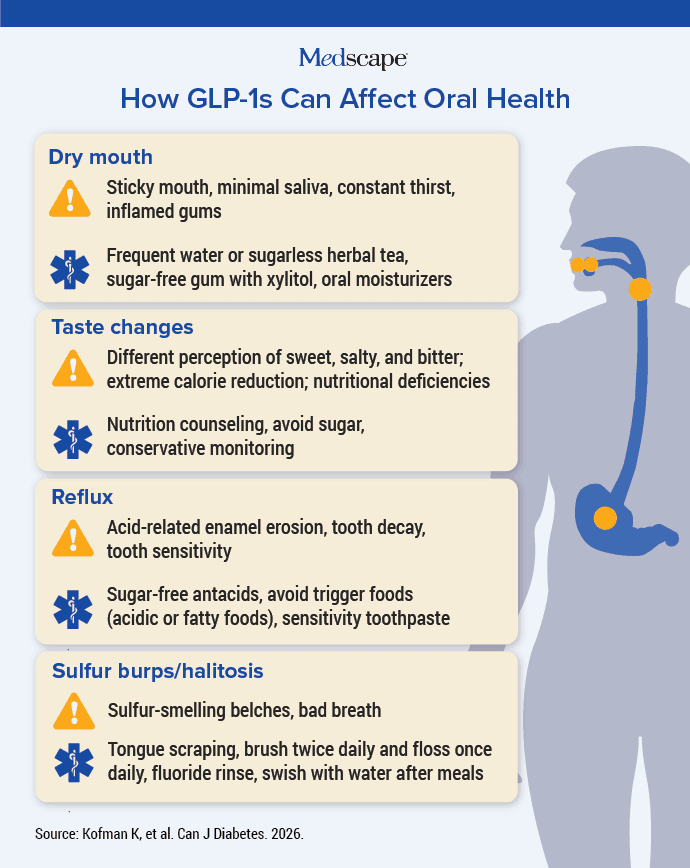
While dry mouth and sulfur burps might not be reason enough for a patient to discontinue the use of a life-changing drug, nobody enjoys the experience. Good oral hygiene — twice-daily brushing for 2 minutes each time and flossing at least once a day — can help, as can these other measures recommended by the American Dental Association and/or Ouanounou:

Dry Mouth

  • Advise patients to drink plenty of water or herbal tea without sugar.
  • Stimulate saliva production with sugar-free gum or pastilles containing xylitol, a sugar alcohol shown to prevent tooth decay. The act of chewing gum itself increases saliva production.
  • Recommend over-the-counter oral moisturizing rinses, sprays, gels, or lozenges.
  • In severe cases, consider prescribing pilocarpine to boost saliva production.

Changes in Taste Perception

  • Suggest smaller, more frequent meals to better tolerate the effects.
  • Refer patient for nutritional counseling to maintain a balanced diet.
  • Monitor the patient closely because altered taste perception can lead quickly to nutritional deficiencies.

Reflux and Vomiting

  • Encourage patients to replenish fluids consistently and eat smaller, more frequent meals.
  • Suggest sugar-free antacids.
  • Help patients identify trigger foods or behaviors to avoid — they might include certain acidic or fatty foods or smoking.
  • Advise against brushing teeth right after vomiting when tooth enamel is softened and vulnerable to mineral loss. Instead, have them swish with water immediately and wait at least 30 minutes to brush.
  • Recommend using toothpaste formulated for sensitive teeth.
  • Consider modifying the medication dose to reduce vomiting.

Sulfur Burps and Halitosis

  • Advise the use of a fluoride-containing antibacterial toothpaste, preferably with zinc, to help neutralize sulfur compounds and kill odor-causing bacteria.
  • Recommend tongue scraping and flossing at least once a day.
  • Instruct patient to swish and spit out water after eating to remove food debris.
  • Recommend a fluoride-containing mouth rinse.

Conditions such as dry mouth, vomiting, and reflux put a patient at a higher risk for tooth decay. If they’re not able to follow recommendations — or if the suggestions don’t help their symptoms — encourage them to see their dentist every 3 or 4 months rather than the standard 6-month interval.

Those cited in this article reported no relevant disclosures.

https://www.medscape.com/viewarticle/how-ozempic-mouth-became-thing-and-how-treat-it-2026a1000jsd