- US special operations forces seized Venezuelan President Nicolás Maduro and his wife, Cilia Flores, in a nighttime operation to bring him to the United States to face a 2020 narco-terrorism indictment.
- The removal of Maduro has immediately created a power vacuum in Venezuela, leading to massive market volatility in the energy sector as traders weigh the risk of civil war against a potential oil recovery.
- The strike has been framed by the US as a blow against a "narco-state" and a strategic move to sever a critical Latin American artery for China, but it has drawn international backlash, with Russia and Cuba labeling it a violation of sovereignty.

The geopolitical landscape of the Western Hemisphere shifted violently Saturday morning. In a nighttime operation that mirrors the 1989 capture of Manuel Noriega, U.S. special operations forces—reportedly including the Army’s Delta Force—struck Caracas and seized Venezuelan President Nicolás Maduro and his wife, Cilia Flores.
President Donald Trump confirmed the capture on social media, describing it as a "large-scale strike" conducted alongside law enforcement.
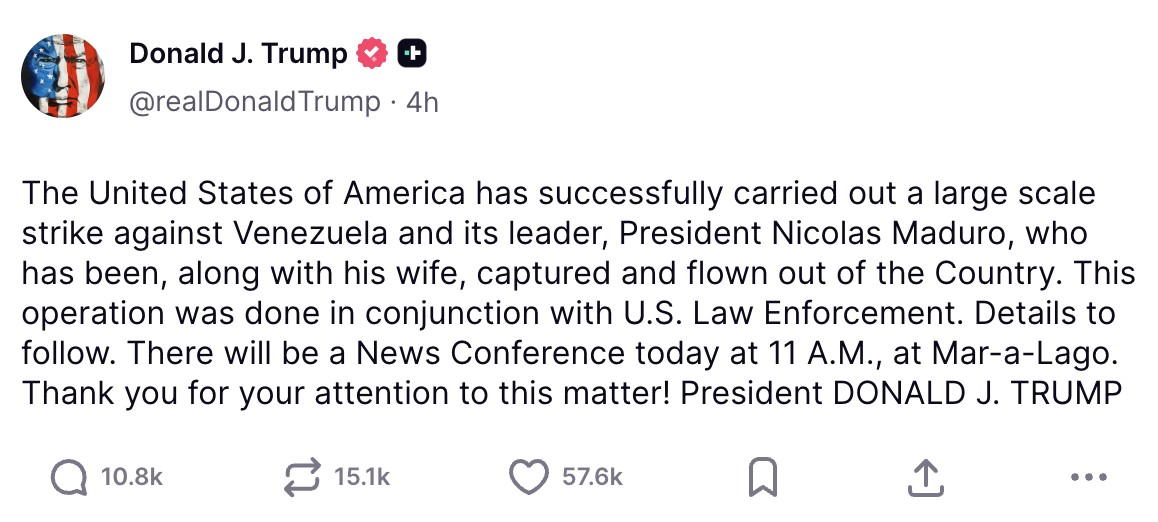
Maduro is currently being flown to the United States to face a 2020 indictment in the Southern District of New York (SDNY) for narco-terrorism and cocaine importation conspiracy.
The sitting leader of the country with the world's largest proven oil reserves is now in American custody.
For the energy markets, the immediate question isn't necessarily about justice, but about the flow of 800,000 to 900,000 barrels of oil per day. Early assessments from state-run Petróleos de Venezuela S.A. (PDVSA) suggest that production and refining facilities remain intact, though the port of La Guaira has sustained "severe damage."
Venezuela sits on roughly 300 billion barrels of oil... most of it trapped under a crumbling infrastructure that needs billions in Western capital to breathe again.
The Trump administration has framed this as a blow against a "narco-state," but the underlying strategy leans heavily on the Monroe Doctrine.
By removing Maduro, Washington effectively severs a critical Latin American artery for China, which has been the primary buyer of Venezuelan crude in exchange for debt repayment.
Markets can expect a massive spike in volatility as traders price in the risk of a Venezuelan civil war versus the potential for a "Chevron-led" recovery of the Orinoco Belt.
Legal Limbo and the Ghost of 1989
The legal authority for a direct strike on a sovereign head of state remains murky, echoing the controversial "Noriega Precedent" from exactly 36 years ago. While Attorney General Pam Bondi emphasized the criminal charges—specifically narco-terrorism and the possession of "destructive devices"- the operation bypasses traditional diplomatic immunity.
The U.S. position relies on a specific legal loophole: because Washington does not recognize Maduro as the legitimate president following the disputed 2024 elections, it views him not as a protected head of state, but as an indicted fugitive leading a criminal enterprise.
In the eyes of the Justice Department, this was the high-stakes execution of an arrest warrant.
But the domestic political fallout is already mounting.
Congress was notably left in the dark, and the administration’s reliance on Article II "Commander in Chief" powers to justify a unilateral strike on a foreign capital has hit a bipartisan nerve. Sen. Mike Lee (R-Utah) has already questioned the constitutional justification for the strike in the absence of a formal declaration of war or specific Authorization for Use of Military Force (AUMF).
"The Constitution does not permit the executive branch to unilaterally commit an act of war against a sovereign nation that hasn't attacked the United States," Rep. Thomas Massie (R-Ky.) noted earlier this month, anticipating this exact escalation.
The U.S. is essentially betting that the "shock and awe" of Maduro’s removal will cause the Venezuelan military to fracture rather than fight. It is a gamble on the "Ker-Frisbie" doctrine—a legal principle suggesting that once a defendant is in a U.S. courtroom, the "shady" nature of how they got there doesn't invalidate the trial.
If the military holds its loyalty to Interior Minister Diosdado Cabello or Vice President Delcy Rodríguez, the U.S. hasn't just captured a "tyrant"... it has opened a theater of urban warfare on its own doorstep. The transition from "kidnapping" to "cooperative extradition" depends entirely on whether a new, U.S.-recognized government is installed quickly enough to retroactively "consent" to the raid.
Global Markets Brace for the Aftershock
The reaction from the international community has been split along predictable, yet dangerous, lines. Russia and Cuba have already labeled the move an "unacceptable violation" of sovereignty and "state terrorism."
Moscow’s first official response, channeled through its embassy in Caracas, accused Washington of "armed aggression," while reports suggest Vladimir Putin has convened emergency closed-door meetings at the Kremlin to address the loss of its most significant strategic ally in the Americas.
China, meanwhile, has been quieter but no less firm, previously criticizing the U.S. naval blockade as "illegal unilateral sanctions." For Beijing, Maduro’s removal isn't just a political loss; it’s a direct threat to the billions in debt-for-oil swaps that have fueled its energy security for a decade.
Meanwhile, regional neighbors are panicking. Colombian President Gustavo Petro has deployed troops to the 2,000-kilometer border, describing the strike as an "assault on the sovereignty" of Latin America. Petro has activated contingency plans for what he expects to be a massive, chaotic influx of refugees—or worse, a spillover of military skirmishes as Venezuelan forces mobilized under "external disturbance" protocols.
In sharp contrast, Argentina’s Javier Milei celebrated the capture with his characteristic "Long live freedom" slogan, while Nobel laureate María Corina Machado has praised the move as a blow against a "criminal structure."
Data from the International Energy Agency (IEA) has long highlighted Venezuela as the "wildcard" of global supply. Even before today’s raid, IEA forecasts for 2026 had been trimmed due to the U.S. blockade and sanctions hitting Russian and Venezuelan exports. If a transitional government friendly to Washington takes over, we could see the fastest return of "lost" barrels in history... assuming the power grid in Caracas doesn't collapse entirely first.
The physical reality on the ground, however, is grim. Smoke is rising from the hangar of the La Carlota air base, and fire has been reported at Fuerte Tiuna, the country's largest military complex.
The 11 a.m. press conference at Mar-a-Lago will likely dictate whether this is the end of a surgical strike or the beginning of a prolonged regional conflict that could keep 300 billion barrels of oil locked in the ground for years.

No comments:
Post a Comment
Note: Only a member of this blog may post a comment.