Search This Blog

Monday, December 10, 2018

WuXi, Brii in Research Link for Novel Bispecific Antibody Immunotherapeutics


Wuxi Biologics (2269.HK), a leading global open-access biologics technology platform company offering end-to-end solutions for biologics discovery, development and manufacturing, announced today a strategic collaboration with Brii Biosciences (Brii Bio), an innovative biotechnology company operates in China and the US, focusing on accelerating innovation and optimizing access to serve the need of Chinese patients and public health, to discover and develop bispecific antibodies to treat infectious diseases and other immunologic disorders.
This collaboration will further integrate the advantages of the two companies and expedite the development of Brii Bio’s pipeline. Under the terms of the exclusive research agreement, Brii Bio has the access to WuXi Biologics’ entire antibody platform capabilities including the WuXiBody™ technology to discover novel bispecific antibodies. WuXi Biologics will also be the exclusive development and manufacturing partner of any novel bispecific antibodies discovered from the WuXiBody™ Platform.
“Discovery of novel immunotherapeutics modulating the host immune responses represents an untapped paradigm that may improve the treatment of infectious diseases,” said Dr. Zhi Hong, Co-founder and Chief Executive Officer of Brii Biosciences, “WuXi Biologics has successfully grown and expanded its capability and capacity in biopharmaceutical, which will enable us to translate target insight to key therapeutic modalities and innovate in China for the world.”
“We are pleased to enable Brii Bio in developing and manufacturing bispecific therapeutics through the proprietary WuXiBody™ Platform that tackles technical hurdles of bispecific platforms and tremendously reduces the cost of making these biologics, therefore offer novel treatments for unmet medical needs,” said Dr. Chris Chen, Chief Executive Officer of WuXi Biologics. “The collaboration is expected to develop and manufacture life-saving biologics targeting different diseases, and then benefit patients around the world.”

Sunday, December 9, 2018

Daiichi Sankyo Updates Phase 1 Results of Breast Cancer Med at SABCS


. Updated analysis from ongoing phase 1 study of [fam-] trastuzumab deruxtecan (DS-8201) demonstrated a confirmed overall response rate of 44.2 percent and a disease control rate of 79.1 percent in 43 evaluable patients with heavily pretreated HER2 low metastatic breast cancer
・ A further subgroup analysis of 38 patients whose disease was also hormone receptor (HR) positive showed a 47.4 percent confirmed overall response rate and 81.6 percent disease control rate
・ No anti-HER2 therapies are currently approved for HER2 low expressing breast cancer, and plans for a phase 3 study are underway
Daiichi Sankyo Company, Limited (hereafter, Daiichi Sankyo) announced that updated safety and efficacy data from the ongoing phase 1 study with [fam-] trastuzumab deruxtecan, an investigational HER2 targeting antibody drug conjugate (ADC), were presented for a subgroup of patients with heavily pretreated HER2 low expressing metastatic breast cancer during a Poster Session at the 2018 San Antonio Breast Cancer Symposium(SABCS) (#P6-17-02).
The updated analysis of 43 evaluable patients with HER2 low expressing metastatic breast cancer (IHC 2+/ISH- or IHC 1+), who received [fam-] trastuzumab deruxtecan at a recommended expansion dose of 5.4 or 6.4 mg/kg, demonstrated a confirmed overall response rate of 44.2 percent (19/43 patients) and a disease control rate of 79.1 percent (34/43 patients). Preliminary estimate of median duration of response was 9.4 months (range: 1.5+, 23.6+), and median progression-free survival was 7.6 months (95 percent CI: 4.9, 13.7). A total of 54 patients with heavily pretreated (median 7.5 prior anticancer regimens) HER2 low breast cancer have received ≥1 dose [fam-] trastuzumab deruxtecan 5.4 or 6.4 mg/kg in the study and 23 patients remain on treatment as of data cut-off on October 12, 2018.
‘While anti-HER2 therapies play an important role in the treatment of HER2 positive breast cancer, they historically have not demonstrated effectiveness against tumors that express lower levels of HER2,’ said Shanu Modi, MD, Breast Medical Oncologist, Memorial Sloan Kettering Cancer Center and study investigator. ‘These data offer preliminary evidence of [fam-] trastuzumab deruxtecan activity in HER2 low expressing breast cancers, and based on further study, we are beginning to consider the implications for how we classify and treat these patients.’
A further subgroup analysis of 38 evaluable patients whose disease was also hormone receptor (HR) positive demonstrated a confirmed overall response rate of 47.4 percent (18/38 patients) and a disease control rate of 81.6 percent (31/38 patients) with [fam-] trastuzumab deruxtecan. Preliminary estimate of median duration of response was 11.0 months (range: 1.5+, 23.6+), and median progression-free survival was 7.9 months (95 percent CI: 4.4, 13.7) in this patient subgroup. A total of 45 patients with HR positive, HER2 low breast cancer have received ≥1 dose [fam-] trastuzumab deruxtecan 5.4 or 6.4 mg/kg in the study and 21 of these patients remain on treatment as of data cut-off.
‘There are no anti-HER2 therapies currently approved for HER2 low expressing breast cancer, which represents about half of all breast cancers,’ said Gilles Gallant, BPharm, PhD, Vice President, DS-8201 Global Team Leader, Oncology Research and Development, Daiichi Sankyo. ‘Based on these data, plans for a phase 3 trial in patients with HER2 low metastatic breast cancer are underway, adding to our broad development program evaluating [fam-] trastuzumab deruxtecan in HER2 expressing breast cancers and other tumor types.’
Updated overall safety data as of October 12, 2018 for all breast cancer patients in the ongoing phase 1 study were also reported at SABCS. Among 170 patients who received at least one dose of [fam-] trastuzumab deruxtecan 5.4 or 6.4 mg/kg for advanced breast cancer in the dose expansion or dose escalation part of the study (regardless of HER2 status), the most common adverse events (≥30 percent, any Grade) included nausea (79.4 percent), decreased appetite (54.1 percent), alopecia (46.5 percent), vomiting (45.9 percent), fatigue (42.4 percent), anemia (40.0 percent), constipation (38.2 percent) and diarrhea (38.2 percent). A total of 50.0 percent of the breast cancer patients experienced a Grade ≥3 adverse event and 22.9 percent had a serious adverse event, including 2.9 percent of patients who experienced an adverse event that lead to death.

Gilead Sciences to hire Roche executive O’Day as new CEO


Drugmaker Gilead Sciences Inc will name Roche Holding AG executive Daniel O’Day as its new chief executive officer, according to a source familiar with the matter.

The announcement of O’Day’s hiring could come as early as Monday, the source said.
It is not clear when O’Day, currently the CEO of Roche Pharmaceuticals, will start at Gilead.
The news of O’Day’s hiring comes about four months after Gilead said in July that it’s Chief Executive John Milligan and Chairman John Martin would step down at the end of the year.
Martin, who preceded Milligan as Gilead CEO, said he planned to leave the board when a new CEO joins the company.
Up to Friday’s close, the company’s shares have fallen nearly 14 percent since Milligan and Martin’s departures were announced by Gilead in July.

Roth Capital Starts CorMedix (CRMD) at Buy


Roth Capital analyst Jerry Issacson initiates coverage on CorMedix (NYSE: CRMD) with a Buy rating

Unilever downgraded to Underweight from Neutral at JPMorgan


JPMorgan analyst Celine Pannuti downgraded Unilever to Underweight and lowered her price target for the shares to EUR 44.50 from EUR 46. The analyst views consensus expectations as elevated.
https://thefly.com/landingPageNews.php?id=2834189

Gilead to hire Roche’s Daniel O’Day as next CEO


WSJ report

US Spending on Physician, Clinical Services Rose 4% in 2017


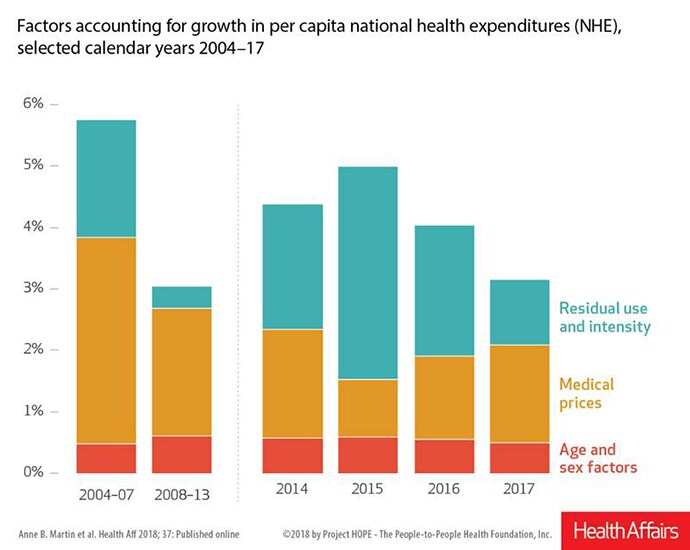
US spending for physician and clinical services rose 4.2% in 2017, the smallest increase seen since 2013, according to a new report. This continues a recent ebb in the growth rate for total national healthcare expenses, which followed a jump in 2014 and 2015 due to expansion of Medicaid and private insurance coverage.
The Office of the Actuary at the Centers for Medicare & Medicaid Services (CMS) on Thursday released the latest version of its widely followed annual national health expenditures reportHealth Affairs published a related articleimmediately online, which will appear in the January issue of the journal.
Total US health spending experienced a bump in annual growth rates in 2014 (5.2%) and 2015 (5.8%), compared with annual increases of between 3% and 4% seen from 2011 to 2013, CMS said.
Around 2014, many states expanded their Medicaid programs, while at the same time, public and private insurers wrestled with the cost of new drugs for hepatitis C. By 2016, however, the Medicaid expansion was largely established and many people had been treated for hepatitis C, thus the growth rate for total US health spending that year slowed to a 4.8% increase.
In 2017, national healthcare spending rose by just 3.9% to a total of $3.49 trillion.
Spending on physician and clinical services followed a similar pattern, with annual gains between 2.2% and 4.6% from 2011 to 2014, CMS said. The growth rate then hit 6.0% in 2015, slowed to 5.6% in 2016, and slipped again to 4.2% for last year. Spending for physician and clinical services totaled $694.3 billion last year, CMS said.
On a call with reporters, Aaron Catlin, deputy director in the National Health Statistics Group in CMS’ Office of the Actuary, said there are a number of factors that could play into the drop in growth rate for physician and clinical services for which the agency hasn’t created specific estimates.
In response to a question from a reporter, Catlin said high-deductible health plans might play a role in the decrease in intensity of services. (These plans make their customers directly pay a larger share of some medical bills, giving them an incentive to reconsider some visits or treatments.) He also noted that there has been a shift in site of care, with some physician services shifted to freestanding and other clinical settings.

Drug Spending

The recent spike and decline in spending growth has been even more pronounced for prescription drugs. Annual increases in this spending ranged from 0.2% to 2.3% in 2011 to 2013. A 12.4% spike occurred in 2014, due in part to the introduction of costly sofosbuvir (Sovaldi), a hepatitis C antiviral drug sold by Gilead Sciences Inc.
The rate of growth has slowed since, dropping to 0.4% last year, with retail prescription drug spending totaling $333.4 billion. The slower growth rate reflects a continued shift to lower-cost generic drugs, slower growth in the volume of some high-cost drugs, declines in generic drug prices, and lower price increases for existing brand-name drugs, CMS said.
These cost-saving steps for pharmaceutical purchases were, however, balanced by the continued introduction of new medicines, which often command high prices. In the new report, CMS noted that there were 46 new drug approvals last year, more than double the 22 approvals in 2016.
The 2017 introductions included 13 new drugs approved for cancer, CMS said. Of the new drugs introduced in 2017, 15 were “first in class,” including drugs for eczema and multiple sclerosis. Eighteen new drugs were intended for rare diseases and are often referred to as “orphan drugs,” CMS said.
CMS officials also reported that:
  • Hospital spending rose 4.6% to $1.1 trillion, less than the 5.6% growth seen in 2016.
  • Private health insurance spending increased 4.2% to $1.2 trillion in 2017, less than the 6.2% growth seen in 2016. CMS said this deceleration reflects both slower growth in medical benefits and a decline in taxes resulting from the suspended collection of a health insurance provider fee in 2017.
  • Medicare spending grew 4.2% to $705.9 billion in 2017, little changed from 2016 when spending grew 4.3%. Growth in fee-for-service Medicare spending was 1.4% in 2017 compared to 2.6% in 2016, while spending for Medicare private health plans rose 10.0% in 2017 compared to 8.1% in 2016.
  • Medicaid spending growth slowed in 2017, increasing 2.9% to $581.9 billion following growth of 4.2% in 2016.
  • Out-of-pocket spending by consumers, including copayments, deductibles, and spending not covered by insurance, grew 2.6% to $365.5 billion in 2017, which was slower than the 4.4% growth in 2016.
The CMS officials ended their report by highlighting the overall trend toward having healthcare costs consume more of the nation’s economy, although there was a slight drop last year in its share. Healthcare spending accounted for 17.9% of GDP last year, as opposed to 18.0% in 2016.
Last year was the first since 2013 that healthcare’s share of the gross domestic product did not increase. “2014 and 2015 were marked by insurance coverage expansion and expensive new drug treatments that produced faster growth in health care spending, while 2016 was affected by low economic growth,” the CMS officials said.
The CMS officials noted that health care spending growth averaged 4.3% per year between 2008 and 2017, compared with an average annual rate of 7.3% in 1998 through 2007.
Even so, healthcare spending’s share of GDP increased by 1.6 percentage points from 2008 to 2017, compared with a 2.6-percentage-point increase from 1998 to 2007, CMS said.
“For a health sector that now accounts for nearly one-fifth of the US economy, future increases in health care expenditures will likely lead to policy decisions focused on affordability and sustainability,” the CMS officials wrote.
The authors have disclosed no relevant financial relationships. The opinions expressed in the analysis are the authors’ and not necessarily those of CMS.
Health Aff. Published online December 6, 2018. Abstract
CMS. Published online December 6, 2018. Report