Search This Blog

Sunday, February 3, 2019

Treat your family like VIPs

If you’ve ever been at an event with a high-level person like a politician, celebrity, or business executive, you’ve likely noticed the guys wearing sunglasses and sporting an earpiece, trying to look as unassuming as possible while vigilantly keeping an eye out for their client, or “principal.”
These guys are part of a personal security detail (PSD), and their job is to protect VIPs from embarrassment, harassment, and harm.
While you probably don’t work as a personal security agent as your day job, if you’re a man with a family, you’ve still got some VIPs that you’re responsible for keeping safe: your wife and your kiddos.
The world is an unpredictable place. While you and your family are unlikely to find yourselves in the middle of a dangerous emergency, crimes and accidents happen, and random, civilian-targeted terrorist attacks are statistically on the rise.
A man’s most ancient role is to act as protector for those he loves. The skillset needed to fulfill this calling has changed from time period to time period, but the charge has remained consistent. It’s a job that need not involve paranoia, becoming overly cautious, or loading up on tons of “tactical gear.” Rather, it involves adopting a calm, but vigilant mindset — a state of relaxed alert — and carrying a few tools that are better to have on hand and not need, than need and not have.
To help us learn how to treat our families like VIPs, I talked to the owner of Greyfox Industries here in Tulsa, OK. He runs personal security details for high-level business and NGO executives when they travel internationally. Below you’ll find insights and tactics that the everyday family man can use to provide personal security protection for the VIPs in his life — his principle loved ones.
Note: Due to the nature of his work, the owner of Greyfox asked that we didn’t use his name in this article. So throughout the post, I’ll simply be referring to him as “Greyfox.”

Be Prepared

PSD spend most of their time planning and preparing to protect their client. While you likely don’t have the time or resources to do the same sort of preparation as a professional PSD, you can apply the same ethos when taking care of your family.
Do Your Research
Before a PSD team goes somewhere with their principal, they’ve done reconnaissance on the place to ensure there aren’t any security threats, and if there are, they do what they can to eliminate or mitigate them. You can do something similar with your family. Before you visit a location you’ve never been, read up on it. If you find out people have died jumping off a certain cliff at a watering hole, avoid that cliff. If the forecast calls for rain, tell the kids to pack ponchos. If the destination is in an entirely unsafe part of town, well, don’t go there.
Be Thoughtful About Your EDC
personal defense edc first aid kit knife gun flashlight illustration
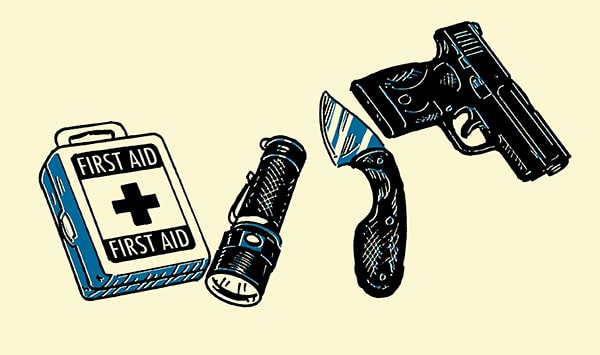
Besides reconnaissance, PSD teams carry the gear they need to protect their clients. Greyfox recommends always having a first aid kit in your car to take care of minor injuries that may occur when out and about. (While you’re at it, consider adding a few other things too.) He also suggests keeping tourniquets stocked in the first aid kit to stop massive bleeding in the event of an active shooting or similar attack.
On your person, you’ll want to keep at a minimum your cell phone (to call emergency crews when needed) and a tactical flashlight. The tactical flashlight is one of the most underrated personal defense tools. A bright flashlight can help you identify threats in dark environments and can be used to momentarily disorient attackers. In a pinch, it could also double as an improvised weapon. Greyfox recommends tactical flashlights from Klarusbecause of their ease of use and compactness.
Consider Carrying a Weapon
Most professional PSD teams are armed. Whether you carry weapons to defend your familial VIPs from a life-threatening attack is a decision only you can make. If you do decide to carry a firearm, make sure you understand the laws governing its use in self-defense situations and that you regularly train with it. Simply carrying a gun around without knowing how to use it, and regularly practicing your marksmanship, does not constitute adequate personal defense.
As Greyfox puts it, “I want to be at the highest level I can possibly be because my family deserves it, just like my client does.” To keep himself accountable, Greyfox asks himself whether he’d want someone with his own firearms background and training to protect his family:
“If I was hiring someone to protect my family, would my skills be enough? Would I look at my own resume and say, ‘Yeah, this guy is good. This guy is worth putting in’? That’s the way I like to look at it. If I ask them, ‘Well, when was the last time you were at the range, what did you do at the range? Are you actually training or are you just shooting? What are you actually doing on a day-to-day basis?’ Would I hire this individual to protect my family? That’s how I judge myself.”
If carrying a firearm isn’t something you want to do, or you’re in a location (bars, schools, government buildings) or a country that doesn’t allow it, you can carry a knife (though some countries and even states forbid this as well). Greyfox recommended the Ka-Bar TDI knife. Again, if you’re going to carry a weapon for self-defense, make sure you understand the laws governing its use in self-defense situations and train on how to use it.
And if carrying a weapon isn’t something you want to do, at least consider carrying a tactical pen — a pen that can improvise as a weapon if needed. You can carry them anywhere discreetly and legally. For a pen that packs more punch, but looks more obviously “tactical,” check out the Hoffman Richter Stinger pen. For a pen that appears more innocuous (and is cheaper), pick up a Zebra F-701.

Look Like a Protector

Most ruffians are ruffians of opportunity. They’ll only attack or bother a VIP if they think they’ll have a chance of succeeding without suffering harm. If they see a team of strong, fit, and stern-looking men near a potential target, they’re not likely to bother him. The mere presence of these bodyguards is a threat deterrent.
As the PSD for your family, make sure you have a presence that will deter would-be troublemakers. First, get strong and look fit. Like other animals, humans key in on certain physical characteristics to determine whether another person would be dominant or submissive in a fight. Wide shoulders with a tapered torso in men indicate strength and physical fitness, and thus physical dominance. Would-be attackers will likely think twice before attacking a man who looks fit and strong because there’s a good chance they’ll suffer some damage in the attempt. So if you’re not as in shape as you’d like to be, get going on it; being able to protect your family is some of the best motivation for getting and staying strong.
Besides being fit, just carry yourself in a confident manner. This doesn’t require that you look like a scowling Secret Service agent or stick out your chest like an Affiliction-tee-wearing dude-bro. Stand up straight, look people in the eyes, and speak low, slow, and with confidence. The goal is to project to others that if there’s a problem, you’re going to do something about it and not be a passive victim.

Be the Agent in Charge

A full PSD team has several agents who have different jobs. For example, there’s an advance team that’s on location before the VIP arrives to assess the situation and head-off any potential threats. And pre-posted agents assume positions throughout an area to monitor risks.
As the PSD for your family, you don’t have the luxury of having a full team of agents dedicated to protecting your family. So think of your role as that of the “Agent In Charge” or AIC. In the world of PSD, the AIC stays one step to the rear and one step to the right of the VIP at all times. This position allows him to constantly keep the principal in sight, and to direct them to where they need to go should a threat arise.
As the AIC of your family, you’ll want to assume a physical position similar to that of a professional AIC. Stay near your wife and kids. If a threat arises, you’ll be able to direct them to safety. When entering a building, open the door for your family and let them go in first. It’s good manners, but it also naturally and discreetly puts you in the ideal AIC tactical position, as it allows you to keep your family in sight as they go inside.
When you’re out walking on sidewalks, stand between the street and your family. “Not only is it the gentlemanly thing to do, but in the world of security, that’s what you should be doing,” said Greyfox. “It adds a layer of protection to your family. If some car starts swerving towards you, you can move them out of the way. This is especially important nowadays with people texting and driving.”
As the AIC, work with your wife to have a plan in place on what you two would do if trouble arises. Again, you don’t have to be super intense with this. Just make sure you’re both on the same page. Decide which parent would be in charge of/responsible for which kid(s) if you had to escape from an active shooter or other threat. For example, Kate and I know that if something bad were to happen, she’s to grab our daughter, and I’m to grab our son when we hightail it out of there. Also decide that if you guys get separated during the situation, you’ll meet each other at the car.

If a Place Looks Like Trouble, Leave
family in bar with rough crowd illustration
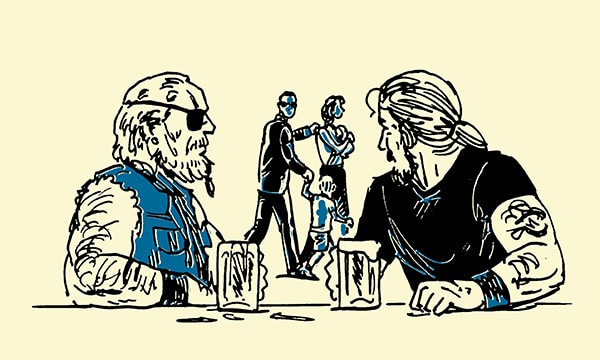
In the professional PSD world, the AIC is the man who decides if the principal needs to be directed out of a potentially dangerous environment. The best outcome for a PSD is if the principal never has to encounter the potential for harm, harassment, or embarrassment. As the AIC of your family, your job is to do likewise.
When you’re out with your family, survey the place you’re in. Be prepared to leave if you don’t feel like it’s safe for your family. This will rarely happen, but it should be an option. Don’t be paranoid, but don’t let the inconvenience of having to go to another restaurant or skip out on a baseball game early deter you from keeping your family safe, either. A PSD does his job well if he can completely avoid a situation that may potentially escalate.

Maintain Situational Awareness

As you’re out and about with your family, practice good situational awareness. We’ve written about how to do that in detail here, but here are the basics:
family at restaurant shady guy walking in illustration
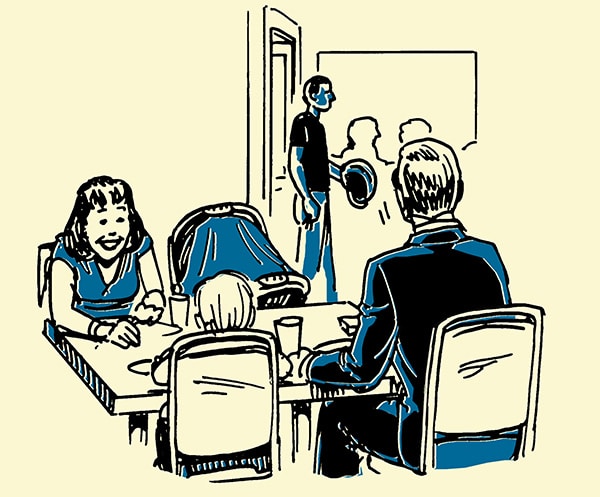
Put yourself in a position of optimal observance. Typically this means being in a place where you can see all entrances and exits. At a restaurant, ask to be seated at a table with the best vantage point. If that’s not possible, at least sit at the table with your family so you can see the most exits and entrances.
Establish baselines. When you’re in a place, figure out what’s “normal” for that situation. That’s going to change from situation to situation, but you should be able to establish baselines relatively quickly.
Look for anomalies. Once you establish a baseline, start looking for anomalies. What sort of behavior would cause a person to stick out in that particular situation? Greyfox recommends checking faces and hands to look for anomalies, as these parts of the body reveal threats the best. Hands hold what can kill you; faces (particularly eyes), show intent. You don’t have to be nutty about this. Don’t stare people down one-by-one. Just play it cool, glance at hands and faces, and actually notice what you see.
If you observe an anomaly, it doesn’t necessarily mean the person is a threat, so there’s no need to get all amped up. Just notice it and keep it front of mind.
Have a plan. In every place you go, have a plan of what you’re going to do if you notice an anomaly. Let’s say you’re in a movie theater with your family. One baseline would be that people would enter the theatre through the normal entrances and exits, not the emergency exits near the screen. What would you do if someone entered the theater through one of those exits? It could just be a kid trying to sneak in for a free movie, or it could be an active shooter. Increase your level of alertness and decide what you’ll do should the interloper turn violent.
Again, anomalies are rarely going to happen, but you’ve got to have a plan for what you’re going to do should they occur.

If Someone Is Giving Your Family Trouble, Leave. Don’t Escalate.
family being accosted by drunk man illustration
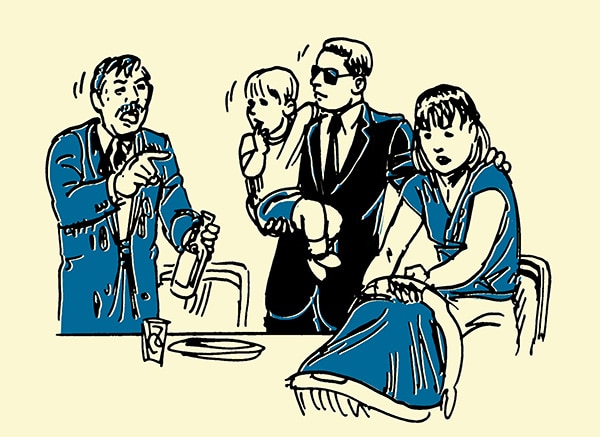
If your family is facing an imminent, life-threatening attack, your priority is to keep them safe. And that usually means getting them out of there as fast as possible. As we discussed in our article about what to do in an active shooter situation, running is your first line of defense. Fighting back should always be on the table, but typically as a last resort. When you’re with your family, the priority should always be to get them as far away from the threat as quickly as possible. If running isn’t an option, then you do what you have to do to protect your family.
Where things get murky is what to do if someone is just verbally harassing your family. Most men would want to defend their loved one’s honor by immediately telling the harasser to shut the hell up. In the world of PSD, they handle those types of situations much more discreetly. Depending on the situation, a team of agents will escort the harasser out of the area. As the AIC of your family, you likely won’t have that option. So you do what professional PSDs would do if they can’t move a harasser: move the principal, i.e., your family.
“You’ve got to check your pride before putting your family at risk,” says Greyfox. “Yeah, you could get aggressive and have a yelling contest with an asshole, but is that going to be best for your family? Probably not. It will freak your kids out and could needlessly escalate the situation.”
So instead of escalating things, calmly and confidently remove your family from a situation in which they’re being harassed. If the harasser pursues you and gets physical, then you’re within your right to use a similar amount of physical violence to end the threat. So if he’s shoving your wife, you can punch the guy, but not shank him with your knife or shoot him with your gun.
But again, your job as AIC for your family is to make sure that things never get that far. Just get them out of there.

Keep Your Flashlight At the Ready When Walking At Night

family walking at night dad husband with flashlight illustration
Would-be attackers like to use the cover of darkness to surprise their victims. So when you’re out with your family at night, keep your tactical flashlight at the ready. “You don’t need to take your flashlight out and shine it around like an idiot while you’re walking in a dark parking lot,” Greyfox says. Again, discretion is key. Just keep your hand in your pocket and around your flashlight so you can deploy it quickly should you notice a potential threat.

Let Your Family Get in the Car First

When you’re getting into a vehicle, you’re pretty open to attack because you’re so focused on getting children or stuff loaded into the car. When you’re out with your family and they’re getting into the car, remember to assume the position of AIC — stay behind your principal. “Stand at the back of the car while your family gets in. You don’t need to act like you’re posted up protecting your family from would-be assassins, but keep an eye on your family and glance around for possible threats,” Greyfox suggests. If you’re in the car before your family gets in and an attack does happen, you’re at a tactical disadvantage. Threats don’t even have to be attackers. It could be little old ladies who are backing up their boat of a Cadillac and can’t see that they’re about to hit your kid.

When Stopped in Your Vehicle, Be Sure You Can See the Tires of the Car in Front of You
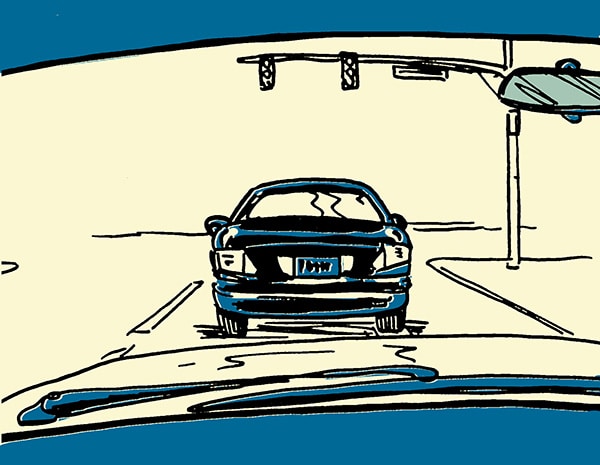
car stopped at stoplight illustration
The driver is an important part of the PSD team. These guys are trained in tactical driving and know how to get the principal to safety as quickly as possible. While you’ll likely never have to utilize a Rockford J-Turn to escape from bad guys, one simple tip you can take from PSD drivers is to make sure you can see the tires of the cars in front of you whenever you’re stopped at an intersection. “This allows you enough room to steer and drive away if you need to,” Greyfox explains. Beyond threats, it allows ease of movement if an emergency vehicle needs to get its way through traffic; if everyone is bumper to bumper, nobody can move to the side.

Conclusion

The members of your family are your VIPs in life. Give them the same protection that corporate or political VIPs get when you’re out and about together. You don’t have to go full-on, tacti-cool bonkers with it. Like real-world PSD, be discreet. Use common sense, maintain situational awareness, and have a plan for what you’ll do to protect your family from harm.

At Super Bowl, which kicker will choke first?

WHETHER YOU’RE ROOTING for the New England Patriots this weekend or the Los Angeles Rams, some of the tensest moments of Super Bowl LIII will likely come when a kicker stares down the field, breaks into a sprint, and plants his foot on the ball, sending it arcing towards the field goal in hopes of scoring a few precious points. Those slowed-down moments of the game, in the high-stakes environment of football’s championship event, are when a little sports psychology can go a very long way.
Any team wants its star kicker to display great range and accuracy. But that’s not enough without an exceptional mental game to match. Both teams heading into this year’s Super Bowl are well-equipped in this department. The Patriots’ Stephen Gostkowski is among the NFL’s most consistent and prolific placekickers. Not only is he New England’s all-time leading scorer, he’s also the league record-holder for most consecutive extra points (523, counting postseason performances).
Rams kicker Greg Zuerlein, meanwhile, may well possess the most powerful leg the game has ever seen; his nigh-ballistic feats from beyond the 50-yard-line have made him a tremendous tactical asset, while earning him nicknames like “Legatron” and “Greg the Leg.” Truth be told, the Rams might not be Super Bowl-bound, were it not for Zuerlein and his prodigious lower limb: Earlier this month, when his team faced the New Orleans Saints in the NFC Championship, it was a 48-yard field by goal by Zuerlein that sent the game into overtime with seconds left in regulation, and, minutes later, his cracking 57-yarder that won the game.
That overtime kick, which looked like it could have been good from 70 yards, was the longest game-winning kick in NFL playoff history. But just as impressive as Zuerlein’s phenomenal range was his ability to post that record-setting yardage in the face of defeat. He could have choked, but he didn’t—and at a competition like the Super Bowl, that might be the most desirable quality of all.
“Every athlete has on days and off days, but choking, cracking under pressure, that’s different,” says cognitive scientist Sian Beilock, president of Barnard College and author of Choke: What the Secrets of the Brain Reveal About Getting It Right When You Have To. “When I say ‘choking,’ I mean the person delivers a worse performance than you would expect, given their skill level, because of the anxiety they’re experiencing due to their situation.”
Ironically, your propensity to choke might vary according to your abilities—and not necessarily the way you might think. In a study recounted in The Quarterly Journal of Experimental Psychology, Beilock observed that skilled golfers putted more accurately when they were instructed to putt quickly, whereas novice golfers performed worse. Strangely, asking the golfers to take their time produced the opposite effect. “When experienced athletes start thinking too much about the details of their performance, that’s actually when they mess themselves up,” Beilock says.
One interpretation of Beilock’s finding is that the better a person becomes at some skill—whether it’s putting, kicking a field goal, or tying their shoes—the more automatic that skill becomes. She also suspects that switching an expert offof autopilot can throw them off their game.
By meddling with the amount of time at the expert golfers’ disposal, Beilock was interrupting their flow and upping the odds that they’d choke. That’s the same idea behind a tactic known in football as “icing,” whereby the defending team’s coach calls a timeout right as the offensive kicker is attempting a high-stakes field goal. That’s precisely what New Orleans Saints head coach Sean Payton tried to pull on Zuerlein, at the NFC championship: The first time the Rams’ kicker lined up for his game-winning attempt from 57 yards, Payton called a TO, hoping the gravity of the situation would sandbag some of Zuerlein’s range or throw off his accuracy.
But the ice attempt failed. On his second go of it, Legatron, true to his name, sent the ball soaring through the uprights, won the game, and secured his team’s spot at the Super Bowl.
That’s the funny thing about icing kickers: Sometimes it backfires. While some data suggests interrupting a kicker’s flow in high-stakes scenarios can reduce their accuracy from long range, when University of Chicago behavioral economist Tobias Moskowitz analyzed high-pressure field goal attempts between 2001 and 2009, he found that kickers who were iced with fewer than 15 seconds on the clock tended to be more accurate, not less so.
So when should coaches ice the opposition? Hard to say. The tactic’s effectiveness remains an active area of debate, with statisticians turning to other variables—like weather, game location, and which team calls the timeout—in their analyses.
But the most important variable of all might be who’s being iced. Some kickers are probably just better under pressure. Perhaps Zuerlein is such a kicker.
Even if he is, everyone misses eventually, even preternaturally consistent performers like Gostkowski. Between 2012 and 2016, the Patriots kicker made 53 out of 53 of his postseason kicks. But going into Super Bowl LIII, he’s missed six kicks in his last nine playoff games.
That kind of hiccup can get inside a player’s head. Beilock’s advice? “What he shouldn’t do is dwell on his recent misses,” she says. “You want him to be thinking about his consistency over the years, his top performances, and then to go out there and do it. And I would remind him: He has a track record of success. This is gonna be no sweat.” A mistake would be to start over-analyzing his mechanics of his kick, or dwelling on the stakes—even if they don’t get much higher than his sport’s championship event.
As for whether he should practice being iced? “I mean, I think everyone should.”

The labor market continues to improve

The January jobs report handily beat expectations, with a gain of 296K private sector jobs vs. expectations of 175K. Considering all the disruptions (weather, government shutdown) and despite a big drop in consumer confidence, the numbers appear solid enough to say that the labor market continues to improve.
Here is a small collection of charts that I find most interesting:
Chart #1
Chart #2
Chart #1 shows the monthly change in private sector jobs, while Chart #2 shows the percentage gain over 6- and 12-month periods (which is important in order to filter out the notorious month-to-month volatility of this series). The growth rate of jobs bottomed in September 2017 at 1.5-1.6%, and it now stands at 2.1%. That’s a meaningful increase, and it likely accrues to both Trump’s tax cuts and and his frontal assault on regulatory burdens.
Chart #3
Chart #3 compares private sector jobs to public sector jobs. Here we see that there has been ZERO growth in public sector jobs for the past 10 years! Public sector jobs as a percent of total jobs now stand at the lowest level since 1957. Wow. If you believe, as I do, that public sector workers are less efficient than private sector workers (and less productive), then this means that the underlying productivity of the U.S. workforce has increased meaningfully in the past decade.
Chart #4
As Chart #4 shows, part-time employment has also been flat for the past decade. Relative to total private sector employment, part-time employment has shrunk impressively over the course of the recent expansion.
Chart #5
As Chart #5 shows, the labor force participation rate (the ratio of those working or looking for work relative to the total number of people of working age) has ticked higher for the first time in many years. People who were “on the sidelines” are now beginning to reenter the workforce. If this continues, it means the economy has lots of upside potential.

4 comments:

steve said…
Good stuff, Scott. The labor participation chart is most telling. Looks like it may have hit a nadir-until the crazies take over and tax income to 70% and confiscate wealth illegally in the name of “inequality”.
I love it too that many uber wealthy people in the public eye (Buffet, Gates, Dalio etc…) want inequality tax AFTER they made their billions. What a load of anti-altruistic (selfish) bs. They want to APPEAR magnanimous when in fact what the F difference does it make to them if the government confiscates a few $B of their money?
But is that good for the US economy? Hell to the no. And no one will convince me otherwise. Perhaps IF our illustrious government wasn’t so profligate with their spending then at least the egregious theft could somehow be swallowed (actually…no it couldn’t) but you and I know damn well that ain’t gonna happen.
Which is why in November of next year I’ll go the booth close my eyes and vote DT.
Good grief.
John A said…
Speaking of the labor market …
Benjamin Cole said…
Great review and good news.
Nothing is better for the general population than very tight labor markets. I hope we see a couple generations of labor markets tighter than a drum.
If we see some wage increases, that’ll be the least of our problems.
The US Federal Reserve, by constantly targeting higher unemployment rates, is doing all it can to elect Bernie Sanders president. I sure hope the Fed has seen the light.
steve said…
Re the link John provided, it reminds me much of “data mining” when it comes to system analysis for building quantitative stock trading models. Basically, the idea is if you throw enough variables at a set of data, one or two of them is bound to provide some fantastical “backtest” return over the past X years. Of course, it’s all complete BS. Backtesting has cost traders more $ than probably any other idea.
I have no idea if a recession is near but I sincerely doubt that if the unemployment rate ticks up to 4.1% from 4%, BOOM that’s it due to a moving average.
Just sayin…
Oh and John I am not casting aspersions at you personally so please don’t take offense.

What are my options with an inherited IRA and 401(k)?

Q.: I am single and just learned I inherited a 401(k) and an IRA from my sister. Can these be rolled over or converted to a Roth IRA?
— Al in Boise
A.: My condolences on the loss of your sister, Al.
There are a large number of options and restrictions when inheriting a 401(k), IRA or Roth IRA but here are some highlights.
Upon one’s death, the permitted transfers are:
1. Deceased’s pretax 401(k) to Inherited IRA
2. Deceased’s pretax 401(k) converted to Inherited Roth IRA
3. Deceased’s Roth 401(k) to Inherited Roth IRA
4. Deceased’s after-tax contributions in 401(k) to Inherited Roth IRA
5. Deceased’s IRA to Inherited IRA
6. Deceased’s Roth IRA to Inherited Roth IRA
Note that none of the options include rolling funds into any of your existing personal 401(k), IRA or Roth IRA accounts. The list includes only “Inherited” accounts as possible destinations. This is because only spouses can roll a deceased’s retirement accounts into their own accounts.
Inherited accounts can utilize “stretch” provisions in the tax law. When a stretch is not employed, generally the account must be fully distributed within five years. The stretch provisions are so named because they allow you to be subject to a Required Minimum Distribution based upon your age and thus stretch out distributions over more than five years.
Some 401(k) plans allow the deceased’s assets to stay in the plan as an inherited account and include stretch provisions, but many do not. When no stretch is available, the entire plan balance must be distributed within five years, rolled over to an eligible inherited account, or converted to an Inherited Roth IRA.
You can see that the items 1-4 relating to 401(k) balances offer different options based upon the nature of the funds in the 401(k).
You may also notice that I did not list an option to convert a deceased’s IRA to an Inherited Roth IRA. This type of conversion is not allowed under the law IRC Section 408(d)(3)(C). So, once you roll 401(k) money into an Inherited IRA, those funds are no longer convertible to a Roth IRA.
Other than item 2, none of the transfers trigger any taxes if done via so-called “direct rollovers” or “trustee to trustee” transfers. In a direct rollover, the check from the 401(k) is made payable to the Inherited account for your benefit, not to you as an individual.
This is important because IRC Section 408(d)(3)(C) is clear. If the 401(k) money is paid to you, that distribution is not eligible for any rollover treatment. You’ll owe tax on the 401(k) balance that was paid to you.
Item 2 causes the amount converted to the Inherited Roth IRA to be recognized as taxable income. This is the only situation in which retirement funds can be converted after death. The five-year rule regarding the 10% penalty on conversions does not apply even if the beneficiary is under 59½. However, the five-year rule regarding the taxation of earnings applies regardless of the beneficiary’s age.
Because Inherited Roth IRAs are subject to Required Minimum Distributions but personal Roth IRAs are not, it is generally better to convert your personal IRA rather than converting a deceased’s 401(k) into an Inherited Roth IRA.

Treadmill and Cycling Desks More Beneficial Than Standing Desks

Target Audience and Goal Statement:
Cardiologists, internists, family medicine specialists, primary care physicians, exercise physiologists, and orthopedic specialists
The goal was to compare the benefits of various active workstations — standing, cycling, and walking (treadmill) — with regard to biomechanical, physiological, and psychobiological outcomes, and work performance.
Question Addressed:
How do three types of active workstations compare in a range of parameters, including biomechanical, physiological, and psychobiological outcomes?
Study Synopsis and Perspective:
Compared with standing desks, cycling and treadmill workstations burned slightly more calories and were associated with a marginal blood pressure drop, according to a meta-analysis of 12 studies.

Action Points

Writing online in Occupational & Environmental MedicineMarie-Eve Mathieu, PhD, of the University of Montreal, and colleagues reported that cycling with 20-30 W resistance led to a doubling of the metabolic equivalent (MET) in energy expended compared with standing desks. Similarly, treadmills set at 1-1.5 mph raised the energy expenditure by 1 MET.
Blood pressure was similar between standing and treadmill groups in one study included in the meta-analysis; the other study that assessed blood pressure showed that ambulatory systolic blood pressure fell by 1-2 mm Hg when overweight people cycled at 20 W and/or walked at 1 mile/hour on the treadmill during daytime work hours, and by 8-9 mm Hg in the late afternoon-evening.
A 5- to 12-bpm increase in heart rate was observed among people working on a treadmill going 1.5-2 mph or cycling with 30 W resistance. Going slower at these stations, however, produced no elevation in heart rate than if the person had just been at a standing desk, the researchers reported.
They concluded that cycling and treadmill workstations appear to provide greater short-term physiological changes than standing workstations that could potentially lead to better health.
Cycling, treadmill, and standing workstations all appear to show short-term productivity benefits, while treadmill workstations reduce the performance of computer-related work.
The meta-analysis involved 12 studies that generally included a few dozen people each. Investigators for these studies had assessed the interventions for no more than a workday at a time.
“The benefits associated with each type of active workstation (e.g., standing, treadmill, cycling) may not be equivalent,” Mathieu and co-authors wrote. “Overall, cycling and treadmillworkstations appear to provide greater short-term physiological changes than standing workstations that could potentially lead to better health.”
One caveat for the active workstations is that they were associated with slower typing, as well as slower and less accurate computer mouse pointing, the researchers noted.
Regarding other work performance, perceived accuracy declined with the low-intensity treadmill compared with the low-intensity cycling workstation, in one study. Notably, none of four studies found differences between the three types of active workstations (standing, treadmill, and cycling) in selective attention, the team said. “Moreover, divided attention and short-term auditory verbal memory revealed no differences between standing, treadmill, and cycling workstations.”
One study considered psychobiological outcomes, evaluating level of arousal, boredom, stress, and task satisfaction. The authors noted that treadmill workstations increased arousal compared with standing, as well as cycling compared with standing. Boredom decreased with treadmill and cycling workstations compared with standing, and stress scores showed that treadmill workstations reduced stress compared with standing.
Source ReferenceOccupational & Environmental Medicineonline Jan 28, 2019; DOI: 10.1136/oemed-2018-105397
Study Highlights: Explanation of Findings
Cycling and treadmill workstations appear to provide greater short-term physiological changes than standing workstations that could potentially lead to better health. Cycling, treadmill, and standing workstations appear to show productivity benefits while treadmill workstations seem to reduce the performance of work-related use of computers. Cycling was the only active workstation that decreased diastolic blood pressure. “Although cardiometabolic benefits accompany 20-30 W of resistance, a lower intensity (i.e., 5 W) does not provide any advantages over standing or treadmill conditions,” the authors noted. “Also, bouts of 10 min/hour using a cycling workstation are not enough to reverse the negative effects of prolonged sitting time on lower limb endothelial dysfunction.”
Cycling workstations increase arousal and reduce boredom significantly better than standing workstations, Mathieu, and co-authors wrote. “These outcomes are relevant as research has reported an interaction between level of physical activity at work, well-being at work, and work productivity.”
One study, for example, showed that cycling workstations could increase short-term memory and attention more effectively than standing or treadmill workstations.
The researchers also found that use of treadmills versus standing workstations decreased systolic blood pressure, whereas no difference was evident for diastolic blood pressure. Treadmills can also reduce task stress and feelings of boredom, and raise feelings of task satisfaction, one study found. However, executive motor task function, such as typing or mouse pointing, decreased with treadmill workstations.
Finally, while standing workstations do not exceed a sedentary threshold (i.e., energy expenditure), they do improve postprandial glycemia excursion and blood pressure compared with seated workstations, and prevent back injury seen with extended sitting, the team said.
Some experts, however, were critical of the studies considered in this meta-analysis: “Understanding the true effects of interacting with these workstations would take weeks, months, or even years,” said Susan Kotowski, PhD, of the University of Cincinnati College of Allied Health Sciences, who was not involved with the study. “Some of the immediate physiological and psychobiological results found could be amplified over time, could decrease, or could even disappear as an individual adapts to the workstation. An hour or a day is nowhere near long enough to understand what is truly happening.”
“It’s great that scientists are looking into these alternative types of workstations, but drawing conclusions in terms of the clinical significance of these findings based on the given data would be premature and a disservice to the community,” Kotowski added.
Still, the “soft benefits” that Mathieu’s group attribute to treadmill and cycling workstations are “reassuring,” commented Chip Lavie, MD, of the John Ochsner Heart and Vascular Institute in New Orleans, who was also not involved with the study. “What people really care about are ‘hard events,’ like heart attacks, strokes, heart failure, cardiovascular deaths, and all-cause mortality. Obviously, this is not available.”
“In a perfect world, everyone would be exercising 30 to 45 minutes most days and limiting sitting time to <6-8 hours per day and avoiding sitting for more than 30 minutes straight,” he told MedPage Today. “This is far from the case, so any efforts to increase physical activity and reduce sedentary time are good ideas.”
Last Updated February 01, 2019

Revising Stark Self-Referral Law Raises Many Questions

If the  hospital you work for gives you a cybersecurity system, is that a violation of federal law? The Department of Health and Human Services (HHS) is thinking hard about that as it attempts to revise the Stark self-referral law, an HHS official said here Wednesday.
In June, HHS requested comments on how to revise the 1989 law, which “prohibits a physician from making referrals for certain designated health services payable by Medicare to an entity with which he or she (or an immediate family member) has a financial relationship (ownership, investment, or compensation), unless an exception applies,” as CMS notes on its website. One big concern was whether and how the laws were stifling efforts of practices to move from getting paid under a fee-for-service system to getting paid under a value-based system.
“We received 375 comments totaling about 3,500 pages,” Kimberly Brandt, CMS’s principal deputy administrator for operations, said Wednesday at an event sponsored by the Brookings Institution, a left-leaning think tank here. “The comments we got were extremely thoughtful and really gave us great insight into where it is people were having impediments to value-based care.”
Brandt listed several areas that the comments fell into. “The first area we heard about was alternative [payment] models and care coordination,” she said. “People were asking, ‘Should there be specific exceptions’ [for those arrangements] and how would those exceptions work? There was a lot about how that plays out and what should stay and what should go.”
Another area — one Brandt said CMS hadn’t really thought much about — “was in the area of being able to donate cybersecurity technology … How [does that] work in a system where a hospital asks a physician office to put a certain type of cybersecurity software in place; are they allowed to give that to them, or not? There were also a lot of questions about electronic health records and that kind of technology, particularly in coordinated care types of settings.”
Other issues included making sure any new exceptions would not exacerbate ability to have overutilization in the program, and issues of cash versus “in kind” gifts. “Is it OK if we provide pizza to the attending doctor who got caught because it’s -60° outside and he couldn’t get home?” she said.
image
(l-r) Tim Gronniger, Caravan Health; Bobbie Gostout, MD, Mayo Clinic; Kimberly Brandt, JD, Centers for Medicare & Medicaid Services; Kevin McAnaney, JD; Christen Linke Young, JD, Brookings Institution (Livestream photo courtesy Brookings Institution)
Overall, “the number one thing we heard about is clarity — commenters were very clear they wanted clarity in the definitions of ‘reasonableness’ and ‘fair market value,'” Brandt said. “Traditionally, those definitions have consistently been less than clear and have caused constructive debate in the industry, and people felt that without clarity, it held them back from being able to know where the line is.”
HHS deputy secretary Eric Hargan pointed out that his agency needs to be mindful of the consequences of changing the Stark law. “Most commentators believe that regulatory changes are needed to support the move [to] value-based payment, but they also recognize there is potential for program integrity vulnerability,” he said. “We cannot ignore the current fee-for-service system, and the reality is that it will be around in some form or fashion for the foreseeable future. It is the majority of the system right now, but it has a smaller and smaller percentage, yearly, of the overall market.” Rulemaking on the Stark law will begin “soon,” he added.
The department also is working on changes to the federal anti-kickback statute, which “prohibits the knowing and willful payment of ‘remuneration’ to induce or reward patient referrals or the generation of business involving any item or service payable by the Federal health care programs (e.g., drugs, supplies, or health care services for Medicare or Medicaid patients),” according to the HHS Inspector General’s website.
“Here too, we’re going to be very attentive to the need for program integrity,” said Hargan. “The questions include, ‘How can we expect a provider to improve outcomes for, say a patients with a poor track record of not showing up to appointments if we’re not willing to look at how a patient can get assistance in transporting them to those appointments? How can we encourage patients to take more ownership of their own healthcare without thinking about providing them — maybe free of charge — patient-empowering technologies such as a heart monitor or tablet? … I’m not prejudging these things; these are just questions that have been raised.”
The anti-kickback statute is a little more complicated to revise than the Stark law because it’s a criminal statute and is enforced by the Department of Justice, said Kevin McAnaney, a healthcare attorney here. Criminal prosecutors tend to be “risk averse” and would rather target too many people “than let a bad guy go … they have this world view that people are all out to rip us off.”
Under some of the new value-based payment systems like accountable care organizations (ACOs), providers are incentivized to keep patients within a certain referral network, “so it’s treading close to the line,” he said. In addition, some of the investments in an ACO, “even if you’re only [making them] for a commercial entity or in one of the waivered programs, those benefits also accrue to Medicare fee-for-service patients.”
The concern is that such arrangements could be targeted under the federal False Claims Act, where penalties “are three times the amount of the claim and a mandatory $15,000 per claim,” said McAnaney. “So if you’re looking at a value-based system … you’re talking a potentially huge number of claims, a huge number of referrals … So it really is a significant chill on a health system that’s trying to implement these programs.”

Nurses on their struggles with substance use disorder

Rates of substance use disorder have continued to grow in the U.S. and studies have shown that 10%-15% of health care professionals abuse substances at some point in their lifetime. Many individuals working in the health care field are dealing with patients, so these numbers present serious safety issues for their patients if a professional is impaired. To get some first hand insight on this issue, I have asked two nurses in recovery, Kristin L., RN, and Cynthie K., RN, to share their experience and knowledge on the subject to shed awareness on this issue.
Kristin has been sober for 13 years and began abusing prescription opioids during her career in nursing. She has been able to retain her license despite facing legal consequences. Cynthie has been sober for 6 months and is still facing consequences from her drug and alcohol abuse.
How did your addiction affect your career?
Kristin was working with intubated patients where they administered Fentanyl and she began stealing any extra Fentanyl because, as she explained, after she took it once, she had to have it every time she went to work. After 9 months she was caught and arrested the first time, resulting in the loss of her medical license. Kristin felt like she dodged a bullet by ending up with misdemeanors, but she began working as a medical secretary where she immediately started calling in prescriptions for herself. When she was caught doing this, she spent 4 months in jail and is now carrying the weight as a convicted felon. Fortunately, she was able to retain her nursing license after a 5 year monitoring program.
When Cynthie made the decision to get sober, she was working as Director of Nursing. She explains that working while impaired affected her judgment and decision making. She wasn’t able to perform to the best of her ability and no longer had the enthusiasm about work that she once had. She frequently called out of work because drinking became more important. Since her judgment was off, she thinks it could have had an effect on patient outcome which was potentially dangerous for families who were in difficult situations. She notes that she lost her job due to a DUI, but was able to maintain her license through the help of a nurse who worked with a statewide program for professionals with substance use disorder.
What kind of programs and support were you offered?
Through the Professional Assistance Procedure (PAP) program in Wisconsin that Kristin participated in, she was given a restricted license so she could still work as a nurse. She had to do weekly random drug screens, attend counseling, 12 step meetings, and submit quarterly reports to the nursing board. If at any time she did not comply to these standards, her license may have been suspended again.
In New York, Cynthie was able to get help through the Statewide Peer Assistance for Nurses (SPAN) program. A nurse who worked with SPAN helped Cynthie go to detox and treatment, allowing her to get help before her license was revoked as a result of her DUI. In this program, individuals are subject to random drug screenings while being closely monitored by a supervisor so they may continue to practice while obtaining the help and support of professionals.
What would you add to these programs to make them more effective?
Kristin and Cynthie both feel strongly that anyone working with narcotics or controlled substances should be subject to random drug screens. Both women believe that if we tested more people in hospitals and clinics, the numbers of addicts silently suffering would be astonishing. Kristin estimates that many providers would lose about 10% of the workforce due to substance abuse problems. She suggests that a great addition to the programs offered to her would be a yearly training on how to report to the nursing board. With these ideas implemented, the hope is for health care professionals to feel safe reporting anyone suffering in silence.
What measures can be taken for prevention of substance abuse in the health care field?
Despite different stories and consequences, both Kristin and Cynthie agree that more conversation about substance abuse, in both the health care field and within society as a whole, needs to take place. Both women explain it would be beneficial to invite a recovering health care professional, who has personally suffered through addiction, to share their story with others at yearly conferences or trainings. Kristin explained that having a person share their experience, as a health care professional suffering from addiction, can potentially help reduce the stigmas surrounding addiction. Kristin also believes this could help not only the individual struggling, but their families as well. Bringing awareness to the disease of addiction can help reduce the stigmas of addiction and open the lines of communication for other nurses in similar situations, in hopes of allowing them to reach out and ask for help.