Search This Blog

Wednesday, August 7, 2019

A new explanation for why U.S. health care spending is so high

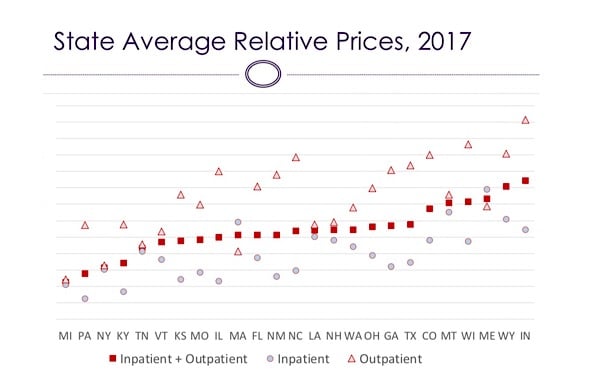
This shows outpatient costs are way high and inpatient costs are OKThis shows outpatient costs are way high and inpatient costs are OK
One thing the researchers found is that private plan payments averaged more than 200 percent of Medicare payments for the same care at the same hospitals. (Chart: RAND)
Chapin White has come up with an explanation for why the United States spends so much more than the rest of the world on health care: private health plans pay wild prices for outpatient care.
White and colleagues have put data supporting that conclusion in a paper distributed by the RAND Corp.

White briefed state insurance regulators on the study findings today, at a session in New York that was organized by the National Association of Insurance Commissioners’ Health Insurance Innovations Working Group.The NAIC started its summer national meeting this weekend in New York.
The NAIC is a group for insurance regulators. Its meeting discussions can shape states’ efforts to write and update Insurance laws and regulations.
White said RAND conducted its research in response to earlier research showing that U.S. residents get about as much health care as residents of other countries but pay much higher prices for the care, and other research showing that most of the gap is due to the high prices private health plans pay.
White’s team looked at the price gap by comparing health care facilities reimbursement data, from states with good data, with traditional Medicare plan reimbursement data.
One thing the researchers found is that private plan payments averaged more than 200 percent of Medicare payments for the same care at the same hospitals.
Another thing is that the private plan-to-Medicare spending ratio for facility bills varied widely from state to state.
The ratio ranged from under 175 percent, in Michigan, up to more than 275 percent, in India, with a median between 225 percent and 250 percent.
The researchers found that, in most of the states studied, the ratio was much higher for outpatient care than for inpatient care.
In most states, the ratio for inpatient care was around 200 percent or lower.
The ratio for outpatient care was under 250 percent care in the cheapest states and over 300 percent in the most expensive states.
White said he thinks the size of the gaps is at least partly due to complicated provider payment agreements.
He said two relatively easy things regulators could do to improve the price situation are to make health plans use tougher provider reimbursement agreements and, especially, to limit prices for out-of-network care.
Limits on prices for out-of-network care have a surprisingly big effect, White said.
“That’s why providers really fight those limits,” he said.
Several state regulators at the session asked White to add hospitals’ data on the gap between what Medicare pays and what hospitals say they need to get to break even.
Regulators said they want to know how much of the extra private plan spending might be the result of hospitals trying to make up for losses on Medicare patients.

Myriad Genetics to seek U.S. approval of BRACAnalysis CDx prostate cancer test

Based on the positive outcome of a Phase 3 study evaluating AstraZeneca and Merck’s PARP inhibitor Lynparza (olaparib) in men with metastatic castration-resistant prostate cancer (mCRPC) with BRCA1/2 or ATM mutations, Myriad Genetics (MYGN -1%plans to pursue FDA approval of its BRACAnalysis CDx test as a companion diagnostic for olaparib in BRCA mutation-positive mCRPC patients.
The company has been collaborating with AstraZeneca on olaparib since 2007. BRACAnalysis CDx is currently approved in the U.S. as a companion diagnostic in breast and ovarian cancer patients.

Assembly Bio names ex-Gilead R&D chief as CEO

Assembly Biosciences (ASMB +12.1%appoints John Hutchison, A.O., M.D. as President & CEO succeeding co-founder Derek Small who is returning as managing director of his venture capital firm.
Dr. Hutchison was recently Chief Scientific Officer and Head of R&D at Gilead Sciences.

Leidos acquiring IMX Medical Management Services

Leidos (NYSE:LDOSwill acquire the URAC-accredited commercial independent review organization for undisclosed terms. The deal is expected to close in Q3.
After the transaction closes, IMX will operate under QTC Management, a Leidos subsidiary.
QTC provides more than 3K independent medical exams and medical record reviews per day across the U.S. for key federal customers.

Paratek Pharmaceuticals EPS beats by $0.14, beats on revenue

Paratek Pharmaceuticals (NASDAQ:PRTK): Q2 GAAP EPS of -$1.02 beats by $0.14.
Revenue of $2.05M (+5025.0% Y/Y) beats by $0.22M.

Permira Funds to buy contract manufacturer Cambrex in $2.4 bln deal

Contract development and manufacturing company Cambrex Corp said on Wednesday it was being bought by an affiliate of private equity firm Permira Funds in a deal valued at about $2.4 billion, including net debt.
The all-cash offer of $60 per Cambrex share represents a 47% premium to the stock’s Tuesday close.

Allergan says it will shed two drugs as AbbVie takeover looms

Allergan has confirmed that it will divest experimental inflammatory bowel disease therapy brazikumab and marketed drug Zenpep ahead of its $63 billion acquisition by AbbVie.
The company announced the plans in its second-quarter results filing, whilst reporting a 0.8% decline in revenues to $4.1 billion – slightly ahead of analyst forecasts – and a loss of $1.8 billion resulting from a hefty impairment charge caused by delays in clinical studies and a drop in the expected value of some R&D projects.
Allergan said it had decided to divest brazikumab and Zenpep – a treatment for pancreatic lipase deficiency – regardless of whether getting rid of them is required for clearance of the AbbVie takeover by antitrust regulators such as the Federal Trade Commission (FTC).
That seems prudent, given the FTC seems to be raising the bar for antitrust approvals in pharma at the moment – witnessed by Roche’s much-delayed $4.3 billion Spark takeover and Bristol-Myers Squibb’s forced divestiture of psoriasis Otezla to seal its $74 billion acquisition of Celgene.
The brazikumab decision comes just a few months after Allergan announced it was starting two major clinical research programmes for the interleukin-23 inhibitor in Crohn’s disease and ulcerative colitis, but this is no big surprise given that AbbVie has just claimed approval for its own IL-23 inhibitor Skyrizi (risankizumab) in plaque psoriasis.
Skyrizi is already being tipped as a future blockbuster and is in phase 3 development for ulcerative colitis and Crohn’s disease. Meanwhile, AbbVie’s big-selling TNF inhibitor Humira (adalimumab) also makes a sizeable chunk of its $20 billion annual sales from the inflammatory bowel disease category.
Zenpep meanwhile is a direct competitor to AbbVie’s Creon product for pancreatic lipase insufficiency, a condition that prevents patients digesting food normally. Allergan recorded $133 million in sales for its product in the first half of the year, all from the US market, while Creon made $484 million in the same period.
Allergan chief executive Brent Saunders said the company achieved “steady growth” in the second quarter, driven once again by wrinkle treatments Botox and Juvederm, up 4% to $974 million and 11% to 323 million, respectively. There was also a strong contribution from antipsychotic drug Vraylar (cariprazine) which grew 72% to $196 million.
The company joined many other pharma companies in lifting its annual sales guidance for the year, saying it now expects to post $15.4-$15.6 billion, up from its earlier prediction of $15.1-$15.4 billion.
It’s also expecting some important pipeline news during the remainder of the year, topped by an FDA decision on oral CGRP receptor antagonist ubrogepant for the acute treatment of migraine, which is due in December.