Search This Blog

Saturday, May 2, 2020

How Can We Make Lasting Changes In Our Lives?

There are many approaches to change in the world of psychology, but a robust research literature suggests that these ultimately work for similar reasons. For instance, the quality of the relationship between the helper and the person seeking help accounts for a surprising amount of the change that occurs. The big takeaway from this work is that how techniques are implemented is every bit as important as what those techniques are.
When we attempt to make changes in our lives, whether it’s losing weight, improving our relationships, or becoming more productive, our tendency is to turn to self-help techniques. Not uncommonly, we try these techniques and see only modest results, leading us to backslide and return to where we started. For example, this is very common among the newer traders I encounter as a performance coach. They bounce from one method of trading financial markets to another, ultimately failing to climb the ladder of expertise.
A look at research in psychotherapy finds that change indeed occurs among a majority of people seeking help, but that change requires a significant number of sessions, often more than 20. Yes, brief therapies have been found to be effective, but even in those cases we commonly find sessions spread over time to allow for changes to be rehearsed and internalized. Without repetition and time, the results of our efforts at change too often fall into relapse.
A great example of how we can make lasting changes is Alcoholics Anonymous. In A.A., the primary emphasis is not on change techniques per se, but on consistent meetings over time with the guidance and support of the group and sponsors. When I worked in a community mental health center, it was common for people seeking treatment for alcohol-related concerns to attend 90 meetings in 90 days. “Bring the body and the mind will come”, was the A.A. slogan. Addiction problems are notoriously susceptible to relapse. The key effective ingredient of change was the frequent repetition of emotionally-impactful experiences. Doing the same things the same way with meaningful impact creates new and lasting habit patterns. This is an important common effective ingredient of change.

So what does this mean for those of us seeking changes in our lives?
A deceptively simple formula for making changes in our lives is to begin change efforts by making very small, doable changes the same way each day and in novel states of mind and body. This is a very powerful principle.
Whether it’s in traditional therapy or self-help such as A.A., change efforts occur when we are in modes of experiencing different from our norm. In therapy or in a group, we are socially connected and more emotionally connected. We enter states of consciousness very different from our norms. As a rule, in our habitual states of mind and body, we gravitate to our habitual thoughts and behaviors. That is relapse. If we’re looking to make changes, we want to anchor those changes to fresh cognitive and emotional states. It is the consistency of our anchoring efforts that allows us to internalize changes and make them part of us.
Here’s a practical example:
Mike Bellafiore of SMB Capital and I recently spoke with members of the BearBull Trading Community, many of whom are developing traders of financial markets. A common concern of these traders is that they become so caught up in profits and losses that they fail to follow their own trading rules and plans. This leads to inconsistent decision-making and little progress on the ladder of development. An idea that we explored in our discussion was making the “discipline” process a social one by sharing best practices, establishing teams within the community, and making ourselves accountable to people we care about—not unlike A.A. This taps into wholly new sources of motivation and mind states, as the social connection adds a fresh sense of commitment to change efforts. Anchoring developmental efforts to teamwork and social support transforms every team meeting into experiences of insight and inspiration with everyone acting as teacher and student.
But even such anchoring only works if change is pursued one small step at a time, with each change undertaken in the same way at the same time each day. Changes in our states of consciousness can open us to change, but it is repetition and the internalization of success experiences that creates new habits. As Charles Duhigg explains, there is a science of habit that can change behavior in radical ways through seemingly small shifts in our environment and in our physical states. When we join in teams, sharing ideas and reviewing performance each and every day, the change process literally becomes part of us. As we see with very successful traders, we make quantum leaps in our performance and sizable life changes by climbing the ladder one consistent step at a time, in fresh mindsets that energize our ascent.
https://www.forbes.com/sites/brettsteenbarger/2020/04/30/how-can-we-make-lasting-changes-in-our-lives/#adb0a7519d9a

States ordered nursing homes to take COVID-19 residents. Thousands died.

On March 29, as New York and other states began ordering nursing homes to admit medically stable residents infected with the coronavirus, national trade groups warned it could unnecessarily cost more lives.
The health directives put “frail and older adults who reside in nursing homes at risk” and would “result in more people going to the hospital and more deaths,” the American Health Care Association and affiliates said at the time.
A month later, it appears government officials should have heeded the dire call to pursue different pandemic emergency plans.
The deadly virus has spread like wildfire through many nursing homes across the Northeast, and state officials are scrambling to better protect those most vulnerable to COVID-19, the disease caused by the virus.
The death toll is devastating:
At least 3,043 people have died inside New York nursing homes due to COVID-19 complications, or about 17% of the state’s 18,015 deaths as of Wednesday.
In Pennsylvania, about 65% of coronavirus deaths were nursing-home residents, and New Jersey had 3,200 residents of long-term care homes die due to complications from the virus, about 40% of the statewide total.
About 58% of the deaths in Delaware lived in nursing homes, and 46% of the fatalities in Maryland were at nursing homes, prompting Gov. Larry Hogan to order residents and staff members at nursing homes be tested for coronavirus.
Meanwhile, advocates and residents’ relatives have criticized state and federal officials, as well as some nursing homes, for failing to address the crisis as deaths mounted.
“To have a mandate that nursing homes accept COVID-19 patients has put many people in grave danger,” said Richard Mollot, executive director of the Long Term Care Community Coalition in New York.
“We know facilities have a lot of infection-control problems, we know that facilities have low staff, so what do you think was going to happen when the staff were further strained in caring for these patients?”
Amid the pushback, New York Health Commissioner Dr. Howard Zucker on Wednesday issued an advisory warning nursing homes they could face fines or lose their license if they didn’t properly isolate COVID-19-infected residents, citing state health law.
The letter noted nursing homes incapable of isolating contagious residents should transfer them to other medical facilities and stop admitting additional residents.
New Jersey’s Health Commissioner Judith Persichilli took a similar step on April 13, clarifying how the state’s nursing homes could deny admitting infected patients.
“People just can’t go back until the spread in the nursing homes slows down and until they can take care of their residents appropriately,” Persichilli said the day the revised guidelines were distributed.
A grieving daughter’s COVID-19 nursing home story
Yet the efforts have come too late for some family members, many of whom complained of being kept in the dark about risks at nursing homes since visitors were banned in March to combat the virus.
One is Kathleen Cole, who said her 89-year-old mother, Dolores McGoldrick, died April 17 after contracting COVID-19 at Ferncliff Nursing Home in Rhinebeck, New York.
McGoldrick, a former teacher, was infected shortly after a fellow nursing home resident was re-admitted from a hospital in late March, Cole said.
The nursing home staff said the other resident didn’t have COVID-19 when re-admitted but didn’t provide many other details about the case, she added.
Cole, who is a nurse, cast blame for her mother’s death on the entire nursing home system. It spanned from Ferncliff’s inability to contain the virus to state officials’ refusal to release many details about infections and deaths at the facility and others.
“The whole thing has just been handled awfully … by everybody in regard to nursing homes,” she said. “It’s like a slaughterhouse at these places.”
Cole recounted calling nursing home staff about her mother and being told repeatedly that she was stable since testing positive on April 2. But at one point, several phone calls went unanswered, which Cole chalked up to understaffing over the holiday weekend in mid-April.
Cole said she only learned of the true situation after her mother was transferred to a local hospital’s emergency room on April 14.
“My mother’s hands were blue — it wasn’t like a dusky shade blue, her nail beds were blue, her feet were blue, she was ice cold,” Cole said, recalling the scene at the hospital.
“She never opened her eyes for anybody to speak with, and she was just in a horrible, horrible state,” she said. “I know that didn’t occur over the course of several hours; that was something that was accumulating over time.”
Cole has countless unanswered questions, including how her mother contracted the virus. She was in a private room, and staff said there was an isolation unit set up for COVID-19-positive residents, suggesting lapses in containment efforts, Cole said.
“I just felt that she wasn’t being evaluated appropriately, and that actions should have been taken sooner and maybe my mother would have made it through,” she said.
Jon Goldberg, a spokesman for Ferncliff, which had reported six deaths as of Thursday, declined to discuss a specific resident’s case, citing health privacy laws.
In general, Goldberg disputed that staffing shortages existed. He noted the facility was providing sufficient protective gear and COVID-19 testing for its residents and staff despite supply challenges caused by state and federal issues.
In an email, Goldberg wrote that Ferncliff “has no higher priority than the health and lives of our residents and care members.
“We will continue to do everything in our power to protect, care and advocate for them, and to communicate truthfully and candidly with the people who love them and the communities we serve,” he added.
What states are doing about COVID-19 in nursing homes
Central to the nursing home crisis was the early focus on preventing coronavirus patients from overwhelming hospitals.
Massive convention centers and college buildings were converted into temporary hospitals in New York and New Jersey as infections mounted, and hospitals in other states braced to handle surges in COVID-19 patients.
On March 31, the New Jersey Department of Health told the state’s long-term care facilities that they could not deny admission or re-admission based on a confirmed diagnosis of COVID-19.
The state needed to make room in its hospitals for the growing number of COVID-19 cases and turned to nursing homes to take over the care of some patients.
At the time, Persichilli said there were restrictions in place to prevent the spread of the virus, such as placing asymptomatic residents on their own wings or floors.
“What we were encountering was that a resident would go to the hospital, be treated, recover, and [the nursing home] would not accept the resident back,” Persichilli said at the time.
“Part of the directive is that this is that resident’s home. We keep forgetting that. They should be accepted back with the appropriate precautions,” she added.
At the time, there were fewer than 1,000 known cases in long-term care facilities, which includes nursing homes, assisted living facilities and other care homes.
Not even two weeks later, the number of cases had climbed to more than 5,200, prompting the state to provide additional guidance.
Persichilli on April 13 clarified that the state allowed for re-admission of suspected COVID-19 patients only if they could be placed in isolation.
The order required nursing homes to separate residents in groups and designate staff for each, preventing employees from moving between patients who could spread the virus.
The separate groups are residents who have tested positive for or show symptoms of COVID-19; residents who might have been exposed to the virus; and residents who are not ill and have not been exposed.
On Wednesday, New York’s health commissioner outlined similar guidelines for separating nursing home residents and staff. The advisory also reinforced prior measures taken to protect nursing homes, such as banning visitors and requiring temperature checks of staff.
New York Gov. Andrew Cuomo has said the coronavirus has proven an efficient predator that preys upon nursing homes staff and residents, despite the precautions. He has also urged some nursing homes to reach out to the Health Department to help relocate patients.
“If a nursing home has a patient that they can’t handle, COVID, or whatever the reason, they must refer that patient out of that facility,” he said during a press briefing Monday.
But state Assemblyman Ron Kim, D-Queens, on Wednesday asserted the virus has exposed the poor state of many nursing homes after decades of governmental funding cuts and harmful regulatory changes.
“These tragedies in nursing homes are not accidents, they’re the outcome of bad policy decisions,” he said during a press briefing to announce new legislation seeking to improve care and transparency at nursing homes.
In Pennsylvania, 461 — one quarter of the state’s roughly 1,900 long-term care centers —- had at least one COVID-19 case, according to state health data.
Pennsylvania is among the states where health officials are allowing licensed long-term care facilities to continue admitting new patients, including those discharged from hospitals but unable to go home, and to readmit current patients after hospital stays.
“This may include stable patients who have had the COVID-19 virus,” according to a copy of March 18 guidelines the state department of health issued.
The reasoning for allowing readmissions, according to the guidance, was “to alleviate the increasing burden in the acute care settings.”
State health officials also directed long-term care centers to employ “normal discharge-to-home” criteria to assist in long-term care bed availability.
Pennsylvania Health Department spokesman Nate Wardle said the department is aware of the “significance” of COVID-19 in long-term care facilities and is working to assist them as individuals are discharged from hospitals.
What nursing homes say about COVID-19 crisis
Nursing home leaders contend state and federal officials have failed to provide adequate resources and guidance during the pandemic.
From insufficient coronavirus testing and personal protective equipment shortages, they said the dereliction of duty helped ignite and fuel the outbreak in nursing homes.
“Frankly, I think we’ve been neglected, and we’re still neglected,” said Dr. Elaine Healy, vice president of the New York Medical Directors Association.
“When the focus started being put on us through the efforts of the press, the response has been to sort of look at us in a negative way,” she said, citing New York authorities launching investigations into COVID-19 deaths at nursing homes.
“This is really a series of forest fires burning in different facilities that we didn’t start,” she added.
Strikingly, Italian officials issued similar orders for nursing homes to admit coronavirus patients on March 8, a move under investigation by authorities for contributing to potentially preventable deaths, according to the Associated Press.
Despite push back on state decisions to send infected patients into nursing homes, some administrators say there was no other option.
“Our facilities were ultimately the release valve” for overwhelmed hospitals, said Jordan Strohl, the administrator at The Actors Fund Home in Englewood in Bergen County, the epicenter of the outbreak in New Jersey.
“When we heard from them how bad it was and how bad things were there, I felt like it was our obligation to step up and do the right thing,” he added.
Strohl converted half of the 25-bed sub-acute care building to care for COVID-19 cases, hiring a contractor to install airlocks to prevent contamination. He offered hazard pay and incentives to keep his staff on the job and had nurses volunteering to work with residents on the COVID-19 wing, he said.
Strohl said The Actors Fund Home was likely better prepared than some other nursing homes in the state, and still residents’ relatives were concerned about the state’s order to admit patients with known cases.
One person suggested flying sick residents out to the U.S.N.S. Comfort, the U.S. Navy hospital ship docked in New York Harbor at the time, he said. But that was outside of Strohl’s authority, so he did what he could.
“I tried to write back to every single person,” he said. “I said, ‘I understand your concern, but I will tell you this is the best way to take care of them.’”
Nurse practitioner Lisa Kaplewicz at the Tarrytown Hall Care Center in Westchester Couty said an issue for residents is when they have to leave the nursing to go a medical appointment.
“That’s a concern because they have the exposure to other people in the community that might potentially be asymptomatic carriers, so we have to presume that there’s been an exposure,” she said.
“We have to isolate these residents within our facility to prevent transmission to the other residents that are here.”
Some nursing homes in New Jersey also adjusted to care only for COVID-19 patients, according to Theresa Edelstein, senior vice president of the New Jersey Hospital Association.
“Nursing homes that care for COVID-19 patients are playing a very important role in preserving access to care,” she said.
“Not every COVID patient discharged from the hospital can go directly home. For those who need additional skilled nursing care, our nursing homes have been there.”
Some experts have called on New York to pursue COVID-19 only facilities for infected nursing home residents, such as those in New Jersey, Massachusetts and Connecticut.
Cuomo this week said some hospitals are designated as COVID-19 only, but the state has not released any details on them.
And others want the state to at least test everyone in every nursing facility for coronavirus. Dutchess County in the Hudson Valley said it will look to test all residents at its 13 homes.
“We have seen the ravaging toll COVID-19 has taken on nursing homes throughout our nation, and we are taking proactive steps to ensure we save lives,” said Dutchess County Executive Marc Molinaro, whose father recently died from the virus.
How nursing homes are testing, staffing during COVID-19 pandemic
In Maryland, Gov. Larry Hogan enacted an executive order on Wednesday requiring universal testing of all residents and staff at Maryland nursing homes, regardless of whether they are symptomatic.
Nursing home outbreaks represent 19% of all total positive cases in Maryland and 46% of all deaths. There have been outbreaks or clusters of cases at 278 different facilities across the state, including 4,011 confirmed cases at 143 different Maryland nursing homes.
“Even when best practices and care is in place, this virus may still be transmitted by asymptomatic staff, meaning that every patient interaction comes with some risk,” Hogan said at a press briefing.
Impacted facilities are also required to provide regular updates to their residents, resident representatives and staff regarding COVID-19 infections, a measure that New York officials required this month amid calls for improved transparency.
Under the executive order, any nursing home staff who test positive will be immediately discharged into isolation. It will also be mandatory for facilities to cooperate with strike teams deployed by the state.
The strike teams will be supplemented with newly-created “bridge teams,” which will provide emergency clinical staffing to facilities in crisis.
Meanwhile, New York on Wednesday revised guidelines preventing COVID-19 positive nursing home employees who are asymptomatic from returning to work for 14 days from the first positive test date.
Previously, the workers could return in seven days based on Centers for Disease Control and Prevention guidance, according to a letter issued by the health commissioner.
Health experts asserted improved testing and clearer guidance on isolation will be key to limiting the death toll in nursing homes.
As the virus is spreading, it is very hard to know what the threshold for stopping admissions should be particularly if adequate COVID-19 testing is not available for residents and staff, said Summer Johnson McGee, the dean of the School of Health Sciences at the University of New Haven in West Haven, Conn.
But McGee believes if new admissions were stopped after the first positive case was identified, it may have given facilities better ability to contain its spread.
“Many facilities are at 100% capacity, which means there were no beds to create isolation units,” she said.
“Nursing homes should be working to create excess beds to be able to isolate healthy patients in local hotels or surge capacity venues.”
https://www.recordonline.com/news/20200501/states-ordered-nursing-homes-to-take-covid-19-residents-thousands-died-heres-what-happened

SF had the 1918 flu under control – then it lifted restrictions


Image: SF Influenza Hospital
When the clock struck noon, the masks came off.
It was Nov. 21, 1918, and San Francisco residents gathered in the streets to celebrate not only the recent end of World War I and the Allies’ victory, but also the end of an onerous ordinance that shut down the city and required all residents and visitors to wear face coverings in public to stop the spread of the so-called Spanish flu.
A blaring whistle alerted gratified residents across the city and, as the San Francisco Chronicle reported at the time, “the sidewalks and runnels were strewn with the relics of a torturous month,” despite warnings from the health department to maintain face coverings. As celebrations continued and residents flocked to theaters, restaurants and other public spaces soon thereafter, city officials would soon learn their problems were far from over.
Now, amid the coronavirus pandemic, as President Donald Trump urges the reopening of the country and some states, such as Georgia, move to resume normal business even as new cases emerge, how officials acted during the 1918 flu pandemic, specifically in cities such as San Francisco, offers a cautionary tale about the dangers of doing so too soon.
Alex Navarro, the assistant director of the Center for the History of Medicine at the University of Michigan, which detailed historical accounts of the 1918-19 flu pandemic in 43 cities, told NBC News in a phone interview that officials often acted quickly at the time but restrictions were eased to varying degrees.
“There was a lot of pressure in pretty much all of these American cities to reopen,” said Navarro, whose research was done in conjunction with the Centers for Disease Control and Prevention. “When they removed those restrictions too soon, then many cities saw a resurgence in cases.”

The center’s research found that cities that used “early, sustained and layered” practices such as social distancing, closing public events and stay-at-home orders “fared better than those that did not.”

‘A lot of stock in masks’

Just two months earlier, in September, the first case of the so-called Spanish flu was identified in San Francisco and city health officials sprung into action.
Dr. William C. Hassler, the city’s health officer, ordered the local man who apparently brought the disease to the city after a trip to Chicago into quarantine to stop the disease from finding another human host, according to the center’s research of reported accounts.
But it was too late as the virus had already begun to make its way through the city. By mid-October, the cases jumped from 169 to 2,000 in just one week. Later that month, Mayor James Rolph put in place social distancing practices and met with Hassler, other health officials, local business owners as well as officials from the federal government to discuss a plan to close the city.
Some officials demurred at the idea, worried about damage to the city’s economy and the risk of causing public panic. Eventually, on Oct. 18, the city voted to shut down “all places of public amusement.”
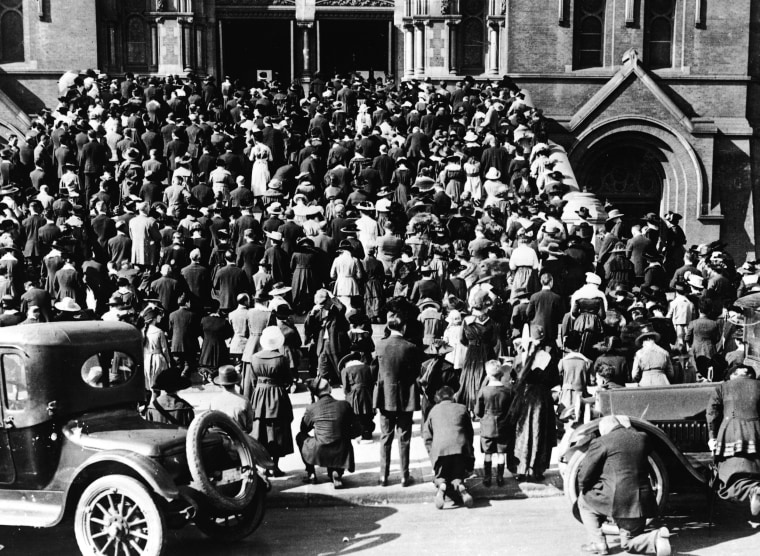
Image: Praying for Health During Flu Epidemic
The congregation praying on the steps of the Cathedral of Saint Mary of the Assumption, where they gathered to hear mass and pray during the influenza epidemic, San Francisco, California, 1918.Hulton Archive / Getty Images file
City officials also strongly advocated for face coverings, which were at first optional and soon required by a mayoral order — the country’s first at the time, Navarro said.
“They were the one city that put a lot of stock in masks,” he said.
With the pandemic still raging across the globe during World War I, the mask also became a symbol of “wartime patriotism.”
“The man or woman or child who will not wear a mask now is a dangerous slacker,” a public service announcement from the American Red Cross said at the time, according to Navarro’s research.
m defying the order — 110 people were arrested and given a $5 fine in one day in October shortly after the measure went into place, improperly wearing a mask or not wearing one entirely, according to the center’s research. Over time, the jails were overcrowded with people failing to adhere to the rules. However, most cases were later dismissed.
By the end of October, there were 20,000 cases and more than 1,000 deaths. However, as the days went on, the city saw a dip in newly reported cases, which prompted officials to begin to reopen the city and rescind the mask order. By the end of November, officials believed the city had stabilized.
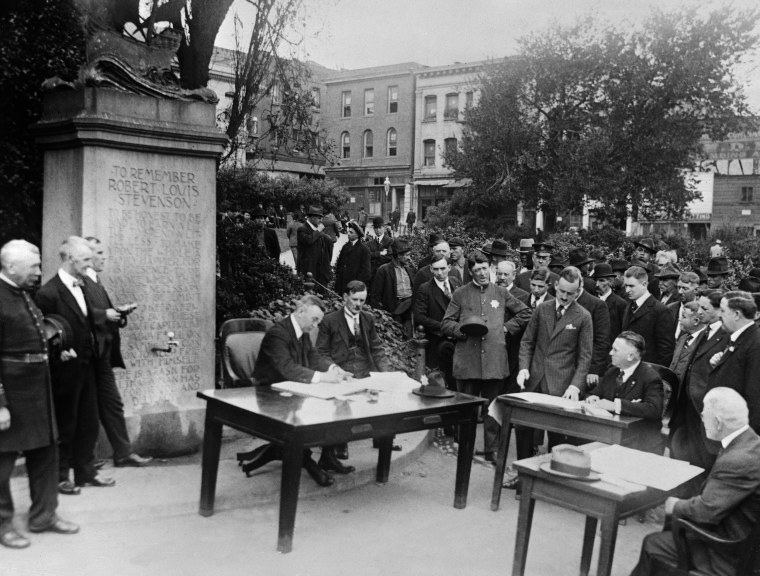
Image: Court in Open Air During Epidemic
Court is held in open air during the influenza epidemic in San Francisco, 1918.Bettmann Archive / Getty Images file

‘They were flattening that curve’

But three weeks after that celebration of removing their masks, the city saw a dramatic resurgence. Officials at first rejected the idea of reopening the city and suggested residents could voluntarily wear face coverings.
But shortly after the New Year in 1919, the city was hit with 600 new cases in one day, prompting the Board of Supervisors to re-enact the mandatory mask ordinance. Protests against the mandate eventually led to the formation of the Anti-Mask League. The detractors eventually got their way when the order was lifted in February.
San Francisco’s ambivalence to quarantine measures ran counter to other U.S. cities, though. Navarro said Los Angeles, for instance, implemented strict social distancing and face coverings about a week before San Francisco did and its measures stayed in place for weeks longer.
Navarro said that many cities often became complacent once they saw a dip in cases, and when a resurgence happens residents often question the public health guidance.
“They were flattening that curve; they just weren’t realizing it,” Navarro said. “A lot of people thought, ‘Well, what did we go through that for? It did have an impact, they just didn’t know it.”
As Dr. Anthony Fauci, the nation’s top infectious disease expert, put it in March, “If it looks like you’re overreacting, you’re probably doing the right thing.”
Back during the Spanish flu, San Fransisco’s failure to take swift action and the decision to ease restrictions after only a few weeks had huge ramifications. With 45,000 cases and more than 3,000 deaths, the city was reported to have been one of, if not, the hardest-hit big city.
Roughly a century later, the San Francisco Bay Area imposed the nation’s first stay-at-home order and other restrictions when coronavirus cases were rapidly growing, placing a spotlight on its pandemic response again. Those aggressive actions are credited with saving lives, avoiding the scale of the tragedy found in New York City.
Mayor London Breed said she took heed of history and implemented an order last week requiring anyone setting foot on the streets of San Francisco, outside their homes, to wear a face covering.
Breed told MSNBC’s Chris Hayes in an appearance in mid-April that she has considered the city’s history with past pandemics, such as the HIV/AIDS crisis and the Spanish flu when deciding to ease restrictions.
“Just because San Francisco is being praised for flattening the curve, we’re not there yet,” she said. “And so we cannot let up just because for some reason we believe that we’re in a better place.”
https://www.nbcnews.com/politics/politics-news/san-francisco-had-1918-flu-under-control-then-it-lifted-n1191141

NYC nursing home’s huge coronavirus deaths don’t match state reports

The state is seeking to account for as many as 98 residents of the Isabella Geriatric Center in Washington Heights who have reportedly died of COVID-19,  officials said Saturday.
The state lists only 13 deaths at the facility.
“We are working to verify all the information reported to us” at Isabella and all 613 nursing homes and 544 adult-care facilities, said Gary Holmes, a state Health Department spokesman.
Officials could not say whether Isabella deliberately misled the state. The facility insists it reported all deaths.
Gov. Cuomo Friday had harsh words for nursing homes, saying they submit numbers “under penalty of perjury.”
“You violate, you commit fraud, that is a criminal offense, period. So they can be prosecuted criminally for fraud on any of these reporting numbers,” he said.
On Saturday, a state Department of Heath website listed 13 deaths of Isabella residents as of May 1 despite news reports that nearly 100 facility residents had died.
The nursing home has acknowledged 60 confirmed and suspected COVID-19 deaths at the massive, 705-bed facility, plus 38 others who died of confirmed or suspected cases in the hospital.
Snafus in the state monitoring system are widespread, The Post found.
At the sprawling Hebrew Home in Riverdale, 25 residents have died of suspected or confirmed cases of the coronavirus since March 1, a spokeswoman said, but the state still lists the number at  zero.
The largest private nursing home in the state with 751 beds, Hebrew Home says half of the 14 patients who died in its beds were confirmed COVID-19 cases and half were presumed to have it. And another 11 of its residents died of the bug after being transported to hospitals.
“The Hebrew Home has been and continues to be fully transparent in its reporting of deaths due to covid,” spokeswoman Wendy Steinberg said.
The state website also lists the wrong name of a nursing home run by city Health + Hospitals.
An Isabella spokesperson declined to comment Saturday, but said last week, “From the beginning of this pandemic, Isabella has reported truthful and accurate data requested by the Department of Health. We have shared daily the number of confirmed and presumed positive cases at both the residence and hospital, including deaths.”
The state in the past had cited Isabella, and other nursing homes, for letting oxygen tubes connected to patients sit on the floor.
State health official Holmes said the agency is trying to “determine whether [the] facility is under reporting. We have not found that yet.
“We went back and asked every nursing home to provide all COVID-19 deaths, both confirmed and unconfirmed,” he said.
https://nypost.com/2020/05/02/nyc-nursing-homes-staggering-coronavirus-deaths-dont-match-state-reports/

Berkshire’s cash pile isn’t huge in worst-case scenario, Buffett says

Berkshire Hathaway’s (NYSE:BRK.B) (NYSE:BRK.A) cash position “isn’t all that huge when you think about worst-case possibilities,” Warren Buffett said during the annual meeting’s question and answer section.
“We don’t prepare ourselves for a single problem, we prepare ourselves for problems that sometimes create their own momentum.”
The conglomerate had $137B of cash and Treasury bills on its balance sheet as of March 31, 2020.
Asked why he hasn’t invested in any companies during the pandemic crisis like the company did during the financial crisis, Buffett said “we haven’t seen anything attractive.”
Furthermore, funding was a lot easier to get this time around.
“The Federal Reserve did the right thing and very promptly,” Buffett said. “Companies got the chance to finance in huge ways in the last five weeks.”
“Berkshire actually raised more money” recently,  although it didn’t need it, he added.
Update at 7:12 PM: Regarding how Berkshire’s operating companies are handling the pandemic environment, “Very few of our businesses have required funds,” said Vice Chairman Greg Abel, who heads all operating businesses except for insurance.
Berkshire has advanced funds to the few of its businesses that did need them, he said.
This is a developing story; check back for updates.
https://seekingalpha.com/news/3567988-berkshires-cash-pile-isnt-huge-in-worst-case-scenario-buffett-says

We Can’t Ignore the Harms of Social Distancing

While uncertainty prevails, I worry that hard questions are being avoided. I will strive not to be tone-deaf, but in the same way we discuss prognosis with patients with cancer or heart failure, we must also address difficult questions concerning the COVID-19 crisis.
The social distancing policies are harming people—not potential harms, but real harms. Economic harm is a euphemism because the economy is people.
I have had patients stop their medications because of job loss. When I state this publicly, some rebut it with the fact that US healthcare is unjust, which is true but also a non sequitur. We do not live in the healthcare system we want but the one we have.
A recent paper, in preprint form, suggests a substantial proportion of excess deaths observed in Scotland, the Netherlands, and New York during the current pandemic are not attributed to COVID-19 and may represent an excess of deaths due to other causes.
While the virus has been shown to harm minorities and the disadvantaged, it is also true that these same groups could be disproportionately harmed by our interventions. Shutting our clinics and reducing non-COVID care in hospitals threaten the poor more than the wealthy. Basic warfarin management in disadvantaged patients has been a huge challenge.
I don’t have an easy answer for societal inequities, but it does public intellectuals no favors to ignore the fact that decision-makers have the luxury of a job and the ability to work from home. Our public interventions have made the poor even poorer. Raj Chetty and coworkers have shown that lower wealth strongly associates with a shorter lifespan.
Then there are the elderly. One of my colleagues suggested targeted strategies to protect older people. That sounds excellent. Put guards in nursing homes; allow older people no visitors.
Again, the reality is that you can isolate older people for a month or two, but are children and grandchildren going to avoid grandparents indefinitely? Is loneliness nothing?
What about the sole caregiver of a person with dementia? Before social distancing, they could get help from family or neighbors. Now the burden falls to one person. Unseen harm is still harm. A younger family member could infect an older person, but their absence could also be harmful.
My final but most important point is the timeline and endpoints for dealing with this virus. Take Sweden. Much has been said about their more moderate social distancing policies. Those who favor strong interventions point to the increasing COVID-19 death curve of Sweden relative to its Nordic neighbors.
The problem with such thinking is it belies both the timeline and endpoint of the COVID-19 intervention. The virus will not be eradicated (unless New Zealand wants to close its borders to all tourism for years). SARS-CoV2 will spread, and it will kill people. But so will our interventions.
Less restrictive policies combined with attentive public health surveillance do not equate to the idea of sacrificing the vulnerable. Rather, they attempt to balance the nondichotomous continuous nature of both COVID and non-COVID mortality.
COVID-19 is only one cause of death; there will be many more non-COVID deaths over the next 2 years. That is why the endpoint of this experiment is not this summer or next summer, but possibly the summer after that. And at that endpoint, we mustn’t count only COVID-19 deaths but all deaths.

Conclusion

A decision to treat a medical illness comes with benefits and harms. When there is not a cure, and there rarely is, we consider outcomes of both the disease and the intervention.
Sometimes the best answer is no intervention, sometimes a moderate intervention, and occasionally, aggressive action is best. But whatever the choice, we cannot ignore the realities of the situation, however stark they may be.
Coronavirus is bad, but we can make it worse by avoiding candid discussion of the important questions.
John Mandrola practices cardiac electrophysiology in Louisville, Kentucky, and is a writer and podcaster for Medscape. He espouses a conservative approach to medical practice. He participates in clinical research and writes often about the state of medical evidence. 
https://www.medscape.com/viewarticle/929765

NYU Leadership Gaslights Residents Over Hazard Pay

New York University residents are seeking compensation for the increased risk they face as they are called to the front lines of the COVID-19 pandemic, but leadership has declined their request for hazard pay and now stands accused on social media of gaslighting residents.
Residents created a petition, addressed to NYU Langone Medical Center leadership, outlining the increased risk they face as the demand placed on the hospital system “skyrockets.” They ask for life and disability insurance, as well as hazard pay.
“We are honored and willing to take on these greater clinical responsibilities … but along with this comes an increased risk for disability and death,” they wrote. “In light of the changing times, we believe there should be a change in our benefits to accurately reflect this new high-risk environment.”
In an email sent to urology residents, department chair Herbert Lepor, MD, acknowledged that some of his residents had been assigned to COVID-19 wards, but said demanding hazard pay now was “not becoming of a compassionate and caring physician.”
“Now is the time to accept the hazards of caring for the sick and do what we are trained to do and fulfill our commitment to the healthcare needs of our community rather than focusing on making a few extra dollars,” he wrote.
Internal emails sent between Lepor and other superiors — which were circulated on social media — revealed leadership’s attempt to deflect residents’ compensation requests.
In one message, internal medicine residency director Patrick Cocks, MD, acknowledged that residents were hearing “we have $” and that if they explained the larger financial impact across institutions, “the more mature residents may understand.”
NYU gastroenterology director Mark Pochapin, MD, asked to see the names of residents who signed the petition to see if any of his fellows’ names were on it.
When asked to comment on the emails circulating on social media, Lisa Greiner, a hospital spokesperson, said Pochapin and others were misrepresented and their statements were taken out of context.
For example, Pochapin asked if his residents had signed the petition so he could meet with them to address the issue, and did not intend for it to be threatening, Greiner said.
One surgical trainee in New York City who spoke to MedPage Today on the condition of anonymity said the language in the leaked emails is representative of a residency culture in which trainees are taught suffering makes a good doctor.
Elements of that may be true, but when residents are asked to serve on the front lines of this unprecedented pandemic, institutions training them should provide them with the physical, psychological, and financial resources they need, the resident said.
“We are not soldiers,” the trainee said. “No one is trained to confront this amount of death in such a short period of time.”
Before COVID-19, residents across the country were pushing for higher wages, with one survey showing an average $61,200 salary in 2019. NYU internal medicine residents made as little as $67,432 in the 2017-2018 year, which increased with each training level.
When asked how NYU Langone has changed its policies to reflect the increasing demand placed on residents, Greiner told MedPage Today, “residents and fellows who have provided direct clinical care to COVID patients at a higher level of responsibility than usual will have their compensation advanced to the next PGY level retroactively to April 1, 2020, rather than July 1, 2020.”
Calls for healthcare workers to start receiving hazard pay began as early as mid-March and a petition demanding the federal government provide hazard pay to front-line workers has racked up half a million signatures. New York Gov. Andrew Cuomo has also advocated for hazard pay for healthcare workers on the front lines.
Other local hospital systems have responded to the call. Northwell Health is slated to deposit $2,500 bonuses to front-line workers and New York-Presbyterian granted eligible staff a $1,250 bonus. At Mount Sinai Health System, top executives announced they would take a 50% pay cut to offset COVID-19 costs.
Nate Wood, MD, an internal medicine resident at Yale New Haven Hospital in Connecticut, said residents pushing for hazard pay are not only motivated by financial incentives, but are also seeking a gesture from leadership that demonstrates institutional support. His program has granted residents $1,800 bonuses, he said.
“I think what’s going on is people on the front lines want their administrators to show them appreciation,” Wood told MedPage Today. “The most tangible way to do that is for administration to put their money where their mouth is.”
NYU Langone is projecting losses of $450 million a month and an operating deficit of $1.2 billion from increased expenses and lost revenues related to COVID-19, Greiner said.
The hospital system reported $2.1 billion in revenue in 2017 and made tuition free for medical students the following year. Lepor, who co-founded MedReview, was accused in 2017 of spending $2 million in profits on personal expenses such as ski vacations and his daughter’s bat mitzvah.
On March 27, NYU Langone sent an email warning staff that speaking to media without approval would be “subject to disciplinary action, including termination.”
When asked to comment on this email, Greiner said this policy was in place before COVID-19 and that its purpose was to protect the confidentiality of patients and staff.
“Because information related to coronavirus is constantly evolving, it is in the best interest of our staff and the institution that only those with the most updated information are permitted to address these issues with the media,” Greiner said.
Daniel E. Choi, MD, a spinal surgeon in New York, said most physicians are willing to be deployed to the front lines but many may not have the financial protections in place to protect themselves and their families if they contract COVID-19.
“You’re being asked to face death, and you’re thinking, ‘am I going to saddle my family with medical school debt?'” Choi told MedPage Today. “We’re being asked to go to the front lines and put ourselves in harm’s way, yet there are minimal conversations happening about how to protect us physically and economically.”
https://www.medpagetoday.com/infectiousdisease/covid19/86126