Search This Blog

Tuesday, June 30, 2020

FDA will require 50% efficacy for COVID-19 vaccines

Coronavirus vaccine developers now have some advice from the FDA: To win approval, any vaccine must be at least 50% more effective than placebo in preventing the disease.
FDA Commissioner Stephen Hahn plans to roll out that guidance at a Senate hearing today, the Wall Street Journal reports. It sets a bar about on par with a flu shot’s performance in a good year—but it falls short of some expert recommendations for arresting the virus’ spread.
The agency also won’t approve a shot based on its ability to create antibodies in patients’ blood, the WSJ reports. Experts don’t yet know how those antibodies translate to protection against COVID-19.
Despite the urgency of this particular vaccine hunt, the FDA “will not reduce its standards or cut corners in its review to approve a vaccine,” according to a summary of the guidance cited by the WSJ.
That pledge comes as some industry watchers worry the Trump administration could pressure the agency to approve a vaccine before the election for a political win. Hahn has said politics will not go into COVID-19 vaccine reviews.
An efficacy figure of 50% would compare somewhat favorably to flu vaccine efficacy in the last decade, which has ranged from 19% to 60% since 2010, according to the CDC. Many childhood vaccines are effective for 85% to 95% of recipients, the World Health Organization says.
Merck’s Everbo, an Ebola vaccine developed in response to a 2014 outbreak, was 100% effective in a “ring” vaccination study. The drugmaker is using the same platform for one of its COVID-19 vaccine programs.
But 50% efficacy falls short of what some researchers have concluded would have been needed to quash the COVID-19 outbreak. In a computer model, a team found that a vaccine would’ve needed to be at least 70% effective to halt the spread of the virus, if it were given to 60% of the population within 90 days of the outbreak starting.
For its part, the WHO has set its own success benchmarks for COVID-19 vaccines, according to GlobalData. The higher benchmark calls for 70% efficacy and a duration of protection for one year, while the lower threshold calls for 50% efficacy for 6 months.
In approving a COVID-19 vaccine, there are two approaches the FDA could take—a full approval or an emergency authorization. The full approval would require about 30,000 participants to enroll in a phase 3 trial, which experts have worried might be difficult to conduct if the outbreak quieted over the summer.
But with cases spiking in numerous states, researchers may be in a better position to recruit patients for massive efficacy studies. The U.S. government’s Operation Warp Speed plans to kick off phase 3 trials of several leading candidates this summer, the WSJ previously reported.
An emergency authorization, meanwhile, would be a quicker process than a full approval, but it’d still require the developer to show proof of efficacy. In any case, after potential approvals, the FDA will require a year-long post-marketing study to track potential risks, WSJ reports.
As of Monday, 17 COVID-19 vaccines are in human testing, and more than 130 are in preclinical research stages, according to the World Health Organization.

Roche wards off Herceptin copycats with new, easy-to-use Perjeta combo product

Roche’s Herceptin, like other larger cancer drugs in its portfolio, is under biosimilar assault. But with a new, easy-to-use combo product, the Swiss drugmaker may be able to defend its star against the copycats.
Monday, the FDA green-lighted a fixed-dose combination of Herceptin and add-on product Perjeta, administered under the skin alongside intravenous chemo, for early and metastatic HER2-positive breast cancer patients.
The new product, called Phesgo, comes in a single-dose vial and can be given in a treatment center or at home. After an initial eight-minute loading dose, each treatment takes about five minutes to administer.

That’s a big improvement for both doctors and patients on the convenience side, compared with using the drugs’ separate IV formulations. A loading dose of the meds in their original form takes about 150 minutes, and infusions take between 60 and 150 minutes thereafter, Roche said.
It’s also an improvement both groups may be particularly interested in at a time when people—particularly the immunocompromised, including breast cancer patients—are trying to avoid the COVID-19 pandemic by staying out of treatment centers as much as possible.
“Phesgo offers a treatment administration that supports the needs and preferences of individual patients, and helps to meet the increasing demand across the healthcare system for faster and more flexible treatment options,” Levi Garraway, M.D., Ph.D., chief medical officer and head of global product development for Roche’s Genentech, said in a statement.
Roche, for its part, is hoping to see the product catch on quickly. It’s already made its case for adding Perjeta to Herceptin and chemo, showing last year as part of the phase 3 Aphinity trial that doing so slashed patients’ risk of cancer recurrence or death by 24%. And data from another recent study, the phase 2 PHranceSCa trial, showed 85% of patients preferred Phesgo to standard IV treatment.

If Roche can convince doctors to pick up the new product, it’ll help the Basel-based drugmaker ward off biosimilar challengers, which recently entered in the U.S. In the first quarter, knockoffs to Herceptin—along with fellow cancer blockbusters Avastin and Rituxan—shaved $885 million off the company’s sales.
Luckily for Roche, though, its suite of newer meds is picking up the slack. Together, PD-L1 therapy Tecentriq, multiple sclerosis drug Ocrevus and hemophilia A hotshot Hemlibra generated an additional $1.7 billion in sales compared with 2019’s first-quarter haul.


New York adds eight states to quarantine list

“You must self-quarantine for 14 days,” says New York Governor Andrew Cuomo to prospective travelers to the Empire State. The list of those so-warned now includes California. The others: Alabama, Arkansas, Arizona, Florida, Georgia, Iowa, Idaho, Louisiana, Mississippi, North Carolina, Nevada, South Carolina, Tennessee, Texas, and Utah.

Coronavirus Cases Vs Fatalities: ‘Why The Next 6 Days Will Be Crucial’

With the current state of coronavirus infections in the US increasingly about political considerations (especially whether a second wave will lead to another round of shutdowns, more economic carnage, millions more unemployed and crush Trump’s re-election chances) and far less about actual epidemiology and standards of care, two ideological camps have emerged – one which tries to overstate the impact of the pandemic in the US by focusing on the recent surge in new cases in sunbelt states (while ignoring the role recent protests and riots played in said surge), and another which, in downplaying the severity of the coronavirus, has been emphasizing the increasing testing which arguably also explains the jump in confirmed covid cases while underscoring the decline in covid-linked fatalities. This divergence is shown in the chart below.
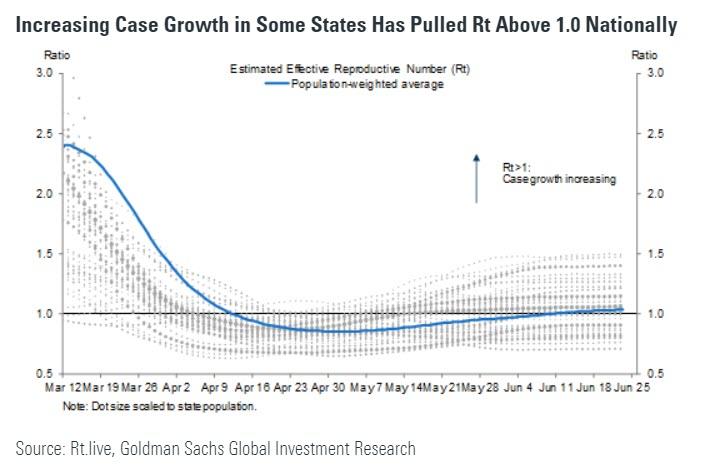
Of course, this is a simplified assessment of the current debate. For a more nuanced take we go to JPM’s Nikolaos Panigirtzoglou who over the weekend wrote that the bank sees little evidence that the virus transmission rate, the so-called R, is increasing at an alarming rate.
Additionally, the JPM analyst notes that the evidence from China, Western Europe and from the North Eastern US states suggests that higher mobility post-lockdown has not seen a significantly higher R or a significant rise in hospitalizations. Furthermore, “the increase in cases in some Southern and Western US states and some countries such as Brazil or India do not imply a big second wave, but rather a situation where it takes longer for states to come out of the first wave as they either did not as strict lockdowns in place or relaxed them prior to shifting more meaningfully down the virus curve.”
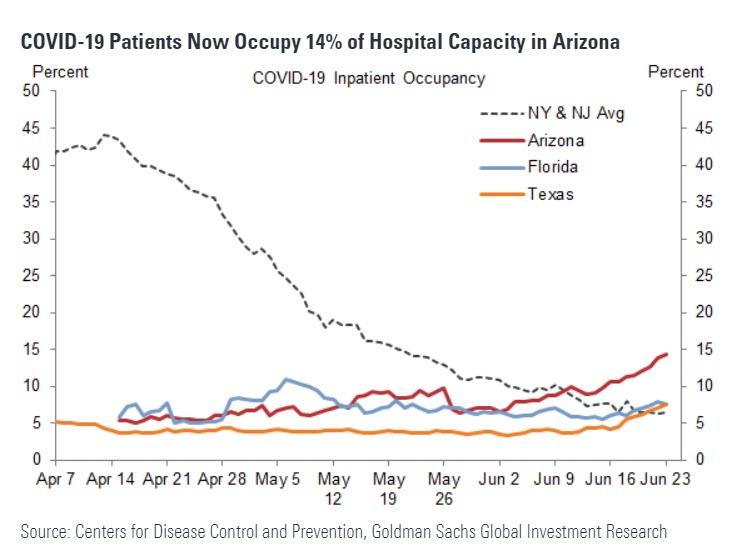
Panigirtzoglou also reminds us that most of the US states reporting significant increases in reported cases have also reported large increases in testing. If we instead focus on hospitalization data from the CDC to gauge severity of the outbreaks, they suggest far more modest increases in most cases.
That said, there is a clear reflexivity in behavior in the context of the recent news, and while the severity thus far looks more muted, JPM points out that negative headlines as well as the risk of some roll-back of re-opening measures, as already announced in Texas, California, Arizona and New Jersey could induce more cautious behavior by people and potentially slow the growth recovery going forward. “If this downside risk materializes It would mean that we get more of a U rather than of a V shaped growth trajectory”, according to JPM.
Going back to the original point of “cases vs fatalities”, we hand the mic over to Nordea’s Andreas Steno Larsen who has argued in recent days that despite the recent deterioration in statistics, the US economy is unlikely to see similar shut downs to those experienced in March as the economic cost is simply too large.
As Larsen writes, pointing to the chart at the top, “the new increase in the amount of daily cases on a global scale is yet to morph into a re-increase in the amount of daily fatalities. Fatal cases are currently flatlining or maybe trending slightly upwards around 4-5000 a day. BUT (!), bear in mind that fatal cases are lagging the number of confirmed cases, why the jury is still out.”
The Nordea strategist then proposes that if the amount of fatal cases doesn’t increase more compared to current case count, “it likely reflects either i) that testing capabilities have been ramped up markedly, ii) that the virus is spreading in areas with a younger population (e.g. India and Brazil) or iii) that the CFR (case fatality ratio) is decreasing. We mostly buy into a combo of factor i) and ii).”
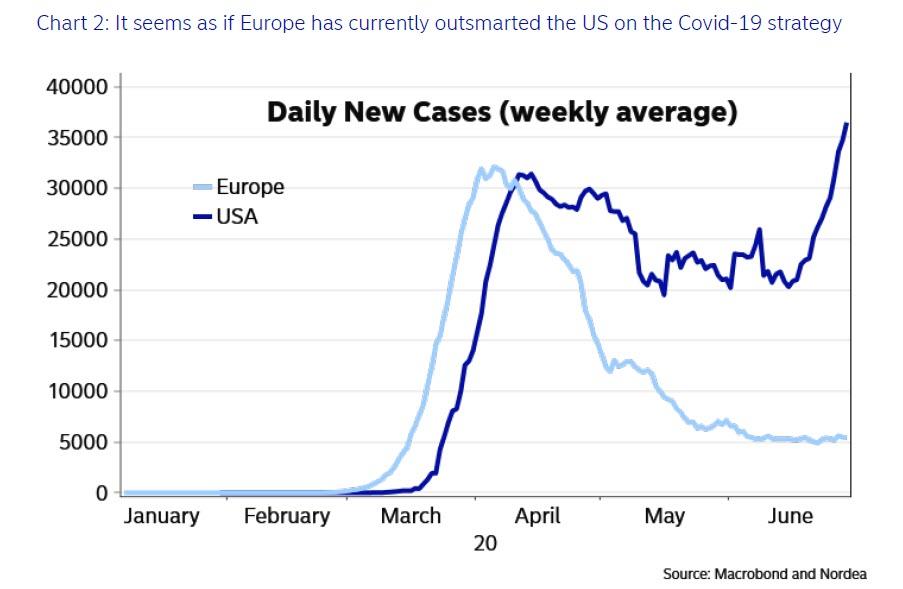
Larsen then echoes JPMorgan, and warning that consumption may take a “lock-down like” hit if the virus spread is not under  control, said that a “hammer and dance” strategy (swift total lockdown followed by a wide testing strategy) is ultimately the cheapest medium-term strategy. In this context, Europe is currently outsmarting the US on the Covid-19 strategy as is evident from the recent new case-spike in the US, which has led to setbacks for the re-opening momentum compared to Europe.
And, just like Panigirtzoglou, Larsen cautions against interpreting the renewed spike as a second wave, since it is mostly a result of a pick-up in cases in states that weren’t hit (materially) initially: “This is rather just the first material wave in areas that were not affected at the outset, while we are thankfully still yet to see a double-spike in e.g. the early epicentres as New York, Lombardia in Italy and Castilla La Nueva in Spain.”
That said, the Nordea strategist says that he doesn’t buy Trump’s message that “increased testing” is behind the case-spike as “the ratio of positive tests to negative tests are on the rise in e.g. Florida and Texas, which is a clear sign that the virus is spreading faster.”

India’s first COVID-19 vaccine candidate approved for human trials

Bharat Biotech’s COVID-19 vaccine has been approved for human trials, making it India’s first domestic candidate to get the green light from the government’s drug regulator as cases surge in a country with more than 1.3 billion people.
The Drug Controller General of India has approved the company’s application to conduct a Phase I and II clinical trial of Covaxin, which was developed along with the Indian Council of Medical Research’s National Institute of Virology, the company said in a statement on Monday.
Human clinical trials are scheduled to start across the country in July for the vaccine, which was developed and manufactured in Bharat Biotech’s facility at Genome Valley in Hyderabad, India.
India, which lags only the United States, Brazil and Russia in total cases, reported close to 20,000 new infections on Monday, according to data from the country’s federal Health Ministry.
More than 16,000 people have died from the disease since the first case in India in January — low when compared to countries with similar numbers of cases. But experts fear hospitals in the densely populated nation will be unable to cope with a steep rise in cases.
No vaccine has yet been approved for commercial use against the illness caused by the new coronavirus, but over a dozen vaccines from more than a 100 candidates globally are being tested in humans.
China’s military received the approval to use a COVID-19 vaccine candidate developed by its research unit and CanSino Biologics (6185.HK) after clinical trials proved it was safe and showed some efficacy, the company said on Monday.

U.S. FDA to release guidance on COVID-19 vaccine approval

The U.S. Food and Drug Administration plans to release guidance on Tuesday outlining its conditions for approving a vaccine for the coronavirus, the Wall Street Journal reported, citing a summary of the guidance.
The agency would require drugmakers to show “clearly demonstrated” proof of a vaccine’s safety and effectiveness through a clinical study, and at least 50% more effectiveness than a placebo, the report here said.
There is currently no U.S.-approved treatment or vaccine for the respiratory illness that has claimed over 126,100 lives in the country, according to a Reuters tally.
More than 100 vaccines are being tested worldwide against the virus, with only a handful in the human testing phase, including candidates from AstraZeneca Plc and Moderna Inc.
Experts have suggested that it could take a minimum of 12 to 18 months to guarantee a safe and effective vaccine through clinical trials.
The guidance is expected to be discussed by FDA Commissioner Stephen Hahn in an appearance before a Senate committee on Tuesday, the report said.

Global COVID-19 prevention trial of hydroxychloroquine to resume

A global trial designed to test whether the anti-malaria drugs hydroxychloroquine and chloroquine can prevent infection with COVID-19 is to restart after being approved by British regulators. 
The Medicines and Healthcare Products Regulatory Agency (MHRA) took its decision on what is known as the COPCOV trial after hydroxychloroquine was found in another British trial to have no benefit as a treatment for patients already infected with COVID-19, the disease caused by the new coronavirus.
The COPCOV study was paused pending review after the treatment trial results.
It is a randomised, placebo-controlled trial that is aiming to enrol 40,000 healthcare workers and other at-risk staff around the world, and is being led by the Oxford University’s Mahidol Oxford Tropical Medicine Research Unit (MORU) in the Thai capital, Bangkok.
U.S. President Donald Trump said in March hydroxychloroquine could be a game-changer and then said he was taking it himself, even after the U.S. regulator, the Food and Drug Administration (FDA), advised that its efficacy and safety were unproven.
The FDA later revoked emergency use authorisation for the drugs to treat COVID-19, after trials showed they were of no benefit as treatments.
But Oxford University’s Professor Nicholas White, who is co-leading the COPCOV trial, said studies of the drugs as a potential preventative medicine had not yet given a conclusive answer.
“Hydroxychloroquine could still prevent infections, and this needs to be determined in a randomised controlled trial,” he said in a statement. “The question whether (it) can prevent COVID-19 or not remains as pertinent as ever.”
White’s team said recruitment of British health workers would resume this week, and said plans were under way for new sites in Thailand and Southeast Asia, Africa and South America. Results are expected by the end of this year.
The death toll from COVID-19 surpassed half a million people on Sunday, according to a Reuters tally, with the number of cases reported globally now more than 10 million.