Search This Blog

Monday, March 8, 2021

Ex-NYC Health chief speaks out on de Blasio’s handling of pandemic

 Mayor Bill de Blasio and his top aides “panicked” at the prospect of speaking frankly to New Yorkers about the coronavirus’ deadly potential during the pandemic’s early days, former city Health Commissioner Dr. Oxiris Barbot says in a new documentary.

Barbot, who resigned in August while voicing “deep disappointment” in de Blasio’s handling of the health crisis, spoke out in a new feature for the BBC’s streaming service, BBC Select, a three-minute clip of which was posted to YouTube on Monday.

“Behind the scenes, we had talked to the mayor and his team, [saying] that we could see tens of thousands of people die if we don’t act quickly,” recalled Barbot, who does not specify in the clip exactly when the conversation occurred.

The direct talk was greeted with “sort of this panic in the room of like, ‘Oh my God, you can’t say that to the public because we’re gonna lose their trust.'”

Conversely, Barbot felt “really strongly that we needed to prepare New Yorkers emotionally for what was coming,” she recalled. “We need New Yorkers to be ready for loved ones dying.”

The early weeks of the city’s pandemic response were marked by an error-prone, micromanaging approach on the part of de Blasio, leaving members of his staff at a loss, insiders have said.

Publicly, de Blasio encouraged New Yorkers to “go about [their] lives” — leading by example by continuing his jaunts to work out at the Park Slope YMCA into March 2020.

This clashed with Barbot’s advocacy for a more forthright approach.

“I was trying to, in that early period, be deliberate about…” she said in the clip, trailing off into several seconds of silence as tears welled in her eyes.

“As the city’s doctor, taking my city through what I knew was coming.”

Through Monday afternoon, some 755,261 New Yorkers have been diagnosed with a confirmed or probable case of the coronavirus since the pandemic’s start, and 29,866 have died, according to city data.

Barbot has also been criticized for telling New Yorkers to attend the Lunar New Year parade in Chinatown on Feb 9, 2020.

City Hall on Monday strongly disputed Barbot’s characterization of the pandemic response in a statement.

“The idea that Dr. Barbot was pounding on the table, warning City Hall behind closed doors that tens of thousands of people would die without more aggressive action is simply false,” a spokeswoman said.

“All we wanted was a clear prognosis on when to shut down the city, and how far we had to go. She was unable to produce either.”

https://nypost.com/2021/03/08/ex-nyc-health-chief-speaks-out-on-de-blasios-handling-of-pandemic/

Gottlieb: COVID-19 surge unlikely despite new variants

 The former head of the Food and Drug Administration said new COVID-19 variants may slightly drive up the number of cases, but they’re unlikely to trigger a new wave.

Dr. Scott Gottlieb said vaccines and antibodies from previous infections are still likely to provide some protection against new variants, such as the UK’s highly contagious strain.

“There’s probably some crossover in the immunity you get from [the UK variant] and immunity against those other strains. That’s going to probably cause infections to tick back up,” Gottlieb told CBS anchor Margaret Brennan on “Face the Nation.”

“I don’t think we’re going to see another surge of infection this spring, but we might see a plateauing before we see continued declines again.”

Gottlieb said he expects the number of people dying from the virus will also “decline quite dramatically” as more vulnerable people receive COVID-19 vaccines.

“Just looking at nursing homes alone. If you look at overall deaths, they are declining,” Gottlieb said.

“But of the deaths that are occurring, 13% right now are occurring in nursing homes. That’s down from 40%. And so that’s a real significant indication that the overall vulnerability of the most vulnerable people, those who are succumbing to COVID, is starting to decline quite dramatically as we get more of them vaccinated.”

Gottlieb estimated that by the end of the week, nearly 25% of adults will be vaccinated.

“So we’re reducing the overall vulnerability of the population,” he said.

https://nypost.com/2021/03/08/ex-fda-head-says-covid-surge-unlikely-despite-new-variants/

Peloton alternative launches at Sam's Club for $799

 Big box retailers are aiming to compete with Peloton.

Sam’s Club has launched a $799 connected fitness bike, an alternative to Peloton made by Echelon Fitness exclusively for the members club.

Sam’s Club has launched a $799 connected fitness bike, an alternative to Peloton made by Echelon Fitness. (Echelon Fitness). 

Like the Peloton bike, the Sport-S Connected Bike comes with a high-resolution screen and allows users to stream live and on-demand workouts that work in tandem with its app. The Sport-S bike costs $1,096 less than Peloton’s standard bike, priced at $1,895. Echelon’s Sport-S bike was made exclusively for Sam’s Club, which is owned by Walmart. It features 32 resistance levels and comes with a six-month membership.


More retailers have begun selling at-home fitness equipment in stores to presumably lure shoppers back into stores enabling them to test out products before they buy. Last week, Nordstrom announced a partnership with Tonal, a fitness company that makes wall-mounted strength training machines, to install 40 “shops” in its retail stores nationwide. The equipment costs $2,995 per month with the option to finance it for $149 per month.


And many home fitness companies have seen greater momentum from the new normal of remote work brought on by the coronavirus pandemic. Tonal saw sales of its equipment rise by 800% between December 2019 through December 2020, resulting in up to a 12-week wait for delivery, according to data from Stadler as reported by Tech Crunch.  Peloton’s sales, meanwhile, increased 232% year-over-year to $757.9 million in November. The publicly-traded company also experienced shipping delays last year.

https://www.foxbusiness.com/retail/peloton-launches-sams-club-799

CDC Is About To Be Canceled By Google & Facebook For COVID Heresy

 On Friday afternoon, the US Centers for Disease Control and Prevention (still called the CDC, even though they added a ‘P’) released a heretical report about mask-wearing and COVID-19.

The report, authored by at least a dozen medical doctors, PhD researchers, and, bizarrely, a handful of attorneys, examined how mask mandates across the US affected COVID cases and death rates.

You’d think with all of the media propaganda about mask effectiveness… and all the virtue signaling, with politicians and reporters appearing on live TV wearing masks… that the data would prove incontrovertibly and overwhelmingly that masks have saved the world.

But that’s not what the report says.

According to the CDC’s analysis, between March 1 and December 31 last year, statewide mask mandates were in effect in 2,313 of the 3,142 counties in the United States.

And, looking at the county-by-county data, the CDC concludes that mask mandates were associated with an average 1.32% decrease in the growth rates of COVID-19 cases and deaths during the first 100 days after the mask policy was implemented.

Wait, what? Only 1.32%?

You read that correctly, they didn’t misplace the decimal: according to the federal government agency that is responsible for managing the COVID-1984 pandemic, the difference between mask mandates and no mask mandate is literally just a 1.32% difference.

And bear in mind, it’s entirely possible that the real figure is even lower than that, given all the questionable COVID statistics.

For example, the CDC reports that influenza cases in the United States have dropped to almost zero in the 2020-2021 flu season, down from 56 MILLION the previous year.

It’s amazing they expect anyone to take this data seriously.

Are we honestly supposed to believe that the flu has been eradicated?
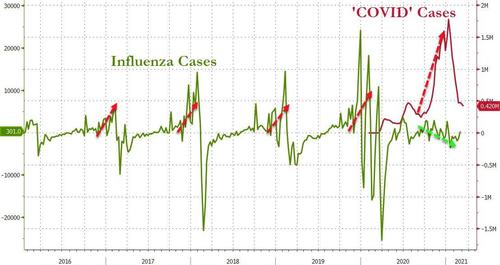
Or is it possible, that, maybe just maybe, at least some influenza cases have been misdiagnosed as COVID?

If that’s the case, then the real impact of masks on COVID growth rates is potentially much lower than 1.32%.

Even the CDC seems to understand this, because at the end of its report, they inspidly conclude by stating that mask mandates “have the potential to slow the spread of COVID-19. . .” [the bold is mine, obviously]

Really? “Potential”? That’s HERESY! And an obvious contradiction to WHO guidance. It makes we wonder whether Google and Facebook are gearing up to censor this report, given they have self-appointed themselves as the Ministry of Truth.

Frankly it’s pretty incredible that the data was too weak for the CDC to make a clear assertion about the benefits of mask mandates.

(though I did say there were a couple of lawyers who co-authored this paper… and using non-committal language like “potential” certainly sounds like typical weasel lawyer-speak.)
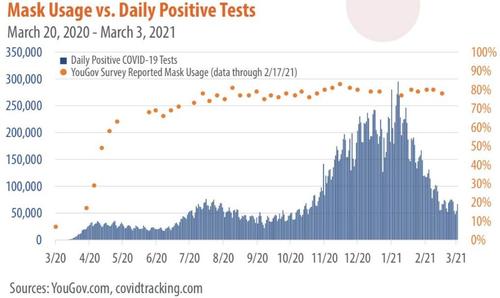
Now, please don’t misunderstand the point of this letter. I’m not here to bash masks or say that they don’t work, or go on some anti-mask rant.

The point is that I’m pro-data. And pro-reason.

Public health policies come with consequences. There are always costs, and there are (hopefully) benefits.

The CDC has just published an official analysis of the benefits, quantified at precisely 1.32%.

What are the costs of their decisions? Well there’s plenty of data about that too.

For example, a recent study published earlier this month in the premier scientific journal Nature shows that Americans who wear masks are more likely engage in riskier activities, like, you know, leaving the house.

The study conclude that mask mandates “lead to risk compensation behavior” and mask wearers “spend 11-24 fewer minutes at home on average and increase visits to some commercial locations– most notably restaurants, which are a high-risk location.”

Other consequences are more grim.

There have been several studies which chronicle the alarming rise in severe mental health issues, including a spike in youth suicide, as a result of various public health policies, including mask mandates and lockdowns.

For example, another study published in Nature from early January reported that, in late 2020, suicide rates among children in Japan jumped 49%.

And the US government’s Substance Abuse and Mental Health Service (SAMHSA) reported an incredible 890% increase in call volume to its nationwide suicide hotline last April.

Then there are the economic consequences to consider: Do mask mandates boost the economy by giving people more confidence to go out and spend? Or do mask mandates compel more people to stay home to avoid the hassle, and hence reduce economic activity?

There’s still no conclusive analysis on the subject. But you’d think that policymakers would want to know.

You’d think that they would look at all the data, all the pro’s and con’s, economic consequences, public health consequences, etc., and make an informed, rational decision.

But that doesn’t seem to happen anymore.

There can be no rational discourse on the topic. You’re not allowed to ask any questions or express any intellectual dissent, otherwise you’ll be denounced as a conspiracy theorist.

You have one job: obey. It’s not even about ‘trusting the science’ anymore, as we’ve been told to do over and over again during the pandemic. Because now the science tells us that mask mandates “have the potential” to reduce Covid growth rates by just 1.32%.

Not that you’ll hear this in the media.

There actually was a bonanza of coverage over the weekend about the CDC’s new report.

  • The Washington Post headline read “After state lift restrictions, CDC says mask mandates can reduce deaths”.

  • The New York Times reported that “Wearing masks, the [CDC] study reported, was linked to fewer infections with the coronavirus and Covid-19 deaths.”

  • NBC called the report “strong evidence that mask mandates can slow the spread of the coronavirus. . .”

But very little of the media coverage bothered to mention the real data, i.e. the marginal 1.32% reduction in growth rates.

Just like the CDC’s influenza data, it’s incredible that the media expects to be taken seriously, or that they pass themselves off as an objective, unbiased source of information.

https://www.zerohedge.com/political/cdc-about-be-canceled-google-facebook-covid-heresy

Acadia Pharma call on regulatory update on dementia-psychosis med

 - Conference call and webcast to be held today at 5:00 p.m. Eastern Time

Acadia Pharmaceuticals Inc. (Nasdaq: ACAD) today announced that the Company received a notification from the U.S. Food and Drug Administration (FDA) on March 3, 2021, stating that, as part of its ongoing review of the Company’s supplemental New Drug Application (sNDA), the FDA has identified deficiencies that preclude discussion of labeling and post-marketing requirements/commitments at this time. The FDA stated that the notification does not reflect a final decision on the information under review.

The notification does not specify the deficiencies identified by the FDA and there has been no clarification by the FDA at this time. The Company plans to work with the FDA to learn the nature of the deficiencies and seek to resolve them. In July 2020, the FDA assigned a Prescription Drug User Fee Act (PDUFA) action date of April 3, 2021 for completion of its review of the sNDA.

Conference Call and Webcast Information

Acadia management will discuss today’s announcement via conference call and webcast at 5:00 p.m. Eastern Time. The conference call may be accessed by dialing 855-638-4820 for participants in the United States or Canada and 443-877-4067 for international callers (reference passcode 4153316). A telephone replay of the conference call may be accessed through March 15, 2021 by dialing 855-859-2056 for callers in the United States or Canada and 404-537-3406 for international callers (reference passcode 4153316). The conference call also will be webcast live on Acadia’s website, www.acadia-pharm.com under the investors section and will be archived there through April 8, 2021.

https://finance.yahoo.com/news/acadia-pharmaceuticals-provides-regulatory-supplemental-210500999.html

Viatris cut to Neutral from Buy by Goldman

 Target to $15 from $20

https://finviz.com/quote.ashx?t=VTRS

KemPharm Won FDA Approval, But Analyst Balks

 Usually when a pharma company announces approval of one of its products, it usually merits an upwards rejig to an analyst’s model. But "usually" doesn't mean "always."

On Wednesday, KemPharm (KMPH) announced that the FDA had given its nod of approval for Azstarys, the company's once a day treatment of attention deficit hyperactivity disorder (ADHD). But where the analyst’s model is concerned, H.C. Wainwright analyst Oren Livnat points out why his reaction to the approval is not as would be anticipated.

As Livant highlights, the decision makes Azstarys the first approved prodrug version of any MPH-based ADHD product— putting it amongst a group that generates almost 20 million prescriptions annually. So, good news there.

What’s more, the potential cash windfall from the approval is significant. KemPharm has a commercial partnership with Corium, a portfolio company of Gurnet Point Capital. KemPharm could be due a $48 million approval milestone payment, royalties of high-single digits up to mid-20%, and sales-based milestones that could reach up to $42 million.

However, “potential cash windfall” is the key phrase here, says Livnat, because of a “disagreement on terms given the final Azstarys label.”

Livnat has long maintained that Azstarys’ label notes regarding onset and duration of efficacy, will be key.

“We believe the drug has best-in-class 0.5-13 hour efficacy, but its pivotal classroom study—with an unorthodox SAP—yielded 1-10 hours. Post hoc analysis using FDA’s typical method, as well as secondary endpoints and PK data, support 0.5-13 hours,” the 5-star analyst said. “The approved label seems to be an FDA compromise, with an efficacy curve reflecting as reported pivotal data rather than better post hoc curves, but without error bars specifying lack of statistical significance at the earliest and latest timepoints, thus still conveying drug superiority vs. placebo for 0.5-13 hours.”

That issue aside, Livnat says the label looks good, and should help make Azstarys the “Vyvanse of methylphenidate.”

But while Livnat still believes that Azstarys’ peak sales could reach over $300 million and the label should be enough for Corium to “differentiate the product,” there could be trouble ahead.

“There now appears to be risk that GPC does not view the label as sufficiently reflecting the best-case 0.5-13 hour profile, which represents downside risk to deal terms, including the $48M approval milestone and perhaps royalty rates,” the analyst said.

Therefore, while the approval amounts to a “major achievement,” given the “uncertainty around economics,” and the recent January dilution far beyond Livnat’s prior estimates, the analyst downgraded his rating from Buy to Neutral (i.e. Hold). Livnat also slashed his price target from $24 to $12, leaving room for 19% upside from current levels.

https://finance.yahoo.com/news/kempharm-won-fda-approval-analyst-011510319.html