Search This Blog

Wednesday, March 10, 2021

ChromaDex Announces Retail Distribution of Tru Niagen® in US Walmart Stores

 ChromaDex Corp. (NASDAQ:CDXC) announced today its flagship consumer product and industry-leading NAD+ booster Tru Niagen® will be available in 3,000 Walmart retail stores across the United States beginning June 2021. ChromaDex will introduce Tru Niagen® in two packaging options for Walmart customers, which will have distinct serving sizes and price points. In addition to in-store availability, these two options will be available online with same-day delivery and in-store pickup options for select locations.

“We believe Tru Niagen® is one of the most important new dietary supplements to emerge in many years,” says ChromaDex CEO Rob Fried. “We are grateful to Walmart in assisting in our quest to help as many people as possible to Age Better®.”

Tru Niagen® helps users Age Better® by safely and effectively increasing NAD+ (nicotinamide adenine dinucleotide) supporting the trillions of cells in the body. NAD+ levels decline with age as well as physiological stressors including stress on the immune system, alcohol consumption, over-exercising, and lack of healthy sleep cycles. 

https://www.businesswire.com/news/home/20210310005161/en/ChromaDex-Announces-Retail-Distribution-of-Tru-Niagen%C2%AE-in-Walmart-Stores-Across-the-United-States

Alkermes gets FDA orphan tag in mucosal melanoma


  • Alkermes (NASDAQ:ALKS) receives FDA orphan designation for its fusion protein comprised of a circularly-permuted interleukin-2 (IL-2) with the extracellular domain of IL-2 receptor alpha in the treatment of mucosal melanoma.
  • Among the benefits of Orphan Drug status in the U.S. is a seven-year period of market exclusivity for the indication, if approved.

Tuesday, March 9, 2021

COVID-19 antibody study: 1 of every 8 Americans were infected by October 2020

 COVID-19 antibody study: 1/8 in U.S. infected by October 2020

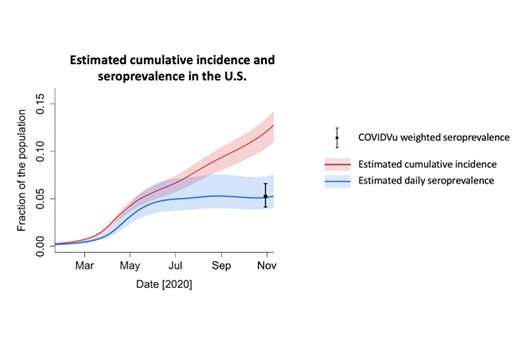
One in eight residents of the United States – more than 39 million people -- had been infected with SARS-CoV-2 by the end of October 2020, according to a “national probability sample” study conducted by Emory researchers. Credit: Emory University

In a first of its kind nationwide survey, Emory University researchers found that one in eight residents of the United States—more than 39 million people—had been infected with SARS-CoV-2 by the end of October 2020.

The results from a "national probability sample" of antibody tests were given on Saturday, March 6 at the Conference on Retroviruses and Opportunistic Infections (CROI) as a Science Spotlight presentation.

"Early estimates of national prevalence had been developed among toward people who were symptomatic, who had some reason to be tested for the virus, or who were seeking care for other medical conditions." says lead author Patrick Sullivan, DVM, Ph.D., Charles Howard Candler Professor of epidemiology and global health at Emory's Rollins School of Public Health. "This was an effort to minimize those biases as much as possible. By mailing out test kits, we were able to include people who might not have experienced symptoms or might not have been unable to travel to be tested."

The study found that people living in metropolitan areas were 2.5 times more likely to have been infected than those living in non-metropolitan areas. Also, people who are Black and Hispanic were more likely than whites to have experienced SARS-CoV-2 infection (2.2 times and 3.1 times more, respectively). Roughly one in six of those infected at some point had been diagnosed with COVID-19 and reported to health departments, based on comparison with CDC reports.

In addition, in a survey of participants' attitudes toward vaccination, the study found that 32 percent said they were unsure or unwilling to receive a COVID-19 vaccine. Vaccine willingness was measured with a 5-point scale. The overall findings were: 12 percent Very Unlikely, 7 percent Somewhat Unlikely, 13 percent Unsure, 19 percent Likely, and 50 percent Very Likely.

Many population groups at higher risk for SARS-CoV-2 infection were more likely to be unsure or unwilling: Black vs White (46 vs 30 percent), people working outside the home vs those working at home (38 vs 21 percent) and smokers vs nonsmokers (44 vs 29 percent). The surveys were completed from August to December 2020, overlapping with national news about the success of early vaccine clinical trials.

"Our findings demonstrate both a challenge and an opportunity for public health, because most of those who said they were unsure or unlikely to be vaccinated were not strongly opposed to vaccination," says Aaron Siegler, Ph.D., associate professor of epidemiology. "They could be convinced—and targeted interventions are underway to do that."

In the COVIDVu study, participants were randomly selected from a U.S. Postal Service database and sent invitations to provide samples. More than 4,600 people completed surveys and returned samples to a central laboratory by mail.

The number of people positive for SARS-CoV-2 antibodies at a given time rose to about 5 percent nationwide in the summer and peaked in September, according to the researchers' data. That fraction was stable through the fall, because of both new infections and fading levels of antibodies, while the cumulative number of people who had been infected continued to rise (see graph).

The researchers obtained both dried blood spots for antibodies and nose swab samples for RT-PCR. Antibody tests were conducted in a two-step confirmatory procedure described in this Annals of Epidemiology paper. Antibody tests were purchased from BioRad and EUROIMMUN, a division of PerkinElmer, and both tests have received Emergency Use Authorization from the FDA.

The COVID study included respondents from across the country, and additional projects surveying the states of California and Georgia in greater detail are underway. Follow-up samples collected in March and June of 2021 will be able to differentiate between infected with SARS-CoV-2 and those who were vaccinated.

More information: COVIDVu Study: covidvu.emory.edu/

https://medicalxpress.com/news/2021-03-covid-antibody-americans-infected-october.html

Biden Criticism of Trump Team’s Vaccine Contracts Is a Bit Much

 During a March 2 news conference on the covid-19 pandemic, President Joe Biden claimed that former President Donald Trump’s administration did not ensure there would be enough vaccines for the American public.

“When I came into office, the prior administration had contracted for not nearly enough vaccine to cover adults in America,” said Biden. “We rectified that.”

Biden then announced he was using the Defense Production Act to facilitate a partnership between two competing drug companies: Merck had agreed to help manufacture the recently authorized Johnson & Johnson vaccine.

The move, he said, would accelerate the timeline for the availability of vaccines: “We’re now on track to have enough vaccine supply for every adult in America by the end of May,” he said, two months earlier than he had previously projected.

It’s been a common political message since the Biden administration took office that the initial vaccine rollout under Trump was “chaotic.” PolitiFact previously rated a claim by Biden’s chief of staff, Ron Klain, that the Trump administration left no vaccine plan behind as Mostly False.

So, we thought it was important to check whether Biden was going too far in alleging that the Trump administration hadn’t contracted for enough vaccines to cover the American public. Let’s see what the contracts, which are public documents, say.

The Operation Warp Speed Contracts and FDA’s Process

As part of Operation Warp Speed, the Trump administration entered into contracts with multiple drugmakers. The contracts were generally signed while potential vaccines were still in clinical trials.

Experts told us this was smart because the Trump administration didn’t know which vaccines from which drugmakers would work, how effective they would be or how quickly they could be produced.

“That was the whole approach of Operation Warp Speed,” said Dr. Amesh Adalja, a senior scholar at the Johns Hopkins Center for Health Security. “Not knowing which one would cross the finish line, the Trump administration took a portfolio approach and invested in multiple vaccines.”

Here’s what the Trump team’s contracts called for drugmakers to supply to the U.S. government:

In all, the amounts agreed to under these contracts total about 800 million vaccine doses, or enough for more than 400 million people.

The U.S., based on U.S. Census estimates, has around 328 million people, of whom about 255 million are 18 or older. (Vaccines are not yet authorized for children.)

So, it appears that the Trump administration’s contracts with drugmakers did cover enough doses to vaccinate the entire U.S. adult population — and then some. By that measure, Biden’s statement is inaccurate.

An important point to remember, though, is that these contract numbers don’t necessarily represent deliverable vaccines. The contracts represent early promises. There were still important hurdles to be cleared before these possible vaccine candidates could be a reality.

Kevin Gilligan, a senior consultant with Biologics Consulting, a firm focused on pharmaceuticals, said that once drugmakers develop a vaccine they must test it through clinical trials with humans and amass enough data to show the vaccines are safe and effective and cause minimal side effects.

The data is then presented to the Food and Drug Administration, which decides whether the vaccine should be authorized for emergency use. Granting an emergency use authorization means the vaccine can then be distributed to the public.

Until recently, the Pfizer and Moderna vaccines were the only two that had reached that point, gaining authorization on Dec. 11 and 18 respectively.

The Trump administration announced Dec. 23 that it would buy an additional 200 million doses in total of both companies’ vaccines.

A Caveat Worth Noting: The Real Numbers Were Lower

A Biden administration press official told KHN that the president was referring only to orders for the authorized vaccines: “When the Trump administration was in office, there were only two approved vaccines (Pfizer and Moderna) and the Trump administration had not contracted for enough of them to vaccinate all Americans. They only had 400 million doses of these authorized vaccines, which is only enough for 200 million Americans. Upon coming into office, one of our first steps was to ensure that we had enough supply secured for every American. We were prepared from Day One.”

On this point, the Biden White House is correct. The U.S. government had in place agreements to buy 400 million doses of the authorized vaccines, which were both two-dose vaccines — not enough for the entire U.S. adult population.

It’s also true that five days after Biden became president, he announced his administration had reached agreements with Moderna and Pfizer to buy a combined additional 200 million doses. That purchase was finalized on Feb. 11 and brought the total U.S. supply to 600 million, or enough to vaccinate 300 million people.

In addition, on Feb. 27, Johnson & Johnson’s vaccine was authorized for emergency use. Under the Operation Warp Speed contract, J&J is supposed to provide 100 million doses to the U.S. by the end of May, but the company is reportedly behind on production. The Biden administration’s move to get J&J to team up with Merck to achieve its production goal will increase vaccine supply.

But, is it fair for Biden to blame the Trump administration for not buying more of the Pfizer and Moderna vaccines once they became authorized for emergency use?

The answer to that isn’t clear-cut, said the experts.

“It’s not totally fair to say the prior administration didn’t purchase enough, since they did move to purchase more doses after the vaccine was authorized,” said Jennifer Kates, senior vice president and director of global health and HIV policy at KFF. “I think the question is should they have purchased it earlier?”

The New York Times reported on Dec. 7 that before Pfizer’s covid vaccine was shown to be highly effective in clinical trials, the company had offered the U.S. government the option to buy additional doses, but the Trump administration declined. Former Health and Human Services secretary Alex Azar disputed the news report, saying during a TV interview that Pfizer hadn’t agreed to a production amount or delivery time for the additional vaccine, so he couldn’t agree to the deal: “I’m certainly not going to sign a deal with Pfizer giving them $10 billion to buy vaccine that they could deliver to us five, 10 years hence. That doesn’t make any sense.”

James Love, director of Knowledge Ecology International, a nongovernmental organization that obtained copies of covid government contracts, agreed that once it was clear the Pfizer and Moderna vaccines were likely to receive FDA authorization, the Trump administration could have taken action to make competing drug companies increase their vaccine manufacturing capacity in the way Biden did with Merck and J&J.

“The U.S. could have forced technology transfer between companies, which meant they would have been assured of additional vaccine manufacturing capacity,” said Love. “The agreements we have now about scaling manufacturing are coming pretty late actually. It takes several months to get stuff up and running.”

But Gilligan noted that the Biden administration had the advantage of hindsight. “Biden inherited the success of vaccine development done under Trump and then expanded on it,” said Gilligan. “And the Biden administration has the benefit of looking back at what was done well and what wasn’t and making the appropriate corrective changes. Hindsight is 20/20.”

Overall, there are questions around whether the Trump administration could have acted more quickly to buy doses or increase vaccine manufacturing capacity. And the Biden administration has certainly taken significant measures to expand supplies.

But it’s stretching the truth to say the Trump administration hadn’t contracted for enough covid vaccines to inoculate the U.S. adult population.


Biden said the Trump administration “had contracted for not nearly enough vaccine to cover adults in America.”

While Trump was still in office, his administration had agreements in place to buy 400 million doses of authorized vaccine, or enough to inoculate about 200 million people. That wouldn’t cover the U.S. adult population.

However, KHN-PolitiFact reviewed the Trump administration’s Operation Warp Speed contracts and found those included enough vaccine doses that, once cleared for use by the FDA, would inoculate about 550 million people — more than double the U.S. adult population.

https://khn.org/news/article/fact-check-president-joe-biden-criticism-of-trump-administration-vaccine-contracts-and-supply-not-accurate/

What does COVID immunity get me? Not much. Government should catch up to science.

 One of my patients, age 45, doesn’t remember having had COVID but he has the antibodies to prove it, and the amounts are quite high. He is happy to have the immune protection while having dodged the clinical bullet. Another patient, 20 years older, obese and at risk of complications, developed double pneumonia but recovered with the help of a monoclonal antibody infusion against the SARS COV 2 virus.

What do these two patients have in common? They have both developed antibodies and a degree of immunity against the virus. A recent report from the National Institutes of Health showed that this immunity can last for at least eight months. 

What is still needed is a better lab test of this immunity as well as permission for the COVID-recovered to go places unrestricted. The science backs this up even if the government doesn’t yet offer its permission slip. This delay in translating evolving science into policy while leaving punitive restrictions in place has been a big problem throughout the pandemic.

Translate science into policy faster

Consider that as of a week ago, over 20% of Americans and close to 50% of those 65 and over had received at least one dose of a COVID-19 vaccine. This is sure to have an impact and create pockets of community immunity. Over 80% of the COVID deaths in the United States occurred in patients 65 and over. The COVID vaccines have been shown to dramatically decrease severity of illness, and more and more data demonstrate that they decrease viral load and transmission.

Well over 2 million Americans are now being vaccinated daily, and this number is about to increase as Johnson and Johnson shipped out 4 million doses of its newly available vaccine on Monday. This single-dose vaccine, which can be stored in a refrigerator for three months, has been shown to be 85% effective against severe disease and 100% effective against hospitalization and death — with a single shot. 

Why isn’t the government keeping up with the science and translating it immediately into policy? Consider a new Harvard study of 1.2 million people in Israel, close to half of whom had received the Pfizer/BioNTech vaccine. After two doses, the vaccine was found to be just as effective for adults over 70 as for younger people, with a 94% reduction in symptomatic COVID-19, an 87% reduction in hospitalization and, importantly, prevention of 92% of all documented infections — even at a time in Israel when the U.K. B117 highly transmissible variant was surging.

But these results, published in the prestigious New England Journal of Medicine, did not lead to an immediate change in policy here as they did in Israel. In fact, the CDC had planned to issue guidance for vaccinated people Thursday, but is holding it up. In Israel, meanwhile, vaccination or proof of immunity from infection has become a ticket to reopening society. A so-called green passport now allows Israelis admission into gyms, shopping malls and restaurants, and travel to Greece and Cypress.


Iceland allows travelers to present passports in lieu of quarantine or testing requirements, why can’t we? Why was I compelled to show a negative PCR test result to get into Madison Square Garden to see a basketball game with a socially distanced small crowd when I could have shown my proof of vaccine card from the Centers for Disease Control and Prevention. The science is showing that vaccination or recovery from COVID or both are far more reliable indicators than a negative COVID test, which can easily be done at the wrong time in the disease process.

Consider public health, not politics

Critics of the so-called vaccine passport say that rewarding immunity is a way of penalizing those who aren’t yet immune. While this may be a fair point, it is imperative to look at this more from a purely public health perspective; who is at risk, and who is putting others at risk. If you are in the rapidly growing immune group, you are much less likely to spread or get sick from the virus. This is the public health bottom line. It doesn’t mean it's time to throw away your masks or to resume gathering in crowds, but it does mean that you can see grandma, especially if both of you have been vaccinated.

A public health perspective includes more than just the ravages of the virus, it also must consider the loneliness and isolation that have been caused by the efforts to control it. Sometimes these efforts are effective, especially when they are imposed in advance of viral spread, but sometimes they are excessive and cause greater harm than good. There is an epidemic of depression and anxiety here to match the COVID pandemic.

Our government has made many promises it hasn’t kept. We must not allow the vaccine to become another political weapon. We need to use our immunity as a bridge to reopen society and overcome our depression and isolation now before its too late. If there is a tangible incentive to take the vaccine in terms of restaurants, gyms, movie theaters, and travel, then many more people will do so.

My mother-in-law, bedbound from multiple sclerosis, turns 80 this month. I have not seen her in a year, but now that we are vaccinated, I'll be on my way there soon to celebrate with her.

Dr. Marc Siegel, a member of USA TODAY's Board of Contributors and a Fox News medical correspondent, is a professor of medicine and medical director of Doctor Radio at NYU Langone Health.

https://www.usatoday.com/story/opinion/2021/03/05/covid-vaccines-immunity-science-path-to-reopen-america-column/6875835002/

Cana can’t – can Cantargia?

 Novartis’s canakinumab always looked like a long shot in cancer, and today the company confirmed the worst: the Canopy-2 trial, in second or third-line metastatic non-small cell lung cancer, has failed. The anti-IL-1 beta antibody is still in a couple more pivotal NSCLC studies, but these must now be regarded as pretty slim hopes. The Swiss group's stock sank 1% today, but a bigger loser was Cantargia, the developer of the next most advanced similar project: Can04 or nidanilimab, which inhibits the IL-1 receptor accessory protein, is in a phase II study in several solid tumours and could yield data next year. Can04, like canakinumab, is also being tested in combination with Keytruda. Its 2026 sales forecasts sit at $564m, according to EvaluatePharma’s sellside consensus. Cantargia’s investors have been spooked by the cana readout; the company’s shares are down 23% so far today. Meanwhile, Novartis has another shot at IL-1 with VPM087, or gevokizumab, which is in a phase I basket trial. An allosteric inhibitor of IL-1 beta, gevokizumab has a slightly different mechanism than the competitive inhibitor cana, but success for the follow-on project now also looks dicey.

Anti-IL-1 projects in development for cancer
ProjectCompanyDescriptionIndication(s) Trial details & readouts
Phase III
CanakinumabNovartisAnti-IL-1 beta MAb (competitive inhibitor)NSCLC Canopy-2, 2L (NCT03626545), failed; Canopy-1, 1L, Keytruda combo (NCT03631199), data due H2 2021; Canopy-A, adjuvant (NCT03447769), data due 2022
Phase II
Can04 (nidanilimab)CantargiaAnti-IL1RAP MAbSolid tumours incl pancreatic cancer & NSCLCPh2 Canfour (NCT03267316), completed Dec 2020; Ph1 Keytruda combo (NCT04452214), completes Jan 2022
Phase I
VPM087 (gevokizumab)NovartisAnti-IL-1 beta MAb (allosteric inhibitor)Colorectal, renal & gastro-oesophageal cancers1L (NCT03798626)
Source: EvaluatePharma & clinicaltrials.gov.

https://www.evaluate.com/vantage/articles/news/snippets/cana-cant-can-cantargia

Antihistamines and azithromycin as treatment for COVID-19 in elderly patients


Juan IgnacioMorán BlancoabJudith A.Alvarenga BonillaabSakaeHommacKazuoSuzukidPhilipFremont-SmitheKarinaVillar Gómez de las Herasf


Abstract

Background

Between March and April 2020, 84 elderly patients with suspected COVID-19 living in two nursing homes of Yepes, Toledo (Spain) were treated early with antihistamines (dexchlorpheniramine, cetirizine or loratadine), adding azithromycin in the 25 symptomatic cases. The outcomes are retrospectively reported. The primary endpoint is the fatality rate of COVID-19. The secondary endpoints are the hospital and ICU admission rates. Endpoints were compared with the official Spanish rates for the elderly. The mean age of our population was 85 and 48% were over 80 years old. No hospital admissions, deaths, nor adverse drug effects were reported in our patient population. By the end of June, 100% of the residents had positive serology for COVID-19. Although clinical trials are needed to determine the efficacy of both drugs in the treatment of COVID-19, this analysis suggests that primary care diagnosis and treatment with antihistamines, plus azithromycin in selected cases, may treat COVID-19 and prevent progression to severe disease in elderly patients.