Search This Blog

Friday, March 19, 2021

5 reasons why COVID herd immunity is probably impossible

 As COVID-19 vaccination rates pick up around the world, people have reasonably begun to ask: how much longer will this pandemic last? It’s an issue surrounded with uncertainties. But the once-popular idea that enough people will eventually gain immunity to SARS-CoV-2 to block most transmission — a ‘herd-immunity threshold’ — is starting to look unlikely.

That threshold is generally achievable only with high vaccination rates, and many scientists had thought that once people started being immunized en masse, herd immunity would permit society to return to normal. Most estimates had placed the threshold at 60–70% of the population gaining immunity, either through vaccinations or past exposure to the virus. But as the pandemic enters its second year, the thinking has begun to shift. In February, independent data scientist Youyang Gu changed the name of his popular COVID-19 forecasting model from ‘Path to Herd Immunity’ to ‘Path to Normality’. He said that reaching a herd-immunity threshold was looking unlikely because of factors such as vaccine hesitancy, the emergence of new variants and the delayed arrival of vaccinations for children.

Gu is a data scientist, but his thinking aligns with that of many in the epidemiology community. “We’re moving away from the idea that we’ll hit the herd-immunity threshold and then the pandemic will go away for good,” says epidemiologist Lauren Ancel Meyers, executive director of the University of Texas at Austin COVID-19 Modeling Consortium. This shift reflects the complexities and challenges of the pandemic, and shouldn’t overshadow the fact that vaccination is helping. “The vaccine will mean that the virus will start to dissipate on its own,” Meyers says. But as new variants arise and immunity from infections potentially wanes, “we may find ourselves months or a year down the road still battling the threat, and having to deal with future surges”.

Long-term prospects for the pandemic probably include COVID-19 becoming an endemic disease, much like influenza. But in the near term, scientists are contemplating a new normal that does not include herd immunity. Here are some of the reasons behind this mindset, and what they mean for the next year of the pandemic.

It’s unclear whether vaccines prevent transmission

The key to herd immunity is that, even if a person becomes infected, there are too few susceptible hosts around to maintain transmission — those who have been vaccinated or have already had the infection cannot contract and spread the virus. The COVID-19 vaccines developed by Moderna and Pfizer–BioNTech, for example, are extremely effective at preventing symptomatic disease, but it is still unclear whether they protect people from becoming infected, or from spreading the virus to others. That poses a problem for herd immunity.

“Herd immunity is only relevant if we have a transmission-blocking vaccine. If we don’t, then the only way to get herd immunity in the population is to give everyone the vaccine,” says Shweta Bansal, a mathematical biologist at Georgetown University in Washington DC. Vaccine effectiveness for halting transmission needs to be “pretty darn high” for herd immunity to matter, she says, and at the moment, the data aren’t conclusive. “The Moderna and Pfizer data look quite encouraging,” she says, but exactly how well these and other vaccines stop people from transmitting the virus will have big implications.

A vaccine’s ability to block transmission doesn’t need to be 100% to make a difference. Even 70% effectiveness would be “amazing”, says Samuel Scarpino, a network scientist who studies infectious diseases at Northeastern University in Boston, Massachusetts. But there could still be a substantial amount of virus spread that would make it a lot harder to break transmission chains.

Vaccine roll-out is uneven

The speed and distribution of vaccine roll-outs matters for various reasons, says Matt Ferrari, an epidemiologist at Pennsylvania State University’s Center for Infectious Disease Dynamics in University Park. A perfectly coordinated global campaign could have wiped out COVID-19, he says, at least theoretically. “It’s a technically feasible thing, but in reality it’s very unlikely that we will achieve that on a global scale,” he says. There are huge variations in the efficiency of vaccine roll-outs between countries (see ‘Disparities in distribution’), and even within them.
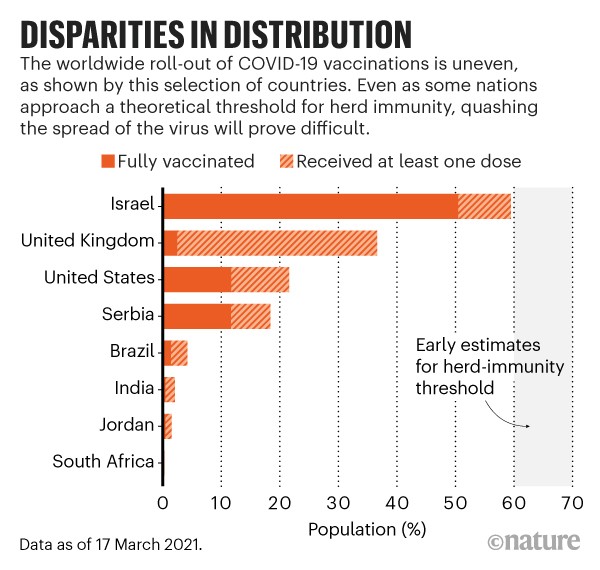
Disparities in distribution: Barchart showing that the roll-out of COVID-19 vaccinations is uneven.

Source: Our World In Data

Israel began vaccinating its citizens in December 2020, and thanks in part to a deal with Pfizer–BioNTech to share data in exchange for vaccine doses, it currently leads the world in terms of roll-out. Early in the campaign, health workers were vaccinating more than 1% of Israel’s population every day, says Dvir Aran, a biomedical data scientist at the Technion — Israel Institute of Technology in Haifa. As of mid-March, around 50% of the country’s population has been fully vaccinated with the two doses required for protection. “Now the problem is that young people don’t want to get their shots,” Aran says, so local authorities are enticing them with things such as free pizza and beer. Meanwhile, Israel’s neighbours Lebanon, Syria, Jordan and Egypt have yet to vaccinate even 1% of their respective populations.

Across the United States, access to vaccines has been uneven. Some states, such as Georgia and Utah, have fully vaccinated less than 10% of their populations, whereas Alaska and New Mexico have fully vaccinated more than 16%.

In most countries, vaccine distribution is stratified by age, with priority given to older people, who are at the highest risk of dying from COVID-19. When and whether there will be a vaccine approved for children, however, remains to be seen. Pfizer–BioNTech and Moderna have now enrolled teens in clinical trials of their vaccines, and the Oxford–AstraZeneca and Sinovac Biotech vaccines are being tested in children as young as three. But results are still months away. If it’s not possible to vaccinate children, many more adults would need to be immunized to achieve herd immunity, Bansal says. (Those aged 16 and older can receive the Pfizer–BioNTech vaccine, but other vaccines are approved only for ages 18 and up.) In the United States, for example, 24% of people are under 18 years old (according to 2010 census data). If most under-18s can’t receive the vaccine, 100% of over-18s will have to be vaccinated to reach 76% immunity in the population.

Another important thing to consider, Bansal says, is the geographical structure of herd immunity. “No community is an island, and the landscape of immunity that surrounds a community really matters,” she says. COVID-19 has occurred in clusters across the United States as a result of people’s behaviour or local policies. Previous vaccination efforts suggest that uptake will tend to cluster geographically, too, Bansal adds. Localized resistance to the measles vaccination, for example, has resulted in small pockets of disease resurgence. “Geographic clustering is going to make the path to herd immunity a lot less of a straight line, and essentially means we’ll be playing a game of whack-a-mole with COVID outbreaks.” Even for a country with high vaccination rates, such as Israel, if surrounding countries haven’t done the same and populations are able to mix, the potential for new outbreaks remains.

New variants change the herd-immunity equation

Even as vaccine roll-out plans face distribution and allocation hurdles, new variants of SARS-CoV-2 are sprouting up that might be more transmissible and resistant to vaccines. “We’re in a race with the new variants,” says Sara Del Valle, a mathematical and computational epidemiologist at Los Alamos National Laboratory in New Mexico. The longer it takes to stem transmission of the virus, the more time these variants have to emerge and spread, she says.

What’s happening in Brazil offers a cautionary tale. Research published in Science suggests that the slowdown of COVID-19 in the city of Manaus between May and October might have been attributable to herd-immunity effects (L. F. Buss et alScience 371, 288–292; 2021). The area had been severely hit by the disease, and immunologist Ester Sabino at the University of São Paulo, Brazil, and her colleagues calculated that more than 60% of the population had been infected by June 2020. According to some estimates, that should have been enough to get the population to the herd-immunity threshold, but in January Manaus saw a huge resurgence in cases. This spike happened after the emergence of a new variant known as P.1, which suggests that previous infections did not confer broad protection to the virus. “In January, 100% of the cases in Manaus were caused by P.1,” Sabino says. Scarpino suspects that the 60% figure might have been an overestimate. Even so, he says, “You still have resurgence in the face of a high level of immunity.”

There’s another problem to contend with as immunity grows in a population, Ferrari says. Higher rates of immunity can create selective pressure, which would favour variants that are able to infect people who have been immunized. Vaccinating quickly and thoroughly can prevent a new variant from gaining a foothold. But again, the unevenness of vaccine roll-outs creates a challenge, Ferrari says. “You’ve got a fair bit of immunity, but you still have a fair bit of disease, and you’re stuck in the middle.” Vaccines will almost inevitably create new evolutionary pressures that produce variants, which is a good reason to build infrastructure and processes to monitor for them, he adds.

Immunity might not last forever

Calculations for herd immunity consider two sources of individual immunity — vaccines and natural infection. People who have been infected with SARS-CoV-2 seem to develop some immunity to the virus, but how long that lasts remains a question, Bansal says. Given what’s known about other coronaviruses and the preliminary evidence for SARS-CoV-2, it seems that infection-associated immunity wanes over time, so that needs to be factored in to calculations. “We’re still lacking conclusive data on waning immunity, but we do know it’s not zero and not 100,” Bansal says.

Modellers won’t be able to count everybody who’s been infected when calculating how close a population has come to the herd-immunity threshold. And they’ll have to account for the fact that the vaccines are not 100% effective. If infection-based immunity lasts only for something like months, that provides a tight deadline for delivering vaccines. It will also be important to understand how long vaccine-based immunity lasts, and whether boosters are necessary over time. For both these reasons, COVID-19 could become like the flu.

Vaccines might change human behaviour

At current vaccination rates, Israel is closing in on the theoretical herd-immunity threshold, Aran says. The problem is that, as more people are vaccinated, they will increase their interactions, and that changes the herd-immunity equation, which relies in part on how many people are being exposed to the virus. “The vaccine is not bulletproof,” he says. Imagine that a vaccine offers 90% protection: “If before the vaccine you met at most one person, and now with vaccines you meet ten people, you’re back to square one.”

The most challenging aspects of modelling COVID-19 are the sociological components, Meyers says. “What we know about human behaviour up until now is really thrown out of the window because we are living in unprecedented times and behaving in unprecedented ways.” Meyers and others are trying to adjust their models on the fly to account for shifts in behaviours such as mask wearing and social distancing.

Non-pharmaceutical interventions will continue to play a crucial part in keeping cases down, Del Valle says. The whole point is to break the transmission path, she says, and limiting social contact and continuing protective behaviours such as masking can help to reduce the spread of new variants while vaccines are rolling out.

But it’s going to be hard to stop people reverting to pre-pandemic behaviour. Texas and some other US state governments are already lifting mask mandates, even though substantial proportions of their populations remain unprotected. It’s frustrating to see people easing off these protective behaviours right now, Scarpino says, because continuing with measures that seem to be working, such as limiting indoor gatherings, could go a long way to helping end the pandemic. The herd-immunity threshold is “not a ‘we’re safe’ threshold, it’s a ‘we’re safer’ threshold”, Scarpino says. Even after the threshold has been passed, isolated outbreaks will still occur.

To understand the additive effects of behaviour and immunity, consider that this flu season has been unusually mild. “Influenza is probably not less transmissible than COVID-19,” Scarpino says. “Almost certainly, the reason why flu did not show up this year is because we typically have about 30% of the population immune because they’ve been infected in previous years, and you get vaccination covering maybe another 30%. So you’re probably sitting at 60% or so immune.” Add mask wearing and social distancing, and “the flu just can’t make it”, Scarpino says. This back-of-the-envelope calculation shows how behaviour can change the equation, and why more people would need to be immunized to attain herd immunity as people stop practising behaviours such as social distancing.

Ending transmission of the virus is one way to return to normal. But another could be preventing severe disease and death, says Stefan Flasche, a vaccine epidemiologist at the London School of Hygiene & Tropical Medicine. Given what is known about COVID-19 so far, “reaching herd immunity through vaccines alone is going to be rather unlikely”, he says. It’s time for more realistic expectations. The vaccine is “an absolutely astonishing development”, but it’s unlikely to completely halt the spread, so we need to think of how we can live with the virus, Flasche says. This isn’t as grim as it might sound. Even without herd immunity, the ability to vaccinate vulnerable people seems to be reducing hospitalizations and deaths from COVID-19. The disease might not disappear any time soon, but its prominence is likely to wane.

Nature 591, 520-522 (2021)


Thrombocytopenia following Pfizer and Moderna SARS‐CoV‐2 vaccination


DOI: https://doi.org/10.1002/ajh.26132

PDF: https://onlinelibrary.wiley.com/doi/epdf/10.1002/ajh.26132

 Cases of apparent secondary immune thrombocytopenia (ITP) after SARS‐CoV‐2 vaccination with both the Pfizer and Moderna versions have been reported and reached public attention. Public alarm was heightened following the death of the first identified patient from an intracranial hemorrhage, which was reported on the Internet, then in USA Today1 and then in The New York Times.2 Described below, we have collected a series of cases of very low platelet counts occurring within 2 weeks of vaccination in order to enhance our understanding of the possible relationship, if any, between SARS‐CoV‐2 vaccination and development of ITP with implications for surveillance and management.

Twenty case reports of patients with thrombocytopenia following vaccination, 17 without pre‐existing thrombocytopenia and 14 with reported bleeding symptoms prior to hospitalization were identified upon review of data available from the Centers for Disease Control and Prevention (CDC), the Food and Drug Administration (FDA), agencies of the U.S. Department of Health and Human Services (HHS) Vaccine Adverse Events Reporting System (VAERS), published reports,34 and via direct communication with patients and treating providers. These cases were investigated as suspicious for new onset, post‐vaccination secondary ITP; we could not exclude exacerbation of clinically undetected ITP. Search terms relating to “decreased platelet count”, “immune thrombocytopenia”, “hemorrhage”, “petechiae”, and “contusion” were utilized to identify cases reported in VAERS.

The reports describing 19 of 20 patients included age (range 22–73 years old; median 41 years) and gender (11 females and 8 males). Nine received the Pfizer vaccine and 11 received the Moderna vaccine. All 20 patients were hospitalized and most patients presented with petechiae, bruising or mucosal bleeding (gingival, vaginal, epistaxis) with onset of symptoms between 1–23 days (median 5 days) post vaccination. Platelet counts at presentation were available for all 20 cases with the majority being at or below 10 × 109/L (range 1–36 × 109/L; median 2 × 109/L).

One patient had known ITP in remission; another had mild–moderate thrombocytopenia in 2019 with note of positive anti‐platelet antibodies, a third had previous mild thrombocytopenia (145 × 109/L) while a fourth had inherited thrombocytopenia with baseline platelet counts of 40–60 × 109/L. Three other patients had known autoimmune conditions including hypothyroidism, Crohns disease, or positive tests for anti‐thyroglobulin antibodies. Treatment for suspected ITP was described in 15 of the cases, including corticosteroids n = 14, intravenous immune globulin (IVIG) n = 12, platelet transfusions n = 8, rituximab n = 2, romiplostim = 1, vincristine = 1, and aminocaproic acid (Amicar) n = 1; combination therapy was used in most patients. Initial outcomes were reported in 16 cases. An improvement in the platelet count was described in patients treated with platelet transfusion alone (n = 1), corticosteroids alone (n = 1), corticosteroids + platelet transfusion (n = 3), corticosteroids + IVIG (n = 3), corticosteroids + IVIG + platelet transfusion (n = 5), corticosteroids +IVIG + rituximab + vincristine + romiplostim (n = 1). The index patient passed away after a cerebral hemorrhage, as mentioned, notwithstanding having received emergent treatment with IVIG, steroids, rituximab and platelet transfusions. Another patient had no improvement in platelet counts after 3 days, but treatment details are not specified.

Five additional patients with ”thrombocytopenia” or ”immune thrombocytopenia” post vaccination were identified in VAERS (last accessed 2/5/21), but either available information is insufficient for inclusion or the clinical scenarios suggest alternative processes contributing to thrombocytopenia. One 59 year‐old man was identified with ”thrombocytopenia” at an unspecified time after receiving the Pfizer vaccine without additional details regarding platelet count, clinical course, or treatment. A 44 year‐old woman was hospitalized for nausea, vomiting and chest pain on the day that she received the Pfizer vaccine. Her laboratory values included a platelet count of 85 × 109/L and a peak troponin level of 4 ng/mL (normal < = 0.04 ng/mL). The patient was diagnosed with myocarditis but did not require treatment for thrombocytopenia. Her platelets were 61 × 109/L on discharge, but subsequent platelet counts were not reported. The third is a patient without age or gender reported who was found to have thrombocytopenia, neutropenia and a pulmonary embolism at an unspecified time following the Pfizer vaccine. This patient was hospitalized and passed away; no additional details were available. A fourth patient, a 37‐year‐old man, had ”thrombocytopenia requiring hospitalization, meds and platelet infusion” 4 days following the Moderna vaccine with no details regarding presenting symptoms, platelet count, treatment or outcome. The last patient is an 80 year‐old man with multiple medical problems including recent transcatheter aortic valve replacement, hypothyroidism, and diverticulosis who presented 6 days after the Pfizer vaccine with bloody diarrhea, hemoglobin 8.7 g/dL and platelets 60 × 109/L. He received several units of packed red blood cells and two units of platelets with improvement to 101 × 109/L and was discharged 5 days later. There were a handful of reports with minimal additional details alluding to a male who passed away in December from brain hemorrhage following the Pfizer vaccine – these could be describing the index patient. We did not attempt to obtain information on patients with pre‐existing active ITP who received a SARS‐CoV‐2 vaccine for this report.

We identified additional reports of post‐vaccination bruising or bleeding unrelated to the injection site, but no mention of platelet counts, or thrombocytopenia, was provided. Note, VAERS was last accessed on January 29, 2021 for this search. Fourteen patients reported ”petechiae”/”bruising” of whom three were evaluated in the office and one presented to the emergency room. There have been 51 reports of” bleeding”/”hemorrhage” (vaginal n = 11, conjunctival n = 13, cerebral n = 6, gingival n = 2, gastrointestinal n = 5, epistaxis n = 12, and cutaneous n = 2). There were 31 patients who did not seek additional evaluation, seven were seen via office visits, while 13 presented to the emergency room or were hospitalized. Two patients passed away in the hospital. No additional details are available.

Are these case of primary ITP coincident with or secondary ITP as a result of vaccination? In either case, the clinical presentations and the favorable response to “ITP‐directed” therapies in most of the treated patients, such as corticosteroids and IVIG suggest an antibody‐mediated platelet clearance mechanism that is operative in ITP.

Is the relationship between vaccination and thrombocytopenia coincident or causal? It is not surprising that 17 possible de novo cases would be detected among the well over 20 million people who have received at least one dose of these two vaccines in the United States as of February 2, 2021. This would be less than one case in a million vaccinated persons, consistent with the absence of cases seen in the more than 70 000 subjects enrolled in the combined Pfizer and Moderna vaccine trials.56 If we assume that these reports identify 17 cases of secondary ITP that developed following vaccination, this extrapolates to 17 ×  6 (because only cases that occurred during the first 2 months [December 2020 – January 2021] following vaccine rollout are captured) × 15 to cover the fraction of the population that has been vaccinated [20 million of the 300+ million total US population]) = approximately 1500 cases of post‐vaccine secondary ITP/year. There are approximately 50 000 adults who are diagnosed with ITP in the US each year. If we explored the temporal relationship of the 17 cases occurring within 1‐2 weeks of vaccination, then we could extrapolate by multiplying by 26 or 52 weeks to look at the rate of ITP per year if the cases are totally ‘coincidental’. This would be approximately 39,000 to 78,000 cases of ITP per year which is not far from the estimated total baseline incidence per year. Thus, the incidence of an immune‐mediated thrombocytopenia post SARS‐CoV‐2 vaccination appears either less than or roughly comparable to what would be seen if the cases were coincidental following vaccination, perhaps enhanced somewhat by heightened surveillance of symptomatic patients. These estimates are very rough so this information should be considered very preliminary. It also assumes that all cases of clinically significant ITP are reported.

The incidence of secondary ITP following other types of vaccines provides an inconsistent picture. It is estimated that approximately 1:40 000 children develop secondary ITP after receiving measles‐mumps‐rubella (MMR) vaccine.7 Well‐documented cases of acquired immune thrombocytopenia have been reported after varicella and other vaccinations as well, including one described in this issue of the American Journal of Hematology following Shingrix recombinant Zoster vaccine.8-10 On the other hand, the only case–controlled study of adult recipients of all vaccines published 10 years ago was interpreted as indicating no discernable increase in ITP within 1 year post vaccination.11 In the absence of pre‐vaccination platelet counts and given the variable time post vaccination to discovery of thrombocytopenia, it is impossible to precisely estimate the incidence of secondary ITP post SARS‐CoV‐2 vaccination at this time. However, it is notable that all but one of the cases identified thus far occurred after the initial dose of SARS‐CoV‐2 vaccine. One would assume that if the vaccination was unrelated to development of ITP, case occurrences would divide more evenly between the two doses. It is also likely that the actual incidence of thrombocytopenia, including mild asymptomatic cases, may be higher and go unreported.

Even in view of the uncertain relationship between SARS‐CoV‐2 vaccination and secondary ITP, it is worth considering possible mechanisms by which this might occur. Thrombocytopenia has been reported after treatment with some anti‐sense oligonucleotides,1213 but it would seem that a far higher, sustained level of RNA reaching dendritic cells in lymph nodes and elsewhere would be required to generate an immune response than is likely seen based on a single intramuscular injection. This is also inconsistent with the very rapid onset of thrombocytopenia in the index and additional cases.

Another possibility is that some individuals may have pre‐formed antibodies, including those directed against poly‐ethylene‐glycol or to other components of the outer lipid layer of the nanoparticles. This presumes that antibodies directed against a novel antigen formed by attachment of vaccine particles on a small number of platelets trigger a reaction involving “all” platelets, which seems unlikely. Recent articles identified antibodies detected post Covid‐19 infection that activated platelets14 and an ITP‐like syndrome following natural infection1516; both findings require confirmation and the relationship to the post vaccination ITP cases reported here is uncertain.

Third, some patients may have had mild “compensated” thrombocytopenia of diverse causes, for example, pre‐existing ITP or hereditary thrombocytopenia. For example, one of the patients reported in this issue of the American Journal of Hematology had a documented borderline platelet count (145 × 109/L) 2 months prior to receipt of the vaccine raising the question of pre‐existing subclinical ITP.3 The other patient reported in this issue of the American Journal of Hematology had chronic, hereditary thrombocytopenia, with a last known exacerbation 12 years prior to the present episode.4 An additional patient identified in VAERS had platelets of 55–115 × 109/L in 2019. Severe thrombocytopenia in these patients or others may have been induced by enhancement of macrophage‐mediated clearance or impaired platelet production as part of a systemic inflammatory response to vaccination.817 This is compatible with patients in whom severe thrombocytopenia was first noted 1–3 days post‐vaccination. Transient drops in platelet counts post vaccinations for influenza and other viruses is a not uncommon observation in patients with ITP and other causes of thrombocytopenia.

Lastly, post‐vaccination ITP remains possible, especially in those with onset 1‐2 weeks after exposure. One patient in our series had a normal platelet count documented in the week prior to receipt of the vaccine and only developed symptomatology 13 days post vaccination compatible with vaccine related secondary ITP.

The reported cases also provide insight into diagnosis and treatment. Most of the patients responded to treatment with corticosteroids and IVIG but showed little benefit from platelet transfusion, a pattern consistent with that of ITP. There was no response in the two patients treated with rituximab but they were only evaluable for up to 2 weeks; in addition, rituximab would impair the response to vaccination, if given within days to 2 weeks of the vaccination and for at least 4‐6 months subsequently. The first of two patients (with sufficient information available) continued to have a platelet count of 1–2 × 109/L and died of intracranial bleeding 16 days post vaccination and 13 days post presentation of ITP despite receiving platelet transfusions, steroids, IVIG, and rituximab. The second patient presented 1 day after vaccination and still had a count of 1 × 109/L 7 days later despite receiving the same combination of the four ITP treatments; however, she responded following addition of vincristine and romiplostim. The suggestion might be (from this very limited information) to give IVIG and high dose steroids as initial treatment. If this does not work and the platelet count remains very low, it would seem appropriate to institute other treatments within the first week including a thrombopoietic agent perhaps starting above the lowest dose often recommended to initate therapy and potentially vinca alkaloids depending upon response. Excluding rituximab from initial treatment seems appropriate in most cases given that response can take up to 8 weeks18 and response to vaccination can be impaired. Once a platelet response is seen, patients could be managed as if they were typical cases of primary ITP. Whether such cases will prove to be self‐limiting or persist and lead to chronic ITP remains uncertain.

In summary, we cannot exclude the possibility that the Pfizer and Moderna vaccines have the potential to trigger de novo ITP (including clinically undiagnosed cases), albeit very rarely. Distinguishing vaccine‐induced ITP from coincidental ITP presenting soon after vaccination is impossible at this time. Additional surveillance is needed to determine the true incidence of thrombocytopenia post vaccination. If the incidence of thrombocytopenia post vaccination is higher than that based on available case reports, we anticipate that many more cases will be reported in the coming weeks as a higher proportion of the population is vaccinated. It may be worthwhile to see whether exacerbations of other conditions considered to have an autoimmune pathophysiology occur as well to gain a better understanding of host response to vaccination.

Notwithstanding these concerns, the incidence of symptomatic thrombocytopenia post vaccination is well below the risk of death and morbidity from SARS‐CoV‐2 infection as also described on the Platelet Disorder Support Association (PDSA) website in the statement from the Medical Advisory Board. We echo recommendations from the PDSA and the American Society of Hematology that strongly encourage reporting this and other potential complications through VAERS and in any other way deemed appropriate. Finally, we recommend immediately checking a platelet count in anyone who reports abnormal bleeding or bruising following vaccination and consulting a hematologist.

Management of vaccination in patients with pre‐existing ITP is complex and is not explored here. The opinion of the Medical Advisory Board of PDSA is that in most, but not necessarily all, patients the benefit of vaccination exceeds the risk of exacerbating ITP. At this time, for patients with ITP it appears reasonable to obtain a baseline count before vaccination and then obtain additional platelet count(s) following vaccination based on patient clinical and treatment history. In patients who present with severe thrombocytopenia soon after vaccination in the absence of other likely causes, we believe it would be appropriate to pursue aggressive treatment for presumed ITP. Whether to administer a second dose of vaccine or whether a change to a different vaccine is warranted in patients who develop thrombocytopenia or substantial worsening of pre‐existing thrombocytopenia with the initial dose requires further study.

https://onlinelibrary.wiley.com/doi/10.1002/ajh.26132

Gen Z Angels: How Younger Generation Of Investors Gets In On Deals

 Joe Niehaus made one of his first angel investments after hearing about the deal through a Slack channel for Generation Z venture capitalists, investors and founders.


The University of Cincinnati student, now 22, had recently heard about the company, ethically sourced tinned seafood brand Fishwife, when the deal surfaced in the #dealflow channel for the organization Gen Z VCs. So, he asked to be connected to the company’s founder and set up a call. 

“Someone in the Slack channel connected me with Becca, the founder of Fishwife, and we got on a call,” Niehaus said. “And I was like, I can’t meet this minimum, but this is a super interesting company.”

But the Fishwife deal stayed on his radar and Niehaus DoorDashed over the holiday break to make some extra cash. He reached out to a mentor about the deal as well, and ultimately went in with his cousin for the investment.

Niehaus is among a group of younger angel investors — part of Generation Z, or those born after 1996 — cropping up and writing checks to invest in companies early. A group, Gen Z VCs, has even been formed to support aspiring venture capitalists, early-career VCs, and other young investors and founders. The group has grown to more than 6,000 members since it was formed in November 2020.

Historically, there were greater barriers to entry into angel investing. In order to invest in most early-stage startups, a person had to be considered an accredited investor by the Securities and Exchange Commission. And to be an accredited investor, a person either needed to have a net worth of at least $1 million alone or with their spouse, excluding the value of their primary home, or make $200,000 individually each year or $300,000 combined with their spouse. 

Investing in early-stage startups is considered risky, and the SEC rules made it so that only people meeting certain wealth guidelines qualified to invest. But it’s also drawn criticism for shutting out many people from investing early and, for lack of a better phrase, letting only the rich get richer. 

In August 2020, the SEC revised its rules so that people with professional knowledge, experience or certifications could also be considered accredited investors. A person could, for example, take a Series 65 exam, which is meant for people wanting to be licensed investment adviser representatives, and become an accredited investor. 

And on Monday, the SEC’s loosened crowdfunding rules went into effect, making it so that startups could raise more money through regulation crowdfunding and individual investors could invest more. The regulation crowdfunding limit was increased from $1.07 million to $5 million.

The barriers to entry have been lowered thanks to new ways to invest like syndicates, rolling funds and platforms like AngelList, according to John Smothers, 24, an investor at Acrew Capital. That’s also helped demystify the world of angel investing. In the past, Smothers said, he felt that people were often under the impression that they had to write at least a $25,000 check to companies to angel invest. 

Now, through platforms like AngelList, or if the investor knows a founder, they see they can invest less money. The rise of special-purpose vehicles also allows people to write checks for between $500 and $2,000.

“I feel like folks who are in the Gen Z category who don’t have a ton of liquid capital see that they can get into the industry,” Smothers said.

Smothers began angel investing while in college at the University of Delaware with small checks, and invested in companies like FinixBuy Me A Coffee and Ample Foods.

“It’s probably not the old man’s game anymore, which I think is awesome,” Nik Sharma, CEO of Sharma Brands and a Gen Z investor who has invested in around 25 deals, said in an interview. “It’s really anybody who can be involved in it can be involved in it. And of course platforms like AngelList and Republic … these platforms also make it really accessible whether it’s through syndicates or rolling funds. You don’t have to be a lucky friend of someone with a prolific venture fund.”

Sharma, 24, made his first angel investment in late 2018 with the alcohol brand Haus. Sharma became acquainted with the founder of Haus through Twitter and stayed in touch through direct messages for about a year before the company launched.

He said he finds deal flow via a group chat with other younger investors. Someone will typically send a DocSend link or a link to a pitch deck and offer introductions.

The COVID-19 pandemic has contributed to more awareness and accessibility to investing, according to Meagan Loyst, 23, an early-stage investor at Lerer Hippeau and the founder of Gen Z VCs. 

Before the pandemic, young people wanting to invest might be more dependent on resources offered by their college — if they had a dorm room fund, for example. 

“COVID, being at home — it forced people online and it forced people to get out of the central school bubble,” Loyst said. 

It’s also given them access to more deal flow. The Gen Z VCs Slack, for example, has a channel where members can post deals, which is how Niehaus heard about Fishwife raising money and made an angel investment.

“It’s no longer your network is your campus, your network is Gen Z VCs,” Loyst said.

Loyst also pointed to the GameStop investing saga and retail investors becoming more active while at home as parallel to the idea of more younger people getting involved in investing.

“(People are) realizing that you have the agency to put your capital to work in different ways,” Loyst said. “And platforms like Republic are doing that too. You can invest alongside core VCs … there are ways as a nonaccredited investor where you can get involved.” 

For those who want to build a career in VC, angel investing early also helps them build a track record, according to Loyst.  

“A lot of people now care about the Gen Z perspective and we’re also making VC more transparent and accessible to the next generation of investors” Loyst said.

Of course, angel investing does come with notable risks. Investors are betting on young companies often without a long track record of operating. It’s not the same as investing in a public company that has to meet regulations set by the SEC. 

Because of that risk, people shouldn’t be investing any money they aren’t willing to lose, according to Sharma.

“Most of the people I know, they just assume it’s never coming back and hopefully it does come back,” Sharma said. “And I also think a lot of angel investors are getting in so early to these companies you might at least make that back.”

Sarah Behr, a financial planner at Simplify Financial Planning in San Francisco, said as a general guideline for angel investing, it’s wise only to invest less than 20 percent of a person’s total investable assets.

“It’s mostly not risking so much so if it’s gone or it’s not available for a certain amount of time … that you don’t have to give up other opportunities, namely other things that might be other financial goals for you like buying a home, or going to grad school, or taking a year off for traveling,” Behr said.

Angel investing can produce great returns. But it’s inherently riskier than investing in the public markets, and the reporting and transparency requirements of startups aren’t standardized either.

“Getting in early on a company, the potential for significant return on investment is much greater than in the public market,” Behr said. “But also the reason is risk and return go hand in hand. It’s much more risky.”

And ultimately, Gen Z is the future, and there’s value in having that perspective on the cap table, according to Erik de Stefanis, 24, an associate at Interlace Ventures, who leads the Gen Z VCs syndicate.

“People are realizing that this generation is coming of age and beginning to earn more money and becoming a more and more powerful consumer base, and founders I’ve talked to about potentially having a syndicate come in, it’s becoming a more valuable proposition to have young people on that cap table and have that view.”

https://news.crunchbase.com/news/gen-z-angel-investing/

Weak effect of virus state of emergency prompts Japan gov't to end it

 he Japanese government is poised to lift its declaration of a state of emergency over the spread of the coronavirus despite a slight rise in the number of new infections, as it fears that spreading fatigue from voluntary restraint and acclimatization to the declaration have undermined its effectiveness.

    As there were no prospects of a reduction in the number of infections even if the state of emergency over Tokyo and three surrounding prefectures were extended, the government was pressured to lift the declaration, with a mood of resignation even starting to drift in.

    When asked about the risk of a resurgence of the virus if the declaration were lifted, Prime Minister Yoshihide Suga told a group of reporters on March 17, "Since the state of emergency was declared, there has actually been about an 80% reduction (in the number of infections). Amid this situation, I understand infections have plateaued and are now slightly rising. I'd like to take measures to firmly prevent a rebound."

    Suga stated that the main reason for extending the state of emergency was pressure on the number of available hospital beds, and said this was also the main reason for lifting it. Looking at the actual figures in the prefectures subject to the state of emergency, 31% of hospital beds in Tokyo were occupied as of March 2, before the current state of emergency was extended, compared with 29% in Kanagawa, 51% in Chiba and 42% in Saitama. But as of March 16 (whose figures were announced the following day), the rates had dropped to 25% each in Tokyo and Kanagawa, 37% in Chiba and 38% in Saitama. The weekly number of infections had also dropped below "Stage 3" (corresponding to a sudden rise), and a senior official at the Ministry of Health, Labor and Welfare commented, "The fact that new beds have been secured has had an effect. An environment where we can look to lift the state of emergency is coming into place."

    However, in Tokyo and Saitama Prefecture, the number of people newly infected with the coronavirus has continued to rise, albeit slightly. An official from Japan's ruling Liberal Democratic Party (LDP) who previously served as a Cabinet member commented apprehensively, "Even if the (occupancy rate) figures for hospital beds fall, the number of new infections is still increasing, which means that hospital bed figures will also eventually rise."

    The reason the government is set to lift the declaration regardless is that slackness has spread as people have become acclimatized to the state of emergency, and there are no prospects that continuing it would have any effect. One government official commented, "It's no use even if the declaration were to remain in effect. We have no option but to lift it." Those close to the prime minister, meanwhile, have similarly voiced the opinion, that even if the declaration were extended "the situation would remain the same," indicating there is a widespread perception that the effectiveness of the declaration is weakening.

    Due to the prolonged impact of the virus on the economy, the government is reluctant to issue a widespread call for restraint on business activities including during the day, like during the first state of emergency between April and May 2020, and one figure close to the prime minister commented, "Even if we extend it, we have no options."

    There also remains the risk that new infections could increase even if the state of emergency were extended. The prime minister and Cabinet members including economic revitalization minister Yasutoshi Nishimura and health minister Norihisa Tamura gathered at the prime minister's office on March 16, and one Cabinet member commented, "If infections continue to increase like this, the declaration of a state of emergency would be meaningless."

    If the declaration, which was supposed to be the government's treasured last-resort sword to fight the virus, is treated as a blunt imitation sword, then the government will be going into the battle against the virus empty-handed, and prospects of bringing it under control will grow even more distant.

    One official in the Suga administration commented, "If we don't reset the situation somewhere, we won't be able to make the next move." Another senior official at the prime minister's office commented, "People are exhausted from voluntary restraints. If we don't rest here now, then we won't be able to tell people to put in an effort next time."

    https://mainichi.jp/english/articles/20210318/p2a/00m/0na/013000c

    All Utah adults eligible for COVID-19 vaccine March 24

     All Utah adults will be eligible to schedule an appointment for the COVID-19 vaccine starting March 24, Gov. Spencer Cox announced Thursday.

    Utahns ages 16 to 18 will only be eligible to receive the Pfizer vaccine, which is the only vaccine that has received federal approval for that age group thus far, Cox added during a news conference.

    The governor stressed that there will not be enough doses of the vaccine by March 24 to keep up with demand. People will be eligible to make an appointment for the vaccine next week, but their appointments may still be several weeks out, he added.

    "We know we need to do better," Cox said. "We need more vaccine to make that happen."

    The eligibility expansion will happen sooner than the previous expected date of April 1, and it comes at the request of local health departments to broaden eligibility sooner than previously planned, the governor said.

    The state has implemented a vaccination roadmap for underserved populations, such as multicultural communities and homeless individuals. That process includes sending mobile vaccination units into multicultural and rural communities that otherwise don't have enough access to the vaccine.

    When those mobile units get sent to those areas, it's easier for vaccine administrators to simply offer doses to as many people as possible instead of worrying about their age or health status or another eligibility factor, Cox said. The expansion to everyone next week will make things easier for those situations, so health districts and community partners requested the governor make the change, he said.

    Health officials have said 70-90% of a given population needs to be vaccinated for herd immunity to be reached. Cox said Utah won't be able to achieve herd immunity if the majority of the state is vaccinated, but pockets remain in those underserved populations where only 30-40% of people have received the vaccine.

    The state has administered 140,000 vaccine doses over the past week, and 87% of Utahns aged 70 and over have received at least one dose, Cox said Thursday. A large number of people under the age of 50 who have underlying health conditions have also received a dose, he added.

    Utah is expecting a large increase in its vaccine allocation toward the end of March and into April as Pfizer, Moderna and Johnson & Johnson all are set to ramp up the production of their respective vaccines, Cox said.

    "We are really happy with where things are right now," the governor added.

    https://www.ksl.com/article/50128750/all-utah-adults-eligible-for-covid-19-vaccine-next-week-as-state-sees-560-new-cases-5-deaths-25k-vaccinations