Search This Blog

Monday, March 29, 2021

More than a dozen states to open vaccines to all adults

 More than a dozen states will open vaccine eligibility to all adults this week in a major expansion of COVID-19 shots for tens of millions of Americans amid a worrisome increase in virus cases and concerns about balancing supply and demand for the vaccines.

Meanwhile, the director of the Centers for Disease Control and Prevention said Monday she had a recurring feeling of "impending doom" about a potential fourth wave of coronavirus infections after cases in the U.S. rose 10% over the last week. She pleaded with Americans not to relax preventative practices such as social distancing measures and mask-wearing.

"Just please hold on a little while longer," Dr. Rochelle Walensky said during a White House briefing. Several Northeastern states and Michigan have seen the biggest increases, with some reporting hundreds or thousands more new cases per day than they were two weeks ago.

new study by the CDC concluded that the Pfizer and Moderna vaccines were 90% effective after two doses, a finding that Walensky said should offer hope.

States opening eligibility to anyone ages 16 and older on Monday included Texas, Oklahoma, Louisiana, Ohio, North Dakota and Kansas.

The rapid expansion has fueled concerns that the number of eager vaccine seekers will far outstrip the available supply of shots, frustrating millions of newly eligible people who have waited since late last year for a chance to get an injection. Other officials have put their faith in a promised glut of vaccines and instead turned their attention to the next challenge: Pressing as many people as possible to get the shots so the nation can achieve herd immunity at the earliest opportunity.
At least 11 more states to open virus vaccines to all adults
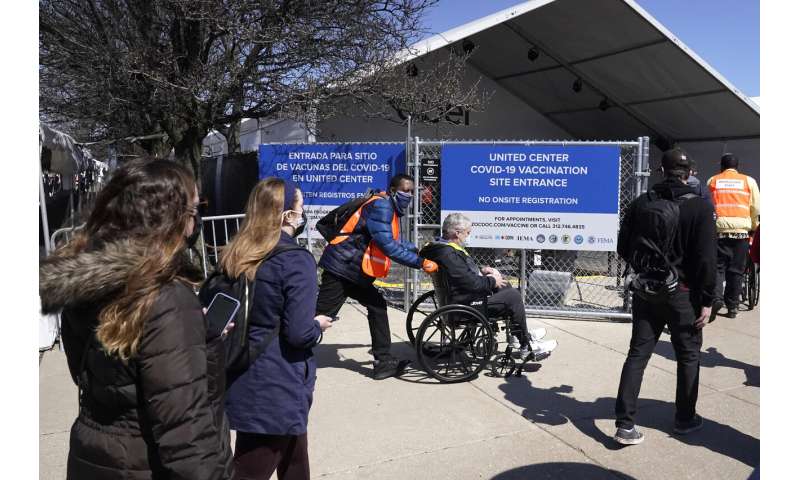
Chicago area residents head into a walk-in mass vaccination site Monday, March 29, 2021, across the street from the United Center, home to the Chicago Bulls and Blackhawks in Chicago. At least 11 states opened vaccine eligibility to all adults this week in a major expansion of COVID-19 shots for tens of millions of Americans amid a worrisome increase in virus cases and concerns about supply and demand for the vaccines. In Chicago, the vaccine will not be available to everyone until at least May 1 because the city does not have enough shots on hand. (AP Photo/Charles Rex Arbogast)

In Kansas, where some local health officials have said they are struggling to find people to vaccinate, another 400,000 people are now eligible for shots. Democratic Gov. Laura Kelly has been criticized by Republicans for a slow and disorganized vaccine rollout, and she faced more criticism Friday when she announced the plan to expand eligibility. One Republican lawmaker said people with chronic medical conditions could be left behind.

Louisiana Gov. John Bel Edwards has said the state will soon have enough shots for everyone who wants one, and that the challenge now is to make sure people want to get vaccinated.

Some counties in Illinois are being allowed to expand eligibility to all this week if they find doses are going unused. Meanwhile, in Chicago, the vaccine will not be available to everyone until at least May 1 because the city does not have enough shots on hand.

On Tuesday, Minnesota opens eligibility, followed by Indiana and South Carolina on Wednesday, Connecticut and Montana on Thursday and New Hampshire and Colorado on Friday. In New York, Gov. Andrew Cuomo announced that residents over 30 will be eligible for vaccinations starting Tuesday, and everyone over 16 will be eligible starting April 6.
At least 11 more states to open virus vaccines to all adults
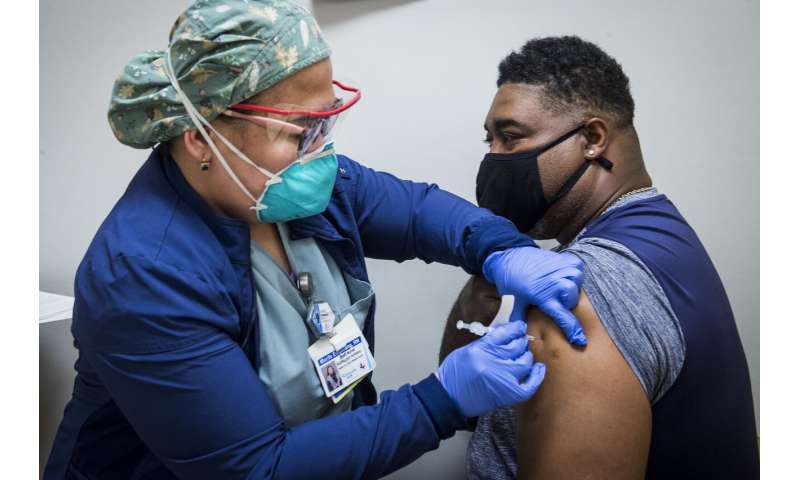
In this Feb. 11, 2021, file photo, registered nurse Marife Edquilang, left, administers a dose of Pfizer COVID-19 vaccine to Anthony Monroe during a vaccination drive at Texas Southern University in Houston. At least 11 states opened vaccine eligibility to all adults this week in a major expansion of COVID-19 shots for tens of millions of Americans amid a worrisome increase in virus cases and concerns about supply and demand for the vaccines. States opening eligibility to anyone ages 16 and older on Monday included Texas, Oklahoma, Louisiana, Ohio and Kansas. (Brett Coomer/Houston Chronicle via AP)

Indiana Health Commissioner Dr. Kristina Box said last week that the wait for an appointment could be extended from three weeks to six weeks or more to ensure the system does not overbook.

Arizona opened up eligibility to everyone 16 and up last week, but has since been dealing with an unintended consequence: Interest in volunteering at four state-run vaccination sites plummeted almost immediately. Rhonda Oliver, CEO of HandsOn Greater Phoenix, a nonprofit handling online volunteer recruitment, said since February, thousands of volunteer shifts filled up within an hour. Now many remain vacant.

"People saw it as a way to get the vaccine sooner," Oliver said. "We anticipated a drop-off, but we just didn't expect it to go off a cliff in a matter of 24 to 48 hours like this."

On Wednesday, the first day of the new eligibility, only 70 of the scheduled 145 volunteers appeared at State Farm Stadium in Glendale, and dozens of people either withdrew earlier or simply did not show up. Oliver said that put an unfair burden on volunteers who did show up and could not take breaks.
At least 11 more states to open virus vaccines to all adults
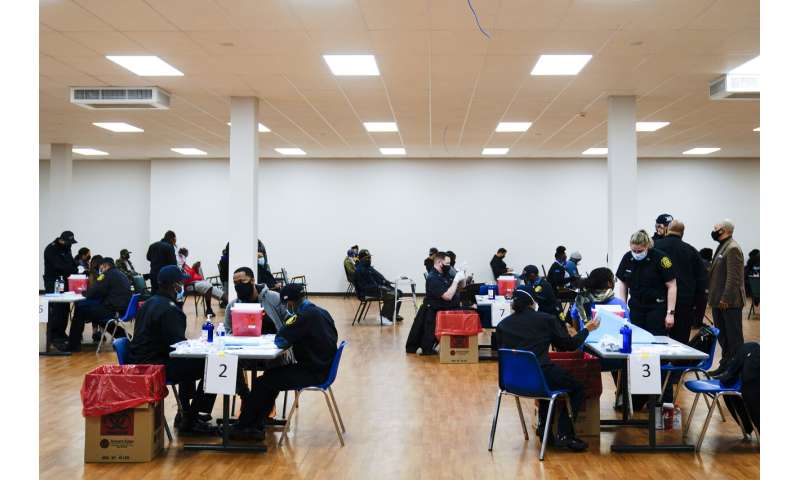
Members of the Philadelphia Fire Department administer COVID-19 vaccines at a site in Philadelphia, Monday, March 29, 2021. (AP Photo/Matt Rourke)

People getting the vaccine, however, should not be affected by the drop. Oliver said volunteer attendance will not affect wait times for those with appointments. HandsOn Greater Phoenix is hoping to lessen the hemorrhaging by reaching out to large companies and community groups looking for service activities. The group is also encouraging friends or family members who have been vaccinated to volunteer together.

Many other states are still holding back amid a continued lack of supply.

California officials said the state can administer 3 million shots a week now, and Democratic Gov. Gavin Newsom has predicted that maximum capacity will climb to 4 million by the end of April. But supplies have limited the effort so far to 1.8 million shots per week, a figure that is expected to increase to 2.5 million per week in the first half of April and then 3 million by the end of April, when everybody 16 and older will be offered the vaccine.

Santa Clara County Health Officer Dr. Marty Fenstersheib said his county has been told it will get 58,000 doses this week, but the state will begin allowing about 400,000 more people between the ages of 50 and 64 in the county to sign up as of Thursday, in addition to the current backlog.

"We don't have the vaccine, and we are concerned," Fenstersheib said.

Among the methods officials are employing to reach underserved communities are vans that can be used as mobile clinics that travel to hard-hit neighborhoods and provide on-the-spot vaccinations.

In California, mobile clinics are helping to vaccinate farmworkers who may not have transportation to larger vaccination sites or who cannot navigate the state's online signup portal. The city of Los Angeles also plans to have 10 mobile vaccination teams. Colorado Gov. Jared Polis said Monday that four mobile bus clinics will distribute vaccines to underserved communities.

While demand has dropped off in some communities, it's as brisk as ever in others, and sign-up hassles continue.

Dwight and Kate Blint both got their first shots Saturday in Hartford, Connecticut, but it took some time and work to do it. For starters, the process to sign up online was simply too confusing, so they decided to call on the phone for appointments. But the two, both 56, with jobs in communications in the insurance business, could not spend hours on the phone. Dwight Blint's mother, who is retired, agreed to call.

"It took four or five tries, waiting on the phone for a half hour to speak to someone to be told we don't have an appointment," he said. "We're talking hours."

But the effort was smoother for University of Utah professor Bill Johnson. He said he was bracing for a time consuming and confusing experience but instead found it remarkably easy.

"We had to make the appointment online and got in two days later," said Johnson, 59, who got his first shot at the convention center in Salt Lake City. "It took us 10 minutes to drive there, and they jabbed us two minutes after we arrived."

https://medicalxpress.com/news/2021-03-states-virus-vaccines-adults.html

What Is The AOK Digital Health Pass And How Does It Work?

 Digital passports could become a requirement for international travel in a post-COVID-19 pandemic reality. AOK is one of the digital passports backed by the International Chamber of Commerce. Dr. Chester Drum is the medical scientist credited with designing AOK in Singapore.

What Happened: AOK creates a completely decentralized health record designed to protect the individual's privacy, Drum said on CNBC's "The Edge." At the same time, it is part of a common authentication network that protects countries by validating the health data.

Users would download the AOK app on their phone and results from a lab would be uploaded to a profile. Once the data is uploaded, the "only way it ever leaves the phone is completely cryptographically anonymized," he said.

Since there is no centralized database, a user will never share their information, Drum said. Instead, they merely demonstrate the health information to the relevant authorities.

Why It's Important: People need confidence in knowing the plane or ship they are in is "COVID free" and reduce or eliminate quarantine times upon arrival, International Chamber of Commerce Secretary General John Denton told CNBC. The best way to accomplish these objectives is through an app providing the "ultimate level of security" for all.

What's Next: The AOK app is operational across multiple travel routes and is expected to be launched in other regions.

"If we want to talk about how we get lives and livelihoods happening again and ensure we mobilize the world again and allow the world to move again," said Denton, "we have to actually create standards to enable that to happen."

https://www.benzinga.com/news/21/03/20384840/what-is-the-aok-digital-health-pass-and-how-does-it-work

Canada Urges Halt in Use of AstraZeneca Covid-19 Vaccine in People Under 55

 Canadian authorities recommended Monday a halt on administering the AstraZeneca PLC Covid-19 vaccine on people under the age of 55 in light of evidence from Europe on potentially serious side effects targeting younger women.

The change in guidance marked a sharp shift from Canadian health officials, who up until now have said the AstraZeneca vaccine was safe for people of all ages -- a point they emphasized earlier this month when governments in Europe paused the vaccine's use amid worries over blood clotting. This also marks the latest setback for the British-Swedish drugmaker, which has faced pushback from governments, regulators and the public about the rollout of its vaccine.

Health Canada, the country's drug regulator, has ordered AstraZeneca to conduct a detailed risk-benefit analysis on the vaccine by age and gender. The information, officials said, would help determine whether specific demographic groups might be at higher risk.

Canadian officials said the change in guidance on AstraZeneca stems from the emergence of additional reports of blood clotting in people who received the vaccine in Europe. Some European cases were reviewed in a recent preprint research paper that focused on nine patients in Germany and Austria. The findings from the preprint were first reported by researchers earlier this month.

The preprint research looked at nine patients whose ages ranged from 22 to 49 and who had developed thrombosis, which occurs when a blood clot forms inside a blood vessel, beginning four to 16 days after getting the AstraZeneca vaccine. Eight of the patients were female. Four of the nine patients died.

The paper refers to blood clotting after a Covid-19 vaccination as a rare adverse effect, and one that has so far only been reported in patients who received the AstraZeneca vaccine.

Canadian officials said that, based on information from Europe, the incident rate was originally estimated at one per one million people vaccinated with the AstraZeneca vaccine, but a higher rate of one in 100,000 was later reported by researchers in Germany. Among the people who developed blood clotting after receiving the vaccine, the fatality rate is estimated at 40%, the officials said.

Considering this information and knowing that Canada has authorized three other Covid-19 vaccines, "there is substantial uncertainty about the benefit of providing AstraZeneca Covid-19 vaccine to adults under 55 years of age given the potential risk," said Dr. Shelley Deeks, vice chairwoman of the National Advisory Committee on Immunization, an independent panel of scientists.

The panel's recommendations aren't binding. At least two Canadian provinces, which are responsible for carrying out Covid-19 vaccinations, said they were immediately halting use of the AstraZeneca shot on younger people.

"This is a pause while we wait for more information to better understand what we are seeing in Europe," said Dr. Joss Reimer, head of Manitoba's vaccine task force. "We have to respond to what we know, when we know it, in this vaccine campaign."

An AstraZeneca spokesman said the company respects the decision from the immunization advisory panel. He added that Health Canada still deems the vaccine safe for use, and an "extensive body of data from two large clinical data sets and real-world evidence demonstrate its effectiveness, reaffirming the role the vaccine can play during this public health crisis."

Canada authorized use of the AstraZeneca vaccine, created in partnership with the University of Oxford, on Feb. 26. Health Canada -- which has oversight on drugs -- has said the benefits of the vaccine outweighed any risks and stuck to that position while European countries paused AstraZeneca's use because of concerns about the risk of blood clotting in older people. The European Union's health agency later determined the shot was safe and effective and didn't increase the risk of blood clots.

Dr. Supriya Sharma, senior medical adviser at the country's health department, said last week that reports of blood clots after vaccination were rare, but their unusual nature warranted further investigation. She said Health Canada would review evidence about the blood clots as it becomes available and would take action if new safety issues are confirmed.

On Monday, Dr. Sharma said she supported the recommendation, while adding that the AstraZeneca vaccine will still remain effective in preventing hospitalizations and deaths for people 55 and over, or those most susceptible to Covid-19's fallout. "It's reasonable to pause for a period of time while this [risk] continues to be evaluated," she said. "I fully understand this can be confusing. Especially for this vaccine, which has had a lot of confusion surrounding it."

To date, officials said about 300,000 Canadians have received a shot of the AstraZeneca vaccine. Canada authorized use of AstraZeneca's shot in late February, whereas in the U.S. the vaccine remains under review. It is rare for Health Canada to get so out in front of the Food and Drug Administration on drug authorization, said Mark Warner, a lawyer who practices in Canada and the U.S. who has advised pharmaceutical companies.

"That choice and the continuing noise around the AstraZeneca vaccine has led to some predictable confusion in the rollout of the vaccine in Canada," he said.

https://www.marketscreener.com/quote/stock/ASTRAZENECA-PLC-4000930/news/Canada-Urges-Halt-in-Use-of-AstraZeneca-Covid-19-Vaccine-in-People-Under-55-Update-32832082/

BioNTech, Moderna to Use Same COVID-19 Vax Tech for Other Treatments

 As the world continues rolling out COVID-19 vaccines, some of the companies behind the injections are already looking to the future.

Moderna and BioNTech are two of the pharmaceuticals companies that have brought out vaccines against COVID-19. Thanks to a particular technology they used for these injections, they're now going to see how they can use it in other therapies and vaccines.

A gene technology called messenger RNA, or mRNA, was what helped these two companies bring their respective COVID-19 vaccines to life so quickly, explains the Observer.

Now, they're trying to find out if mRNA can also be used in new vaccines to fight against other illnesses including cancer. 

Compared to traditional vaccines, mRNA vaccines don't put a weakened or inactivated germ or virus into our bodies, the U.S. Centers for Disease Control and Prevention (CDC) explains.

Instead, mRNA teaches our cells how to make a protein that then triggers an immune response in our bodies, which in turn produces antibodies that protect us from becoming infected by the real virus.

What Moderna, and Pfzier and BioNTech plan to do

Speaking with Forbes on March 24, Moderna CEO Stéphane Bancel said his team will be forging ahead in 2021 and 2022 to try and create new vaccines for infectious diseases, new cancer treatments, and cures for genetic disorders.

To begin with, Bancel said that the Moderna team will continue working on its COVID-19 vaccine against the new variants popping up across the world. He explains that we may end up taking the COVID-19 jab every one or two years, just like the flu vaccine, as the virus quickly spreads across new variants. 

Speaking of the flu vaccine, that's also one of Moderna's focuses in the coming years: to create a better flu vaccine. Bancel believes that using the new gene tech, mRNA, they can increase their flu vaccine's efficacy rate up to 90 percent, up from 30 to 60 percent. 

On top of that, Moderna currently has five therapeutic cancer treatments in clinical trials. Again, mRNA may help to improve these and their efficacy. 

Preventing birth defects is another focus for the Boston-based pharmaceutical company, as well as using mRNA to repair hearts, and fix broken genes.

On the other side of the Atlantic, Germany-based BioNTech has similar projects under way using its mRNA technology, too. The company has "several different cancer vaccines based on mRNA," co-founder Özlem Türeci told the Associated Press, that it will keep improving and focusing on.

It looks like the BioNTech husband and wife team is returning to its roots of cancer research soon, and utilize what's learned from its fight against COVID-19. 

The use of mRNA has been on the biotech industry's sights for two decades, the Observer points out, and it looks like its time to shine has arrived.

https://interestingengineering.com/biontech-moderna-to-use-covid-vaccine-tech-for-other-treatments

Eyes Offer Window Into Cognitive Impairment

 Cognitive impairment occurred more than twice as often in patients with normotensive glaucoma (NTG) as compared with high-tension glaucoma (HTG) and exhibited a trend toward greater impairment, a matched case-control study showed.

A telephone-based cognitive assessment questionnaire showed that 14.8% of patients with NTG met criteria for cognitive impairment versus 5.4% of patients with HTG. Patients with cognitive impairment trended toward lower highest-measured intraocular pressure (IOP). Otherwise no ocular parameters had associations with cognitive impairment in either group.

The study builds on existing evidence supporting an association between NTG and dementia, Sean Mullany, MD, of Flinders University in Adelaide, Australia, and coauthors reported in the British Journal of Ophthalmology.

"What we think is important about this study is that it demonstrates, on a small scale, that some of these patients with normal tension glaucoma have clinical features suggestive that nerve degeneration is occurring, not just in the eye, but elsewhere within the brain," Mullany told MedPage Today via email. "That's not to say that people with normal tension glaucoma will get dementia nor vice versa. To us it is more suggestive that there may be some shared risk features - be those genetic or environmental - which may contribute to nerve degeneration within the eye and within the brain."

"This study is important as it provides some additional evidence of a possible relationship between glaucoma and dementia. We think that the takeaway message is that glaucoma is more than just a disease of eye pressure, and that further clinical advances in glaucoma may result from developing a better understanding of the neurological and systemic features of this disease."

The data analysis included a relatively small number of participants (290) and multiple factors could have accounted for the differences observed, which the authors acknowledged, said Andrew Iwach, MD, of the Glaucoma Center of San Francisco, and a clinical spokesperson for the American Academy of Ophthalmology.

"To me the exciting point of all this is that with newer imaging technologies that were originally designed to help us monitor glaucoma patients and retinal disease, these same instruments now have such high resolution that we can detect earlier signs -- we've always been able to see signs of high blood pressure or diabetes in the eye -- but now potentially some of these other neurologic conditions," said Iwach.

"I think [the study] adds to our body of knowledge, but I wouldn't act on this data just yet," he added. "We need a better study, a large study, because it may turn out that there were some other factors that influenced the end result."

Several observational studies provided evidence of an association between primary open angle glaucoma (POAG) and dementia. However, the data have been inconsistent. A recent meta-analysis yielded a small positive association, but individual studies included in the analysis were heterogeneous, as were the results.

Understanding of the pathophysiology of NTG, a POAG subtype arising from retinal degeneration in the absence of ocular hypertension, remains incomplete. However, the discovery of an association between NTG and two genes implicated in frontotemporal dementia suggests the possibility of a shared neurodegenerative pathway, the authors noted as background for their research. Previous studies of NTG and dementia were limited by retrospective study design and small sample sizes.

"We hypothesized that NTG is associated with an increased prevalence of cognitive impairment and sought to elucidate this association through a cross-sectional comparison of cognition in older NTG and HTG participants randomly sampled from a large, multicenter glaucoma registry," Mullany and coauthors stated.

Participants for the study came from the Australian and New Zealand Registry of Advanced Glaucoma (ANZRAG), which has a database comprising more than 7,000 patients, including 3,200 with POAG. Eligibility was limited to ANZRAG participants at least 65 years old. HTG was defined as a highest-recorded IOP of ≥25 mm Hg and NTG as a highest-recorded IOP ≤21 mm Hg.

Investigators identified 248 participants with NTG and an age- and sex-matched group of 349 with HTG. Cognitive function was assessed by means of the telephone version of the Montreal Cognitive Assessment (T-MoCA) with a maximum possible score of 22. Mullany and colleagues defined cognitive impairment as a score of <11.

A total of 290 participants completed the cognitive assessment. The results showed that 21 of 144 participants in the NTG group had T-MoCA scores <11 as compared with eight of 146 participants in the HTG group. The difference translated into an odds ratio of 2.2 for an association between NTG and cognitive impairment (95% CI 1.1-6.7, P=0.030). NTG had a non-significant association with lower absolute T-MoCA score as a continuous variable (P=0.108).

By multivariate analysis, NTG and cognitive impairment remained significantly associated (OR 2.6, 95% CI 1.1-6.7, P=0.034). Hypertension was the only other factor independently associated with cognitive impairment (OR 1.7, 95% CI 1.0-2.8, P=0.038). Participants with cognitive impairment had lower highest-measured IOP, but the difference did not achieve significance versus participants without impairment (P=0.16).


Disclosures

The study was supported by the Australian National Health and Medical Research Council and by Flinders Medical Center.

The authors reported having no relevant relationships with industry.

FDA busts Merck's Keytruda in triple-negative breast cancer with a CRL

 Merck and the FDA have engaged in a high-noon standoff over checkpoint inhibitor Keytruda in triple-negative breast cancer after the agency roundly panned its results in high-risk patients. Now, with a decisive adcomm supporting its criticisms, the FDA has shown Keytruda the door in that indication.


The FDA slapped Keytruda with a CRL in high-risk triple-negative breast cancer after the agency’s Oncologic Drugs Advisory Committee handed out a rather gentle slapdown on the I/O drug’s application last month, Merck said Monday.


Keytruda’s chances as a monotherapy in triple-negative breast cancer were always a longshot after the FDA offered a stinging rebuke of the drug’s pivotal dataset, which it called “questionable” given immature OS data and some wishy-washy efficacy numbers, according to ODAC briefing documents at the time.

What really riled up the agency, however, was that they explicitly asked Merck not to submit for approval after expressing their concerns with the maturity of the dataset after multiple meetings. The CRL doesn’t affect Keytruda’s approval as a combination therapy with chemo in locally advanced, PD-1 expressing TNBC tumors that are metastatic or cannot be surgically removed.


The basis for Merck’s submission was KEYNOTE-522, which tested Keytruda as a post-surgical monotherapy following a combo of Keytruda and platinum-based chemotherapy. The study missed its event-free survival co-primary endpoint over placebo — a quick red flag — and hadn’t watched patients long enough after treatment to determine EFS and OS. At the time of third check-in, just 53% of targeted EFS events had occurred and 32% of OS events.


The agency also pushed back on the study’s pCR co-primary endpoint, which Keytruda hit, calling efficacy over placebo “small.”


The 10-0 ODAC vote, however, wasn’t a nail in the coffin. The advisory committee advocated waiting out final safety figures, and Merck said another interim look-in on the KEYNOTE-522 data was coming up in the third quarter.


Does any of that “wait-and-see” mentality mean the FDA will change its mind and welcome Keytruda back in these patients? That’s unclear. But a win on EFS and OS could be enough to swing a vote given the FDA’s recent history of rewarding drugs that don’t hit the primary endpoint in pivotal studies. Calling an adcomm on data it seemed never likely to approve, however, looked a lot like the FDA and OCE director Richard Pazdur publicly putting an overzealous drugmaker in the penalty box.


Merck, for its part, found the drug’s interim survival data to show a “strong and durable” trend, the drugmaker said in February.

https://endpts.com/fda-busts-mercks-keytruda-in-triple-negative-breast-cancer-with-a-crl-not-unexpected-given-its-disastrous-adcomm/

White House sees no federal mandate for COVID-19 vaccine verification

 The White House said it expected the private sector to take the lead on verification of COVID-19 vaccines, or so-called vaccine passports, and would not issue a federal mandate requiring everyone to obtain a single vaccination credential.

The Biden administration was reviewing the issue and would make recommendations, White House press secretary Jen Psaki said on Monday, but she added, “We believe it will be driven by the private sector.”

Japan is gearing up to issue digital health certificates to citizens who have been vaccinated against the novel coronavirus, joining China, the European Union and others that have adopted similar measures aimed at opening up overseas travel, the Nikkei reported on Saturday.

Psaki said the White House was leading an inter-agency process looking at these issues, and would provide guidance in line with several key principles:

“There are a couple key principles that we are working from. One is that there will be no centralized universal federal vaccinations database, and no federal mandate requiring everyone to obtain a single vaccination credential,” she said.

“Secondly, we want to encourage an open marketplace with a variety of private sector companies and nonprofit coalitions developing solutions. And third, we want to drive the market toward meeting public interest goals.”

Psaki said the Biden Administration would work to ensure that all vaccination credential systems met key standards such as universal accessibility, affordability and availability, both digitally and on paper.

She gave no indication when the process would be completed.

https://www.reuters.com/article/us-health-coronavirus-usa-vaccines-manda/white-house-sees-no-federal-mandate-for-covid-19-vaccine-verification-idUSKBN2BL2F0