Biotech stocks advanced for a second week in running, with stocks reacting to pending releases for the second quarter and the first-half of the year.
The week witnessed a few COVID-19 disappointments. CureVac N.V.CVAC 4.55% confirmed the sub-par efficacy data for its first-generation vaccine against the novel coronavirus.
Altimmune, Inc.ALT 6.97% shares fell about 43% for the week after it announced it is rolling up its intranasal COVID-19 vaccine program. The company was also forced to stop enrollment into the phase 1/2 trial for T-COVID, its single dose intranasal therapeutic for treating early COVID-19. Angion Biomedica Corp. ANGN 7.02% decided to shelve its COVID-19 program following a failed Phase 2 study.
Several R&D collaborations and licensing deals were announced during the week. Alector, Inc.
ALEC 57.12% shares jumped Friday after it announced an out-licensing deal with GlaxoSmithKline plcGSK 0.62% for two monoclonal antibodies being evaluated for the treatment of neurodegenerative diseases.
Among the stocks that made their Wall Street debuts were Acumen Pharmaceuticals, Inc.ABOS 0.9%, medical device maker CVRx, Inc. CVRX 2.34% and Aerovate Therapeutics, Inc. (AVTE), a cardiopulmonary diseases focused biopharma. POINT Biopharma Inc.PNT 11.54% made its debut through a SPAC deal.
Here are the key catalytic events for the unfolding week.
Conferences
European Crohn's and Colitis Organization, or ECCO, 16th Annual Congress: July 2-3 & July 8-10
Society for Reproductive Investigation, SRI, 68th Annual Meeting: July 6-9
European Academy of Allergy and Clinical Immunology, or EAACI, Annual Congress 2021, to be held virtually: July 10-16
PDUFA Dates
The FDA is scheduled to rule on ChemoCentryx, Inc.'sCCXI 0.15% new drug application for avacopan, an orally-administered small molecule being evaluated for the treatment of ANCA-associated vasculitis and other complement-driven autoimmune and inflammatory diseases. An FDA panel that reviewed the NDA in early May issued a split verdict.
Clinical Readouts/Presentations
ObsEva SAOBSV 1.34% is due to present at the SRI annual meeting results from the proof-of-concept trial of ebopiprant for the treatment of spontaneous preterm labor. The oral presentation is scheduled for Wednesday, July 7, at 4-5:30 pm
Morphic Holding, Inc.MORF 1.01% will host a webcast and conference call at 8 am on Friday, July 9 to discuss results from the phase 1 study of MORF-057 in inflammatory bowel disease. The company will also present the data at the ECCO Congress.
Pharvaris N.V. PHVS 6.48% will present clinical data for oral PHA121 that is being evaluated for the treatment of hereditary angioedema, as an e-Poster at the EAACI annual congress. The abstract will be published on the EAACI website on Saturday, July 10. The virtual poster presentation will be on the EAACI website from July 10-16.
Three mutations in the Epsilon coronavirus Spike protein dampen the neutralizing potency of antibodies induced by current vaccines or past COVID infections.
The mutations give this coronavirus variant of concern a means to totally evade specific monoclonal antibodies used in clinics and reduces the effectiveness of antibodies from the plasma of vaccinated people.
To better understand the exact immune escape strategies at work here, the scientists visualized this variant’s infection machinery to see what is different from the original configuration of the pandemic coronavirus, and what the implications of these changes are.
The international project was led by David Veesler’s lab in the Department of Biochemistry at the University of Washington in Seattle and by Luca Piccoli and Davide Corti of Vir Biotechnology.
For several years, the Veesler lab and its collaborators have been exploring the molecular conformation and infection mechanics of SARS-like coronaviruses. They also examine how antibodies attempt to block infection mechanisms, and how variants come up with new dodges.
Their latest data shows that the Epsilon variant “relies on an indirect and unusual neutralization-escape strategy,” according to the researchers.
Their findings are published as a First Release paper in the latest edition of Science. Read the paper.
A molecular clock analysis timed the emergence of the precursor to the Epsilon variant to May of 2020 in California. By summer of 2020 it had diverged into its B.1.427/B.1.429 lineages. COVID cases from the variant increased quickly, and the variant soon became widespread in the United States. It has now been reported in at least 34 other countries.
To learn more about the characteristics of the Epsilon variant, the researchers tested the resilience against the Epsilon variant of plasma from people who were exposed the virus, as well as vaccinated people. The neutralizing potency of the plasma against the Epsilon variant of concern was reduced about 2 to 3.5 fold.
Like the original SARS-CoV-2, the variant infects target cells through its spike glycoprotein – the structure that crowns the surface of the virus. The researchers found that the Epsilon mutations were responsible for rearrangements in critical areas of the spike glycoprotein; electron cryomicroscopy studies showed structural changes in these areas. Visualizing these mutations help explain why antibodies had difficulty binding to the spike glycoprotein.
One of the three mutations in the Epsilon variant affected the receptor binding domain on the spike glycoprotein. This mutation reduced the neutralizing activity of 14 out of 34 neutralizing antibodies specific to that domain, including clinical stage antibodies.
The other two of the three mutations in the variant affected the N-terminal domain on the spike glycoprotein. The researchers used mass spectrometry and structural analysis to find that a part of the coronavirus N-terminal domain was remodeled by these mutations. The signal peptide cleavage site was shifted in the NTD antigenic supersite, and a new disulphide bond was formed. This resulted in a total loss of neutralization by 10 out of 10 antibodies tested specific to the N-terminal domain in the spike glycoprotein.
The scientist believed that uncovering mechanisms of immune evasion, such as this newfound mechanism based on signal peptide modification, is as important as variant surveillance through RNA sequencing. Together, they note, such efforts could help to successfully counter the ongoing pandemic.
The lead scientists on this project were Matthew McCallum and Alexandra C. Walls of the UW School of Medicine Department of Biochemistry; Jessica Bassi and Anna de Marco of Humabs Biomed; and Alex Chen of Vir Biotechnology.
This study was supported by the National Institute of Allergy and Infectious Diseases (DP1AI158186 and HHSN272201700059C, U01 AI151698-01), Pew Biomedical Scholars Award, Investigators in the Pathogenesis of Infectious Disease Awards from the Burroughs Wellcome Fund, Fast Grants, Natural Sciences and Engineering Research Council of Canada, and Pasteur Institute.
Emerging data suggest that the effects of infection with SARS-CoV-2 are far reaching extending beyond those with severe acute disease. Specifically, the presence of persistent symptoms after apparent resolution from COVID-19 have frequently been reported throughout the pandemic by individuals labeled as "long-haulers". The purpose of this study was to assess for symptoms at days 0-10 and 61+ among subjects with PCR-confirmed SARS-CoV-2 infection. The University of California COvid Research Data Set (UC CORDS) was used to identify 1407 records that met inclusion criteria. Symptoms attributable to COVID-19 were extracted from the electronic health record. Symptoms reported over the previous year prior to COVID-19 were excluded, using nonnegative matrix factorization (NMF) followed by graph lasso to assess relationships between symptoms. A model was developed predictive for becoming a long-hauler based on symptoms. 27% reported persistent symptoms after 60 days. Women were more likely to become long-haulers, and all age groups were represented with those aged 50 ± 20 years comprising 72% of cases. Presenting symptoms included palpitations, chronic rhinitis, dysgeusia, chills, insomnia, hyperhidrosis, anxiety, sore throat, and headache among others. We identified 5 symptom clusters at day 61+: chest pain-cough, dyspnea-cough, anxiety-tachycardia, abdominal pain-nausea, and low back pain-joint pain. Long-haulers represent a very significant public health concern, and there are no guidelines to address their diagnosis and management. Additional studies are urgently needed that focus on the physical, mental, and emotional impact of long-term COVID-19 survivors who become long-haulers.
Thanks to a drug that was originally developed to combat heart disease, a team of doctors at the Eye Clinic (Director: Prof. Dr. Friedrich E. Kruse) at the Erlangen University Hospital has now succeeded for the first time in an individual attempt at healing a 59-year-old man with Long COVID Syndrome became symptom-free. Whether the active ingredient BC 007 also helps other sufferers will soon be examined in a clinical study. "At the moment, unfortunately, we can no longer treat people with the drug because it has not yet passed all approval studies," says Prof. Dr. Christian Mardin, senior physician in charge of the eye clinic.
The images of the OCT angiography show: The blood flow to the retina of a patient after corona infection (left) is reduced compared to that of a healthy person (right). Photo: Eye Clinic / University Clinic Erlangen
The doctors of the Eye Clinic and Medical Clinic 1 - Gastroenterology, Pneumology and Endocrinology (Director: Prof. Dr. Markus F. Neurath) and Medical Clinic 3 - Rheumatology and Immunology (Director: Prof. Dr. med. Univ. Georg Schett) of the University Hospital Erlangen had already found out in advance as part of the ReCOVer study: If you have a COVID-19 infection, the blood flow to the eyes is still significantly restricted many months later. The background thought to the attempted healing was that the changed blood flow is certainly not limited to the eye, but can be seen as an example for the entire body.
In the blood of former COVID-19 patients, the team of doctors, together with a long-term cooperation partner and former employee of the Max Delbrück Center for Molecular Medicine in Berlin, Dr. Gerd Wallukat, months after the infection, certain proteins that you have been dealing with for many years in connection with glaucoma (green star): autoantibodies against G-protein-coupled receptors “This means that the immune defense, which is good per se, is directed against the own body and forms substances that can be harmful. This has serious consequences in some cases, ”explains Dr. Dr. Bettina Hohberger, specialist at the Erlangen Eye Clinic. If the body increasingly forms autoantibodies, these may attack different body structures. The interdisciplinary medical and scientific team found out during the blood tests that patients have several of these proteins after a corona infection. "We already know one of these autoantibodies from glaucoma and know that it has a bad effect on the blood circulation in the eye," explains Dr. Hohberger.
Through the long-term cooperation with Dr. Wallukat had heard from the ophthalmologist about a preparation that binds these harmful autoantibodies. This would make it possible to render the autoantibodies harmless and possibly to improve the circulatory disorders. The drug was specially developed for patients with severe heart disease a few years ago by Dr. Wallukat, his colleague Dr. Annekathrin Haberland and former cardiac surgeon of the German Heart Center Berlin in a registration study. "Originally, I wanted to use it to help my glaucoma patients," recalls Dr. Hohberger. “When we then saw the results that arose from cooperation projects on Long COVID, it was like many small pieces of the puzzle that fit together for us. It was quite conceivable
Blood circulation improved significantly
When a long-time patient with glaucoma in the Erlangen glaucoma registry reported his symptoms after surviving corona infection - loss of taste, severe concentration disorders and fatigue that severely restricted him in his professional and private life - the team at the eye clinic wanted to offer him help. As part of an individual attempt at healing with the Berlin drug, BC 007, the 59-year-old received the preparation via infusion and stayed three days as an inpatient at the University Clinic Erlangen. “There was an improvement within a few hours. When he was discharged, our patient felt much more relaxed than before the administration and his autoantibody values confirmed this impression, ”the team of doctors describes the process. The difficulty concentrating also disappeared, the performance of the 59-year-old increased again and the sense of taste returned. "Overall, the blood flow to the capillaries, which we can measure on the eye, has improved significantly." The team at the Erlangen Eye Clinic therefore assumes that the patient's long COVID symptoms have disappeared thanks to the improved blood flow. For the approach to render these autoantibodies harmless with a drug in patients with glaucoma, Dr. Hohberger 2020 nominated for the Galenus von Pergamon Prize in the basic research category. that the patient's long COVID complaints have disappeared thanks to the improved blood circulation. For the approach to render these autoantibodies harmless with a drug in patients with glaucoma, Dr. Hohberger 2020 nominated for the Galenus von Pergamon Prize in the basic research category. that the patient's long COVID complaints have disappeared thanks to the improved blood circulation. For the approach to render these autoantibodies harmless with a drug in patients with glaucoma, Dr. Hohberger 2020 nominated for the Galenus von Pergamon Prize in the basic research category.
ReCOVer study
In cooperation with the intensive care unit of Medicine 1, where corona patients have also been treated since spring 2020, and Medicine 3, the research team at the eye clinic examined the blood flow in the smallest vessels, the capillaries, in COVID-19 patients. They made the blood flow visible with the help of an innovative, painless and non-invasive method: OCT angiography (optical coherence angiography). Only in the eye and at the nail fold - the transition between the nail bed and the finger - is it possible to make the blood flow visible without injecting contrast media, for example. As part of the clinical study, the ophthalmologists at the University Hospital Erlangen have been able to offer this examination method specifically to patients after their COVID-19 infection since 2020. First evaluations show: Even months after the disease, the blood flow within the retina is clearly restricted, even if those affected have no visual problems. The clinical study with patients after a COVID-19 infection will continue. Together with the scientists at the Max Planck Center for Physics and Medicine in Erlangen and the team led by Dr. Wallukat, mechanisms are now being investigated that can lead to the restricted blood flow and explain the mechanism of action of the successful healing attempt. Together with the scientists at the Max Planck Center for Physics and Medicine in Erlangen and the team led by Dr. Wallukat, mechanisms are now being investigated that can lead to the restricted blood flow and explain the mechanism of action of the successful healing attempt. Together with the scientists at the Max Planck Center for Physics and Medicine in Erlangen and the team led by Dr. Wallukat, mechanisms are now being investigated that can lead to the restricted blood flow and explain the mechanism of action of the successful healing attempt.
During June, as the Delta variant of COVID-19 took hold in Missouri, the seven-day average of new cases doubled.
And now that the easily spread mutation has reached every corner of the state, July will be a repeat of June, or worse, according to the University of Missouri professor monitoring wastewater for the coronavirus.
“Pretty much everywhere we have seen the Delta variant appear we have seen a spike in cases in two or three weeks,” Marc Johnson, professor of molecular microbiology and immunology, said on Thursday.
The variant was first identified in Branson in May and has since spread throughout the state. It was identified in every one of 36 samples from large and small sewage systems collected between June 14 and June 20.
“I am assuming our overall state case numbers are going to double or triple in the next few weeks,” Johnson said.
Missouri reported more than 1,000 additional COVID-19 cases on Wednesday and Thursday, the first time since Feb. 12 with consecutive days of more than 1,000 cases. The last date with 3,000 or more cases was Jan. 15.
The seven-day average of reported cases, 400 per day on June 1, was 886 per day on Wednesday.
The highest number reported on a single day was 6,606 on Nov. 14. The lowest number since Jan. 1 other than on a holiday weekend was 189 on May 24.
Missouri has recorded 620,025 cases of COVID-19 since the first was identified in March 2020. The Department of Health and Senior Services (DHSS) has reported 9,350 deaths, 1.5 percent of the total cases confirmed by testing.
Because of the spike in cases, the state is asking for federal help from newly formed surge response teams, DHSS spokeswoman Lisa Cox wrote in an email. She had few other details.
“I’ll provide more as I’m able, but I don’t believe we have firm dates yet,” Cox wrote.
The Kansas City Star reported that the team will focus on vaccine confidence efforts, epidemiology, surveillance and sequencing support related to the Delta variant.
Missouri is 39th of the 50 states and District of Columbia in vaccine delivery, according to the Centers for Disease Control. Statewide, 44.5 percent of the state’s population has received at least one dose of vaccine, compared to 54.6 percent nationwide. Only one of the state’s 117 local health department jurisdictions, Boone County, tops 50 percent.
There are 34 jurisdictions with fewer than 25 percent initiating vaccination, including seven with less than 20 percent.
A vaccine is the only tool available that can stop the spread, said Scott Clardy, assistant director of the Columbia-Boone County Department of Public Health and Human Services.
“This vaccine is not 100 percent effective to keep you from getting COVID-19,” Clardy said. “But what it is very effective at is keeping you out of the hospital and keeping you from dying of COVID-19.”
Where it’s been
Since January, Missouri seemed to be firmly on the downside of the COVID-19 curve.
From almost 90,000 cases to start the year, new infections fell below 30,000 in February and below 20,000 in March.
In May, it was fewer than 15,000.
But by the end of May, the first hints that a new wave was coming were clear. Linn and Livingston counties in northwest Missouri had a combined 488 new cases, a 17 percent increase in total infections.
At that time, Johnson’s analysis showed the Delta variant only in Branson, Brookfield in Linn County and Licking in Texas County.
The variant spread out of Branson along the highway corridors leading to Springfield and the Lake of the Ozarks and soon most of southwest Missouri was showing spikes in cases. From 774 cases in May, Greene County recorded 2,524 COVID-19 cases in June, according to state data. The highest total came on June 30, with 204 additional cases.
The move from rural areas to more populated centers reversed the path used by the Alpha variant, first identified in Great Britain, which first appeared in more populated areas of the state, Johnson said.
Studies suggest the Delta variant is 40 to 60 percent more transmissible than the Alpha variant, which is 50 percent more easily spread than the original coronavirus that emerged in China in 2019.
By the time samples were taken in early June, 18 of the wastewater systems being tested showed the Delta variant, some in combination with the Alpha variant. The map used to illustrate the wastewater results identifies the variant with a color-coded symbol.
The most recent data, posted Tuesday, has 19 purple boxes, from tiny Memphis in northeast Missouri, population 1,822, to the Metropolitan Sewer District serving the homes and businesses of St. Louis.
Where it’s going
This map, a screenshot from a website maintained by the Department of Health and Senior Services, shows the purple boxes where the Delta variant is dominant in wastewater.
Now that the Delta variant is established throughout the state, there is a lot of uncertainty, Johnson said.
“All the larger places it has hit have had the same pattern,” he said. “I don’t know what it will look like because the only place that has gotten to the end is Brookfield and they may have run out of people to infect.”
There are 11,920 people in Linn County and 13.4 percent have had COVID-19 infections identified by a test.
The increase in new cases is clear in Boone and Buchanan counties, which each had more than 425 cases in June and more than 200 in the final week of the month.
Columbia Public Schools in Boone County has 384 students and 13 faculty and staff home with a positive COVID-19 case or in quarantine due to exposure from the summer session that began June 14. The district has 8,900 students enrolled in summer courses, the Columbia Missourian reported.
All the indicators for Boone County show a rapid increase in cases is likely. The positive rate for COVID-19 tests performed by Columbia’s three hospital systems, below 3 percent in the first weeks of May, is 13.3 percent during the seven day period ending Thursday.
From a seven-day average of 4 cases per day on May 31, the rate was 36 per day on Thursday. On April 19, only five people, including four from Boone County, were hospitalized with COVID-19. On Thursday, there were 53, all but 5 from the rural region of about 25 counties served by the city’s hospitals.
The health department moved its hospital status to yellow, meaning steps have been taken either to delay transfers from other facilities or reduce other operations to focus on COVID-19 patients.
“I am hopeful things don’t get as bad as they were back in November when we had nobody vaccinated,” Clardy said.
The department is collecting the data that will show how many of those hospitalized were not vaccinated, Clardy said.
“Just anything to make people understand this is serious,” he said.
The vaccines are a tool that wasn’t available when the virus was raging late last year, Clardy said. While the county leads the state in shots administered, he said, it isn’t enough.
“We’ve got the ability to keep this from going up now,” Clardy said. “We’ve got vaccines. We’ve still got things like masking, social distancing and staying home, but we have to keep pushing to get as many people vaccinated as we possibly can.”
The department is not considering recommendations against gatherings for Independence Day and the city has a full celebration planned downtown for its bicentennial.
Johnson’s project is a collaboration between the university, the Department of Natural Resources, which regulates sewage and collects the samples, and the state health department, which reports the data to local health departments.
Jeff Wenzel, chief of the state health department’s Bureau of Environmental Epidemiology, said the connection between the results from wastewater sampling and the advent of new cases is very strong.
“With our tool, when we have seen an increase in the viral load of 40 percent or greater in one week, it is followed by a 25 percent increase in cases, at least,” Wenzel said.
One aspect of how the coronavirus is spread that was evident early on is that people who do not show symptoms can infect others.
“We’re not done fighting COVID yet,” Wenzel said. “We continue to see these variants, Alpha, Delta. We still need to have good hygiene and stay home if you are sick. You still need to become vaccinated if you are not already.”
Hospitalizations statewide were up more than 40 percent in June, above 900 on June 28 for the first time since March 16. Hospitalizations peaked at 2,862 in late December.
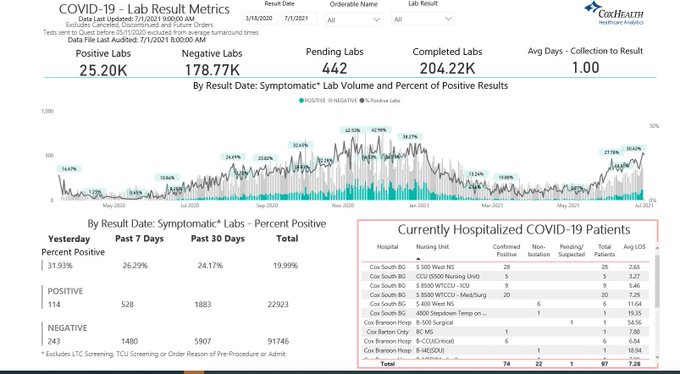
The greatest increase has been in southwest Missouri and Steve Edwards, CEO of CoxHealth in Springfield, has been outspoken in his contempt for people who doubt the effectiveness of the vaccine or the danger from COVID-19.
32% symptomatic pos. rate, very concerning! (From 4%) 4 pediatric Covid inpatients yesterday. Age…a few weeks old to 18 y/o
If you are making wildly disparaging comments about the vaccine, and have no public health expertise, you may be responsible for someone’s death. Shut up.
His hospitals are treating 74 COVID-19 cases, including four pediatric patients, he tweeted Thursday. The children range in age from a few weeks old to 18.
“If you are making wildly disparaging comments about the vaccine, and have no public health expertise, you may be responsible for someone’s death,” Edwards wrote. “Shut up.”