Search This Blog

Wednesday, January 12, 2022

Long-term use of blood pressure drugs may cause kidney damage, study suggests

 New kidney research from the University of Virginia School of Medicine is raising concerns that long-term use of drugs commonly prescribed to treat high-blood pressure and heart failure could be contributing to kidney damage.

Patients should continue taking the medications, which include the well-known and widely used ACE inhibitors, the researchers say. But the scientists are urging studies to better understand the drugs' long-term effects.

"Our studies show that renin-producing cells are responsible for the damage. We are now focusing on understanding how these cells, which are so important to defend us from drops in blood pressure and maintain our well-being, undergo such transformation and induce kidney damage," said Maria Luisa Sequeira Lopez MD, of UVA's Department of Pediatrics and Child Health Research Center. "What is needed is to identify what substances these cells make that lead to uncontrolled vessel growth."

The Causes of Kidney Damage

Chronic high blood pressure affects a billion people around the world. The UVA researchers wanted to better understand why severe forms of the condition are often accompanied by thickening of the arteries and small blood vessels in the kidney, leading to organ damage.

They found that specialized kidney cells called renin cells play an important role. These cells normally produce renin, a vital hormone that helps the body regulate blood pressure. But harmful changes in the renin cells can cause the cells to invade the walls of the kidney's blood vessels. The renin cells then trigger a buildup of another cell type, smooth muscle cells, that cause the vessels to thicken and stiffen. The result: Blood can't flow through the kidney as it should.

Further, the researchers found, long-term use of drugs that inhibit the renin-angiotensin system, such as ACE inhibitors, or angiotensin receptor blockers, have a similar effect. These drugs are widely used for many purposes, including treating high blood pressure, congestive heart failure and heart attacks, as well as to prevent major heart problems. But long-term use of the drugs was associated with hardened kidney vessels in both lab mice and humans, the scientists found.

The researchers note that the medications can be lifesaving for patients, so they stress the importance of continuing to take them. But they say additional studies are needed to better understand the drugs' long-term effects on the kidneys.

"It would be important to conduct prospective, randomized controlled studies to determine the extent of functional and tissue damage in patients taking medications for blood pressure control," said Ariel Gomez, MD, of UVA's Department of Pediatrics and Child Health Research Center. "It is imperative to find out what molecules these cells make so that we can counteract them to prevent the damage while the hypertension is treated with the current drugs available today."

Findings Published

The researchers have published their findings in the scientific journal JCI Insight. The article was selected as a cover story. The research team consisted of Hirofumi Watanabe, Alexandre G. Martini, Evan A. Brown, Xiuyin Liang, Silvia Medrano, Shin Goto, Ichiei Narita, Lois J. Arend, Sequeira-Lopez and Gomez.

The research was supported by the National Institutes of Health, grants P50 DK 096373, R01 DK 116718, R01 DK 116196, R01 DK 096373 and R01 HL 148044; and the Japan Society for the Promotion of Science Overseas Research Fellowships.


Story Source:

Materials provided by University of Virginia Health SystemNote: Content may be edited for style and length.


Journal Reference:

  1. Hirofumi Watanabe, Alexandre G. Martini, Evan A. Brown, Xiuyin Liang, Silvia Medrano, Shin Goto, Ichiei Narita, Lois J. Arend, Maria Luisa S. Sequeira-Lopez, R. Ariel Gomez. Inhibition of the renin-angiotensin system causes concentric hypertrophy of renal arterioles in mice and humansJCI Insight, 2021; 6 (24) DOI: 10.1172/jci.insight.154337

Study challenges evolutionary theory that DNA mutations are random

 A simple roadside weed may hold the key to understanding and predicting DNA mutation, according to new research from University of California, Davis, and the Max Planck Institute for Developmental Biology in Germany.

The findings, published January 12 in the journal Nature, radically change our understanding of evolution and could one day help researchers breed better crops or even help humans fight cancer.

Mutations occur when DNA is damaged and left unrepaired, creating a new variation. The scientists wanted to know if mutation was purely random or something deeper. What they found was unexpected.

"We always thought of mutation as basically random across the genome," said Grey Monroe, an assistant professor in the UC Davis Department of Plant Sciences who is lead author on the paper. "It turns out that mutation is very non-random and it's non-random in a way that benefits the plant. It's a totally new way of thinking about mutation."

Researchers spent three years sequencing the DNA of hundreds of Arabidopsis thaliana, or thale cress, a small, flowering weed considered the "lab rat among plants" because of its relatively small genome comprising around 120 million base pairs. Humans, by comparison, have roughly 3 billion base pairs.

"It's a model organism for genetics," Monroe said.

Lab-grown plants yield many variations

Work began at Max Planck Institute where researchers grew specimens in a protected lab environment, which allowed plants with defects that may not have survived in nature be able to survive in a controlled space.

Sequencing of those hundreds of Arabidopsis thaliana plants revealed more than 1 million mutations. Within those mutations a nonrandom pattern was revealed, counter to what was expected.

"At first glance, what we found seemed to contradict established theory that initial mutations are entirely random and that only natural selection determines which mutations are observed in organisms," said Detlef Weigel, scientific director at Max Planck Institute and senior author on the study.

Instead of randomness they found patches of the genome with low mutation rates. In those patches, they were surprised to discover an over-representation of essential genes, such as those involved in cell growth and gene expression.

"These are the really important regions of the genome," Monroe said. "The areas that are the most biologically important are the ones being protected from mutation."

The areas are also sensitive to the harmful effects of new mutations. "DNA damage repair seems therefore to be particularly effective in these regions," Weigel added.

Plant evolved to protect itself

The scientists found that the way DNA was wrapped around different types of proteins was a good predictor of whether a gene would mutate or not. "It means we can predict which genes are more likely to mutate than others and it gives us a good idea of what's going on," Weigel said.

The findings add a surprising twist to Charles Darwin's theory of evolution by natural selection because it reveals that the plant has evolved to protect its genes from mutation to ensure survival.

"The plant has evolved a way to protect its most important places from mutation," Weigel said. "This is exciting because we could even use these discoveries to think about how to protect human genes from mutation."

Future uses

Knowing why some regions of the genome mutate more than others could help breeders who rely on genetic variation to develop better crops. Scientists could also use the information to better predict or develop new treatments for diseases like cancer that are caused by mutation.

"Our discoveries yield a more complete account of the forces driving patterns of natural variation; they should inspire new avenues of theoretical and practical research on the role of mutation in evolution," the paper concludes.

Co-authors from UC Davis include Daniel Kliebenstein, Mariele Lensink, Marie Klein, from the Department of Plant Sciences. Researchers from the Carnegie Institution for Science, Stanford University, Westfield State University, University of Montpellier, Uppsala University, College of Charleston, and South Dakota State University contributed to the research.

Funding came from the Max Planck Society, the National Science Foundation and the German Research Foundation.


Story Source:

Materials provided by University of California - Davis. Original written by Emily C. Dooley. Note: Content may be edited for style and length.


Journal Reference:

  1. J. Grey Monroe, Thanvi Srikant, Pablo Carbonell-Bejerano, Claude Becker, Mariele Lensink, Moises Exposito-Alonso, Marie Klein, Julia Hildebrandt, Manuela Neumann, Daniel Kliebenstein, Mao-Lun Weng, Eric Imbert, Jon Ågren, Matthew T. Rutter, Charles B. Fenster, Detlef Weigel. Mutation bias reflects natural selection in Arabidopsis thalianaNature, 2022; DOI: 10.1038/s41586-021-04269-6

Alzheimer’s: Inflammatory markers are conspicuous at an early stage

 Long before the onset of dementia, there is evidence for increased activity of the brain's immune system. Researchers from DZNE and the University Hospital Bonn (UKB) come to this conclusion based on a study of more than 1,000 older adults. To this end, various proteins were measured in the cerebrospinal fluid: They served as so-called biomarkers that indicate inflammatory processes of the nervous system. As it turned out, some of these molecules seem to be part of a damage control program of the immune system, which could be useful for the development of new drugs. The study results have been published in the scientific journal Neuron.

In recent years, it has become evident that the brain's immune system and related inflammatory processes -- also known as "neuroinflammation" -- significantly contribute to the development of Alzheimer's disease. In view of this, the scientists analyzed various immunological biomarkers that are characterized by good detectability in the cerebrospinal fluid and reproducible results. "It was already known that these markers indicate immune processes in the context of Alzheimer's disease. However, how these markers relate to brain volume, cognitive performance and other parameters had not been studied as comprehensively as we have now," explains Prof. Michael Heneka, who led the current study during his long-time tenure at DZNE and UKB. Since the beginning of this year, he has been director of the Luxembourg Centre for Systems Biomedicine.

"We have found that some of these inflammatory markers are conspicuous even when there are no symptoms of dementia yet," Heneka says. "Based on the data we have so far, we can't specify the lead time at this point. But my estimate is that it is at least ten to twenty years."

Extensive Database

The starting point for the investigations were data from the so-called DELCODE study, in which the DZNE researches dementia and its preliminary stage in collaboration with several university hospitals across Germany. The current study project included findings from around 300 women and men, all over the age of 60. This group comprised cognitively normal adults, individuals with memory problems of varying degrees of severity and also people with dementia of the Alzheimer's type. Samples of cerebrospinal fluid and standardized memory tests were available from all study participants, and magnetic resonance images of the brain were taken from most of them. For each study participant, the data included the baseline examination and at least one follow-up one year later. For some subjects, findings spanned multiple follow-ups over a period of up to five years.

Striking Even Without Dementia

"There are established biomarkers for amyloid and tau. These are proteins that accumulate in the brain in Alzheimer's disease and can also be detected in the cerebrospinal fluid. Their levels usually change even before symptoms of dementia arise, which is considered a sign of processes for neuronal damage. We wanted to know whether inflammatory markers respond in a similar way," says Dr. Frederic Brosseron, a scientist at DZNE and one of the first authors of the current publication in "Neuron." "In fact, we found that most inflammatory markers are elevated, especially when a marker for neuronal damage is elevated. This applies even when these individuals do not yet show symptoms of dementia. Thus, the inflammatory markers we recorded are particularly useful for studying neuroinflammation at early stages of disease."

Evidence for Neuroprotection

Two of these markers in particular -- proteins belonging to the "TAM receptor family" -- seem to be linked to a damage control program. In study participants with particularly levels of these high markers, brain volume was comparatively large and cognitive functions declined more slowly over time. To verify these findings, Heneka's team evaluated data from a study cohort of ACE Alzheimer Center Barcelona with more than 700 adults, must of them with mild cognitive impairment. This analysis confirmed the results from the DELCODE study were.

"Inflammatory processes are not bad per se, but rather a normal, protective reaction of the immune system to threatening stimuli, especially at the beginning. But they should not last too long, therefore they need to be regulated," says Heneka. TAM family proteins are known to influence immune responses and promote disposal of cellular waste, he explains. "Supporting this protective function would be an interesting approach for pharmaceutical research. This is where I see potential for application of the markers we have identified. For the early detection of dementia in routine care, measuring these markers is too complex. But when testing new drugs in clinical trials, there are other technical options. In trials, indicators are needed to assess whether interventions are working and whether tested drugs are effective. The TAM markers could be very useful for this."

This research was supported in part by funding from the international PREADAPT project, which is funded by the EU Joint Programme -- Neurodegenerative Disease Research (JPND).


Story Source:

Materials provided by DZNE - German Center for Neurodegenerative DiseasesNote: Content may be edited for style and length.


Journal Reference:

  1. Frederic Brosseron, Anne Maass, Luca Kleineidam, Kishore Aravind Ravichandran, Pablo García González, Róisín M. McManus, Christina Ising, Francesco Santarelli, Carl-Christian Kolbe, Lisa M. Häsler, Steffen Wolfsgruber, Marta Marquié, Mercè Boada, Adelina Orellana, Itziar de Rojas, Sandra Röske, Oliver Peters, Nicoleta-Carmen Cosma, Arda Cetindag, Xiao Wang, Josef Priller, Eike J. Spruth, Slawek Altenstein, Anja Schneider, Klaus Fliessbach, Jens Wiltfang, Björn H. Schott, Katharina Bürger, Daniel Janowitz, Martin Dichgans, Robert Perneczky, Boris-Stephan Rauchmann, Stefan Teipel, Ingo Kilimann, Doreen Goerss, Christoph Laske, Matthias H. Munk, Emrah Düzel, Renat Yakupov, Laura Dobisch, Coraline D. Metzger, Wenzel Glanz, Michael Ewers, Peter Dechent, John Dylan Haynes, Klaus Scheffler, Nina Roy, Ayda Rostamzadeh, Charlotte E. Teunissen, Natalie L. Marchant, Annika Spottke, Mathias Jucker, Eicke Latz, Michael Wagner, David Mengel, Matthis Synofzik, Frank Jessen, Alfredo Ramirez, Agustín Ruiz, Michael T. Heneka. Soluble TAM receptors sAXL and sTyro3 predict structural and functional protection in Alzheimer’s diseaseNeuron, 2022; DOI: 10.1016/j.neuron.2021.12.016

Bacterial protein associated with colorectal cancers

 Strains of bacteria that cause common food-poisoning symptoms often contain a toxin that can damage DNA in intestinal cells, potentially triggering colon cancer, according to a study from researchers at the Johns Hopkins Bloomberg School of Public Health.

The discovery raises the possibility that some of the roughly two million new cases of colorectal cancer every year around the world originate from brief and seemingly mild food-poisoning events. It also points to the possibility of future drugs that prevent colorectal cancers by neutralizing the newly identified toxin, UshA.

The findings were published January 12 in the January edition of Cancer Discovery.

Prior research has suggested that certain bacteria that reside in the gut can trigger colorectal cancer via persistent infections involving chronic gut inflammation. Short-term infections causing food poisoning, including traveler's diarrhea, which normally resolve in a day or two, have traditionally been considered non-carcinogenic.

"We hope this study will motivate other researchers to do epidemiological studies to investigate this potential link between transient diarrheal infections and colon cancer development," says study senior author Fengyi Wan, PhD, associate professor in the Department of Biochemistry and Molecular Biology at the Bloomberg School.

In the study, Wan's team performed experiments with a mouse model of transient bacterial diarrheal disease using the bacterium Citrobacter rodentium, which has strong similarities to diarrhea-causing strains of the human-infecting microbe Escherichia coli. The researchers observed that Citrobacter infection quickly led to strong signs of DNA damage in gut-lining cells in the mice.

The scientists also noted that the damage was dependent on a mechanism in the bacteria called the Type 3 Secretion System. This syringe-like appendage is used by some bacteria, including Citrobacter and diarrhea-causing strains of E. coli, to inject proteins into host cells. This mechanism facilitates the invading microbes' growth and survival.

The researchers eventually zeroed in on a T3SS-injected protein, UshA, that accounts for the DNA damage. They found that UshA, which can also be produced by diarrhea-causing E. coli, contains a short segment with DNA-breaking enzyme activity.

The function of this DNA-breaking element in the life cycle of Citrobacter is still unclear. (In the study, deleting it didn't seem to impair bacterial growth or survival.) But the researchers found evidence in their mouse study that UshA can have a definite cancer-causing effect on the infected host.

The scientists experimented with a genetically engineered line of mice that spontaneously develop colon tumors, and found that infecting these mice with UshA-containing Citrobacter dramatically accelerated tumor development. By contrast, infection with an engineered Citrobacter that lacks the UshA gene had essentially no effect in accelerating tumor development.

The researchers also found that the types of mutations in the Citrobacter-accelerated colon tumors were highly similar to those that have been catalogued in human colon tumors, again underscoring the potential relevance to human health.

A strong confirmation of this relevance won't be easy to accomplish, Wan says, since transient infections by definition would be long gone by the time tumors develop. (Colon tumors typically develop for many years before they are detected.) Wan suggests that establishing a link between UshA-containing microbes and human colorectal cancers will require epidemiological studies. These, he says, might best be done in sub-Saharan Africa, where diarrhea-causing bacterial infections -- and colorectal cancers -- are relatively common.

Wan is also now working with collaborating researchers to develop inhibitors of the UshA toxin.

"In principle, you could give such inhibitors to patients who present with diarrheal disease to protect them from cancer-promoting DNA damage," he says.

"Bacterial genotoxin accelerates transient infection-driven murine colon tumorigenesis" was co-authored by Yue Liu, Kai Fu, Eric Wier, Yifan Lei, Andrea Hodgson, Dongqing Xu, Xue Xia, Dandan Zheng, Hua Ding, Cynthia Sears, Jian Yang, and Fengyi Wan.

This work was supported in part by the National Institutes of Health (R01GM111682, R01CA244350, R21AI137719, T32CA009110), the American Heart Association (19PRE34380234), the American Cancer Society (RSG-13-052-01-MPC), the U.S. Department of Defense (W81XWH-19-1-0479), the Willowcroft Foundation, and the Graham Memorial Trust.


Story Source:

Materials provided by Johns Hopkins University Bloomberg School of Public HealthNote: Content may be edited for style and length.


Journal Reference:

  1. Yue Liu, Kai Fu, Eric M. Wier, Yifan Lei, Andrea Hodgson, Dongqing Xu, Xue Xia, Dandan Zheng, Hua Ding, Cynthia L. Sears, Jian Yang, Fengyi Wan. Bacterial Genotoxin Accelerates Transient Infection–Driven Murine Colon TumorigenesisCancer Discovery, 2022; 12 (1): 236 DOI: 10.1158/2159-8290.CD-21-0912


COVID Deaths Jump 40% As US Continues To See More Than 1 Million Cases A Day

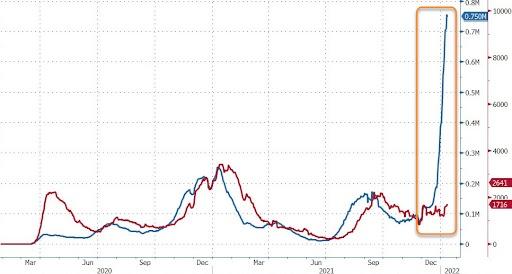
 Deaths involving patients with COVID increased by 40% over the past week, according to the CDC. But as it happens, almost all of the deaths reported involve patients infected with delta, not the omicron variant which is now responsible for nearly all COVID cases.

On average, the US reported about 1,600 cases a day last week, up from about 1,150 the week before, said CDC Director Dr. Rochelle Walensky.

The US has continued to report more than 1 million cases a day, according to Johns Hopkins, with a record-breaking 1.35 million reported yesterday alone.

Walensky, who spoke during a White House COVID Response Team briefing, said she believes these deaths are just "left over" fatalities from the delta wave - nothing to worry about.

Of course, there's no way the CDC can truly know this for certain. The government's COVID policies are mostly just grasping at straws. Though they would never admit that.

So, why is it so hard to believe that delta alone is accounting for these deaths? Well, for one, the government believes the omicron variant accounts for 98.3% of all new cases.

Public health officials will monitor "deaths over the next several weeks to see the impact of omicron on mortality," Walenksy said during the briefing. "Given the sheer number of cases, we may see deaths from omicron, but I suspect the deaths we're seeing now are still from delta."

Of course, while Walensky delivered the news with her characteristic alarmism, we feel it's important to take a beat and put it all in context. See the chart below:

Deaths are nowhere near the highs from last winter.

https://www.zerohedge.com/covid-19/covid-deaths-jump-40-us-continues-see-more-1-million-cases-day

'Flurona' is real, but it's common to get two viruses at once

 No, flurona is not some scary new variant of the coronavirus. 

But the phenomenon of "coinfection" with influenza and the coronavirus is real and, to those in the medical community, not the least bit surprising. A person can be infected with multiple  at the same time—or with a  and some other type of pathogen, such as bacteria or parasites.

"It's a natural occurrence," says Isabella Cattadori, an associate professor of biology at Pennsylvania State University.

That's not to say it's a good idea.

Nearly two years ago, when British researchers identified some of the first cases of flu plus COVID-19, they calculated that these patients were twice as likely to die as those with COVID alone.

So far in the pandemic, these coinfections seem to have been fairly uncommon—especially last winter, when the rate of flu cases was unusually low (a trend that experts attributed to all the social distancing). But with flu on the rise again this winter, physicians say that's all the more reason to engage in sensible precautions. Both viruses are transmitted through the air, so with both, the risk can be reduced by avoiding crowded, poorly ventilated spaces and by wearing masks.

And in both cases, there are effective vaccines. As in most years, this season's flu shot is not a perfect match for the strains in circulation, but that's no reason not to get an injection, says Thomas Fekete, a professor at Temple University's Katz School of Medicine. Every layer of defense helps the individual, as well as those who may be more vulnerable.

"Whatever you do to reduce your risk," he said, "you're also protecting people around you."

At least four patients at Temple University Hospital have tested positive for both flu and COVID, he said. Thomas Jefferson University Hospital officials say they've seen a few cases, as well. Very likely, Fekete said, more people are infected with both viruses outside the  but have not been identified, as most people with respiratory symptoms are not tested for the flu.

Though infections with more than one virus are common, the details of how the immune system responds are complicated, depending on such factors as timing and the types of viruses.

For a crash course, we spoke to Sara Cherry, a professor of pathology and laboratory medicine at the University of Pennsylvania Perelman School of Medicine, and A.J. te Velthuis, a virologist and assistant professor of molecular biology at Princeton University.

What's happening is simply a coinfection. And while influenza and coronavirus both are spiky balls of proteins, they are different types of viruses. They cannot combine into some sort of supervirus. Each contains genetic instructions that allow it to make copies only of itself, Cherry said.

How can you be infected with two viruses?

The same way you can be infected with just one virus: exposure.

If a person is in a place where viruses are circulating—that is, in any place where other people are present—then two or more viruses can cause infection at the same time.

Ideally, someone who feels sick is able to stay home, reducing the risk of becoming infected with a second virus. But viruses have incubation periods, multiplying for a day or more inside the body before the person starts to feel sick. So it is easy for someone to pick up more than one bug before feeling sick enough to retreat to the bedroom.

COVID in particular has a long presymptomatic period, up to four days, though the omicron variant of the virus seems to come on faster. If you're out in a lot in crowds, a double whammy with flu is certainly possible.

"If you're out doing things without a mask, then you're more likely probably to get both," she said.

These respiratory viruses commonly enter through the nasal passages. Often, they are trapped safely in mucus, which is then swallowed and dissolved harmlessly in the stomach. But when they manage to latch on to cells in the airways, the viruses penetrate the , hijack its inner machinery, and begin to copy themselves—the definition of an infection.

Flu viruses latch onto substances on the cell surface called sialic acids. The coronavirus, on the other hand, latches onto a "receptor" called ACE-2. Though they may be infecting cells in the same part of the body, neither is likely to fully crowd out the other, Cherry said. Generally, there is plenty of real estate to go around.

Will coinfections make you sicker?

It depends on the timing. If the person is lucky, the  to the first invader could help protect against the second, Cherry said.

That's because the first line of defense in the immune system, called the innate response, is nonspecific—meaning it is not tailored to any specific type of virus.

Infected cells respond by producing antiviral proteins called interferons, among other weapons, and the interferons that help ward off one type of virus generally will help ward off another.

That doesn't mean it's a good idea to get a second infection on purpose. While a second virus may not increase your misery, it certainly can't make you feel any better.

And in plenty of circumstances, the second infection can make matters worse, said te Velthuis, the Princeton scientist.

That could happen if the viruses infect different parts of the body, for example. Influenza typically invades the upper airways, while some strains of the coronavirus can replicate in the lower airways and the digestive tract, he said.

"The combined infection may trigger immune responses in several locations and a stronger feeling of malaise overall," he said.

All sorts of variables come into play, such as the person's prior exposure to either of the two viruses, whether or not they've been vaccinated, and the sheer number of viruses they ingest, said Penn State's Cattadori.

The impact of a coinfection can be even worse when the second infection is bacterial. Flu and COVID both cause temporary damage to the lining of the airways, impairing the patient's ability to defeat bacteria, said Temple's Fekete.

"The bacteria have an easier time getting in," he said.

In an older person or someone who smokes cigarettes, he said, the result can be pneumonia.

What to do if you have 'flurona'

Most people with the flu and COVID may not realize it, as out-of-hospital testing for the flu is unusual. And lately, as we've all heard, COVID tests are in short supply.

But whether you're infected with one virus or the other, or both, the usual advice applies:

Stay away from others. Drink plenty of water. Call your doctor, and seek emergency care if you feel difficulty breathing.

Treatments are available for both types of infections, should your doctor recommend them.

https://medicalxpress.com/news/2022-01-flurona-real-dont-panicit-common.html

When am I contagious if infected with omicron?

 When am I contagious if infected with omicron?

It's not yet clear, but some early data suggests  might become contagious sooner than with earlier variants—possibly within a day after .

The U.S. Centers for Disease Control and Prevention says people with the coronavirus are most infectious in the few days before and after symptoms develop. But that window of time might happen earlier with , according to some outside experts.

That's because omicron appears to cause symptoms faster than previous variants—about three days after infection, on average, according to preliminary studies. Based on previous data, that means people with omicron could start becoming contagious as soon as a day after infection.

With previous variants, people became contagious two to four days after infection. And people remain contagious a couple days after symptoms subside.

Researchers say it's too early to know whether that shorter incubation period for omicron translates into earlier contagiousness. But it would help explain the 's rapid spread.

Dr. Amy Karger of the University of Minnesota Medical School recommends that people  themselves at three days and five days after exposure if possible.

"A lot of people are turning positive by day three," Karger says, referring to omicron. "There's basically an opportunity here to catch people earlier than you would with the other variants."

If you only have one test, it's fine to wait until day five, Karger says.

People who have COVID-19 symptoms should get tested immediately if possible.

Lab-developed tests are more sensitive than rapid tests so they should be able to pick up the virus by day three after exposure, if not earlier.

People who don't develop symptoms generally have much lower viral levels, so it's far less clear when or if they become infectious.

Still, those who test positive but don't have symptoms should isolate for at least five days, under the latest CDC guidelines. The agency came under criticism for not requiring a negative test before leaving isolation, but even after tweaking the guidelines officials said that step should be optional.

People with symptoms should stay isolated until they have been fever-free for at least 24 hours.

https://medicalxpress.com/news/2022-01-contagious-infected-omicron.html