Search This Blog

Monday, January 24, 2022

Goldman Warns Earnings Guidance 'Disappointing' As 5 of 6 Companies Lower Expectations

 Late on Sunday, Goldman's chief equity strategist David Kostin published a note titled “Anatomy of the S&P 500 sell-off and Nasdaq correction: Valuation compression and the re-pricing of equity risk” (available for professional subs) highlighting how the 8% drop in the S&P500 since Jan 3 (as of mid-Monday, the drop is now 10%, with the S&P officially in correction) and the Nasdaq's 16% drop - matching the drop in December 2018 when Powell was forced to end the Fed's tightening, has been driven by both increased concerns about future growth and a sharp rise in the equity risk premium (ERP).

As Kostin notes, the speed and breadth of the S&P 500 index decline has made it particularly challenging for fund managers to navigate. While the Energy sector surged by 12% since the index peaked the ten other sectors all declined. The 11% drop in Information Technology accounted for nearly half the index decline during the past 13 trading sessions.
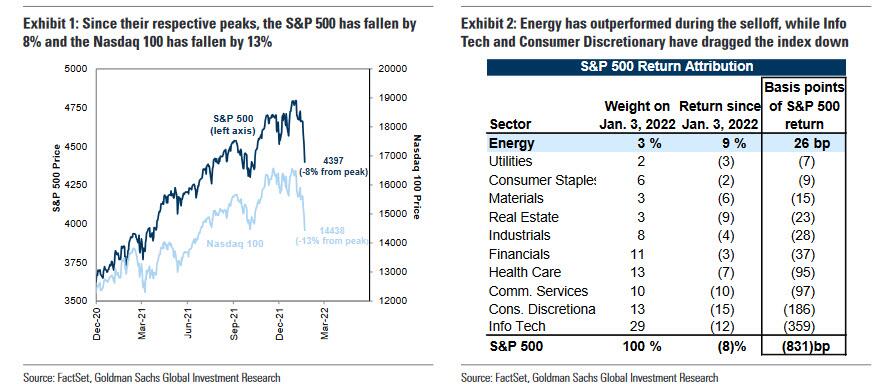
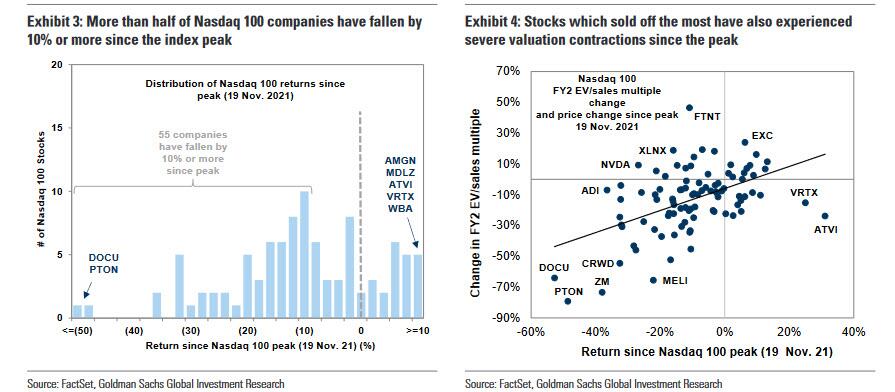
Goldman's market crash post-mortem aside (which Kostin failed to predict in his barrage of bullish notes even as Goldman was selling billions in stocks), what we found most interesting in Goldman's note is that five out of the 6 companies providing 1Q22 guidance so far this earnings season have lowered expectations, and alongside the broader market rout, the forward P/E multiple for the S&P500 index has fallen by 2 points to 19.6X from 21.5X. But even after the multiple contraction, equity valuations remain high on a historical basis, (~94th percentile vs. the last 40 years).  

Before we look at the guidance, Goldman notes that earnings season has been so far characterized by positive sales and EPS revisions but falling share prices, with Kostin adding that "sharp declines in stock prices can reflect a jump in the cost of equity or reduced growth expectations. S&P 500 aggregate sales and EPS estimate revisions for 2022 have been positive during the past 1-month and 3-month periods. However, recent market rotations and investor conversations indicate concern about the growth outlook."

With that in mind, here is a look at what even Kostin admits is "Disappointing guidance. Investors are most interested in forward-looking guidance from managements, and recent information on that front has been concerning. Five of the six S&P 500 firms that provided formal 1Q 2022 guidance following 4Q results lowered expectations."

Drilling into that critical point, the GS strategist notes that following the release of 4Q results, only six companies in the S&P 500 provided formal near-term guidance for 1Q 2022. Unfortunately, five of the six firms guided below consensus for next quarter, including three of the stocks that actually beat expectations in 4Q. Only Micron Technology (MU) “beat-and-raised.”

Here Kostin reminds us that the most notable firm to provide updated guidance was Netflix which "stunned investors by dramatically lowering its expected rate of net subscriber growth in 2022. The shares plummeted by 22% the following day and $50 billion of equity cap was erased on Friday. The stock price has plunged by 33% since the S&P 500 peaked in early January and by 41% since NDX hit its all-time high in November."

Why are investors obsessed with guidance? Because while cynical investors often quip, “Managements are the last to know” Goldman notes that "executives also have line-of-sight on their supply chains, customer orders, and other operating trends." Multiple headwinds exist that make providing forward guidance challenging for executives, including labor (costs, recruitment, and retention), public health (the Omicron variant and shifting local government regulations, and travel restrictions), supply chains (cost and space availability on ships, railroads, and trucks), and monetary policy (pace of Fed hikes and the path of long-term interest rates).

And then there is the Fed, whose increasingly hawkish shift has alarmed equity investors. According to Goldman calculations, two months ago, when the NDX traded at a record high, interest rate futures implied two hikes during 2022. Today it stands at four 25 bp hikes (one per quarter) that would leave the funds rate at 1.0%-1.25% by year-end. Although their baseline forecast is also four hikes, Goldman's US Economists have raised the prospect that the Fed could hike five times (with a hike in May) and perhaps even tighten at every meeting this year starting in March.
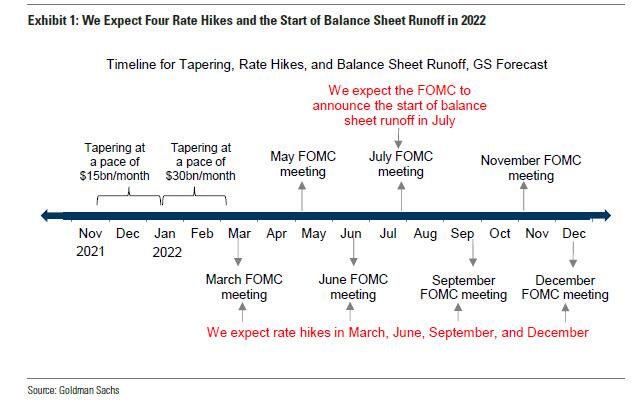
Needless to say, elevated core PCE and labor inflation are the proximate causes for the expected tightening. The uncertain path of future inflation explains the range of forecasts around the pace and duration of tightening following liftoff.

And despite the compression in PE multiples, valuation metrics remain sky high: while the forward P/E multiple for the S&P500 index has fallen by 2 points or 9% since the start of the year (from 22x to 20x) in absolute terms, equity valuations remain at near record levels, in the 94th percentile vs. the last 40 years.

One final highlighted observation from Kostin (there is much more in the full report) and it has to do with investor positioning.

Although equity investor length has declined in recent weeks, it still remains elevated versus history. High frequency hedge fund leverage data from Goldman's Prime Services desk shows that hedge funds have cut net leverage from 86% on December 30th to 80% today. This de-risking has brought net leverage to the lowest level in the past year. However, relative to the last 3 years, net leverage ranks in the 57th percentile. As Kostin warns, "above-average positioning suggests that investors will require a catalyst in the near-term to add length, but few obvious catalysts are evident in the near-term."

One potential catalyst would be a slowdown in inflation, but Goldman economists - who were dead wrong in 2021 on inflation, expecting it to be transitory only to be proven laughably incorrect when even Powell said it is time to retire the word "transitory" - do not expect that will occur until 2Q (of course, once the current market crash translate in inflation terms, expect a major drop in inflationary pressures). That said, and quite obviously, "dovish commentary from the Fed or an extremely strong earnings season could potentially lead investors to increase equity allocations in coming weeks."

* * *

So how to position in light of all this? Given the prospect of tightening financial conditions, Goldman recommends investors own stocks with ‘quality’ attributes (such as strong balance sheets) at moderate valuations. Meanwhile, economically-sensitive small-cap and value stocks tend to suffer amid tightening financial conditions. However, many strong balance sheet stocks today are fast growing and trade at elevated valuations, explaining why weak balance sheet stocks have outperformed YTD. And with uncertainty around margins, Goldman also recommends investors own stocks with strong pricing power.

https://www.zerohedge.com/markets/not-looking-good-goldman-warns-earnings-guidance-disappointing-5-6-companies-lowering

Does the world need more COVID-19 vaccines? Some see room for improvement

 The ultimate COVID-19 vaccine will be able to tackle all emerging coronavirus strains, easy to store and quick to manufacture. And yes, there's still time for the stragglers who were beaten to the punch by Pfizer, BioNTech and Moderna—at least according to the companies still trying to get in line. 

Not to mention, just 60% of the world has been vaccinated, according to the University of Oxford’s Our World in Data database. The rates are higher in richer regions like the U.S. and EU, while the need is great in less developed nations.

But the window to contribute to the vaccine fight is closing. A new report from Morningstar sees demand for boosters remaining heavy in 2022 but dissipating over 2023. If a company isn't already filing for authorization, they'd better get on it.  

Jean-Francois Toussaint, Ph.D., head of research and development for Sanofi Pasteur, said 20 billion doses of existing vaccines are expected to be available this year. So where does that leave remaining companies, like Toussaint’s, that have shots in the pipeline?  

Three key opportunities remain for vaccine makers: differentiation, global distribution, and pan-variant shots.  

RBC Capital Markets analysts predict that strain-specific boosters are going to be important going forward, but the key is how quickly they can be whipped up in pharmaceutical companies’ labs. Pfizer has promised they can turn around strain-specific boosters in three months. But even if that's the case, RBC and others aren't sure how relevant the new shots will be to the current omicron wave.  

“By the time you have an omicron variant, it may have swept through and done its work, and then no one’s that interested in being boosted for omicron. That’s backwards-looking. We’re caring about what’s next,” Gritstone CEO Andrew Allen, M.D., Ph.D., said in an interview. His company has a T cell-inducing vaccine in phase 1 development. 

“Either you have to play whack-a-mole and keep chasing the virus" with updated versions of the current mRNA vaccines, or you go after parts of the virus that "have not changed over many iterations," Allen added.

That's what Gritstone is trying to do, which Allen calls "future-proofing.” This will be key to establishing a strong presence in the vaccine market as we enter the third year of the pandemic, Allen said. First-generation shots go after the spike protein, but targeting that highly mutable portion of the virus means waning efficacy with each new variant. Gritstone's shot aims to attack the spike but also the unchanging parts of SARS-CoV-2 by inducing the body’s T cell response, which helps pad the response against infection. 

COVID-19 is still in the pandemic stage. But once it enters endemic territory, that “doesn’t mean it stops killing people,” Allen said. Companies like Gritstone should look at a pan-coronavirus approach, considering this is the third coronavirus epidemic or pandemic in 20 years, including SARS-CoV in 2003 and MERS-CoV in 2012. 

More variants are likely to emerge after omicron, but RBC said natural infection, coupled with widespread vaccination should make the next waves settle into more predictable seasonal patterns much like the flu. But that’s only if infection with omicron builds immunity to whatever strain emerges next, and the science is still unclear on that one, according to an RBC note.  

“Of course, what we worry about is that we’ll end up with a transmissible and more dangerous virus circulating. Given recent history, nobody can tell you that’s not going to happen. You have to be concerned about that,” Allen warned.  

Protection for all 

Allen says scalability is going to be crucial to next-generation vaccines. Many pockets of the world have yet to receive any shots. “As we all know, global protection actually protects us all,” he said. In parts of the world that are already highly inoculated, biopharmas looking to enter the vaccine market will have to test their jabs as boosters, he said.  

Many are already doing that, like Sanofi/GSK, Valneva and Arcturus, which have all pivoted to testing their shots after primary vaccination with one of the authorized or approved shots. Gritstone’s vaccine is in testing as a booster for people 60 years or older in the U.K. who received two doses of the AstraZeneca jab. Additional studies will test the vaccine in people who are immunocompromised and those with HIV.  

“Let’s be clear, if you’re doing any vaccine trial now in North America or Western Europe, you need the boosting study. Everybody who wants to have a vaccine, has had one, and therefore we’re boosting behind existing products," Allen said.

Morningstar sees the booster market finally becoming competitive in 2022, after Pfizer/BioNTech and Moderna have dominated in the U.S. Other markets, including China, have been tapped by inactivated virus vaccines from Sinovac and Sinopharm and AstraZeneca’s adenoviral vector vaccine, according to Morningstar. 

Research out of Israel, where a fourth-dose booster is in testing, suggests a limited impact on infections compared to a three-dose schedule. This means strain-specific boosters for future variants are needed. And, most importantly, those boosters should be pan-variant, according to RBC. 

Despite regulators' openness to emergency authorizations for vaccines, the road to getting a new shot authorized or conditionally approved in majority-vaccinated regions like the U.S. and EU remains difficult. This is evidenced by Novavax’s struggles with its protein-based jab.

Novavax originally wanted to ask the FDA for authorization by May 2021, and many delays later, the Maryland biotech now anticipates a U.S. request this month after getting green lights in Australia, South Korea and India in the past four weeks.  

Elsewhere, Medicago asked Canadian regulators to approve its plant-based jab last month. Valneva expects potential regulatory approvals this quarter for its inactivated vaccine.   

The World Health Organization is conducting plenty of research on a number of vaccine candidates, which offers an opportunity for companies still trying to get in the game. The organization reports 140 vaccines in clinical development and 194 in pre-clinical development as of Jan. 18.  

The final attribute, differentiation, could also be important. The mRNA shots have clearly cornered the larger markets. While distribution around the world has improved since the early days of the pandemic when storage was a concern, there's still room for more stable vaccines using more traditional technologies.  

Companies with mRNA shots in the pipeline could see some uptake if they're able to improve on delivery. Sanofi, which is eyeing mRNA technology for future vaccines, such as influenza and RSV, wants to improve on tolerability in the next generation as well. The existing mRNA vaccines are known to cause many recipients to feel sick the day after. This is fine in the context of a global pandemic, according to Toussaint, but next-generation mRNA shots need to improve on those side effects.

Capricor Therapeutics is making a next-gen mRNA vaccine that is delivered using an exosome, an extracellular vesicle, rather than lipid nanoparticles with the aim of averting weight loss and heart inflammation concerns, said Linda Marbán, Ph.D., CEO and president, in an interview. The jab is meant to induce B-cell and T-cell responses by going after both the mutating spike protein and the nucleocapsid protein, which is mutated in omicron but not other variants, the CEO said. The biotech anticipates asking the FDA about initiating a booster shot clinical trial in the next quarter or two, she said.

Intranasal, oral or patch administration could make for a quicker and cheaper vaccine that would appeal to people who are scared of needles, according to Gavi, the international vaccine alliance that counts the WHO, Bill & Melinda Gates Foundation and others as partners.

AstraZeneca is testing a nasal version of its authorized vaccine in humans. A VC-crowdfunded biotech that emerged in 2020 called MigVax is working on a COVID-19 vaccine pill, according to Gavi, although no clinical trials for the company are listed on the FDA's database. 

Another idea is to boost existing vaccines with an adjuvant, which gives the immune system an extra kick to fire up protection against a virus. GSK offered up its proprietary adjuvant technology early in the pandemic for use in vaccines under development.

The company said at the time that adjuvants can allow for more doses to be produced using fewer ingredients, which can help with manufacturing. But Gavi notes that adjuvants could also protect against waning immunity that has been seen with existing COVID-19 vaccines, but more research needs to be conducted. 

The adjuvant is being used in GSK's collaborations with Sanofi, Medicago and SK Bioscience. Valneva's shot also uses an adjuvant. 

Morningstar predicts that protein-based vaccines from Sanofi-GlaxoSmithKline and Novavax could find space in the market, as could an upcoming shot out of the Walter Reed Army Institute of Research called the spike ferritin nanoparticle vaccine. That prospect is entering phase 2/3 testing this year. Japan-based Shionogi is in a phase 3 trial for its recombinant protein-based vaccine, S-268019. 

“We don't believe there is much room for additional mRNA vaccines. Why? Because the ones that are out there are doing a fairly good job,” said Toussaint during Fierce JPM Week.  

https://www.fiercebiotech.com/biotech/does-world-need-more-covid-19-vaccines-these-companies-think-there-s-still-room-for

Gilead pulls 2 accelerated approvals as changing lymphoma landscape disrupts confirmatory trial

 Back in 2014, Gilead Sciences’ Zydelig became the first PI3K inhibitor cleared by the FDA for certain B-cell blood cancers. Fast forward to today, and the company has found itself withdrawing two indications gained under the accelerated approval pathway as more treatments have become available.

Gilead is pulling Zydelig’s uses in relapsed follicular lymphoma (FL) and relapsed small lymphocytic lymphoma (SLL), citing failure to complete an FDA-mandated confirmatory trial. The move doesn’t affect Zydelig’s relapsed chronic lymphocytic leukemia use, which was earned with a full FDA go-ahead, the company said.

The retraction comes as the FDA is paying more careful attention to accelerated approvals that have failed to meet postapproval trial requirements. And as Gilead noted, the treatment landscape for the two indolent non-Hodgkin lymphoma subtypes has changed.

Gilead won accelerated approvals for FL and SLL based on phase 2 data showing tumor responses. But drugs that came after it have posted mature clinical efficacy data.

Bayer’s rival PI3K inhibitor Aliqopa, used on top of Roche’s Rituxan, cut the risk of disease progression or death by 48% over Rituxan alone in patients with indolent non-Hodgkin’s lymphoma who had already received one prior therapy, Bayer unveiled in April 2021. Bayer hopes to use the new phase 3 data to turn Aliqopa’s accelerated approval for third-line treatment of follicular lymphoma into a full approval.

Zydelig’s own Rituxan combo trials were stopped early after reports of multiple deaths in its clinical programs in 2016. Because of that safety concern, Zydelig’s sales never picked up, with merely $50 million in global sales in the first nine months of 2021.

Other potentially safer PI3K options than Zydelig, such as TG Therapeutics’ Ukoniq, have also won FDA approvals in the late-line setting and are undergoing clinical trials to move earlier in the treatment sequence.

Plus, AbbVie and Johnson & Johnson’s BTK inhibitor, Imbruvica, has been able to treat newly diagnosed CLL and SLL patients thanks to an FDA nod in 2016 based on disease progression data.

Pointing to the evolved treatment landscape, Gilead admitted that enrollment into Zydelig’s confirmatory study has been a challenge.

Gilead’s decision also comes shortly after Secura Bio made a similar move for Verastem Oncology-inherited PI3K med Copiktra. In December, Secura voluntarily pulled Copiktra’s third-line FL indication off the U.S. market. The company at the time said it had determined that “the current treatment landscape for FL patients in the U.S. and the logistics, cost and timing of the postmarketing requirements for Copiktra in FL was no longer merited.”

The FDA recently launched an industrywide campaign targeting accelerated approvals in oncology with unresolved confirmatory trials. The initiative has triggered the withdrawal of several cancer drug indications, most notably for PD-1/L1 inhibitors including Merck’s Keytruda, Bristol Myers Squibb’s Opdivo, AstraZeneca’s Imfinzi and Roche’s Tecentriq.

https://www.fiercepharma.com/marketing/gilead-pulls-2-cancer-accelerated-approvals-as-changing-lymphoma-landscape-disrupts

Momentum builds for new COVID-19 relief for businesses

 Momentum is building on Capitol Hill for more coronavirus relief funding to support restaurants and other businesses struggling to stay afloat in the face of the latest wave of the pandemic fueled by the omicron variant.

Lawmakers involved in negotiations say support has been building among members for legislation aimed at supporting businesses that have been disproportionately hit by the pandemic.

Sen. Ben Cardin (D-Md.), chair of the Senate Small Business and Entrepreneurship Committee and a leader in discussions on the matter, expressed optimism Thursday when discussing he and Sen. Roger Wicker’s (R-Miss.) efforts to gain more backing for the push among their colleagues.

“We are continuing to try to get broader support,” Cardin told The Hill before adding he thinks lawmakers are “pretty close” to securing the necessary support for the push.

Cardin said the primary focus in talks has been to replenish relief funding for restaurants after a previous batch of funds allocated by Congress ran out months back. The funding would come at a crucial time, advocates say, as restaurants continue to grapple with the economic effects of the ongoing pandemic, particularly as staffing shortages persist in parts of the nation and inflation tacks on to food costs.

Sean Kennedy, executive vice president of public affairs at the National Restaurant Association, told The Hill that the funding “could not happen soon enough,” noting thousands of restaurants “are closed permanently or long term” as many businesses find a hard time recovering during the pandemic.

“Restaurants are still incredibly vulnerable right now and we're getting the triple whammy of inflationary costs affecting our food prices, a labor shortage that shows no sign of resolving itself and omicron continues to wreak havoc on consumer confidence and the ability of restaurants to offer indoor dining,” he said.

Last year, lawmakers approved more than $28 billion in relief funds designated for restaurants and bars as part of the Restaurant Revitalization Fund (RRF) that was established through the American Rescue Plan Act (ARPA), the sweeping $1.9 trillion coronavirus relief package President Biden signed in March that included money for numerous programs, ranging from expansions to the child tax credit and ObamaCare, as well as vaccine distribution efforts, among other measures.

But advocates said that, while those funds were effective in helping many restaurants remain operating in the short term, a chunk of restaurants were left behind in the process.

“The RRF was fantastic because it helped about a third of the restaurants that needed it. But there are two thirds of the restaurants out there that did not get them,” Caroline Styne, an Independent Restaurant Coalition board member, said Friday.

“One hundred and seventy-seven thousand restaurants didn't get this much-needed relief, and they're the ones that have either had to temporarily close, permanently close or are just barely eking by,” she said.

Lawmakers have also been considering providing relief to various businesses that advocates and experts say have been hit hard by the pandemic and will continue to face more pressures as it drags on, including gyms and performance venues.

Brett Theodos, senior fellow and director of the Community Economic Development Hub at the Urban Institute, said there is a need for certain businesses to receive relief after a recent spike in coronavirus cases fueled by the omicron variant. Though he added the current wave “is going to be much more localized of an effect than previous waves.”

“The other bit of context now is that businesses have used up their Paycheck Protection Program, and other restaurant relief stimulus, funding support, so they’re at the point where they need their revenue to come in line with their costs, if they're going to make it going forward,” he said.

Some advocates are also pushing lawmakers to ensure businesses in multiple industries disproportionately impacted by the pandemic receive equitable funding in new relief legislation as restaurant relief emerges as a focal point in conversations.

“They're not any more disproportionately impacted than other types of businesses that have faced in many ways the same or, in some cases, more onerous restrictions around the ability to operate, like fitness clubs and salons and others,” said Matthew Haller, president and CEO of the International Franchise Association, which represents business across a number of industries, including restaurants, hotels and gyms.

While Haller acknowledged that restaurants do take in lower profit margins than businesses like fitness studios, he said many gyms have also taken a hit as their memberships have declined during the pandemic. 

“There's a lot of challenges for hotel owners who are significantly small businesses,” he also said, while emphasizing the downturn in business and leisure travel, adding he thinks it's better Congress take a more “patchwork approach” in relief talks, rather than “a rifle shot.”

Pressed for a top-line number for the proposed targeted relief, Cardin wouldn’t provide a figure on Thursday. However, some reports and sources familiar with talks have placed the amount within the $60 billion range, though it’s unclear how much of the spending would be new.

Cardin said he and other members behind the effort are “looking at repurposing” funds allocated under previous relief legislation like ARPA that remain unspent, in addition to adding new funding to the overall pot. 

His comments come as Republicans have voiced caution to the idea of new spending for relief efforts, though some have also signaled openness to hearing arguments for a bill aimed at certain businesses. 

“I think there's so much money out there that we've shoveled out the door that has not been accounted for. I would want to make sure that there was a true need and it couldn't be met by money that we've already appropriated,” Sen. John Cornyn (R-Texas) said. But he added he is “open to the arguments.”

“I'm willing to listen but I haven't heard anybody make the case,” he told The Hill on Thursday.

Sen. Mitt Romney (R-Utah) also criticized previous relief spending greenlit last year in remarks to The Hill on Thursday and instead voiced support for reallocating unspent relief funds when asked about discussion around the current bipartisan push.

“I think that we spent way too much money in March sending out checks for $1.9 trillion and we ought to repurpose much of that funding to help those entities that really need it,” he said. Though, when pressed further on if he didn’t think another round of funding was necessary, Romney added: “We'll see what comes forward.”

A source familiar with discussions said there’s also wariness on the other side of the aisle for reprogramming unused money allocated under ARPA.

“They want to minimize what accounts are being tapped, and they want to make sure that they're not robbing Peter to take care of Paul,” the source said.

As for when lawmakers would be able to potentially bring legislation to the floor, and how, Cardin said that has yet to be determined, given the upper chamber’s current to-do list.

“The problem is the floor schedule, and other bills that have gotten backed up,” he said, pointing to legislation like the currently stalled Build Back Better Act, a major legislative priority for Biden, as well as government funding legislation.

“We could do it as an independent bill, I think we have adequate support,” he said, though he added he’s open to attaching the push to other legislation in order to get things done.

“We're talking. We're open to a vehicle,” he said.

https://thehill.com/policy/finance/590877-momentum-builds-for-new-covid-19-relief-for-businesses

Less-threatening Omicron lowers Covid-19 vaccine sales estimate

 Evidence that omicron causes less-severe disease than earlier Covid-19 variants will likely blunt growth in vaccine sales this year as wealthier countries rein in purchases, according to Airfinity.

Sales of Covid-19 vaccines, excluding those from China and India, will increase to about $85 billion in 2022, down about 28 per cent from an earlier estimate of $118 billion, London-based Airfinity said Friday. The revision was also due to lower prices paid by poorer nations that are finally obtaining shots, the analytics firm said.

Omicron has spread rapidly but appears less likely to cause hospitalisations and deaths than predecessors such as delta, which the new variant displaced in just weeks. While health experts warn that the global crisis isn’t over and risks remain, optimism for a pandemic reprieve is likely to limit richer countries’ vaccine purchases, Airfinity said in a statement.

https://www.business-standard.com/article/international/less-threatening-omicron-lowers-covid-19-vaccine-sales-estimate-122012200062_1.html

Russia Planning 'Lightning War' To Take Out Ukraine's Capital: UK's Johnson In Dramatic Claim

 As we detailed earlier, EU foreign policy chief Josep Borrell during Monday statements to the press appeared to openly mock the UK and US for their dramatic announcements of embassy personnel evacuations due to threat of a Russian invasion of Ukraine. He said there's no need to "dramatize" the situation given there's high hopes that ongoing diplomacy will prevail. Moscow too has continued to condemn what it called "disinformation hysteria" prevailing in the West, which is fueling the crisis further.

But it seems London is content to hype things further, with Prime Minister Boris Johnson on Monday citing "gloomy" intelligence from UK intel officials warning that Russia is planning a "lightning war" to take out Ukraine's capital of Kiev. Johnson said in a message directed at Russia that an offensive would be a "disastrous step" and "bloody business"

While confirming that some British diplomatic staff have begun to exit the embassy in Kiev and depart of the country, Johnson affirmed "We do think it prudent to make some changes now."

That's when he said in dramatic fashion...

"The intelligence is very clear that there are 60 Russian battle groups on the borders of Ukraine, the plan for a lightning war that could take out Kyiv is one that everybody can see."

"We need to make it very clear to the Kremlin, to Russia, that that would be a disastrous step."

He added during the comments that "from a Russian perspective, (it) is going to be a painful, violent and bloody business." He concluded with: "I think it’s very important that people in Russia understand that this could be a new Chechnya."

More than just issuing jingoist rhetoric, threats, and claims, the UK has over the past week been flying military plane-loads of weaponry into Kiev, something Russia has condemned as a highly dangerous escalation. This is mostly believed to be anti-take and anti-armor systems, missiles, and munitions.

Over the weekend the Kremlin accused Britain of unnecessarily stoking tensions even as London remained on the sidelines of the direct diplomacy currently taking place, which has involved talks between US Secretary of State Antony Blinken and Russian FM Sergey Lavrov in Geneva. Further Normandy format talks will be held in Paris this week, involving the Russians, Ukrainians, French, and Germans. According to the news wires, Biden will also hold a call with European leaders today:

BIDEN TO HOLD VIDEO CALL W/EUROPEAN LEADERS ON UKRAINE TODAY  

The New York Times had observed over the weekend that the UK has pursued a much "more muscular" stance on Russia in recent days. "Britain seized the world’s attention on Saturday by accusing President Vladimir Putin of plotting to install a pro-Russian leader in Ukraine, a dramatic late-night announcement that instantly thrust it on to the front lines of the most dangerous security crisis in Europe in decades," the Times wrote. 

Russia has of course, denied both of these latest bombshell accusations, which included the following: "We have information that indicates the Russian Government is looking to install a pro-Russian leader in Kyiv as it considers whether to invade and occupy Ukraine," the UK statement published Saturday began. Interestingly, EU countries appear to be moving away from this type of charged rhetoric, also with NATO showing it's not ready to present a unified position of "military options" on the table, given especially Germany has lately broken with its Western allies on the question of arming Ukraine.

https://www.zerohedge.com/geopolitical/russia-planning-lightning-war-take-out-ukraines-capital-uks-johnson-dramatic-claim

Arcturus Updates on Covid Booster Trial

 "We continue to gather highly encouraging data from our next-generation, self-amplifying mRNA vaccine candidates ARCT-154 and ARCT-165 that have now both demonstrated encouraging neutralizing antibody concentrations against a broad range of variants upon boosting," said Joseph Payne, President and CEO of Arcturus Therapeutics. "We believe the STARR™ self-amplifying mRNA technology is an ideal platform that could address the ongoing need for updated booster vaccines at substantially lower dose levels, not just for COVID-19, but also for other infectious diseases."

In the ARCT-154 and ARCT-165 arms of the booster cohort of the ongoing Phase 1/2 study being conducted in the U.S. and Singapore, 24 participants divided into two equal groups of 12 received 5 micrograms of ARCT-154 or ARCT-165 following primary vaccination with Comirnaty® at least 5 months earlier. All participants were below 65 years of age at the time of receiving the booster dose. Figures 1 and 2 show the Day 15 and Day 29 post-boost results from validated pseudovirus microneutralization (MNT) and exploratory surrogate virus neutralization (sVNT) assays, respectively, performed with sera from the participants in the ARCT-154 and ARCT-165 groups.

https://finance.yahoo.com/news/arcturus-therapeutics-updates-data-arct-130000031.html