Search This Blog

Sunday, March 6, 2022

People's Convoy Truck Protest To Imminently Encircle Washington DC Beltway

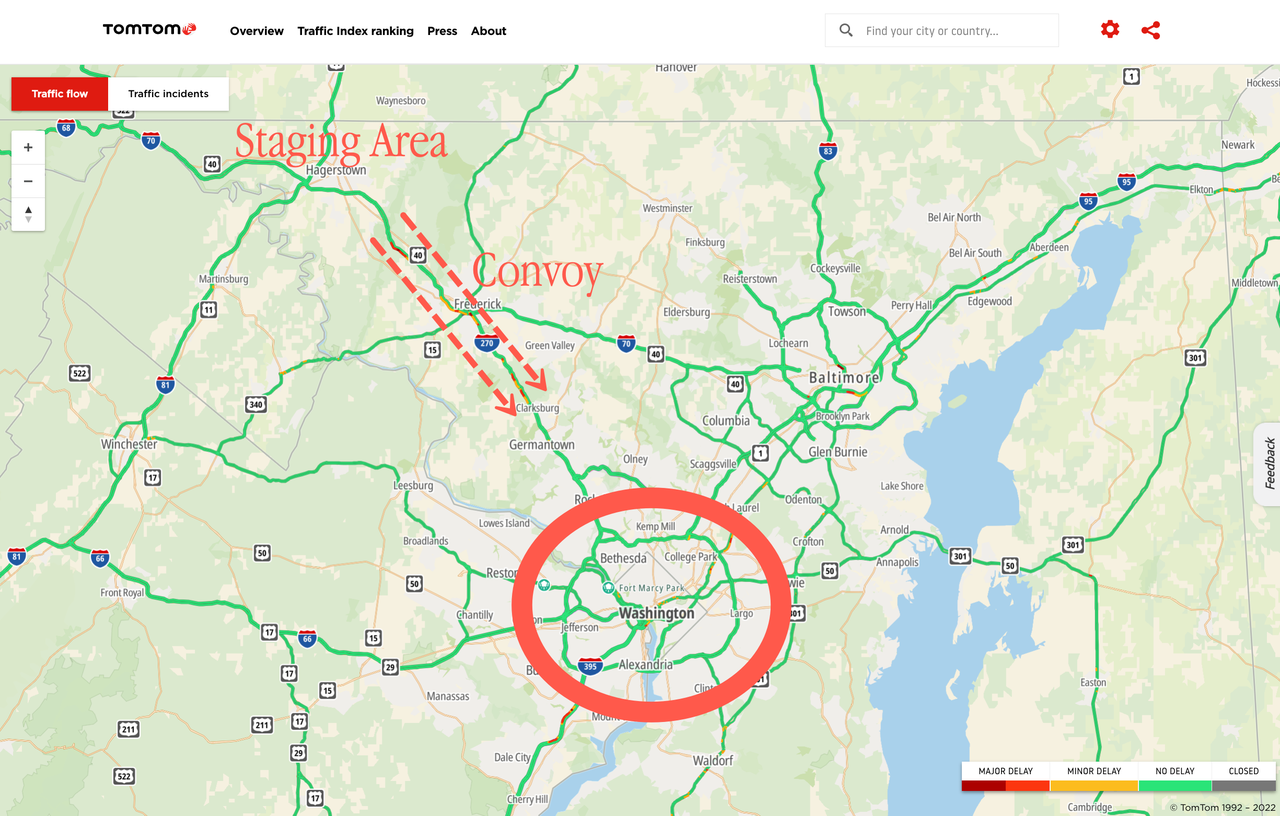
 The "People's Convoy" of semi-trucks (some with trailers), motorhomes, trucks, SUVs, and cars embarked from the speedway in Hagerstown, Maryland, Sunday morning towards the outskirts of Washington. They're expected to arrive on the Capital Beltway later today and circle the stretch of highway that encompasses DC "until the group's demands are met," Brian Brase, a convoy organizer, told WaPo.

Data from geolocation technology company TomTom shows the convoy has left Hagerstown and is already clogging up miles of highway. Hagerstown is about a 70-mile drive from DC. The Daily Mail says the convoy could be up to 30 miles long.  

Brase said the convoy's plan Sunday is to drive slow (without stopping) around the Beltway twice before returning to the staging area in Hagerstown. The move will be repeated each day of the week until the convoy's demands are met. 

Sunday "is a show of just how big we are and just how serious we are," the convoy organizer said. He said the group wants an immediate end to the national emergency declaration in response to the virus pandemic more than two years ago. 

"We're going to be a huge pain," Brase said. He noted that other convoys are en route and will join them.

"We're trying to work with our local law enforcement communities because we want them to understand that we are law-abiding citizens that are just exercising our rights to this protest," he said. But "every day is going to elevate what we do."

"We want to show the American people how large we are." Brase said. "And we want to show our congressional leaders that we're serious and we are here to negotiate. We are here to talk. We are law-abiding. We are peaceful. We don't want to shut anything down, and we're not coming downtown."

On social media, users are reporting the convoy is en route to the Capital Beltway. 

Maryland State Police have issued a warning to motorists as they must plan for "higher volumes of traffic" today. 

Watch live feeds of the convoy.

WNBA All-Star Brittney Griner detained for 3 weeks in Russia after drug arrest

 WNBA All-Star and two-time Olympic champion Brittney Griner has been detained in Russia for three weeks, after she was arrested for having vape cartridges in her luggage at a Moscow airport, according to Russian news sources and a former teammate.

Griner, 31, who won the WNBA championship in 2014 with the Phoenix Mercury and played for a Russian team in the off season, faces 5 to 10 years in Russian prison if convicted on drug smuggling charges.

“Brittney Griner is one of the biggest stars of the league and a generational talent. This really is unsettling,” tweeted Khristina Williams, who founded GirlsTalkSportsTV.

NFL alum Damien Woody also reacted to the news of Griner’s arrest.

“Brittney Griner has been detained for 3 weeks and we’re just hearing about it now?” the former New York Jet tweeted.

Word of Griner’s arrest, which comes against the backdrop of Russia’s invasion of Ukraine and crippling sanctions laid out against it by the West, emerged Saturday.

Surveillance footage of Brittney Griner in the Sheremetyevo airport in Moscow, Russia. Released by the Russian Federal Customs Service on their telegram channel https://t.me/s/customs_rf
Surveillance footage of Brittney Griner in the Sheremetyevo airport in Moscow, Russia.
Russian Federal Customs Service

Russia’s Interfax news agency reported a female US basketball player was arrested in February at Sheremetyevo Airport, just outside Moscow, after arriving on a flight from New York.

A drug-sniffing dog indicated narcotics in her luggage, and when the bag was X-rayed, “so-called ‘vapes’ ” were discovered “with a specific odor,” according to Interfax, which cited the Russian Federal Customs Service.

“The expert found that the liquid is a narcotic drug cannabis oil (hashish oil),” Interfax said.

The independent Russian news Web site Lenta identified the player as Griner.

Interfax said she was detained as a “preventive measure” against drug trafficking.

Surveillance footage of Brittney Griner in the Sheremetyevo airport in Moscow, Russia. Released by the Russian Federal Customs Service on their telegram channel https://t.me/s/customs_rf
The footage shows a drug-sniffing dog with Griner’s luggage.
Russian Federal Customs Service

The report did not say exactly when Griner was arrested, but her Team USA teammate Angel McCoughtry wrote on Instagram that she’s been held for three weeks.

“My homie been there for three weeks. Free her,” she wrote in a comment on a post about Griner’s arrest.

Her team, the Phoenix Mercury, confirmed a “situation in Russia” without mentioning specifics.

“We are aware of and are closely monitoring the situation with Brittney Griner in Russia,” the team said in a statement.

Griner
An airport worker searches Griner’s bag.
Russian Federal Customs Service

“We remain in constant contact with her family, her representation, the WNBA and NBA. We love and support Brittney and at this time our main concern is her safety, physical and mental health and her safe return home.”

An edited video of what appears to be moments surrounding her arrest was posted to Twitter.

In the clip, Griner places a wheeled suitcase into an airport screener, then a man goes through a suitcase on a table on the opposite side of the screening machine.

The man is next shown rifling through paperwork set on the table, with Griner sitting next to him on the table, her back to the camera. She appears to sign some forms before the clip ends.

Griner was arrested after vape cartridges were found in her carry-on luggage at a Moscow airport.

Griner hasn’t posted on her Instagram account since Feb. 5.

Calls to her wife, Cherelle Watson Griner, and her parents, Sandra and Raymond Griner, were not immediately returned.

USA Basketball said in a statement that it is “aware of and closely monitoring the legal situation facing Brittney Griner in Russia.”

“Brittney has always handled herself with the utmost professionalism during her long tenure with USA Basketball and her safety and well being are our primary concerns,” the organization said.

Griner has been absent from social media since Feb. 5.
Paul Beaty

Griner has played during the WNBA off-season for the Russian team Ekaterinburg in the Euroleague since 2015.

“We are aware of the situation in Russia concerning one of our members, Brittney Griner. Our utmost concern is BG’s safety and well-being. On behalf of the 144, we send our love and support. We will continue to closely monitor and look forward to her return to the US,” the WNBA said in a statement.”

https://nypost.com/2022/03/05/all-star-brittney-griner-arrested-in-russia-on-drug-charges/

Allscripts sells hospital business unit in $700M deal

 Allscripts will sell the net assets of its hospital business segment for up to $700 million to Constellation Software’s subsidiary, N. Harris Computer Corporation, the companies announced Wednesday evening.

Harris will acquire a range of assets from the health IT company’s hospital and large physician practices segment, including Sunrise, Paragon, Touchworks, Opal, dbMotion, STAR and Healthquest solutions.

The deal does not include Veradigm, Allscripts’ data analytics unit, which houses the largest linked electronic health records claims patient database available for research.

The total $700 million cash transaction includes $670 million paid at the close of the deal and up to $30 million depending on the business’s performance in the following two years.

The deal is expected to close in the second quarter of 2022.

“The medical industry we faithfully serve has gone through tremendous change and the needs of the customers in our different business segments continue to evolve in different ways,” said Paul Black, Allscripts CEO, in a statement. “We think this transaction maximizes focus as well as future opportunity for our clients, our more than 7,500 associates and our shareholders.”

Allscript’s shares rose as much as 7% Thursday morning following the news.

In an investor presentation, Allscripts said its hospital business segment was expected to shrink in 2022 for the third year in a row, while its Veradigm business continues to grow.

Proceeds from the deal will be used to support strategic M&A for Veradigm as well as for continued share repurchases.

The company reported $1.5 billion in total revenue last year, on par with its 2020 revenue, and beat Wall Street’s projections on earnings at $1.43 per share, a 191% increase over 2020.

Following the announcement of the deal, the company revised its 2022 guidance to account only for its Veradigm segment, which it expects to grow year over year between 6% and 7%.

Allscripts also inked a deal with the Social Security Administration this week, which will allow the agency to request electronic health records through Veradigm’s medical chart retrieval solution.

The administration makes millions of requests each year for healthcare records to process disability applications.

Allscripts’ health IT solution will help minimize provider burden by reducing health record retrieval time from days or even weeks to minutes, according to the company.

https://www.fiercehealthcare.com/health-tech/allscripts-sells-hospital-business-unit-700m-deal-constellation-subsidiary

Moody's: Failure to close Change deal would diminish UnitedHealth's long-term growth

 If UnitedHealth Group's bid to acquire Change Healthcare is ultimately stopped by the Department of Justice, it would be credit positive for UnitedHealth because of the short-term beneficial effect on debt and leverage.

But UnitedHealth's long-term growth prospects would be incrementally diminished, according to a new analysis.

Moody’s Investors Service released a new report looking at the implications of the proposed $8 billion deal.

A year ago, UnitedHealth Group's Optum unit announced plans to buy healthcare technology company Change Healthcare for $7.84 billion in cash plus about $5 billion in debt.

The deal has been a controversial one, with critics such as the American Hospital Association arguing it could lead to significant consolidation in healthcare data. This month, the Department of Justice (DOJ) filed suit to intervene in UnitedHealth Group's acquisition of Change Healthcare, just days shy of the company's planned consummation date of Feb. 27.

The DOJ asserts the deal would harm competition in commercial health markets as well as the market for technology insurers use to process claims and reduce healthcare costs.

DOJ alleges in the complaint that the merger would give UnitedHealth Group, the parent company of the country's largest commercial insurer, UnitedHealthcare, access to a treasure trove of data on its competitors' sensitive information. This could be used to give the company a leg up and would eliminate its only major rival in first-pass claims editing technology.

UnitedHealth said the company would “defend itself vigorously” to go forward with the acquisition.

"Change Healthcare and Optum together can increase efficiency and reduce friction in health care, producing a better experience and lower costs," UnitedHealth Group said in a statement to Fierce Healthcare. "The Department’s deeply flawed position is based on highly speculative theories that do not reflect the realities of the health care system. We will defend our case vigorously.”

"When the deal was announced in January 2021, we viewed it as credit negative in the short-term because of the prospective 30% increase in debt and increase to leverage,” Moody’s vice president Dean Ungar said in a statement. “But longer-term, the deal would add meaningful benefits, including increased scale in the revenue cycle management business of OptumInsight, which was already the market leader, Change is the second-leading player."

The deal would add leading technology in claims adjudication, Ungar said.

As of year-end 2021, UnitedHealth had $50.5 billion of outstanding debt, a corresponding 39.7% debt-to-capital ratio.

If the deal were to close as originally expected in early April and financed in first-quarter 2022, Moody's estimated debt-to-capital would rise to 43.2% and debt-to-EBITDA to 2.1x. Leverage would have been significantly higher than those numbers if the deal had closed as originally expected in the second or third quarter of 2021, according to Moody's.

Without the deal financing, analysts would expect adjusted leverage to improve in this quarter to below 39% for debt-to-capital and approximately 1.7x for debt-to-EBITDA.

As part of the proposed deal, Change Healthcare would become part of Optum, which is composed of three main businesses: OptumRx (pharmacy benefits), OptumHealth (medical providers) and OptumInsight (data, analytics and consulting). Change Healthcare would fold into OptumInsight and would add approximately $1 billion in EBITDA before synergies, Moody's analysts said in the report.

"While this is significant, consolidated UnitedHealth generated $27.1 billion in EBITDA in 2021 with a consistent and high growth rate. Optum, UnitedHealth’s health services subsidiary, has been the main growth driver," analysts wrote.

In 2010, Optum generated $1.1 billion in operating earnings, which was only 14% of consolidated operating earnings. By 2021, Optum’s operating earnings had grown to $12 billion and 50% of consolidated operating earnings, growing 24% per year on average.

Optum, specifically OptumInsight, will remain a robust, high-growth market leader either way, according to Moody's.

OptumInsight generated operating earnings of $3.4 billion, and Moody's estimates it will continue to grow earnings at mid-to-high teens annual rate. Furthermore, there are other potential, smaller acquisitions that could incrementally bolster Optum with less negative effect on leverage.

https://www.fiercehealthcare.com/payers/moodys-failure-close-change-healthcare-deal-would-incrementally-diminish-unitedhealths-long
'99.9% of Medicare Advantage plans offering supplemental benefits'

 A new study found that 99.9% of Medicare Advantage plans are offering supplemental benefits in 2022, with vision and hearing benefits the most widely offered.

The study, conducted on behalf of the Better Medicare Alliance (BMA), found 5,311 of 5,312 MA plans offered supplemental benefits for 2022. The study was done by consulting firm Milliman and also found a 38% increase in supplemental benefits for helping the chronically ill.

“As this analysis shows, Medicare Advantage continues to raise the bar in supplemental benefits offered to seniors,” said Mary Beth Donahue, president and CEO of the BMA. “What’s more, the analysis showed continued growth in benefits like over-the-counter coverage, remote access technologies and meals that are helping seniors weather the COVID-19 pandemic.”

The Centers for Medicare & Medicaid Services (CMS) expanded the number of benefits MA plans could offer to enrollees in 2018 and 2019.

The benefit most widely offered by MA plans was vision coverage, an option included in 97% of plans. This was shortly followed by hearing (94%), fitness (94%) and dental care at 91%.

Another 84% of plans offer over-the-counter benefits and 69% a meal benefit to seniors, which advocates say has been critical in addressing social determinants of health.

The analysis showed more MA plans are also adopting special supplemental benefits for the chronically ill, which can include some non-health-related benefits such as pest control or structural home modifications. Milliman found the number of plans offering these types of benefits increased from 815 to 1,127 plans from 2021 to 2022.

Milliman, which looked at benefit data provided by CMS, also found there are 419 more plans this year offering food and produce to members compared to 2021.

MA has become an increasingly lucrative market for insurers, with more payers seeking market share as enrollment has swelled. A new study from the Chartis Group showed MA enrollment increased by 2.3 million for 2022, with for-profit plans gaining the most new enrollees.

https://www.fiercehealthcare.com/payers/better-medicare-alliance-999-medicare-advantage-plans-offering-supplemental-benefits

South Africa Risks Destroying 100k Vaccine Doses by End-March on Slow Uptake

 About 100,000 doses of Pfizer's COVID-19 vaccine are at risk of being destroyed by the end of this month due to slow uptake by citizens, South African health authorities said on Friday.

South Africa has recorded the most coronavirus infections and deaths on the African continent, however inoculations have slowed and the country has ample vaccine stocks of about 25 million doses.

"There is a risk that just over 100,000 or so doses which will expire by end of March ... may have to be discarded. It will be a sad day if significant volumes of doses can end up being discarded. We hope it will not reach that stage," Health Minister Joe Phaahla told an online news conference.

He said the department was trying to ramp up inoculations to save the vaccine doses from being discarded. South Africa has so far fully vaccinated around 43% of its 40 million adults.

South Africa's vaccination campaign, using the Johnson & Johnson (J&J) and Pfizer vaccines, got off to a slow start due to difficulties securing early supplies but more recently it has been dogged by hesitancy. Last month the country changed its COVID-19 vaccination rules in an effort to encourage more people to get jabs.

https://www.usnews.com/news/world/articles/2022-03-04/south-africa-risks-destroying-100-000-vaccine-doses-by-end-march-due-to-slow-uptake

Georgia senators seek to ban state vaccine mandates for year

 Georgia senators want to prevent state agencies and local governments from requiring COVID-19 vaccines, voting 31-19 on Friday to ban such requirements until mid-2023.

Republicans supporting Senate Bill 345, which moves to the House for more debate, say the state shouldn’t be able to force the inoculation against the respiratory illness. Democrats say the GOP is kowtowing to misinformation on vaccines, discouraging a protective measure in a state that is close to the bottom in vaccination rates according to federal data.

“I think everybody should have vaccinations,” said Republican Sen. Jeff Mullis of Chickamauga. “I just don’t think that state government should mandate it.”

Sen. Michelle Au, a Johns Creek Democrat who is a physician and holds a master’s degree in public health, said the bill would feed unfounded beliefs that the vaccine would somehow be unsafe.

“This bill undermines public trust in the COVID vaccine, full stop,” Au said. “Whether explicitly or not, it gives oxygen to the idea that people should be skeptical of the demonstrated safety and efficacy of a vital public health tool that here in the state of Georgia is still vastly underutilized.”

But some Republicans said people were right to mistrust COVID-19 vaccines even though they have been administered billions of times worldwide.

“There’s so much that we don’t know about this,” said Sen. Matt Brass, a Newnan Republican. “And that is why a lot people are hesitant to take the vaccine.”

Sen Greg Dolezal, a Cumming Republican, accused Democrats of hypocrisy for attacks they made on the vaccine development process when Donald Trump was still president as being the ones who sowed “doubt and corrosive messaging.”

“I support this bill. Mandates have not worked,” Dolezal said. “The vaccine is a decision between individuals and their doctor.”

As originally written, Mullis’ bill would have barred schools from requiring proof of any vaccinations at all. Mullis has said that’s not what he intended. But the measure is likely to make at least one vaccine mandate unenforceable. The Decatur school system suburban Atlanta requires teachers to have the vaccination and booster shot against the virus. No other school systems in Georgia are known to have required employees to get vaccinated.

As amended, the measure excludes health care facilities that are subject to federal mandates for their employees to get vaccinated to continue receiving federal payments. That exemption was key because many Georgia hospitals are owned by city or county health care authorities.

Opponents warned that despite the changes, that it’s difficult to anticipate future circumstances and the bill could hamstring response in a resurgence of COVID-19.

“And it’s a small sacrifice that we’re asking with a vaccine mandate,” said Sen. Nikki Merritt, a Grayson Democrat. “It’s a small sacrifice for the greater good to take care of people.”

https://apnews.com/article/coronavirus-pandemic-health-public-health-georgia-atlanta-a9c9e63516f1d2574d1a225ab4c05277