Search This Blog

Saturday, June 18, 2022

NYC readies vaccine hubs to give COVID-19 shots to kids under 5

 New York City plans to open 10 vaccination hubs Wednesday to provide COVID-19 shots to kids ages 6 months through 5.

The sites will only offer the two-dose Moderna vaccine and appointments can be made starting Tuesday on the city’s vaccine finder site or by calling 877-VAX-4NYC.

The hubs are in all five boroughs and include locations in Times Square, the Brooklyn Children’s Museum, the Queens mall and the Empire Outlets on Staten Island.

COVID VACCINE
New York City will open 10 COVID-19 vaccine hubs to inoculate children aged 6 months through five years old.
AFP via Getty Images
COVID-19 Vaccines
The sites will offer the two-dose Moderna shot.
AP

The city’s plan coincides with Saturday’s expected CDC approval of both the Moderna and Pfizer shots for kids. The FDA gave the greenlight to the vaccines Friday.

https://nypost.com/2022/06/18/nyc-readies-covid-19-vaccine-hubs-for-kids-under-5/

Adams gives unvaccinated NYC workers ‘shot’ to get jobs back

 Mayor Eric Adams is giving city workers who were fired for refusing to get the COVID-19 vaccination another shot at getting their jobs back – provided they opt to get jabbed quickly, The Post has learned.

Internal memos delivered Friday to unvaccinated ex-employees told recipients they have an “opportunity to return to employment if [they] become full vaccinated.” The ex-workers have until June 30 to get the first dose and make arrangements for a second dose by August 15.

“Once you provide proof of full vaccination (both doses), you will be reinstated to your civil service title at your most recent salary within two weeks of submission of proof of full vaccination, with no change to benefits or break in service,” said Marisa Caggiano, the NYPD’s assistant commissioner for human resources in a letter to fired agency workers.

Similar letters were also sent out to all ex-employees in other departments who were fired for breaking vaccination rules, except those who worked for the Department of Education. They will receive letters later this summer, sources said.

An Adams spokesman confirmed the amnesty period, telling The Post the mayor’s “goal has always been vaccination, rather than termination.”

Workers have previously protested the city’s vaccine mandate at the Brooklyn Bridge on October, 25, 2021.
Workers protested the city’s vaccine mandate at the Brooklyn Bridge on October, 25, 2021.
Gregory P. Mango

“Our administration is making a final effort to allow the small number of employees who have been terminated to be rehired so long as they get fully vaccinated,” the spokesman said.

“We hope that they will join the more than 97 percent of city workers who have already gotten their shot to date. But to be clear, no one will be able to resume work or return to payroll under this policy until they are fully vaccinated.”

In February, Adams fired 1,430 city employees, including 914 in the DOE and 36 in the NYPD for not getting vaccinated. In March, the city fired another 101 workers, including 42 in the DOE but none in the NYPD.

More than 6,000 city workers who applied for medical or religious accommodations or exemptions from the vaccination requirement have yet to get a decision.

https://nypost.com/2022/06/18/eric-adams-gives-unvaccinated-nyc-workers-shot-at-jobs/

STATES SHOULD DO REDETERMINATIONS ASAP AFTER MEDICAID HANDCUFFS UNLOCKED


KEY FINDINGS


Congress dramatically expanded welfare programs in response to the COVID-19 pandemic.1 In March 2020, Congress passed the Families First Coronavirus Response Act, which provided a temporary increase in funding to pay for a portion of states’ traditional Medicaid costs during the public health emergency.2

But this federal funding boost came with massive strings attached. In exchange for the funding, states had to give up significant control over their Medicaid programs.3-4 States cannot strengthen program eligibility standards or remove individuals from the program—including individuals who are ineligible or were never eligible for coverage.5 Enrollees may only be removed if they die, voluntarily opt out, or move to a different state.6

So long as states continue to accept the federal funding boost or until the public health emergency officially ends, states are handcuffed from removing ineligible enrollees from Medicaid.7 Unsurprisingly, the federal handcuffs have led to skyrocketing Medicaid enrollment, with millions of ineligible enrollees locked into the program during the pandemic.8

Medicaid handcuffs have led to record-high enrollment and are costing taxpayers billions

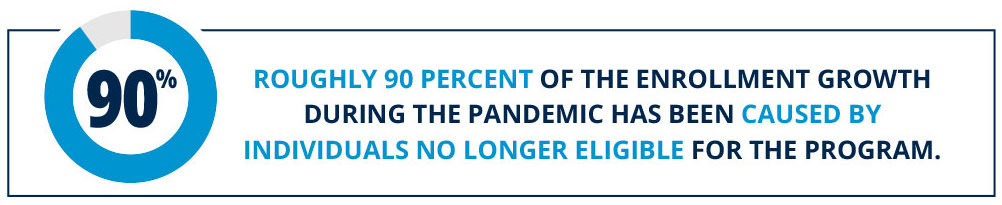
Locking enrollees into the program has caused Medicaid enrollment to soar to record heights.9 By June 2022, total program enrollment had ballooned to an estimated 95 million people, a record high.10 Worse yet, roughly 90 percent of the enrollment growth during the pandemic has been caused by individuals no longer eligible for the program.11 This means that an estimated 20 million enrollees were ineligible for the program nationwide by June 2022.12

Skyrocketing enrollment of ineligible individuals comes with a high price tag for taxpayers. Accepting the federal funding boost is not cost effective for most states, with the funding boost not covering the cost of keeping ineligible enrollees on the program.13 Covering ineligible enrollees is already costing billions of dollars, and soon state taxpayers will be footing an even greater share of the bill.14

State taxpayers will soon be paying an even greater share of the cost of covering ineligible enrollees

Federal taxpayers are temporarily financing the funding boost to states, and states are eligible for the funding until the public health emergency ends.15 But once the public health emergency is officially declared over, states will no longer receive that funding boost.16 At this point, states will be on the hook for an even greater share of the cost of covering ineligible individuals—until officials start removing them from the program.

The Biden administration has signaled that the public health emergency will continue into at least October 2022.17 By then, states will have an estimated 98 million Medicaid enrollees, including as many as 23 million people no longer eligible for the program.18 Those ineligible enrollees will cost taxpayers nearly $16 billion per month, with states picking up nearly $6 billion of those costs when the public health emergency ends.19

Ineligible enrollees come with a high cost to taxpayers and siphon resources away from the truly needy and other state priorities. Fortunately, once the Medicaid handcuffs are unlocked—either by a state’s decision to opt out or when the public health emergency ends—states may once again conduct redeterminations to remove ineligible enrollees.20 The longer states delay removing those ineligible enrollees, the more money state policymakers will need to find to cover their costs.

The Biden administration has encouraged states to take a year or longer after the public health emergency expires to complete these redeterminations—a decision that would add more than $50 billion in new costs for state taxpayers.21 At least 41 states have signaled they are planning to take up to a year to initiate and process redeterminations before eventually returning the program to normal operations.22

To preserve limited resources for the truly needy, state officials must conduct redeterminations and remove these ineligible enrollees as soon as possible.

THE BOTTOM LINE: Once the Medicaid handcuffs are removed, state officials should begin conducting redeterminations as soon as possible.

Once a state opts out of the funding or the public health emergency ends, ineligible enrollees will continue to be locked into Medicaid until states start conducting redeterminations. Conducting redeterminations would remove enrollees who are no longer eligible for the program, reduce taxpayer costs, and protect scarce resources for the truly needy. Once able, state officials shouldbegin conducting redeterminations immediately.

https://thefga.org/paper/states-should-conduct-redeterminations/

Over-the-Counter Hearing Aids Can’t Come Soon Enough

 It has been five years since Congress ordered federal regulators to develop regulations that will allow for hearing aids to be sold over the counter. Yet people today still can’t purchase them.

A bipartisan group of senators wants to change that. In April, a quartet led by Chuck Grassley, R-Iowa, and Elizabeth Warren, D-Mass., introduced legislation that would compel the Food and Drug Administration to finalize its rules on OTC hearing aids within 30 days.

It’s long past time for the agency to get its act together. Millions of Americans would benefit from improved access to hearing aids. Permitting their sale over the counter would inject some dynamism into a market that needs it — and lead to lower prices.

Thirteen percent of American adults — 38 million people — suffer from hearing loss. Hearing aids could dramatically improve their ability to communicate and live productive and satisfying lives. Yet, just one-fifth of Americans who would benefit from such devices use them.

Only about one in 20 people in their 50s with hearing loss uses a hearing aid.

That’s often because hearing aids are expensive. At present, they seldom cost less than $1,000. They can sometimes go for more than $6,000.

People can’t get much help with those costs. Hearing aids aren’t covered by Medicare or many private health plans.

And since hearing aids require a prescription, patients who need them must also deal with the cost and inconvenience of visiting an audiologist — care that may not be covered by insurance.

Allowing the devices to be sold over the counter could expand access and lower their cost.

People are far more likely to seek hearing aids if they can pick them up without an intermediary, as with other essential medical treatments and technologies.

A bigger potential market will attract more manufacturers offering more products. That competition will put downward pressure on prices — and lead to the availability of a wider variety of hearing aids that address different segments of the market.

The upshot will be more widespread adoption of hearing aids and lower overall costs.

This line of thinking inspired senators Grassley and Warren, among others, to sponsor the Over-the-Counter Hearing Aid Act back in 2017. The FDA was supposed to finalize regulations that would have implemented the law in 2020. The agency missed that deadline by more than a year. Public comments on the proposed rule didn’t close until January of this year.

Hence, the new round of legislation from Grassley and Warren.

Opponents of OTC hearing aids — like audiologists and others who benefit from the current system — point out that hearing loss can signal a bigger problem. If people don’t have to visit a healthcare provider to get hearing aids, the thinking goes, that these health concerns could go undiagnosed.

Many audiologists also argue that getting hearing aids over the counter without a prescriptive fitting will undermine their effectiveness — and cause people to conclude that hearing aids won’t work for them.

Healthcare providers have long made arguments like these to try to control the supply of medical care — and keep its price high. Optometrists still grouse about letting consumers order contact lenses online. Doctor organizations lobby state legislators all over the country to restrict the ability of nurse practitioners and physician assistants to treat patients independently.

Barriers like these may benefit incumbent providers. But they raise costs for patients and the rest of the healthcare system.

Further, people will still have the option of seeking the professional assistance of an audiologist. They just won’t be required to do so.

Consumers today buy even more advanced technology than the latest hearing aids without professional assistance. It’s infantilizing to believe they won’t be able to handle shopping for the devices on their own.

Selling hearing aids over the counter will make them more accessible to millions of people. Consumers have waited five years for improved access. They shouldn’t have to wait any longer.

https://insidesources.com/over-the-counter-hearing-aids-cant-come-soon-enough/

Sorry, But We Haven’t Cured Cancer

 If you’re primarily a medical/science writer who reads copious amounts of news articles daily, at least once a week you’ll read headlines proclaiming that cancer has been cured. Well, in rodents. But lo! Now wherever you live in the world, you can read it’s been cured in homo sapiens! You know, us!

  • “Cancer Drug Makes History as Rectal Tumors Vanish in All Trial Participants” (Newsweek)
  • “Cancer Cure Finally Here?” (Mint)
  • “Has Cancer Cure Finally Been Found?” (Hindustan Times)
  • “A Cancer Drug Trial with 100% Success Rate” (Gulf News)
  • “All Cancer Patients in Drug Trial Appear to be Cured for ‘First Time in History’” (Independent of London)

I don’t like raining on anyone’s parade, especially with such an important and intensely emotional subject. But it’s necessary. This is BS. Just among other things, by the standard definition and by everything we know about cancer remission and recurrence, nobody was cured.

All these explosive headlines are coming from a study reported in America’s most prestigious medical journal, The New England Journal of MedicineThe title reads: “PD-1 Blockade in Mismatch Repair–Deficient, Locally Advanced Rectal Cancer,” with the drug in question being GlaxoSmithKline’s (GSK) dostarlimab.

I’m guessing most readers have no idea what any of that means beyond the last four words, which is fine. But they can still read between the lines that this is for something very specific. Viz, cancers that 1) Have a PD-1 blockade, 2) Are mismatch repair-deficient, and 3) Are locally advanced in the rectum. They may well guess (correctly) that at best this is a good treatment for something very specific. What they cannot guess is that despite the prestigious placement, this is a very poorly conducted study that actually doesn’t even tell us much about the treatment of this specific malignancy.

It’s been a loooong time since we believed that all cancers shared much commonality beyond being immortal cell growth, and therefore what works for one type of cancer not only cannot be generalized to all cancers but may not work beyond that one type of cancer. But even before we get there, here are a couple of specific caveats regarding this study.

The drug in question is dostarlimab. Those last three letters indicate it’s a monoclonal antibody, essentially fabricated antibodies that are a fairly new science, having been first licensed in 1986. These “mAbs” have proved useful against a broad range of diseases, although, unlike our natural antibodies, they are very specific to those diseases. A monoclonal that’s highly effective against an autoimmune disease such as rheumatoid arthritis won’t help with cancer.

So in this case, dostarlimab use would almost certainly be restricted to mismatch repair-deficient cells, meaning those that have mutations (changes) in certain genes that are involved in correcting mistakes made when DNA is copied in a cell. Most cancer patients don’t have this condition, so already we see that it’s impossible to extrapolate from these findings to all malignancies.

What about this “PD-1 blockade?”

An important part of the immune system is its ability to tell between normal cells in the body and those it sees as “foreign,” such as germs and cancer cells. This allows the immune system to attack the foreign cells while leaving normal cells alone.

In part, the body does this by using “checkpoint” proteins on immune cells. The checkpoints act like switches that need to be turned on or off to signal an immune response. But cancer cells sometimes find ways to escape and evade. PD-1 (programmed death) and PD-L1 basically employ cloaking devices a la the Romulans in Star Trek or the Cloak of Invisibility in Harry Potter. Drugs like dostarlimab have been designed to penetrate this clever camouflage. “The evolution of [such drugs] represents one of the most successful approach in cancer drug discovery in the past few years,” one medical journal notes.

One such mAb, brand name Keytruda (pembrolizumab), has become the world’s biggest-selling cancer drug (by sales) and this year is set to become the biggest seller period. (In part because of its stunning price tag of $175,000 a year — with a recent price boost.) Depending on the cancer and previous treatments, it can be the first line of treatment or a subsequent one and can be used alone or in combination with other therapies. So GSK could be looking at a real cash cow, even though the vast majority of cancer sufferers cannot benefit from dostarlimab. Now back to that study and what’s wrong with how it’s been portrayed — and even conducted.

The patients received the mAb followed by standard chemotherapy and radiation, except for some who had a clinical complete response after completion of dostarlimab therapy alone. Various scans found no cancer in any of them after a median period of about a year (anywhere from six to 25 months). They were indeed in complete remission. But because no technology can find all cancer cells and just a few such cells may bring the disease roaring back, typically patients have to be in remission for five years to qualify as “cured.” That includes rectal cancer. And yes, sadly, sometimes the relapse even comes after five years and it kills. Since nobody in this study has been in remission for five years, nay not even half that long, nobody has been cured.

Further, the study’s methodology is suspect.

For one, it wasn’t the “gold standard” of a double-blind placebo trial. That means essentially half of the participants receive the actual treatment while half are “matched controls” who receive a dummy drug and neither they nor those administering the treatment know who is getting what. That’s important for measuring negative side effects, so you can see whether they’re from the drug or from apprehension of the drug, or sheer chance. But it’s also important in measuring positive benefits because patients may improve through chance (or better put, mechanisms we don’t understand) and because our minds can be very powerful in counteracting disease. My favorite illustration is my own; as a child, I received huge wart removal pills and within weeks my warts disappeared. But to this day there’s no such thing as pills that remove warts.

We want to know how people without dostarlimab would have fared. We won’t.

Far more important, though, is the tiny sample size and short follow-up time. This was classified as a Phase II trial, which the American Cancer Society says normally has about 25-100 people. Yet it involved only 16 people and the results only include 12 because it hadn’t been at least six months since final treatment for the other four. (Question: Given the small sample size, couldn’t the researchers have waited a bit longer for those four to reach the half-year mark? Yes.)

But I’ve been saving the awful surprise for last. If this was a Phase II, there must have been a Phase I for dostarlimab. What happened in that? For some odd reason, it’s not mentioned in the NEJM article, not even the references. But here it is. The efficacy group in the Phase I comprised 209 endometrial (uterine) cancer patients. After a median duration of just under three years (about twice that in the rectal cancer trial), the overall response rate was 41.6 percent, with only 9.1 percent showing complete remission.

Granted, a rectum and a uterus are rather different. But PD-1/PD-L1 is PD-1/PD-L1, no matter where it’s located. That’s why Keytruda is now FDA-approved for over a dozen different cancer locations and the list is steadily growing.

This NEJM outcome is almost certainly merely a reflection of a tiny sample size and a short follow-up time. If you flip a coin just 12 times, it’s a lot more likely to come up with straight heads than if you flip it 290 times. And sadly, probably a few years from now, some of these “cured” rectal cancer individuals will be dead from a reoccurrence. But guess what? You’ll never read about it. At the very least, a larger trial might have allowed physicians to compare results with the other six anti-PD-1 mAbs that have shown efficacy.

Study author Andrea Cercek of New York’s famed Memorial Sloan Cancer Center has been terribly amiss in expressing the importance of her results. “It’s really what cancer doctors’ dreams are made of, to see incredible efficacy,” she told CNN in a video interview. “It’s absolutely incredible.”

No. Even as I write this, I’ve just received the results of a scan for a friend I love dearly with three small children who has stage III cervical cancer at the tender age of only 31. (Stages are I-IV). The average age is 50. But that age may be her ace in the hole. The immune system is much stronger at 31 than 50 and with a combination of chemotherapy, radiation from within and without, and possibly surgery, she can beat it. But there’s no magic bullet. In 10 years, yes. Not now. In other words, I’m exactly the type of person these “Cancer is cured!” stories at aimed at. This is wrong. It’s absolutely incredibly wrong.

Michael Fumento (www.fumento.com) has been an attorney, author, and science journalist for over 35 years. His work has appeared in the New York Times, the Washington Post, the Sunday Times, the Atlantic, and many other fora. He has written repeated exposes of the FDA’s controversial approval of the monoclonal antibody Aduhelm for treatment of Alzheimer’s Disease.

https://spectator.org/sorry-but-we-havent-cured-cancer/

China's 'zero Covid' policy to persist into 2023, says US envoy

 United States' ambassador to China, Nicholas Burns, said on Thursday he expects Beijing's "zero Covid" policy to persist into early 2023, and that US businesses were reluctant to invest in the country until restrictions ease.

The re-emergence of infections in China's capital Beijing has raised new concerns about the outlook for the world's second-largest economy, which had recently emerged from a long lockdown that shook global supply chains in its most populous city and commercial hub, Shanghai.

"I think we're going to have to live with this for a long time," Burns told an online Brookings Institution event.

"My own assumption is that we'll see the continuation of 'zero Covid' probably into the beginning months of 2023. That's what the Chinese government is signalling," Burns said, referring to China's policy of seeking to stamp out each cluster of new cases, often with strict lockdowns and mass testing.

A worker in a protective suit walks on a closed bridge during lockdown, amid the coronavirus disease (COVID-19) outbreak, in Shanghai, China, May 18, 2022.

"I think there's a hesitancy to invest in future obligations until they can see the end of this," Burns said of US companies.

Analysts say the Chinese government's official GDP growth target of around 5.5% for this year will be hard to achieve without doing away with the strategy.

Burns criticised Beijing for censoring on Chinese social media Secretary of State Antony Blinken's May speech on US policy toward China, in which he said Washington expected Beijing to adhere to international rules.

"We put the speech on Weibo, and WeChat. And it was censored in about two and a half hours. Just taken away," Burns said, adding that the embassy reposted it days later and it was again removed.

Burns also said some assessments within China's government that the United States is in decline and is therefore becoming more aggressive toward China was not accurate and an "excuse".

"I think what's changed is the newly aggressive behaviour of the Chinese government ... over the last five to 10 years. And you've seen a counter-reaction to that," he said.

Did performance-based nursing home payments meet their match with COVID?

 Whether we’re buying groceries, cars, or colonoscopies, quality and cost matter. 

Since 2008, government and private health insurers have moved toward payment systems that purport to reward healthcare providers for the value they deliver — that is, patient health outcomes relative to costs incurred. The idea is that by prioritizing value — with its references to both quality and cost — patients, payers and providers will be well-served. 

But a recent attempt to link emergency funding for nursing homes to their COVID-19 outcomes failed spectacularly, and in ways that surely left public health experts scratching their heads.

Sixty percent of all insurer payments in 2018 were tied to quality or value, and value-based models now account for nearly half of all Medicare payments. Almost all providers currently derive at least some revenue based on their proficiency in hitting quality targets set by insurers or regulators.

When does tying healthcare payments to quality metrics increase value by improving quality, lowering costs, or both? Our recent study examined how the U.S. government provided $9.4 billion of COVID-19 relief funding to nursing homes during 2020.

The first two rounds of government funding distributed $7.4 billion to nursing homes in a non-performance-based manner — a fixed amount per nursing home, plus an additional fixed amount per bed. The Department of Health and Human Services then rolled out its Quality Incentive Payment Program (QIP) to distribute another $2 billion from September through December 2020. Under QIP, a nursing home received funding based primarily on its COVID-19 infection rate relative to its home county infection rate. 

The intent? Let the invisible hand reward high performers, punish low performers and optimally allocate funds to protect nursing home residents.

The results? Over four months, QIP distributed $2 billion to nursing homes that had virtually no COVID-19 infections. Across 15,331 nursing homes and four months, 94 percent of government checks went to nursing homes with no infections; 5.1 percent went to nursing homes with one infection, and 0.9 percent went to nursing homes with two to six infections. The kicker? In those months for which nursing homes did not receive QIP checks, over 300,000 residents contracted COVID-19.

But the dysfunction does not end there. For months when nursing homes did receive QIP payments, the correlation between their infection rates and QIP cash payments was approximately zero. That’s right. Among QIP recipients, a nursing home’s own infection rate had essentially no effect on its payments. In contrast, the correlation between nursing homes’ county infection rates and their QIP payments was 32 percent.

Bottom line: QIP was not “performance-based,” since county infection rates — not facility rates — were the primary driver of payments. Worse still, QIP distributed payments in inverse proportion to need, since nursing homes received nearly $2 billion when they had no infections, but zilch when they had 300,000 infections.

What are the broader lessons? First — in devising payment systems, deal with the hardest question head-on: Are payments warranted at all? MedPAC credits the spike in nursing homes’ profit margins (3.0 percent in 2020, compared with 0.6 percent in 2019) in large part to COVID-19 relief — surely an unsatisfying result if the goal was to combat COVID-19 and not fatten nursing homes’ coffers.

Second — details matter. Performance-based payment systems that link providers’ rewards to invalid or unreliable quality metrics can produce suboptimal (and even deadly) results. Nursing home administrators in particular are well-acquainted with a proliferation of metrics that cycle in and out of quality ratings, but often provide little operational guidance. Value-based payment systems are only as good as their design and implementation.

Third — let’s think twice before incorporating complex, market-based principles into short-term programs intended to combat unpredictable, once-in-a-hundred-years public health crises. HHS’ big whiff with QIP is not a sweeping indictment of all performance-based payment systems. But we should be mindful of the diversity in healthcare’s clinical settings and ecosystem when crafting payment systems. After all, to a bad carpenter with only a hammer in his toolbox, everything looks like a nail.

Elizabeth Plummer, Ph.D., CPA is a professor at Texas Christian University’s (TCU) Neeley School of Business and the TCU School of Medicine. Bill Wempe, Ph.D., is a professor at Texas Christian University’s (TCU) Neeley School of Business.

https://thehill.com/opinion/3527979-did-performance-based-hospital-payment-meet-its-match-with-covid/