Search This Blog

Thursday, February 16, 2023

Blair: West Pharma Q4 Earnings Impressive Despite Headwinds


  • West Pharmaceutical Services Inc  reported Q4 2022 net sales of $708.7 million, down 3%, and organic net sales growth was 2.6%, beating the consensus of $657.17 million.
  • Q4 adjusted EPS of $1.77 fell 13.2% but beat the consensus of $1.38.
  • COVID revenue was approximately $86 million for the quarter, and it now expects COVID contributions of $85 million for the next year as part of its 2023 guidance.
  • EPS guidance of $7.25-$7.40 for 2023 was ahead of the Street ($7.27) and far better than investor expectations, with revenue expectations of 2.935-$2.960 billion vs. the consensus of $2.87 billion.
  • William Blair says the results were impressive, given the headwinds in the quarter. But the focus will be on the guide, as investor conversations over the last couple of months pointed to a $6.75-$7.00 range for EPS given the substantial revenue and profitability headwind from the $300 million COVID step-down in 2023. 
  • West trades at 38 times the midpoint of 2023 EPS guidance, essentially in line with its 10-year average of 37.1 times and a premium to peers at about 28 times. William Blair says it is warranted given West’s resilience and growth profile. Reiterates the Outperform rating.

Hoth Retains ShareIntel to Investigate Illegal Naked Shorting

 Hoth Therapeutics, Inc. (NASDAQ:HOTH), a patient-focused biopharmaceutical company, today announced that it has entered into a service agreement with Shareholder Intelligence Services, LLC ("ShareIntel"), a patented compliance driven SAAS retained by public companies to track shareholder ownership and monitor critical broker-dealer and shareholder movement, to investigate and report on potential illegal naked short selling activities of Company stock (HOTH), among other potential trading violations.

"We believe this collaboration with ShareIntel will be value added by allowing Hoth to better monitor trading activity, including broker-dealer, clearing firm, and shareholder position management," said Robb Knie, Chief Executive Officer. "Through investigating reporting anomalies, we should be able to better understand and identify any suspicious and or unusual trading activity, and implement action to protect investors from illegal naked short selling."

ShareIntel utilizes a patented process called DRIL-Down to aggregate and analyze repository data from reporting entities, broker-dealers and shareholders enabling Hoth to proactively track shareholder ownership, identify parties involved in suspicious, aberrant, or unusual trading activity and deploy corrective action steps to help curtail such activity.

https://finance.yahoo.com/news/hoth-therapeutics-retains-shareintel-investigate-133500710.html

Train Carrying Hazardous Materials Crashes Near Detroit

 Amid the chaos in Ohio, and two more (one in Texas and one in South Carolina), yet another train has derailed Thursday in Van Buren Township outside Detroit, Michigan.

Fox News reports that at least one car contains hazardous materials.

Police told Fox2 Detroit that there were no injuries and the area is not a hazmat situation.

"We are also in touch with the relevant federal authorities, including the EPA," Rep. Debbie Dingell, D-Mich., said in a statement obtained by Fox2 Detroit.

"At this time no one is aware of the release of any hazardous materials, the car carrying hazardous material has been put upright and is being removed from the area of the other derailed cars, and EPA is dispatching a team to ensure public safety," she said.

The Michigan Department of Environment, Great Lakes, and Energy also said it is "aware of the train derailment in Van Buren Township, Wayne County, where initial reports indicate no threat to the public from the derailment.

https://www.zerohedge.com/commodities/another-derailment-train-carrying-hazardous-materials-crashes-near-detroit

Rethinking next-generation vaccines for coronaviruses, influenzaviruses, and other respiratory viruses


Summary

Viruses that replicate in the human respiratory mucosa without infecting systemically, including influenza A, SARS-CoV-2, endemic coronaviruses, RSV, and many other “common cold” viruses, cause significant mortality and morbidity and are important public health concerns. Because these viruses generally do not elicit complete and durable protective immunity by themselves, they have not to date been effectively controlled by licensed or experimental vaccines. In this review, we examine challenges that have impeded development of effective mucosal respiratory vaccines, emphasizing that all of these viruses replicate extremely rapidly in the surface epithelium and are quickly transmitted to other hosts, within a narrow window of time before adaptive immune responses are fully marshaled. We discuss possible approaches to developing next-generation vaccines against these viruses, in consideration of several variables such as vaccine antigen configuration, dose and adjuventation, route and timing of vaccination, vaccine boosting, adjunctive therapies, and options for public health vaccination polices.

Consumer Debt Soars By $394B, Most In 20 Years, To Record $16.9 T As Young Borrowers Struggle To Repay

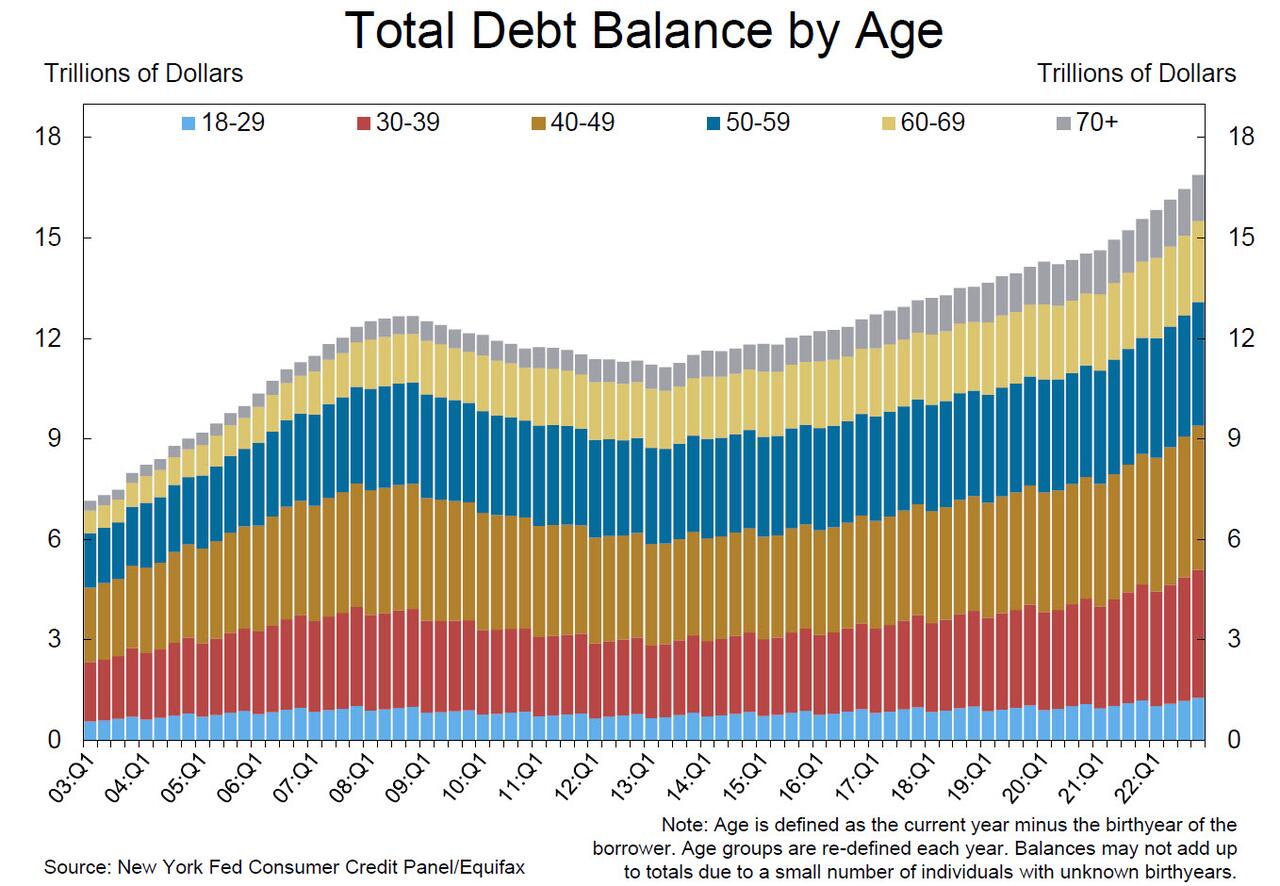
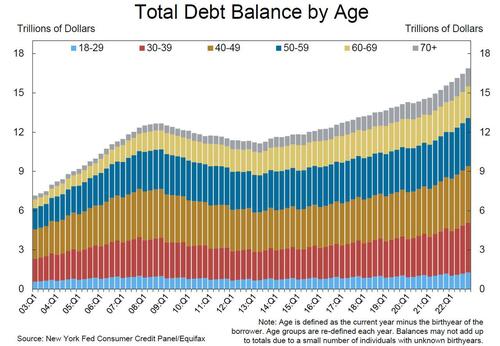
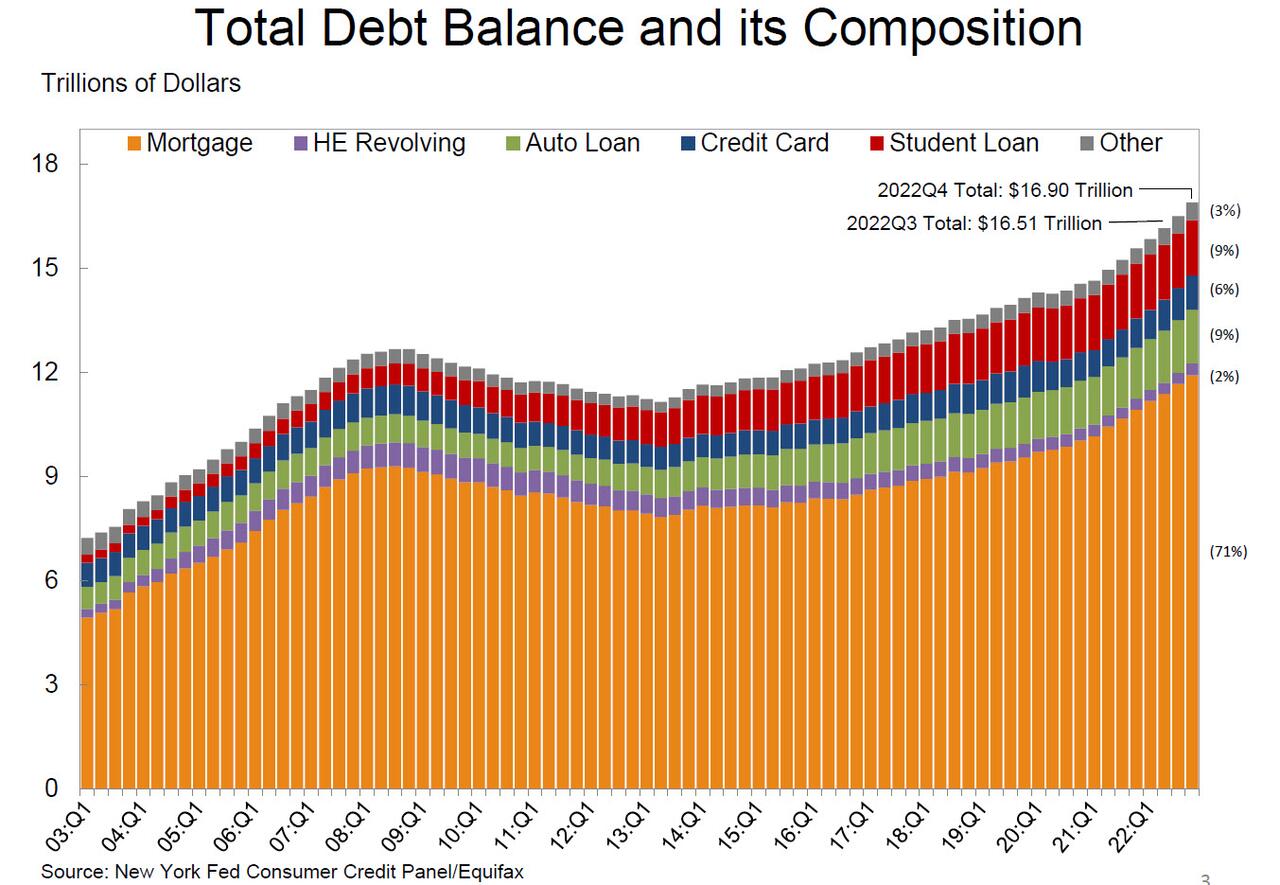
 While it won't tell us anything we don't know - since it is two months delayed and we already get monthly updates from the Fed via the G.19 statement - this morning the NY Fed published its quarterly Household Debt and Credit report, which showed that total household debt in the fourth quarter of 2022 rose by 2.4% or $394 billion, the largest nominal quarterly increase in twenty years, to a record $16.90 trillion. Balances now stand $2.75 trillion higher than at the end of 2019, before the pandemic recession.

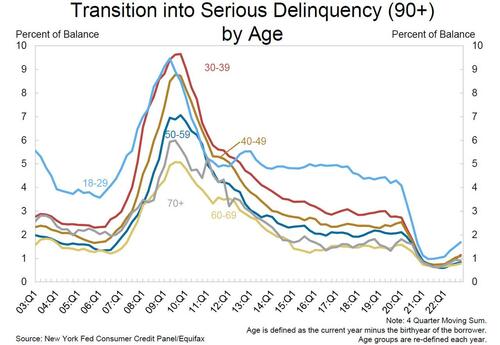
And the same chart broken down by age:
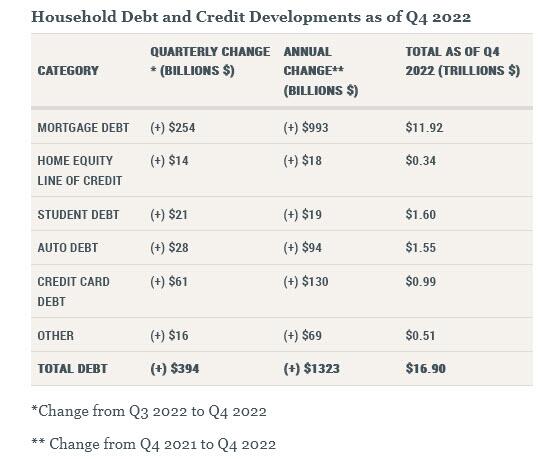
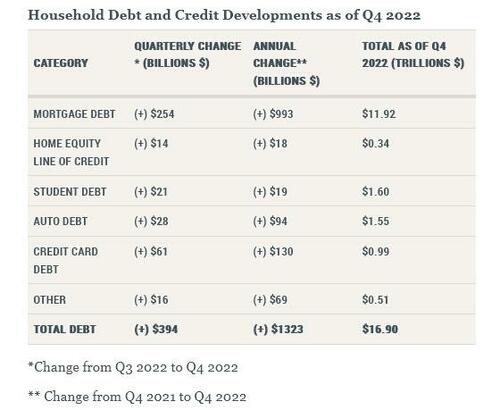
Every type of consumer credit increased in Q4, and here is a detailed breakdown:

  • Mortgage balances rose by $254 billion in the fourth quarter of 2022 and stood at $11.92 trillion at the end of December, marking a nearly $1 trillion increase in mortgage balances in 2022.
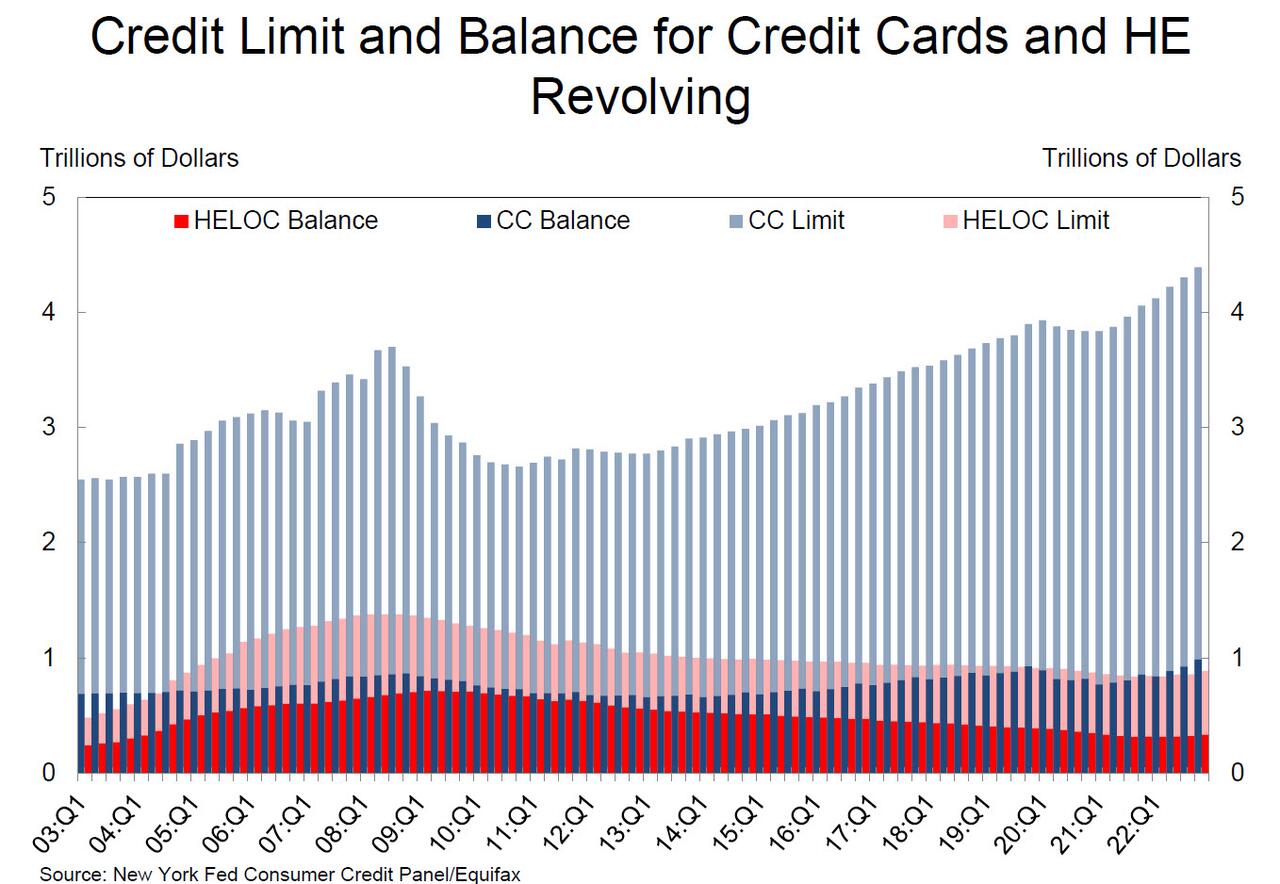
  • Home equity lines of credit rose by $14 billion to $340 billion.
  • Student loan balances now stand at $1.60 trillion, up by $21 billion from the previous quarter. In total, non-housing balances grew by $126 billion.
  • Auto loan balances increased by $28 billion in the fourth quarter, consistent with the upward trajectory seen since 2011.
  • Credit card balances increased $61 billion in the fourth quarter to $986 billion, surpassing the pre-pandemic high of $927 billion.

“Credit card balances grew robustly in the 4th quarter, while mortgage and auto loan balances grew at a more moderate pace, reflecting activity consistent with pre-pandemic levels,” said NY Fed economic research advisor Wilbert van der Klaauw.
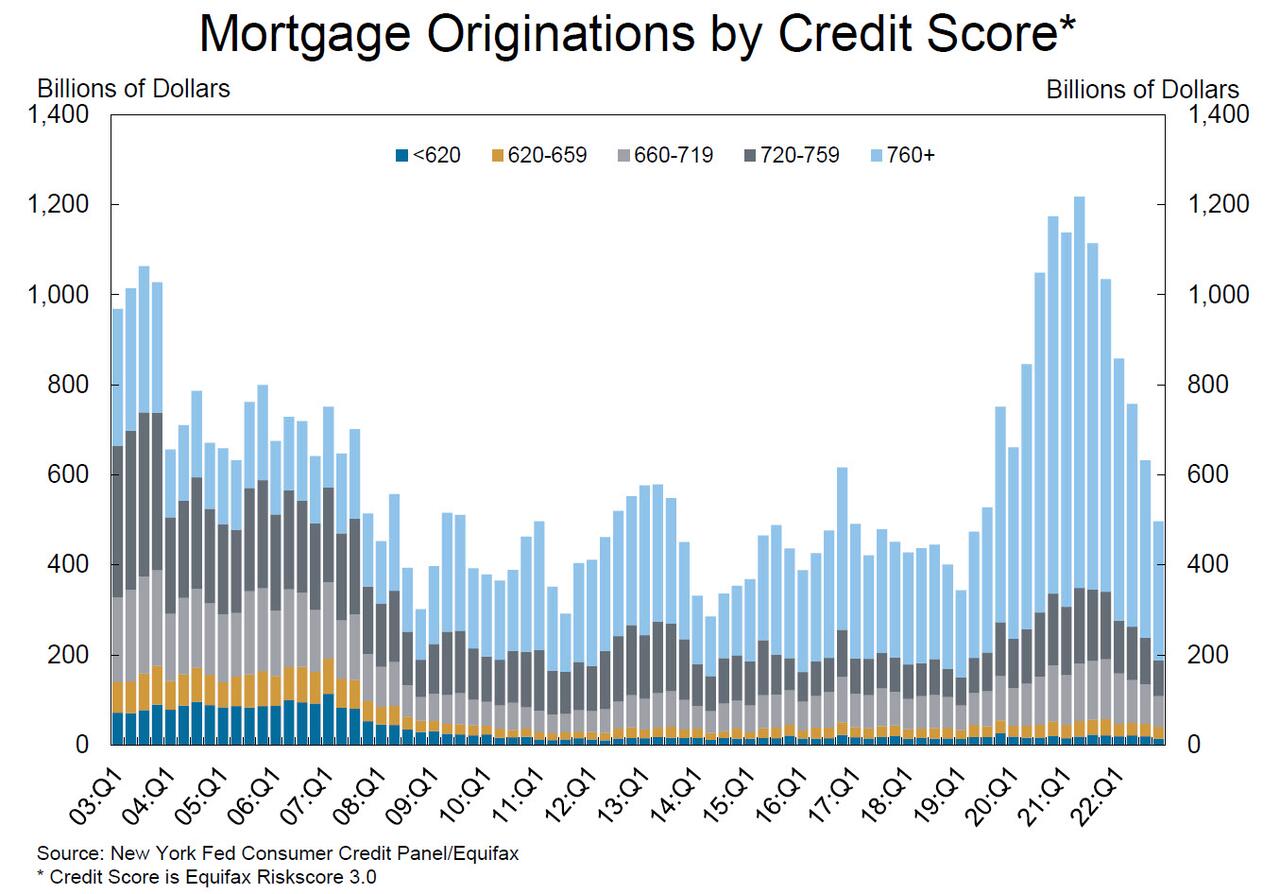
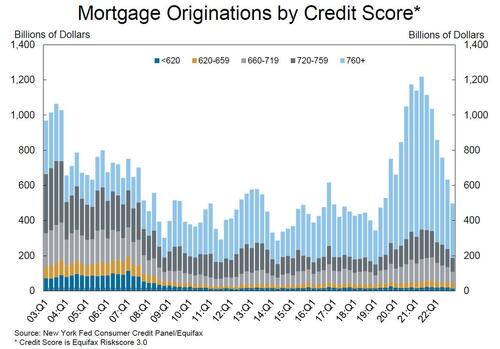
On the other end, mortgage originations, which include refinances, fell to $498 billion in the fourth quarter as a result of soaring rates.
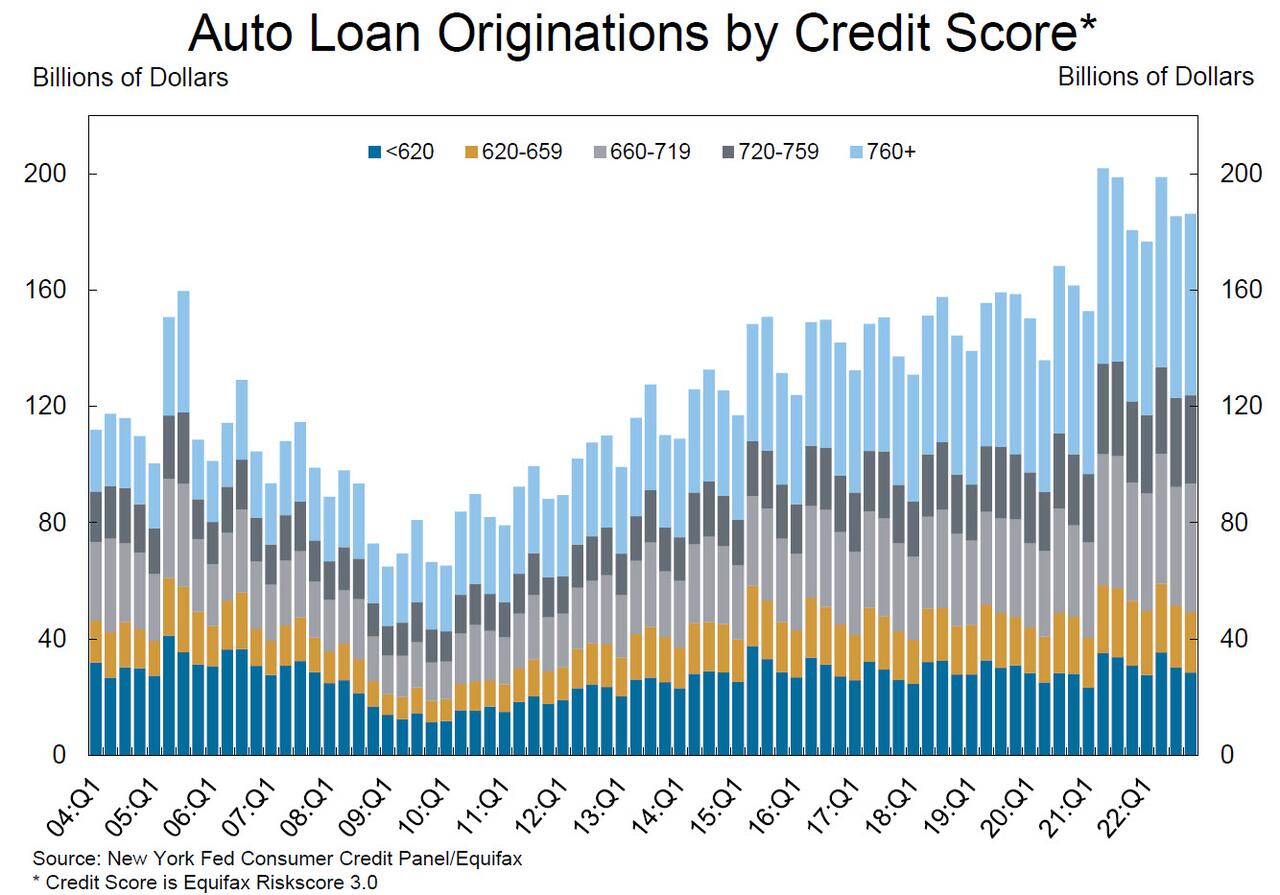
Yet despite record high auto loan rates, the volume of newly originated auto loans was $186 billion, representing a slight increase from the previous quarter. This is something for the Fed to look into as it clearly shows that there is a breakdown in the (tighter) credit channel which is only impacting housing and not purchases of other debt-funded goods.

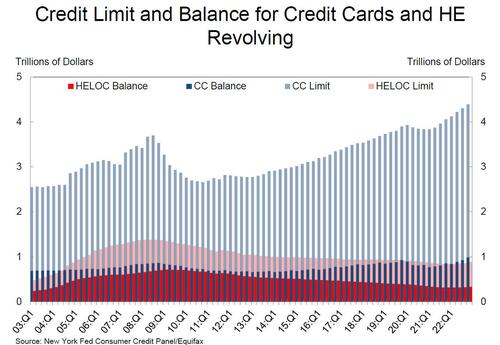
Aggregate limits on credit card accounts increased by $88 billion in the fourth quarter and now stand at $4.4 trillion, just to make sure the debt serfs can always access money they don't have, and have to repay at a record high APR.
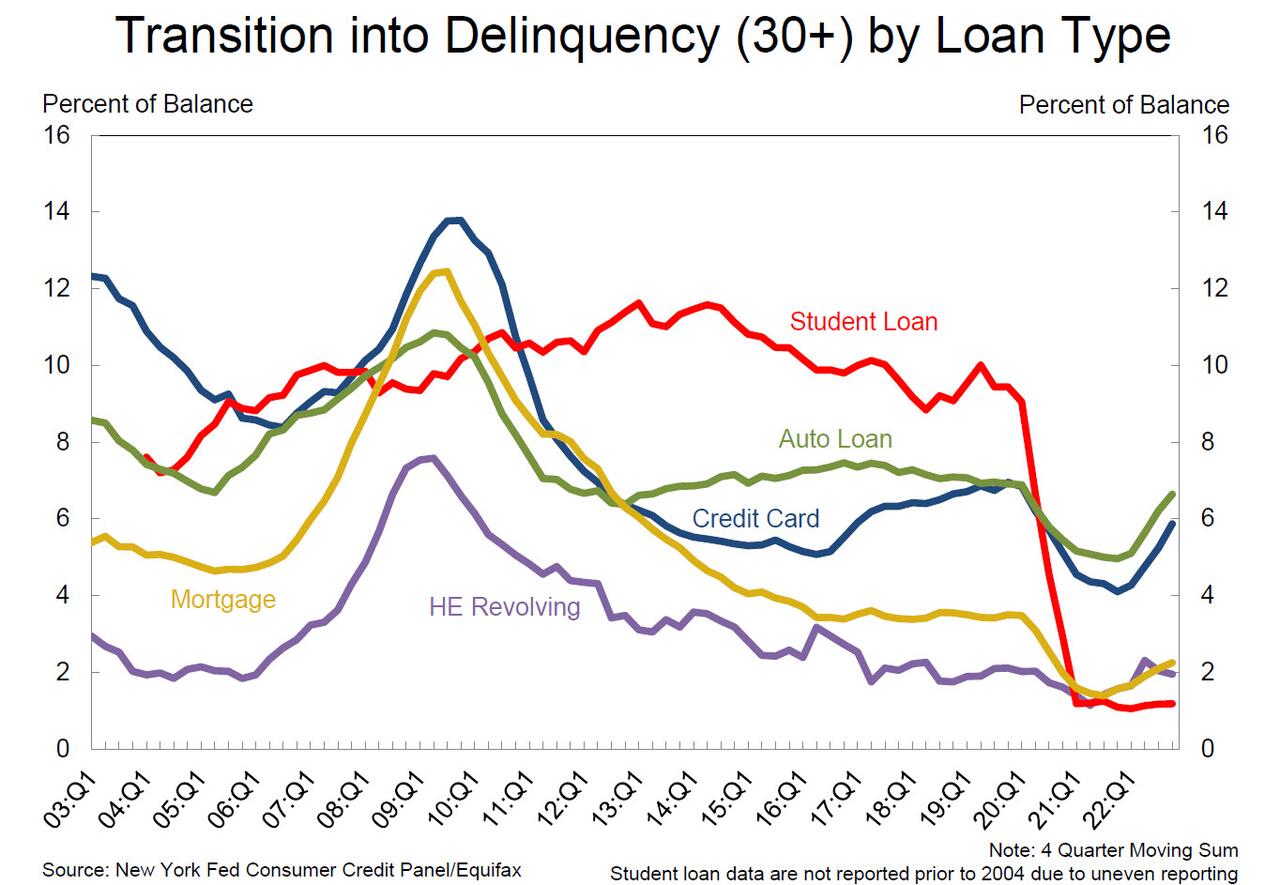
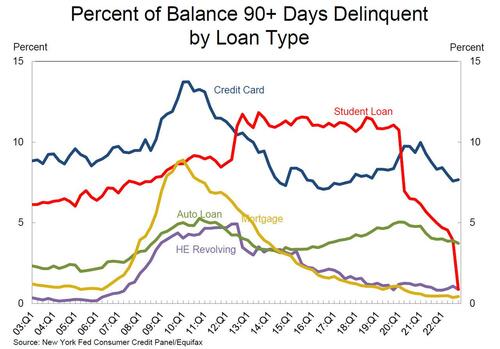
Separately, and also as a result of the surge in interest rates, the share of current debt becoming delinquent increased again in the fourth quarter for nearly all debt types, following two years of historically low delinquency transitions.
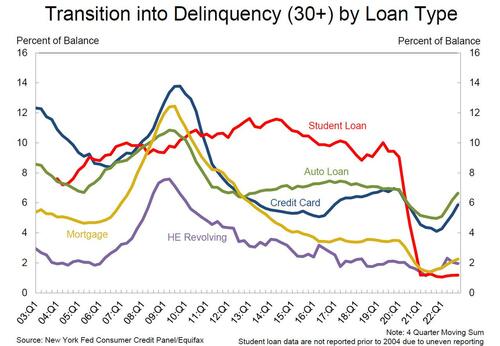
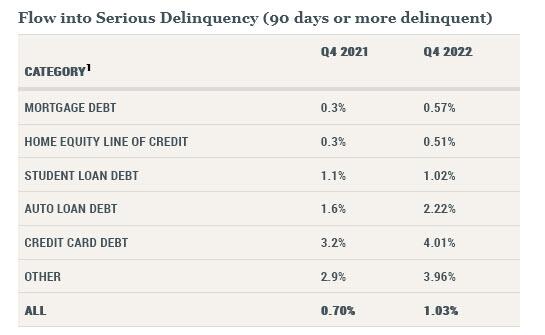
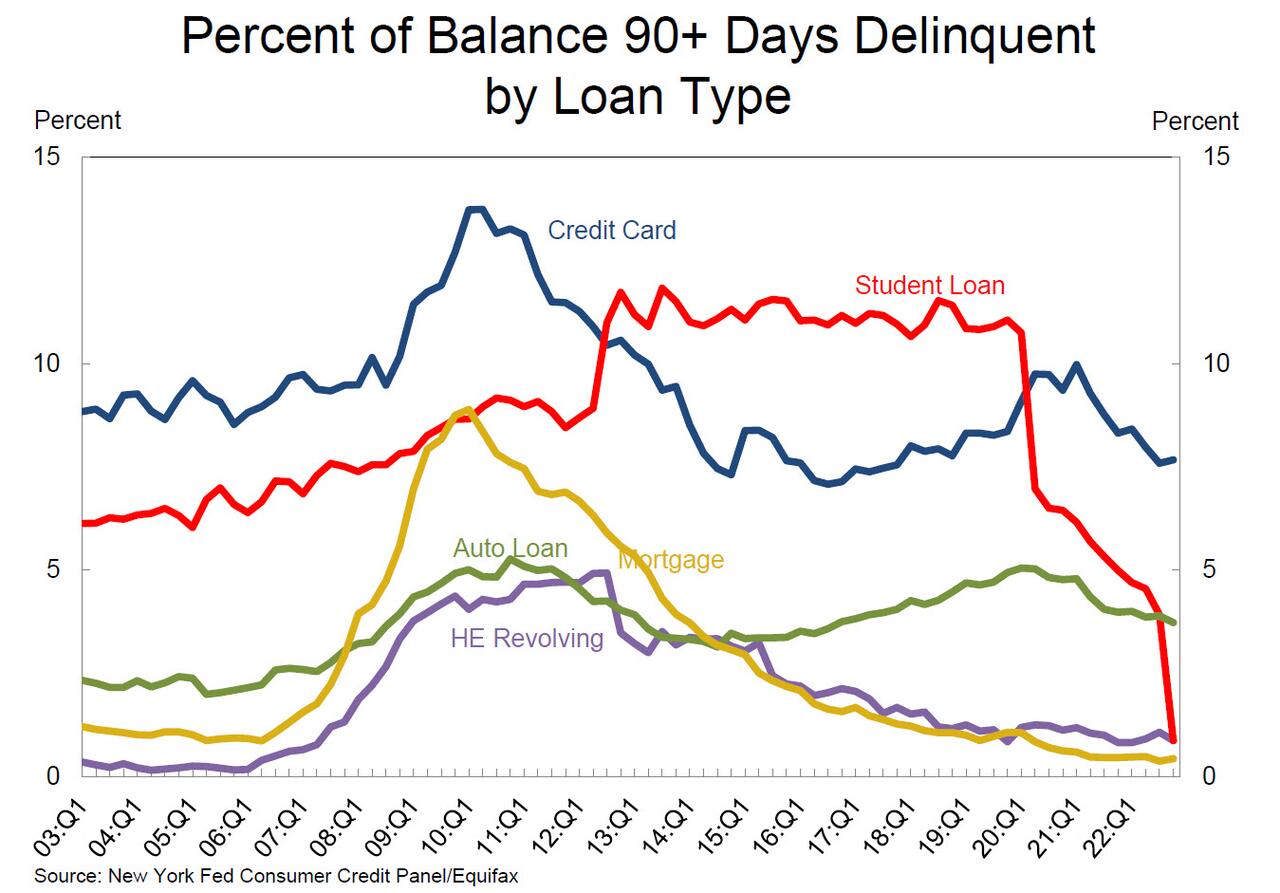
Mortgage loans considered in “serious delinquency” of 90 days or more rose to a rate of 0.57%, still low but nearly double where they were from the year prior. Auto loan debt delinquencies rose 0.6 percentage point to 2.2%, while credit card debt jumped 0.8 percentage point to 4%. The delinquency transition rate for credit cards and auto loans increased by 0.6 and 0.4 percentage points, respectively.
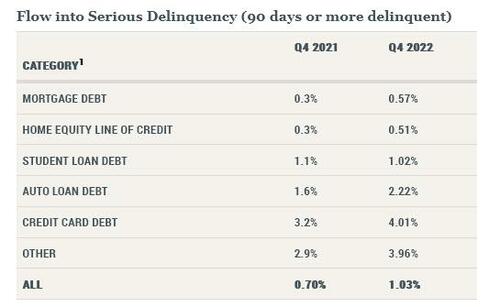
“Although historically low unemployment has kept consumer's financial footing generally strong, stubbornly high prices and climbing interest rates may be testing some borrowers' ability to repay their debts", warned van der Klaauw.

The New York Fed also issued an accompanying Liberty Street Economics blog post examining credit card and auto loan delinquency, with a focus on borrowers by age. While delinquency transition rates appear relatively small, a closer look at the uptick reveals some signs of stress amongst younger borrowers who are beginning to miss some credit card and auto loan payments. 

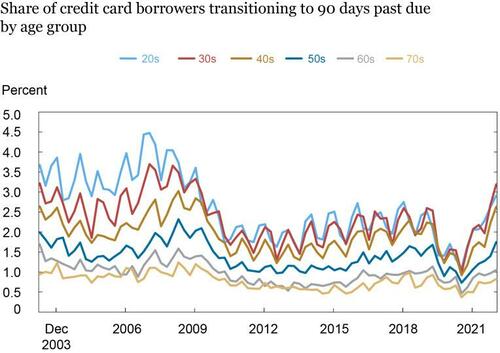
Indeed as shown in the chart below, where the NY Fed changes the focus from balances to borrowers, by measuring the percentage of borrowers that transition into late delinquency during the quarter, credit catd delinquencies are becoming a major issue for young people. [the numerator is the number of borrowers who became 90+ days past due, and the denominator is the number of borrowers who were less than 90 days past due in the previous quarter]. Specifically, credit card borrowers are missing their payments and transitioning to 90+ day delinquency at a rate higher than they had before the pandemic. (These rates are higher than the balance-weighted ones shown in the Quarterly Report because low-balance borrowers are generally more likely to become delinquent.)

The chart disaggregates these rates by age, and we see that this is particularly true for younger borrowers who have surpassed their pre-pandemic rates, while for older borrowers, the rates are rising but have not yet reached their pre-pandemic levels.
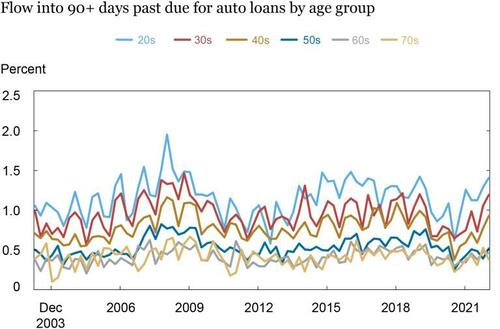
The next chart shows the same calculation, but for auto loans. We see that there’s a similar trend, although auto loan performance at the person level remains slightly healthier than it had just before the pandemic for most age groups, but younger borrowers are struggling relatively more.
The Quarterly Report includes a summary of key takeaways and their supporting data points. Overarching trends from the report’s summary include: 

Housing Debt 

  • There was $498 billion in newly originated mortgage debt in Q4 2022. After two years of historically high volumes of mortgage originations, the Q4 volume more closely resembles pre-pandemic volumes.   
  • Although the foreclosure moratoria have been lifted nationally, new foreclosures have stayed very low since the CARES Act moratorium was put into place. About 34,000 individuals had new foreclosure notations on their credit reports. 

Student Loans  

  • Outstanding student loan debt stood at $1.60 trillion in Q4 2022.
  • Less than 1% of aggregate student debt was 90+ days delinquent or in default in Q4 2022. The sharp drop in the student debt delinquency reflects the beginning of the Fresh Start program, which marked over $34 billion defaulted loans as current, amid the continued repayment pause on student loans.  

And here is why the US consumer is "so strong" - when you don't have to worry about repaying your student debt, well... you spend that money on other useless stuff.
Finally, who benefits from no longer paying student loans? Everyone
Here is the full NY Fed presentation (pdf link).

https://www.zerohedge.com/markets/consumer-debt-soars-394bn-most-20-years-record-169-trillion-young-borrowers-struggle-repay

Biden to deliver remarks addressing downed objects Thursday afternoon

 President Joe Biden will speak Thursday on “the United States’ response to recent aerial objects,” according to the White House, following the US military’s downing of a Chinese spy balloon and other unidentified high-altitude objects over North American airspace in recent weeks.

The speech is scheduled to take place at 2 p.m. ET at the White House.

Federal officials have said an initial Chinese surveillance balloon downed off the coast of South Carolina was capable of conducting signals intelligence collection operations and had a payload around the size of three buses. By comparison, the subsequent objects, which haven’t been attributed to a specific country or entity, are believed to be much smaller.

The US is now also increasingly confident that the three objects that were downed between Friday and Sunday were “benign” balloons.

It’s anticipated that new protocols on how the US will handle similar unidentified objects going forward will be released this week.

Administration officials from the Pentagon, State Department and intelligence community have briefed lawmakers on Capitol Hill on the initial Chinese spy balloon in recent days.

Republicans on Capitol Hill have criticized Biden for not approving the military to down the first balloon quickly enough, letting it sail eastward for days. They’ve also called on him to speak on the matter.

But administration officials argued that the US didn’t move earlier to shoot down the balloon in part over fears it could provoke an escalation of military tensions with China. They also told lawmakers the balloon was not first shot down when it entered Alaskan airspace because the waters there are cold and deep, making it less likely they could have recovered the balloon.

And officials had been wary of having the president speak publicly about the objects until more information was gathered about the three unidentified objects that were downed last weekend.

https://www.cnn.com/2023/02/16/politics/president-biden-downed-objects/index.html

Rand Paul Introduces Bill To Halt Funding For Hospitals Denying Care To The Unvaxxed

 by Steve Watson via Summit News,

Senator Rand Paul has introduced legislation that would see federal funding stopped for health care facilities that choose to deny critical treatment to people who have chosen not to take COVID vaccines.

“No American should be denied access to critical care based on a personal medical decision, yet tragically, many hospitals and other medical facilities continue to discriminate against those unvaccinated for COVID-19,”Paul said in a statement.

The Senator added that his bill titled The COVID-19 Vaccination Non-Discrimination Act “will protect the rights of vulnerable patients to make their own health care choices and ensure that federal taxpayer dollars do not support facilities that turn away patients based on their COVID-19 vaccination status.”

Paul points to a recent case where a 14-year-old girl was refused a kidney transplant by Duke University Hospital because her parents had chosen not to have her vaccinated.

The girl had already had a COVID-19 infection, had developed natural immunity, yet still the hospital refused to give her the critical care she needed.

Numerous hospitals across America are following the same ‘no jab, no transplant’ policy.

Two More Hospitals Demand Mandatory Vaccination Before Allowing Organ Transplants

Colorado’s UCHealth denied a woman who was in stage five renal failure a kidney transplant because she refused to take the jab.

A hospital in Cleveland also refused to a provide a 9-year-old boy a life-saving kidney transplant because his father hadn’t taken the COVID-19 vaccine.

Hospital Refuses to Give 9-Year-Old Boy Life Saving Kidney Transplant Because Father is Unvaccinated

A six-month-old baby boy in Tennessee with a heart defect was also initially denied a transplant because the parents refused to get him vaccinated, with medical ethics expert charging that the doctor involved was playing ‘COVID politics’.

A man in Boston was also denied a heart transplant because he was unvaccinated.

There are also similar shocking cases of children being denied critical transplants in multiple European countries, as well as the UK, purely because the parents had not had them vaccinated.

Senator Paul, a medical doctor himself further notes “There is no place in the medical profession for discrimination. The Hippocratic Oath demands that doctors care for their patients without prejudice and abstain from any intentional wrong-doing or harm. This bill will enshrine that basic principle in law.”

Representative Dan Bishop, who has introduced a companion bill in the House, also noted “There’s no reason that medical facilities should deny care to people based on their COVID-19 vaccination status, and there’s certainly no reason for institutions that do so to receive any federal funding.”

Without intervention such as Paul’s legislation, Americans could find themselves down the road where countries like New Zealand have ended up, with the ‘authorities’ threatening to take children away from parents who refuse to give them COVID vaccines.


https://www.zerohedge.com/political/rand-paul-introduces-bill-halt-funding-hospitals-denying-care-unvaxxed