We noted early that pension protestors in France were gathered outside of BlackRock's Paris headquarters. The protestors have now stormed the building.
Here are the current scenes from Paris:
* * *
France faces another wave of widespread protests and strikes following an unproductive discussion between the prime minister and labor unions. The failure to reach a compromise on the unpopular pension reform, which extends the working years for individuals, has fueled two-and-a-half months of public discontent.
Hundreds of thousands of people are expected to protest on Thursday against Emmanuel Macron's pension reform to raise the minimum age from 62 to 64.
Trade union leaders met the Prime Minister, Elisabeth Borne, on Wednesday, but after just an hour of talks -- they failed to find a comprise. The Guardian provides insight into some of those conversations:
Cyril Chabanier, speaking on behalf of France's eight main unions, said: "We again told the prime minister that the only democratic outcome would be the text's withdrawal. The prime minister replied that she wished to maintain the text, a serious decision."
Sophie Binet, the new leader of the CGT trade union, called for more protests and strikes after the failed talks with the prime minister:
"We have to continue mobilizing until the end, until the government understands there is no way out other than withdrawing this reform," Binet said.
Labor unions plan to keep pressure on the government until the Constitutional Council decides on the pension reform. They believe there's still a chance to block it from becoming law on April 14. If unions are unsuccessful, strikes will likely continue.
"We're in a social crisis, we have a democratic crisis, there is a problem, and the president has the solution in his hands," Laurent Berger, leader of the CFDT union, said on RTL radio.
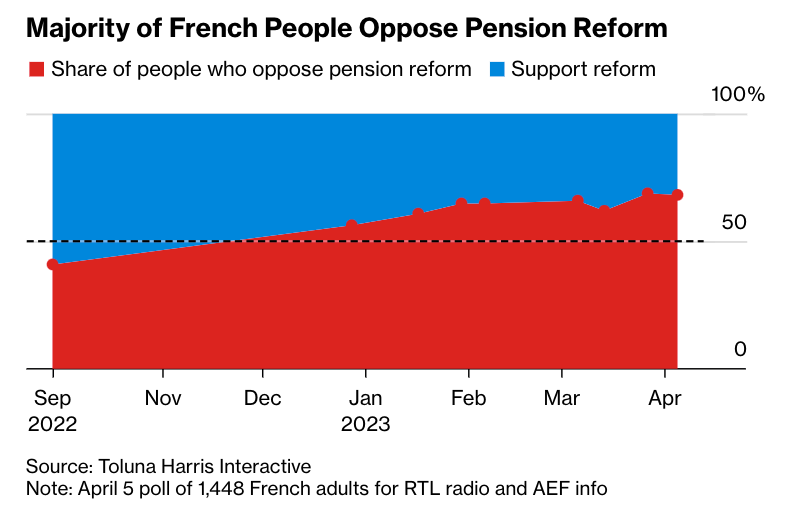
Bloomberg cited a recent poll that shows most French people oppose pension reform.
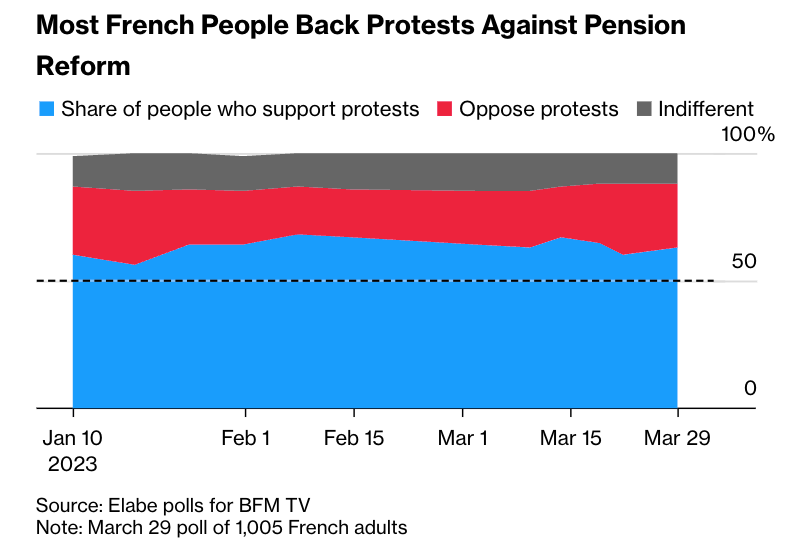
And most French people support pension reform protests.
Meanwhile, Macron is meeting with Chinese President Xi Jinping in Beijing today while France enters another round of mass protests.
Enanta Pharmaceuticals, Inc. (NASDAQ:ENTA), a clinical-stage biotechnology company dedicated to creating small molecule drugs for viral infections, today announced that the U.S. Food and Drug Administration (FDA) has granted Fast Track designation for EDP-323, Enanta’s L-protein inhibitor in development for the treatment of respiratory syncytial virus (RSV).
Even after three years since the emergence of COVID-19, much remains unknown about how it causes severe disease, including the widespread organ damage beyond just the lungs. Increasingly, scientists are learning that organ dysfunction results from damage to the blood vessels, but why the virus causes this damage is unclear. Now a multidisciplinary team of Emory researchers has discovered what they believe is the key molecular pathway.
Results of their study, published today inNature Communications, show that COVID-19 damages the cells lining the smallestblood vessels, choking offblood flow. These results could pave the way for new treatments to save lives at a time when hundreds of people are still dying from COVID-19 each day.
Doctors at Emory Healthcare started this study in the early days of the pandemic, to better understand drivers of severe COVID-19, and why adults develop severe disease more often than children. They used a so-called "multi-omics" approach, studying multiple data sets at once, to examine the biochemistry of blood from COVID patients and compared it to non-COVID patients, looking for clues.
"We were surprised by the little overlap between our adult and pediatric patients," says Cheryl Maier, MD, Ph.D., assistant professor in the Department of Pathology and Laboratory Medicine, Emory University School of Medicine, and the study's senior author. "Both groups had abnormalities related to clotting, but one unique pathway that stood out in the adults was related to vessel health and blood flow."
Maier says this finding was particularly interesting given their clinical observations that blood from patients severely ill with COVID-19 was unusually viscous: think maple syrup rather than water.
Maier worked with collaborator and co-senior author Wilbur Lam, professor in the Department of Pediatrics at Emory University and in the Wallace H. Coulter Department of Biomedical Engineering at Georgia Institute of Technology and Emory University, to create cutting-edge models of the smallest blood vessels, expected to be the most sensitive to altered blood flow, which allowed them to visualize how blood from COVID-19 patients versus other patients might be flowing in the human body.
"Watching videos from these microfluidic devices is like seeing how COVID-19 might be affecting our blood vessels in real time," Maier says. "These lab-made blood vessels are lined with real human vascular cells, called endothelial cells. You can put in plasma and red cells, any of the key components of blood and in different combinations, to watch how it behaves and see how the damage happens."
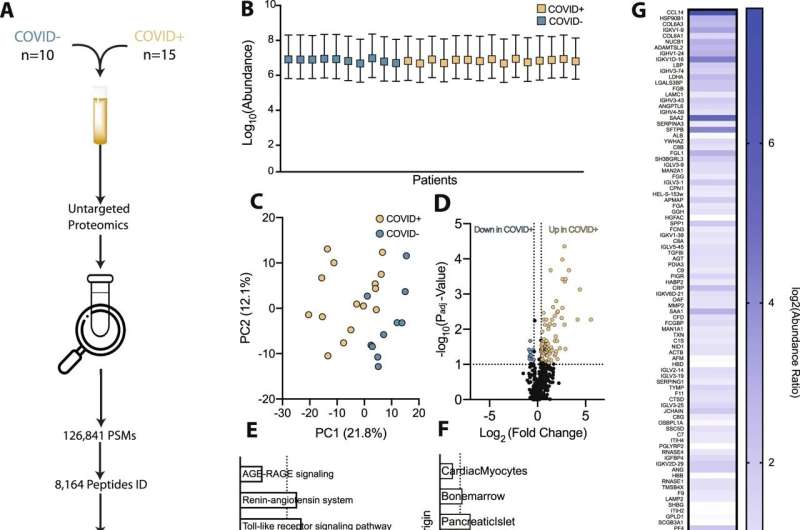
Proteomics analysis comparing adult plasma from critically ill COVID + and COVID-
Fibrinogen: A key culprit?
Since the earliest days of the pandemic, physicians have seen that a blood protein called fibrinogen was extremely elevated in patients with severe COVID-19. This protein is often elevated in other acute illnesses, but the elevations seen in the sickest COVID-19 were much higher. The body forms blood clots in part by cutting fibrinogen to form fibrin, a key component of clots, but fibrinogen itself is not thought to form clots and levels are not affected by anticlotting medications.
But the Emory researchers found that in COVID-19 patients, the sky-high levels of fibrinogen cause red blood cells to clump together, altering blood flow and directly damaging the endothelial glycocalyx, a gelatinous protective layer lining the microvessels. "Fibrinogen is one of the top three most abundant proteins in plasma," Maier says. "It's been hiding in plain sight."
When the researchers combined plasma from COVID-19 patients with red blood cells in lab-made blood vessels, they could visualize the cellular aggregation and quantify the destruction of the endothelial cell glycocalyx. "You have these large clusters of red cells that are all stuck together," Maier says. "Normally this wouldn't happen. Capillaries are so narrow that red blood cells must pass through single file. But in COVID, these aggregates stick together even under flow. It's easy to imagine how this mechanically damages the microvasculature."
Much of the new technology was developed by study co-first author Elizabeth Iffrig, MD, PHD, a critical care fellow in Emory's Department of Medicine. "The foundation of what we did was looking at how red blood cells would form these big globules that would gunk up the microvascular system," Iffrig says.
"Our methodology let us look at this in a dynamic process, seeing what happens to these aggregates as we mimic a true physiologic state of blood flow instead of just suspending them in a fluid and measuring how big they are. The methodology allowed us to quantify all those things simultaneously."
Taken together, these data suggest to Maier that the fibrinogen-induced red blood cell aggregation and resulting microvascular damage could be the major pathway by which COVID causes organ damage and even death.
There's presently no medications targeting high fibrinogen in the blood. However the team has done exploratory research using therapeutic plasma exchange: removing plasma with high fibrinogen from COVID-19 patients and replacing it with donor plasma that has normal fibrinogen levels. Maier thinks her team's discovery is critical because it provides a target that might help save lives.
More information: Samuel Druzak et al, Multiplatform analyses reveal distinct drivers of systemic pathogenesis in adult versus pediatric severe acute COVID-19, Nature Communications (2023). DOI: 10.1038/s41467-023-37269-3
A recent paper in the journalPLOS ONEsuggests that humans have yet to reach their maximum age and that there might not even be one. In the paper, "Mortality postponement and compression at older ages in human cohorts," David Mcarthy of the Terry College of Business, University of Georgia, and his former Ph.D. student, Po-Lin Wang, currently at Muma College of Business, University of Southern Florida, use mathematical modeling of longevity trends, without reference to any biological, social or medical science to extrapolate the future of human longevity.Typically in the introductory section of an academic study, the author provides context on the paper's topic, including relevant citations to help understand what body of work the study is building on.
The first citation in the introduction is a psalm from the King James Bible, which the authors suggest indicates that ancient Hebrews, around 2,500 years ago, believed the maximum age a human could reach was 80 years old. Next, there is a citation of a poem by Horace, from which the authors suggest that the ancient Romans estimated the maximum lifespan of humans to be 100 or 110 years old.
There is the uncited reference to the current human longevity record being 122, unchanged since 1997, which is likely referring to Jeanne Calment, a wealthy French woman who holds the record for the world's most extended verified lifespan. While it is an astonishing age to reach, it has been long predicted to be feasible that someone should reach this age as an outlier. What accompanies that prediction is an expectation that there would not be anyone else close to them in age, and in fact, the next closest oldest verified lifespan is a full three years less. Currently (and I do mean currently), there are eight people over the age of 114 on the planet, all women, with the oldest being 116.
It should also be noted that the lead author of the study, David McCarthy, is an editorial board member and frequent contributor to the Journal of Pension Economics and Finance and describes himself as a policy expert. Mathematical models are commonly used for setting pension goals and life insurance premiums, and predicting the ages that people will live has a long history in the world of finance. For most of that history, a preferred mathematical law from the 19th century has been relied upon with reasonable accuracy.
Gompertz law
The Gompertz law used in the study is a 202-year-old mathematical formula to model mortality rates. The law states that mortality rates increase exponentially with age, meaning the risk of death increases by a magnitude approximately every decade after age 50. The Gompertz law is named after Benjamin Gompertz, a British mathematician who first proposed the law in 1825.
Gompertz himself only believed that his model was reliable up to the age of 85; Gompertz died at age 86. Still, at 86, Gompertz was nine years older than the life expectancy of a male born in the U.S. today.
The paper in PLOS ONE refrains from involving biology in predicting a maximum age. However, it does conclude with math alone that birth year cohorts of individuals born after 1950 should be the first to experience a significant postponement in the historical progression of mortality. By calculating a fixed mortality risk rate for each year after, the study forecasts a future where longevity records will be commonly broken after 2073, with some prediction graphs running into the 140s.
While a combination of medical advances and increased starting populations by birth year favor the extension of the maximum age, the ability to reach these more extreme lifespans will require much more than statistical chance. It will require a much deeper understanding of cellular function, DNA repair, cancer mitigation and tissue rejuvenation. It will likely require lab-assisted prefertilization genetic modifications to equip the body with a genome that can withstand 140 years of cellular replication without disruptive mutations or senescence—and that generation, along with the required knowledge, has not yet been born.
More information: David McCarthy et al, Mortality postponement and compression at older ages in human cohorts, PLOS ONE (2023). DOI: 10.1371/journal.pone.0281752
Eating lots of fats increases the risk of metabolic disorders, but the mechanisms behind the problem have not been well understood. Now, University of California, Irvine biologists have made a key finding about how to ward off harmful effects caused by a high-fat diet. Their study appears inNature Communications.
The UC Irvine research centered on aprotein complexcalled AMPK, which senses the body's nutrition and takes action to keep it balanced. For example, if AMPK detects thatglucoseis low, it can boost lipid breakdown to produce energy in its place. Scientists have known that consuming high amounts of fat blocks AMPK's activity, leading the metabolism to go out of balance. However, until now, how cells block this mechanism has not been widely examined, especially in live models.
The UCI biologists decided to investigate, believing an AMPK component called SAPS3 serves a significant role. They eliminated SAPS3 from the genome of a group of mice and fed them meals with a 45% fat content. The results were startling even to the research team.
"Removing the SAPS3-inhibiting component freed the AMPK in these mice to activate, allowing them to maintain a normal energy balance despite eating a large amount of fat," said Mei Kong, professor of molecular biology and biochemistry, and the study's corresponding author. "We were surprised by how well they maintained normal weight, avoiding obesity and development of diabetes."
The discovery could eventually lead to a new way to approach metabolism-related conditions. "If we block this inhibition activity, we could help people reactivate their AMPK," said first author Ying Yang, a project scientist in the Kong lab. "It could help in overcoming disorders such as obesity, diabetes, fatty liver disease and others. It's important to recognize how important normal metabolic function is for every aspect of the body."
The researchers are working on developing molecules that could inhibit SAPS3 and restore the metabolism's balance. They plan to next study SAPS3's role in other conditions with disturbed metabolic systems, such as cancer and aging.
The discovery comes as metabolic-related diseases such as obesity and diabetes continue to rise. More than half of the global population is expected to be overweight or obese by 2035, compared to 38% in 2020, according to the World Obesity Federation. The number of people worldwide with diabetes is expected to rise to 578 million by 2030, up 25% from 2019, reports the National Center for Biotechnology Information.
More information: Ying Yang et al, SAPS3 subunit of protein phosphatase 6 is an AMPK inhibitor and controls metabolic homeostasis upon dietary challenge in male mice, Nature Communications (2023). DOI: 10.1038/s41467-023-36809-1
Oil priceseased in early Asian trade on Thursday after weak U.S. job openings data signalled cooling economic conditions which may hit demand.
West Texas Intermediate U.S. crude was down 14 cents to $80.47 a barrel at 2241 GMT. On Wednesday, Brent crude futures settled up 5 cents, or 0.1%, at $84.99 a barrel.
Prices jumped by more than 6% on Monday after the Organization of the Petroleum Exporting Countries and allies including Russia, collectively known as OPEC+, pledged voluntary production cuts.
Yet U.S. job openings in February dropped to the lowest level in nearly two years, suggesting that the labour market was cooling. The data offset market's reaction to earlier OPEC+ cuts and the recent reduction of U.S. crude and fuel stockpiles.
"Crude oil's rally paused as it battled the headwinds created by the weak economic data. This offset more positive fundamentals", ANZ Research said in a note.
On a support side, Saudi Arabia, the world's top oil exporter, has raised the prices of its flagship crude for Asian buyers for the third straight month.
"This points to further strength in demand in the region," ANZ Research added.
U.S. crude inventories fell 3.7 million barrels last week, about 1.5 million barrels more than forecast, government data showed.
Gasoline and distillate stocks also fell more than expected, drawing down by 4.1 million barrels and 3.6 million barrels, respectively.
Scilex Holding Company (Nasdaq: SCLX, “Scilex”), a subsidiary of Sorrento Therapeutics, Inc. (OTC Market: SRNEQ) (“Sorrento”), announced today that the Company’s 2023 Annual Meeting of Stockholders (the “Annual Meeting”) that was scheduled to be held at 9:00 a.m. (Pacific Time) on Thursday, April 6, 2023, has been postponed to April 17, 2023 at 9:00 a.m. (Pacific Time). Scilex is postponing the Annual Meeting due to the previously announced substantial underreporting of more than 44 million shares of its common stock by brokers, banks and other nominees (collectively, “brokerage firms”) to Broadridge Financial Solutions, Inc., an independent third party that collects and tabulates stockholder votes for the upcoming Annual Meeting, and in response to multiple brokerage firms requesting more time to complete the reporting per court order described below.
On April 4, 2023, Sorrento announced that the U.S. Bankruptcy Court for the Southern District of Texas entered an order compelling specified brokerage firms to produce non-privileged written responses to Sorrento providing certain information related to the record and beneficial ownership of Scilex common stock received by Sorrento’s stockholders in connection with Sorrento’s previously announced dividend of 76,000,000 shares of Scilex common stock held by Sorrento. The order was executed in connection with Sorrento’s chapter 11 case, which was filed on February 13, 2023. Scilex anticipates that if the brokerage firms comply with the court’s order, a substantial number of the underreported shares will be able to participate in the Annual Meeting.
For information relating to Sorrento’s press release, please click here.
For information relating to the court order, please click here.