Search This Blog

Saturday, August 5, 2023

Ukrainian Prosecutor Joe Biden Had Fired Is Speaking Out

 Former Ukrainian prosecutor Viktor Shokin is speaking out and revealing his side of the story after then Vice President Joe Biden demanded he be fired back in 2016. 


At the time of his firing, Shokin was investigating corruption at Ukrainian gas company Burisma -- the same company that was paying Hunter Biden $80,000 per month to sit on the board. 

During closed door testimony in front of the House Oversight Committee earlier this week, Hunter Biden's former business partner -- Devon Archer -- said he believed Burisma would have gone under if not for the Biden "brand" -- including Joe Biden -- being attached to the company. 

"My only thought is that I think Burisma would have gone out of business if it didn’t have the brand attached to it," Archer said. 

Recommended


Archer also revealed during an interview with Tucker Carlson that Burisma often gave him and Hunter expensive birthday gifts.    

He also emphasized Joe Biden's role in Hunter's foreign dealings.

https://townhall.com/tipsheet/katiepavlich/2023/08/04/the-ukrainian-prosecutor-joe-biden-had-fired-is-speaking-out-n2626659

China Is Losing Out as Global Funds Chase Returns in Japan Stocks

 Japan is leaving China behind as Asia’s two largest stock markets compete for investor capital, with the latter’s prospects clouded by long-running concerns about economic growth and geopolitical tensions with the West.

Foreign buying of Japanese equities has exceeded that of Chinese peers for the first time since 2017, according to a Goldman Sachs Group Inc. report, which cited data for the first six months of the year. Long-only managers continued to sell stocks in China and Hong Kong on a net basis in July despite a sharp rally, while buying shares in Japan, strategists at Morgan Stanley wrote in a report last week.

The tide has turned in favor of Japan as global funds pile into a market they once shunned due to concerns over lackluster earnings growth. Optimism is running high even after the Bank of Japan adjusted its accommodative stance, as investors seek alternatives to Chinese equities amid a lack of conviction that Beijing’s pledges to support a faltering economy will bear fruit.

“There were two main policy events in Asia in the last week of July, the BOJ meeting and the Politburo meeting, none of which change our view of Japan equities outperforming China,” said Frank Benzimra, head of Asia equity strategy at Societe Generale SA. “The reason is that we get increasing signs that the monetary policy normalization in Japan is going to be extremely gradual, which means the yen is not rapidly re-appreciating.”

Allianz Oriental Income, an Asia-focused fund with $1 billion in assets, has been boosting holdings of Japanese equities at the expense of China as part of a reallocation across the region. Japan’s weighting in the fund stood at 40% at the end of June, five times its China exposure, according to a factsheet.

China floodwater diversions to populated areas unleash wave of online anger

Nearly 1 million people in China's northern Hebei province were relocated after record rains forced authorities to channel water from swollen rivers to some populated areas for storage, sparking anger online over the homes sacrificed to save Beijing.

The vast Hai River basin covers an area the size of Poland that includes Hebei, Beijing, Tianjin. Over a span of one week from late July, the region with a population totalling 110 million experienced its most serious flooding in six decades, with Hebei, particularly Baoding prefecture, the worst hit.

According to flood control laws, when basin-wide flooding causes reservoirs, the first line of defence, to exceed their limits, water may be temporarily channelled to so-called "flood storage areas" - including low-lying populated land.

On July 31, Hebei province opened seven of its 13 designated flood storage areas, including two in the city of Zhuozhou in Baoding south of Beijing and north of Xiongan, a zone President Xi Jinping aims to develop into an economic powerhouse serving Hebei, Beijing and Tianjin.

On Aug. 1, Hebei's Communist Party Secretary Ni Yuefeng called Xiongan a top priority for the province's flood prevention work, according to local state media.

On his visit to flood storage areas in Baoding, Ni added that it was necessary to reduce the pressure on Beijing's flood control and create a "moat" for the Chinese capital.

"Beijing should foot the bill", wrote a netizen on the popular Chinese microblog Weibo.

In other posts on Zhuozhou, netizens said residents weren't aware they lived in a flood storage area and the rights of the minority had been sacrificed.

"I'd like to know, among all the people living in flood storage areas across the country, how many of them know they are living in such areas?" one angry netizen asked.

Phone calls to the Hebei provincial government on Sunday seeking comment went unanswered. It did not immediately respond to an email

https://news.yahoo.com/china-floodwater-diversions-populated-areas-030927965.html

Biden Energy Sec Consulted Chinese Energy Official Before SPR Release, Sales To Hunter Biden-Linked China Energy Giant

 US Energy Secretary Jennifer Granholm, whose catastrophic handling of US energy policy will be one of the most memorable and dire consequences of the Biden era, engaged in multiple conversations with the Chinese government's top energy official just days before the Biden administration announced it would tap the Strategic Petroleum Reserve (SPR) to combat high gas prices in 2021, the same China whose Hunter Biden-linked energy giant Unipec, which we previously learned had bought millions of barrels from the SPR release.

Granholm called China National Energy Administration Chairman Zhang Jianhua, a longstanding senior member of the Chinese Communist Party, for a half-hour one-on-one conversation on Nov. 21, 2021. Granholm’s calendar also shows an earlier phone call had been scheduled with Jianhua for Nov. 19 but a rep for the former Michigan governor said the first call never took place. Then, on Nov. 23, 2021, the White House announced a release of 50 million barrels of oil from the SPR, the largest release of its kind in U.S. history at the time.

According to Fox News, Granholm's previously-undisclosed talks with China National Energy Administration Chairman Zhang Jianhua — revealed in internal Energy Department calendars obtained by Americans for Public Trust (APT) and shared with Fox News Digital — reveal that the Biden administration likely discussed its plans to release oil from the SPR with China before its public announcement in the US: yes, China's Communist Party learned what Biden would be doing before the US did.

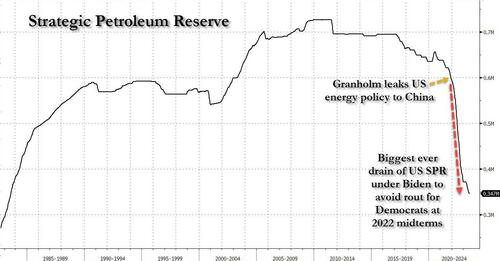
"Secretary Granholm's multiple closed-door meetings with a CCP-connected energy official raise serious questions about the level of Chinese influence on the Biden administration’s energy agenda," APT Executive Director Caitlin Sutherland told Fox News Digital, an "energy agenda" that can be summarized with just one chart:
"Instead of focusing on creating real energy independence for America, Granholm has been too busy parroting Chinese energy propaganda and insisting ‘we can all learn from what China is doing,’" Sutherland continued. "The public deserves to know the extent to which Chinese officials are attempting to infiltrate U.S. energy policy and security."

Hilariously, in response to the leaked calendar, in a statement the DOE said the meeting was broadly part of the agency's effort to combat climate change, but didn't share what was discussed at the meeting.

"Solving the climate crisis means engaging with competitors and allies in clear and substantive discussions — especially among the nations emitting the most carbon pollution into the atmosphere," a DOE spokesperson told Fox News Digital. "We must all address the transnational challenge of climate change to our planet."

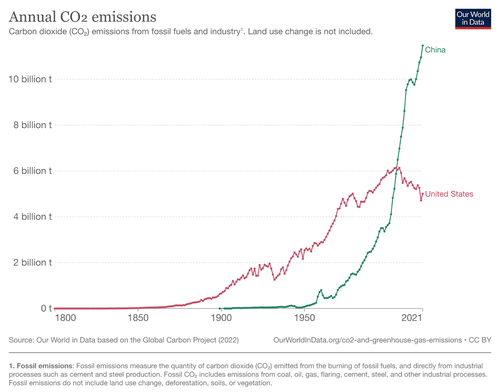
It was unclear just how the DOE is "solving climate crisis" and "addressing climate change" by engaging with China when Chinese CO2 emissions are double those of the US and rising exponentially...
... but that's irrelevant since the DOE - like every other aspect of the Biden administration - was lying.

As part of its announcement in November 2021, the White House said it was releasing oil from U.S. reserves in conjunction with "other major energy consuming nations including China." However, President Biden said in remarks after the announcement that China "may do more as well" and Granholm told reporters during a press briefing that China "will make its own announcement."

What happened next will shock nobody: instead of releasing oil stocks, China aggressively increased its own reserves, and even bought fuel from the US. Meanwhile, SPR releases have weakened U.S. national security and bolstered foreign adversaries' "geopolitical leverage" according to Republican leaders.

"China ramped up its purchases of crude oil from Russia and the United States to boost its own reserves, even as oil prices surged and President Biden called for a coordinated release," House Energy and Commerce Chair Cathy McMorris Rodgers, R-Wash., and former GOP Rep. Fred Upton wrote to Granholm last year.

"As a result, China may now control the world’s largest stockpile of oil, with total crude inventories estimated at 950 million barrels," they added.

In addition, the White House and Department of Energy has been heavily criticized for allowing SPR sales to flow to Chinese state-run energy companies. The White House then fired back in July 2022, arguing that its hands were tied since it is legally required to sell SPR oil to the highest bidder, even if said bidder will be the US adversary in the next world war... then again, with China purchasing influence over the so-called US president through his son, this too should not come as a surprise.

As noted above, the Biden administration has sold at least six million barrels of oil from the SPR to Unipec, an affiliate of the state-controlled China Petrochemical Corporation with extensive connections to Hunter Biden. Jianhua, who met with Granholm in 2021, served in a leadership role for years at the China Petrochemical Corporation, Reuters previously reported.

From September 2021 to July, the Department of Energy (DOE) has awarded three crude oil contracts with a combined value of roughly $464 million to Unipec America, the U.S. trading arm of Chinese state-owned oil company Sinopec, according to a review by The Epoch Times of the DOE documents. A Chinese firm with ties to Hunter Biden had made an investment in the national oil giant.

The sale would tap 5.9 million barrels in total from the U.S. Strategic Petroleum Reserve (SPR) to export to the Chinese firm. The latest contract was unveiled on July 10, consisting of 950,000 barrels sold for around $113.5 million.

The two most recent sales to Unipec came out of an emergency drawdown of the U.S. oil stockpile, initiated under President Joe Biden on March 31, 2022 in what he said would offset the loss of Russian oil in global markets and tame rising fuel costs at home.

The Unipec contracts have been a subject of heavy criticism since the firm’s connections to the younger Biden came into focus a year ago. Republican lawmakers and analysts have said that the selling of oil reserves to foreign adversaries such as China is at odds with U.S. energy and security needs.

Sinopec, the parent organization of Unipec, has been linked to Hunter Biden, through the state-backed Chinese private equity firm BHR Partners, which became a stakeholder of Sinopec in 2014.

Hunter served as a founding board member of BHR from 2013 through April 2020. His firm Skaneateles also held a 10 percent stake in BHR, which his lawyer said has been divested as of November 2021. On BHR’s 2021 annual report released in June, however, Skaneateles was still listed as a shareholder.

At the time of the SPR sale to Unipec, Rep. Ralph Norman (R-S.C.) said the sale demonstrates the current administration’s “rank incompetence.”

“The Biden White House obviously didn’t see a problem with loading millions of barrels from our strategic reserves onto tankers bound for foreign countries, which likely explains why they don’t see a problem selling our emergency crude oil to a Chinese gas company with ties to Hunter Biden’s investment firm,” he told The Epoch Times.

"China is profiting from President Biden’s political abuse of the Strategic Petroleum Reserve," Senate Energy and Natural Resources Committee Ranking member John Barrasso, R-Wyo., said earlier this year. "Meanwhile, America has become more vulnerable to true energy and national security emergencies."

Overall, Biden has ordered the Department of Energy to release a total of about 260 million barrels of oil stored in the SPR since taking office to combat record fuel prices hitting American consumers. In late March 2022, the president announced a draw-down of a million barrels per day from the SPR after Russia invaded Ukraine, roiling global energy markets. The SPR drain, which has offset multiple OPEC+ output cuts, has been instrumental in pushing the price of oil - and thus gasoline - lower, however at the expense of draining the strategic US reserve to 40-year lows.

The SPR's level has fallen to about 346.8 million barrels of oil, the lowest level since August 1983, according to Energy Information Administration data released on July 28. The current level is also 43% lower than its level recorded days prior to the November 2021 release.

The Senate overwhelmingly supported an amendment to this year’s annual defense bill barring future oil exports to US adversaries China, Russia, North Korea and Iran. In a letter to Granholm last year, Republican lawmakers warned that Beijing and Moscow were both buying up oil from the US.

“The Biden administration is depleting the nation’s petroleum reserves, while allowing OPEC, Russia, and China to gain geopolitical leverage over the United States,” wrote then-House Committee on Energy and Commerce ranking member Cathy McMorris Rodgers (R-Wash.) and then-House Energy subcommittee ranking member Fred Upton (R-Mich.).

“As you know, in November 2021, President Biden announced a 50-million-barrel release from the SPR that was supposed to be in tandem with other importing countries, including China,” the lawmakers told Granholm. “In reality, China ramped up its purchases of crude oil from Russia and the United States to boost its own reserves, even as oil prices surged and President Biden called for a coordinated release.”

“As a result, China may now control the world’s largest stockpile of oil, with total crude inventories estimated at 950 million barrels,” they added.

Granholm's just released calendar from Nov 2021 can be found below.

Migrants settling in at makeshift shelter in Brooklyn’s hip McCarren Park, worry about thefts, shower access

 Dozens of adult migrants who had been previously housed in Queens are settling in at the newly opened makeshift shelter at McCarren Park on the border of hipster Brooklyn neighborhoods Williamsburg and Greenpoint Saturday.

Just after midnight, 55 migrants who appeared to be all men were bused to the park’s popular Play Center, where city workers were seen bringing 100 military-style cots and baby supplies Friday, according to asylum-seekers and a spokesperson for the mayor’s office.

In videos and photos obtained by The Post, the floors of the complex’s airy rooms that housed after-school arts programs have been filled with rows of green cots covered in blue blankets. The wood-slat walls are still lined with butcher paper, photos of past events and images of Pokemon characters.

One migrant, who had been staying at a shelter in Rockaways, Queens, said he was given a heads-up two weeks ago about an upcoming move.

“We got on the bus, and they gave us the address and brought us here,” said Albeiro, a 35-year-old father of three from Colombia.

“The truth [is], we were just with the unknown on the bus. They said they were looking for a place to send us and, well, they noticed here.”

Rooms at McCarren Park’s Play Center have been transformed into a makeshift shelter.
Provided to New York Post

Maikel Perez, 25, of Venezuela, said he and other migrants are storing their belongings under their cots, but worry about thefts.

“In reality, we don’t have anything safe,” he said. “It’s very difficult … we are together, we don’t know how to store things.

“But we see each other, we know each other, we stick together.” 

City Hall informed local lawmakers Wednesday that 80 adult migrants would be housed in McCarren Park, which is popular for its pool and other facilities — just days after Hizzoner warned that the spiraling migrant crisis would soon be coming “to a neighborhood near you.” 

Migrants outside McCarren Park
Dozens of migrants are settling in at the makeshift shelter in McCarren Park in Brooklyn.
Michael Dalton for NY Post
One migrant said he had no idea the city was moving him to a makeshift shelter in Brooklyn’s popular McCarren Park.
Gregory P. Mango

Several migrants, however, were concerned about the lack of showers in the immediate shelter facility — especially since they did not seem to have clearance to use the pool’s showers as of Saturday afternoon.

Pols representing the North Brooklyn nabes promised that access to the pool and fitness center “won’t be impacted” by the impromptu shelter, but migrants staying there will have to use the same showers as poolgoers — with private access in the morning and alongside the public in the afternoon, according to City Hall.

“There is no shower here, just a few stretchers,” said Martin Cordero, a 30-year-old Venezuelan who told The Post he works construction in the Bronx and had not yet been able to bathe.

“They said they are reaching some agreement to be able to use the shower near the pool.”

Some of the migrants are concerned about people stealing things in their new shelter.
Michael Dalton for NY Post

A Parks Department official declined to comment on the migrants’ use of the pool’s showers.

One migrant, however, said the McCarren Park setup is “fine.”

“I feel comfortable here — with a roof where you can sleep and [to] not be cold or sunny, it’s fine,” said 28-year-old Carlos Enrique Sanchez Guzman, who came from Mexico and was bused up to New York two months ago.

Local lawmakers said the shelter should not affect the public’s access to the McCarren Park’s pools and other facilities.
Gregory P. Mango

When asked about neighbors’ concerns about the Play Center’s new use Friday, Adams snapped, “Everybody should have concerns.”

“We need the federal government’s help and when we make announcements on our next move, we will let everybody know,” he told The Post.

A Manhattan Supreme Court judge meanwhile suggested that she may require Gov. Kathy Hochul and state lawmakers to provide more aid to the city for it to comply with its decades-old “Right to Shelter” legal obligations, which requires City Hall to provide a bed to any person in need. 

Albany has doled out $1 billion so far to help with the estimated $4 billion-plus bill for housing and providing social services to over 56,000 migrants currently in the Big Apple shelter system. 

Nearly 100,000 asylum seekers have arrived in New York City since spring 2022.

The federal government has forked over $142 million to the city — an amount that the mayor and lawmakers have ripped as paltry.

https://nypost.com/2023/08/05/over-50-migrants-settle-in-at-makeshift-shelter-in-brooklyns-mccarren-park/

More U.S. Mining Is A Win For People And The Planet

 In a continuing trend of mixed signals from the Biden Administration, NASA of all agencies has gone on record as opposing a new lithium mining project in Nevada.

Since assuming office in 2021, President Biden has prioritized the development of wind and solar projects, but there’s been a clear and consistent hypocrisy from administration officials. To build these energy projects, we need raw materials such as copper, cobalt, and lithium – all rare earth minerals which require more mining – something the Biden Administration is refusing to champion. This was on clear display in our home state of Minnesota, where earlier this year, the Biden Interior Department banned copper-nickel mining in part of the Duluth Complex in the Superior National Forest. The Duluth Complex in northern Minnesota is home to the largest copper-nickel find in the world. The area contains 95% of America’s nickel reserves, almost 90% of our cobalt reserves, and some 33% of our copper reserves. 

Yet, with the expansion of clean energy and other mineral needs, demand for raw materials such as copper is only expected to increase in the coming years. In fact, the World Bank estimates that by 2050, our global mining needs will grow by approximately 500%. That is a massive increase, of course, and will require political willpower to mine. If we’re going to expand mining, for the wellbeing of people and our planet, we should do it here in the U.S. 

Currently, many of these raw materials are sourced from countries like China and the DR Congo. In fact, China controls 80% of the world’s rare-earth element supply, a stunning monopoly. The Chinese Communist Party (CCP) has used this monopoly to assert its influence in foreign nations, such as the DRC. These countries, though, have disturbing and abysmal labor and environmental standards. In the DRC, for example, there have been instances of child slave labor in mines, a grievous violation of basic human rights. The exploitation and mistreatment of children through forced labor is an abhorrent practice that should never be tolerated.

In contrast, the U.S. has some of the best labor and environmental standards in the world. If we reshore the mining and processing of crucial raw materials, Americans and our environment win. U.S. mining jobs are well-paying and safer for laborers than the industry often is abroad. Additionally, the U.S. is far better equipped to conserve our natural environment while conducting mining projects using advanced American technology and 21st Century mining methods. In other words, we have the tools to mine for the materials we need without destroying our environment. 

Unfortunately, it’s not only political willpower that is holding back American mining. Our burdensome permitting process is also hindering our ability to mine and process the likes of copper, cobalt, and lithium in this country. Earlier this year, Republicans in Congress passed H.R. 1, the Lower Energy Costs Act, which included Rep. Stauber’s PERMIT-MN Act and other provisions, which would modernize the permitting process for 2023 mining needs.

The fact remains that when we employ an “out of sight, out of mind” mining strategy, both Americans and our environment lose. Not only do Americans lose out on good-paying jobs, but we’re supporting a dirtier, unsafe industry abroad. If we care about our planet and our people, the U.S. will take control of its mining future.

Congressman Pete Stauber has represented Minnesota’s eighth congressional district since 2019.

Danielle Butcher Franz, born and raised in Minnesota, is the executive vice president of the American Conservation Coalition Action (ACC Action). 

https://www.zerohedge.com/energy/more-us-mining-win-people-and-planet

'At least half of all people likely to develop mental health disorders before 75": Lancet

 A recent study in The Lancet found that by the age of 75 about half of all people will develop a mental disorder. 

“These disorders typically first emerge in childhood, adolescence, or young adulthood,” reads the study, co-led by researchers from Harvard Medical School and the University of Queensland. “Services should have the capacity to detect and treat common mental disorders promptly and to optimize care that suits people at these crucial parts of the life course.”

The study included over 150,000 respondents aged 18 and older from 29 countries between 2001 and 2022. The study also noted a finding of different disorders more commonly affecting different genders than others. 

“The two most prevalent disorders were alcohol use disorder and major depressive disorder for male respondents and major depressive disorder and specific phobia for female respondents,” the study said. 

The study noted the importance of studying the frequency and timing of mental disorder development, calling it “fundamental importance for public health planning.”

https://thehill.com/policy/healthcare/mental-health/4139267-at-least-half-develop-mental-health-disorders-before-75/