Search This Blog

Sunday, August 6, 2023

Climate Scientists Criticize Alarmist Rhetoric Over Summer Temperatures

 by Katie Spence via The Epoch Times (emphasis ours),

"Extreme," "hellish," "broiling," and "deadly." These words, and then some, are being used by politicians and media to describe the summer temperatures sweeping the nation.

"The hottest month just ended. We witnessed scorching heat, extreme weather events, wildfires, and severe health consequences," said Tedros Adhanom Ghebreyesus, the director-general of the World Health Organization (WHO), on X, formerly known as Twitter.

"It's a stark reminder of the urgent need for collective action to address climate change. Let's use this alarming milestone to fuel our determination for bold climate action. Together, we can turn up the heat on sustainable solutions and create a cooler, more resilient world for generations to come."

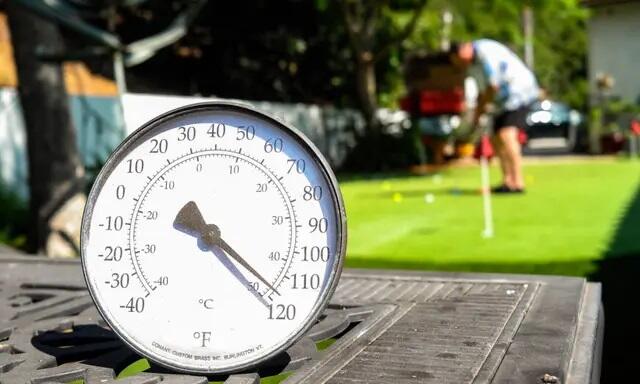
Southern California residents embrace a summer heatwave in Temecula, Calif., on Sep. 3, 2022. (John Fredricks/The Epoch Times)

Myron Ebell, director and senior fellow at the Center for Energy & Environment, said that while June and July were hot in many locations, other places experienced below-average temperatures. Los Angeles for example, experienced its 10th coolest June on record, according to the National Oceanic and Atmospheric Administration (NOAA).

"Yes, June was hot, July was hot, globally, but not through the roof," Mr. Ebell told The Epoch Times. "The planet is not boiling. Southern Europe has been very hot. But not everywhere is having record high temperatures."

A billboard displays the temperature that was forecast to reach 115 degrees Fahrenheit, in Phoenix, Ariz., on July 16, 2023. (Brandon Bell/Getty Images)

Phoenix, Arizona, did have a particularly hot July, with preliminary data showing an average high temperature of 114.7 degrees. The average high temperature from 1991 to 2020 was 106.5 degrees. The temperature readings are recorded at Phoenix-Sky Harbor International Airport, according to NOAA's National Weather Service (NWS).

And Houston, Texas, experienced a 10-degree higher than average temperature in July, according to NWS data. The station located at Houston Intercontinental recorded an average daily temperature of 97.7 degrees for July.

Still, in rural Texas towns like Water Valley, the temperature swings were nowhere near extreme. The average July temperature there was 99.8 degrees, compared to its prior average of 97 degrees.

John Christy, a climatologist and professor of atmospheric science at the University of Alabama and the director of the Earth System Science Center, said for long-term temperature accuracy, rural stations with at least 100 years of records are best to follow.

"Regionally, the West has seen its largest number of hot summer records in the past 100 years, but the Ohio Valley and Upper Midwest are experiencing their fewest," Mr. Christy told The Epoch Times.

"For the conterminous U.S. as a whole, the last 10 years have produced only an average number of records. The 1930s are still champs [for producing the most 100-plus temperature days in a year]."

The first dust storm of the monsoon season rolls over Camelback Mountain in the Paradise Valley suburb of Phoenix on July 17, 2023. (Rob Schumacher/USA Today Network via Reuters)

NOAA's primary method for collecting data on minimum and maximum temperatures are the Global Historical Climatology Network (GHCN) stations. These are land and surface stations across the globe measuring climate data, and are often located in areas of high population and infrastructure.

Mr. Ebell said temperature readings are affected by what's around the thermometer, including infrastructure and people. To get a truly accurate reading on temperature, you have to examine satellite data, he said.

Recording Temperature

Areas of high population and infrastructure experience higher temperatures, which in turn influence large scale area average temperatures because most GHCNs are located where people live and work, said Roy Spencer, a climatologist, former NASA scientist, and now a principal research scientist at the University of Alabama in Huntsville. That effect, Mr. Spencer said, is called the "urban heat island."

"As we progress to higher population stations, we find that [urban heat island] warming effect becomes larger," Mr. Spencer reported on July 13.

Mr. Ebell agrees, "If you believe the consensus climate scientists, then the urban heat island effect doesn't really amount to much. But, in fact, it does. And even fairly small places with asphalt will experience that effect."

To get a more accurate reading of the Earth's fluctuating surface temperatures in general, Mr. Spencer and Mr. Christy developed a global temperature data set from microwave data observed from satellites. They started their project in 1989 and analyzed data going back to 1979.

"With global coverage by the satellites, we could compute the true globally-averaged air temperature," Mr. Christy told the U.S. Senate Committee on Environment and Public Works in 1997. "Two specific layers have lent themselves to accurate measurements: 1) the lower troposphere, or the lowest 7 km [4.3 miles] of air next to the surface, and 2) the layer at 17 to 21 km [10.5 miles to 13 miles], or lower stratosphere."

In 1991, Mr. Christy and Mr. Spencer were awarded NASA's medal for exceptional scientific achievement for their work.

And in 1996, they received a special award by the American Meteorological Society "for developing a global, precise record of earth's temperature … fundamentally advancing our ability to monitor climate."

Mr. Christy said that recent global satellite readings measured the hottest July in 45 years by about a quarter of a degree. He said an "early and strong El NiƱo" was a "major factor" in the increase. And the eruption of Hunga Tonga in 2022 sent water vapor into the stratosphere, which could be adding extra warming.

"It is hot in some places and not in others," Mr. Christy said. “Globally, the temperatures continue to creep upward—but note that the 19th century was one of the coldest in the last 10,000 years, so we would expect Mother Nature to bounce back from that, aided a bit by the extra greenhouse gasses whose rise fundamentally indicates more and more people are experiencing longer and better lives."

In general, since 1979, the Earth's temperature has been increasing at a steady rate of 0.23 degrees Fahrenheit every 10 years, according to global satellite data, Mr. Spencer said on his website.

Sisters Olivia, 10, and Evelyn Black, 12, play in Gateway Fountains at Discovery Green park to escape the hot weather in Houston, Texas, on July 18, 2023. (Adrees Latif/Reuters)

Climate Messaging

On July 27, President Joe Biden delivered a speech, in which he stated that “record temperatures—and I mean record—are now affecting more than 100 million Americans. Puerto Rico reached a 125-degree heat index last month. San Antonio hit an all-time heat index high of 117 last month.

Mr. Biden used the heat index measurement, which combines air temperature and relative humidity, rather than temperature.

In Puerto Rico, the day the heat index reached 125 degrees, the temperature was 95 degrees, according to the NWS.

San Antonio reached a 117-degree heat index in June, thanks to three days of 105-degree temperatures on June 19, 20, and 21, according to the NWS.

Mr. Biden stated that his administration views climate change as an "existential threat."

"I don’t think anybody can deny the impact of climate change anymore," after this summer, he said. “The number one weather-related killer is heat—600 people die annually from its effects.”

In 2022, NOAA reported that 148 people died from heat-related issues in the United States.

Worldwide, however, cold weather continues to kill more people every year than heat. Cold is responsible for 4.6 million excess deaths around the globe each year, according to the Breakthrough Institute. Heat is responsible for 500,000.

Mr. Biden said his administration plans to undertake additional steps to "make our nation more resilient in future heat waves."

His plans include increasing inspections in “high-risk” industries like construction and agriculture, a $1 billion grant from the U.S. Forest Service to plant trees in cities, and directing the Department of Housing and Urban Development to ensure buildings are more "efficient" and “heat resistant."

Mr. Biden said his administration has provided "a record $50 billion for climate resiliency to restore wetlands, manage wildfires, help Americans in every state withstand extreme heat."

Mr. Christy responded to a question about the messaging of the June and July temperatures: "Every summer will see exceptionally hot temperatures somewhere. If it bleeds, it leads. A thorough look, however, at the frequency of hottest extremes indicates little relation to the gradual warming of the Earth, at least for the U.S., where we have the best observations to test these claims."

Mr. Ebell was less diplomatic, "[Climate alarmists] want to scare us into adopting expensive, pointless policies."

He said that the Biden administration and climate alarmists aren't "getting what they want" because the general population doesn't support their extreme green energy and climate crisis agenda. Consequently, they turn up the rhetoric.

"You exaggerate the effects of global warming, the scare stories about storms and hot weather, and then you downplay the cost—try to explain it's really not going to cost anything because the government will pay for it," Mr. Ebell said.

"This is really a kind of battle between conventional energy and renewable energy. And renewable energy isn't commercially viable. So, people are being forced to use it, to buy it, and there are various ways to force people to do that."

Mr. Ebell said that polls show the average American is willing to pay between $5 and $10 per month per family to support the transition to "greener" energy. But if it gets more costly than that, support dwindles. He added that people are already paying extra for energy.

Mr. Ebell said, since 2000, the world has spent approximately $6.5 trillion on transitioning away from oil, coal, and gas. The result is the world's reliance on fossil fuels has reduced from 82 percent to 81 percent.

"[The United States'] emissions have gone down. Our use of coal has gone down. But global coal demand is at an all-time high," Mr. Ebell said. "Chinese emissions are now higher than the United States, the European Union, the United Kingdom, Japan, Canada, and Australia combined.

Mr. Ebell said he believes climate change is real, but not in the way the Biden administration means it.

"They mean we're moving into this new, scary world of weather and climate crisis. But that's all fantasy," he said.

"The weather is changing all the time, and human beings have something to do with it. We're in a warming period—it's warmed up a little bit—but that's been mostly beneficial.”

https://www.zerohedge.com/weather/climate-experts-criticize-alarmist-rhetoric-over-summer-temperatures

Next job-market challenge: the Great Unresignation

 American workers have given up on quitting. Amid last month’s financial results from Wall Street was a warning from some firms that staff haven’t exited at the rate employers expected. The U.S. economy has weathered inflation without widespread layoffs so far, but a Great Unresignation could make seemingly healthy job numbers harder to read.

Just over a year ago, the financial services industry was one of several facing a labor crunch. Job openings in the industry hit a record 499,000 in June 2022, according to the Bureau of Labor Statistics, as firms’ strong demand for workers clashed with a nationwide labor shortage. That hiring spree has since cooled. The sector added 6,300 jobs last month, nearly half the gains seen in July 2022.

But a big input in firms’ hiring plans is “attrition” – the number of workers expected to quit. Giant lender Wells Fargo (WFC.N) said on July 14 that attrition had been “slower than expected” in its second quarter. State Street (STT.N) gave the same message – one shared by other firms too, executives have told Breakingviews. That creates the problem of headcount costs remaining too high, at least for a while.

Companies generally don’t hope their staff will walk. But when interest rates are going up and workers demand higher pay, attrition feels like a painless way to bring down wage bills. That's not so easy anymore, since the so-called quit rate – the percentage of the workforce leaving their employer – has sunk back to its low levels from before the pandemic. One response is for companies to hire less, and the financial sector’s ratio of job openings to current employees has fallen to its lowest since September. If that doesn’t work, layoffs do. The rate of those is edging higher. Companies have an incentive to defer the moment of wielding the ax though, for fear of seeming more troubled than their rivals. Wall Street’s cull last year showed that once one company takes the plunge, others swiftly follow.

The reassuringly low unemployment of the past 12 months, then, needs to be viewed carefully. It might be a sign that rising rates haven’t hurt the economy. But it might also reflect employees staying put until they’re given a shove. The Great Resignation of recent years was an example of how people can behave in surprising ways, temporarily distorting economic predictions. This season’s corporate earnings may tell whether another surprise is in the works.

The percentage of workers leaving their employer in the United States fell to 2.4% in July from 2.6% in the previous month, the Bureau of Labor Statistics said on Aug. 1. The so-called quit rate in the finance and insurance sector dropped to 1.1%, well below a peak of 2.4% in April 2022.

Wells Fargo flagged “slower than expected” attrition as a driver of higher severance costs during the bank’s July 14 earnings call. State Street cited similar pressure from low attrition during its own analyst call on the same day. Citigroup also mentioned severance expenses as a reason for its 9% year-over-year increase in operating costs on July 14.

The U.S. economy added 187,000 nonfarm payrolls in July, the Bureau of Labor Statistics said on Aug. 4. The unemployment rate dipped to 3.5% from 3.6%.

https://www.reuters.com/breakingviews/next-job-market-challenge-great-unresignation-2023-08-04/

From Covert To Overt: UK Govt & Businesses Unleash Facial Recognition Tech

 by Nick Corbishley via NakedCapitalism.com,

The Home Office is encouraging police forces across the country to make use of live facial recognition technologies for routine law enforcement. Retailers are also embracing the technology to monitor their customers. 

It increasingly seems that the UK decoupled from the European Union, its rules and regulations, only for its government to take the country in a progressively more authoritarian direction. This is, of course, a generalised trend among ostensibly “liberal democracies” just about everywhere, including EU Member States, as they increasingly adopt the trappings and tactics of more authoritarian regimes, such as restricting free speech, cancelling people and weakening the rule of law. But the UK is most definitely at the leading edge of this trend. A case in point is the Home Office’s naked enthusiasm for biometric surveillance and control technologies.

This week, for example, The Guardian revealed that the Minister for Policing Chris Philip and other senior figures of the Home Office had held a closed-door meeting with Simon Gordon, the founder of Facewatch, a leading facial recognition retail security company, in March. The main outcome of the meeting was that the government would lobby the Information Commissioner’s Office (ICO) on the benefits of using live facial recognition (LFR) technologies in retail settings. LFR involves hooking up facial recognition cameras to databases containing photos of people. Images from the cameras can then be screened against those photos to see if they match.

The lobbying effort was apparently successful. Just weeks after reaching out to the ICO, the ICO sent a letter to Facewatch affirming that the company “has a legitimate purpose for using people’s information for the detection and prevention of crime” and that its services broadly comply with UK Data Protection laws, which the Sunak government and UK intelligence agencies are trying to gut. As the Guardian report notes, “the UK’s data protection and information bill proposes to abolish the role of the government-appointed surveillance camera commissioner along with the requirement for a surveillance camera code of practice.”

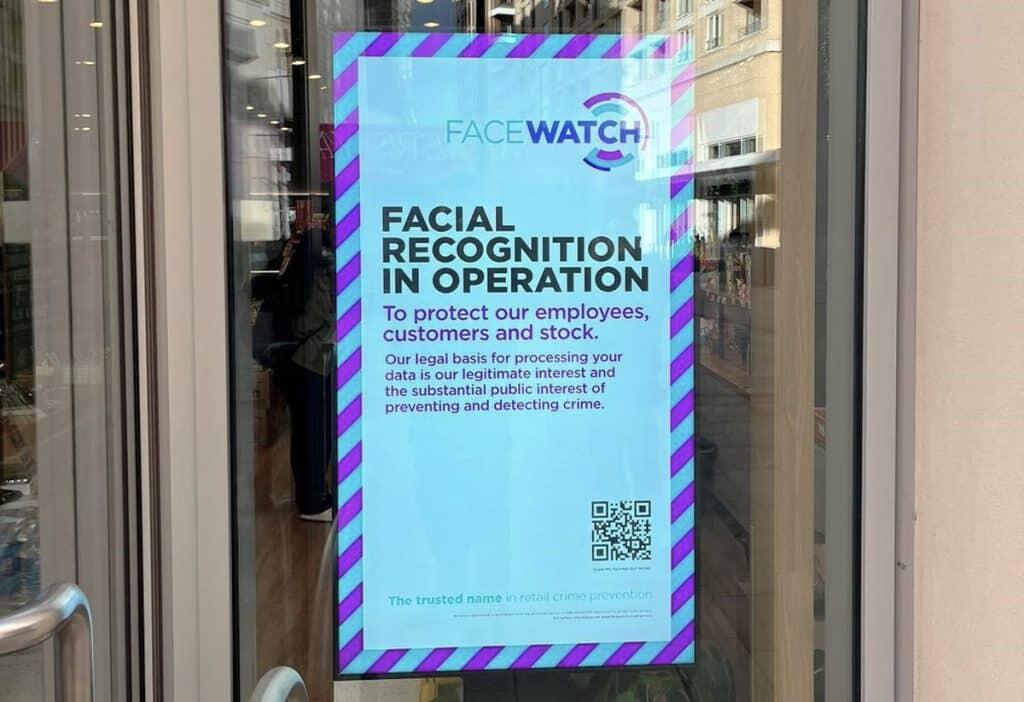
The ICO’s approval gives legal cover to a practice that is already well established. Facewatch has been scanning the faces of British shoppers in thousands of retail stores across the UK for years. The cameras scan faces as people enter a store and screens them against a database of known offenders, alerting shop assistants if a “subject of interest” has entered. Shops using the technologies have placed notices in their windows (such as the one below) informing customers that facial recognition technologies are in operation, “to protect” the shop’s “employees, customers and stock.” But it is far from clear how many shoppers actually take notice of the notices.

As examples of government outsourcing go, this is an extreme one. According to the Guardian, it is happening because of a recent explosion in shoplifting*, which in turn is due to the widespread immiseration caused by the so-called “cost of living crisis” (the modern British way of saying “runaway inflation”).* As NC readers know, runaway inflation is partly the result of corporate profiteering. So far, 400 British retailers, including some very large retail chains (Sports Direct, Spar, the Co-op), have installed Facewatch’s cameras. As the Guardian puts it, the government is “effectively sanctioning a private business to do the job that police once routinely did.”

From Covert to Overt

It is not just retailers that are making ample use of LFR technologies; so, too, is the British police. As I reported in my book Scanned, law enforcement agencies in the UK, specifically London’s Metropolitan Police Service and South Wales Police, and the US have been trialling live facial recognition (LFR) in public places for a number of years. LFR has been used in England and Wales for a number of events including protests, concerts, the Notting Hill Carnival and also on busy thoroughfares such as Oxford Street in London.

In 2019, Naked Capitalism cross-posted a piece by Open Democracy on how the new, privately owned Kings Cross complex in London had used facial recognition cameras to identify pedestrians crossing Granary Square. Argent, the developer and asset manager charged with the design and delivery of the site, then ran the data through a database supplied by the Metropolitan Police Service to check for matches. Kings Cross was just one of many parts of London where unsuspecting pedestrians were having their biometric data captured by facial recognition cameras and stored on databases.

The UK is already one of the most surveilled nations on the planet. By 2019, it was home to more than 6 million surveillance cameras – more per citizen than any other country in the world, except China, according to Silkie Carlo, director of Big Brother Watch.

Until now, the police’s use of LFR has been pretty much covert and each time information has leaked out about that use, there has been a public outcry; now, it is becoming overt. Policing Minister Chris Philip is encouraging police forces across the country to make use of LFR for routine law enforcement, as reports an article by BBC Science Focus (which, interestingly, was removed form the web but not before being preserved for posterity on the Wayback Machine):

Since police offices already wear body cameras, it would be possible to send the images they record directly to live facial recognition (LFR) systems. This would mean everyone they encounter could be instantly checked to see if they match the data of someone on a watchlist – a database of offenders wanted by the police and courts.

The Home Office’s recommendations for much broader use of LFR contradicts the findings of a recent study by Minderoo Centre for Technology and Democracy, at the University of Cambridge, which concluded that LFR should be banned from use in streets, airports and any public spaces – the very places where police believe it would be most valuable.

Unsurprisingly, consumer groups and privacy advocates are up in arms. The civil liberties and privacy campaigning organisation Big Brother Watch has organised an online petition to call on Home Secretary Suella Braverman and Metropolitan Police Commissioner Mark Rowley to stop the Met from using LFR. As of writing, the petition is on the verge of reaching its target number (45,000 signatures).

“Live facial recognition is a dystopian mass surveillance tool that turns innocent members of the public into walking ID cards,” says Mark Johnson, advocacy manager at Big Brother Watch:

Across seven months, thirteen deployments, hundreds of officer hours, and over half a million faces scanned in 2023, police have made just three arrests from their use of this intrusive and expensive mass surveillance tool… Rather than promote its use, the Government should follow other liberal democracies around the world that are legislating to ban this Orwellian technology from public spaces.

Those liberal democracies include the European Parliament which, to its credit, recently decided to ban the use of invasive mass surveillance technologies in public areas in its Artificial Intelligence Act (AI Act). However, that ban does not extend to EU borders, where police and border authorities plan to use highly invasive biometric identification technologies, such as handheld fingerprint or iris scanners, to register travellers from third countries and screen them against a multitude of national and international databases.

Reasons for Concern

UK citizens have plenty of reasons to be concerned about the proliferation of facial recognition cameras and other biometric surveillance and control systems. They represent an extreme infringement on privacy, personal freedoms and basic legal rights, including arguably the presumption of innocence. In fact, the use of LFR has been successfully challenged by British courts and civil liberty groups on the grounds that the technology can infringe on privacy, data protection laws (which, as I mentioned, the British government is trying to gut) and can be discriminatory.

Amnesty International puts it even more bluntly: AI-enabled remote biometric identification systems cannot co-exist with a codified system of human rights laws:

“There is no human rights compliant way to use remote biometric identification (RBI). No fixes, technical or otherwise, can make it compatible with human rights law. The only safeguard against RBI is an outright ban. If these systems are legalized, it will set an alarming and far-reaching precedent, leading to the proliferation of AI technologies that don’t comply with human rights in the future.”

Another common problem is that the internal workings of biometric surveillance tools, and how they collect, use, and store data, are often shrouded in secrecy, or at least opacity. They are also prone to biases and failure. This is particularly true of live facial recognition, as the BBC Science Focus article cautions:

Often the neural network trained to distinguish faces has been given biased data – typically as it is trained on more male white faces than other races and genders.

Researchers have shown that while accuracy of detecting white males is impressive, the biased training means that the AI is much less accurate when attempting to match females faces and of the faces of people of colour.

Facewatch CEO Simon Gordon claims that the current accuracy of the company’s camera technology is 99.85%. As such, he says, misidentification is rare and when it happens, the implications are “minor.” But then he would say that; he has a product to sell.

Lastly, the systems pose another major problem (and I encourage readers to chime in with others): they are AI-operated. As such, many of the decisions or actions taken by retailers, corporations, banks, central banks and local, regional or national authorities that affect us will be fully automated; no human intervention will be needed. That means that trying to get those decisions or actions reversed or overturned is likely to be a Kafkaesque nightmare that even Kafka may have struggled to foresee.

https://www.zerohedge.com/technology/covert-overt-uk-govt-businesses-unleash-facial-recognition-technologies-across-urban

Iowa Governor Deploys Troops To Mexico Border Using COVID-19 Funds

 by Samantha Flom via The Epoch Times (emphasis ours),

Iowa Gov. Kim Reynolds has deployed 109 Iowa National Guard troops to the U.S.–Mexico border to assist Texas in stemming the flow of illegal immigrants into the United States.

The operation, the Republican governor said on Aug. 2, will be paid for with funds allocated to the state under the American Rescue Plan Act, also known as the COVID-19 stimulus package, which she said offers flexibility in how the funds are spent.

The Biden administration has failed to respond to the crisis at the border and, in doing so, has failed the American people—Iowans included,” Ms. Reynolds said in a statement.

“They have created one of the most significant national security and humanitarian crises of our generation and are blatantly ignoring the impact it’s having on our states, cities, and our people.

Since the administration refuses to invest in securing the border and protecting its citizens, Texas has asked other states to help, and Iowa is ready and willing to assist.

Texas Gov. Greg Abbott (R), another vocal critic of the Biden administration, launched Operation Lone Star in March 2021 amid the mounting flood of illegal immigrants and drugs across the border into his state.

Since then, other Republican governors have sent troops to help hold the line.

According to U.S. Customs and Border Protection, U.S. Border Patrol has encountered nearly 6 million illegal immigrants at the southern border since President Joe Biden took office—a fact that Ms. Reynolds attributes to his policies.

On his first day in office, President Biden reversed commonsense policies that protected the U.S. southern border and American citizens,” she noted.

“Since that time, our country has experienced a historic rise in illegal immigrants and illicit drugs entering our country.

"Two years later, every state is a border state and Iowa’s unique location at the intersection of two major interstates makes it a target for human traffickers and drug cartels.”

According to the governor’s office, the National Guard soldiers began their journey south on Aug. 2. Their deployment will last through Sept. 1, during which time they will aim to deter illegal border crossings and prevent the trafficking of illegal substances through Texas.

On Aug. 31, the troops will be joined by a group of Iowa State Patrol officers from the Iowa Department of Public Safety.

That deployment, ending on Oct. 2, will support Texas State Troopers with criminal interdiction, crime prevention, traffic enforcement, and law enforcement assistance.

Operation Lone Star

According to Mr. Abbott’s office, Operation Lone Star has led to more than 397,900 illegal immigrant apprehensions and more than 31,800 criminal arrests at the border.

Additionally, Texas law enforcement has seized more than 422 million lethal doses of fentanyl in the operation.

Yet even so, the crisis continues.

Following the end of Title 42 expulsions in May, Mr. Abbott called upon his fellow governors for help addressing the anticipated influx of illegal border-crossers.

The flood of illegal border activity invited by the Biden administration flows directly across the southern border into Texas communities, but this crisis does not stop in our state.

"In the federal government’s absence, we, as governors, must band together to combat President Biden’s ongoing border crisis and ensure the safety and security that all Americans deserve,” he wrote in a May 16 letter to all of the nation’s governors.

“Join us in the mission to defend our national sovereignty and territorial integrity and send all available law enforcement personnel and resources to the Texas-Mexico border to serve alongside our thousands of Texas National Guard soldiers and Texas Department of Public Safety troopers,” he entreated.

In response, Ms. Reynolds led 23 other Republican governors in pledging their support for Texas’s efforts.

“The federal government’s response handling the expiration of Title 42 has represented a complete failure of the Biden administration,” they said in a statement.

“While the federal government has abdicated its duties, Republican governors stand ready to protect the U.S.–Mexico border and keep families safe.”

Answering the Call

The latest deployment marks the third time since 2020 that Ms. Reynolds has sent troops to the border, but she isn't the only Republican governor to do so this week.

On July 31, Nebraska Gov. Jim Pillen announced his intention to send 60 National Guard personnel to Texas.

Those troops also deployed on Aug. 2 and will assist with observation and reporting along the border for about a month.

“This mission is critical to the security of Nebraska as well as other states,” Mr. Pillen said in a statement.

“We need to maintain the safety of our citizenry and stem the ongoing influx of illegal drugs, weapons, and criminals into our borders.”

The governor added that federal funds would cover the cost of the deployment.

Other states that have recently dispatched troops to the border include Florida, Virginia, and South Carolina, among others.

Homeland Security Secretary Alejandro Mayorkas has rejected criticism of his handling of the border, maintaining that the Biden administration’s policies are “working.”

https://www.zerohedge.com/political/iowa-governor-deploys-troops-mexico-border-using-covid-19-funds

Saturday, August 5, 2023

China's Ukraine peace talks gambit shows shifts amid hard realities

 China's decision to join international talks in Saudi Arabia this weekend seeking to end Russia's war in Ukraine signals possible shifts in Beijing's approach but not a U-turn in its support for Moscow, analysts say.

While Beijing declined to join earlier talks in NATO member Denmark, analysts said it feels far more comfortable joining the effort in Saudi Arabia, even if Russia is not present and Ukraine is pushing its own plan.

China has refused to condemn Moscow for the invasion it launched in February 2022 but has offered its own peace plan, Beijing appears to be confronting some hard realities as the conflict drags on.

"Beijing has been gearing more toward peace efforts but it also knows that a peace initiative led by Beijing is unlikely to be embraced by the West at this point," said Yun Sun, a director of the China programme at the Stimson Center think tank in Washington.

"Beijing will not want to be absent from other credible peace initiatives that are led by non-Western countries."

Peace envoy Li Hui was joining senior officials from some 40 countries in Jeddah, China's foreign ministry said on Friday, for talks that Ukrainian and Western envoys hope will forge key principles for an eventual settlement to end the war.

Beijing's latest move on the global diplomatic stage comes as President Xi Jinping grapples with a host of internal issues, including the unexplained replacement last month of Qin Gang as foreign minister, the abrupt replacement of the top brass at the People's Liberation Army Rocket Force and deepening woes for the world's second-biggest economy.

China did not attend the talks in Copenhagen in late June, despite being invited and having proposed its own 12-point plan for peace.

'COMPLEX MANOEUVRE'

Beijing has maintained close economic and diplomatic ties with Russia since President Vladimir Putin ordered the invasion, and has accused U.S.-led Western forces of seeking to prolong the conflict by providing arms and support to Ukraine.

Visualizing America's Import-Reliance Of Key Minerals

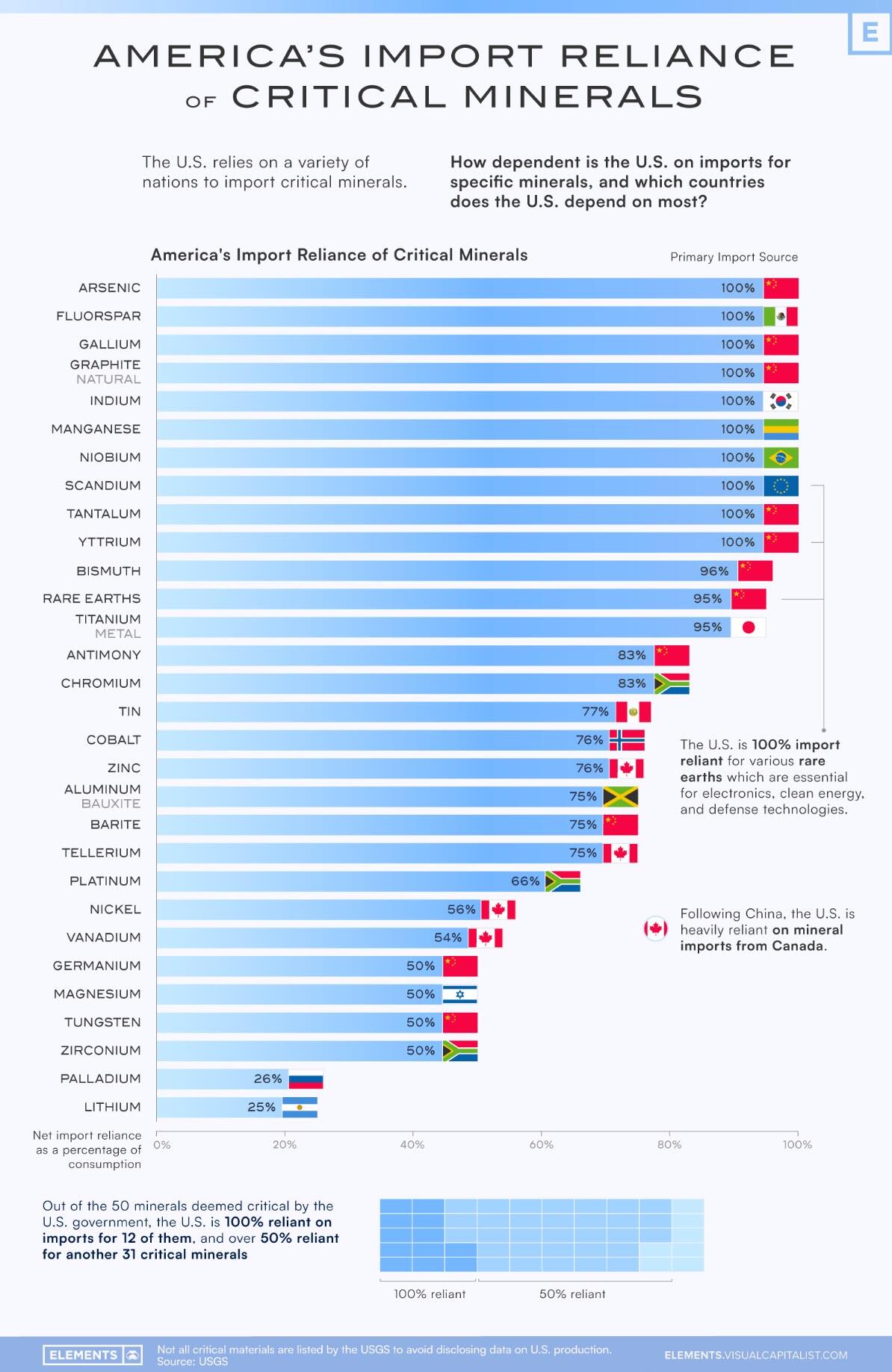
 The push towards a more sustainable future requires various key minerals to build the infrastructure of the green economy. However, the U.S. is heavily reliant on nonfuel mineral imports causing potential vulnerabilities in the nation’s supply chains.

Specifically, the U.S. is 100% reliant on imports for at least 12 key minerals deemed critical by the government, with China being the primary import source for many of these along with many other critical minerals.

In the following infographic, Visual Capitalist's Niccolo Conte and Pernia Jamshed use data from the U.S. Geological Survey (USGS) to visualize America’s import dependence for 30 different key nonfuel minerals along with the nation that the U.S. primarily imports each mineral from.

U.S. Import Reliance, by Mineral

While the U.S. mines and processes a significant amount of minerals domestically, in 2022 imports still accounted for more than half of the country’s consumption of 51 nonfuel minerals. The USGS calculates a net import reliance as a percentage of apparent consumption, showing how much of U.S. demand for each mineral is met through imports.

Of the most important minerals deemed by the USGS, the U.S. was 95% or more reliant on imports for 13 different minerals, with China being the primary import source for more than half of these.

MineralNet Import Reliance as Percentage of ConsumptionPrimary Import Source (2018-2021)
Arsenic100%šŸ‡ØšŸ‡³ China
Fluorspar100%šŸ‡²šŸ‡½ Mexico
Gallium100%šŸ‡ØšŸ‡³ China
Graphite (natural)100%šŸ‡ØšŸ‡³ China
Indium100%šŸ‡°šŸ‡· Republic of Korea
Manganese100%šŸ‡¬šŸ‡¦ Gabon
Niobium100%šŸ‡§šŸ‡· Brazil
Scandium100%šŸ‡ŖšŸ‡ŗ Europe
Tantalum100%šŸ‡ØšŸ‡³ China
Yttrium100%šŸ‡ØšŸ‡³ China
Bismuth96%šŸ‡ØšŸ‡³ China
Rare Earths (compounds and metals)95%šŸ‡ØšŸ‡³ China
Titanium (metal)95%šŸ‡ÆšŸ‡µ Japan
Antimony83%šŸ‡ØšŸ‡³ China
Chromium83%šŸ‡æšŸ‡¦ South Africa
Tin77%šŸ‡µšŸ‡Ŗ Peru
Cobalt76%šŸ‡³šŸ‡“ Norway
Zinc76%šŸ‡ØšŸ‡¦ Canada
Aluminum (bauxite)75%šŸ‡ÆšŸ‡² Jamaica
Barite75%šŸ‡ØšŸ‡³ China
Tellerium75%šŸ‡ØšŸ‡¦ Canada
Platinum66%šŸ‡æšŸ‡¦ South Africa
Nickel56%šŸ‡ØšŸ‡¦ Canada
Vanadium54%šŸ‡ØšŸ‡¦ Canada
Germanium50%šŸ‡ØšŸ‡³ China
Magnesium50%šŸ‡®šŸ‡± Israel
Tungsten50%šŸ‡ØšŸ‡³ China
Zirconium50%šŸ‡æšŸ‡¦ South Africa
Palladium26%šŸ‡·šŸ‡ŗ Russia
Lithium25%šŸ‡¦šŸ‡· Argentina

These include rare earths (a group of 17 nearly indistinguishable heavy metals with similar properties) which are essential in technology, high-powered magnets, electronics, and industry, along with natural graphite which is found in lithium-ion batteries.

These are all on the U.S. government’s critical mineral list which has a total of 50 minerals, and the U.S. is 50% or more import reliant for 43 of these minerals.

Some other minerals on the official list which the U.S. is 100% reliant on imports for are arsenic, fluorspar, indium, manganese, niobium, and tantalum, which are used in a variety of applications like the production of alloys and semiconductors along with the manufacturing of electronic components like LCD screens and capacitors.

China’s Gallium and Germanium Restrictions

America’s dependence on imports for various minerals has resulted in a new challenge resulting from China’s announced export restrictions on gallium and germanium that took effect August 1st, 2023. The U.S. is 100% import dependent for gallium and 50% import dependent for germanium.

These restrictions are seen as a retaliation against U.S. and EU sanctions on China which have restricted the export of chips and chipmaking equipment.

Both gallium and germanium are used in the production of transistors and semiconductors along with solar panels and cells, and these export restrictions present an additional hurdle for critical U.S. supply chains of various technologies that include LED lights and fiber-optic systems used for high-speed data transmission.

The restrictions also affect the European Union, which imports 71% of its gallium and 45% of its germanium from China. It’s another stark reminder to the world of China’s dominance in the production and processing of many key minerals.

The announcement of these restrictions has only highlighted the importance for the U.S. and other nations to reduce import dependence and diversify supply chains of key minerals and technologies.

https://www.zerohedge.com/commodities/visualizing-americas-import-reliance-key-minerals

Evidence Of Biden Burisma Corruption Is Overwhelming

 A key associate of Hunter Biden reluctantly admitted details about how the Biden family business was run — and those details are shocking.

Devon Archer, a longtime business partner and close friend of Hunter Biden’s, told congressional investigators Monday that at a meeting in Dubai on Dec. 4, 2015, top executives of Ukrainian energy concern Burisma asked Hunter Biden and himself for help from D.C. At the time of the meeting, Hunter Biden’s dad, Joe Biden, was serving as Barack Obama’s vice president as well as his point person on Ukraine. Mykola Zlochevsky, the owner of Burisma, and Vadym Pozharski, a Burisma executive, wanted to get Ukrainian prosecutor Viktor Shokin fired as he was investigating the company for corruption, Archer told members of Congress.

Hunter Biden put Zlochevsky and Pozharski on a call with “D.C.,” Archer said, noting he was not part of the phone call so couldn’t possibly know who exactly was on the other end of the line. Joe Biden did meet and speak more than 20 times with various business associates who were paying for access to the Biden family, Archer admitted.

In this case, Burisma was paying Archer and Hunter Biden as much as $83,000 a month to serve on the Ukrainian energy concern’s board, despite the fact that neither man had relevant experience or expertise for the job outside of their frequent meetings and contact with the then-vice president. The two were hired the same month that the U.K. had opened an investigation into company officials. The money was well spent.

A mere five days after the Dubai meeting and phone call, Vice President Joe Biden gave a speech to the Ukrainian Rada, its parliament in Kyiv, attempting to lay the groundwork for firing Shokin.

It took just a few short months before Shokin was fired. Joe Biden bragged in a public speech in January 2018 that he was personally responsible for getting that firing accomplished so quickly. In fact, he claimed he had bullied the Ukrainian government into firing the investigator by threatening to withhold a billion-dollar loan guarantee unless he got what he wanted. Seriously:

And I was supposed to announce that there was another billion-dollar loan guarantee. And I had gotten a commitment from Poroshenko and from Yatsenyuk that they would take action against the state prosecutor. And they didn’t. So they said they had — they were walking out to a press conference. I said, nah, I’m not going to — or, we’re not going to give you the billion dollars. They said, you have no authority. You’re not the president. The president said — I said, call him. (Laughter.) I said, I’m telling you, you’re not getting the billion dollars. I said, you’re not getting the billion. I’m going to be leaving here in, I think it was about six hours. I looked at them and said: I’m leaving in six hours. If the prosecutor is not fired, you’re not getting the money. Well, son of a bitch. (Laughter.) He got fired.

What an amazing series of events that led to Joe Biden personally fulfilling what Burisma was paying Hunter Biden to accomplish. What are the odds?

Not the Weather

After Archer’s transcribed interview, Rep. Dan Goldman, a Democrat from New York who previously ran some of the Russia-collusion hoax as a congressional staffer, ran to the cameras to cushion the blow of the explosive new information.

For years, the corporate press and other Democrats had uncritically accepted Biden’s preposterous claim that he had never spoken with his son or his son’s business partners about the Biden family business. Even when Biden business associate Tony Bobulinski described — in detail, on the record, and with supporting evidence — how Joe Biden served as the “chairman” of the family business, the media largely ignored the explosive claims.

With Archer echoing Bobulinski’s claims, and further noting that the business wouldn’t have worked without Joe Biden’s “brand,” Goldman and others like him had to concede that Biden did in fact speak with Hunter’s business associates. In fact, they had to admit he spoke with them frequently. However, Goldman claimed, they were only talking about the weather.

While no one actually thinks Joe Biden has a secret interest in meteorology that he only shares with corrupt foreign oligarchs who happen to be in business with his son, the claim is ridiculous for another reason.

As conservative broadcaster Larry O’Connor wrote, “Understand this: Hunter getting Joe on speakerphone WAS THE DELIVERABLE. It literally doesn’t matter what was discussed. Showing that he could get the Vice President of the United States on the phone was all Hunter had to show his clients to seal the deal. He was selling ACCESS not policy. Getting The Big Guy to pick up the phone demonstrated his ability to deliver that access. Case closed. Impeach.”

Otherwise, why would Joe Biden get on the phone with his business associates at all? Why would Barack Obama’s point man in Ukraine be talking to Ukrainian officials under suspicion of massive corruption who were paying large sums of money to his son? What was the point, exactly, if not as chairman of the family business?

We know Burisma was paying Biden family members for help getting powerful people in D.C. to get investigators off its back. We know Biden was the top official in D.C. related to Ukraine. Five days after Burisma made the request, Biden was laying the groundwork for the firing. And he has publicly bragged about getting the prosecutor fired.

In 2019, President Donald Trump was impeached for raising the issue of a potential corruption scandal involving Joe Biden, Hunter Biden, and Burisma. At that time, scores of corporate media and other Democrat activists asserted without evidence that Shokin was not investigating Burisma and that it was a lie to suggest otherwise.

For instance, Glenn Kessler of The Washington Post wrote in 2019, “Trump has falsely claimed that Biden in 2015 pressured the Ukrainian government to fire Viktor Shokin, the top Ukrainian prosecutor, because he was investigating Ukraine’s largest private gas company, Burisma, which had added Biden’s son, Hunter, to its board in 2014. There are two big problems with this claim: One, Shokin was not investigating Burisma or Hunter Biden, and two, Shokin’s ouster was considered a diplomatic victory.”

Since that false “fact” “check,” investigators in the House and Senate have shown that the Biden family business involves oligarchs and other powerful figures from Russia, Romania, China, and even France and other countries. Joe Biden reportedly met and spoke with his son’s employers from across the globe. The corporate press and other Democrats will fight disclosure about the Biden family business every step of the way, but Archer’s transcribed interview shows how important it is to reveal the truth of that business to the American people.

Mollie Ziegler Hemingway is the Editor-in-Chief of The Federalist. She is Senior Journalism Fellow at Hillsdale College and a Fox News contributor. She is the co-author of Justice on Trial: The Kavanaugh Confirmation and the Future of the Supreme Court. She is the author of "Rigged: How the Media, Big Tech, and the Democrats Seized Our Elections."