Search This Blog

Wednesday, August 16, 2023

Sinema rips Biden, Dems for giving $100M in border funds to NY while Arizona sees $24M

 Sen. Kyrsten Sinema slammed Democratic Party leaders again Wednesday for celebrating more than $100 million in federal funds to help shelter migrants in New York while her own border state of Arizona was given a fraction of that.

The senator, who left the Democratic Party in December to become an independent, doubled down on criticism she made earlier this month of Senate Majority Leader Chuck Schumer (D-NY) and House Minority Leader Hakeem Jeffries (D-NY) after the two boasted in June of securing Gotham $104.6 million of an $800 million grant from the Biden administration.

The Federal Emergency Management Agency awarded just $23,890,395 in the same month to organizations in Arizona through its Shelter and Services Program, according to its webpage.

In an interview with Politico published Wednesday, Sinema said the reason for the discrepancy was “fairly obvious.”

“I don’t know if you noticed, but the announcement about that $104 million came out first, in a joint press release from Schumer and Jeffries — not from the White House or from FEMA,” she told the outlet. “The first news of it broke by their press release. Now, how did that happen?”

Sinema added that she followed up with officials at both the Department of Homeland Security and the White House, telling them the decision was “deeply, deeply wrong.”

“This administration has been working from day one to build a safe, orderly, and humane immigration system and we’ve led the largest expansion of lawful pathways for immigration in decades,” a White House spokesperson said in a statement to Politico. “We are committed to our continued partnership with border communities to ensure they can receive the support they need.”

The Senate tucked the federal funds into its $1.7 trillion omnibus spending bill passed last December — months before President Biden moved to end Title 42 deportations in May.

Senate Majority Leader Chuck Schumer (D-NY) and House Minority Leader Hakeem Jeffries (D-NY)
The senator doubled down on her criticism earlier this month of Senate Majority Leader Chuck Schumer (D-NY) and House Minority Leader Hakeem Jeffries (D-NY).
Getty Images

Sinema had told an attendee at an Aug. 2 roundtable in Yuma that her staff would “be really upset” with her for speaking candidly about the issue but she would “tell you the truth here.”

“The reason the money is going to New York is because the Speaker of the House is from New York and the leader of the United States Senate is from New York,” she said, apparently misidentifying Jeffries’ title. “That is how a bunch of money went to New York.”

President Biden
The Senate tucked the federal funds into its $1.7 trillion omnibus spending bill passed last December — months before President Biden moved to end Title 42 deportations.
REUTERS
Senate Majority Leader Chuck Schumer (D-NY)
“I don’t know if you noticed, but the announcement about that $104 million came out first, in a joint press release from Schumer and Jeffries — not from the White House or from FEMA,” Sinema said.
AP

“The money was intended, and there’s language that was put in in the law that said it should be going for decompression at the border,” she also said.

“The fact that a yeoman’s amount of this money went to New York City, in my opinion, is wrong because they are not a border state and they are not facing the kind of pressure that we are facing here.”

Schumer and Jeffries called the disbursement “the largest share” of any federal funds to states for supporting asylum seekers, according to their press release.

Reps for Schumer and Jeffries did not immediately respond to a request for comment.

Mayor Eric Adams has said the Big Apple faces a shocking $12 billion price tag over the next year to house and care for its growing migrant population.

“We are past our breaking point,” Adams warned the Biden administration in an address at City Hall.

House Minority Leader Hakeem Jeffries (D-NY)
Schumer and Jeffries called the disbursement “the largest share” of any federal funds to states for supporting asylum seekers.
AP
New York City Mayor Eric Adams
New York City Mayor Eric Adams said the Big Apple faces a shocking $12 billion cost in the next year to house and care for its growing migrant population.
Matthew McDermott

Arizona Democratic Rep. Ruben Gallego has also criticized the Biden administration for its decision to allocate the “funding away from border communities and towards interior states.”

“After continued conversations with entities in Arizona whose funding has been altered under the new allocation, it is clear Arizona’s communities face potentially dire funding cliffs,” Gallego wrote in an Aug. 1 letter to Homeland Security Secretary Alejandro Mayorkas.

The Arizona Democrat said his state’s funds would last only a few months before running out.

The frustration comes as Gallego prepares to potentially face Sinema in a competitive, three-way Senate election next year.

Sen. Kyrsten Sinema (I-Ariz.)
Sinema said the reason for the money discrepancy was “fairly obvious.”
Getty Imagges
Few Republican candidates have announced their campaigns for Senate in the border state, though reports indicate failed 2022 gubernatorial contender Kari Lake has considered entering the race.

More than 32,000 migrants crossed the US-Mexico border into the Yuma and Tucson sectors this past June, Customs and Border Protection data show. Nearly 10,000 arrive every month in New York City.

https://nypost.com/2023/08/16/arizona-sen-sinema-rips-biden-dems-for-giving-100k-in-border-funds-to-ny/

Thanks To Government, Maui's Lahaina Fire Became A Deadly Conflagration

 by Connor O'Keefe via The Mises Institute,

The most destructive natural disasters are never 100 percent natural. Human choices, land use, and government policies play a big role in how harmful hurricanes, tornadoes, earthquakes, flash floods, and wildfires are to the affected communities.

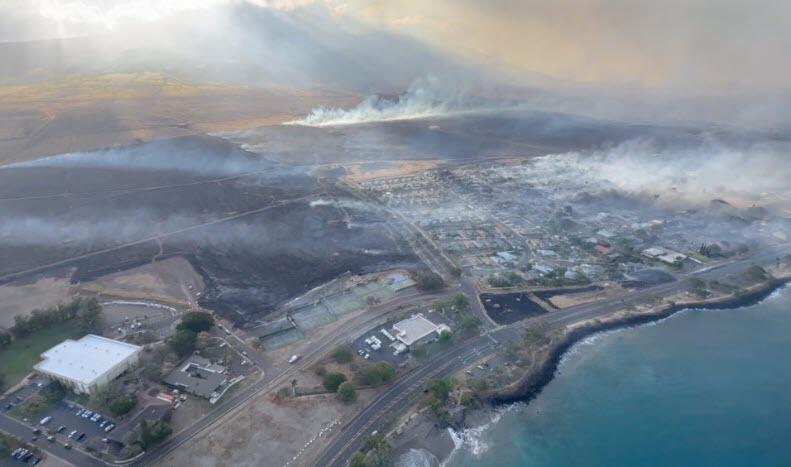
And after catastrophes like the wildfire that destroyed much of the historic Hawaiian city of Lahaina last week, it’s worth taking stock of how much of the disaster was the result not of natural or accidental factors, but of policies and institutions that can be changed.

Though details are still emerging, it’s becoming clear that government failure did much to make this disaster worse - and possibly even started it.

While the so-called experts are blaming climate change—and in the process demanding that government grab even more power and authority ostensibly to someday give us better weather—the destructiveness this fire was the product of an all-powerful and all-incompetent régime.

The specific origins of the fire are still being investigated, but there is much we already know. The city of Lahaina sits on the west coast of Maui, Hawaii’s second-largest island. It is surrounded by grassland, much of which the state owns.

Nearly a decade ago the Hawaii Wildfire Management Organization, a research nonprofit, warned the Hawaiian government that the area around Lahaina was extremely fire-prone due to frequent downslope winds, steep terrain, and dry grass. Little was done to address these risks. A subsequent report in 2020 added that an invasive species of exceptionally flammable grass was prevalent in the surrounding fields and that passing hurricanes created strong winds known to fuel wildfires on the islands.

Early last week, Hurricane Dora crossed the ocean south of Hawaii. By early Tuesday morning, August 8, winds as fast as sixty miles per hour were blowing down the slopes of the West Maui Mountains into Lahaina. Around sunrise, a large fault was detected in the power grid, indicating a downed power line. Twenty minutes later, the first reports of fire came in from the area around Lahainaluna Road, uphill and upwind from the city.

The area where flames were first spotted is full of electrical infrastructure, mostly operated by Hawaiian Electric, the state’s monopoly electricity supplier. This included a substation and a multitude of power lines. Most of the land in the area is owned by the State of Hawaii except for a parcel belonging to the estate of one of Hawaii’s last princesses. This parcel housed a solar farm supplying electricity to the Hawaiian Electric substation. Early last year, NPR published a glowing article about the solar project, praising it the direct result of government regulation crafted to help transition Hawaii to 100 percent renewable power by 2045.

But on the morning of August 8, as winds hammered the old wooden utility poles, this highly electrified area in the dry grasses above Lahaina was quickly becoming dangerous. Yet no formal procedure was in place to shut off sections of the grid in the face of severe fire risks. As a result, twenty-nine fully energized poles fell across West Maui that day.

But even with downed poles in the way, the first firefighters on the scene met with some early success. Around 9 a.m., the county fire department declared the fire “100 percent contained.” But the message to residents included an ominous request. The county’s water pumps were powered by electricity, much of which was frantically being turned off to deactivate the downed lines. Officials asked the public to conserve water to preserve water pressure.

But by midafternoon, a flare-up brought the fire back to life on the Lahaina Bypass, a major road that heads straight into town.

The flames moved swiftly into Lahaina at 4:46 p.m., one minute after the county government finally sent out an alert to warn the city’s population, largely without power, about the flare-up that had occurred over an hour before.

To make matters worse, county officials failed to activate emergency sirens, leaving residents unaware of the danger bearing down on them.

And as firefighters heroically rushed toward the flames to try and save their community, they found that there was little to no water pressure in the fire hydrants, which quickly ran dry.

With a single backed-up highway leading out of the city, many residents of Lahaina had nowhere to go. Some scrambled into the ocean to escape the smoke and flames. But in the end, many couldn’t get out. At least ninety-nine people have been confirmed dead at this writing, making this the deadliest American wildfire in over a century. In addition, 2,207 buildings were destroyed, with property damages expected to reach $5.5 billion.

To review, a power company shielded from competition by the state placed electrical infrastructure among highly flammable state-owned grass fields above the historic city of Lahaina, which the government was twice warned were highly susceptible to fire. And once a fire broke out, a combination of defective water infrastructure, terrible communication by government officials, and only one escape route doomed the people of Lahaina to the worst wildfire experienced in this country in over a hundred years.

This was government failure through and through. In Human Action, Ludwig von Mises explains that on the market, the ultimate source of profits is foresight—the ability to anticipate future conditions. And economic loss occurs when market actors fail to anticipate the future. This possibility of riches if one succeeds, and the guarantee of painful failures if one doesn’t, forces producers and service providers on the market to constantly weigh risks and opportunities.

Government immunizes itself from the profit and loss system, and therefore from much of the need to weigh risk. Sure, some county officials may resign because of this. And the share price of Hawaiian Electric may dip. But the people of Maui will be forced to keep compensating the very organizations that have failed them. And there’s nothing natural about that disaster.


Keystone Dental Holdings, Check-Cap in Definitive Business Combination Agreement

 Proposed business combination to create a Nasdaq-listed medical device company focused on advancing the commercial execution and market development of Keystone’s comprehensive portfolio of implants, arches and other tooth replacement solutions

Keystone 2022 revenues exceeded $60 million

The combined company will trade on the NASDAQ with the ticker “KSD”

Investor conference call and webcast scheduled for 8:30 a.m. ET on Thursday, August 17th

Keystone Dental and Check-Cap will host a conference call and webcast tomorrow, August 17, at 8:30 AM Eastern Time. The call can be accessed by dialing (877) 269-7751 (U.S. and Canada) or (201) 389-0908 (international) and entering passcode 13740624. A link to the live webcast, including the presentation of corporate slides, by clicking here. To access a subsequent archived recording, visit the “Events & Presentations” section of the Check-Cap website at https://ir.check-cap.com/events-and-presentations, or the “Events” section of the Keystone Dental website at https://keystonedental.com/pages/events.

https://finance.yahoo.com/news/keystone-dental-holdings-check-cap-210800347.html

LIMINAL BIOSCIENCES OBTAINS INTERIM ORDER FOR PROPOSED ARRANGEMENT WITH STRUCTURED ALPHA LP

  Liminal BioSciences Inc. (NASDAQ: LMNL) ("Liminal BioSciences" or the "Company"), announced today that the Ontario Superior Court of Justice (Commercial List) (the "Court") has issued an interim order (the "Interim Order") in connection with the previously-announced plan of arrangement under section 192 of the Canada Business Corporations Act (the "Plan of Arrangement") pursuant to which Structured Alpha LP ("SALP"), a limited partnership managed by its general partner, Thomvest Asset Management Ltd., will acquire all of the issued and outstanding common shares of Liminal BioSciences (the "Shares") not currently owned by SALP or its affiliates and associates (the "Minority Shares") at a price of US$8.50 per Share, payable in cash (the "Arrangement").

The Interim Order, among other things, authorizes the holding of a special meeting (the "Meeting") of the common shareholders of the Company (the "Shareholders") as of the record date of August 15, 2023 to consider, and if deemed advisable, pass a special resolution (the "Arrangement Resolution") to approve the Plan of Arrangement. Pursuant to the Interim Order, the Meeting is scheduled to be held virtually by live webcast on September 15, 2023 at 8:00 a.m. (Eastern time) at https://web.lumiagm.com/465634100. To become effective, the Arrangement Resolution requires the approval of (i) at least two-thirds (66 2/3%) of the votes cast by Shareholders virtually present or represented by proxy at the Meeting, and (ii) the majority of the Shareholders virtually present or represented by proxy at the Meeting, excluding the votes of Shareholders whose votes are required to be excluded for the purposes of "minority approval" under Multilateral Instrument 61-101 – Protection of Minority Security Holders in Special Transactions ("MI 61-101") in the context of a "business combination", including the Shares over which SALP and its affiliates and associates exercise control or direction.

Twitter Gave Special Counsel Trump's Deleted Messages, Location Data: Documents

 by Zachary Stieber via The Epoch Times,

Twitter has handed over a voluminous set of data from former President Donald Trump's account to special counsel Jack Smith, newly unsealed documents show.

Twitter, now known as X, gave Mr. Smith's team data including deleted direct messages, other direct messages, draft posts, and information on the locations of users who posted to the account, lawyers for the company said in a Feb. 9 closed-door court hearing, a transcript of which was just made public.

The data included what Twitter described as "confidential communications," or messages between President Trump and his senior advisers.

Twitter challenged a warrant issued by U.S. District Judge Beryl Howell for the data but the judge shot the challenge down, ruling that Mr. Smith had provided sufficient evidence for the warrant and a linked non-disclosure order.

Twitter said the latter infringed on its constitutional rights and sought clearance to alert President Trump to the warrant's existence so he could file opposition based on claims of executive privilege, but Judge Howell, appointed under President Barack Obama, upheld both orders and sanctioned X for failure to provide the data in a timely manner.

Twitter appealed the ruling to an appeals court but the court backed Judge Howell, finding that prosecutors had an “unquestionably compelling” interest in pursuing their investigation of Mr. Trump and keeping it secret from him and also because the order was “narrowly tailored,” such as by limiting its duration to 180 days.

The newly released transcript was part of a tranche of unsealed documents that also includes the warrant.

Mr. Smith's team was authorized by the warrant to obtain an extensive amount of data from Twitter, including all records from October 2020 to January 2021 of composed posts, whether they remained in draft form or not; all direct messages that were sent, received, or drafted; all devices used to access the account; and any credit card or bank account information linked to the account.

Ari Holtzblatt, an attorney representing Twitter, told the judge during the February hearing that there was no bank or credit card information associated with the account.

"Really? Then how did somebody pay for the account at all?" Judge Howell asked.

"You don't have to provide that information to use a Twitter account?"

"That's correct, your honor," Mr. Holtzblatt said.

"The Twitter service is free."

Twitter was also ordered to hand over lists of users President Trump followed and blocked, users who liked or shared the president's posts, and all searches he performed from October 2020 to January 2021.

Twitter produced many of the records but was still working on compiling some, including data that may have been deleted by a person with access to the account after Twitter reinstated it in late 2022, lawyers for the company said. The company suspended President Trump in 2021 following the breach of the U.S. Capitol.

Twitter has conveyed to the government that President Trump had to delete posts to have the account reinstated, government lawyers testified.

President Trump, who is running for president in the 2024 election, has said that the actions by President Joe Biden's Department of Justice were aimed at "trying to infringe on my campaign." He questioned in a recent statement, "Does the First Amendment still exist?"

Challenge

Along with the warrant, Mr. Smith's team had asked for a non-disclosure order compelling Twitter to keep the warrant secret, arguing that letting President Trump know of the warrant would result in harm.

The secrecy, they said, would help make sure a grand jury considering charges against President Trump would be able to freely deliberate and prevent efforts to tamper with witnesses.

The existence of the investigation is public, being made known by the same Department of Justice, and numerous reports have detailed steps taken by the grand jury, including people who have testified before it, Twitter noted.

The company said that the non-disclosure order was violating its First Amendment rights and pointed to its terms that tell users it will notify them of disclosures of account information unless prohibited from doing so.

"The non-disclosure order in this case is particularly significant given that the warrant seeks the contents of private communications sent to or from the then-President of the United States that raise unique and complex issues of executive privilege," Twitter said in one filing.

"Allowing Twitter the opportunity to notify the account holder would afford the user-the principal party in interest for executive privilege-an opportunity to address the legal issues surrounding a demand for presidential communications in this unique context, and give this court a full adversarial process in which to evaluate them."

Government officials said that President Trump has a history of obstructing investigations, pointing to the report issued by former special counsel Robert Mueller, and that disclosure would harm its investigation.

Judge Howell badgered Twitter lawyers on their motivation for challenging the non-disclosure order.

"Is it because the CEO wants to cozy up with the former president?" she asked at one point, referring to Twitter CEO Elon Musk.

"No your honor," a Twitter lawyer said.

"It's whether or not they are facially valid."

"It couldn't be that Twitter is trying to make up for the fact that it kicked Donald Trump off Twitter for some period of time that it now is standing up to protect First Amendment rights here, is it?" Judge Howell said later.

"No," a Twitter lawyer said.

https://www.zerohedge.com/political/twitter-gave-special-counsel-trumps-deleted-messages-location-data-documents

Impel seeks loan leniency to avoid asset sale or bankruptcy

 Impel Pharmaceuticals’ money miseries have left it looking to lenders for leniency. In breach of a credit agreement, the developer of intranasal drugs has warned it may have to sell assets or file for bankruptcy if it is unable to restructure its deal and secure fresh funding. 

Seattle-based Impel went public in 2021 to secure funding to bring its intranasal migraine drug Trudhesa to market. The nasal drug delivery specialist won FDA approval later that year, succeeding where MAP Pharmaceuticals and Allergan failed, but failed to hit its commercial targets. Having begun 2022 targeting 70,000 to 85,000 Trudhesa prescriptions, the company closed out the year with a total of 58,400.

R&D paid the price for the commercial problems as Impel eliminated pipeline programs and reduced its head count by 16% early this year. But the changes have only deferred the development of a potentially terminal problem.

Impel set out the situation in an explanation for its failure to file a quarterly financial report. Under the terms of its credit agreement with Oaktree Fund Administration, Impel cannot be the subject of a “going concern” notice and must always have at least $12.5 million in unrestricted cash. Impel breached the first of the clause in its 2022 annual report but obtained a waiver from its lender.

Now, Impel has breached the second clause. The company alerted investors to the risk of a breach earlier this year but said it planned to address the condition in the second quarter, “either through additional equity financings or through other capital sources, including collaborations with other companies or other strategic transactions.” The hoped-for deal never materialized. 

Oaktree, a recurring character in the stories of biotechs nearing the bottom of the barrel, is now in talks with Impel about restructuring its credit agreement. Impel is also in negotiations with Oaktree and other investors about a potential $20 million bridge financing. 

If the talks fail, Impel “expects to explore a range of strategic alternatives to maximize stakeholder value, which may include, without limitation, a sale of assets of the company, or the initiation of bankruptcy proceedings.” The situation led Impel to tell the U.S. Securities and Exchange Commission that it cannot file its quarterly financial report on time “without unreasonable effort or expense.”

Shares in Impel fell 38% to 66 cents in premarket trading from a Tuesday closing price of $1.08.

https://www.fiercebiotech.com/biotech/impel-seeks-loan-leniency-avoid-asset-sale-or-bankruptcy

Precision, pivoting to in vivo editing, punts early-phase CAR-T to Imugene for $21M upfront

 Precision BioSciences has moved quickly to partner its CAR-T cell therapy candidate. Less than three weeks after confirming it planned to partner the program, the biotech has agreed to offload the asset to Imugene for $21 million upfront and much more on the back end.

North Carolina-based Precision shared early-phase clinical trial data on the allogeneic CAR-T candidate, the CD19-directed azercabtagene zapreleucel (azer-cel), in May. The clinical trial linked azer-cel to a 41% complete response in relapsed or refractory non-Hodgkin lymphoma patients. Precision saw the highest complete response rate, 61%, in a subset of 18 CD19-positive, CAR-T relapsed patients.

Subsequent talks with the FDA provided clarity on a “potential pathway toward registration,” but, with multiple programs on the go, Precision opted against walking the path itself, choosing instead to look for a partner. Enter Imugene.

The Australian biotech has agreed to pay $21 million upfront in cash and equity for global rights to the CAR-T candidate. Imugene will hand over another $8 million, again in cash and equity, once the therapy completes phase 1b dosing in the CAR-T relapsed large B-cell lymphoma patient population. As the asset advances, Precision could receive up to $198 million in milestones plus double-digit royalties on net sales. 

Imugene has also secured an option to develop up to three other cancer programs. Each of the programs is tied to $145 million in milestones. Precision’s phase 1 PBCAR19B stealth cell and multiple myeloma CAR-T assets, plus rights to azer-cel in non-oncology indications, remain available for partnering. 

Precision wants to partner the cell therapy programs and pivot to the in vivo gene editing applications of its technology. The Imugene deal supports the plan by adding to Precision’s bank balance and wiping $20 million off its annual spending, changes that could extend the biotech’s cash runway to the third quarter of 2025, up from the first quarter of 2025 under the previous plan.

Over the length of its cash runway, Precision plans to advance a chronic hepatitis B gene editing program, which it plans to file to test in humans next year, and support other in vivo gene editing programs it is working on with Eli Lilly and Novartis.

It appears investors may still need some convincing. While Precision’s share price did rise 30% in early premarket trading Wednesday in the wake of news of the Imugene deal, the stock still only sits at 69 cents.

https://www.fiercebiotech.com/biotech/precision-pivoting-vivo-editing-punts-early-phase-car-t-imugene-21m-upfront