Search This Blog

Sunday, September 10, 2023

'Curriculum changes to counter learning loss needed to bring teachers up to speed'

 In the fight against students’ learning loss, numerous states and school districts have implemented new curriculum in reading and math, bringing fresh urgency to another important issue that needs to be tackled post-pandemic: educating the educators. 

Since 2021, 23 states have switched their reading instructional style to the science of reading, according to a count by Education Week. And California, the nation’s largest state, has adopted a controversial new math framework that switches what math is taught in different grades. 

While these new strategies could be useful tools against decades of progress lost in reading and math, educators are going to need time and resources to learn how to properly implement the changes in order for them to work, according to experts.

“We are grateful that districts are revisiting curriculum, but there’s another under-addressed or under-appreciated component of this equation, which is getting from the what we are teaching to the how we are teaching it,” said Chase Nordengren, principal research lead for Effective Instructional Strategies at NWEA, an educational research organization. 

While many of these curriculum changes have been in discussion for years, the pandemic propelled officials to move forward — and the relief money schools have received from the federal government is fueling multiple lesson plan transitions.

The science of reading, for example, is an approach to teaching literacy that focuses on phonics, or sounding out words and knowing what sounds certain letters make together. It is replacing the long-used balanced literacy, which focuses on a “whole language approach” that teaches larger sounds and speech.

Nordengren said the school districts his organization works with are asking educators to “go through several hours of professional learning around the core principles of the science of reading and some of those things they might have not gotten as much of in teacher education.”

The State University of New York at New Paltz is launching Science of Reading Fundamentals cohorts this fall to help educators learn the pillars of the method, which will be used across New York City’s 32 school districts.

“The microcredential at New Paltz will empower teachers with the knowledge and information needed to more effectively administer the educational programs within their school districts,” Sarah Holbrook, instructional leader in the Middletown City School District and co-creator of the microcredential, said in the program’s announcement.

The ability to get these changes implemented takes time as educators will have to learn how to teach this new method on top of all the other responsibilities they have during the school year.

“This is an important time to make that shift happen because we know there are better ways to teach kids to read. But we also have to have the hold the expectation that it’s going to take a little while to build trust with educators to help them understand why these approaches that are based in science are better and more effective,” said Benjamin Powers, director of the Global Literacy Hub at the Yale Child Study Center.

“Then it’s going to take significant time to really train them and how to apply this in the classroom,” Powers added.

The switch in curriculum in critical subjects comes as students have been found to be decades behind in learning from the pandemic.

The latest National Assessment of Educational Progress (NAEP) in June showed average scores for 13-year-olds in reading dropped to levels seen in 2004. In math, scores matched those seen in 1990.

In California, the state sent out new guidelines restructuring when and how math is taught in different grade levels, sparking objections from critics.

“I’m thankful for everyone who worked tirelessly to develop this framework to ensure California’s students have equitable access to rigorous and high-quality math instruction that will prepare them for the future. The framework has struck a great balance in new ways to engage students in developing a love for math while supporting those on an accelerated path,” said Mary Nicely, California’s chief deputy superintendent of public instruction.

California is now prioritizing data science, moving classes such as algebra to higher grade levels and using inquiry-based instruction.

Elementary school teachers, however, have already been shown to have high anxiety over teaching math even before the curriculum changes. 

The National Survey of Science and Mathematics Education found in 2018 that only 3 percent of elementary school teachers have a degree in math or math education.

The Stanford Graduate School of Education is hosting an upcoming workshop focused on teachers in grades three through five called “Teaching Mathematics through Big Ideas in the Elementary Years.” The one-day, six-and-a-half-hour online workshop is available to all elementary school teachers and focuses on “Big Ideas,” a concept that aims to “raise individual standards to a higher level so that students can learn mathematics as a meaningful subject of connected ideas.”

Educators also have access to other organizations that aim to help them overcome math anxiety and provide support to bolster their skills.

John Mighton, founder of JUMP Math, a nonprofit that aims to give teachers resources to improve math instruction, advocates for the “science of learning” and says the way some teachers are asked to approach math changes can be challenging.

“The actual math content can be a problem because a lot of, through no fault of their own, many elementary school teachers are mathphobic, or don’t know the math deeply,” Mighton said. “Our solution was to write very detailed lesson plans for them and also even give them slides where they can project all the questions you want to ask the kids.”

“We tried to take that load off teachers and I think that’s the only way you do it. You have to have a resource that allows them to learn the math as they teach it,” he added

https://thehill.com/homenews/education/4192987-curriculum-changes-to-counter-learning-loss/

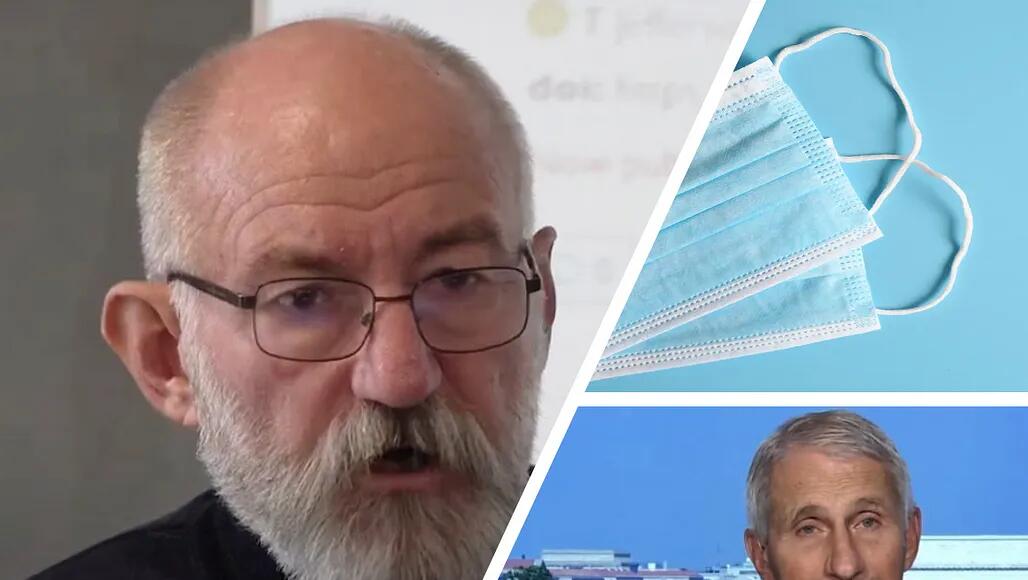
Lead Author Of Cochrane Mask Review Responds To Fauci's Dismissal Of Evidence

 by Maryanne Demasi via Substack,

Former chief medical advisor to the US President Anthony Fauci was questioned over the weekend by CNN reporter Michael Smerconish, about face masks being able to curb the spread of covid-19.

There’s no doubt that masks work,” said Fauci.

Different studies give different percentages of advantage of wearing it, but there’s no doubt that the weight of the studies … indicate the benefit of wearing masks,” he added.

Smerconish brought up the 2023 Cochrane review which found no evidence that physical interventions like face masks could stop viral transmission in the community and cited my interview with lead author of the study Tom Jefferson who confirmed, “There is just no evidence that they [masks] make any difference. Full stop.”

Fauci replied, “Yeah but there are other studies,” stressing that masks work on an individual basis.

“When you’re talking about the effect on the epidemic or the pandemic as a whole, the data are less strong…but when you talk about an individual basis of someone protecting themselves or protecting themselves from spreading it to others, there’s no doubt that there are many studies that show there is an advantage,” said Fauci.

Professor Tom Jefferson, who says he is committed to updating the Cochrane review as new evidence emerges, has responded to Fauci’s comments.

So, Fauci is saying that masks work for individuals but not at a population level? That simply doesn’t make sense,” said Jefferson.

And he says there are ‘other studies’…but what studies?  He doesn’t name them so I cannot interpret his remarks without knowing what he is referring to,” he added.

Jefferson explains that the entire point of the Cochrane review was to systematically sift through all the available randomised data on physical interventions such as masks and determine what was useful and what was not.

Since 2011, the Cochrane review only included randomised trials to minimise bias from confounders.

“It might be that Fauci is relying on trash studies,” said Jefferson. “Many of them are observational, some are cross-sectional, and some actually use modelling. That is not strong evidence.”

“Once we excluded such low-quality studies from the review, we concluded there was no evidence that masks reduced transmission,” he added.

The problem with Fauci is that his story has changed.

Initially, Fauci said that masks were ineffective and unnecessary. In March 2020, Fauci told 60 Minutes, “Right now in the United States, people should not be walking around with masks.”

But only a few weeks later, he did a U-turn and began recommending widespread use of face masks.

Fauci defended his U-turn saying, “When the facts change, I change my mind.” 

Jefferson retorted, “What facts changed?  There were no randomised studies, no new evidence to justify his flip-flop. That’s simply not true.”

Since then, Fauci has remained adamant that face masks not only stop people from infecting others, but they also protect the wearer. 

Fauci advocated for the use of cloth masks, and even encouraged double-masking in the absence of evidence.

“You put another layer on, it just makes common sense that it would be more effective,” Fauci told NBC News.

“What Fauci doesn’t understand is that cloth and surgical masks cannot stop viruses because viruses are too small and they still get through,” said Jefferson.

He laments that public figures have tried to undermine the Cochrane review, despite it representing the gold standard of evidence.

Columnist Zeynep Tufekci wrote an article in the New York Times titled, “Here’s Why the Science Is Clear That Masks Work,” claiming that Cochrane’s mask study had misled the public.

Cochrane’s editor-in-chief, Karla Soares-Weiser capitulated to pressure and “apologised” for the wording in the plain language summary of the review because it “was open to misinterpretation” and may have led to “inaccurate and misleading” claims.

And former CDC director Rochelle Walensky misled Congress after claiming the Cochrane review had been “retracted” which was patently false. 

As it stands, the Cochrane review will continue to be the subject of attacks because it presents a major roadblock for implementing masking policies. Jefferson says he doesn’t know what motivates people to ignore the facts. 

Could it be part of this whole agenda to control people’s behaviour? Perhaps,” he speculated.

“What I do know,” said Jefferson, “is that Fauci was in a position to run a trial, he could have randomised two regions to wear masks or not. But he didn’t and that’s unforgivable.”

Fauci, who served as the federal government’s top infectious disease specialist for nearly 40 years, stepped down in Dec 2022 and is now a professor at Georgetown University’s Department of Medicine, in the Division of Infectious Diseases.

https://www.zerohedge.com/political/simply-doesnt-make-sense-lead-author-cochrane-mask-review-responds-faucis-dismissal

CNN Poll: Majority Of Americans Think Biden Directly Involved In Hunter's Dealings While VP

 A majority of Americans, 61%, think that President Joe Biden was involved in his son Hunter's business dealings with Ukraine and China while he served as Vice President under Barack Obama, according to a CNN poll conducted by SSRS.

What's more, 42% say they think he acted illegally, while 18% say Biden was 'unethical' but not illegal. Another 38% said they don't think Biden was involved in Hunter's dealings, while 1% think he was involved, but didn't do anything wrong.

55% of those polled says Biden acted inappropriately during investigations into Hunter Biden's alleged crimes, while 44% think Biden acted appropriately.

The poll was conducted before special counsel David Weiss said in a Wednesday court filing that he intends to seek an indictment against Hunter Biden relating to gun charges by the end of the month. President Biden has denied being involved in any of his son’s business dealings, and House Oversight Republicans have not presented any direct evidence that the president personally benefited from any of them.

Americans’ views on Joe Biden’s conduct related to Hunter Biden largely divide along partisan lines. Fewer than one-third of Democrats believe that Biden had involvement in his son’s business dealings, or that he has acted inappropriately regarding the investigation. Even among Democratic-aligned voters who say they’d prefer to see their party nominate someone different in next year’s presidential election, just 37% believe Joe Biden was involved in his son’s business dealings, and only 29% find his actions regarding the investigation inappropriate. In response to an open-ended question asking for their biggest concern about Joe Biden as a candidate, almost none mentioned the situation regarding Hunter Biden. -CNN

Meanwhile, the vast majority of Republicans, 76%, think Biden acted illegally in regards to Hunter's business dealings, while 90% say he behaved inappropriately during the later investigation into his son. 

Among independents, 64% think Biden had some involvement in Hunter's dealings while VP, but 39% said he acted illegally in doing so. 52% say Biden acted inappropriately during the investigation.

https://www.zerohedge.com/political/cnn-poll-majority-americans-think-biden-directly-involved-hunters-dealings-while-vp

Saturday, September 9, 2023

Colombian President proposes Latin American alliance to transform 'war on drugs'

 Colombian President Gustavo Petro proposed on Saturday an alliance between Latin American countries to bring a unified voice to the fight against drug trafficking, by recognizing drug consumption as a public health problem instead of confronting it with what he called a "failed" militarized approach.

Petro, the first leftist president in Colombia's history, closed the Latin American and Caribbean Conference on Drugs, which was held in the city of Cali, by saying that 50 years of a failed war on drugs had resulted in immeasurable bloodshed and pain in Latin America.

"What I propose is to have a different and unified voice that defends our society, our future and our history and stops repeating a failed discourse," said the Colombian president.

"It is time to rebuild hope and not repeat the bloody and ferocious wars, the ill-named 'war on drugs', viewing drugs as a military problem and not as a health problem for society," Petro said.

Colombia, like other Latin American countries, faces persistent violence resulting from drug trafficking and the presence of cartels with growing firepower and economic might, according to security sources and analysts.

The countries participating in the conference said in a joint statement that demand for illicit drugs must be reduced by educating the public and combating inequality, poverty, lack of opportunities and violence.

They also agreed on the need to break the harmful links between drug and firearms trafficking, transnational organized crime, illegal logging, human trafficking, migrant smuggling, money laundering and corruption.

Mexican President Andres Manuel Lopez Obrador, who attended the event, said countries must strengthen family unity with love, combat poverty, and encourage the planting of corn, beans, cocoa, coffee, fruits and timber to reduce land area dedicated to illicit crops like marijuana, as well as opium poppy and coca leaf - the raw materials for drugs such as heroin and cocaine.

The Mexican president said Latin American countries need to support the United States in its fight against fentanyl out of a "moral obligation" and "humanism."

"They are facing a pandemic," Lopez Obrador said. "Regardless of our differences, above partisan ideas and ideological positions are human rights and the main human right is the right to life."

https://news.yahoo.com/colombian-president-proposes-latin-american-230214274.html

Meta Platforms must face medical privacy class action

 A U.S. federal judge said Meta Platforms must face a lawsuit claiming that it violated the medical privacy of patients who were treated by hospitals and other healthcare providers that used its Meta Pixel tracking tool.

U.S. District Judge William Orrick in San Francisco said the plaintiffs could pursue claims that Meta violated a federal wiretap law and a California privacy law, and violated its own contractual promises governing user privacy on Facebook.

In a 26-page decision on Thursday, the judge said the case, based on the evidence so far, "does not negate the plausible allegations that sensitive healthcare information is intentionally captured and transmitted to Meta."

Orrick dismissed some other claims but said the plaintiffs, all using John Doe or Jane Doe pseudonyms, could try to replead them.

According to the plaintiffs, Meta Pixel provided sensitive information about their health to Meta when they logged into patient portals, where the tracking tool had been installed, enabling Meta to make money from targeted advertising.

The lawsuit seeks unspecified damages for all Facebook users whose health information was obtained by Meta.

Neither Meta nor lawyers for the Menlo Park, California-based company responded on Friday to requests for immediate comment. Lawyers for the plaintiffs did not immediately respond to similar requests.

When the litigation began in June 2020, lawyers for one plaintiff said they had found at least 664 hospitals and other healthcare providers that used Meta Pixel.

In seeking a dismissal, Meta said it "does not disagree" that sending sensitive health information could be a serious problem.

But it also said there was nothing inherently harmful or unlawful about its technology, and that it was up to the healthcare providers to decide how to use Meta Pixel.

Orrick, however, said it was not clear whether Meta did enough to stop the transmission of patient details, or might be excused because healthcare providers actually consented to it.

Afghanistan meth trade surges as Taliban clamps down on heroin, UN report says

 Methamphetamine trafficking in and around Afghanistan has surged in recent years, even as the Taliban has curbed heroin trafficking since taking power, a United Nations report said on Sunday.

"The surge in methamphetamine trafficking in Afghanistan and the region suggests a significant shift in the illicit drug market and demands our immediate attention," said Ghada Waly, executive director of the U.N. Office of Drugs and Crime (UNODC).

The Taliban, which regained power in August 2021, announced a ban the following April on the production of narcotics in Afghanistan, the world's main opium producer. Taliban officials say its security forces are clamping down on Afghan poppy farmers and destroying crops.

While heroin trafficking has slowed, the UNODC said in a statement, meth trafficking "has intensified since the ban".

Meth seizures in and around Afghanistan jumped 12-fold in the five years through 2021. Between 2019 and 2022, nearby countries such as Iran and Pakistan also reported increased seizures. Countries as far away as France and Australia have reported seizing methamphetamine that likely originated in Afghanistan it said.

The UNODC said much of the meth from Afghanistan was made with pre-cursor ingredients such as those found in some cold and flu medication.

Afghanistan is home to the ephedra plant, which can be used to make methamphetamine, but the UNODC said the quantities needed to produce the drug and the risk of unreliable crops meant that Afghanistan's production did not depend on the plant alone.

"Common cold medications and industrial-grade chemicals are more efficient and cost effective for the manufacture of methamphetamine and thus pose a far bigger threat," the UNODC said.

https://www.yahoo.com/news/afghanistan-meth-trade-surges-taliban-050455357.html.

'How to still get free covid tests'

 COVID-19 hospitalizations and deaths are climbing heading into the fall, and although free testing isn’t as widely accessible as it once was, low- or no-cost tests may still be available.

The government’s program that mailed free tests through COVIDtests.gov has been suspended and as of June 1 is no longer accepting orders.

However, an estimated 10,000 Increasing Community Access to Testing (ICATT) sites continue to support testing. Testing at those sites remains free for people without health insurance.

Other community-based testing sites can be located on the U.S. Department of Health and Human Services website.

Health centers provide free or low-cost COVID-19 tests to people who meet certain criteria and may provide sliding fee discounts based on patients’ income and family size.

Some insurance plans still reimburse for testing, according to CBS. Previously expired tests may still be usable, too.

The expiration date for an at-home COVID-19 diagnostic test may have been extended beyond the date on the box as more data was collected.

Updated expiration dates can be found online at FDA.gov.

https://thehill.com/policy/healthcare/4195648-cases-of-covid-19-are-on-the-rise-heres-how-you-can-still-get-free-tests/