Akebia Therapeutics®, Inc. (Nasdaq: AKBA), a biopharmaceutical company with the purpose to better the lives of people impacted by kidney disease, today announced it has resubmitted its New Drug Application (NDA) to the U.S. Food and Drug Administration (FDA) for vadadustat, Akebia's investigational oral hypoxia-inducible factor prolyl hydroxylase inhibitor, for the treatment of anemia due to chronic kidney disease (CKD) in adult patients on dialysis. Vadadustat is currently approved for use in 35 countries.
Thursday, September 28, 2023

UAW’s Real Enemy Is Forced EV Conversion
by Andy Puzder via RealClear Wire,
Speaking at a convention in April, United Auto Workers President Shawn Fain identified what he considered the union’s “one and only true enemy – multibillion-dollar corporations and employers that refuse to give our members their fair share.” He may be attacking the wrong enemy.
The UAW is now engaged in a strike of historic proportions against America’s big three auto manufacturers: GM, Ford, and Stellantis (owner of Chrysler). But it’s the Democratic Party’s climate activists who pose the most significant threat to American auto workers today – the forced transformation of the U.S. auto industry from gas to electric-powered vehicles (EVs).
As for the strike, the UAW’s demands include a stunning 40% pay raise over the next four years. According to CEO Jim Farley, that increase would put Ford “out of business.” Yet, in a response that hardly seems miserly, Ford has offered a 20% increase over the life of the contract and an immediate 10% increase.
For a starting point in negotiations, it’s strong evidence of good faith, if not generous. GM and Stellantis will likely make offers in that range. But the final number won’t mean much to the union workers whose jobs disappear.
Turns out that it takes 40% fewer employees to manufacture EVs than it does to manufacture gas-powered vehicles. According to a recent analysis by James Sherk and Jacob Sagert at the America First Policy Institute, the Biden administration’s proposed EV rules will eliminate at least 117,000 existing auto manufacturing jobs.
In addition, the majority of EV jobs won’t be union jobs. They will either go to non-union companies (such as Tesla) or right-to-work states in the South. In those states, workers can’t be compelled to join a union, which explains why so many foreign manufacturers have opened their U.S. plants there.
Part of the problem is that the Democrats’ climate bill (ironically named the Inflation Reduction Act) promotes the use of “domestic” labor rather than “union labor.” That was the result of lobbying by foreign auto manufacturers, many of which have or intend to build plants in right-to-work states. It’s also evidence that the climate-activist wing of the Democratic Party is more concerned with promoting EVs than with preserving jobs for their traditional union allies.
In fact, to accomplish its EV goals, the Biden administration is attempting to force them on consumers who just don’t want them. According to the Deloitte 2023 Global Automotive Study, 62% of Americans prefer their next car purchase to be a gas-powered vehicle, 20% prefer a hybrid, and a mere 8% prefer a pure EV.
So, perhaps it’s not surprising that Ford, the second-largest seller of EVs with 7.5% of the market, can’t sell all the EVs it’s producing despite losing nearly $60,000 on every sale. This year alone, Ford estimates it will lose $4.5 billion in its EV business. That’s money that could be available to meet the UAW’s demands if the Biden administration weren’t pushing EVs on American consumers – and manufacturers.
The problems the UAW is facing should not come as a surprise. Given the lack of consumer demand, the transition to EVs will only occur if the government suppresses the free market and forces a conversion. There are always unanticipated consequences when government elites impose their will rather than allowing consumer demand and the free market to guide the economy. It’s one of the primary reasons socialism always fails.
The unintended consequences of the administration’s green agenda will be numerous and consequential. The rare-earth minerals necessary for battery production come from foreign countries, where they are extracted using forced labor and child labor. Mining those ores, and then disposing of the batteries at the end of their useful lives, will cause long-term environmental damage. Moving to EVs at scale will increase America’s reliance on China, where the batteries, their components, and the great majority of EVs are manufactured. Finally, America’s electricity grid, which is already stressed, is likely to be overwhelmed once a large segment of the population is using it to power their cars.
The current strike is one of these unintended consequences, as the union sees EV jobs moving to non-union companies, right-to-work states, and China. Discussing the EV transition in an op-ed earlier this month, Fain stated that “at stake in these contract negotiations is the very future of the auto industry itself – and workers’ place in it.” Given the Biden administration’s push for EVs, is it any wonder that the UAW has yet to endorse President Biden for 2024?
Certainly, no one could blame workers for believing climate activists in the Democratic Party are selling out their union supporters. It’s an unintended consequence that could be a game-changer in next year’s election. Even if the big three auto manufacturers meet the union’s demands on wages, the EV problem will not go away.
Nevertheless, President Biden appeared on the UAW picket line in Michigan on Tuesday, attempting to walk a fine line between supporting striking workers and giving the presidential stamp of approval to the union’s specific demands. Bullhorn in hand, he told the crowd, “You guys, UAW, you guys saved the automobile industry. … You should be doing incredibly well too.” He didn't take questions.
Donald Trump sees an opening. Already popular with union workers, though perhaps not their leaders, Trump recently pointed out the obvious – EVs are “a disaster for both the United Auto Workers and the American Consumer” that would “wipe out” the UAW. He’s skipping next week’s Republican presidential debate and visiting Detroit to speak with striking auto workers. The reception he gets may be telling.
Andrew F. Puzder is the former CEO of CKE Restaurants, Inc. and a senior fellow at the Heritage Foundation and the Pepperdine University School of Public Policy.
https://www.zerohedge.com/political/uaws-real-enemy-forced-ev-conversion
Newer antibiotic effective against deadly staph infection in trial
An antibiotic already in use in Europe to treat pneumonia controlled deadly bloodstream infections with Staphylococcus aureus bacteria just as effectively as the most powerful antibiotic currently in use, according to data from a late-stage trial.
Ceftobiprole from Swiss drugmaker Basilea Pharmaceutica appeared to be equally effective as the older drug daptomycin in the roughly one-in-four patients who had particularly difficult to treat methicillin-resistant S. aureus (MRSA) infections, researchers reported on Wednesday in The New England Journal of Medicine.
“This is an area of true need,” study leader Dr. Thomas Holland of Duke University School of Medicine said in a statement. “There has not been a new antibiotic approved for the treatment of S. aureus bacteremia for over 15 years.”
For the study, 390 patients hospitalized with complicated bloodstream staph infections were randomly assigned to receive infusions of ceftobiprole or daptomycin.
The treatment was successful in 69.8% of the ceftobiprole group and 68.7% of the daptomycin group, according to the report. Success was defined as survival, symptom improvement, clearance of S. aureus from the blood, absence of new complications and no need for other antibiotics.
Gastrointestinal issues were the most common side effect with both drugs.
Daptomycin was the most recently approved new antibiotic for S. aureus bacteremia more than 15 years ago, the researchers noted.
“Despite a lot of work in medical science, complicated staph infections still have a 25% mortality rate at 90 days,” study co-author Dr. Vance Fowler Jr. of Duke Health said in a statement. “We need more options for treating these infections.”
In August, Basilea Pharmaceutica filed for approval of ceftobiprole with the U.S. Food and Drug Administration.
https://www.yahoo.com/news/newer-antibiotic-effective-against-deadly-210208536.html
Trump says UAW talks don't matter because EV shift will kill jobs
Former U.S. President Donald Trump said on Wednesday it mattered little whether striking union autoworkers secured a favorable deal in talks with America's biggest carmakers because the shift to electric vehicles would soon make them obsolete.
Speaking in terms that contrast with the confidence shown by carmarkers spending aggressively to electrify their fleets, Trump predicted the U.S. auto industry would succumb to massive losses in just a few years.
"It doesn’t make a damn bit of difference what you get because in two years you're all going to be out of business," Trump told several hundred blue-collar workers gathered at a non-union auto supplier outside Detroit.
Trump, who chose to skip the second Republican presidential debate on Wednesday night, has made attacking President Joe Biden's promotion of electric vehicle production through incentives a routine component of his stump speech.
At the debate, Trump was attacked by Florida Governor Ron DeSantis as "missing in action", while former New Jersey Governor Chris Christie mocked him as "Donald Duck" for skipping the event.
On Tuesday, Biden joined a picket line to show solidarity with the United Auto Workers union, which began its walkouts on Sept. 15, its first simultaneous strikes at General Motors, Chrysler parent Stellantis and Ford. Biden backed their call for a 40% pay raise and improved working conditions.
In response to Trump's speech, the Biden campaign called the former president a "billionaire charlatan" who didn't care about the working class but instead pursued pro-business policies that moved jobs overseas during his time in office.
"Donald Trump is lying about President Biden's agenda to distract from his failed track record of trickle-down tax cuts, closed factories, and jobs outsourced to China," Biden's campaign said in a statement while Trump spoke.
The decision by both Trump and Biden to insert themselves into the historic auto strike highlights the importance both men place on securing support from working-class voters in Michigan and other battleground states in next year's presidential race.
Trump, who appears on track to clinch the Republican Party nomination and challenge Biden for the presidency, lost Michigan in 2020 by some 154,000 votes. It is one of three Rust Belt states, along with Pennsylvania and Wisconsin, that Trump picked up in 2016 but lost in 2020, and the three will likely prove critical to both parties next year.
Jason Roe, a Republican strategist based in Michigan, said Trump was successfully tapping into angst among working class voters who feel they are falling behind economically, a trend exacerbated by the COVID-19 pandemic and inflation.
"That’s what he's exploiting. That’s what he exploited in 2016," Roe said.
U.S. automakers have complained that the Biden administration's rules promoting electric vehicles risk burdening them with excessive costs, but there is no evidence to suggest they are headed towards bankruptcy as Trump suggested.
Spurred on by incentives, automakers are sinking tens of billions of dollars into new domestic factories to meet demand for electrified vehicle sales, which captured 8.9% of the U.S. market during the first half of 2023 and continue to grow.
During Trump's 2017-2021 White House term, his administration generally sided with businesses over the interests of workers on policy matters, though some of his trade policies were aimed in part at protecting domestic manufacturing jobs.
The UAW has to date not backed either presidential candidate, making it the only major union not to endorse Biden. The UAW leadership has welcomed Biden's support, however, and spoken about Trump and his record in scathing terms.
Promising to end the government's EV push if elected, Trump urged the UAW to back him in the presidential race.
"I don't care what you get in the next two weeks or three weeks or five weeks," he said. "They're going to be closing up and they're going to be building those cars in China and other places. It's a hit job in Michigan and on Detroit."
https://news.yahoo.com/trump-skips-debate-woo-blue-101016790.html
If China Is So Weak, Why Are Commodities So Strong?
By Ye Xie, Bloomberg markets live reporter and strategist
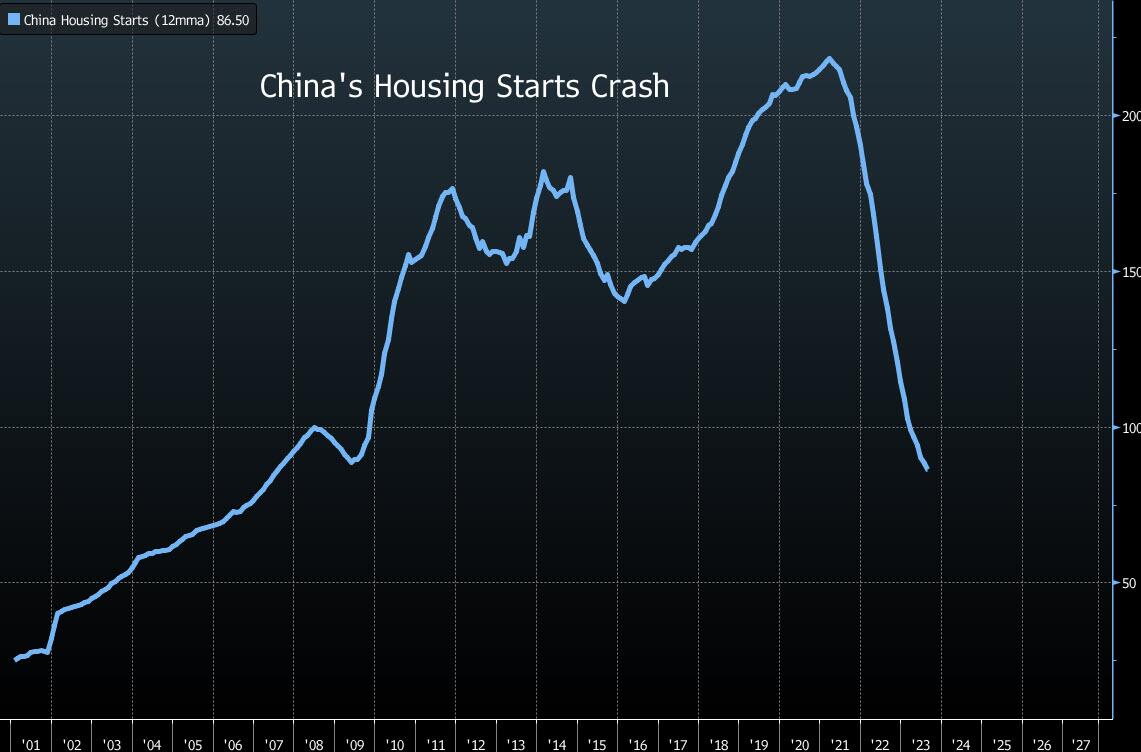
The decline in China’s home construction has been remarkable, almost rivaling the US housing crisis of 2008.
It raises the question: Why are commodity prices so resilient if one of the biggest buyers is in malaise?
It turns out China’s demand for raw materials is more robust than the overall economy. In other words, there’s some decoupling between China’s housing activity and commodities.
US rates and crude oil remain the two most-important variables driving asset prices globally now. WTI crude rose to a one-year high near $94 a barrel. Ten-year yields jumped to 4.6%, pushing the dollar stronger along the way.
The strength in oil, and more broadly the resilience of raw materials, seems at odds with a sluggish Chinese economy, considering the commodity-heavy housing sector remains in trouble. The floor space of newly started housing averaged about 87 million square meters over the past 12 months, marking a 60% decline from a peak in 2021. That isn’t far from the slump in the US housing market during the financial crisis.
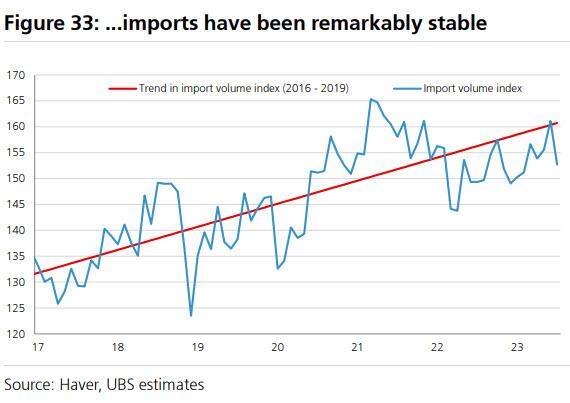
Yet, China’s import volume of commodities from oil and coal to iron ore remains in-line with the trend growth, as shown in this chart from UBS. What gives?
For oil, it’s easier to understand. The US consumes 20% of global oil, compared with China’s 15%. So part of the oil price increase reflects a strong US economy, plus OPEC+ output cut. And in China, while the economy struggles, measures of transportation such as domestic flights and trucking have already risen above the pre-pandemic level, underpinning the demand for fuel.
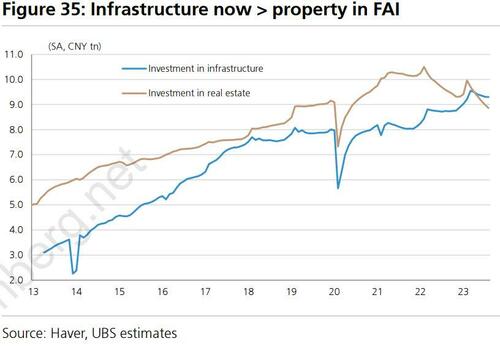
UBS’s strategists including Manik Narain noted two other supportive factors: strength in infrastructure and manufacturing investments, as well as export demand for commodity-sensitive products (steel) and inventory rebuilding (coal). Bloomberg also reported that railway construction has been robust.
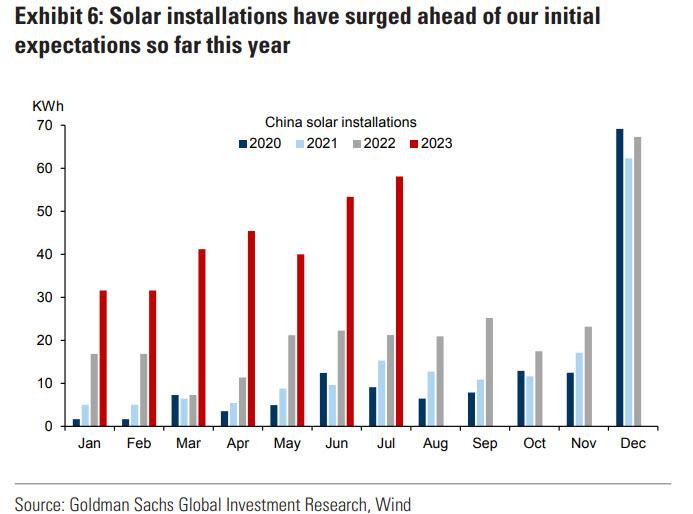
In a report published Wednesday, Goldman Sachs’s strategists Nicholas Snowdon and Aditi Rai also pointed out that the demand for copper and aluminum is supported by growth in renewable energy, the power grid and property completions. For example, China’s solar installations this year have surged.
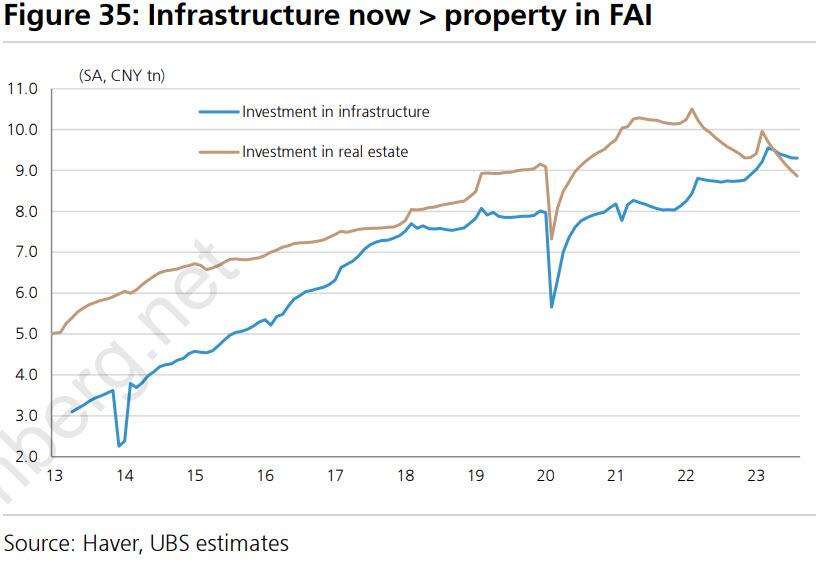
So the demand for commodities at idiosyncratic, micro levels is outperforming China’s macro economy. Is this a structural change? That remains to be seen. But for anyone who is bearish on China, shorting commodities hasn’t been a great trade so far.
https://www.zerohedge.com/economics/if-china-so-weak-why-are-commodities-so-strong
Canada Launches UN Declaration Targeting Online 'Disinformation'
by Amanda Brown via The Epoch Times (emphasis ours),
Foreign Affairs Minister Melanie Joly has launched a United Nations declaration that calls for action to protect what it calls "information integrity" and to tackle "disinformation."
Ms. Joly launched the Global Declaration on Information Integrity Online jointly with Dutch Foreign Affairs Minister Hanke Bruins Slot during the U.N. General Assembly in New York on Sept. 20.
“Information integrity is essential to help ensure the strength of democratic processes and to protect fundamental rights,” says a joint statement by Canada and the Netherlands.
“The erosion of information integrity, including the propagation of disinformation, weakens the strength of democratic engagement.”
In a speech on Sept. 20, Ms. Joly said the declaration is a “concrete step toward establishing global norms on disinformation, misinformation, and information integrity,” the National Post reported.
Speaking to the U.N. on the same day, Ms. Bruins Slot said the emerging online environment makes it difficult to determine what is and what is not truthful.
“Every day, the world is flooded with disinformation and misinformation. Rapid advances in technology—particularly generative AI—make it more and more difficult to tell fact from fiction,” she said.
Canada, the United States, the United Kingdom, Germany, Australia, Japan, and South Korea are among the 30 countries that have signed the declaration.
The declaration promotes concepts such as respect for "the right to freedom of opinion and expression, and the freedom to seek, receive, and impart information."
It says signatories need to "take active steps to address misinformation and disinformation targeted at women, LGBTIQ+ persons, persons with disabilities and Indigenous Peoples."
It also calls on signatories to "refrain from unduly restricting human rights online, especially the freedom of opinion and expression, under the guise of countering disinformation," and to "promote and respect pluralistic media and journalism, and protect access to media content as one measure to counter disinformation."
Multiple Strategies
In recent years, the federal government has initiated a number of projects to counter “misinformation,” “disinformation” and what it considers extremist ideologies.
Some initiatives are the result of international collaborative efforts to shape the flow of information, and others have been conceived closer to home.
Canada's participation in the Rapid Response Mechanism, established by G7 leaders at the 2018 G7 Summit in Charlevoix, Quebec, monitors the digital information environment. Its goal is to encourage cooperation among member countries to provide a coordinated response to "foreign state-sponsored disinformation" and the “evolving foreign threats to democracy.”
The Liberal government has enacted legislation to shape the information space, with bills C-18 and C-11 being passed in recent months.
The Online News Act, Bill C-18, which passed in June, has been framed as an attempt to defend democracy by bolstering the coffers of flailing legacy media with money from Big Tech.
In reaction to the new legislation, Meta has restricted Canadians’ access to news content in their feeds, to avoid sharing revenue with media outlets. Google has threatened to take action but hasn't yet.
The Liberal government also passed Bill C-11, the Online Streaming Act, in order to boost Canadian content and to regulate some aspects of online streaming and social media.
A new bill to address "online harms" is also in the works, but it does not appear to be a legislative priority for the government at this time.
Costa Rica Declares State Of Emergency As Migrant Crisis Rocks Americas
Costa Rica's President Rodrigo Chaves declared a state of emergency on Tuesday as the number of migrants passing through the Central American country on the way toward the US surges, Reuters reported.
"I have instructed the security ministry to take a firm stance with anyone who takes Costa Rica's kindness for weakness," Chavez older reporters, referring to recent riots caused by migrants crossing the country.
Chavez explained the tsunami of migrants is coming from Ecuador, Venezuela, Colombia, Haiti, Yemen, Bangladesh, and even China. He noted, "We all know that throughout the Americas there is a migration crisis."
Since the beginning of the year, nearly 400,000 migrants have crossed the border from Panama into Costa Rica.
Costa Rica's migrant chaos comes as President Biden's disastrous open southern border crisis has sparked a record-breaking month for August. According to the US Customs and Border Protection, 232,972 migrants were encountered at the US-Mexico border in August.
Biden greenlighted migrants worldwide in a June 20 statement marking World Refugee Day: "Welcoming refugees is part of who we are as Americans – our nation was founded by those fleeing religious persecution. When we take action to help refugees around the world, and include them, we honor this past and are stronger for it."
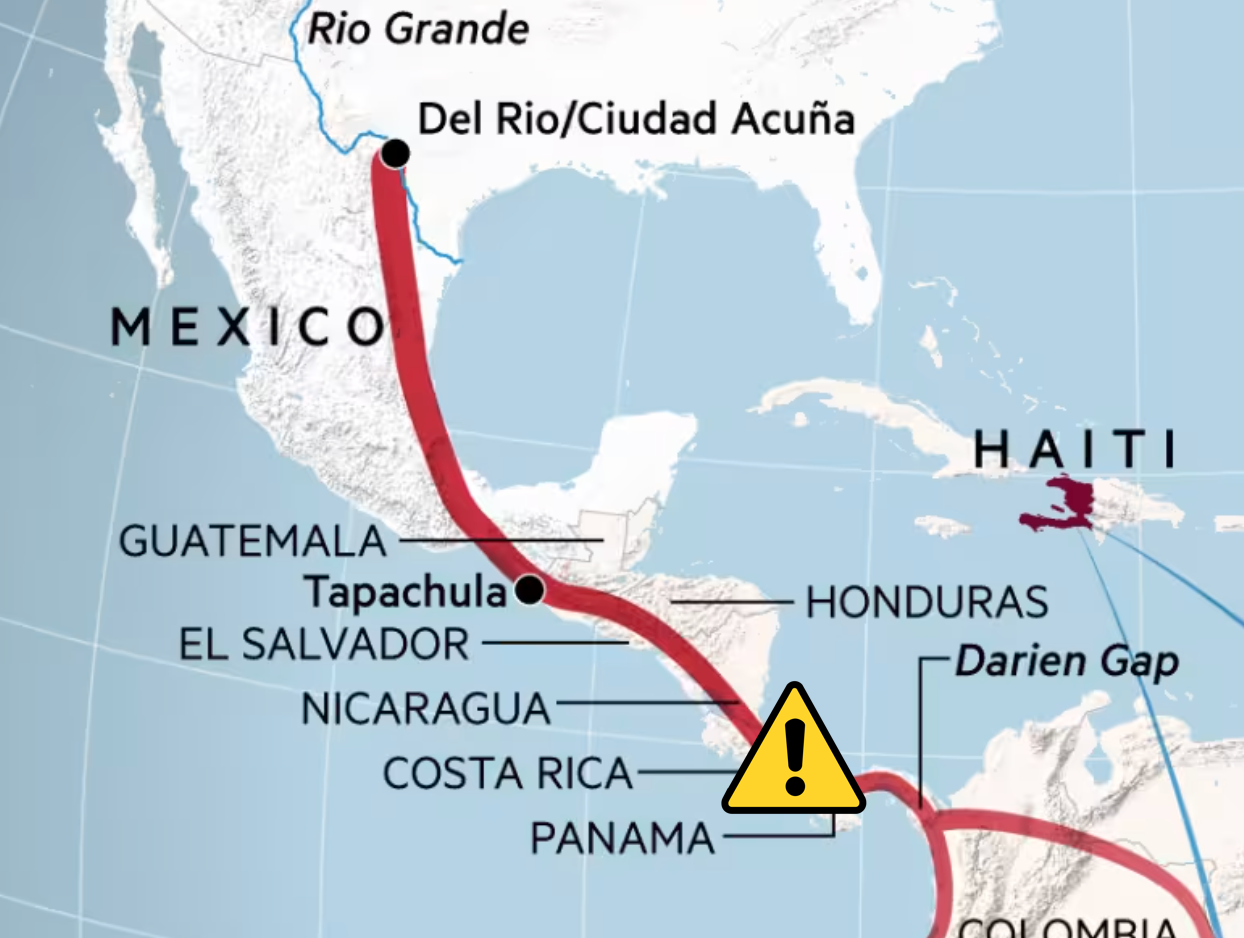
In recent weeks, all hell has broken out at Eagle Pass, Texas, and other border crossings as migrants flood the southern border via an easy commute through Mexico by freight train.
Law-abiding taxpayers need to ask why the Biden administration is pushing disastrous open border policies to flood illegals into metro areas ahead of the presidential election. These devastating policies are against the will of the majority and only supported by a fringe minority of political elites and progressive billionaires.
Subscribe to:
Posts (Atom)