Search This Blog

Friday, November 3, 2023

House GOP approves cutting EPA budget by nearly 40 percent

 House Republicans approved legislation Friday that would slash nearly 40 percent of the budget for the Environmental Protection Agency (EPA). 

The funding bill, passed by a 213-203 vote, cuts 39 percent of the EPA’s budget and would be the smallest budget the agency has had in three decades. Republican Reps. Brian Fitzpatrick (Pa.), Mike Lawler (N.Y.) and Marc Molinaro (N.Y.) voted against the bill, while Democratic Rep. Vicente Gonzalez (Texas) was recorded as voting for it.

Republicans have had longstanding complaints about the agency, which takes on pollution, contamination and climate change, arguing that it overreaches.  

Rep. Mike Simpson (R-Idaho), who chairs the subcommittee that wrote the bill, characterized the funding reductions it would deliver as necessary to curtail Inflation and the national debt. 

“Cutting funding is never easy or pretty, but with the national debt in excess of $33 trillion and inflation at an unacceptable level, we had to make tough choices to rein in federal spending,” Simpson said on the floor Thursday. 

The massive funding cut proposed by the GOP has virtually no chance of becoming law in this year’s budget but marks a starting point in negotiations for Republicans as they look to negotiate with Democrats in the Senate on funding the government.  

The bill is one of 12 annual government funding bills Republicans hoped to have passed by a Nov. 17 deadline to prevent a shutdown. However, Republicans face a challenge in staying unified on spending as they look to approve the remaining five bills in the tight window.  

In addition to the top-line EPA cuts, the GOP bill would also rescind provisions from the climate, tax and health care bill that Democrats passed last year. It targets funding aimed at helping underserved communities combat climate change and pollution.  

It additionally seeks to defund the EPA’s efforts to curtail toxic pollution and planet-warming emissions, preventing the agency from using funding to enforce its rules on power plants. 

The bill would also deliver cuts, albeit less dramatic ones, to the Interior Department, reducing its funding by about 4.5 percent. It delivers a steeper cut of 13 percent to the National Park Service. 

The legislation would also require the Biden administration pursue drilling off the coast of Alaska, where the administration does not currently plan to offer new oil lease sales. It would require the administration to auction off the right to drill for oil there at least twice a year and would also require twice-a-year-oil lease sales in regions of the Gulf of Mexico.  

The bill looks drastically different from its counterpart in the Senate, which calls for $7 billion more in total funding than the legislation passed in the House and was approved with overwhelming bipartisan support in committee earlier this year.  

The gap comes as no surprise, as House Republicans announced earlier this year they would be marking up their fiscal 2024 government funding plans below the budget caps deal struck between President Biden and former Speaker Kevin McCarthy (R-Calif.) over the summer. 

Hard-line conservatives had sought to dial up pressure on GOP leadership to make further spending cuts.

The bill was expected to contain billions of dollars in additional cuts as part of an intraparty agreement later in the summer to lock down support from hard-line conservatives. Simpson is among the appropriators who voiced frustration with the pressure campaign by hard-liners at the time.

https://thehill.com/policy/energy-environment/4291864-house-gop-approves-cutting-epa-budget-by-nearly-40-percent/

US flying unarmed drones over Gaza in search for hostages

 The U.S. military deployed unarmed drones in Gaza to assist Israeli armed forces in searching for hostages held by Hamas, the Department of Defense confirmed on Friday.

Hamas militants captured about 200 hostages during its surprise attack on Israel early last month, which also killed more than a thousand Israeli civilians and sparked the ongoing war in Gaza.

“In support of hostage recovery efforts, the U.S. is conducting unarmed UAV [unmanned aerial vehicle] flights over Gaza, as well as providing advice and assistance to support our Israeli partner as they work on their hostage recovery efforts. These UAV flights began after the Oct. 7 attack by Hamas on Israel.”  said Pentagon press secretary Brig. Gen. Pat Ryder in a statement.

Some of the hostages are U.S. citizens, but exactly how many is unknown.

Israeli airstrikes on Gaza have killed more than 9,200 people, including over 3,800 children, according to the Hamas-run Gaza Health Ministry.

The Biden administration urged the Israeli military to halt its ground invasion of the territory this week in favor of a “humanitarian pause” in the conflict in order to assist and evacuate civilians.

“I think we need a pause. A pause means give time to get the prisoners out,” President Biden said Wednesday.

Secretary of State Antony Blinken was in Israel on Saturday to deliver the same message, though the administration has not backed a total cease-fire in the conflict.

More than a dozen Democratic Senators urged Biden to back a pause in hostilities this week.

“The failure to adequately protect non-combatant civilians risks dramatic escalation of the conflict in the region and imposes severe damage on prospects for peaceful coexistence between Israelis and Palestinians,” reads the Democrats’ letter, which was led by Sens. Ed Markey (Mass.) and Tim Kaine (Va.).

“Based on the consensus opinion of U.S. and international aid officials, it is nearly impossible to deliver sufficient humanitarian aid to protect civilian life under current conditions,” the senators added. “Thus, we join President Biden in his call for a short-term cessation of hostilities that pose high-risk to civilians, aid workers or humanitarian aid delivery in Gaza.”

Israeli Prime Minister Benjamin Netanyahu said Saturday that there would be no pause before Hamas released the hostages.

https://thehill.com/policy/defense/4292498-us-unarmed-drones-gaza-search-hostages-israel/

MODERNA : Goldman Sachs reaffirms its Buy rating

 Already positive, the research from Goldman Sachs and its analyst Salveen Richter still consider the stock as a Buy opportunity. The target price is decreased from USD 269 to USD 231.

https://www.marketscreener.com/quote/stock/MODERNA-INC-47437573/news/MODERNA-Goldman-Sachs-reaffirms-its-Buy-rating-45233181/

Travere Late-Breaking Data from Phase 3 Studies of Sparsentan

 Two-year results from both PROTECT and DUPLEX pivotal Phase 3 studies demonstrate treatment with sparsentan has the potential to preserve kidney function and significantly delay time to kidney failure, suggesting long-term benefits in IgAN and FSGS

In PROTECT, the only head-to-head study conducted to date in IgAN, FILSPARI® (sparsentan) showed one of the slowest rates of kidney function decline in IgAN trials, consistent treatment effects across baseline eGFR and proteinuria, and higher rates of complete remission compared to maximally tolerated dose of irbesartan through 110 weeks of treatment

In DUPLEX, the largest interventional study in FSGS and only study against a maximally dosed active comparator, sparsentan delivered a clinically meaningful benefit at 108 weeks with significant proteinuria reduction, higher rates of partial and complete remission, and lower rates of end-stage kidney disease

Sparsentan was well tolerated with a safety profile comparable to the maximally tolerated dose of irbesartan in both Phase 3 studies, including no drug-induced liver injury or fluid overload

https://www.globenewswire.com/news-release/2023/11/03/2773287/0/en/Travere-Therapeutics-Announces-Late-Breaking-Data-from-Phase-3-Studies-of-Sparsentan-in-IgAN-and-FSGS-Published-in-The-Lancet-and-The-NEJM-Respectively-and-Presented-at-the-America.html

Sangamo cut to Sector Perform from Outperform by RBC

Target to $2 from $6

https://finviz.com/quote.ashx?t=SGMO&p=d

Record Number Of Multiple Jobholders: A Closer Looks Inside The Horrific October Jobs Report

 Today's jobs data was so ugly, not even the Biden admin had anything positive to say about it.

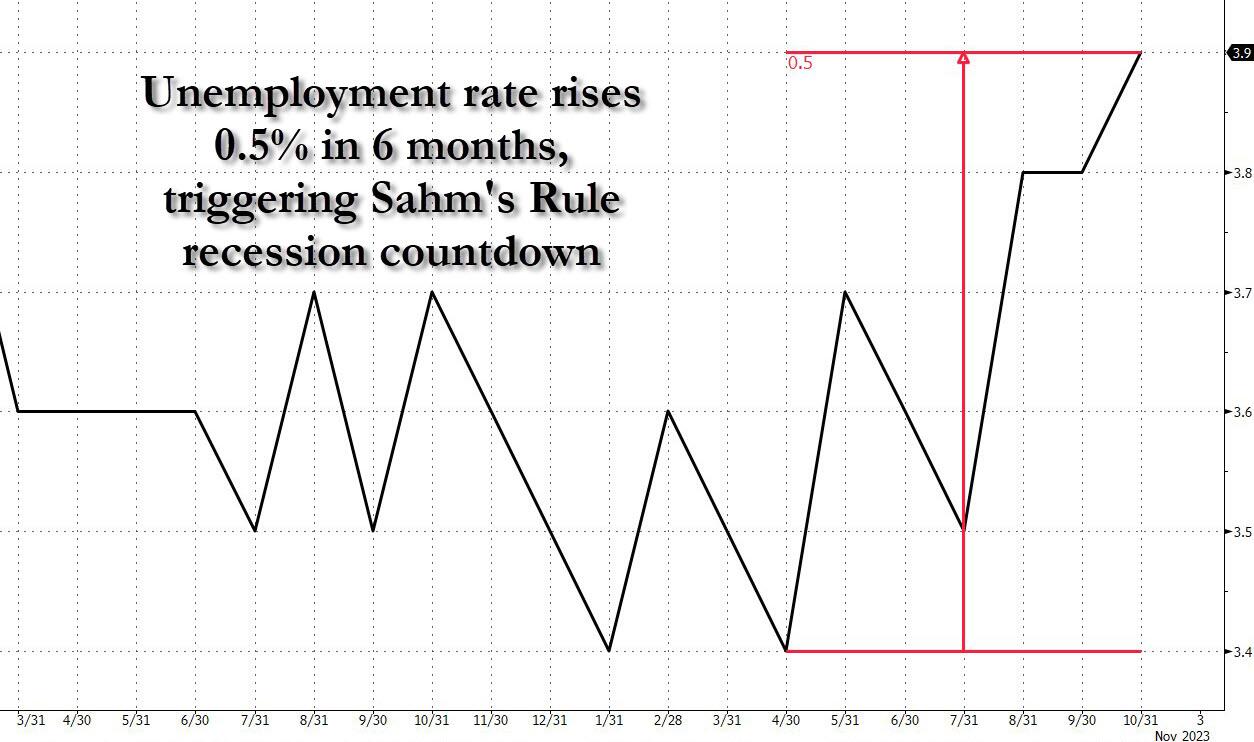
For those who missed our recap, this is what we found just superficially: nonfarm payrolls slowed by more than expected; the unemployment rate rose to 3.9%, up 0.5% from April and triggering Sahm's Rule countdown to a recession, and average hourly earnings were mixed with sequential rising less than expected.

But it's what was hiding below the surface that was truly horrific.

Let's start at the top.

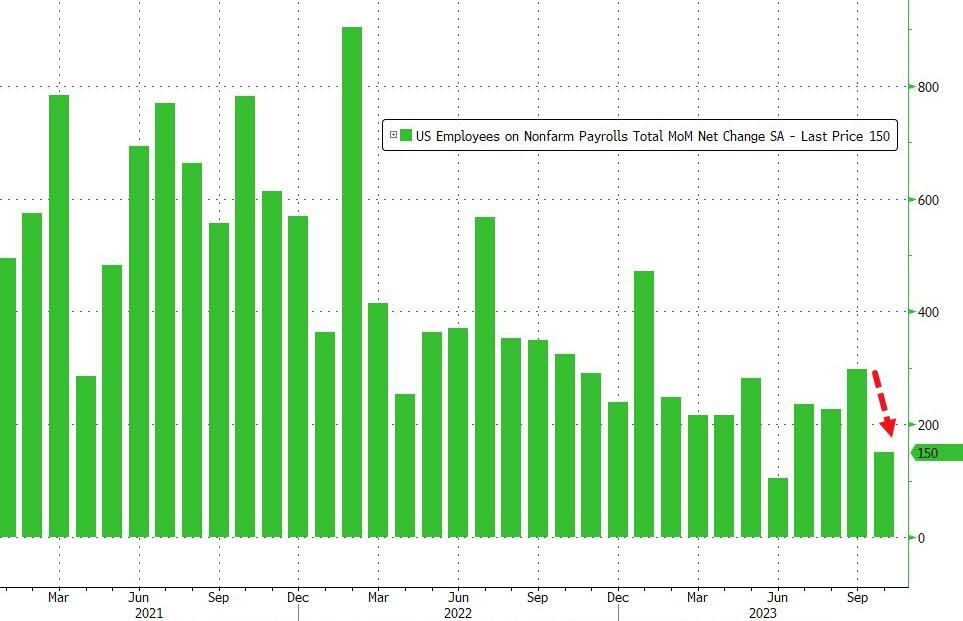
1. Nonfarm Payrolls printed at just 150K, below the 180K expected, down by 50% from the (downward revised) September print of 297K and the second lowest since the Covid crash/lockdown.

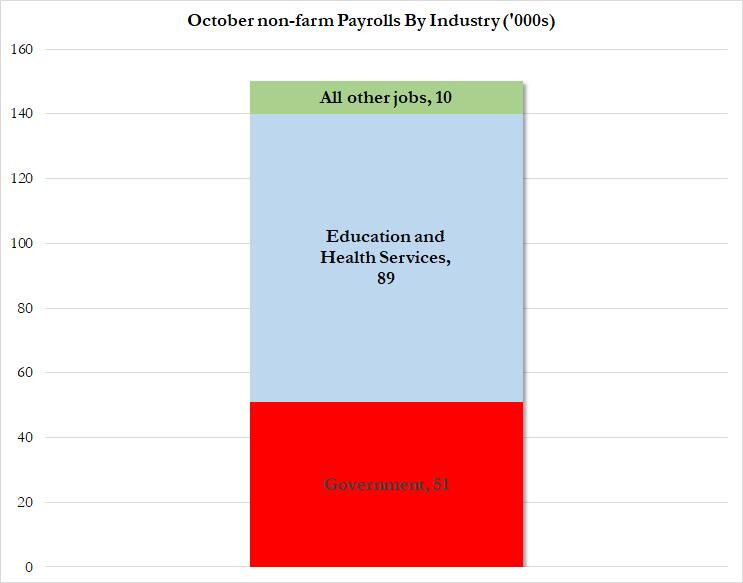
2. Atrocious job composition. Not only was the quantity of jobs poor, the quality (or composition) was absolutely atrocious: of the 150K jobs added in October, 51K, or more than a third was government workers (which as everyone knows aren't real employees as they don't produce anything of value but instead are a tax on the private sector); and of the remaining 99K jobs, 89K was "education and health services" workers with low-paid healthcare and social assistance workers accounting for the vast majority here (77.2K). The remaining jobs was a paltry 10K and this included declines in such high paying sectors as Trade and Transportation (-1K), Information (-9K), Financial Activities (-2K), and a whopping 35K drop in Manufacturing jobs.

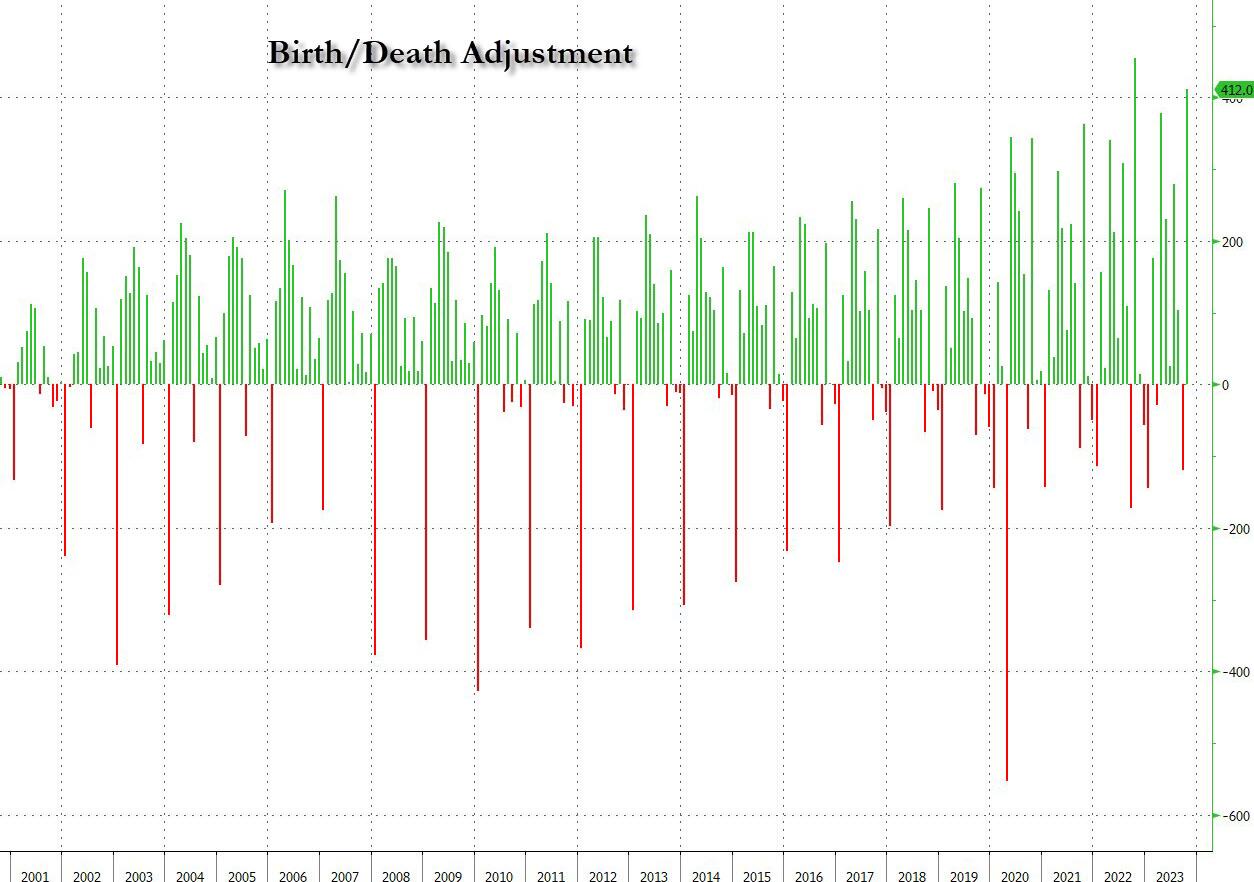
3. Birth-Death Adjustment was 412K, the second highest in historyFor those unfamiliar with the Birth-Death adj, the BLS has a primer here, but the bottom line is that the BLS is assuming that business/job creation - which is a fudge factory it applies to the non-seasonally adjusted payrolls number - was the second highest on record, which means that the BLS is seeing unprecedented economic growth taking place behind the scenes, with millions of new businesses somehow opening (without this fudge factor, the baseline number of jobs to which the BLS applies seasonal adjustments would be 412K lower, meaning that the actual job print in October would be deeply negative) The reality, of course, is just the opposite, which brings us to the next point...

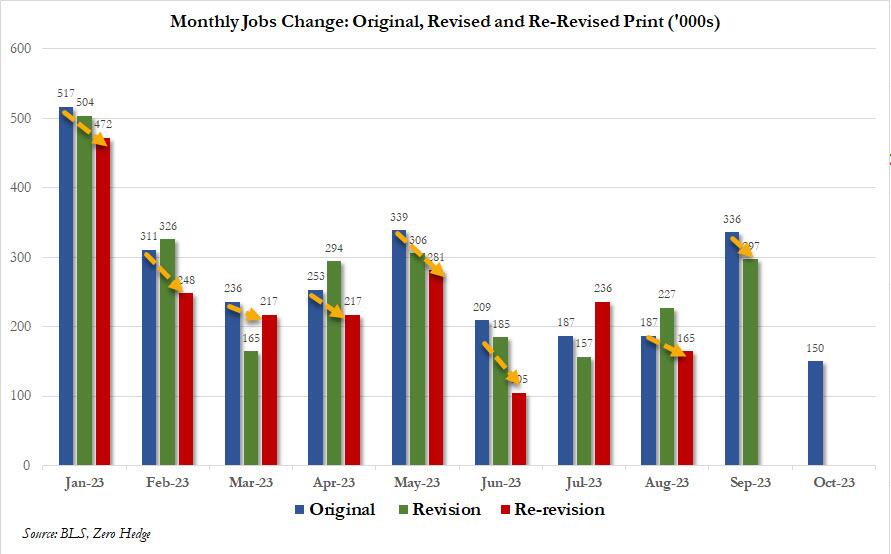
4. Record, relentless downward revisions. The October jobs report confirmed what many expected: both the August and September jobs reports were far too high when initially reported (in large part because of similarly ridiculous Birth-Death adjustments in prior months). To wit, the jobs change for August was revised down by 62,000, from +227,000 to +165,000, and the change for September was revised down by 39,000, from +336,000 to +297,000. With these revisions, employment in August and September combined is 101,000 lower than previously reported. But it gets worse: as shown in the chart below, the Biden Labor Bureau has downward revised 8 of the 9 previous monthly jobs reports for 2023, an outcome which if it was purely by chance would be a 10-sigma event. Which is why the only conclusion one can make is that the BLS data is rigged to show a strong initial print, and then when the number is less relevant 1-2 months later, the much uglier truth finally emerges and the "strong" initial fake number gets cuts substantially to what it really was originally.

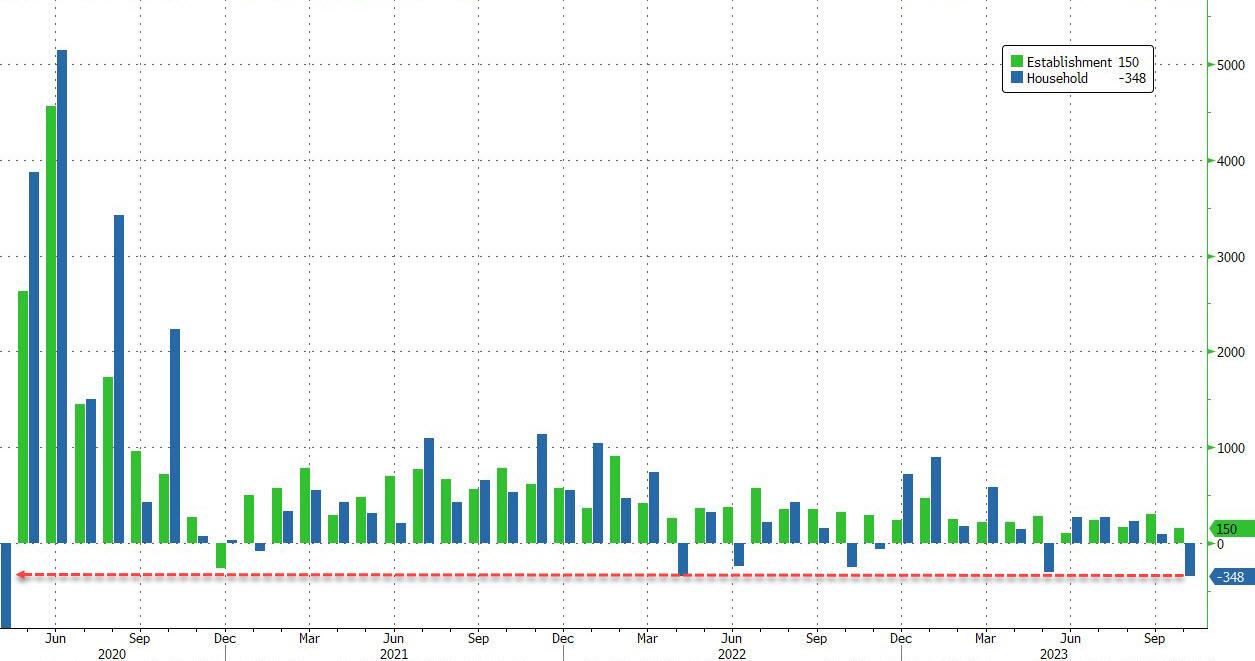
5. Employment Collapsing. Yes, payrolls may still be positive but the actual change in monthly employment isn't. In fact, in October the number of employer Americans collapsed by 348K (per the Household Survey). This was the second negative print this year, and the 7th negative employment month since the covid crash. Ironically, since then, we have seen just one negative payrolls months which makes sense, since the nonfarm payrolls number is far less accurate and much more gamed due to its market-moving abilities. The plunge in employment coupled with the jump in unemployed workers (by 146K) is also the reason why the unemployment rate unexpectedly went up.

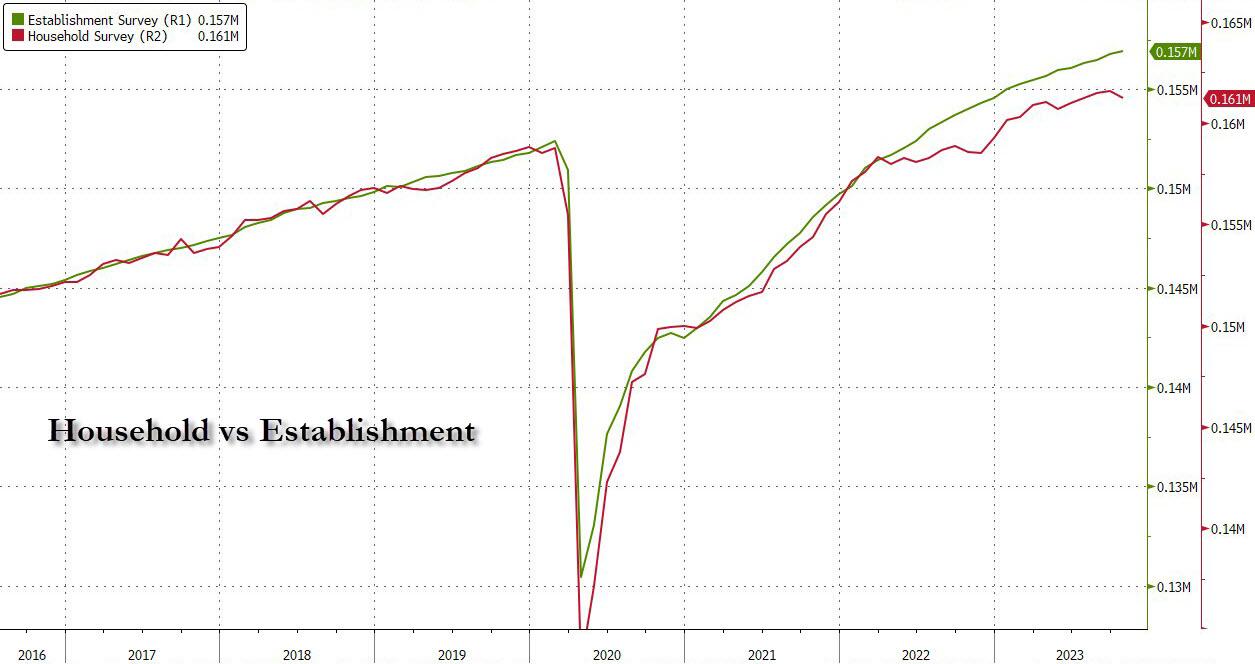
6. Record Divergence between Jobs and Employed workers. The bizarre divergence between the number of employed workers (per the Household Survey) and number of jobs (Establishment Survey) was not a one off thing. In fact, as shown in the next chart, the divergence between these two series, which in the past were virtually overlapping, has never been bigger.

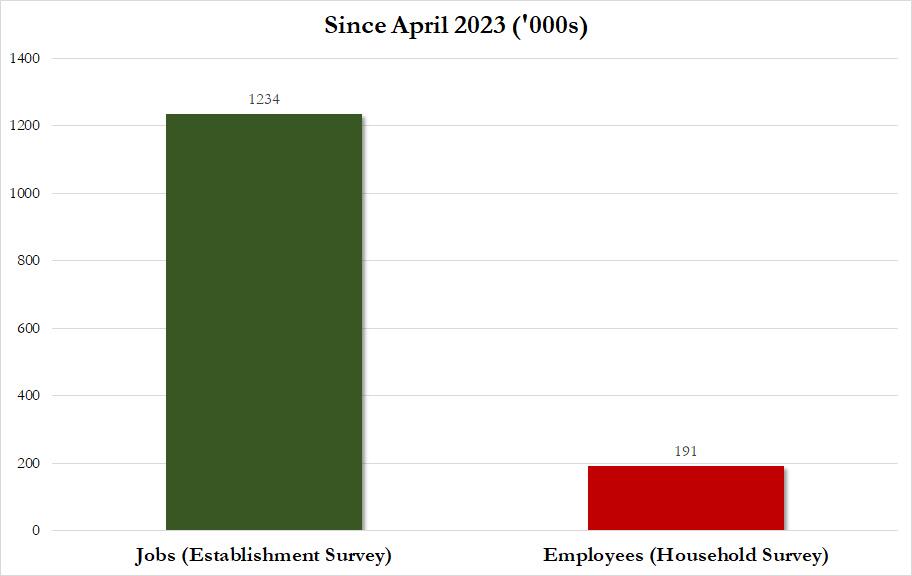
Taking a closer look at the data reveals that in the past six months, since April 2023, the US has reportedly added 1.234 million jobs, yet just 191 people found new employment. How is this possible? The answer leads us to...

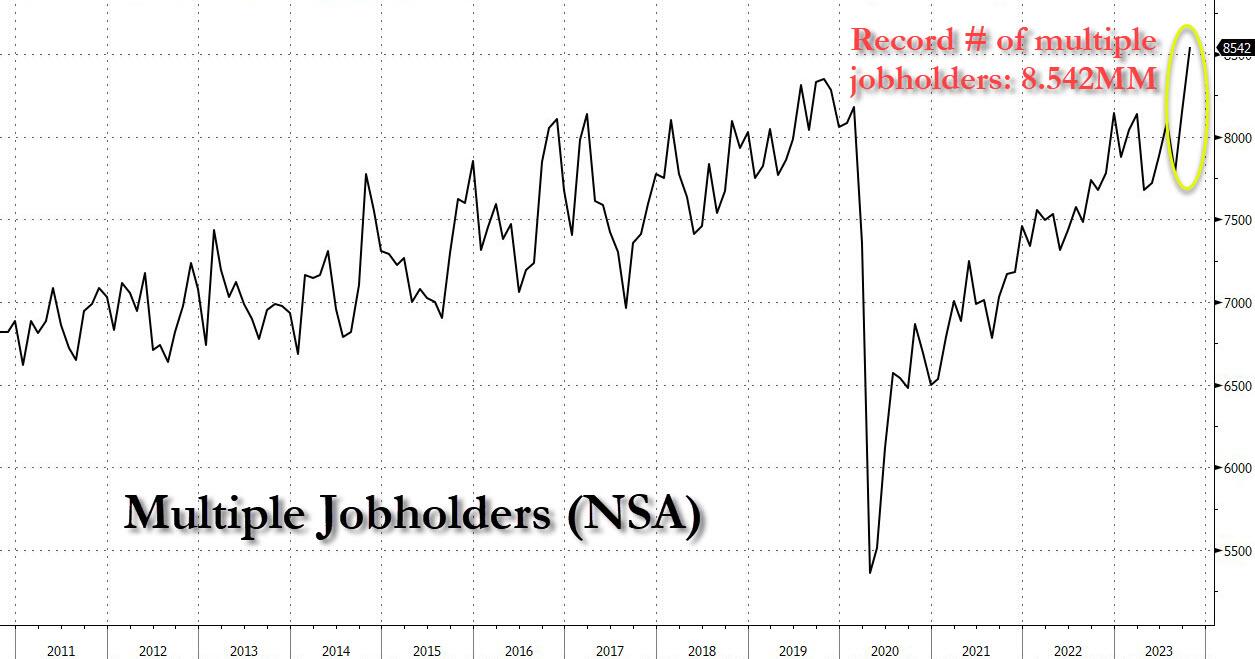
7. Record number of multiple jobholders. While the is still adding jobs at a brisk clip, that doesn't mean that the number of people finding jobs is similar. Quite the opposite: as the next chart shows, under the Biden administration increasingly more people have been forced to take on two or more jobs to make ends meet. In fact, in October, the (not seasonally adjusted) number of multiple jobholders was a record high 8.5 million, a surge of 396K in one month.

Ironically, the surge in multiple jobholders - which translates into steady nonfarm payrolls gains - indicates just the opposite of what the Biden admin wants to telegraph. Instead of a strong labor market, it merely confirms that a record number of Americans now have to work two or more jobs to make ends meet as a result of the runaway inflation unleashed by the Fed and the Biden admin.

8. Unemployment Rate spike begins countdown to the next recession. Last but not least, the increase in the unemployment rate from 3.8% to 3.9% means that the Sahm's Rule predicting the next recession has been triggered. As a reminder, the rule, created by former Fed economist Claudia Sahm, posits the start of a recession when the three-month moving average of the unemployment rate rises by a half-percentage point or more relative to its low during the previous 12 months. The low for joblessness so far this year was 3.4% in April while October’s rate was 3.9%, the highest so far this year and following two readings at 3.8% in August and September. More importantly it means that there is now a 0.5% spread from the April low and while one can wait for the 3MMA to confirm it, we can now go on the record as saying that the Sahm's Rule has been activated and the countdown to the next recession has begun.


https://www.zerohedge.com/markets/record-number-multiple-jobholders-closer-looks-inside-horrific-october-jobs-report

HHS Challenges AstraZeneca’s Motion for Summary Judgement in IRA Lawsuit

 The Department of Health and Human Services on Wednesday filed its opposition to AstraZeneca’s motion for summary judgement in a legal case regarding the Inflation Reduction Act’s Drug Price Negotiation Program.

AstraZeneca filed its lawsuit against HHS in August 2023 calling into question a guidance document from the Centers for Medicare and Medicaid Services (CMS), which outlines the selection criteria for medicines that would be affected by the first round of drug price negotiations. The company filed a motion for summary judgement in September 2023.

The British drugmaker challenged the CMS definition of “qualifying single source drug,” which the agency interprets to encompass “all dosage forms and strengths of any drug marketed by the manufacturer with the same active moiety or ingredient.”

AstraZeneca argued in its legal filing that “whether a drug constitutes its own Qualifying Single Source Drug depends on whether it has been approved under a separate New Drug Application (NDA) or licensed under a separate Biologics License Application (BLA).”

The company also contested the CMS “bona fide marketing” requirement, which it contends “sweeps drugs into the selection process even when they have generic competition.”

In its 67-page response to AstraZeneca’s claims, the government’s counsel pointed out that “even if CMS had made both of Plaintiffs’ preferred interpretive choices, that would have had no effect on the inclusion of AstraZeneca’s drug Farxiga among the drugs CMS selected for negotiation.”

CMS released the list of the first 10 drugs that would be affected by the drug price negotiations in August 2023, which includes AstraZeneca’s heart failure and diabetes therapy Farxiga (dapagliflozin).

The U.S. government has argued that AstraZeneca’s legal challenge “ultimately comes down to a disagreement about policy” regarding the passage of the IRA. President Joe Biden signed the IRA into law in August 2022, with the goal of generating some $25 billion in drug cost savings over the next eight years.  

According to Wednesday’s HHS filing, going with AstraZeneca’s interpretation of what constitutes a “qualifying single source drug” would open the IRA up to “gamesmanship” from industry players, who could potentially attempt to side-step the negotiation program by shifting their production over to another product with the same active ingredient but is under a different NDA or BLA.  

“Permitting such gamesmanship is neither required by the IRA nor consistent with congressional intent,” the filing states. “And CMS’s decision to minimize incentives for manufacturers to engage in such behavior is neither arbitrary nor capricious.”

Several pharmaceutical companies have filed lawsuits seeking to block the drug negotiation program, including MerckBMS and J&J.

https://www.biospace.com/article/hhs-challenges-astrazeneca-s-motion-for-summary-judgement-in-ira-lawsuit/