Search This Blog

Thursday, November 9, 2023

Minnesota Supreme Court Dismisses Case To Keep Trump Off The Ballot

  by Catherine Yang via The Epoch Times (emphasis ours),

The Minnesota Supreme Court rejected a lawsuit that sought to keep former President Donald Trump off the state's Republican primary ballot on Wednesday, after having heard arguments on whether they should take the case.

In a brief opinion and order written by Minnesota Supreme Court Chief Justice Natalie Hudson, the justices said the petition was dismissed without prejudice.

Free Speech for People, a liberal group, had sued on behalf of eight local voters, arguing that the secretary of state putting President Trump on the ballot would be an "error."

In the opinion, Chief Justice Hudson wrote, "there is no 'error' to correct here as to the presidential primary election if former President Trump’s name is included on the presidential primary ballot after the Chair of the Republican Party of Minnesota provides his name to the Secretary of State."

"Because there is no error to correct here as to the presidential nomination primary, and petitioners’ other claims regarding the general election are not ripe, the petition must be dismissed," she wrote.

She added that this dismissal would not prevent the petitioners from bringing forth the claim again regarding the general election ballot.

President Trump commented on the decision in a Truth Social post.

"Ridiculous 14th Amendment lawsuit just thrown out by Minnesota Supreme Court. Without Merit, Unconstitutional. Congratulations to all who fought this HOAX!" he wrote.

State Secretary Powers

During a hearing on Nov. 2, the justices had seemed skeptical of the petitioner's arguments, noting that it would give the secretary of state a great amount of power if, as petitioners argued, they had the power to decide who to put on election ballots.

The secretary of state, Steve Simon, had declined to make arguments on merit, saying only that he disagreed it was his authority to determine eligibility and would defer to the court's decision.

In the opinion, Chief Justice Hudson wrote that allowing President Trump to appear on the ballot if the state's Republican party deems he meets their requirements is the correct procedure under state law.

"There is no state statute that prohibits a major political party from placing on the presidential nomination primary ballot, or sending delegates to the national convention supporting, a candidate who is ineligible to hold office," she wrote.

14th Amendment Challenges

The 14th Amendment grants citizenship and equal rights to all persons born or naturalized in the United States. Ratified after the Civil War, it also included a section that prohibited those who had participated in "rebellions" or "insurrections" against the nation from holding office.

The Minnesota petition argued that, under section three of the 14th Amendment, President Trump is disqualified from holding elected office again because he engaged in an "insurrection."

Similar challenges have been brought in several other states, with most courts having ruled similar to Minnesota in dismissing the cases. Some note they don't have jurisdiction over the matter, while in Minnesota justices also brought up the question of whether it was prudent for them to take on the case even if they did have jurisdiction, as it could potentially create "chaos" with ballots varying from state to state.

Likewise, secretaries of state have across the board said they don't have the authority to determine the eligibility of a candidate under state laws, sometimes leading to petitions against them.

On Thursday, a hearing will take place in Michigan, where petitioners have sued Michigan Secretary of State Jocelyn Benson, arguing she needs to keep President Trump off the ballot. President Trump and the Trump Campaign are intervenors in this case, as they have been with other 14th Amendment challenges.

To date, only Colorado has brought such a case to trial, and a state court spent two weeks hearing substantive testimony from witnesses and experts on whether Jan. 6, 2021, constituted an "insurrection" and whether President Trump "engaged" in that.

Colorado District Court Judge Sarah Wallace will rule on the case next week.

"This is an internal party election to serve internal party purposes."

https://www.zerohedge.com/political/minnesota-supreme-court-dismisses-case-keep-trump-ballot

ChatGPT Created a Fake Dataset With Skewed Results

 The latest version of ChatGPT was able to create an entirely fake dataset -- one that showed better results for one ophthalmic procedure over another, a research letter in JAMA Ophthalmology

opens in a new tab or window showed.

As prompted, GPT-4 with its "Advanced Data Analysis" technology made up the data and showed a significantly better post-operative best spectacle-corrected visual acuity (BSCVA) and topographic cylinder for deep anterior lamellar keratoplasty (DALK) compared with penetrating keratoplasty (PK) (P<0.001), according to Giuseppe Giannaccare, MD, PhD, of the University Magna Graecia of Catanzaro and the University of Caligari in Italy, and colleagues.

"GPT-4 created a fake dataset of hundreds of patients in a matter of minutes and the data accuracy vastly exceeded our expectations," Giannaccare told MedPage Today in an email. "To be honest, this was a surprising, yet frightening experience!"

"The aim of this research was to shed light on the dark side of AI, by demonstrating how easy it is to create and manipulate data to purposely achieve biased results and generate false medical evidence," he added. "A Pandora's box is opened, and we do not know yet how the scientific community is going to react to the potential misuses and threats connected to AI."

Giannaccare noted that while some experts have raised concerns about the use of generative AI in manuscript texts, "few authors have addressed the threat of malicious data manipulation with AI in the medical setting."

"Data manipulation is a very well-known issue in academia; however, AI may dramatically increase its risk, and academics are not paying enough attention to this issue," he added.

The capabilities of GPT-4 have recently been expanded with Advanced Data Analysis, which uses the programming language Python to enable statistical analysis and data visualization, the researchers explained.

To assess whether it could indeed create a fake dataset with skewed results, the researchers prompted it to fabricate data for 300 eyes belonging to 250 patients with keratoconus who underwent either DALK or PK. Giannaccare said the team submitted "very complex" prompts to GPT-4, which contained a "large set of rules for creating the desired cohort population."

"The required data included sex distribution, birthdate, date and type of surgery, preoperative and postoperative best spectacle-corrected visual acuity, topographic cylinder, intraoperative and postoperative complications," he said. They also prompted it to generate "significantly better visual and topographic results" for DALK over PK, he added.

Overall, the researchers found that "almost all" the criteria were met in the fake dataset "and it is hard to find a difference between a genuine dataset and the one [created] by AI," Giannaccare told MedPage Today. And it was capable of producing results that favored one procedure over another.

They did note, however, that the data ranges of continuous variables were not always accurate. Nonetheless, Giannaccare said, it would be possible "to submit more consecutive prompts ... fine-tuning the statistical properties of the fake dataset by including additional data columns, fixing mistakes, and obtaining more desirable statistical outcomes. Besides, we asked GPT-4.0 to fabricate data based only on ranges and means; however, it is theoretically possible to ask for specific target standard deviation, confidence interval values, and adjust the shape of data distribution."

"The possibilities are endless, and increasing the quality of the prompts may lead to even more detailed and realistic datasets compared to the one we fabricated," he said.

Data manipulation has already been a challenge in academia, and now it may only get harder, he cautioned.

"It may be possible to scan datasets to check for suspicious patterns of data. For instance, real-world data typically contains outliers, which might not appear in an AI-generated dataset with fixed ranges set by the user," he said. "However, well-designed prompts may include more specific rules to fix this and other possible flaws. In the future, we will witness an ongoing tug-of-war between fraudulent attempts to use AI and AI detection systems."

Despite those threats, Giannaccare said, "an appropriate use of AI can be highly beneficial to scientific research, and our ability to regulate this valuable tool is going to make a substantial difference on the future of academic integrity."

Disclosures

Authors had no conflicts of interest.

Primary Source

JAMA Ophthalmology

Source Reference: opens in a new tab or windowTaloni A, et al "Large language model advanced data analysis abuse to create a fake data set in medical research" JAMA Ophthalmol 2023; DOI: 10.1001/jamaophthalmol.2023.5162.


https://www.medpagetoday.com/special-reports/features/107247

Lawsuit Challenges Federal Vaccine Injury Compensation Program

 A recently filed lawsuit is challenging the constitutionality of the federal Countermeasures Injury Compensation Program (CICP).

In a complaint filed in the U.S. District Court for the Western District of Louisiana last month, attorneys for a group of plaintiffs alleging they have been seriously injured after they "did the right thing" and received a COVID-19 vaccine wrote that the CICP is the "epitome of a kangaroo court or a star chamber -- a proceeding that ignores recognized standards of law and justice, is grossly unfair, and comes to a predetermined conclusion."

The CICP is meant to provide compensation for serious injury or death as a result of the administration of a countermeasure, such as vaccines, to address a public health emergency, according to the Health Resources & Services Administration (HRSA), a division of HHS. Both HRSA and HHS are named as defendants in the case.

But the plaintiffs argued that the court should "strike down" the Public Readiness and Emergency Preparedness Act of 2005 that was used to create the CICP "to the extent it fails to provide basic due process protections, transparency, and judicial oversight."

"The CICP as it functions now is fundamentally inconsistent with Congress' intent," the complaint noted. "CICP claims are consistently lost, ignored, denied, or caught up in the years-long purgatory of government bureaucracy."

In an email to MedPage Today, Aaron Siri, JD, the managing partner of Siri & Glimstad, who is representing the plaintiffs, wrote that "leading up to when we filed, there had been hope that Congress was going to correct the serious issue of failing to provide often desperately needed support for those injured by COVID-19 vaccines."

However, to date, there has been little in the way of resolution or compensation for plaintiffs "wholly consumed by survival needs," but who "recognize the importance of the challenge they currently bring" to the court, the complaint noted.

As of October 1, there have been 12,233 CICP claims related to COVID countermeasures. The CICP has compensated six of those claims -- five for myocarditis and one for anaphylaxis.

Though the average payout related to COVID countermeasures has been less than $3,000, the CICP's average payout on injuries tied to the H1N1 flu vaccine was more than $198,000, according to the complaint.

"It's got legs," Katharine Van Tassel, JD, MPH, of Case Western Reserve University School of Law in Cleveland, told MedPage Today. "I think it's a good case."

A significant concern is that a lack of compensation will fuel anti-vaccination efforts, she explained, noting that she believes there may be similar legal challenges to the CICP's constitutionality that follow suit.

Renée Gentry, JD, director of the Vaccine Injury Litigation Clinic at George Washington University Law School in Washington, D.C., said that the "best way to preserve" an effective vaccination program is to "have a safety net under it."

"That's the real fear, that when the next pandemic comes ... now you've got a group of people who were pro-vaccine who now are going to think twice," she told MedPage Today.

Overall, the current lawsuit alleges that the CICP claims submission and review process is "shrouded in secrecy," including "undefined standards" and "no clear process or timeline" for review. The government also does not provide the opportunity for discovery nor does it identify expert witnesses in making determinations.

The CICP "appears unable to adequately compensate -- further evidence that the program is simply theatre," the complaint noted. "If COVID-19 claims were compensated at CICP's historical rate, CICP would face around $21.16 million in compensation outlays and $317.94 million in total outlays which is 72.1 times its current balance."

Furthermore, the CICP "fundamentally differs" from other compensation programs in its lack of judicial oversight, the complaint added. For instance, the National Childhood Vaccine Injury Act of 1986 -- which led to the National Vaccine Injury Compensation Program (VICP) -- is subject to judicial oversight from the U.S. Court of Federal Claims.

Since 1988, total compensation paid over the life of the VICP program is approximately $5 billionopens in a new tab or window, according to HRSA data. (The program is funded by a $0.75 excise taxopens in a new tab or window on vaccines recommended by the CDC for routine administration to children, while the CICP is backed by appropriated funds.)

Ultimately, the plaintiffs in the case are asking the court to declare unconstitutional the provisions that established the CICP, and prohibit these provisions from being enforced until all COVID vaccine injury claims are allowed to be brought to the U.S. Court of Federal Claims, or the CICP is reformed.

Neither HHS nor HRSA immediately responded to requests for comment on the lawsuit.

https://www.medpagetoday.com/special-reports/features/107237

USMC: Blast Overpressure Effects, March 2019

 Executive Summary:

In 2018, Headquarters Marine Corps Force Preservation Directorate (MCDAPO), in collaboration with the Navy Marine Corps Public Health Center (NMCPHC), initiated a longitudinal health record review of the medical encounter data of 56 service members (SM) from Fox Battery 2/10 (F 2/10), which fired an unusually high number of artillery rounds while deployed from April-September 2017. Initial analysis revealed that these SMs suffered a higher rate of traumatic brain injuries (TBIs) than the rest of the artillery community. When scaled to larger artillery units and future combat against peer/near peer adversaries, this operational tempo could result in the artillery community suffering injuries faster than combat replacements can be trained to replace them. Such human costs should be incorporated into the evaluation of future programs and systems. Subsequent analysis exploring correlations between combat and several categories of medical conditions and procedures that might be caused by exposure to combat revealed that artillery Marines, regardless of whether they have deployed or not, suffer a higher rate of TBIs and Sensory injuries in comparison to Marines in other MOSs. This difference is exacerbated the more an artillery Marine deploys. Furthermore, in the five months prior to a combat deployment, TBIs suffered by artillery Marines increase by a factor of 4, and once artillery Marines suffer a TBI, they will suffer, on average, 1.2 additional TBIs per year of service after their initial TBI and become more susceptible to spending extended periods of time on Limited Duty. Artillery Marines and those in other combat arms MOSs require, on average, a similar amount of medical care costs (~$600) for procedures related to BOP injuries each year. This average cost accounts for 13% of total budgeted costs for medical care for the average Marine ($4,471). The characteristics of the blast wave that cause TBIs are not fully understood at this time. As such, the Marine Corps should consolidate and fund blast surveillance programs that monitor, record, and maintain data on blast pressure exposure for individual Marines to inform ongoing research and the evaluation of potential mitigation techniques and protective equipment. A 01 February 2019 memo signed by the Deputy Assistant Secretary of Defense for Health Readiness Policy and Oversight outlines six lines of effort that should similarly guide the Marine Corps’ efforts to improve the health and readiness of the artillery community.

https://www.hqmc.marines.mil/Portals/61/Users/019/71/4371/Overpressure%20Study%20Report%2020191025.pdf?ver=Nta6RKsuKvaHCTG_HrY1MQ%3D%3D

10 Ways MedPAC Commissioners Think Regulators Should Fix Medicare Advantage Plans

 Medicare Payment Advisory Commission (MedPAC) members wrestled last week with how to prevent a range of frustrations they say providers and patients are encountering with Medicare Advantage (MA) plans.

Although the commissioners were just discussing ideas and didn't make any formal recommendations, MedPAC staff will analyze the commissioners' remarks for possible inclusion in an upcoming report to Congress -- a report that will suggest regulatory changes to help the plans work better for patients and providers.

This year, the number of Medicare beneficiaries enrolled in MA plans toppedopens in a new tab or window 50% of 65.7 million eligible, and as MedPAC chair and Harvard health policy professor Michael Chernew, PhD, noted, the program is only going to get "bigger and bigger."

These meetings give commissioners "a broad range of freedom to say whatever they want, and make a number of suggestions about problems and solutions," Chernew told Medpage Today in a phone interview.

But getting to an actual recommendation requires lengthy and complex staff analyses to understand possible unintended consequences, he said. Implementation may take years, and will only come after approval by the Centers for Medicare & Medicaid Services (CMS).

That said, here are some of the problems commissioners want the agency to address:

1. Pave a way for unhappy MA enrollees with "reasonable buyer's remorse" to leave their MA plans and have a "special election period" to buy a supplemental plan that picks up traditional Medicare's 20% Part B co-pays and hospitalization deductibles.

Beneficiaries have limited periods in which they can buy a supplemental plan without medical underwriting. Those periods are generally limited to their first 6 months of eligibility or, if they leave traditional Medicare later for an MA plan, they have a one-time 12-month period in which they can go back to traditional Medicare and get their supplemental plan back if it is still available.

"I'm in a state that does not have guaranteed issue rights to supplement outside of very restricted periods," said Gina Upchurch, RPh, MPH, founder and executive director of Senior PharmAssist, a nonprofit in Durham, North Carolina. "We see a lot of people that really cannot make the selection to go back" to traditional Medicare with a supplement plan because they would have to undergo medical underwriting, she said.

"If a member attests to a reasonable buyer's remorse, they [should] have guaranteed issue to go back to traditional Medicare" with a supplemental plan. "That's ideal from a public policy [standpoint]," said Scott Sarran, MD, MBA, consultant and principal at Triple Aim Geriatrics.

"People need to understand if someone is in MA, and for whatever reason doesn't like the prior authorization or the networks ... You really don't know what's going to happen to you. So switching back [to traditional Medicare] would be important," said Larry Casalino, MD, former health policy chief at Weill Cornell Medical School's Department of Population Heath Sciences.

2. Require MA plans to maintain up-to-date directories of providers, including clinicians, that are not only in network, but available to see new patients. CMS should step up efforts to audit those listings, the commissioners said.

"Provider directories are a problem. It's sort of ridiculous to enroll in a plan and have the provider directory be out of date. It's unbelievable we are having this discussion in 2023," said Brian Miller, MD, MPH, an assistant professor of medicine at Johns Hopkins University.

Numerous CMS reports over the years have documented high rates of inaccuracies in those directories, with clinicians going off contract or not accepting new patients during the plan year. CMS could verify through claims data to determine "to what extent the listed providers in the directory are actually seeing patients for a plan," Casalino suggested.

"Having out-of-date directories is completely unacceptable when we think about the fact that people will pick plans based on the coverage of their providers," said Stacie Dusetzina, PhD, professor of health policy at Vanderbilt University Medical Center in Nashville.

3. Study Medicare's rules for assuring that MA plan enrollees can get in-network coverage for medically necessary care with out-of-network specialists when the plan has no appropriate in-network specialists that can meet the patients' needs. "Who monitors that, and do we see that a lot?" Upchurch asked.

4. Mandate that beneficiaries have a reliable way to compare plans in terms of prior authorization review and compliance with various rules, perhaps requiring that such information be displayed on the Medicare Plan Finder, said Sarran.

"It should be clear to a prospective member making a buying decision how Plan X compares to Plan Y and their percent of denials, percent of overturns, maybe any corrective actions that have been taken against the plan, [and] enforcement actions by CMS," he said.

5. Prohibit plans from restricting first-choice access to Part B cancer drugs that are listed in the National Cancer Center Network compendia, or requiring the patient to try other drugs first. "There should be no requirement for a 'step' to get to anything that's in that category," Sarran said.

6. Require that each plan disclose on the Medicare Plan Finder whether it allows enrollees to get care at comprehensive or National Cancer Institute-designated cancer centers in network -- or with discounted co-pays at out-of-network facilities -- and to specify which ones.

"Prior research has suggested that there are some problems with network coverage of any of those levels of more specialized care," Dusetzina said.

A patient who needs specialty cancer care but can't get it in network might pay full price for that care, or leave MA for traditional Medicare without a supplement, thus paying 20% of all cancer care costs, "which is unaffordable," Dusetzina said.

Rather than having plans specify which specialty providers they include, perhaps requiring them to "highlight exclusions from their network might be an interesting approach," said Sarran. "And you could require listed exclusions on [the Medicare] Plan Finder of cancer centers, of teaching hospitals, of major hospital systems with large market shares. Again, we want an informed consumer. Industry can't reasonably argue against an informed consumer making good, informed decisions, so how do we enable that?"

7. Revamp MA plan star ratings metrics to reflect the stability and consistency of a plan's provider network in a way that would include each plan's prior authorization denial rate, and indicate how much enrollees can rely on their providers staying in-network.

"You know, we figure out how to pay people. So it feels like we should be able to tie these things together in a way that makes it really clear who is available, who's accepting patients," Dusetzina said.

8. Find ways to make sure beneficiaries know what they are giving up when they enroll in an MA plan with respect to being constrained to narrow provider networks and accepting delays or denials of care because of prior authorization.

"Anything we do that helps people understand what they're giving up and what they're getting I think is an absolutely central principle," said Betty Rambur, PhD, RN, professor of nursing at the University of Rhode Island.

"It's important that Medicare beneficiaries know what their trade-offs are; those trade-offs are often not clear," Miller said.

9. Require that MA plans list behavioral health plans in their directories by provider name rather than just giving patients a company to call.

Patients often don't really want to go see a psychiatrist, but if a doctor recommends it, "you want them to see someone good that you know, and that they would be happy with," and get feedback from that visit, said Casalino. Currently, doctors sometimes just have an 800 number to give the patient and no idea who the patient would end up seeing.

"It would be hard to exaggerate the discontent of a physician who has to do that," he said.

10. Improve the user-friendliness of the appeals process for both enrollees and providers. "The more we make that an easy remedy, the more plans will back away from unnecessary denials on the front end," suggested Sarran.

Chernew stressed that MA plans were designed to reduce unnecessary care and use the savings from that to add other benefits and reduce premiums.

"But that doesn't mean there aren't situations in which care is denied that shouldn't be denied, or that the quality in the plan is worse than it would be in fee-for-service," he said. Getting the balance between getting to efficient delivery systems, "versus the potential for [MA plans] to be overly aggressive is a challenging thing for CMS."

Chernew also emphasized that everyone agrees beneficiaries need to be better informed about the things they give up by choosing MA over fee-for-service, but given the complexities of the plans, "that is a daunting task."

https://www.medpagetoday.com/special-reports/features/107253

How to use the new tax-bracket information for 2024 to lower your tax bill

 If you're planning a Roth conversion, charitable donation or any other complicated financial move, you need a plan for tax-bracket management

When it comes to managing your taxes, where you fall in one of the seven progressive tax brackets is the key to understanding how much you're going to end up paying when you file your return.

The Internal Revenue Service announced new inflation-adjusted brackets for 2024 on tax rates that go from 10% to 37%. The dollar amounts of income separating the bands run from as little as $11,600 to more than $365,000, for those filing single, with similar ratios for those married filing jointly.

You can pay no attention to this at all, and just let your tax preparer or software figure out the math for you. Or you can delve into the details and potentially reduce the amount you owe.

A progressive tax system means you don't pay the top rate on your whole income. Instead, you pay the rates for each band in a row as you go up the income ladder. If your taxable income as a single filer is $11,600 in 2024, you'll pay 10% on the entire amount. Anything above that, and you pay the 10% tax on that first chunk, and then add each additional band on top of it.

Next year, for instance, if you have taxable income of more than $609,350, that puts you in the 37% bracket. You'll pay $183,647.25 -- the stacked combination of the 10%, 12%, 22%, 24%, 32% and 35% brackets -- plus 37% of the excess over $609,350.

To figure out where you fall on the spectrum, you just need to estimate your 2024 taxable income or extrapolate from your previous tax returns. You can see the full tax-bracket charts here.

This may seem like just a curiosity for those with straightforward income, but you'll need to pay close attention if you're planning any atypical financial moves, such as a retirement, a conversion from a 401(k) to a Roth IRA or the sale of a business or significant piece of property.

"Everyone seems to care about tax brackets," says Sri Reddy, the senior vice president of retirement and income solutions at Principal Financial Group. "But I wouldn't tell you to worry about it. You should make as much money as you want, because you get to keep some portion of it. I'd just rather have you have an awareness of what it might mean to you."

Here's where tax-bracket management matters most:

Retirement savings

You can know your tax bracket now, but you don't know what it will be in the future. Your retirement savings are stuck in the middle.

Should you pay tax on your retirement savings now and save in a Roth IRA or Roth 401(k), so the growth is tax-free after you're 591/2? Or should you save in tax-deferred accounts and pay tax down the road when you spend the money -- or are forced to withdraw it yearly for required minimum distributions? And if you do this, at some point do you want to convert some of those funds to Roth, pay the tax and then let the funds grow tax-free into the future?

"If you're in a high tax bracket now, doing a Roth contribution to your 401(k) makes no fiscal sense," says Chris Chen, a Boston-based certified financial planner who runs Insight Financial Strategists.

Chen recently advised a couple in their 50s who wanted to shift all of their 401(k) contributions from tax-deferred accounts to Roth to save the hassle of converting the funds later. The challenge is they are currently in the 35% tax bracket, and must also pay Massachusetts' 5% state income tax. They plan to retire early, at which point they'll probably drop to the 12% bracket.

"So putting money in Roth now does not make sense from a tax standpoint," says Chen. "They got persuaded to continue putting money into a traditional 401(k), and they deferred the Roth idea to later."

Roth conversions

When you do come to the Roth conversion stage, you'll need to look even closer at your tax bracket so that you can see how much income you can add without pushing into the next level. It's a particularly steep increase from the 12% bracket to the 22% bracket, and then from the 24% bracket to the 32% bracket.

"You have to see at what point is it too painful to pay the tax," says Ryan Losi, a CPA and executive vice president at PIASCIK, based in Glen Allen, Va. "We don't want to go up to 32% or 35%, because that's too big a payment."

For example, if your taxable income for 2024 is going to be $80,000 as a married couple, you'd be in the 12% bracket. If you plan to convert $20,000 from your 401(k) or IRA to Roth, that pushes you over the $94,300 limit, and $5,700 would be taxable at 22%, to the tune of $1,254. So perhaps you'd want to only convert $14,000 instead, and by controlling the size of the conversion, you can minimize your tax liability.

You can do some of this tax-bracket management on the income side as well, Reddy says. You can employ a bunching strategy, meaning you make all your stock sales that would cause capital gains in one year and avoid transactions the following year. Or you might be due a lump-sum payment for disability or severance or from an annuity, and you can spread it out instead. "This is where awareness is important," says Reddy.

Charitable giving

Bunching strategies also are helpful with charitable giving. Losi's high-income clients are big users of donor-advised funds, which are charitable accounts that allow donors to take a deduction the year they deposit the funds and then distribute them later. "Clients will call and ask me, 'What do I need to contribute this year to get me out of the 37% bracket?'" Losi says.

This works with the lower brackets, too, not just among the rich. If you're in a high-tax state or paying a mortgage, it might benefit you to see where you are in your tax bracket. If you make a charitable donation of even a few hundred dollars, it could make sense for you to itemize instead of taking the standard deduction, and that extra amount could push you into a lower bracket.

Business owners and QBI

Business owners and sole practitioners are the ones who pay the most attention to their tax brackets, Losi says, especially because of the qualified business income deduction that can reduce taxes on business income by up to 20%. The rules are complicated, and it takes a lot to manage not only where you fall in the brackets, but also the phase-outs for specific trades.

For these taxpayers, it may make sense to try to get paid less by clients in a certain calendar year, and pay themselves more.

"You can invoice, but tell clients to hold off on payment," Losi says. "You can accelerate deductions. You can deduct 100% of capital spent for automobiles, desks, chairs -- everything [a business] needs to run."

Losi also encourages business owners to pay themselves a healthy salary, which can reduce business income, and then set up solo qualified plans and cash-balance pension plans to put that money away pretax. "Heck yeah, cash-balance pension plans," Losi says. "I'm the trustee of ours."

More on investment tax strategy:

If saving $23,000 in your 401(k) next year isn't enough, you can double that (or more) with the right strategy -- and it's legalIndexed universal life insurance may be the right choice for some people -- but probably not youIs it better to buy bonds or bond funds? It depends how hard you are willing to work.

https://www.morningstar.com/news/marketwatch/202311091097/heres-how-to-use-the-new-tax-bracket-information-for-2024-to-lower-your-tax-bill

"Another Inconvenient Truth": Northern Hemisphere Snow Cover Nears 57-Year High

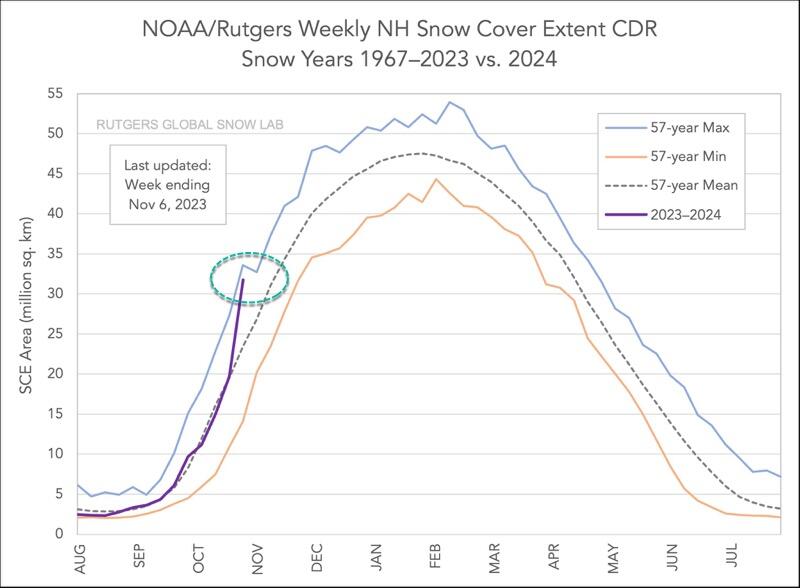
 A new weekly report from the Rutgers University Global Snow Lab reveals snow cover across the Northern Hemisphere is at the upper end of a 57-year maximum. 

"Yet another inconvenient truth. When it warms, it snows more, which starts the process of cooling. That has been old-time climate cycle theory for 60 years because it was in a book my dad gave me when I was 8," meteorologist Joe Bastardi wrote on X. 

Bastardi quoted another X user's post: "Latest Rutgers snow lab NH snow cover extent, now near the 57yr maximum. Astonishing in a world "Burning up.""

Recall over the summer. Corporate media unleashed a barrage of climate doom headlines, including "Era of global boiling has arrived," "Hottest month in the history of civilization," and "Hottest day ever recorded."

CBS News wrote, "Earth sees third straight hottest day on record, though it's unofficial: 'Brutally hot.'" It's crucial to note that CBS hedged itself with "unofficial," meaning the data was never verified. 

This led the National Oceanic and Atmospheric Administration to question the climate math pushed by corporate media outlets: 

"Although NOAA cannot validate the methodology or conclusion of the University of Maine analysis, we recognize that we are in a warm period due to climate change."

In a world that is supposedly burning because of cow farts and fossil-fuel cars, the one thing that should not be happening is rising snow coverage. 

Just wait until corporate media cites some unknown think tank with shady climate math that pushes the narrative that 'increasing snow coverage is because of climate change.' 

We hate to break it to corporate media, but the climate has constantly changed for billions of years. 

According to climate child warrior Greta, we should all be dead right about now. 

Climate fear has been a multi-decade scheme... 

Remember that in the Northern Hemisphere, it's an El Nino winter

https://www.zerohedge.com/weather/another-inconvenient-truth-northern-hemisphere-snow-cover-nears-57-year-high