Search This Blog

Thursday, November 9, 2023

'First-ever crowd-sourced small molecule discovery and potent SARS-CoV-2 antiviral lead compound'

 The work of the COVID Moonshot Consortium has been published in the journal Science revealing their discovery of a potent SARS-CoV-2 antiviral lead compound. It also reflects on the success of its open science approach in launching a patent-free antiviral discovery program to rapidly develop a differentiated lead in response to a pandemic emergency.

The COVID Moonshot initiative started as a spontaneous virtual collaboration in March 2020, when a group of scientists and students from academia and biopharma, triggered by a Twitter appeal, joined forces to begin a race against the clock to identify new molecules that could block the SARS-CoV-2 virus.

This unprecedented, crowd-sourced, and fully open collaboration of more than 200 scientists, rapidly identified and developed novel compounds with excellent antiviral activity against a key enzyme of the SARS-COV-2 virus, namely the main protease (Mpro).

The lead candidate is now in preclinical evaluation in collaboration with the Drugs for Neglected Disease initiative (DNDi). The COVID Moonshot is dedicated to the discovery of safe, globally affordable antiviral drugs against COVID-19 and future viral pandemics, and is pioneering a straight-to-generic, patent-free approach.

The consortium's paper reports on the discovery of a non-covalent, non-peptidic inhibitor scaffold with lead-like properties that is differentiated from current main protease inhibitors. Their approach leveraged crowd-sourcing, machine learning, exascale molecular simulations, and high-throughput structural biology and chemistry.

It built on data from a large experiment, performed in record time at the start of the pandemic, at Diamond Light Source's XChem facility for crystallographic fragment screening using Diamond's high-throughput crystallography. In the experiment, 1,495 fragment-soaked crystals were screened within weeks to identify 78 hits that densely populated the enzyme's active site.
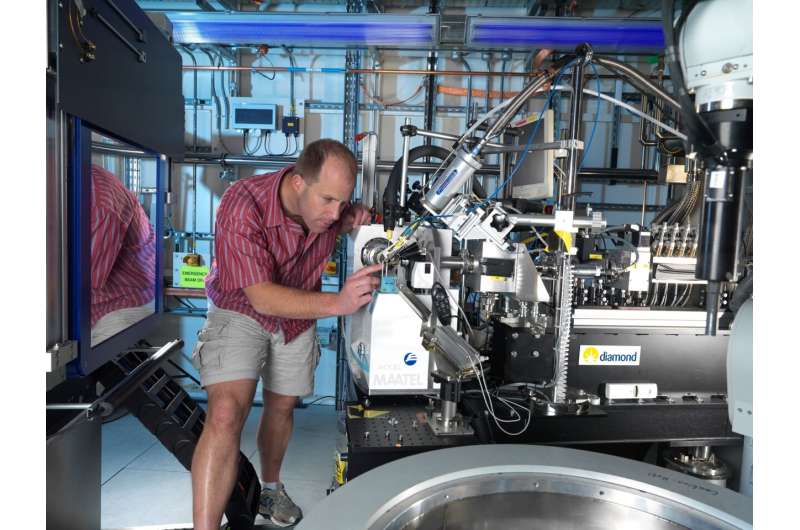
First-ever crowd-sourced small molecule discovery and a potent SARS-CoV-2 antiviral lead compound announced by COVID Moonshot Consortium
Professor Frank von Delft, Principal Beamline Scientist, Diamond 104-1. Credit: Diamond Light Source

The team were able to generate a detailed map of the structural plasticity of the SARS-CoV-2 main protease, extensive structure-activity relationships for multiple chemotypes, and a wealth of biochemical activity data. All compound designs (>18,000 designs), crystallographic data (>840 ligand-bound X-ray structures), assay data (>10,000 measurements), and synthesized molecules (>2,400 compounds) for this campaign were shared rapidly and openly, creating a rich open and IP-free knowledge base for future anti-coronavirus drug discovery.

By making all data immediately available, with all compounds purchasable from the Ukrainian chemistry supplier Enamine, the consortium aims to accelerate research globally along parallel tracks following up on their initial work.

"The data set enclosed in the Science publication provides a unique resource linking comprehensive structural data, fragment hits, multiple chemical scaffolds, as well as biochemical and cellular assay data that can be viewed and exploited by other scientists," states Dr. Lizbe Koekemoer, one of the lead authors and a team leader at the Center for Medicines Discovery, University of Oxford.

"This is the first time such a large number of protein-ligand structures have been generated for a drug discovery campaign and released in the public domain. It is a testament to Diamond's high-throughput crystallography infrastructure, but also the astonishing coordination across many research groups world-wide under enormous pressure," adds Dr. Daren Fearon, another lead author and Senior Beamline Scientist at Diamond Light Source, who leads the XChem facility.

As a striking example for the impact of open-science, the Shionogi clinical candidate S-217622, which is available in Japan under emergency approval as Xocova [ensitrelvir], was identified using the data generated at Diamond and openly released.

Senior author Prof Frank von Delft, Principal Beamline Scientist at Diamond, Professor for Structural Chemical Biology at University of Oxford, and one of the founders of the consortium, says, "Open science efforts have transformed many areas of biosciences. The COVID Moonshot provides an exemplar of a viable route to open science early drug discovery leading to advances in infectious diseases drug discovery—a research area of grave public importance but one which is chronically underfunded by the private sector."

"The Moonshot structure-enabled drug discovery campaign targeting the coronavirus main protease is providing a roadmap for the potential development of future antivirals."
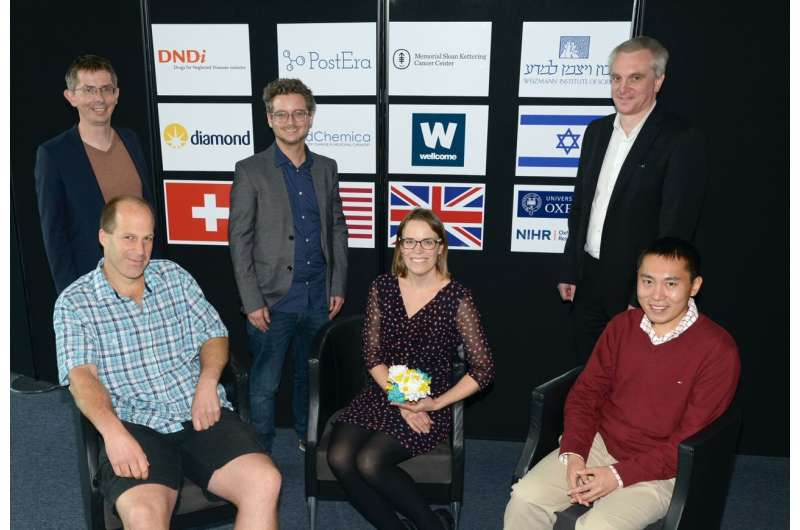
First-ever crowd-sourced small molecule discovery and a potent SARS-CoV-2 antiviral lead compound announced by COVID Moonshot Consortium
COVID Moonshot Consortium Collaborators. Credit: Diamond Light Source

Dr. Annette von Delft, University of Oxford adds, "This publication showcases the enormous value that crowd-sourcing can bring to drug discovery. The COVID Moonshot project has been unique in its  and commitment to open science and demonstrates how collaboration can be a driver for innovation."

"Every day at Diamond, we are proud to be working with leading scientists and academics from all over the world like the COVID Moonshot Consortium, who are conducting innovative and inspired research using our facility. Bringing together experts in physical and life science innovations, cross disciplinary teams, and access to collaborative facilities allows our users to shine their brilliance on new technologies, treatments, sustainable materials and climate solutions for the many 21st century challenges we face," comments Diamond's new CEO, Gianluigi Botton.

The discovery platform collaboration that spontaneously formed as the COVID Moonshot now continues its work as the ASAP discovery consortium, which stands for AI-driven Structure-enabled Antiviral Platform, aiming to discover and develop novel broad-spectrum small molecule inhibitors against coronaviruses, flaviviruses and enteroviruses for pandemic preparedness.

The initiative is a collaborative effort of the Nuffield Department of Medicine at the University of Oxford; Diamond Light Source; PostEra; Weizmann Institute of Science; MedChemica Ltd; Icahn School of Medicine at Mount Sinai; Enamine Ltd; Memorial Sloan Kettering Cancer Center; and Thames Pharma Partners LCC.

More information: Melissa L. Boby et al, Open science discovery of potent noncovalent SARS-CoV-2 main protease inhibitors, Science (2023). DOI: 10.1126/science.abo7201www.science.org/doi/10.1126/science.abo7201


https://medicalxpress.com/news/2023-11-first-ever-crowd-sourced-small-molecule-discovery.html

5 hospitals partnering with Best Buy

 Retail giant Best Buy has created a sizable healthcare presence through its remote patient monitoring partnerships with hospitals and other digital health services. The company has partnered with large health systems in Massachusetts, Illinois, Pennsylvania and New York.

Best Buy's flurry of healthcare activity stems from its $400 million acquisition of remote patient monitoring company Current Health in 2021. Here are five health systems partnering with Best Buy that Becker's has reported on since March 2023:

  1. In November, Boston-based Mass General Brigham announced that it would be partnering with Best Buy to use the retail giants' technology to provide care-at-home.

  2. Peoria, Ill.-based OSF HealthCare said that its 2019 partnership with Best Buy subsidiary Current Health lowered costs and lessened emergency room visits.

  3. In September, Danville, Pa.-based Geisinger expanded its at-home health partnership to focus on treating patients with chronic conditions.

  4. In March, Best Buy announced that it was partnering with New York City-based Mount Sinai Health System on remote patient monitoring. 

  5. In March, Best Buy inked a remote patient monitoring-focused deal with New York City-based NYU Langone Health. 

What’s really at the root of anti-Jewish hate on college campuses

 Pro-Hamas protests erupting on campuses across the country have shocked and dismayed Americans.

These protests are bone-headed and wrong for many reasons, but suffice to say it’s a monstrous failure in moral judgment to draw equivalence between deliberately targeting innocents for slaughter and the inevitable, often forewarned collateral killing of innocents, especially when they’ve been planted as human shields for terrorist installations in schools, mosques and hospitals.

And the rationalization that Israel should be wiped off the map because it is an apartheid state founded on settler colonialism — that’s as fabricated a race hoax as the 1619 Project.

Many Americans, having magnanimously acceded to the diversity-equity-inclusion narrative for “oppressed minorities,” feel betrayed.

How can kids who linked arms with their Jewish comrades Oct. 6 to demand every “inclusive” accommodation for every last LGBTQIA+ person so <chosen pronoun> would “feel safe” leave their Jewish friends cowering in fear Oct. 8 while they, flaunting paraglider posters, lustily celebrate terrorists who slaughtered kids and shout “Kill all Jews”?

For this betrayal, many Americans blame college administrators.

Indeed, college administrations can’t disown the students they enrolled after bragging that their “holistic admissions” evaluates not just scholastic promise — that would “not be inclusive” — but the “whole student,” for which they summoned the dark art of “personal scoring” to predict “integrity” and “courage.” Right.

Nor are administrators credible when they suddenly proclaim newfound love for “academic freedom” to coddle pro-Hamas campus militancy when their campuses are effectively no-free-speech-zones.

First prize for academic-freedom hypocrisy goes to Harvard President Claudine Gay, who notoriously led the witch-hunt against heterodox Professor Roland Fryer, though University of Pennsylvania President Liz Magill doesn’t lag far with her ongoing persecution of heterodox Professor Amy Wax.

Yet blaming college administrators is fighting shadows of the real culprit because kids didn’t lose their brains and morality when they stepped on campus.

That happened in K-12.

Indoctrinate kids in K-12 that America is irredeemably odious because it is an apartheid state founded on settler colonialism, and kids are primed to rally that Israel must be wiped off the map because it, too, is an apartheid state founded on settler colonialism.

This fabrication, straight from the oppressor-oppressed revolutionary ideology of critical-race theory, is equally weaponizable against any meritocratically earned success story: America, IsraelJewsAsians.

But blaming the K-12 educracy is still fighting shadows — who made K-12 toxic?

While education schools come to mind, the 800-pound gorilla of CRT is the teachers unions.

But that’s still fighting shadows.

The teachers unions owe their outsized power to their heady marriage with the Democratic Party: The unions deliver manpower, donations and future Democratic activists while Democrats reciprocate with friendly legislationpolicies and taxpayer dollars.

The Democratic Party is the ultimate purveyor of CRT; it is its core ideology, with teachers unions playing eager partners.

Whenever Democrats spout all-too-familiar racial dog-whistles like “underrepresented,” “marginalized,” “inequity,” “privilege,” “systemic” and the latest, a real juggernaut, “reparations,” we recognize the toxic marks of CRT.

And in CRT’s racial cauldron, Jews and Israel stand unequivocally in the wrong; the battle-cry “From Ferguson to Jerusalem” is no accident.

Some “progressives,” pointing to President Biden’s support for Israel and Rep. Ritchie Torres’ denunciation of Hamas, say antisemitism occupies only the extreme-left Democratic Socialist of America fringe, not mainstream, of the Democratic Party.

But that’s delusory, because with CRT as a core ideology, Democratic support for a pro-West, entrepreneurial, successful Israel that unapologetically rejects the oppressor-oppressed binary is necessarily conflicted.

It’s no accident Jimmy Carter already in 2006 called Israel an apartheid state, Obama sent billions to Hamas’ and Hezbollah’s paymaster Iran, Biden would have sent $6 billion to Iran but for Republican outcry, Secretary of State Antony Blinken’s first reaction to Hamas’ attack was to call for cease-fire, mainstream Democrats Dick Durbin and Chris Murphy call Israel’s campaign “unacceptable” and Biden and Vice President Kamala Harris noisily announced an “anti-Islamophobia” initiative last week.

As if further confirmation is needed, Gallup polling shows that Democratic sympathy for Israel, perennially weaker than Republican, finally swung deeply negative this year.

Mainstream Democrats’ support for Israel lives on borrowed time.

It is the DSA that enjoys coherence between core ideology and Jew-hatred; it has the upperhand and is surely gaining.

To our Jewish Democratic-voting friends: Are you ready for this future Democratic Party?

Wai Wah Chin is the founding president of the Chinese American Citizens Alliance Greater New York.

https://nypost.com/2023/11/09/opinion/whats-really-at-the-root-of-anti-jewish-hate-on-college-campuses/

"Younger Voters Have Turned Against Governor": Berkeley Poll: Record Californians Diss Newsom

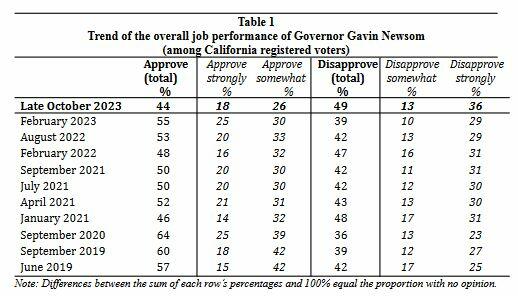
 new poll from the University of California-Berkeley Institute of Governmental Studies (IGS) reveals that more Californians disapprove of the job Gov. Gavin Newsom (D) is doing (49%) than approve (44%) - the first time this has happened since Newsom took office in 2019.

This marks an 11-point decline in Newsom's approval rating since the last time IGS asked the same question in February, just nine months ago.

"This includes significant declines among the governor’s Democratic voter base and is most prominent among two of the state’s swing voter blocs – political moderates and No Party Preference voters," according to the poll.

"Younger voters have also turned against the governor, while voters ages 65 or older remain supportive."

Poll Director Mark DiCamillo suggested the sharp decline was due to those with extreme views, "with the proportion strongly approving of Newsom’s performance declining from 25% to 18%, while those strongly disapproving climbed from 29% to 36%," NY1 reports.

According to DiCamillo, the decline is "broad-based and is particularly noteworthy among political moderates and No Party Preference voters."

While 66% of Democrats approve of the job Newsom is doing, just 37% of No Party Preference and 7% of Republicans approve. Support was strongest in San Francisco (53%), where Newsom served as mayor before being elected governor, and among females, with 46% of women approving of his job performance compared with 41% of men.

While 53% of voters age 65 or older continue to support the governor, younger voters are less approving. Just 35% of voters age 18 to 29 and 38% of voters age 30 to 39 approve of the job he’s doing. -NY1

Newsom's declining approval rating comes as California struggles with budget shortfalls and other issues. Meanwhile, just 50% of California voters approved of Newsom's recent trip to China to meet with President Xi Jinping, while 39% disapproved.

It also comes as Newsom stands accused of running a 'shadow' Presidential campaign to take the mantle if Joe Biden dies or otherwise isn't the Democratic nominee in the 2024 US election.

https://www.zerohedge.com/political/younger-voters-have-turned-against-governor-berkeley-poll-reveals-record-number

2.9 Million Borrowers Pay Nothing In Biden's 'Most Generous Ever' Student Loan Repayment Plan

 by Bill Pan via The Epoch Times (emphasis ours),

Nearly 5.5 million federal student loan borrowers have enrolled in what the Biden administration calls "the most generous" repayment option ever offered, federal officials said on Wednesday.

The repayment plan, dubbed the Saving on Valuable Education (SAVE) plan, went into effect in August as part of President Joe Biden's regulatory effort to dramatically reduce monthly obligations for student borrowers who aren't earning very much, with many borrowers seeing their bills shrink to practically nothing.

According to the latest update from the U.S. Department of Education, about 2.9 million of the SAVE plan's current enrollees have incomes that are low enough that they have monthly payments of $0.

The updated SAVE enrollment figure includes 1.8 million borrowers who have newly signed up for the program, as well as another 364,000 borrowers who were automatically switched to SAVE because they had already been in one of the existing income-driven repayment (IDR) plans that the Biden administration seeks to replace with SAVE.

The new figure is based upon enrollment in the program as of Oct. 15. It reflects an increase from the the 4 million borrowers that the Education Department said were enrolled in the plan at the beginning of September.

Overall, borrowers are repaying $300 billion in federal student loans on the plan. That represents about 19 percent of the $1.6 trillion in outstanding debt from the federal student loan portfolio.

One of the biggest differences between the SAVE plan and IDR plans is that the amount of income incurring no charge, or protected income, rises from 150 percent above the federal poverty guidelines to 225 percent. Under the SAVE plan, payment also drops from 10 percent of the difference between earnings and protected income to 5 percent.

In practice, this means a single person who earns less than $32,800 a year is required to pay $0 a month. The same applies to a family of four that has an annual income less than $67,500.

On top of all that, under the SAVE plan, borrowers will see their remaining loan balances wiped out after 10 years of repayments. By comparison, it takes 20 or 25 years under IDR for borrowers to get their remaining debt canceled.

"I'm thrilled to see that in less than three months, nearly 5.5 million Americans in every community across the country are taking advantage of the SAVE Plan's many benefits, from lower monthly payments to protection from runaway student loan interest," U.S. Secretary of Education Miguel Cardona said in a statement on Monday, promising to "not rest" in the efforts to "make paying for college more affordable."

Biden Plan Faces Republican Challenge

The SAVE plan is expected to cost billions in taxpayer dollars, a point Republican lawmakers have been emphasizing since the plan's announcement.

Estimates vary widely, but one analysis by the University of Pennsylvania's Wharton School suggests that the plan will cost about $475 billion in a span of 10 years.

"About $200 billion of that cost will come from payment reduction for the $1.64 trillion in loans already outstanding in 2023," the analysis read.

According to the leading business school, the SAVE plan will be incentivizing college students to collectively borrow billions more dollars every year in the next decade due to the expectation that they may not have to repay the debt.

"The remainder of the budget cost, or about $275 billion, comes from reduced payments for about $1.03 trillion in new loans that we estimate will be extended over the next 10 years," it added.

Citing Wharton's estimates, a group of 17 Republican senators in September introduced a Congressional Review Act (CRA) resolution against the plan. A CRA resolution does not only nullify an existing rule but bans the federal agency from issuing the same rule again unless Congress later passes a new law authorizing the agency to do so.

"It's incredibly unfair to those who never incurred student debt because they didn't attend college in the first place or because they either worked their way through school or their family pinched pennies and planned for higher education," said Sen. Bill Cassidy (R-La.), ranking member of Senate's education committee.

"Our resolution protects the 87 percent of Americans who don't have student debt and will be forced to shoulder the burden of the President's irresponsible and unfair policy," he added.

Sen. Cassidy is joined by Sens. John Barrasso (R-Wyo.), Mike Braun (R-Ind.), John Cornyn (R-Texas), Mike Crapo (R-Idaho), Steve Daines (R-Mont.), Joni Ernst (R-Iowa), Chuck Grassley (R-Iowa), Cindy Hyde-Smith (R-Miss.), Ron Johnson (R-Wis.), James Lankford (R-Okla.), Cynthia Lummis (R-Wyo.), Roger Marshall (R-Kan.), James Risch (R-Idaho), Tim Scott (R-S.C.), John Thune (R-S.D.), and Thom Tillis (R-N.C.).

A companion CRA resolution was introduced by Rep. Lisa McClain (R-Mich.) in the lower chamber. Both chambers are expected to vote on the Republican-led resolutions in the coming weeks.

In defense of the repayment plan, Mr. Cardona implored lawmakers seeking to undo it to speak with borrowers who are "drowning in debt."

"We're hearing from the American people who are drowning in debt and can't buy a home in the economy because of college costs," he said during a Sept. 8 interview on CNN. "Those who are vehemently opposed to it have not spoken to their constituents who are drowning, who need support, who need to make higher education more accessible."

https://www.zerohedge.com/political/29-million-borrowers-pay-nothing-bidens-most-generous-ever-student-loan-repayment-plan

Individual Investors Pull Most Cash From US Stocks in Two Years


  • Retail traders stop chasing the 2023 rally as FOMO evaporates
  • Net sales from the group total almost $16 billion in October

Individual investors who had been behind the stock-market rally this year pulled more money from US equities in October than they have in any month over the past two years.

Retail traders sold nearly $16 billion in stocks last month, nearly twice what they unloaded in September, according to S&P Global Market Intelligence. They dumped shares in nearly every sector, although they increased their exposure to real estate, which is the second worst performer in the S&P 500 Index this year with an 8.3% decline.

https://www.bloomberg.com/news/articles/2023-11-09/mom-pop-investors-pull-most-cash-from-us-stocks-in-two-years

Walgreens cuts Cencora stake further in $674 million share sale

 Walgreens Boots Alliance has further lowered its stake in Cencora, formerly known as AmerisourceBergen Corp, by selling shares worth about $674 million, the U.S. drugstore chain said on Thursday.

After the share repurchase, Walgreens now owns approximately 15% in drug distributor Cencora, it said, adding that it would use the proceeds to pay down debt. Walgreens still remains Cencora's largest shareholder.

AmerisourceBergen disclosed plans early this year to rename itself as Cencora in a bid to expand internationally beyond drug distribution. The company adopted the name in the second half of 2023.

Walgreens has been reducing its stake in Cencora over time. Walgreens sold some shares of Cencora for proceeds of about $1.85 billion in August.

https://finance.yahoo.com/news/walgreens-cuts-cencora-stake-further-011659913.html